Social Media Content Plan: The One-Page System That Survives Busy Months
A social media content plan is a written system that decides four things in advance: which platform you’re serious about, what mix of content you’ll post, on what cadence, and how each post gets made without starting from zero. That’s it. Not a 40-tab spreadsheet, not a brand bible. The plans that survive contact with a busy month fit on one page.
I’ve built these for clients ranging from solo consultants to SaaS teams, and the pattern behind every failed one is identical: too many platforms, no repurposing system, and a cadence set by ambition instead of capacity. So this guide is the opposite of aspirational. One primary platform, a 70/20/10 mix, a weekly cadence you can actually hold, and a pipeline that turns one article into five posts. Everything below is the system I run, with the 2026 numbers that justify each choice.
What a Social Media Content Plan Includes
A complete social media content plan answers six questions on a single page. If your document doesn’t answer all six, it’s a wish list; if it takes ten pages to answer them, it won’t be opened twice:
- Goal: the one business outcome social supports (leads, hiring, audience for launches). One.
- Primary platform: where you post natively and reply to comments. Everything else is syndication.
- Content mix: the ratio of value posts to proof posts to promotional posts (mine is 70/20/10).
- Cadence: posts per week you can sustain on your worst week, not your best.
- Source system: where posts come from (the repurposing pipeline below), so nothing starts blank.
- Scorecard: the two or three numbers you check monthly, tied to the goal.
Step 1: Pick One Primary Platform (Yes, One)
Pick the single platform where your buyers already spend attention, and demote the rest to copy-paste syndication. Multi-platform-native is a team sport; solo operators and small teams who try it produce thin content everywhere. The 2026 shorthand I use with clients:
| Platform | Pick it when | 2026 reality check |
|---|---|---|
| B2B, services, hiring | Video under 5 min drives 52% more pipeline-attributed conversions than static posts (LinkedIn data) | |
| TikTok | Consumer, education-as-entertainment | Highest organic reach ceiling; personality beats production (see Duolingo) |
| Visual products, local, lifestyle | Reels still out-reach static; Stories retain existing audience | |
| YouTube | Considered purchases, tutorials | Compounds like SEO; hardest production lift |
| X/Twitter | Tech, finance, media niches | Fast feedback loop, weakest click-through to site |
If you’re torn between two, run the audit I published as a 12-point social media audit on both accounts; the one with existing traction wins, because momentum is the scarcest input.
Step 2: Set the Content Mix (70/20/10)
The mix that keeps an audience without embarrassing you at promo time is 70% value, 20% proof, 10% promotion. In practice, for a services business posting four times a week:
- 70% value: teach one specific thing per post. How-tos, mistakes, frameworks, opinions with reasons. Short video earns its place here: Meta’s Creative Performance Lab found 30-to-89-second videos beating 2-minute-plus videos by 118% on completion and 94% on click-through.
- 20% proof: client results, before/afters, process screenshots, customer posts reshared. Content from real people engages roughly 28% more than brand-made content, so resharing customers is a cheat code, not a cop-out.
- 10% promotion: the offer, stated plainly, with one link. Earned by the other 90%.
The ratio matters more than the categories. Feeds punish accounts that invert it, and audiences unfollow them quietly… which you’ll never see in a dashboard, only in reach that slowly goes cold.
Step 3: Build a Cadence You Can Hold
The right cadence is the one you can sustain for six months, and it’s lower than you think: consistency signals reliability to both algorithms and audiences, while bursts followed by silence reset your reach. Working floors I give clients, per platform, assuming one committed person:
- LinkedIn: 3-4 posts/week, one of them video or a document post
- TikTok/Reels: 3-5 short videos/week (batch-filmed in one session)
- YouTube: 1 video/week, or 2/month long-form plus shorts cut from them
- X: daily is table stakes, but threads twice a week do the heavy lifting
- Everything as syndication: whatever the primary produces, adapted in under 10 minutes
Schedule it once a week, not daily. A scheduler (I compared the current field in my roundup of social media scheduling tools) turns the plan into a Monday-morning hour instead of a daily interruption.
Step 4: The Repurposing Pipeline (One Article, Five Posts)
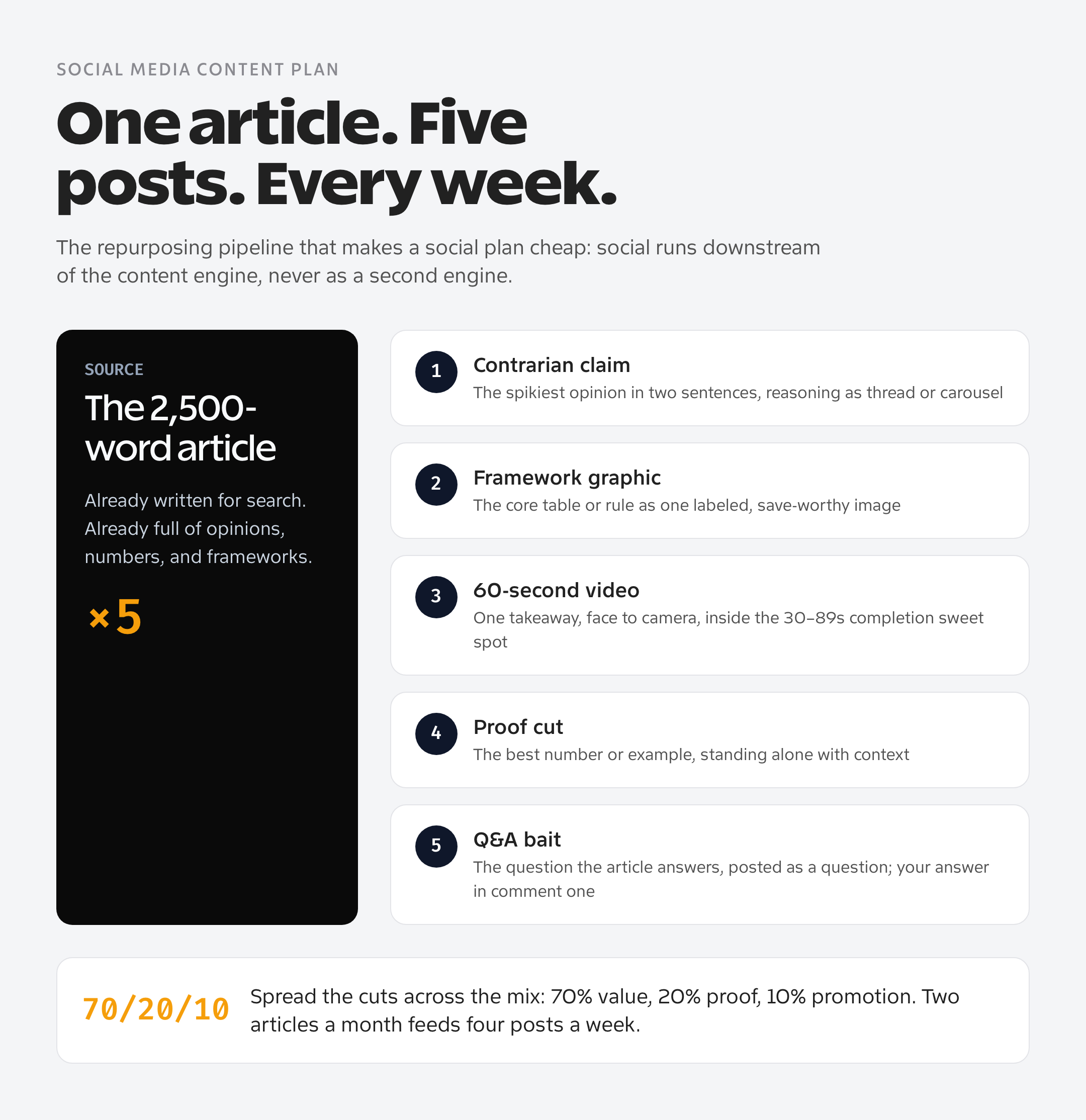
The pipeline is the part that makes the whole plan cheap: every long-form asset you already produce becomes a week of social content through five standard cuts. From one 2,500-word article:
- The contrarian claim post: the article’s spikiest opinion, stated in two sentences, with the reasoning as a short thread or carousel.
- The framework graphic: the article’s core table or decision rule as a single labeled image (the kind that gets saved, which platforms now weight heavily).
- The 60-second video: face to camera, one takeaway, inside Meta’s 30-89 second sweet spot.
- The proof cut: the article’s best number or example, standing alone with context.
- The Q&A bait: the question the article answers, posted as a question, with your answer in the first comment. Engagement mechanics without the cringe.
Full distribution mechanics per platform live in my guide to promoting content on social media. The point here is structural: social should be downstream of your content engine, never a second engine competing for the same hours.
Step 5: Paid Promotion, Reach, and Frequency
Boost only what has already proven itself organically, and cap frequency before your audience learns to scroll past you. Paid promotion on social works as an amplifier, not a defibrillator: a post with organic traction gets cheaper distribution (platforms price engagement risk into delivery), while boosting a dead post buys impressions that behave like wallpaper.
Two terms worth using precisely, since they decide the budget: reach is how many distinct people saw the post; frequency is how many times each of them saw it. Reach times frequency equals impressions, which is why impressions flatter every report. For small budgets, my working rules: boost the top 10% of posts only, cap frequency near 2-3 per week per person for cold audiences, and put retargeting dollars ahead of cold-reach dollars, since warm audiences convert at a multiple of cold ones. The broader paid-versus-organic split sits in my social media marketing overview if you need the full budget picture.
Step 6: Measure Three Numbers, Ignore the Rest
Monthly, check exactly three: saves-plus-shares per post (quality signal the algorithm also uses), profile-to-site clicks or DMs started (business signal), and follower growth last (it’s the output of the first two, not a goal). Quarterly, tie it back to the goal you wrote on the one-pager: did social-attributed leads, hires, or launch signups move?
What you’re allowed to ignore: impressions, likes, and follower counts as monthly KPIs. They’re the social equivalent of the vanity metrics I flagged in my content marketing ROI guide, pleasant, directionless, and free to inflate.
Social Media Content Plan Template (PDF and Word)
The whole system fits on one page. This template is that page, plus the supporting pieces that keep it running through a busy month.
- A one-page plan covering platform, cadence, pillars, and the weekly pattern
- A format bank for when you know the topic but not the shape of the post
- A 90-minute batch session agenda with what not to do at each stage
- A minimum viable month to fall back to, so a bad month costs output rather than the habit
Free to use and adapt.
The 4-Hour Monthly Social Media Content Plan
Here’s the whole system compressed into the calendar reality of someone with a business to run. Four hours a month, in four blocks:
- Hour 1 (first Monday): pick the month’s 2 long-form sources, run each through the five-cut pipeline on paper. Twenty post skeletons exist by minute 40.
- Hour 2 (same day): batch-produce visuals and film the month’s short videos in one sitting. Same shirt, nobody notices.
- Hour 3: load the scheduler, spread the mix 70/20/10 across the cadence, leave two slots a week empty for reactive posts.
- Hour 4 (last Friday): pull the three numbers, kill the weakest format, double the strongest, write next month’s two spiky opinions.
That’s a real plan, and it beats the elaborate one you’ll abandon by March. The clients of mine who grew on social all run some version of this; the ones who churned through ‘strategies’ all had prettier documents.
Social Media Content Plan: FAQ
The questions that come up every time I set this up for someone:
What is a social media content plan?
A one-page system defining your goal, primary platform, content mix, posting cadence, content source pipeline, and the two or three metrics you’ll check monthly. It turns posting from a daily creative decision into a weekly production routine.
How do I create a social media content plan from scratch?
Six steps: pick one business goal, choose one primary platform where your buyers are, set a 70/20/10 value-proof-promotion mix, commit to a cadence you can hold on your worst week, build a repurposing pipeline from your long-form content, and define three metrics. Write it on one page.
How often should I post on social media?
Floors that work for one committed person: LinkedIn 3-4 posts/week, TikTok or Reels 3-5 short videos/week, YouTube 1 video/week, X daily with two threads. Sustainable beats optimal; bursts followed by silence reset your reach.
What is the 70/20/10 rule for social media content?
70% value posts that teach, 20% proof posts that show results and customers, 10% promotional posts with a direct offer. The ratio keeps reach healthy so the promotional tenth actually gets seen.
Should I post the same content on every platform?
Produce natively for one primary platform, then syndicate everywhere else with under ten minutes of adaptation per platform. Full multi-platform-native production is a team-scale commitment that thins out solo operators.
What’s the difference between reach and frequency?
Reach is how many distinct people saw your content; frequency is how many times each person saw it. Reach times frequency equals impressions. Cap cold-audience frequency around 2-3 per week before fatigue sets in.
When should I put paid promotion behind a post?
Only after it proves itself organically, roughly your top 10% of posts. Boosting underperformers buys wallpaper impressions. Retargeting warm audiences returns more per dollar than cold reach at small budgets.
How do I measure if my social media content plan is working?
Monthly: saves plus shares per post, profile-to-site clicks or DMs started, then follower growth. Quarterly: whether social-attributed leads, hires, or signups moved toward the one goal in the plan. Impressions and likes stay out of the report.
Where I’d Leave You
Write the one-pager today: one goal, one platform, 70/20/10, a cadence with a margin of safety, the five-cut pipeline, three numbers. Then protect the four hours a month like a client meeting, because that’s what it is, a recurring appointment with the audience you’re building.
The plan isn’t the strategy. Showing up every week for a year is the strategy. The plan just makes showing up cheap enough to survive.
Tell Google you want more of this.
Add Gatilab as a preferred sourceOne tap, and this site shows up more often in your own Top Stories, AI Overviews and AI Mode. Remove it any time.