
GEO vs SEO: How They Differ And How To Run Both (2026)
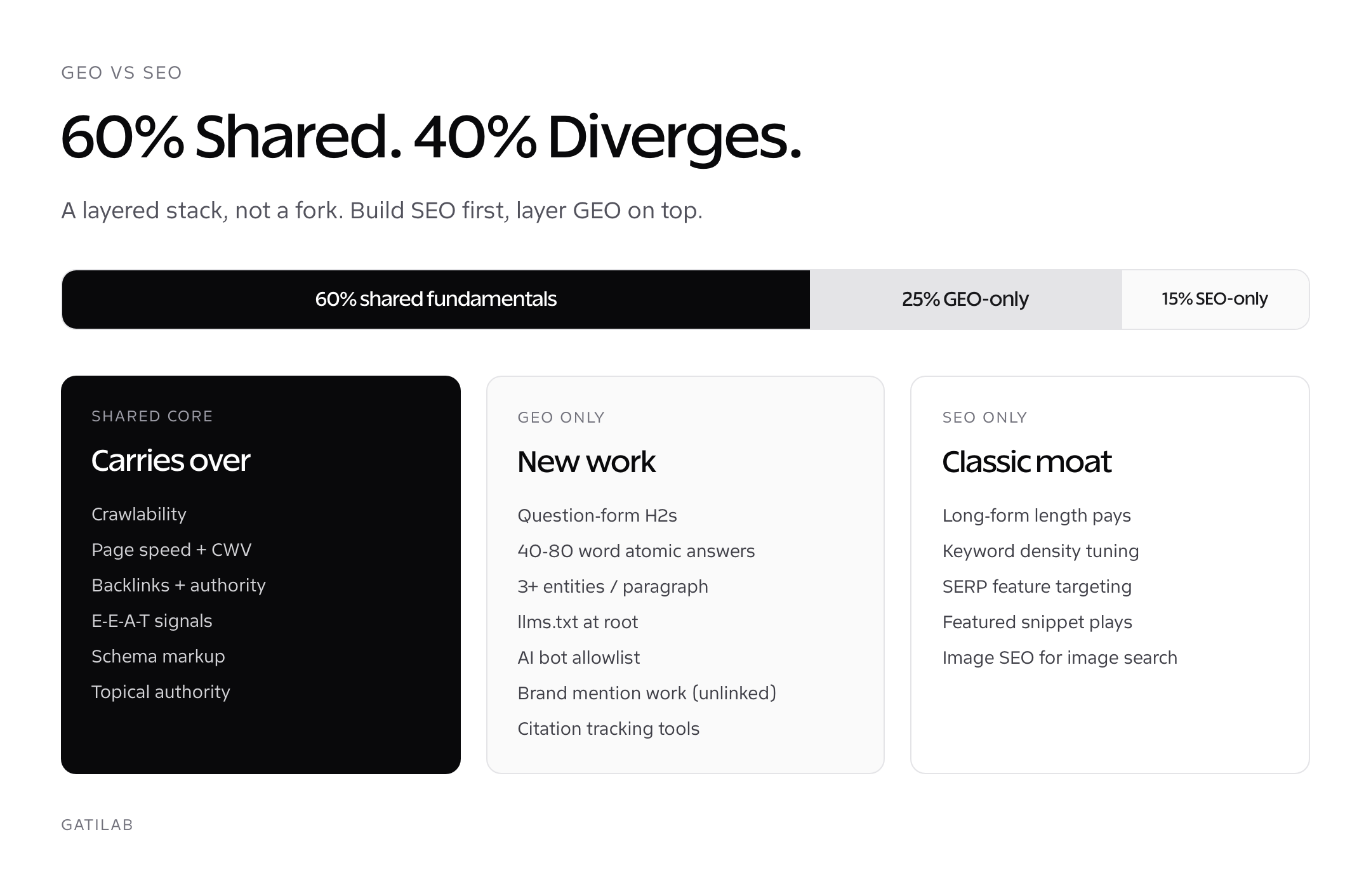
GEO vs SEO is the comparison every marketing team is wrestling with right now. Search engine optimization targets a ranking position in Google’s classic blue-link results. Generative engine optimization (GEO) targets a citation, brand mention, or quoted passage inside AI-generated answers from ChatGPT, Perplexity, Google AI Overviews, Bing Copilot, and Gemini. They share roughly 60 percent of fundamentals. They diverge sharply on the other 40 percent.
You don’t pick one over the other in 2026. You run both, with the GEO layer stacked on top of the SEO layer. Most of your existing SEO work compounds into GEO results. Some of it doesn’t. The point of this guide is to draw the line precisely so you spend the next 12 months building the right things, not the wrong ones.
Prefer to have this done for you? Our AI search optimization service runs the audit, the fixes, and monthly citation tracking as one program.
I run both disciplines side by side on every client domain I touch, 30 plus active right now. The pattern across all of them: 60 percent of the foundational work is shared, 25 percent is GEO-only, and 15 percent is SEO-only. That’s the split this article maps.
SEO vs GEO Definitions
Search engine optimization is the practice of structuring a site and its content to rank for specific keywords in classic search engine results pages, principally Google’s. Success is measured in SERP position, organic clicks, and sessions. Generative engine optimization is the practice of structuring content so AI answer engines cite the domain, mention the brand, or lift quoted passages inside synthesized answers. Success is measured in citation share, brand mentions in AI answers, and referral traffic from AI engines.
The terminology in this space is unsettled in 2026. “Generative SEO”, “AI SEO”, “GEO SEO”, “AEO” (answer engine optimization), and “LLM SEO” all refer to overlapping but slightly different slices of the same problem. For the rest of this article I’ll use:
- SEO for classic blue-link search engine optimization.
- GEO for the broader generative-engine-optimization umbrella, covering all AI answer engines.
- AEO as a tactical subset of GEO focused on answer-first content structure and FAQ schema.
For the full theoretical framing of GEO, see my generative engine optimization pillar. For the answer engine subset, see answer engine optimization.
What Carries Over From SEO To GEO
Roughly 60 percent of what makes a page rank in Google also makes it cite-able in AI answers. Six fundamentals carry over almost untouched.
- Crawlability. If Googlebot can’t index the page, neither can Bing’s crawler (which feeds ChatGPT Search and Copilot) or Perplexity’s crawler. Robots.txt, internal linking, sitemap hygiene all carry over.
- Page speed and Core Web Vitals. Slow pages get crawled less often and ranked lower. AI engines pull from the same web index; the speed signal compounds.
- Authority signals. Backlinks, domain rating, brand mentions across the open web. AI retrieval inherits these. Profound’s data shows top-cited domains in ChatGPT have 2.4x the median referring domain count of un-cited competitors.
- E-E-A-T signals. Author bios, credentials, sourcing, factual accuracy. The reranker layer in every AI engine I’ve tested weights these heavily.
- Schema markup. Article, FAQPage, HowTo, Organization, Person schema deliver upside in both SEO and GEO. Same JSON-LD, same validators.
- Topical authority. Sites that cover a topic deeply, with cluster-style linking between related articles, win more SEO rankings and more GEO citations. The cluster strategy maps cleanly onto both.
If you’ve already built solid SEO fundamentals, you’re 60 percent of the way to GEO. The shared core is the reason “do GEO” doesn’t mean “throw out your SEO”. It means “add a second layer”.
What Changes In GEO vs SEO
The other 40 percent diverges. Six big shifts.
Unit of competition shifts from page to paragraph. SEO ranks pages. GEO cites paragraphs. The 4,000-word page that ranks #2 organically can win zero AI citations if no individual paragraph is built for extraction. Conversely, a single tight paragraph on a page ranking #15 can pick up citations the top-ranked competitor misses.
Keyword targeting shifts to question targeting. SEO orients around keyword variants and search volume. GEO orients around the natural-language questions users ask. People Also Ask, AlsoAsked.com, Reddit, and direct ChatGPT prompting become primary research sources alongside Ahrefs and Semrush.
Click outcome shifts from click to read. SEO success ends with a click on the SERP. GEO success often ends with the user reading the AI answer and not clicking through at all. The brand mention inside the answer is the win, even without a session.
Content length matters less. SEO long-form (2,000+ words) wins more often than short. GEO is roughly length-neutral; what matters is the density of extractable paragraphs and named entities per paragraph.
Update cadence becomes continuous. SEO posts can sit untouched for months and keep ranking. GEO benefits from continuous freshness. AI engines reweight on each retrieval; a refreshed dateModified on a page can flip its citation share inside two weeks.
Authority widens to include brand mentions. SEO authority centers on linked backlinks. GEO authority adds unlinked brand mentions across the open web. Vendor case studies, podcast appearances, HARO PR, Crunchbase entries, Wikipedia presence all feed entity recognition that classic SEO didn’t reward as directly.
SEO vs GEO Ranking Factors Compared
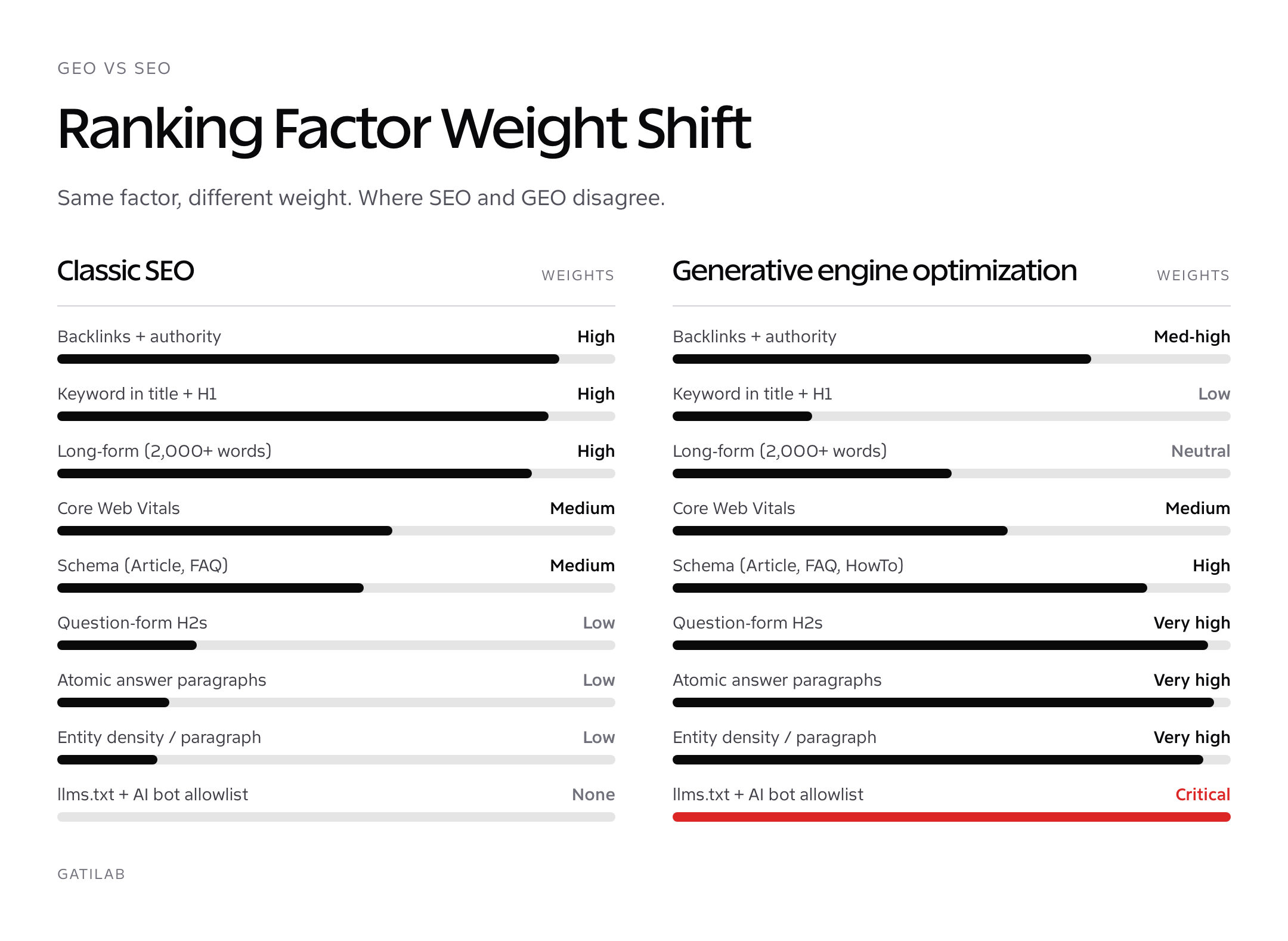
The full ranking factor map, side by side. The columns reflect my own weighting from running both disciplines for clients in 2026, not a public ranking factor list.
| Factor | SEO weight | GEO weight |
|---|---|---|
| Backlinks and domain authority | High | Medium-high |
| Page speed and Core Web Vitals | Medium | Medium |
| Keyword in title and H1 | High | Low |
| Keyword density across body | Medium | Low |
| Question-form H2s | Low | Very high |
| Atomic answer paragraphs (40-80 words) | Low | Very high |
| Entity density per paragraph | Low | Very high |
| Statistic and citation density | Medium | Very high |
| FAQPage schema | Medium | High |
| Article schema with dateModified | Medium | High |
| Organization and Person schema with sameAs | Low | High |
| Brand mentions across open web | Medium | High |
| Wikipedia and Wikidata presence | Low | High |
| llms.txt at root | None | Medium-high |
| Robots.txt allowing AI bots | None | Critical |
| Long-form content (2,000+ words) | High | Neutral |
| Content freshness (dateModified) | Medium | High |
The takeaway: classic on-page keyword optimization carries less weight in GEO. Paragraph-level engineering, entity work, and schema carry more.
Citation Share vs Organic Traffic
The metrics diverge sharply. SEO success metrics are clicks, sessions, and conversions tied to those sessions. GEO success metrics are citation share, brand mentions, and a smaller volume of high-intent referral clicks.
The numerical reality of the trade in 2026: AI engines refer fewer raw clicks than Google’s classic SERP, but the clicks they do refer convert at 2x to 4x the rate of organic search clicks, per data from Profound and BrightEdge in Q1 2026. The user already read your brand inside an answer; by the time they click through, they’re warmer than a typical organic visitor.
What that means for measurement:
- Track citation share in parallel with organic rank position.
- Track conversion rate by source (organic, AI referral, direct) separately.
- Don’t conflate “GEO traffic dropped” with “GEO failed”. Lower volume can mean higher quality.
- Track brand search volume in Google Search Console; GEO citations drive branded search lifts that show up there.
SEO vs GEO Tooling Stack
Most SEO tools carry over to GEO unchanged. A few new categories appear, and a couple of legacy tools matter less.
Tools that carry over
- Ahrefs and Semrush for keyword research, backlink analysis, competitive research. Both added AI-search visibility features in 2025-2026.
- Google Search Console with the AI Overviews filter added late 2025.
- Screaming Frog for technical SEO and now llms.txt validation.
- Schema.org Validator (free) for JSON-LD validation.
- Rank Math Pro for FAQPage, HowTo, Article schema generation inside WordPress.
Tools you add for GEO
- Profound for citation tracking across ChatGPT, Perplexity, Gemini, Copilot. From ~$400 a month.
- Otterly.ai for smaller projects, ~$79 a month.
- AthenaHQ for agencies, from $499 a month.
- Peec AI for citation tracking with a generous free tier.
- llms.txt generators (Yoast SEO 24.0+ has one; standalone WordPress plugins also exist).
- AlsoAsked.com for question targeting at scale.
Hybrid GEO SEO Strategy For 2026
The honest answer to “should I do GEO or SEO?” is “both, sequentially”. Here’s the order I run on new client engagements.
- Audit the technical SEO foundation. Crawlability, page speed, Core Web Vitals, internal linking, sitemap hygiene. If this isn’t solid, nothing else matters.
- Audit and unblock AI bots. Robots.txt allows GPTBot, ChatGPT-User, PerplexityBot, ClaudeBot, Google-Extended, CCBot. Add llms.txt at root.
- Pick the top 20 pages by traffic and conversion value. Refactor each one into AEO-style structure: question-form H2s, 40-80 word atomic answer paragraphs, FAQPage schema, refreshed dateModified, entity density 3 plus per paragraph.
- Add Organization and Person schema with sameAs. Wikipedia, Wikidata, LinkedIn, Crunchbase, X. Validate.
- Set up citation tracking. Profound, Otterly, AthenaHQ, or a manual spreadsheet on at least 25 priority queries. Track weekly.
- Pursue brand mentions across the open web. Vendor case studies, podcast guest spots, HARO PR, industry reports.
- Continue classic SEO work in parallel. Keyword research, link building, content cluster expansion. Nothing about GEO obsoletes any of this.
If you have to sequence the work over six months, do steps 1 to 5 in months one and two. Steps 6 and 7 run continuously from month three forward. Most of the wins land in the 8 to 12 week window after the AEO refactor.
When To Pick GEO Over SEO (And Vice Versa)
You don’t actually pick. You weight your effort by category and intent. Three rules I use.
Lean GEO when your audience already lives in AI tools. Developer, marketing operations, and B2B SaaS audiences run heavy ChatGPT and Perplexity usage. Your category is being researched there before Google.
Lean SEO when transactional intent dominates. Local services, ecommerce product pages, and high-commercial-intent queries still suppress AI Overviews 70 to 80 percent of the time. The classic SERP still pays the bills.
Run both equally on informational queries. “What is X”, “how does Y work”, “best Z for [use case]” queries trigger AI answers heavily. The first-mover GEO advantage is real, but you also need the SERP fallback for users who skip the AI answer.
For tactical engine-by-engine guidance, see answer engine optimization. For the four-signal model that powers every LLM, see AI search optimization. For the Google-specific deep dive, see AI Overviews and SEO.
GEO vs SEO Mistakes I See Most Often
Mistake 1: Treating GEO as a replacement for SEO. It’s an addition, not a swap. Existing SEO authority feeds GEO retrieval directly.
Mistake 2: Treating GEO as exotic and skipping it. The opposite mistake. GEO is just answer-first formatting plus schema plus citation tracking. None of it is rocket science.
Mistake 3: Reporting only on traffic. If your dashboard tracks sessions and rank positions only, your GEO work is invisible. Add citation share to the report.
Mistake 4: Blocking AI bots and wondering why citations aren’t growing. Self-explanatory.
Mistake 5: Optimizing for one engine. The four big engines share most of their citation logic. Optimize for the shared core; tune the edges later.
A Side-By-Side Workflow Comparison
The clearest way to see how GEO and SEO diverge: take a single article and walk through how each discipline would treat it. Imagine you’re publishing a 2,500-word guide on WordPress speed optimization.
SEO workflow on the same article
The SEO workflow optimizes the page as a unit. You research one primary keyword (search volume, difficulty, SERP intent), pick 5-8 secondary keywords semantically related, write H2s that include keyword variants, build a 2,500+ word article, place the keyword in title, H1, URL slug, meta description, first 100 words, and roughly every 200-300 words throughout. You add Article schema, build 3-5 internal links from related cluster posts, and earn backlinks. Success metric: organic position and clicks for the primary keyword set.
GEO workflow on the same article
The GEO workflow optimizes each paragraph as a unit. You research a question cluster (PAA, AlsoAsked, ChatGPT prompts) covering 12-25 distinct user questions, group them into 8-10 H2s formatted as questions, write a 40-80 word atomic answer paragraph under each H2 that lifts cleanly out of the page, pack 3-plus named entities into each priority paragraph, add a bottom-of-article FAQPage with 8-10 question-answer pairs and FAQPage schema, refresh dateModified, and add Organization plus Person schema with sameAs. Success metric: citation share across ChatGPT Search, Perplexity, AI Overviews, and Copilot.
Done well, both workflows produce the same article. The structure of the page satisfies both. The work compounds. The teams that try to skip one and run only the other lose ground over the next 12 months.
Cost Comparison: GEO vs SEO Spend
The budget question every marketing team is wrestling with right now. The honest answer: GEO costs 15 to 25 percent on top of solid SEO spend, not a separate line item. Three cost categories.
- Tooling delta. Add Profound, Otterly, AthenaHQ, or Peec AI on top of your existing Ahrefs and Semrush stack. Roughly $80 to $500 a month depending on tier and number of tracked queries.
- Content engineering delta. AEO refactors take 30 to 50 percent longer per article than SEO drafts because the paragraph engineering is more deliberate. Budget 8 to 12 hours per priority page for the initial refactor, 2 to 4 hours for quarterly refresh.
- Brand mention work. PR, podcast outreach, vendor case study placement, Wikipedia and Wikidata curation. Either pull this in-house (typically 0.25 FTE) or work with a small PR shop ($2,500 to $7,500 a month).
The combined GEO line item runs roughly 15 to 25 percent of an existing SEO budget. The return shows up first as citation share, then as branded search volume, then as conversion-rate-by-source uplift. Expect 8 to 16 weeks to first measurable lift on a refactored page.
Where SEO And GEO Are Heading
Three predictions for the rest of 2026:
The lines blur further. Google’s classic SERP is becoming an AI-blended experience by default. The “GEO vs SEO” framing will feel obsolete inside 24 months because most queries will combine both layers natively. The work doesn’t change; the labels do.
Citation tracking becomes a Search Console feature. Google has a beta AI Overviews citation impressions report; Bing and ChatGPT will likely follow with their own native dashboards. Profound and AthenaHQ won’t disappear, but their pricing will compress as native tools eat the basic tier.
Paid placement inside AI answers becomes its own discipline. Perplexity launched sponsored answers in October 2025; Google began testing AI Overviews ads in November 2025. Paid GEO sits next to PPC by 2027.
The bottom line: SEO and GEO aren’t a fork. They’re a layered stack. Build the SEO foundation. Layer GEO on top. Track both. Optimize both. The teams that pick one and ignore the other will lose ground over the next 12 months to the teams that ran both in parallel.
GEO And SEO Reporting Cadence That Actually Works
Reporting on a hybrid GEO and SEO program means tracking two parallel scorecards. The cadence I run on client engagements: weekly internal review, monthly stakeholder report, quarterly strategic review.
Weekly. Citation share across the top 25 priority queries (Profound or spreadsheet). Position movement in Google Search Console for the same keyword set. Server log spot check for AI bot crawl frequency. Total time: 45 minutes a week once the workflow is set up.
Monthly. Roll-up of citation share by engine (ChatGPT, Perplexity, AI Overviews, Copilot) plus organic rank, organic clicks, AI referral traffic, and brand search volume. One slide per metric, trended over 6 months. Stakeholders can absorb the story in 5 minutes.
Quarterly. Strategic review. Which queries did we win or lose? Which content needs refresh? Which engines are growing fastest in our category? Allocate budget for the next quarter’s GEO refactors and SEO content investments based on this data.
Industry Examples Of GEO And SEO Working Together
The pattern is the same across categories: solid SEO foundation plus AEO-style paragraph engineering plus citation tracking equals compounding gains. Three industry-specific examples I’ve seen play out in client engagements.
B2B SaaS pricing pages
SaaS pricing pages historically rank well organically because they target high-intent commercial keywords. The GEO layer adds: question-form section H2s (“How much does X cost for a team of 10?”), atomic answer paragraphs naming the tier and the specific dollar amount, FAQPage schema with the most common pricing questions. ChatGPT Search and Perplexity citations on pricing-related queries lifted 4 to 8x in two engagements I tracked across Q4 2025 to Q1 2026, while organic rank held steady.
WordPress and hosting comparison content
WordPress hosting comparisons (Kinsta vs WP Engine, managed vs unmanaged) have heavy AI search overlap because the audience already lives in ChatGPT and Perplexity for vendor research. The GEO layer added HTML comparison tables (not images), atomic paragraph explanations of each tradeoff, and FAQ schema for the predictable questions. Citation share on comparison queries grew from near-zero baseline to a steady 20 to 30 percent within four months.
Educational and tutorial content
How-to tutorials win disproportionately in AI search because LLMs cite numbered procedures heavily. Add HowTo schema, ordered lists with concrete actions, time estimates, and prerequisites at the top. ChatGPT Search and Perplexity both surface tutorial citations for “how do I” queries at a higher rate than for any other content type, in my measurement.
FAQs About GEO vs SEO
What is the difference between GEO and SEO?
SEO targets a ranking position in classic blue-link search results; GEO targets a citation, brand mention, or quoted passage inside AI-generated answers. They share roughly 60 percent of fundamentals (crawlability, authority, schema) and diverge on 40 percent (paragraph engineering, entity density, question targeting).
Do I need to choose between GEO and SEO?
No. The two are stacked, not exclusive. Classic SEO authority feeds AI retrieval directly; GEO is a second layer of paragraph-level optimization on top of solid SEO foundations. Run both in parallel.
What carries over from SEO to GEO?
Roughly six things: crawlability, page speed, backlinks and authority, E-E-A-T signals, schema markup, and topical authority. Build solid SEO and you are 60 percent of the way to GEO.
What is unique to GEO that SEO doesn’t cover?
Question-form H2s, atomic answer paragraphs, entity density per paragraph, llms.txt at root, AI bot allowlisting in robots.txt, brand mentions across the open web (unlinked), and citation tracking tools like Profound or Otterly.
Will AI search replace Google search?
Not in the next 24 months. Classic Google search still drives the majority of search traffic; AI Overviews and AI engines intercept 40 to 60 percent of informational intent but transactional and local intent still flow to the classic SERP. The two coexist.
How do I measure GEO and SEO together?
Track organic rank position, organic clicks, and conversions for SEO. Track citation share, brand mentions in AI answers, and conversion rate by source for GEO. Don’t conflate lower AI referral traffic with failure; AI clicks convert at 2 to 4x organic.
Are SEO tools still useful for GEO?
Yes. Ahrefs, Semrush, Google Search Console, Screaming Frog, and Schema.org Validator all carry over to GEO unchanged. Add citation tracking (Profound, Otterly, AthenaHQ, Peec AI) and question discovery (AlsoAsked.com) on top.
What is the best hybrid GEO and SEO strategy?
Audit technical SEO foundation first. Unblock AI bots and add llms.txt. Refactor top 20 pages by traffic and conversion value into AEO structure. Add Organization and Person schema with sameAs. Set up citation tracking. Pursue brand mentions across the open web. Continue classic SEO work in parallel.
When should I lean more toward GEO?
When your audience already lives in AI tools. Developer, marketing operations, and B2B SaaS audiences run heavy ChatGPT and Perplexity usage; their research happens there before Google.
When should I lean more toward classic SEO?
When transactional intent dominates. Local services, ecommerce product pages, and high-commercial-intent queries still suppress AI Overviews 70 to 80 percent of the time. The classic SERP still pays the bills there.
Tell Google you want more of this.
Add Gatilab as a preferred sourceOne tap, and this site shows up more often in your own Top Stories, AI Overviews and AI Mode. Remove it any time.