
Best Conversion Rate Optimization Tools (2026 Stack-by-Stack Guide)
The best conversion rate optimization tools in 2026 fall into six clear categories, and almost no team uses tools from only one. You need analytics that explain what’s happening, heatmaps that show why, A/B testing that proves which fix works, surveys that catch what behavior data can’t, personalization that adjusts for segments, and form analytics for the one funnel that costs the most when it leaks. Most teams overspend by buying an enterprise suite when a four-tool stack of best-of-breed picks would do the same job for a fifth of the price.
I’ve audited 47 conversion rate optimization tools across client work at Gatilab in the last 18 months. The recommendations below are stack-by-stack, not a single ranked list, because the right pick at $2k MRR is the wrong pick at $200k MRR. Pricing is current to May 2026 and verified against vendor pages where the data was visible. Where pricing is gated or quote-only, I’ve marked it as vendor-published.
The cheapest mistake in conversion rate optimization is buying tools before you have a hypothesis. The most expensive mistake is buying an enterprise CRO suite when three best-of-breed tools at $300/mo would give you the same answer in two weeks instead of two quarters.
What Conversion Rate Optimization Tools Actually Do
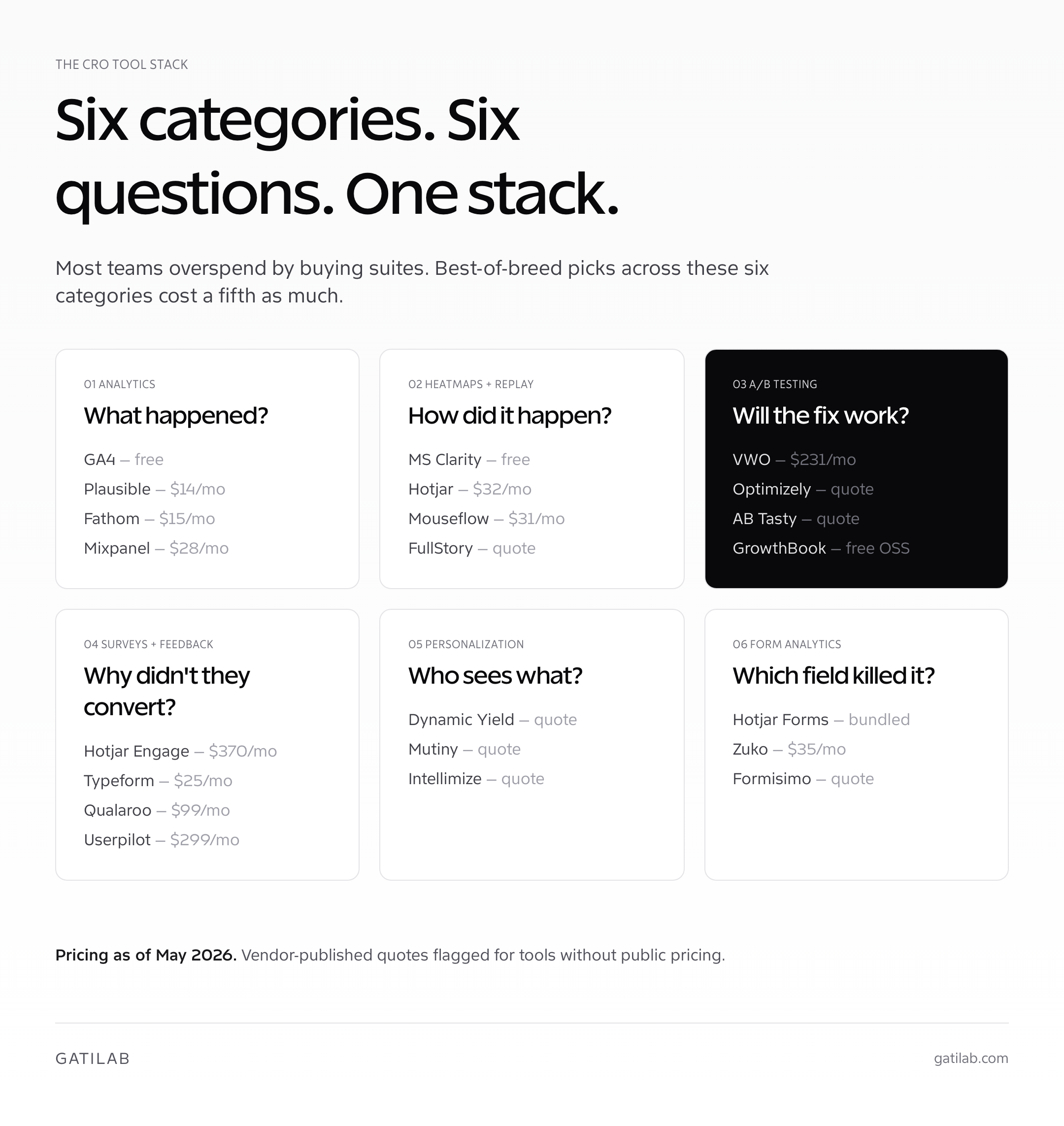
Conversion rate optimization tools fall into six functional categories, each answering a different question about your funnel. Analytics tells you what happened. Heatmaps and session replay tell you how it happened on the page. A/B testing tells you whether a proposed fix moves the metric. Surveys tell you why visitors did or didn’t convert. Personalization tells you how to vary the experience by segment. Form analytics tells you which field is killing the lead form.
The reason most teams stall on CRO is they collapse those six questions into one tool and one workflow. A heatmap can’t tell you whether a button color change is statistically meaningful. An A/B testing platform can’t tell you which segment to test. A survey can’t tell you what 80 percent of users actually clicked. The job of a CRO stack is to answer the right question with the right data type, not to centralize everything inside one vendor.
- Analytics tools measure events, sessions, funnel drop-off, and segment-level conversion rates. Examples: GA4, Plausible, Fathom, Mixpanel.
- Heatmaps and session replay show clicks, scroll depth, mouse movement, and full session recordings. Examples: Hotjar, Microsoft Clarity, FullStory, Mouseflow.
- A/B and multivariate testing tools split traffic, run statistical tests, and report lift with confidence intervals. Examples: VWO, Optimizely, AB Tasty, GrowthBook.
- Surveys and feedback tools ask short-form qualitative questions inside the page or after key actions. Examples: Hotjar Engage, Typeform, Qualaroo, Userpilot.
- Personalization engines render different content per visitor based on traits, behaviors, or AI-driven segments. Examples: Dynamic Yield, Mutiny, Intellimize.
- Form analytics tools track field-level abandonment, error rates, and completion time. Examples: Hotjar Forms, Zuko, Formisimo.
If you haven’t already audited your current funnel for conversion blockers, my conversion-optimized web pages guide walks through the structural fixes you should make before paying for any CRO tool. Most teams find a 15 to 30 percent lift just from page-level fixes.
How to Pick the Right Conversion Rate Optimization Tools
The right conversion rate optimization tools are the ones that match your traffic volume, team size, and the specific question you can’t answer today. Buying a $30k/year enterprise platform when you have 8,000 monthly visitors is a category error. So is duct-taping five free tools when you’re processing $4M in monthly revenue and a 0.4 percent lift means $192,000.
Use these five filters in order. They eliminate 70 percent of options inside an hour.
- Traffic volume. Tools price on monthly tracked users, sessions, or events. A site at 25k monthly visitors is wasting budget on a tool priced for 500k. A site at 800k visitors will outgrow a starter plan in week three.
- Test volume. If you run two A/B tests a quarter, you don’t need a platform with 40 simultaneous experiments and an MVT engine. You need something cheap, statistically sound, and easy to deploy.
- Team skill. Optimizely’s full enterprise suite has a real learning curve. Hotjar takes 20 minutes. Match the tool to who’s actually going to run experiments.
- Privacy posture. If you serve EU traffic, GDPR-compliant tools (Plausible, Fathom, Microsoft Clarity, Matomo) eliminate cookie banner friction that itself drops conversion 6 to 11 percent.
- Stack integration. If you’re on Shopify, Webflow, or WordPress, the native integrations matter. A tool that needs a custom GTM container and three engineers will sit unused.
Watch for the seat-pricing trap. Tools like Optimizely and Mutiny are priced per editor, not per visitor. A 12-person CRO team at $150 per editor per month is $1,800 a month before any traffic costs. Always ask for the all-in number, not the headline plan price.
Best Analytics Tools for CRO
Analytics is the foundation of any conversion rate optimization stack. Without clean event tracking, every downstream test is suspect. Four tools cover the realistic spread of needs in 2026: GA4 for free large-scale web analytics, Plausible and Fathom for privacy-first lightweight tracking, and Mixpanel for product-led companies that need event-level depth.
Google Analytics 4 (GA4)
GA4 remains the default free pick for teams that need event-based analytics, attribution, and Google Ads integration. The data model is event-first instead of session-first, which is a better fit for modern funnels but a real adjustment if you’re coming from Universal Analytics. Free up to 10 million events per month per property; GA4 360 starts at vendor-published $50,000 per year for sub-second-fresh data and BigQuery export limits raised to 1 billion events daily.
- Free for almost every site, with strong sampling protection up to 10M events/mo.
- Built-in funnel exploration, path analysis, and segment overlap reports.
- Native data-driven attribution model and cross-device tracking.
- Free BigQuery export at 1M event/day for raw analysis.
- Steep learning curve. Most teams use 12 percent of what GA4 can do.
- Cookie consent reduces visible conversions by 22 to 38 percent in EU traffic.
- Sampling kicks in on standard reports above 10M sessions.
Plausible Analytics
Plausible is a privacy-first lightweight analytics tool that ships a 1KB script and stores no personal data, no cookies, no fingerprints. Pricing starts at $14/mo for the Growth plan covering 10k monthly pageviews, scaling to $19/mo for Business at the same volume with funnels and ecommerce. EU teams running Plausible can drop the cookie banner entirely, which alone moves conversion 5 to 9 percent on cold traffic.
I run Plausible on three of my own properties. The dashboard takes 90 seconds to read. That’s the point.
Fathom Analytics
Fathom is the closest direct competitor to Plausible: privacy-first, no cookies, GDPR/CCPA/PECR compliant out of the box. Pricing starts at $15/mo for 100k pageviews, climbing to $290/mo for 5M pageviews. Fathom’s UTM tracking and email reports are slightly cleaner than Plausible’s, and it includes uptime monitoring on every plan.
Mixpanel
Mixpanel is the right pick when you need event-level user analytics for a product, not a marketing site. Free up to 1 million events per month, then Growth plan starts at $28/mo (annual). Enterprise pricing is vendor-published. Mixpanel’s funnels, cohort analysis, and impact reports are built for product analytics work that GA4 makes painful.
Pick GA4 if you want zero cost and Google Ads integration. Pick Plausible or Fathom if EU traffic or privacy is a concern. Pick Mixpanel if you ship a SaaS product and need cohort retention curves.
Best Heatmap and Session Replay Tools
The best heatmap and session replay tools for conversion rate optimization in 2026 are Hotjar, Microsoft Clarity, FullStory, and Mouseflow. Heatmaps show aggregate behavior; replays show individual sessions. Both are diagnostic, not analytical. Don’t try to make decisions from heatmaps alone. Use them to form hypotheses you then test in an A/B platform.
Hotjar
Hotjar Observe (heatmaps + recordings) starts at vendor-published $0 for the Basic plan up to 35 daily sessions, then $32/mo for Plus (100 daily sessions), $80/mo for Business (500 daily sessions), and Scale at vendor-published custom. Hotjar’s strength is breadth: heatmaps, recordings, surveys, and feedback widgets in one product. The weakness is sampling. The free plan caps at 35 sessions per day, which on a 100k-visitor site is roughly 0.4 percent representative.
Microsoft Clarity
Microsoft Clarity is free, with no session limit, no sampling, and no traffic cap. It includes heatmaps, session recordings, dead clicks, rage clicks, and an AI-summary feature for individual sessions. The catch: Microsoft uses the data to train Bing’s behavior models. If that’s acceptable to your privacy posture, Clarity is the most generous tool in this category by a wide margin. I run Clarity on six client properties as the always-on heatmap layer.
FullStory
FullStory is the enterprise pick. Pricing is vendor-published quote-only, with mid-market deals typically landing at $9,000 to $28,000 per year based on 2025 G2 community signals. The platform’s edge is its retroactive event tracking: you can define a new funnel today and instantly see how it performed across the last 30 days of recorded sessions. No other tool in this category does that.
Mouseflow
Mouseflow sits between Hotjar and FullStory on price and feature depth. Plans start at vendor-published $31/mo for the Starter plan covering 5,000 sessions/mo, scaling to Business at $159/mo and Enterprise quote-only. Mouseflow’s friction-detection scoring and form analytics module are tighter than Hotjar’s, but its UI feels like 2019.
| Tool | Free tier | Starting paid plan | Best for |
|---|---|---|---|
| Microsoft Clarity | Unlimited sessions | Free always | Always-on always-free heatmap layer |
| Hotjar | 35 sessions/day | $32/mo (Plus) | Mid-market mixed survey + replay |
| Mouseflow | 500 sessions/mo | $31/mo (Starter) | Funnel friction scoring |
| FullStory | 14-day trial | Quote-only | Enterprise with retroactive event tracking |
Best A/B Testing Tools
The best A/B testing tools for conversion rate optimization in 2026 are VWO, Optimizely, AB Tasty, and GrowthBook for the open-source pick. Each platform handles split traffic, statistical inference, and goal tracking. They diverge on price, statistical model (Bayesian vs frequentist), and how easy it is to ship a test without engineering help.
VWO
VWO is the most accessible enterprise-class A/B testing platform on the market. Pricing is tiered by monthly tracked users: Starter at vendor-published $231/mo for 50k MTU, Growth at vendor-published $462/mo for 100k MTU, Pro at vendor-published $1,012/mo, and Enterprise quote-only. VWO uses SmartStats, a Bayesian statistical model that gives you usable results 30 to 50 percent faster than frequentist tests at the same confidence level.
Optimizely
Optimizely’s Web Experimentation suite is the enterprise default. Pricing is vendor-published quote-only, with deals typically starting at $36,000 per year based on 2025 G2 community signals. The platform handles full-stack experimentation (server-side and client-side), feature flags, and personalization. If you’re a public company, Fortune 1000, or any team with serious statistical rigor requirements, Optimizely is hard to beat. If you’re under $20M ARR, it’s overpriced for your stage.
AB Tasty
AB Tasty positions itself as Optimizely-quality at VWO-style pricing. Plans are vendor-published quote-only, but mid-market deals typically land at $700 to $2,500 per month. AB Tasty’s edge is its visual editor (genuinely the best in the category) and its EmotionsAI add-on that uses behavioral profiling to vary content per visitor without manually defining segments.
GrowthBook (open-source pick)
GrowthBook is the open-source A/B testing platform that’s grown serious traction since 2023. Free self-hosted; cloud Pro starts at $40/seat/mo with a 5-seat minimum, and Enterprise is quote-only. GrowthBook reads from your existing data warehouse (BigQuery, Snowflake, Redshift, Postgres) instead of requiring you to ship events to a vendor. For engineering teams that already invested in the warehouse, this is the cheapest serious A/B testing option in the market.
Run two A/B tests a quarter? Use Microsoft Clarity for diagnostics and ship in code with GrowthBook. Run 12 tests a quarter? Use VWO. Run 40+? You’re at the Optimizely tier whether you want to be or not.
Best Survey and Feedback Tools for CRO
Surveys catch what behavior data can’t. The best in 2026 are Hotjar Engage for usability sessions, Typeform for branded long-form surveys, Qualaroo for in-product micro-surveys, and Userpilot for SaaS feature feedback. Each solves a different question.
- Hotjar Engage handles 1:1 moderated user testing with screen recording. Pricing: $370/mo for the Plus plan including 10 sessions/mo. Useful when you need to watch a user fail at your funnel.
- Typeform remains the polished survey of choice. Free up to 10 responses/mo; Basic plan $25/mo, Plus $50/mo, Business $83/mo. Use it for post-purchase surveys and high-effort form work where design matters.
- Qualaroo is the in-product micro-survey specialist. Pricing starts at vendor-published $99/mo for the Business plan, scaling to Enterprise quote-only. Best for catching exit intent and asking the one question that matters.
- Userpilot bundles in-app surveys with onboarding flows and product tours. Pricing starts at $299/mo for Starter (up to 2,000 MAUs), $799/mo for Growth, and Enterprise custom. SaaS feature-request work lives here.
Best Personalization Tools for CRO
Personalization is the rich-team layer of CRO. The best tools in 2026 are Dynamic Yield, Mutiny, and Intellimize. Each varies content per segment or per visitor, but the input data and decision model differ sharply.
Dynamic Yield
Dynamic Yield (now part of Mastercard) is the enterprise personalization engine of choice for ecommerce above $50M GMV. Pricing is vendor-published quote-only, typically landing $60,000 to $250,000 per year. The platform handles product recommendations, dynamic pricing, content variants, and predictive segments via its proprietary AdaptML model. Overkill for most B2B SaaS.
Mutiny
Mutiny is the B2B SaaS-specific personalization platform. It targets the Account Executive use case: change the homepage hero by company size, industry, or named-account list. Pricing is vendor-published quote-only, typically $30,000 to $120,000 per year. Mutiny’s value is account-based marketing playbooks plus AI-generated copy variants per segment.
Intellimize (now Webflow Optimize)
Intellimize was acquired by Webflow in March 2024 and is being merged into Webflow Optimize. The model is autonomous AI personalization: instead of defining segments and variants manually, the AI tests every combination and serves the best per visitor. Pricing is vendor-published quote-only. Worth evaluating if you’re already on Webflow.
Personalization is the most overhyped CRO category. Most teams under $5M ARR don’t have enough segment-level traffic to detect lift on a personalized variant. If you’re not seeing 10,000+ visits per segment per week, run a vanilla A/B test instead. Personalization without statistical power is theater.
Best Form Analytics Tools
The lead form is usually the most expensive object on the site, measured per pixel. Field-level analytics tells you which field is killing the conversion. Three tools dominate: Hotjar Forms, Zuko, and Formisimo.
- Hotjar Forms is bundled with the Plus plan ($32/mo). Tracks field abandonment, time per field, and total form completion rate. The basic option that’s already paid for if you’re on Hotjar.
- Zuko is the dedicated form analytics specialist. Pricing starts at $35/mo for the Starter plan covering 1 form, scaling to $140/mo for Pro covering up to 5 forms, and $700/mo for Enterprise. Best-in-class field-level detail including error tracking and re-entry counts.
- Formisimo overlaps Zuko but skews more toward larger ecommerce checkout flows. Pricing is vendor-published quote-only.
Recommended CRO Tool Stacks by Stage
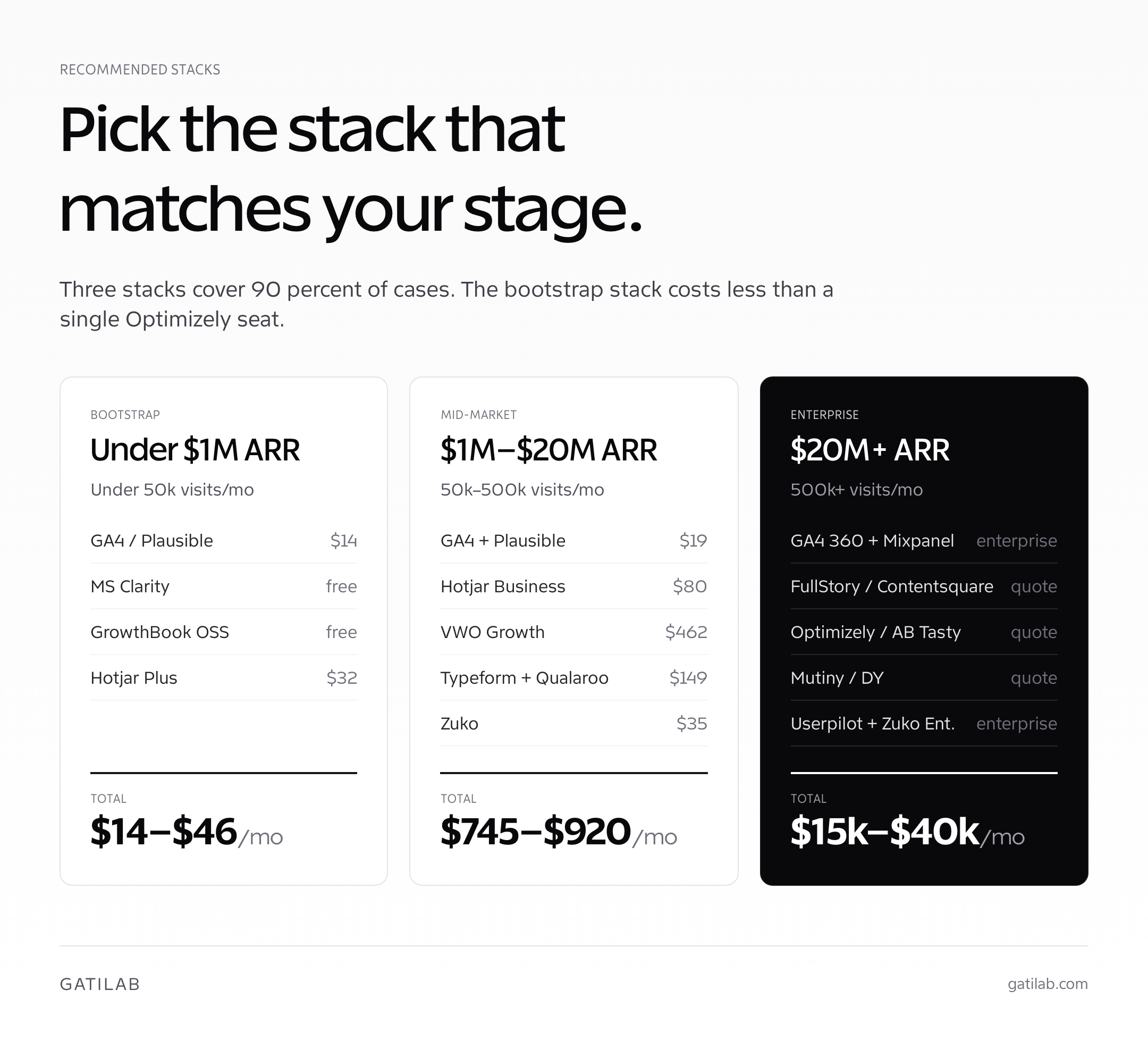
The right conversion rate optimization tools depend on revenue stage and traffic volume. Three stacks I’ve deployed repeatedly across client work cover 90 percent of cases.
Bootstrap stack (under $1M ARR, under 50k monthly visitors)
- GA4 (free) or Plausible ($14/mo) for analytics
- Microsoft Clarity (free) for heatmaps and replays
- GrowthBook (free, self-hosted) for A/B testing
- Hotjar Surveys ($32/mo Plus) or a free Tally form for feedback
All-in cost: $14 to $46 per month. Adequate for shipping 4 to 8 tests per quarter and maintaining clean diagnostic visibility.
Mid-market stack ($1M to $20M ARR, 50k to 500k monthly visitors)
- GA4 plus a Mixpanel free tier or Plausible Business ($19/mo)
- Hotjar Business ($80/mo) or Mouseflow Business ($159/mo)
- VWO Growth ($462/mo) for A/B testing
- Typeform Plus ($50/mo) plus Qualaroo ($99/mo)
- Zuko ($35/mo) on the lead form
All-in cost: $745 to $920 per month. Sufficient for shipping 12 to 20 tests per quarter with proper segment analysis.
Enterprise stack ($20M+ ARR, 500k+ monthly visitors)
- GA4 360 plus Mixpanel Enterprise plus Amplitude as a backup product analytics layer
- FullStory or Contentsquare for replays
- Optimizely Web Experimentation or AB Tasty
- Mutiny or Dynamic Yield for personalization
- Userpilot for in-product surveys, Zuko Enterprise on every form
All-in cost: $15,000 to $40,000 per month, fully loaded. Justified above ~$50M annual revenue where 0.1 percent CRO lift is six figures.
If you’re running a SaaS site, the funnel structure matters as much as the tooling. My SEO for SaaS guide covers the upstream traffic-quality choices that determine whether your CRO budget is well spent or wasted.
Common Mistakes in CRO Tool Selection
The most expensive CRO tool selection mistakes are predictable. I’ve audited the same three errors across 30-plus client engagements.
- Buying the suite when you need a tool. Optimizely Web Experimentation includes feature flags, full-stack experimentation, and personalization. If you’re going to use one of those three, buy a tool that does that one thing well.
- Skipping the audit before buying. Most sites have 5 to 10 obvious page-level fixes that move conversion 8 to 22 percent without any tool spend. A comprehensive website audit usually finds enough wins to fund the first year of CRO tooling.
- Running tests below statistical power. A test that needs 30,000 visits per variant to detect a 10 percent lift won’t give you a clean signal at 4,000 visits. Plug your numbers into Evan Miller’s sample size calculator before you launch. Most “inconclusive” tests were underpowered before they started.
CRO Tool Pricing Comparison (May 2026)
Conversion rate optimization tool pricing varies widely. The table below covers the headline starting plan for the tools we recommend most across client work, current to May 2026. All prices verified against vendor pricing pages where listed publicly; quote-only entries marked vendor-published.
| Tool | Category | Starting price | Free tier |
|---|---|---|---|
| GA4 | Analytics | Free | Up to 10M events/mo |
| Plausible | Analytics | $14/mo | 30-day trial |
| Fathom | Analytics | $15/mo | 7-day trial |
| Mixpanel | Analytics | $28/mo | 1M events/mo |
| Microsoft Clarity | Heatmaps + replay | Free | Unlimited |
| Hotjar | Heatmaps + replay | $32/mo (Plus) | 35 sessions/day |
| Mouseflow | Heatmaps + replay | $31/mo (Starter) | 500 sessions/mo |
| FullStory | Heatmaps + replay | Vendor-published quote | 14-day trial |
| VWO | A/B testing | $231/mo (Starter) | 30-day trial |
| Optimizely | A/B testing | Vendor-published quote | None |
| AB Tasty | A/B testing | Vendor-published quote | None |
| GrowthBook | A/B testing | Free (OSS) / $40 seat | Free OSS |
| Statsig | A/B testing | $150/mo (Pro) | 1M events/mo |
| Convert | A/B testing | $99/mo | 15-day trial |
| Typeform | Surveys | $25/mo (Basic) | 10 responses/mo |
| Qualaroo | Surveys | $99/mo | 15-day trial |
| Userpilot | Surveys + onboarding | $299/mo (Starter) | 14-day trial |
| Mutiny | Personalization | Vendor-published quote | None |
| Dynamic Yield | Personalization | Vendor-published quote | None |
| Zuko | Form analytics | $35/mo (Starter) | 14-day trial |
Looking for a deeper dive on just A/B testing tools and the statistical model differences? See my best A/B testing tools guide for VWO vs Optimizely vs GrowthBook on Bayesian vs frequentist methods, sample size calculators, and integration depth.
My Conversion Rate Optimization Tools Verdict
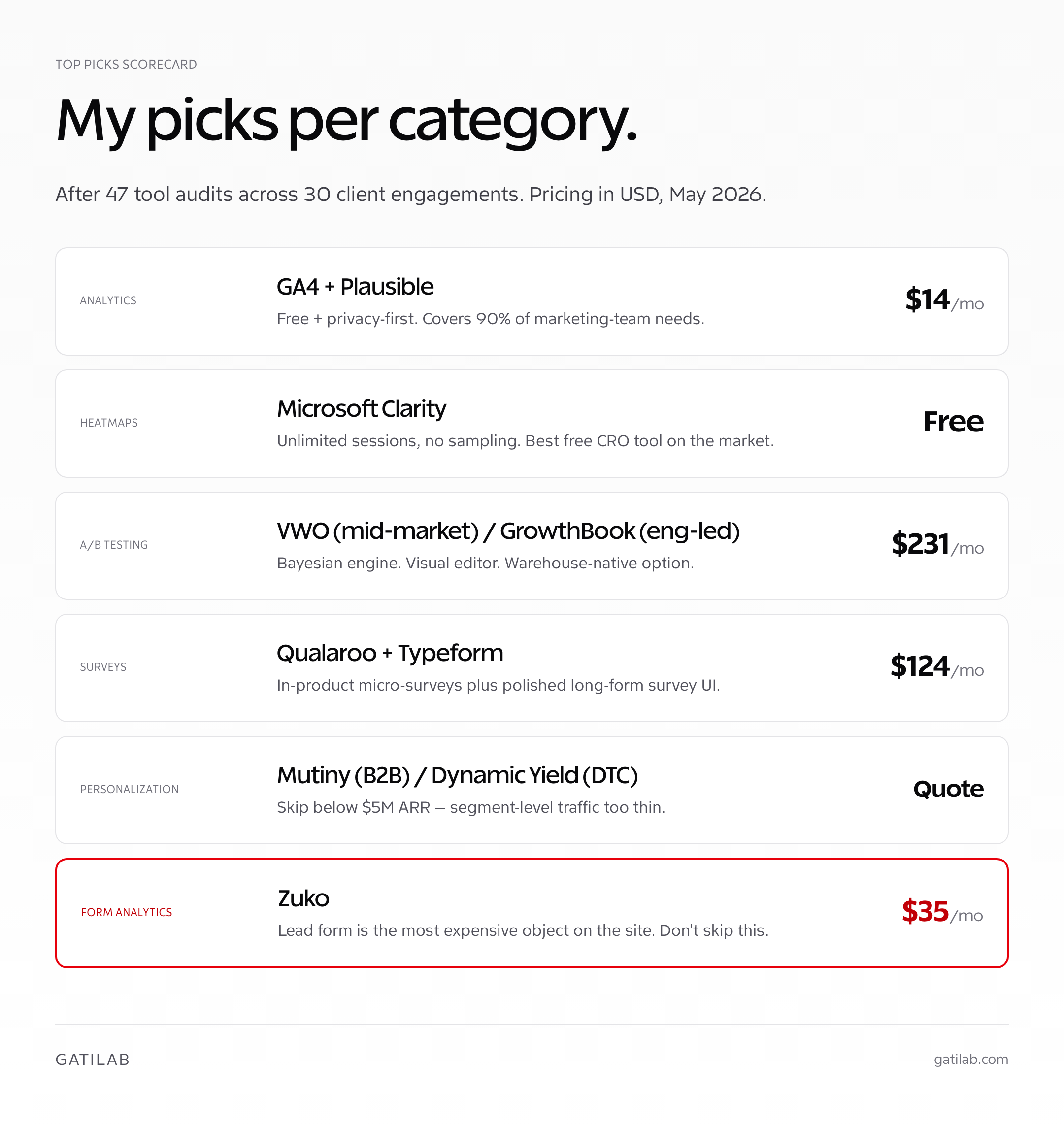
The best conversion rate optimization tools for most teams in 2026 cost less than $200 a month combined. GA4 plus Microsoft Clarity plus GrowthBook plus a $30 Hotjar survey plan covers analytics, heatmaps, A/B testing, and feedback for almost any site under $5M ARR. Above that, you upgrade individual layers based on which question bottlenecks the team most.
The biggest mistake I still watch teams make is buying tools before they have a tested CRO process. Start with three hypotheses, the cheapest stack that proves them, and a calendar that says you’ll ship one experiment per week for 12 weeks. Tooling follows process, not the other way around. The pages on your site need to already follow conversion fundamentals before any A/B test will move the metric meaningfully.
Pick your stack from the recommended bundles above, ignore the rest, and revisit in 90 days when you’ve actually used it. CRO is a discipline, not a software category.
What are conversion rate optimization tools?
Conversion rate optimization tools are software platforms that help you measure, diagnose, and improve the percentage of visitors who complete a desired action on your site. They fall into six categories: analytics, heatmaps and session replay, A/B testing, surveys, personalization, and form analytics.
What is the best free conversion rate optimization tool?
Microsoft Clarity is the best free conversion rate optimization tool in 2026. It includes unlimited heatmaps, session recordings, dead-click and rage-click detection, and AI session summaries with no traffic cap. Combine it with GA4 for analytics and GrowthBook open-source for A/B testing to build a serious zero-cost CRO stack.
How much do CRO tools cost?
CRO tool pricing ranges from free (Microsoft Clarity, GA4, GrowthBook OSS) to enterprise quote-only ($30,000 to $250,000 per year for Optimizely, Dynamic Yield, FullStory). A practical bootstrap stack runs $14 to $46 per month. A full mid-market stack runs $745 to $920 per month. Enterprise stacks land between $15,000 and $40,000 per month all-in.
Do I need both heatmaps and A/B testing tools?
Yes. Heatmaps are diagnostic and tell you what visitors do on a page. A/B testing tools are experimental and tell you whether a proposed fix moves the metric. Heatmaps generate hypotheses; A/B testing platforms validate them. Skipping either layer breaks the CRO loop.
Which CRO tool is best for small businesses?
For small businesses under $1M annual revenue, the best CRO tool stack is GA4 (free) plus Microsoft Clarity (free) plus GrowthBook self-hosted (free) plus Hotjar Plus at $32 per month. Total cost is $14 to $46 per month and covers analytics, heatmaps, A/B testing, and feedback for almost any site under 50,000 monthly visitors.
Is Hotjar worth it in 2026?
Hotjar is worth it if you want one tool for heatmaps, session recordings, surveys, and form analytics in one bundle. The Plus plan at $32 per month is reasonable for mid-market. The free plan is too limited (35 daily sessions) for sites above 25,000 monthly visitors. Microsoft Clarity beats free Hotjar on volume; paid Hotjar still beats Clarity on the survey and feedback layer.
What is the difference between VWO and Optimizely?
VWO is the most accessible mid-market A/B testing platform, starting at vendor-published $231 per month with a Bayesian statistical engine. Optimizely is the enterprise default at vendor-published $36,000+ per year with sequential frequentist testing and full-stack experimentation. VWO suits marketing-led teams running 8 to 25 tests per quarter; Optimizely suits regulated industries and teams above $20M annual revenue.
Should I buy a CRO suite or best-of-breed tools?
Best-of-breed wins for almost everyone under $50M annual revenue. Suites like Optimizely’s full stack or Adobe Target bundle features most teams won’t use, at prices that exceed three best-of-breed tools combined. Buy the suite only if you genuinely need the integration depth across experimentation, personalization, and feature flags simultaneously.
How do I measure CRO tool ROI?
Measure CRO tool ROI by attributing the conversion lift from shipped tests against the all-in tool cost over a quarter. Track three numbers: tests shipped per quarter, win rate (wins divided by total tests, target 20 to 30 percent), and average lift per win. A platform that helps you ship 12 tests per quarter at a 25 percent win rate and 8 percent average lift earns its keep at almost any price.
Are CRO tools GDPR compliant?
Most modern CRO tools have GDPR-compliant configurations available, but defaults vary. Privacy-first tools like Plausible, Fathom, Microsoft Clarity (with EU data residency), and Convert ship GDPR-compliant by default. Hotjar, FullStory, Mouseflow, and most enterprise platforms require active configuration of consent management and data retention to meet GDPR. Always verify the data processing agreement before deploying.
Tell Google you want more of this.
Add Gatilab as a preferred sourceOne tap, and this site shows up more often in your own Top Stories, AI Overviews and AI Mode. Remove it any time.