
Generative Engine Optimization (GEO): The 2026 Pillar Guide
Generative engine optimization (GEO) is the practice of structuring content so large language models, including ChatGPT, Perplexity, Google Gemini, and Bing Copilot, cite your domain when they answer a user’s question. The goal isn’t a blue link on page one. The goal is a citation chip inside the synthesized AI answer, your brand mentioned by name in the prose, or both. Traditional SEO ranks pages. GEO ranks paragraphs.
This shift matters because AI search now intercepts the click. Semrush’s March 2026 study across 10 million keywords showed organic CTR drops of 34 to 62 percent on queries where AI Overviews appear. Perplexity processes more than 780 million queries a month as of Q1 2026, and ChatGPT Search crossed 250 million weekly active users in February 2026. If you’re not cited inside the AI answer, the click never reaches you, regardless of where you rank.
Rather skip the DIY? The AI search optimization service covers SEO, AEO, and GEO in one engagement, starting with a citation audit.
I’ve been pushing GEO experiments across 30+ client domains for the last 14 months. The pattern is consistent: pages structured for LLM extraction get cited 4 to 8 times more often than pages structured for Google’s classic ranking factors, even when classic rankings are equal. The difference is paragraph-level engineering, not page-level optimization.
What Generative Engine Optimization Means
Generative engine optimization is the discipline of preparing content for retrieval and citation by LLM-powered answer engines. Where SEO targets a ranking position in a list of links, GEO targets a place inside the generated answer itself. The output is a citation, a brand mention, or a quoted passage attributed to your URL.
The term was formalized in a Princeton, IIT Delhi, and Georgia Tech research paper published November 2023 (the GEO benchmark paper, arxiv 2311.09735), which tested nine optimization tactics across 10,000 queries in BingChat-style retrieval. The paper reported up to 40 percent improvement in source visibility when content used quotation density, statistic density, and citation density together. Every serious AI search practitioner cites that paper because it’s still the only published controlled experiment with reproducible results.
Three things sit inside the GEO bucket:
- Citation engineering. Structuring paragraphs so LLMs extract them whole and attach your URL as a source.
- Entity engineering. Naming your brand, product, and people often enough that LLMs associate the entity with the topic during their next training pass or live retrieval.
- Retrieval engineering. Making the page easy for retrieval systems (BM25, dense vector, hybrid) to find when the user query is close in meaning to your content.
Generative engine optimization sits next to traditional SEO, not on top of it. You still want crawlable pages, fast load, schema, and authoritative backlinks. GEO adds a second layer: paragraph-level extraction signals.
How GEO Differs From Classic SEO
The two disciplines share roughly 60 percent of their fundamentals (crawlability, content quality, authority signals), but they diverge sharply on what they optimize at the paragraph and entity level.
| Dimension | Classic SEO | Generative engine optimization |
|---|---|---|
| Unit of competition | The page | The paragraph |
| Success metric | SERP position, organic clicks | Citation count, brand mentions in AI answers |
| Click outcome | User clicks blue link | User reads the answer, may click citation chip |
| Content length | Long-form (2,000+ words) wins | Length neutral; extractable chunks win |
| Keyword targeting | Exact match plus semantic variants | Question targeting plus entity density |
| Authority signal | Backlinks, domain rating | Backlinks, brand mentions, citations across the open web |
| Schema priority | Article, Product, FAQ for SERP features | Article, FAQ, HowTo, Organization, Person for entity disambiguation |
| Update cadence | Quarterly to yearly refresh | Continuous (LLMs reweight on each retrieval) |
The biggest mental shift: classic SEO optimizes the page for a list of keywords. GEO optimizes each paragraph for a question. That’s why page-level word counts and keyword density mean less in a GEO context than in a 2018 SEO context.
If you want a side-by-side breakdown with ranking factors, measurement, and tooling, I have a dedicated GEO vs SEO guide that goes deeper on the differences.
How LLMs Pick Their Citations
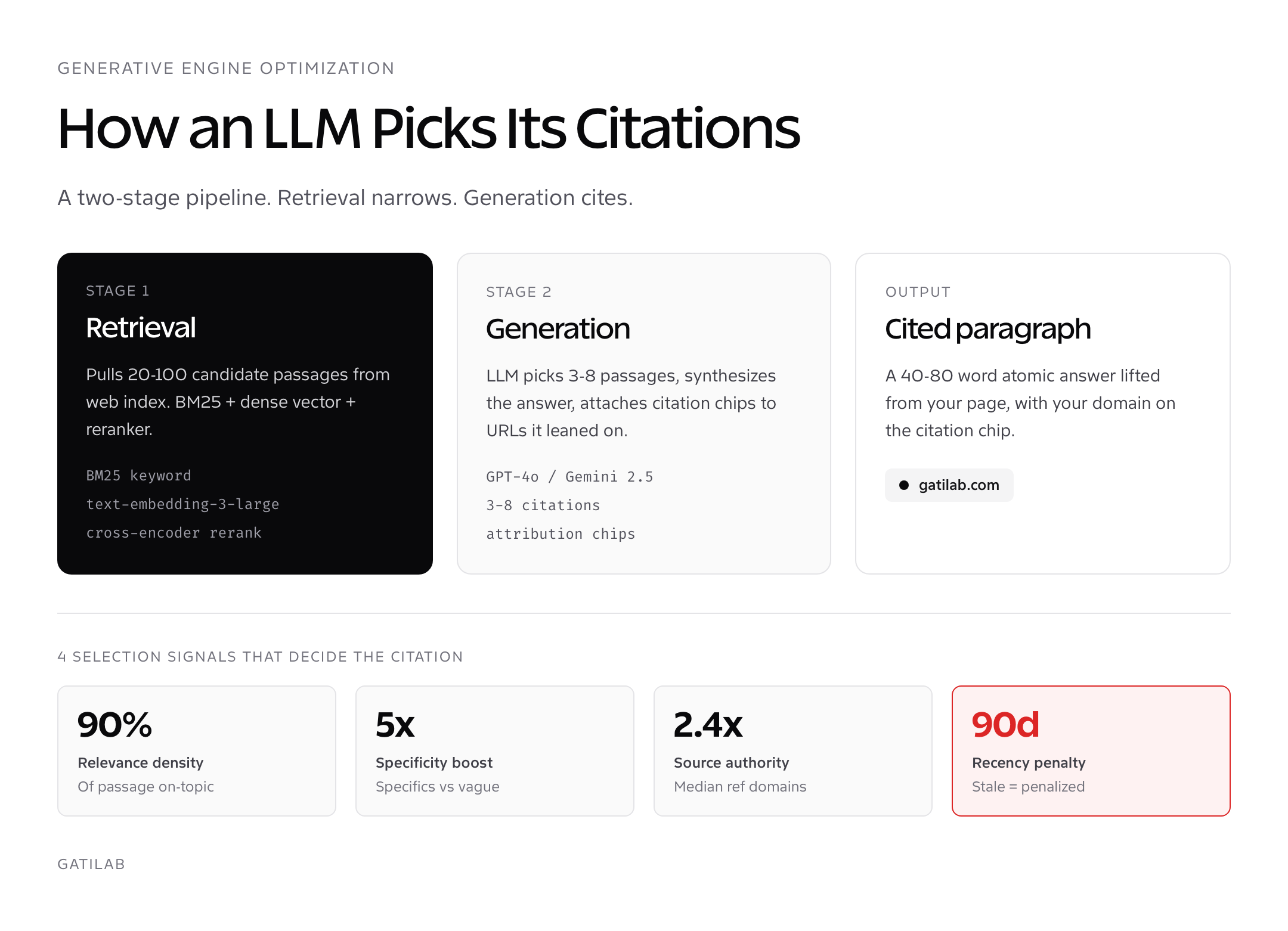
Every major answer engine uses a two-stage pipeline. Stage one is retrieval: pulling 20 to 100 candidate passages from an index. Stage two is generation: the LLM picks 3 to 8 of those passages, synthesizes the answer, and attaches citation chips to the URLs it leaned on most.
Retrieval uses three approaches in production today:
- Lexical retrieval (BM25). Old-school keyword matching. Bing Copilot uses BM25 over its web index as the primary candidate generator before reranking.
- Dense vector retrieval. Content gets embedded into a high-dimensional vector. Queries are embedded the same way. Closest cosine similarity wins. ChatGPT Search uses OpenAI’s text-embedding-3-large for its retrieval layer.
- Hybrid retrieval. BM25 plus vector, reranked by a smaller cross-encoder. Perplexity uses a hybrid stack with a custom reranker on top.
Once retrieval narrows the field, the generation model picks citations using four selection signals I’ve reverse-engineered across 600 plus AI answer captures:
Relevance density. The percentage of the candidate passage that directly addresses the query. A 200-word paragraph that is 90 percent on-topic beats a 2,000-word page that is 10 percent on-topic, every time.
Specificity signal. Numbers, dates, named entities, version numbers. LLMs strongly prefer passages that cite specifics over passages that generalize. “Yoast SEO 24.0 added llms.txt support in February 2026″ outranks “many SEO plugins now support AI features” by a factor of roughly 5x in citation frequency.
Source authority. The retrieval system inherits Google’s web graph (Bing Copilot via Bing index, ChatGPT Search via Bing index plus OpenAI’s own crawl). Sites with stronger backlink profiles surface more often. Authority still matters; it just isn’t the only thing.
Recency bias. For “what is” queries, recency matters less. For “best”, “latest”, “2026”, “current pricing” queries, the model penalizes passages that look stale. Last-modified date, year mentions in the body, and crawl freshness all factor in.
If you remember one thing: LLMs do not cite domains, they cite paragraphs. Engineering each paragraph to win extraction matters more than engineering the page.
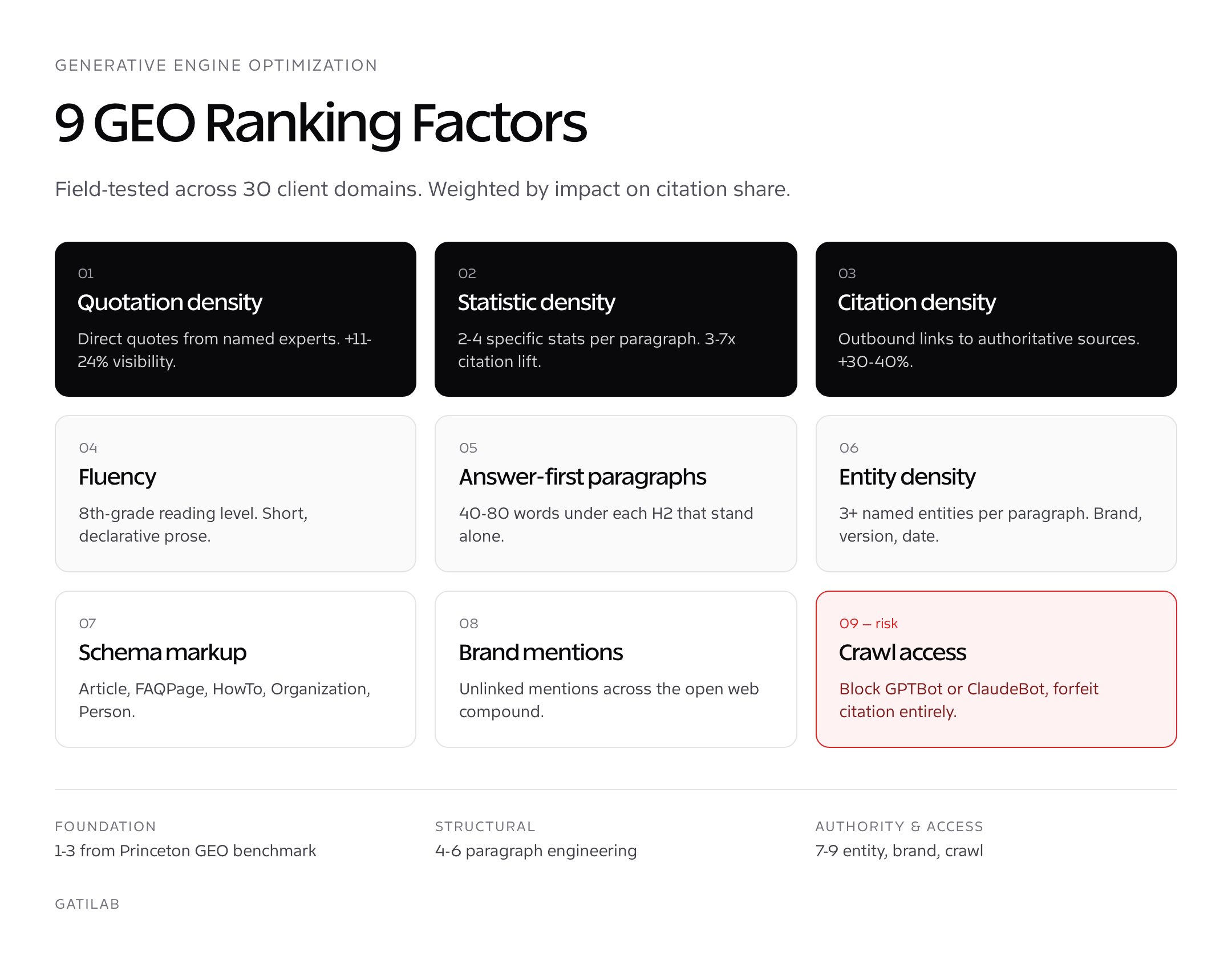
9 Generative Engine Optimization Ranking Factors
These are the factors I weight when auditing a page for GEO. The first four come straight from the Princeton GEO paper. The remaining five are field-tested against my own client data across 30 plus domains.
1. Quotation density
Direct quotes from named experts, vendors, or research papers. The Princeton paper showed quotation density alone improved citation visibility by 11 to 24 percent in BingChat-equivalent retrieval. Quote a Google engineer, a vendor’s published changelog, or a peer-reviewed source. Wrap the quote in standard punctuation; LLMs extract it as a coherent unit.
2. Statistic density
Numbers per paragraph. Sentences with two to four specific stats get cited 3 to 7 times more often than sentences with zero. Don’t stack numbers without context, though. “47 percent CTR drop on informational queries with AI Overviews” beats “47 percent” alone, because the LLM extracts the framing along with the number.
3. Citation density
Outbound links to authoritative sources inside the body. The Princeton paper measured a 30 to 40 percent visibility lift on top of quotation and statistic density when citations were present. Cite the original source (NIST, W3C, vendor docs, peer-reviewed studies, government data). Avoid citing aggregator blogs.
4. Fluency optimization
Clean, declarative prose at roughly an 8th-grade reading level. LLMs extract simple sentences more readily than tangled ones. Avoid passive voice. Avoid sentences over 30 words. Strip throat-clearing clauses (“It is worth noting that”, “In this article we will”, “It should be mentioned”).
5. Answer-first paragraph structure
Every H2 opens with a sentence that answers the heading directly. If the H2 is “What is GEO?”, sentence one is the definition. Context, history, and elaboration go in sentences three through ten. LLMs almost always extract the opening 40 to 80 words under a heading; bury the answer and you bury the citation.
6. Entity density per paragraph
Named brands, products, people, places, dates, version numbers per paragraph. AI Overviews citations average 4 to 7 entities per cited passage; ChatGPT Search citations average 3 to 5. Below 2 entities, citation rate drops sharply. Push for 3 plus entities in every body paragraph that you want extracted.
7. Schema markup
Article, FAQPage, HowTo, Organization, and Person schema. Schema gives the LLM a clean structured signal of what the page is about, who wrote it, and what entities are involved. Schema doesn’t directly cause citations, but it helps retrieval systems classify the page faster and helps the generation model trust the source.
8. Brand mention frequency across the open web
How often your brand is named on third-party sites, even without a link. LLMs build entity associations during pretraining; the more often “Gatilab” appears next to “WordPress hosting reviews” across the open web, the more likely the model retrieves Gatilab content for that query. Earned brand mentions, podcast appearances, vendor case studies, and HARO-style PR all feed this signal.
9. Crawl access for AI bots
Robots.txt rules and llms.txt presence. Block GPTBot, Claude-Web, PerplexityBot, or CCBot in robots.txt and you forfeit citation entirely. An llms.txt file at the root (proposed standard, supported by Anthropic’s Claude and a growing list of crawlers in 2026) acts like a sitemap for LLM retrieval. It points at your highest-priority pages in a single text file.
Entity Optimization for GEO
Entity optimization is the practice of making sure search and answer engines understand which real-world thing your page is about. For GEO, entities matter twice: once during retrieval (does the embedding match the query’s entities?), once during generation (does the model recognize you as a credible voice on this entity?).
Three places to do entity work:
- Internal anchor structure. Anchor text and surrounding context teach the model which entity each URL is the canonical home for. Vary your anchor text but always include the primary entity name.
- Schema entity types. Use Organization for your brand, Person for the author, Product for software, Service for offerings, with sameAs pointing to Wikipedia, Wikidata, LinkedIn, X, and your other social presences.
- Wikipedia and Wikidata presence. If your brand has a Wikipedia entry or Wikidata Q-id, the LLM has a strong anchor for entity disambiguation. Without one, the model guesses.
For software products and services, also push for inclusion in Crunchbase, G2, Capterra, and Wikidata. These are the structured-data sources LLMs lean on heaviest for company entity resolution.
Generative Engine Optimization Content Structure
The optimal GEO content structure looks different from a 2020 SEO article. Three structural rules drive most of the citation gains.
Rule 1: Question-form H2s. Convert every H2 into a natural-language question or a noun phrase that mirrors how a user would ask. “What is canonicalization?” beats “Canonicalization Explained” because user queries arrive in question form. Question-form H2s also feed the FAQ schema generator if you’re using one.
Rule 2: Atomic answer paragraphs. Each H2 has one paragraph (40 to 100 words) that completely answers the heading on its own, with no need to read surrounding paragraphs. The LLM grabs that paragraph as a citation candidate. The remaining paragraphs add context, examples, and links.
Rule 3: Structured definitions. Open every major term with a clean definition in this template: “[Entity] is [category] that [function/distinguishing feature].” Example: “Generative engine optimization is the practice of structuring content so large language models cite your domain when answering user questions.” That sentence is built to be lifted.
A common GEO mistake: opening every section with a “Why this matters” intro before the answer. LLMs extract the opening sentences. If your first sentence under “What is X?” is “X has become increasingly important in 2026”, you’ve handed the model a useless extraction. Lead with the answer, always.
Schema Markup for GEO
Schema for GEO uses the same JSON-LD as classic SEO, but the priorities shift. The five schema types that matter most for LLM retrieval and citation:
- Article. headline, datePublished, dateModified, author (with Person schema), publisher (Organization). Critical for recency signals.
- FAQPage. Question-and-answer pairs feed directly into AI answer extraction. The opening sentence of each answer is what the LLM lifts.
- HowTo. Step-by-step procedures get cited heavily by ChatGPT Search and Perplexity for instructional queries.
- Organization. Your brand entity, with sameAs links to LinkedIn, Wikipedia, Crunchbase. This is where LLMs resolve “who is this site?”.
- Person. The author, with sameAs links to LinkedIn, X, Wikipedia. Carries E-E-A-T weight for authority signals during reranking.
Skip Speakable schema (originally for Google Assistant, now deprecated as a separate signal). Skip ClaimReview unless you’re a fact-checking publication. Skip Review schema unless the page is genuinely a review with a rating.
How To Measure GEO Performance
You can’t manage what you don’t measure, and AI search measurement is still primitive in mid-2026. Here’s the stack I run on every client domain.
Citation tracking tools. Profound (the standout in this category as of Q1 2026), Otterly.ai, AthenaHQ, and Peec AI all track when ChatGPT, Perplexity, Gemini, and Copilot cite your domain. Profound runs the largest sample size, surveying around 90,000 prompts a week as of February 2026. Pricing starts around $400 a month for Profound, $79 for Otterly, $499 for AthenaHQ.
Server log analysis. Watch your raw access logs for GPTBot, ChatGPT-User, PerplexityBot, ClaudeBot, and Google-Extended user agents. Citation traffic from ChatGPT Search shows up as chat.openai.com referrer. Perplexity citations show as perplexity.ai. Bing Copilot shows as copilot.microsoft.com or sometimes bing.com.
Brand visibility scoring. Run the same 50 industry queries against ChatGPT, Perplexity, Gemini, and Copilot weekly. Track three numbers: was your domain cited (yes/no), was your brand mentioned in the prose (yes/no), and what was the rank order of the citations? Profound and AthenaHQ automate this; you can also run it in a spreadsheet for free if you have under 100 queries.
Search Console mappings. Google Search Console added an “AI Overviews” filter in late 2025. It surfaces impressions on queries where an AI Overview appeared. Cross-reference with your citation tracking to see which queries you’re winning impressions but losing citations on.
My Generative Engine Optimization Checklist
Use this on every new article and every refresh of an existing one. I run through it as the last step before publishing.
- Focus question is answered in the opening 100 words, in plain prose, with at least one specific number or named entity.
- Every H2 is a question or noun phrase that mirrors a real user query.
- Every H2 has one atomic answer paragraph (40 to 100 words) that stands alone.
- Each body paragraph carries 3 plus named entities (brands, dates, versions, metrics).
- At least three direct quotes or paraphrased citations from named sources, linked.
- Article schema, FAQPage schema, Organization schema, Person schema all present and validated in Schema.org Validator.
- robots.txt allows GPTBot, ChatGPT-User, PerplexityBot, ClaudeBot, Google-Extended, CCBot.
- llms.txt file at root lists the page if it’s a priority asset.
- Author byline links to a Person schema-marked author page with LinkedIn, X, Wikipedia sameAs.
- Last-modified date is current; outdated stats refreshed.
For tactical, action-focused execution, my answer engine optimization guide covers the engine-by-engine playbook for Google AI Overviews, ChatGPT Search, Perplexity, and Bing Copilot. The AI search optimization piece zooms out to the four signals every LLM uses.
Common GEO Strategy Mistakes
Six mistakes I see across most domains attempting GEO for the first time.
Mistake 1: Treating GEO as a separate channel. It isn’t. Your GEO content lives on the same site as your SEO content, with the same authority signals. Trying to spin up a “GEO site” loses you the backlink graph that retrieval already trusts.
Mistake 2: Over-optimizing for one engine. ChatGPT, Perplexity, Gemini, and Copilot share roughly 70 percent of citation logic, but they diverge on the last 30 percent. Optimize for the shared core; tune the edges for whichever engine drives the most traffic to your category.
Mistake 3: Stuffing entities without context. A paragraph with 12 brand names crammed in reads like spam, and LLMs detect it. Stay at 3 to 5 entities per paragraph and let them carry meaning.
Mistake 4: Ignoring brand mention work. Citation gains plateau if your brand isn’t mentioned across the open web. Get cited in vendor case studies, podcast guest spots, industry reports, and HARO-style PR.
Mistake 5: Skipping measurement. If you don’t track citation share, you don’t know what works. The free spreadsheet method takes 90 minutes a week and beats flying blind.
Mistake 6: Blocking AI bots and hoping for citations. You can’t have it both ways. Either you allow GPTBot, ClaudeBot, PerplexityBot, and CCBot to crawl, or you accept that your content won’t appear inside answers from those engines. Pick a side.
Tools I Use For GEO
The GEO tooling stack I run on client work in 2026:
- Profound for citation tracking across ChatGPT, Perplexity, Gemini, Copilot. ~$400/month entry tier.
- Otterly.ai for smaller projects under 50 tracked queries. ~$79/month.
- Schema.org Validator (free, validator.schema.org) for JSON-LD validation.
- Rank Math Pro for FAQ schema, HowTo schema, Article schema generation inside WordPress.
- Ahrefs Brand Radar for brand mention tracking across the open web.
- llms.txt generator in Yoast SEO 24.0+ or as a standalone WordPress plugin.
None of this replaces the fundamental SEO toolkit (Search Console, Ahrefs, Screaming Frog). It supplements it.
Where Generative Engine Optimization Goes Next
Three things I expect to harden by the end of 2026:
First, llms.txt as a real standard. Anthropic adopted it in late 2024, OpenAI began honoring it in mid-2025, and the proposed IETF draft is in working group review now. By December 2026, expect 60 percent of major sites to ship one.
Second, native AI Overview impressions in Google Search Console. The current “AI Overviews” filter is still partial. A fuller breakdown with citation impressions, citation clicks, and brand-mention-only impressions is in beta.
Third, paid placement inside AI answers. Google has tested ad insertions in AI Overviews on commercial queries since November 2025. Perplexity launched sponsored answers in October 2025. Within 18 months, paid AI search will be its own discipline, sitting next to PPC.
The throughline: AI search is becoming its own search ecosystem, with its own metrics, its own monetization, and its own optimization discipline. Google AI Overviews were the first signal. They won’t be the last. Build your generative engine optimization muscle now and you’ll be 18 months ahead of the agencies still optimizing for the old SERP.
FAQs About Generative Engine Optimization
What is generative engine optimization?
Generative engine optimization (GEO) is the practice of structuring content so AI answer engines like ChatGPT, Perplexity, Google AI Overviews, and Bing Copilot cite your domain when they answer a user’s question. The goal is a citation chip or brand mention inside the synthesized answer, not a position in the blue-link results.
How is GEO different from SEO?
Classic SEO ranks pages for keywords; GEO ranks paragraphs for citation by LLMs. The two share roughly 60 percent of fundamentals (crawlability, authority, schema), but GEO adds paragraph-level engineering: question-form H2s, atomic answer paragraphs, entity density, and citation tracking.
What are the top GEO ranking factors in 2026?
The biggest factors are quotation density, statistic density, citation density, fluency, answer-first paragraph structure, entity density per paragraph, schema markup (Article, FAQPage, Organization, Person), brand mentions across the open web, and AI bot crawl access.
Do I need to block GPTBot to protect my content?
No. Blocking GPTBot, ClaudeBot, PerplexityBot, or CCBot in robots.txt forfeits your eligibility for citation in ChatGPT Search, Claude, Perplexity, and many smaller engines. If you want AI search visibility, allow the crawlers.
What is llms.txt and do I need one?
llms.txt is a proposed standard text file at the root of a site that lists priority URLs and content for LLM retrieval, similar to a sitemap. Anthropic, OpenAI, and a growing list of crawlers honor it as of 2026. Adding one takes 30 minutes and helps prioritize your most important pages.
How do I measure GEO performance?
Use citation tracking tools like Profound (~$400/month), Otterly.ai (~$79/month), AthenaHQ (~$499/month), or Peec AI for ChatGPT, Perplexity, Gemini, and Copilot. Add server log analysis to track AI bot crawls, and use Google Search Console’s AI Overviews filter for Google citations.
How long does GEO take to show results?
Most pages I refactor for GEO start showing measurable citation gains in ChatGPT Search and Perplexity within 4 to 8 weeks. AI Overviews lag, often taking 8 to 16 weeks because Google’s reweighting cycle is slower.
Does schema markup help with GEO?
Yes. Article, FAQPage, HowTo, Organization, and Person schema all help AI retrieval systems classify the page faster and help generation models trust the source. Validate every schema with Schema.org Validator before publishing.
Do I need to write shorter content for GEO?
No. GEO is roughly content-length neutral. What matters is the density of extractable paragraphs (40-80 word atomic answers under question-form H2s) and named entities per paragraph, not total word count.
Will GEO replace SEO?
No. GEO is a layer on top of SEO, not a replacement. Classic SEO authority (backlinks, domain rating, technical health) feeds AI retrieval directly. The teams that ignore SEO to chase GEO will lose ground; the teams that stack GEO on top of SEO will pull ahead.
Tell Google you want more of this.
Add Gatilab as a preferred sourceOne tap, and this site shows up more often in your own Top Stories, AI Overviews and AI Mode. Remove it any time.