
SEO Agency Pricing
SEO agency pricing usually falls between $500 and $5,000 per month for mainstream retainers, while larger agencies and competitive programs often start around $3,000 and can exceed $20,000 per month. The useful number is not the average. It is the amount of accountable work, specialist time and implementation responsibility included in the quote.
A $700 retainer can be sensible for one local location with a narrow brief. The same price cannot support a technical migration, weekly content, digital PR and a 50-location reporting system without something important being omitted. The invoice may stay small. The missing work does not.
Current pricing studies show a wide market because “SEO” can mean several different jobs. A technical audit, a local search program and a national ecommerce campaign do not consume the same people or carry the same risk.
Current SEO Pricing Data
The strongest public datasets use different samples, so their numbers should be read together rather than averaged into a new figure.
| Source | Sample Or Basis | Main Finding |
|---|---|---|
| Ahrefs SEO pricing survey | 439 SEO providers | $2,917 average monthly price; $111 average hourly rate; 78.2% use retainers |
| Ahrefs local SEO segment | Survey respondents serving local markets | $1,557 average monthly price |
| Clutch pricing guide | 65,550 SEO companies and client project reviews | Most listed agencies charge $100-$149/hour; typical reviewed projects are below $10,000 |
| WebFX public packages | One large US agency’s published plans | SEO service starts at $3,000/month; listed packages run much higher with broader scope |
The Ahrefs pricing study found:
- 63% of businesses represented in the provider data spend between $500 and $5,000 per month.
- $501-$1,000 is the most common monthly retainer band, selected by 20.4% of respondents.
- 42.8% charge between $501 and $2,000 per month.
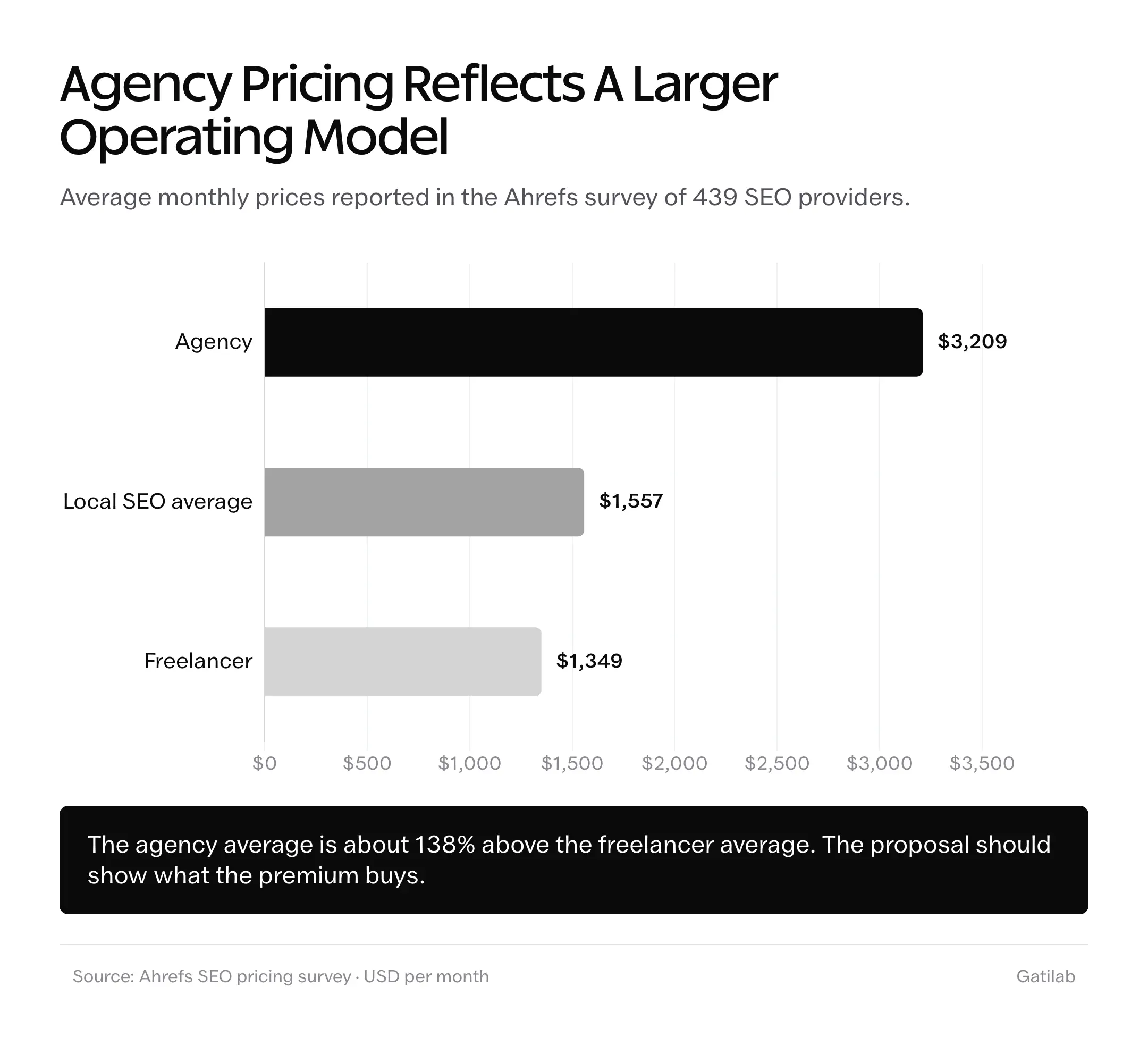
- Agencies average $3,209 per month versus $1,348.63 for freelancers.
- Local SEO averages $1,557 per month.
- The most common hourly band is $100-$150.
- Providers serving a worldwide market average $3,473.74 per month, 123.1% above the local-market average.
The Clutch 2026 pricing guide reports a different slice of the market:
- most SEO agencies list $100-$149 per hour;
- reviewed projects usually cost less than $10,000;
- monthly agency engagements commonly sit between $2,000 and $20,000;
- local SEO is listed at $100-$149 per hour in its service table.
Clutch’s dataset leans toward agencies with profiles and reviewed projects on its marketplace. Ahrefs surveyed providers directly. The different results are not a contradiction. They describe different populations.
SEO Pricing In India
India-based providers sit lower in the Ahrefs survey, but the spread is still wide. 76% of India-based respondents charged $1,000 or less per month, while the remaining 24% sat between $2,001 and $10,000.
Ahrefs’ 2026 statistics summary also reports that 85.7% of India-based SEOs charge $30 or less per hour. That geographic discount explains part of the difference between an Indian freelancer and a US agency, but not all of it.
Price also changes with:
- seniority of the people doing the work;
- whether implementation is included;
- access to developers, writers and digital PR staff;
- number of locations, products or templates;
- reporting and attribution requirements;
- regulatory or migration risk;
- communication and project-management load;
- the market and language being targeted.
An India-based agency can be cheaper because its operating costs are lower. It can also be cheaper because the proposal contains 2 reports and no implementation. Those are very different savings.
Monthly Retainers
Monthly retainers suit SEO work that compounds and requires repeated decisions. Technical fixes get deployed, pages are improved, links are earned, competitors change and Search Console data creates the next queue of work.
The Ahrefs survey found 78.2% of SEOs use monthly retainers for some or all of their services. That dominance makes sense because the work does not end when the audit PDF is delivered.
Typical retainer bands can be interpreted like this:
| Monthly Retainer | Plausible Scope | What Usually Does Not Fit |
|---|---|---|
| $250-$750 | Advice, reporting or a narrow local campaign | Heavy implementation, content production and digital PR together |
| $750-$1,500 | One local business, a focused site or specialist consulting | Large ecommerce catalogs and multi-market campaigns |
| $1,500-$3,500 | Ongoing technical, content and local work with implementation | Large editorial teams or aggressive national link acquisition |
| $3,500-$10,000 | Competitive SEO with several specialists and regular production | Unlimited work across every channel |
| $10,000+ | Enterprise, multi-location, international or high-risk programs | A fixed commodity package |
These are decision bands, not a new market survey. The evidence behind a quote still has to come from its scope.
The retainer should name:
- included people and responsibilities;
- expected capacity or output range;
- implementation ownership;
- approval requirements;
- reporting cadence;
- minimum term and cancellation rule;
- work excluded from the fee;
- what happens when priorities change.
“Ongoing SEO” is not a scope. It is an invitation to argue later.
Project Pricing
Project pricing works when the outcome has a clear boundary. A technical audit, migration plan, keyword map or local SEO setup can be scoped, accepted and closed.
The Ahrefs survey found $2,501-$5,000 was the most common project band, selected by 21.2% of respondents. Clutch says the typical reviewed SEO project costs less than $10,000.
Project pricing is suitable for:
- technical SEO audits;
- site migrations;
- content and keyword architecture;
- local SEO setup;
- structured data implementation;
- analytics repair;
- competitive research;
- recovery diagnosis.
The model becomes weak when the outcome depends on months of iteration. A one-time “link-building project” or “rankings project” can pressure the provider to optimize for visible activity rather than durable results.
Use a project fee when the deliverable can pass an acceptance test. Use a retainer when the work must respond to evidence over time.
Hourly Pricing
Hourly pricing is useful for consulting, diagnosis, training and unpredictable technical work. It is easy to understand but hard to budget when implementation can uncover hidden dependencies.
Public benchmarks include:
- $111 average hourly rate in the Ahrefs survey;
- $100-$150 as the most common Ahrefs band;
- $100-$149 for most Clutch-listed agencies;
- $75-$100 as the most common local SEO hourly band in the Ahrefs study.
An hourly quote should still include an estimate and a stop condition.
Estimated hours = expected task hours + review time + contingency
Estimated project cost = estimated hours × hourly rate
Suppose a migration review needs:
- 12 hours for crawl and indexation analysis;
- 8 hours for redirect and canonical mapping;
- 6 hours for analytics and Search Console validation;
- 4 hours for meetings and handoff;
- 20% contingency for unknown templates.
The estimate is 36 hours. At $100 per hour, that is $3,600. At $150, it is $5,400.
The point is not that every migration costs those amounts. The example shows why “$150 an hour” says less than the estimated workload and boundary.
Why Agencies Cost More Than Freelancers
Ahrefs found agencies average $3,209 per month while freelancers average $1,348.63. The agency average is about 138% higher.
Part of that premium buys overhead. Part of it can buy resilience:
- a technical specialist can investigate crawling while a writer handles content;
- another team member can cover absence or turnover;
- project management keeps dependencies visible;
- implementation can move without handing every task to another vendor;
- QA can be separated from the person who made the change.
But an agency logo does not guarantee those benefits. A small agency can route all work through one overloaded account manager. A senior freelancer can be more capable than a 20-person firm where junior staff do the work.
Ask who will work on the account, not how many people appear on the About page.
What A Retainer Buys
A simple workload model makes pricing easier to judge.
Assume an agency allocates these roles:
| Role | Monthly Hours | Illustrative Rate | Cost |
|---|---|---|---|
| SEO strategist | 8 | $125 | $1,000 |
| Technical SEO or developer | 8 | $125 | $1,000 |
| Content research and editing | 12 | $75 | $900 |
| Reporting and project management | 4 | $75 | $300 |
| Total | 32 | – | $3,200 |
These are constructed rates, not a quote or market average. They show the relationship between scope and price. A $900 retainer cannot contain this 32-hour model unless the rate, workload or role mix changes substantially.
This is where cheap packages usually bend:
- fewer hours than the buyer assumes;
- junior labor replacing specialist time;
- advice without implementation;
- templated content;
- automated reports counted as strategy;
- link quantity replacing link quality;
- work deferred to the next month.
The package is not cheap if the buyer has to hire another person to finish every recommendation.
Public Agency Packages
Public prices help anchor the upper part of the market. WebFX lists SEO services starting at $3,000 per month and publishes example packages with:
- initial 2-month investments from $5,900 to $12,200;
- subsequent monthly optimization from $2,900 to $9,200;
- 150 to 300 optimized keyphrases, depending on plan;
- 30 to 60 optimized pages, depending on plan.
That does not make WebFX the normal price for every business. It shows what a large agency publicly charges when design, content, analytics and specialist teams sit behind the SEO program.
One public package is an anchor, not an industry average.
What Should Be Included?
A useful SEO quote connects its price to an operating system.
At minimum, the scope should define:
- baseline and target market;
- technical priorities;
- content responsibilities;
- internal-linking work;
- local or ecommerce requirements;
- digital PR or link acquisition, if included;
- implementation ownership;
- analytics and conversion tracking;
- reporting metrics and denominator;
- review meetings;
- exclusions and third-party costs.
The report should not promise a number-1 ranking. Google’s own SEO hiring guidance says no one can guarantee first place and recommends finding someone else when a provider makes that promise.
A useful target can be measured without pretending the provider controls Google’s result:
- increase qualified non-brand clicks;
- improve indexed commercial-page coverage;
- reduce crawl and canonical errors;
- improve local visibility across a defined grid;
- increase leads from organic landing pages;
- earn citations for defined AI-search prompts;
- grow the share of priority queries in agreed position bands.
The agency controls the work and its quality. It does not control Google’s final vote.
Red Flags In A Cheap Quote
A low price can be efficient. These behaviors are the problem.
The proposal promises rankings without defining the market, location, device or query set. The promise cannot be measured fairly and cannot be controlled.
The package lists 30 activities but no priorities. Activity volume makes the document look full while avoiding the harder question of what should happen first.
Content is priced by article count without research, editing or subject expertise. The pages may be inexpensive and still create years of cleanup.
Link building is sold by quantity. A package promising hundreds of links at a fixed low price has already told you how quality will be sacrificed.
Reporting contains impressions, clicks and rankings without conversions or page ownership. The chart can move while the business stays still.
Implementation is excluded but buried. The buyer receives an audit and then discovers the website still needs a developer.
The Limits
Pricing surveys age quickly and represent the providers who responded or the agencies present on a marketplace. They are useful anchors, not a rate card for every country and niche.
Currency is another limit. Converting a US agency’s dollar price into rupees does not make it an Indian market quote. Purchasing power, taxes, staffing and scope differ.
And price does not measure competence. A $10,000 retainer can fund experienced work or expensive confusion. A $700 specialist can solve one narrow problem better than a large agency.
The proposal has to expose the difference.
How Much Should You Budget?
Use the smallest budget that can support the required work without pretending the missing work will happen anyway.
For a small local business with one location, a focused $750-$1,500 monthly engagement can be sensible when scope is narrow. A growing content or ecommerce site usually needs $1,500-$5,000. Competitive national, international or multi-location programs often move above that range because more specialists, pages and decisions are involved.
If the budget is below the required operating cost, reduce the scope. Do not keep every promise and squeeze the work until only the report survives.
Good SEO pricing is not the lowest number. It is the clearest relationship between money, work, responsibility and risk.
Tell Google you want more of this.
Add Gatilab as a preferred sourceOne tap, and this site shows up more often in your own Top Stories, AI Overviews and AI Mode. Remove it any time.