
Best Local SEO Tools
The best local SEO tools solve different measurement gaps. BrightLocal is the strongest all-round platform for supported countries, Local Falcon gives the clearest geo-grid and AI-visibility data, Semrush Local combines profile automation with listings, Whitespark is the specialist citation tool and Google Business Profile remains the free source for first-party profile performance.
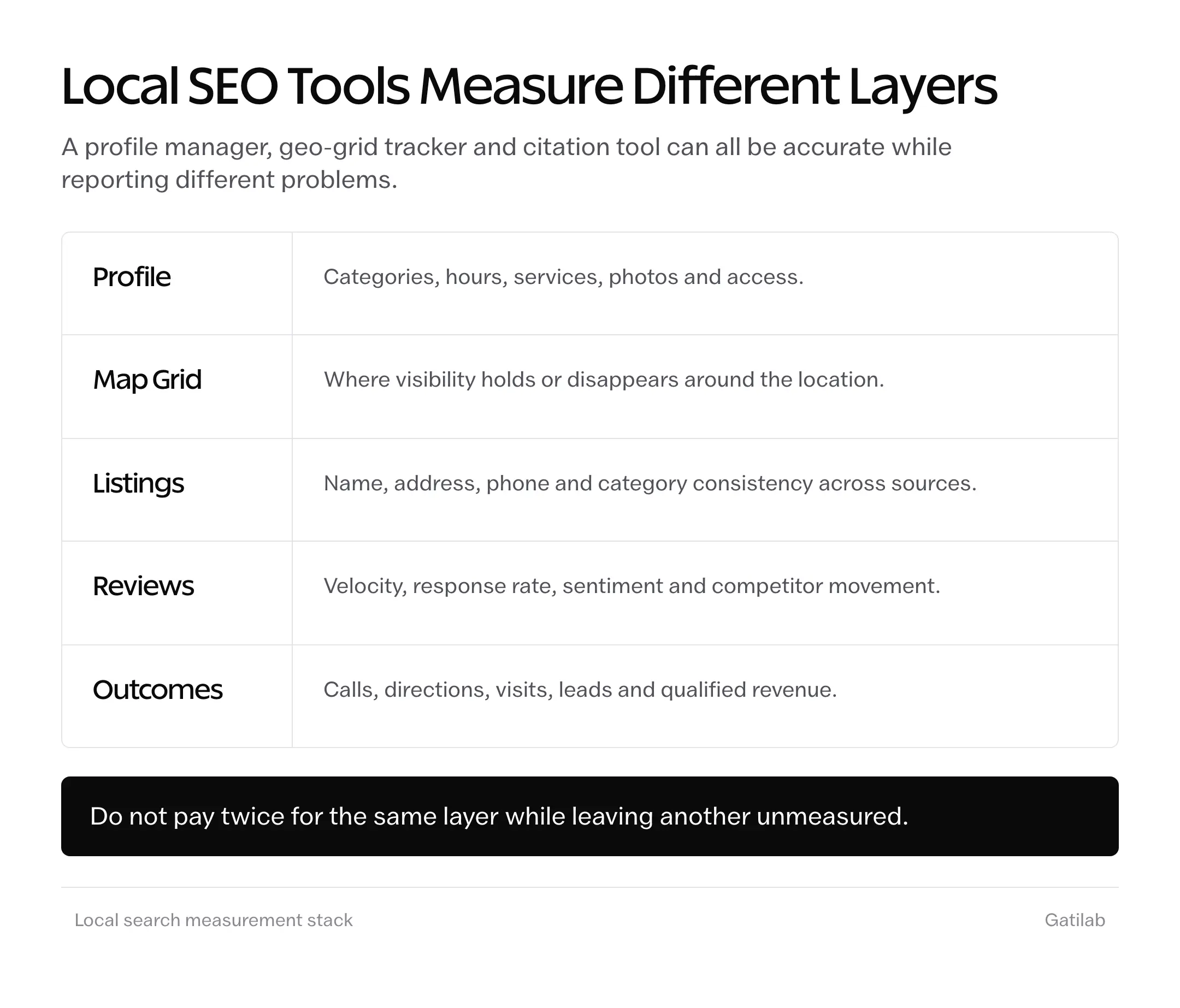
No product wins every layer. A geo-grid tracker cannot repair a wrong phone number across directories. A listing manager cannot tell you that visibility disappears 3 kilometers east of the shop. Buying one “all-in-one” dashboard does not make those jobs the same.
Local SEO work usually needs 5 functions:
- Google Business Profile management;
- neighborhood-level rank tracking;
- listing and citation accuracy;
- review monitoring and response;
- reporting tied to calls, directions, website visits and leads.
The right stack covers the functions your business needs without paying twice for the same directory sync.
Quick Comparisons
| Tool | Best Fit | Public Entry Price | Pricing Unit | Main Strength | Main Limit |
|---|---|---|---|---|---|
| Google Business Profile | Every eligible local business | Free | Business profile | First-party profile management and performance | No neutral competitor grid or citation audit |
| BrightLocal | Small businesses and agencies in supported countries | $41/month | Active locations | Broad rank, grid, citation and review platform | Core platform coverage is strongest in US, UK, Canada and Australia |
| Local Falcon | Geo-grid, multi-location and AI visibility | $24.99/month | Credits / map points | Flexible grids, Google and Apple Maps, AI-search tracking | Credit planning becomes its own operating task |
| Semrush Local | Businesses wanting profile automation plus listings | $30/month per location, billed annually | Location | GBP automation, grid tracking and Semrush connection | Cost scales linearly by location |
| Whitespark Local Citation Finder | Citation discovery and competitive citation work | $39/month | Campaign and daily search limits | Specialist citation research | Not a full review, GBP or rank-tracking suite |
Prices were checked against current vendor pages on August 24, 2026. Billing periods and regional availability change the comparison, so the price without its unit is incomplete.
Local SEO Tool Categories
Local search tools look similar because they all show a business name beside a map. The underlying data is different.
Profile managers connect to Google Business Profile and change the information customers see. Google itself and Semrush Local fit here.
Geo-grid trackers run the same query from many coordinates around a location. Local Falcon, BrightLocal and Semrush Map Rank Tracker fit here.
Listing systems distribute or audit name, address, phone and category data across directories. BrightLocal, Semrush Local and Whitespark operate in different parts of this job.
Review systems collect, monitor or help respond to reviews. BrightLocal and Semrush Local include this in higher plans.
These systems can support one another. They should not be combined into a single score.
Best Local SEO Tools
Google Business Profile
Google Business Profile is the baseline because it controls the listing shown in Google Search and Maps. It is free, first-party and required before most paid local SEO tools become useful.
Profile management includes:
- business name;
- primary and secondary categories;
- address or service area;
- opening hours;
- phone number and website;
- products and services;
- photos;
- posts;
- reviews and responses;
- user access.
Its performance data can report interactions such as calls, website clicks and direction requests where available. This is closer to business behavior than a rank grid, but it still does not prove a completed sale.
Google Business Profile does not give you a neutral map of rankings across a city. A search from the shop counter and a search 5 kilometers away can produce different local results. The profile interface also does not audit hundreds of third-party citations or give a matched competitor grid.
Best for: every eligible business as the source account.
Skip as the only tool when: you need competitor comparison, geo-grid tracking or directory cleanup.
The paid stack should sit around this account, not replace it.
BrightLocal
BrightLocal is the best all-round option when its country coverage matches the business. It combines local rank tracking, search grids, citation tracking, GBP auditing, listings and reviews in one platform.
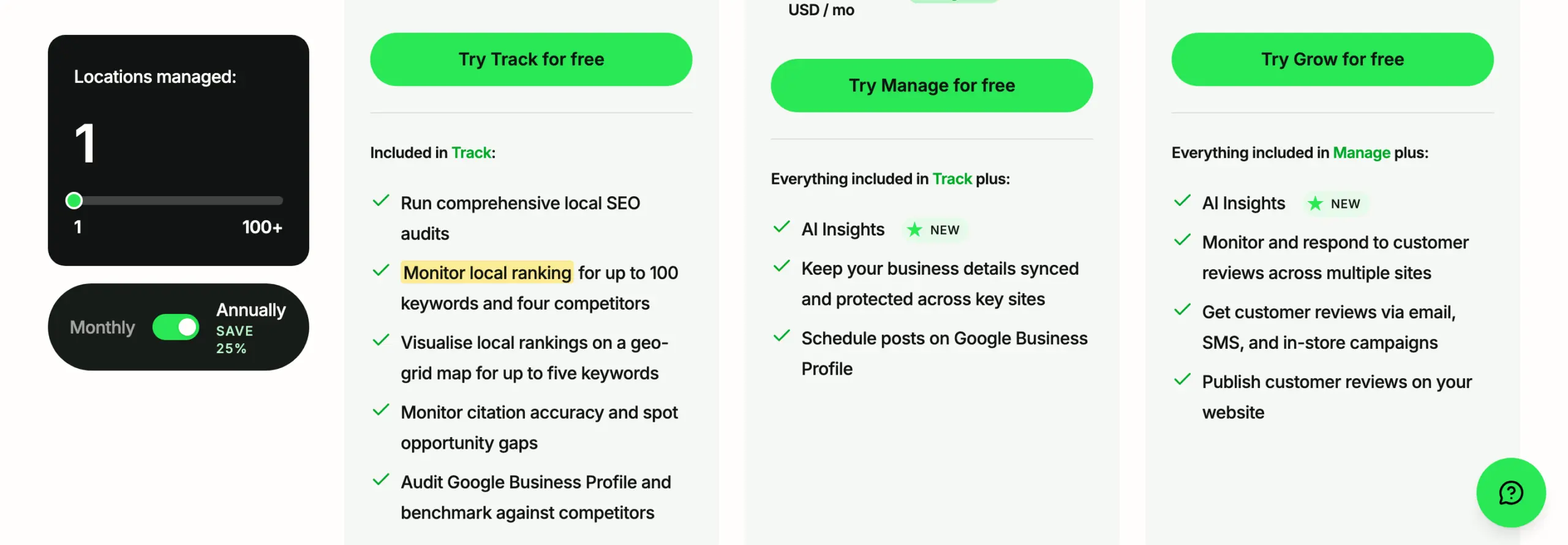
The current BrightLocal pricing starts at:
| Plan | 1 Location, Monthly | 1 Location, Annual | Main Job |
|---|---|---|---|
| Track | $41 | $369 | Rankings, grid and audits |
| Manage | $54 | $485 | Track plus listing management |
| Grow | $65 | $584 | Manage plus review growth and monitoring |
The 1-location annual price is about 25% below paying the monthly rate for 12 months. But location scaling is not linear at the smallest bands. Track costs $62 per month for 2 to 5 locations and $83 for 6 to 10, which improves the cost per location as the account grows.
Track includes:
- up to 100 tracked keywords and 4 competitors per location;
- local geo-grid visibility for up to 5 keywords;
- citation accuracy monitoring;
- Google Business Profile auditing;
- shareable location reporting.
Citation building is separate. BrightLocal lists citations from $3.20 each or $2 with bulk credits. That separation is sensible because a business should own the listings it buys rather than pay a permanent subscription simply to keep them alive.
The important limit is geography. BrightLocal says its core platform works in the United States, United Kingdom, Canada and Australia. Citation services extend into more markets, but a business in India should verify the exact rank, listing and review features it needs before building the workflow around it.
Best for: agencies and businesses wanting one reporting layer in supported countries.
Choose differently when: India or another unsupported core market is the main use case.
Local Falcon
Local Falcon is the strongest geo-grid choice in this comparison and the most interesting bridge between local rankings and AI visibility. It tracks Google Maps and Apple Maps, supports variable grids and also monitors local visibility across AI platforms.
The Local Falcon pricing model is based on credits. One credit equals one map point.
| Plan | Monthly Price | Monthly Credits | Approximate Price Per Included Credit |
|---|---|---|---|
| Starter | $24.99 | 7,500 | $0.00333 |
| Basic | $49.99 | 15,150 | $0.00330 |
| Pro | $99.99 | 31,250 | $0.00320 |
| Premium | $199.99 | 63,150 | $0.00317 |
A 5×5 scan uses 25 points and therefore 25 credits. A 9×9 scan uses 81. The workload multiplies by keywords, locations, platforms and frequency.
Suppose one business tracks:
- 10 keywords;
- 1 location;
- a 9×9 grid;
- weekly scans;
- Google Maps only.
That consumes 3,240 credits in a 4-week month:
10 keywords × 81 grid points × 4 scans = 3,240 credits
The Starter plan’s 7,500 credits can cover that example with room for one-off checks. Add Apple Maps and the usage can double. Add 5 locations and the same design reaches 16,200 credits, beyond Basic’s 15,150-credit monthly allowance.
Local Falcon also prices Falcon AI analysis at 25 credits per report. Its public page lists free API access above the Starter monthly plan and an on-demand API at $199 per month plus $0.0032 per request.
The product’s main advantage is precision around location. A citywide average can say “rank 4” while the grid shows rank 1 near the office and outside the top 20 across the river. The map tells you where the average is lying by omission.
Best for: geo-grid analysis, multi-location comparisons, Apple Maps and local AI-search visibility.
Choose differently when: listing distribution and review acquisition are the main jobs.
Semrush Local
Semrush Local is the best fit for a business that wants profile automation, listing management and map tracking inside a broader Semrush account.
The Semrush Local plans are priced per location when billed annually:
| Plan | Monthly Price Per Location | Included Map Rank Tracker Credits | Listings And Reviews |
|---|---|---|---|
| Base | $30 | 375 | No full listing-management layer |
| Pro | $60 | 1,225 | Listing management, review management and advanced GBP tools |
| Business | Custom | Custom | Enterprise limits and support |
Base focuses on Google Business Profile automation:
- profile audit and optimization plan;
- automated posts;
- review auto-replies;
- photo posting;
- business-description work;
- map rank tracking;
- competitor heatmaps.
Pro adds listing distribution across 70-plus directories in the United States, competitor review analytics, review generation, GBP edit monitoring, bulk profile management and more grid credits.
Per-location pricing is simple and can become expensive. Pro costs $600 per month for 10 locations and $3,000 for 50 before any other Semrush toolkit is added.
That is not automatically poor value. A 50-location business may save far more than $3,000 in staff time and listing errors. But the comparison has to use total portfolio cost, not the attractive 1-location price.
Best for: businesses already using Semrush and wanting GBP automation beside listings and reporting.
Choose differently when: the portfolio has many locations and only grid tracking is required.
Whitespark Local Citation Finder
Whitespark is the specialist choice when citation discovery is the problem. It finds where competitors are listed, organizes citation opportunities into campaigns and supports a much narrower job than an all-round local SEO suite.
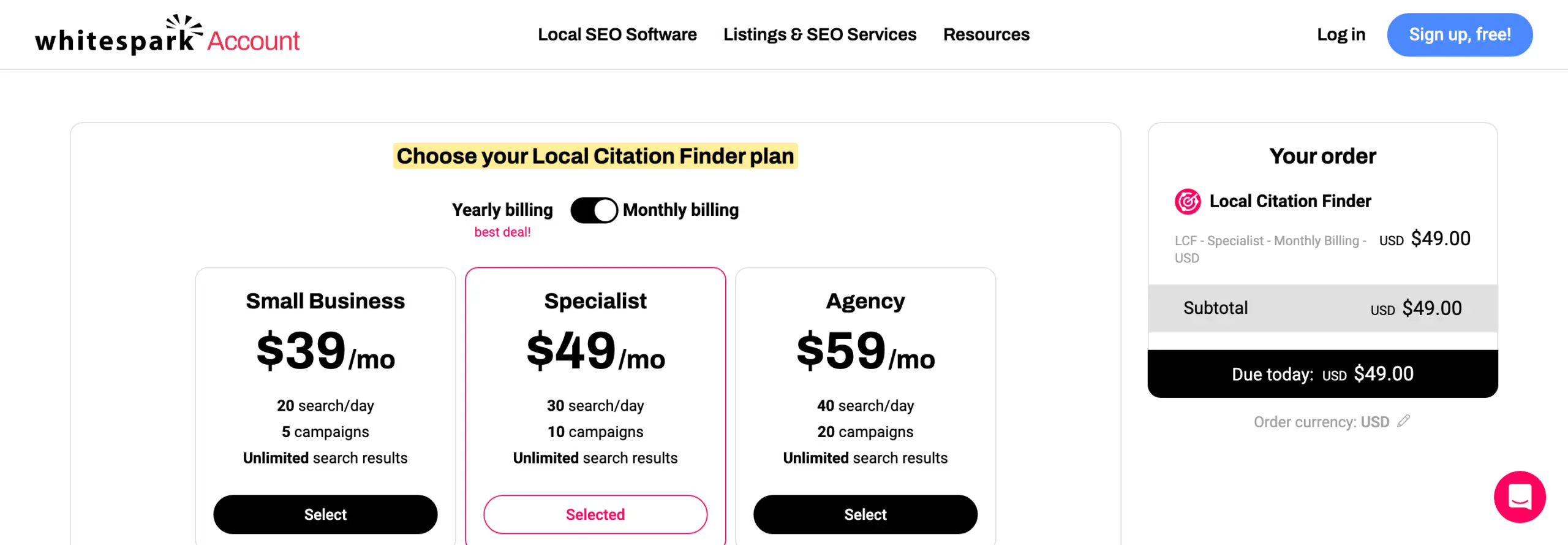
The current Local Citation Finder plans are:
| Plan | Monthly Price | Searches Per Day | Campaigns |
|---|---|---|---|
| Small Business | $39 | 20 | 5 |
| Specialist | $49 | 30 | 10 |
| Agency | $59 | 40 | 20 |
| Enterprise | $149 | 100 | 100 |
All plans list unlimited search results. The difference is operational capacity, not result truncation.
Whitespark makes sense when the question is:
- Which directories list the leading competitors?
- Which citation opportunities are missing?
- Which markets need separate citation campaigns?
- How should opportunities be organized for clients?
It does not replace Google Business Profile management, review software or a neutral rank grid. That narrowness is a strength when citation research is the job and a weakness when the buyer expects one dashboard to run the whole local program.
Best for: agencies and specialists doing structured citation discovery.
Choose differently when: rankings, reviews and GBP operations need to sit in the same product.
Cost At Multiple Locations
Per-location pricing changes the winner as the portfolio grows. The table below uses public monthly prices and a 10-location example where the vendor publishes enough data for a clean calculation.
| Tool And Plan | 1 Location | 10 Locations | Pricing Behavior |
|---|---|---|---|
| BrightLocal Track | $41/month | $83/month for 6-10 locations | Bundled location bands |
| Semrush Local Base | $30/month | $300/month | Linear per location |
| Semrush Local Pro | $60/month | $600/month | Linear per location |
| Local Falcon Starter | $24.99/month | Depends on scan design | Credits follow grid points, keywords and frequency |
| Whitespark Agency | $59/month | 20 campaigns included | Campaign and daily-search limits |
BrightLocal looks cheaper at 10 locations because the Track plan uses bands. But that price does not include the same profile automation and listing-management scope as Semrush Pro. Local Falcon can be cheaper or more expensive depending on grid design.
Matched work first. Monthly fee second.
Local SEO Metrics
A useful local SEO stack should keep several measures separate:
- Average rank position: mean rank across measured points, with the treatment of missing ranks stated.
- Top-3 coverage: grid points ranking in the local pack divided by enabled points.
- Share of Local Voice: a rank-weighted visibility measure across the grid.
- Listing accuracy: correct listings divided by audited listings.
- Review velocity: new reviews per defined period.
- Review response rate: answered reviews divided by eligible reviews.
- GBP interactions: calls, website clicks, directions and other available first-party actions.
- Qualified leads: enquiries meeting the business’s qualification rule.
Do not blend them into one health score without publishing the formula. A listing can be accurate and rank poorly. A profile can rank well and convert badly. The diagnosis changes with the metric.
What Quietly Ruins The Stack
Running grids with different centers, sizes or times makes the trend incomparable. The map changed before the ranking did.
Tracking 50 keywords at one coordinate creates a long report and a weak local picture. Fewer commercial keywords across a representative grid usually tell you more.
Buying listing distribution in a country the network barely covers wastes money while making the dashboard look complete.
Automating review replies without reviewing tone and edge cases turns a trust channel into a batch process. A fast wrong response is still wrong.
Reporting rank without calls, directions, visits or leads mistakes visibility for business performance.
Adding every tool creates duplicate costs and conflicting definitions. One provider’s Share of Local Voice is not automatically comparable with another provider’s visibility score.
The Limits
Local rankings vary by coordinate, time, device, query and whether the business is open. A grid is a controlled sample, not the exact result every customer sees.
Listing networks differ by country. Review data can be delayed. Google Business Profile interactions do not capture every offline action. Call tracking can improve attribution and create NAP problems if implemented badly.
And no tool can replace local relevance. A business with weak service, few customers and no community presence cannot software its way into durable trust.
Which Local SEO Tool Should You Choose?
Every business should start with Google Business Profile. Choose BrightLocal when broad local reporting and listings are needed in its strongest markets. Choose Local Falcon when the map and local AI visibility are the main questions. Choose Semrush Local when profile automation and listing management need to sit beside the wider Semrush suite. Choose Whitespark when citation discovery is the focused job.
For an agency serving several Indian locations, Local Falcon is the better measurement starting point because it is globally available and prices by scan workload. Pair it with direct Google Business Profile management and add a citation service only after the local directories and data sources that matter have been identified.
The shortest useful stack wins. Every extra dashboard has to justify the decision it changes.
Tell Google you want more of this.
Add Gatilab as a preferred sourceOne tap, and this site shows up more often in your own Top Stories, AI Overviews and AI Mode. Remove it any time.