
Programmatic SEO: The Complete Guide for 2026
Programmatic SEO is a publishing method where one template plus one dataset produces hundreds, thousands, or millions of unique URLs that target long-tail search demand. Zapier publishes around 800,000 [App] + [App] integration pages this way. Wise publishes a [Currency A] to [Currency B] page for every conversion pair. Tripadvisor’s entire footprint of 7 million plus location pages runs on a handful of templates. The unit of work is the row in a spreadsheet, not the article.
I’ve shipped programmatic SEO programs ranging from 600 service-area pages for a single agency client to 47,000 currency conversion pages for a fintech. The pattern that wins is always the same: a long-tail keyword head with stable demand, a dataset where every row carries unique facts, a template that exposes those facts in extractable form, and an indexation gate that prunes anything Google refuses to rank. Most pSEO programs fail at the indexation gate, not at the template.
I’ll walk through the full pipeline I deploy for clients, with real examples from Zapier, Wise, Tripadvisor, Webflow, and G2, the three stack patterns that actually scale, the indexation traps that kill 40 percent of programs in their first quarter, and the 2026 Helpful Content rules that decide whether your 10,000 pages live or die.
What programmatic SEO actually is (and what it isn’t)
Programmatic SEO is template-driven publishing pointed at long-tail demand. You decide on a keyword pattern, build a dataset where every row maps to one URL, render those rows through a single template, and let search engines index the result. It is not AI content generation. It is not spam. It is the same model that powers e-commerce category pages, Yelp’s local listings, and every directory site you’ve ever used. The difference in 2026 is that AI tooling has dropped the cost of building the dataset by roughly 80 percent.
Two false ideas keep killing first attempts. First, that pSEO means low-quality content. The pSEO leaders publish very high-quality pages, just at scale. Each Wise currency page has live mid-market exchange rates, a calculator, real fee comparisons against banks, and a chart of 30-day movements. None of that is filler. Second, that pSEO is a shortcut to traffic. It is a shortcut to publishing. Indexation, ranking, and conversion still take the same time they always have.
For the strategic frame, see my content cluster strategy. For B2B keyword work, the B2B SaaS keyword research guide covers the head-term selection step in depth.
When programmatic SEO works (and the four cases where it fails)
Programmatic SEO works when three things line up. There’s a long-tail keyword pattern with hundreds of permutations and stable demand. You have or can build a dataset where every row carries unique, useful facts. The user intent is informational or transactional, not editorial. If any of those break, the program fails. programmatic SEO is not a universal SEO tactic, it’s a pattern-match tactic.
Case A: works
Wise’s currency conversion program. Every [Currency A] to [Currency B] page has live mid-market rates, real bank fees, a calculator, and historical charts. The dataset (~190 currencies × 190 currencies = ~36,000 pairs) is finite and naturally unique per row. Demand is stable, intent is transactional. Result: roughly 200,000 indexed pages contributing to the bulk of organic traffic in that segment.
Case B: works
Zapier’s [App] + [App] integration pages. Two apps × 6,000+ apps = ~36 million possible permutations. Zapier publishes the ~800,000 with non-zero search demand. Each page lists the actual triggers, actions, and pre-built Zaps. The data is unique because the integrations are unique. Estimated to drive 8 to 12 percent of total Zapier organic traffic in 2024 by Foundation Marketing’s reverse-engineering.
Case C: fails
“Best [Tool] for [City]” pages with no city-specific data. Twenty thousand URLs that all say the same thing about Asana with the city name swapped. Google’s Helpful Content system was built specifically to demote this. I’ve watched three clients lose 60 to 90 percent of pSEO traffic within 60 days when the unique-data layer was missing.
Case D: fails
Editorial topics dressed as pSEO. “Ultimate guide to [Topic]” pages don’t programmatize. Editorial guides need depth, point of view, and original argumentation. Spinning them through a template flattens the value. Keep editorial pages hand-written and pSEO pages pattern-matched.
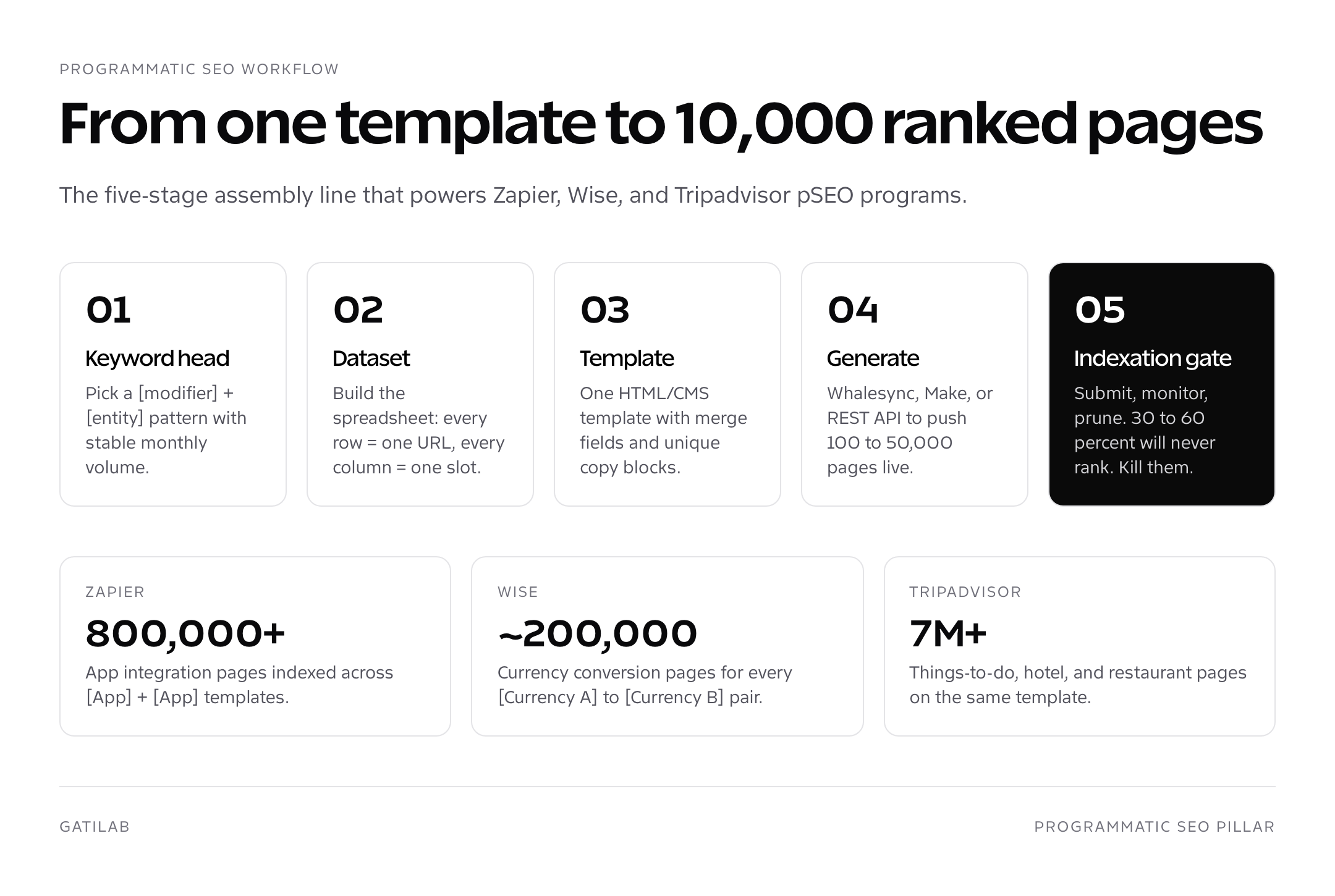
The five-stage programmatic SEO pipeline
Every successful pSEO program runs through the same five stages. Skip any one and the program limps. I’ll walk through each with the decisions that matter.
Stage 1: Pick the keyword head
The keyword head is the [modifier] + [entity] pattern your URLs will target. “[App] integrations,” “[Currency A] to [Currency B],” “[Tool] alternatives,” “[CRM] for [industry],” “[Hotel] in [City].” The pattern needs three properties: stable monthly volume per permutation, a finite enumerable list of values for each slot, and intent that doesn’t require deep editorial reasoning. Pull permutations from Ahrefs Keyword Magic Tool, Semrush’s Bulk Keyword tool, or DataforSEO Labs. Discard any permutation under 10 monthly searches; the long tail dies fast.
Stage 2: Build the dataset
The dataset is one row per planned URL with every column mapping to a slot in your template. For a [SaaS] for [industry] page, columns might be: SaaS name, primary use case, three industry-specific use cases, pricing, three competitor names, three customer logos in that industry, an FAQ, a screenshot URL. Every column you add increases unique content per page, which is the difference between indexation and Helpful Content suppression. I aim for 60 to 70 percent unique content per page, measured by a tool like Sitebulb’s content uniqueness check.
Stage 3: Design the template
One template for the whole program. It pulls in fields from the dataset, exposes them in scannable structure (tables, lists, FAQs), and adds non-merge content like internal navigation and section intros. Three template rules I never break. First, the H1 must contain the focus keyword for that row. Second, every page gets at least one HTML table with row-specific data. Third, an FAQ block with FAQPage schema, three to five Q’s per page, where the questions are templated but the answers reference row data.
Stage 4: Generate
This is the boring stage that no one writes about. Generation is mechanical. Whalesync syncs Airtable to Webflow CMS bidirectionally. Make.com runs scheduled jobs that POST to your CMS REST API. WP All Import ingests CSV into WordPress + ACF posts. Next.js with ISR builds and revalidates pages on demand. Pick the tool that matches your stack, not the tool that the loudest Twitter account is selling.
Stage 5: The indexation gate
This is where most programs die. After publishing, only a fraction of your URLs will get crawled. Of those, only a fraction will get indexed. Of those, only a fraction will rank. Submit sharded sitemaps (1,000 to 5,000 URLs each), monitor coverage in Search Console weekly, and noindex or 410 anything that hasn’t been indexed in 90 days or that ranks but gets zero clicks. Pruning is not optional. Programs that publish 50,000 pages and refuse to cull tend to get hit by site-wide quality demotion within six months.
The data-and-template approach: how the programmatic SEO engine actually runs
The technical core of every pSEO program is the same: a structured dataset and a single template that reads it. The dataset can live in Airtable, a Google Sheet, a Postgres database, a headless CMS, or even a static JSON file shipped with your build. The template can be a Webflow CMS collection, a WordPress + ACF post type, a Next.js dynamic route, or a Django view. The combination is what makes the URLs scale.
Dataset construction
I build datasets in three layers. Layer one is the keyword permutations, scraped from Ahrefs or Semrush. Layer two is the structural data: pricing, ratings, screenshots, competitor info, dates. Layer three is the unique content: opening paragraphs, FAQ answers, comparison cells. Layer three is where AI tools earn their keep, but the output needs human review for the first 100 rows or you ship slop. Use Apify or Browse.ai to scrape the structural data, GPT-4 class models for the unique content layer, and a human edit pass for the first 100 rows to lock the voice.
Template construction
The template is one file. In Webflow it’s a CMS collection page. In WordPress it’s a single-{cpt}.php template or an ACF block field rendered through render_callback. In Next.js it’s a [slug].tsx file under /pages or /app. The merge fields read from the dataset, the chrome (header, footer, nav) reads from your normal layout. Add a contextual internal link section: pull three to five related rows from the same dataset and render links to them. This solves the orphan-page problem that wrecks indexation on flat pSEO programs.
Real examples: Zapier, Wise, Tripadvisor, Webflow templates, G2
Five canonical examples worth dissecting. Each runs the same five-stage pipeline, with the differentiating data layer driving the unique content.
Zapier integration pages
URL pattern: zapier.com/apps/[app-a]/integrations/[app-b]. Around 800,000 indexed pages. Each page lists the actual triggers and actions exposed by the two apps’ APIs, plus pre-built Zap templates. The data is automatically unique because the underlying integrations are unique. Estimated by Foundation Marketing to drive 8 to 12 percent of Zapier’s total organic traffic. The big lesson: the data layer (real API endpoints) was the moat, not the template.
Wise currency conversion
URL pattern: wise.com/us/currency-converter/[ccy-a]-to-[ccy-b]-rate. Around 200,000 indexed pages. Each shows the live mid-market rate, a calculator, fee comparisons against major banks, and a 30-day historical chart. The data is finite (190 currencies × 190 = ~36,000 unique pairs) and unique by definition. Wise dominates conversion-rate queries despite competing against banks with 50x the domain authority.
Tripadvisor location pages
URL pattern: tripadvisor.com/Tourism-g[id]-[city-name]. Around 7 million pages across hotels, restaurants, things to do, and locations. The unique data per page comes from user reviews, photos, and bookings. Tripadvisor proves that pSEO can be the entire site, not just a section. The trade-off: the editorial content per page is thin; user-generated content carries the load.
Webflow templates marketplace
URL pattern: webflow.com/templates/[category]/[template-slug]. Each template page has a screenshot, demo URL, feature list, designer info, and price. The data is provided by template creators; Webflow exposes it through a templated CMS page. The marketplace itself is a pSEO program inside the Webflow site.
G2 alternative pages
URL pattern: g2.com/products/[product]/competitors/alternatives. G2 publishes a competitor and alternatives page for nearly every B2B SaaS in their database. The unique data is sourced from G2’s own user reviews. Anchor a [Tool] alternatives query and you’ll likely see a G2 page in the top three. The data layer (real reviews) does the heavy lifting.
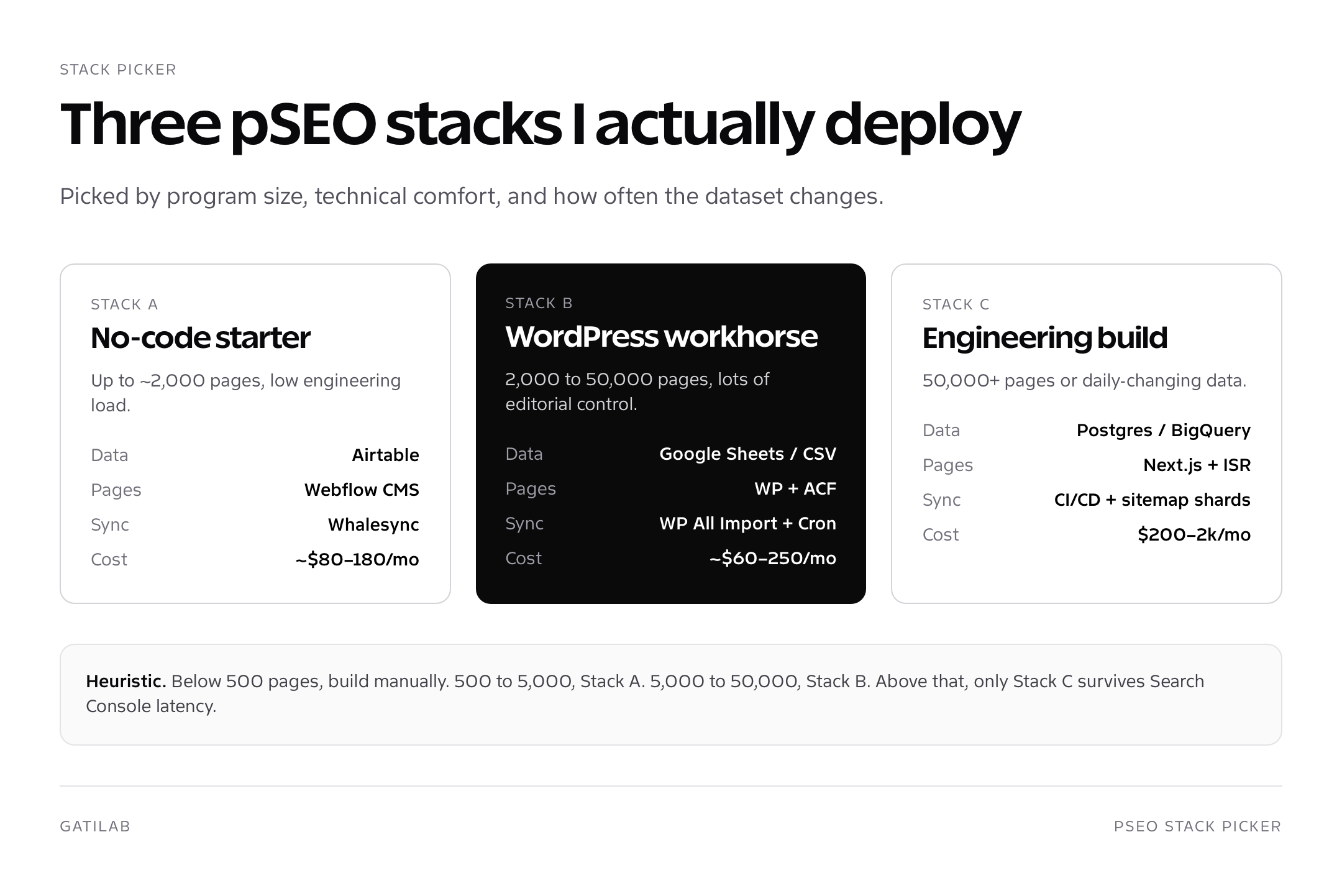
Three programmatic SEO tool stacks I actually deploy
There are three honest stack patterns for programmatic SEO. Pick by program size, technical comfort, and how often the dataset changes. The fourth pattern, the all-AI no-data stack, isn’t a stack, it’s a way to lose money.
Stack A: Airtable + Webflow + Whalesync
Airtable holds the dataset, Webflow renders the pages through a CMS collection, Whalesync keeps them in two-way sync. Range: 100 to 5,000 pages. Cost: roughly $80 to $180 per month all-in. Best for marketing teams without engineers and programs that prioritize design polish. Limit: Webflow CMS caps at 10,000 items per collection, and indexation latency on Webflow is real for programs above 5,000 pages.
Stack B: WordPress + ACF + WP All Import
WordPress with Advanced Custom Fields holds the schema, WP All Import ingests CSV, and either Bricks Builder or a custom theme renders the pages. Range: 2,000 to 50,000 pages. Cost: $60 to $250 per month for hosting, plus annual licenses. Best for teams that need editorial control on top of programmatic generation, that already run WordPress for the rest of their site, or that want WP-CLI for batch operations. WP All Import Pro at $199 per year handles cron-driven re-imports.
Stack C: Postgres + Next.js + ISR on Vercel
Postgres or BigQuery holds the dataset, Next.js with Incremental Static Regeneration renders pages on demand and caches them at the edge. Range: 50,000 to multi-million pages. Cost: $200 to $2,000+ per month including database, hosting, CI/CD. Best for engineering teams, daily-changing data, and programs where indexation latency is mission-critical. The investment is steep but the ceiling is high.
Heuristic: under 500 pages, build manually. 500 to 5,000, Stack A. 5,000 to 50,000, Stack B. Above 50,000 with daily-changing data, Stack C is the only one that survives indexation latency.
Quality and indexation: where 40 percent of programs die
Generation is easy. Indexation is hard. The 2026 Google playbook for programmatic SEO programs has three big rules. First, every page must carry information gain over search competitors. Second, internal linking must be dense and relevant; orphan pages don’t get crawled. Third, the program must have a pruning policy from day one.
Information gain per page
Information gain is the marginal new fact a page adds beyond what competitors already publish. For pSEO, information gain comes from the unique data per row: live exchange rates, real API integrations, first-party reviews, original calculations. If your dataset doesn’t have this, your program won’t rank, regardless of template quality.
Internal linking density
Every pSEO page needs 5 to 12 internal links to related pages from the same program. Link from [Currency A] to [Currency B] to other pairs involving Currency A and other pairs involving Currency B. This keeps the crawl graph dense and gives Google semantic context for what each row means. Programs without internal linking commonly see 30 to 50 percent of pages stuck in ‘Discovered, not indexed’ for months.
Pruning policy
Set a 90-day index-or-prune rule. Any page that hasn’t been crawled and indexed in 90 days, plus any page that’s indexed but earns zero clicks for 60 days, gets noindex or 410. Sites that publish 50,000+ pages and never prune tend to get hit by site-wide quality demotion within six months of launch. Pruning is not pessimistic, it’s how you signal to Google that you respect the index.
| Indexation outcome | What it means | What to do |
|---|---|---|
| Indexed, ranking | Page is healthy | Improve internal links, monitor CTR |
| Indexed, no clicks for 60 days | Demand was lower than expected | Noindex or 410 |
| Crawled, not indexed | Quality signal too weak | Add unique data layer, recrawl |
| Discovered, not crawled | Internal linking is sparse | Link from a hub page |
Pitfalls and red flags I see on every audit
After auditing 11 client pSEO programs in the last 18 months, the same five mistakes show up over and over. Avoid these and you’ve sidestepped 80 percent of the failure modes.
- No unique data per row. Every page is the same paragraph with the city or product name swapped. Google’s Helpful Content system finds and demotes this within 60 to 90 days.
- No internal linking. Pages float as orphans. Crawl budget gets eaten by the homepage and a few hub pages. The long tail never gets discovered.
- No pruning. 50,000 pages live, only 4,000 indexed, all 50,000 are in the sitemap. The program looks bigger than it is and the quality signal looks worse than it should.
- Targeting head-term keywords. Programmatic SEO is a long-tail tactic. If you’re trying to rank “crm software” with a templated page, you’ve picked the wrong tool.
- Ignoring CWV and rendering. A 7-second LCP page renders 50,000 times across your program. Compounded slowness signals poor quality. Run a sample audit through PageSpeed Insights every quarter.
Once your pSEO program is producing pages that rank, layer GEO on top. The generative engine optimization guide walks through how to make programmatic pages cite-worthy for ChatGPT, Perplexity, and AI Overviews. For SaaS-specific pSEO, see SEO for SaaS. For CRO on the resulting traffic, see best CRO tools.
How programmatic SEO fits into a broader SEO program
Programmatic SEO is one of three SEO investments most B2B and SaaS companies should run in parallel: pillar editorial content, programmatic long-tail capture, and generative engine optimization. Each does something the others don’t.
Editorial pillars build topical authority and the head-term rankings that earn backlinks. Programmatic SEO captures the long tail at scale. GEO ensures your work shows up in AI search. If you’re starting fresh, see what is programmatic SEO for the plain-English version of this article. To pick a stack, the programmatic SEO tools comparison walks through 10 named tools and the cost ranges for each program size.
Bottom line on programmatic SEO in 2026
Programmatic SEO still works in 2026, but the bar is higher than it was in 2022. Helpful Content has erased the easy wins. AI tooling has made the dataset cheaper, but it’s also raised the noise floor: Google now sees thousands of low-quality programs per week. The programs that win are the ones that carry real, unique data per row, link densely internally, and prune ruthlessly. Build that, and programmatic SEO is still one of the highest-leverage organic plays available.
My pSEO playbook for 2026: pick a long-tail [modifier] + [entity] pattern with stable demand, build a dataset where every row carries proprietary data, ship via Stack A under 5,000 pages or Stack B for 5,000 to 50,000, link internally 5 to 12 times per page, and prune at 90 days. That’s the programmatic SEO program that survives the next algorithm update.
A real programmatic SEO program in numbers
To make the playbook concrete, here’s the rough shape of a 12,000-page B2B SaaS pSEO program I helped a client ship in late 2025. The program targets the [Use case] for [Industry] keyword pattern. Twelve use cases, 1,000 industries, 12,000 permutations, ~7,800 with non-zero search volume.
Build phase ran 11 weeks: three weeks to scope the keyword permutations and validate volume in DataforSEO Labs, four weeks to construct the dataset (industry-specific use cases, screenshots, customer logos pulled from public case studies, FAQ Q’s templated, A’s authored), three weeks to design the WordPress plus ACF template and implement Bricks Builder dynamic data tags, and one week to ship the first 500-page batch.
Indexation phase ran 14 weeks. Submission strategy: shard sitemaps into batches of 1,000 URLs, submit one shard every two weeks. Coverage report at week 4: 38 percent indexed. Week 8: 51 percent. Week 14: 64 percent. The remaining 36 percent split between ‘Crawled, not indexed’ and ‘Discovered, currently not indexed.’ We pruned 600 zero-traffic indexed pages at month four (the 60-day rule was a 90-day rule on this program).
Traffic at month six: ~14,000 monthly organic sessions across the program, growing roughly 8 percent month over month. Average session-to-trial conversion rate: 1.8 percent, vs the editorial pillars’ 4.2 percent. Lower per-session conversion, but the volume more than compensated. By month nine the program drove ~26 percent of total trial signups for the SaaS.
Cost breakdown for the same program
Twelve weeks of one engineer at half-time and one editor full-time during build, then 4 to 8 hours per month of maintenance after launch. Tooling: WordPress hosting at $250/mo (managed WP host with bulk-edit support), ACF Pro at $59/yr, WP All Import Pro at $199/yr, Bricks Builder at $79/yr, Apify at $49/mo for monthly competitor data refreshes. Total tooling: under $400/mo, plus the build labour.
What I’d do differently
Three lessons from the program I’d apply on day one of the next one. First, prune at month two not month four, the indexation ceiling shows up earlier than you think. Second, build the internal-linking sidebar before the first sitemap submission, not after, because pages without internal links sit in ‘Discovered’ for months. Third, run a sample CWV audit on the template before generating the bulk; we discovered a 4.1-second LCP at page 800 that we had to fix retroactively across all 12,000 pages.
How AI search is changing programmatic SEO
Through 2025 and into 2026, AI search engines (ChatGPT Search, Perplexity, Google AI Overviews, Bing Copilot) have started to ingest programmatic pages differently from traditional Google search. Three patterns matter for pSEO operators.
First, AI engines weight first-party data heavily. A Wise currency page with live mid-market rates gets cited in AI answers about exchange rates more often than competitor pages with stale or vendor-supplied numbers. The dataset moat translates directly into citation rate.
Second, structural extractability matters. Pages with clean HTML tables, FAQ schema, and answer-first paragraph openings get pulled into AI answers more often than pages built on JavaScript-heavy frameworks. This favours WordPress and Next.js with proper SSR, and disfavours client-side-rendered React without ISR.
Third, recency matters more in AI search than in classic SERP. dateModified on an HTML page and last-updated timestamps inside body content both feed AI ranking. Programmatic SEO programs that re-render with refreshed data quarterly tend to maintain AI citation rates; programs that publish once and never refresh tend to drop out of AI results within 6 to 9 months.
If you’re starting a pSEO program in 2026, build refresh into the schedule from day one: a quarterly dataset re-pull, a webhook-triggered update on key fields, and a dateModified field that the template surfaces in JSON-LD. The compounding effect over three to four refresh cycles is the difference between a program that earns AI citations and one that doesn’t.
Frequently asked questions about programmatic SEO
Is programmatic SEO still effective in 2026?
Yes, when each page carries unique data and the program prunes aggressively. The Helpful Content system has demoted thin programs, but data-rich programs like Zapier integrations and Wise currency pages continue to dominate their long-tail segments.
How is programmatic SEO different from regular SEO?
Regular SEO writes one page per keyword, by hand. Programmatic SEO writes one template plus one dataset and renders thousands of pages from the combination. The leverage is on the dataset, not the prose.
Do I need an engineer to do programmatic SEO?
Not for programs under 5,000 pages. The Airtable plus Webflow plus Whalesync stack runs without code. Above 50,000 pages or for daily-fresh data, you’ll want an engineer to ship the Postgres plus Next.js stack.
How many pages does a programmatic SEO program typically publish?
Programs range from 200 to 7 million pages. Most B2B SaaS programs land in the 1,000 to 20,000 range. Above 50,000 pages, indexation latency becomes the binding constraint, not generation.
Will Google penalize my programmatic SEO program?
Google does not penalize pSEO as a tactic. It demotes thin, duplicate, and unhelpful pages whether they’re hand-written or templated. The Helpful Content system is the relevant gate, not a manual penalty.
How long does it take a programmatic SEO program to rank?
Indexation takes 30 to 90 days for the bulk of pages. Ranking on competitive long-tail terms takes another 60 to 180 days. Plan for six months before the program produces meaningful traffic.
Can I use AI to write programmatic SEO content?
Yes, for the unique content layer (intros, FAQ answers, summary blurbs), but human review of the first 100 rows is mandatory. AI without dataset-grounded facts produces slop and gets demoted.
What is the cheapest programmatic SEO stack to start with?
Notion plus DataFetcher for the dataset and a static site generator like Astro or Eleventy for rendering, hosted on Cloudflare Pages or Vercel free tier. Total cost under $20 per month for a 500-page test program.
How do I prune underperforming programmatic SEO pages?
Pull the ‘Pages’ report from Google Search Console. Filter to pages with zero clicks over 60 days and pages stuck in ‘Crawled, not indexed’ for 90 days. Add noindex meta or return 410 status. Resubmit the sitemap.
Can programmatic SEO work for local businesses?
Yes, for multi-location businesses with per-location data: hours, photos, services, reviews. Single-location businesses don’t have the keyword permutation space to justify pSEO.
Tell Google you want more of this.
Add Gatilab as a preferred sourceOne tap, and this site shows up more often in your own Top Stories, AI Overviews and AI Mode. Remove it any time.