
What Is Programmatic SEO? A Plain-English Guide for 2026
What is programmatic SEO? It’s a publishing method where one template plus one dataset produces hundreds, thousands, or millions of unique URLs that target long-tail search demand. The template defines the layout and chrome. The dataset has one row per planned URL. The combination renders pages at a scale a human writing team could never match. It’s the engine behind Zapier’s 800,000 integration pages, Wise’s currency conversion footprint, and Tripadvisor’s 7 million location pages.
If you’ve used the words “category page,” “directory site,” or “comparison page,” you’ve already seen programmatic SEO in the wild. The novelty in 2026 isn’t the tactic, it’s the cost. AI tooling, no-code data sync, and CMSes with proper REST APIs have dropped the build cost roughly 80 percent versus 2018. A program that needed a four-person engineering team five years ago can now ship from a marketing team of two.
I’ll define programmatic SEO precisely, show concrete examples from Zapier, Wise, and Webflow templates, walk through the four-step framework I use with clients, and call out the three situations where you should not use it. By the end, you’ll know whether your business is a programmatic SEO candidate.
Programmatic SEO defined in one sentence
Programmatic SEO is template-driven publishing pointed at long-tail search demand. The unit of work is the row in your dataset, not the article. You decide on a keyword pattern, build a dataset where every row maps to one URL, render those rows through a single template, and let search engines index the result. The leverage is in the dataset; the template is the cheap part.
Three properties separate what is programmatic SEO from spam. First, every page carries unique data. A Wise [Currency A] to [Currency B] page has the live mid-market rate, not boilerplate. Second, the user intent matches a real search demand. People type “USD to EUR rate” daily. Third, the template adds something a competitor’s results page doesn’t: a calculator, a chart, a fee comparison, a related pairs list.
For the deeper engineering walkthrough, see my programmatic SEO complete guide. To pick a stack, see the programmatic SEO tools comparison.
Real-world examples that answer ‘what is programmatic SEO?’ visually
Definitions get fuzzy in isolation. Five examples make the pattern obvious.
Zapier app integration pages
URL pattern: zapier.com/apps/[App A]/integrations/[App B]. Around 800,000 indexed pages. Each one lists the actual triggers and actions the two apps’ APIs expose, plus pre-built Zap templates. The data is unique because the integrations are unique. Foundation Marketing’s reverse-engineering estimates this program drove 8 to 12 percent of Zapier’s total organic traffic in 2024.
Wise currency conversion
URL pattern: wise.com/us/currency-converter/[Currency A]-to-[Currency B]-rate. Around 200,000 pages. Each shows a live mid-market rate, a calculator, fee comparison against banks, and a 30-day historical chart. The dataset is the cross-product of Wise’s supported currencies, naturally unique per row.
Tripadvisor location pages
URL pattern: tripadvisor.com/Tourism-g[id]-[city]. Around 7 million pages across hotels, restaurants, things to do, and locations. The unique data per page is user reviews and photos. Tripadvisor proves programmatic SEO can be the entire site.
Webflow templates marketplace
URL pattern: webflow.com/templates/[category]/[template]. Each template page shows a screenshot, demo URL, feature list, designer info, and price. The marketplace itself runs on a templated CMS page; the data layer is supplied by template creators.
G2 alternatives pages
URL pattern: g2.com/products/[product]/competitors/alternatives. G2 publishes a competitor and alternatives page for nearly every B2B SaaS in their database, sourced from their own user reviews. The data layer (real reviews) does the heavy lifting.
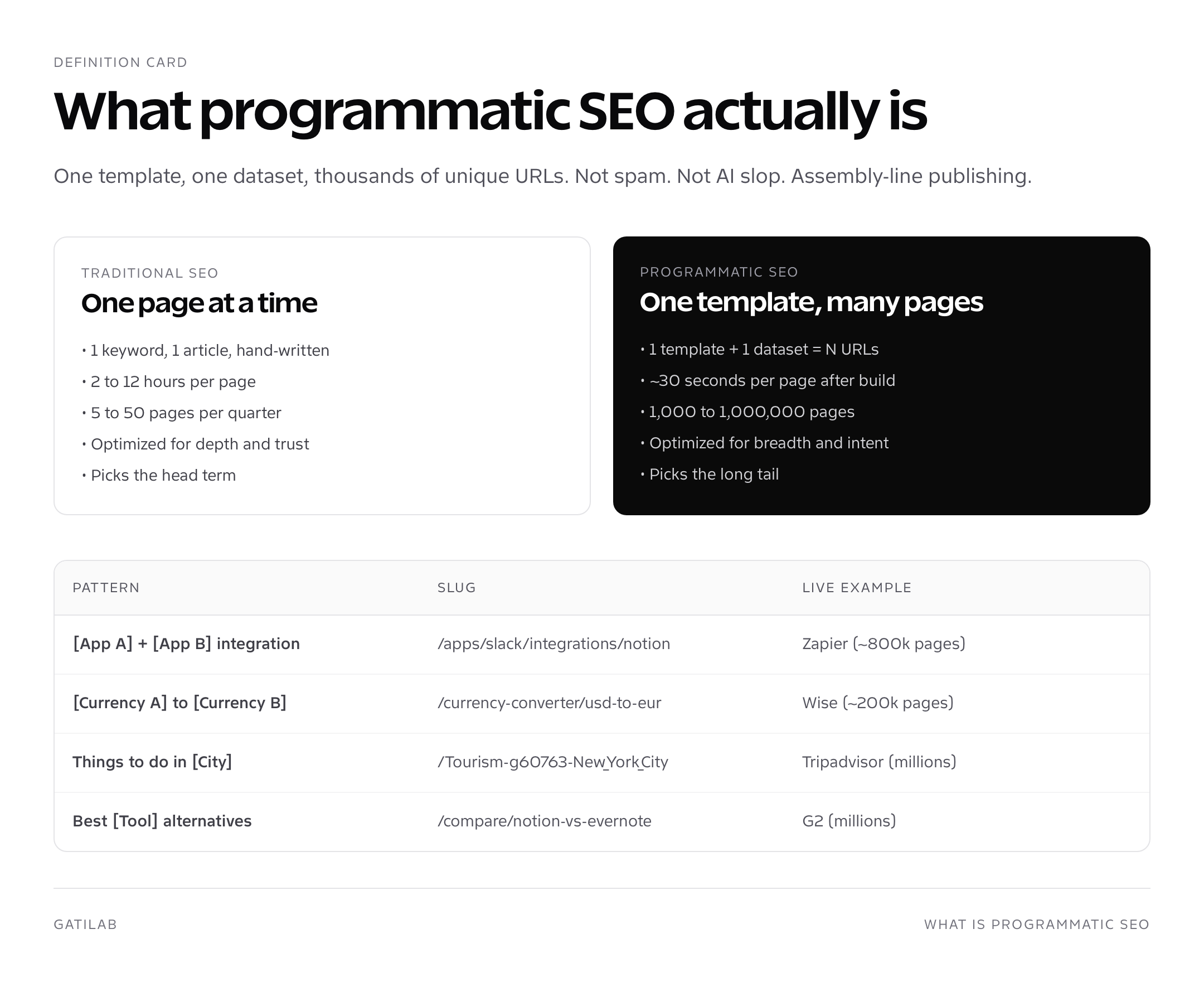
How what is programmatic SEO differs from traditional SEO
Traditional SEO writes one page per keyword by hand. A skilled writer drafts an article on “how to write a cold email,” optimizes it for one focus keyword, ships it, and moves to the next topic. The math: one writer produces 5 to 50 articles per quarter.
Programmatic SEO writes one template plus one dataset and renders thousands of pages from the combination. The math: one engineer plus one editor can ship a 5,000-page program in two months. The trade-off is depth. A handcrafted pillar earns 100 backlinks; a programmatic page earns three. Programmatic SEO is for breadth on the long tail; pillar SEO is for depth on head terms.
| Dimension | Traditional SEO | Programmatic SEO |
|---|---|---|
| Unit of work | One article | One row in a dataset |
| Time per page | 2 to 12 hours | ~30 seconds after build |
| Output per quarter | 5 to 50 articles | 1,000 to 1,000,000 pages |
| Best for | Head terms, depth, backlinks | Long-tail, breadth, intent capture |
| Failure mode | Slow to scale | Helpful Content demotion |
| Capital cost | Writers | Engineering plus data |
The two tactics are complementary, not competitive. The B2B SaaS playbook I run for clients combines a small portfolio of editorial pillars (depth, backlinks, brand authority) with a programmatic long-tail program (breadth, intent capture, conversion volume). For the keyword research workflow that feeds both, see the B2B SaaS keyword research guide.
The four-step framework: how to build a programmatic SEO program
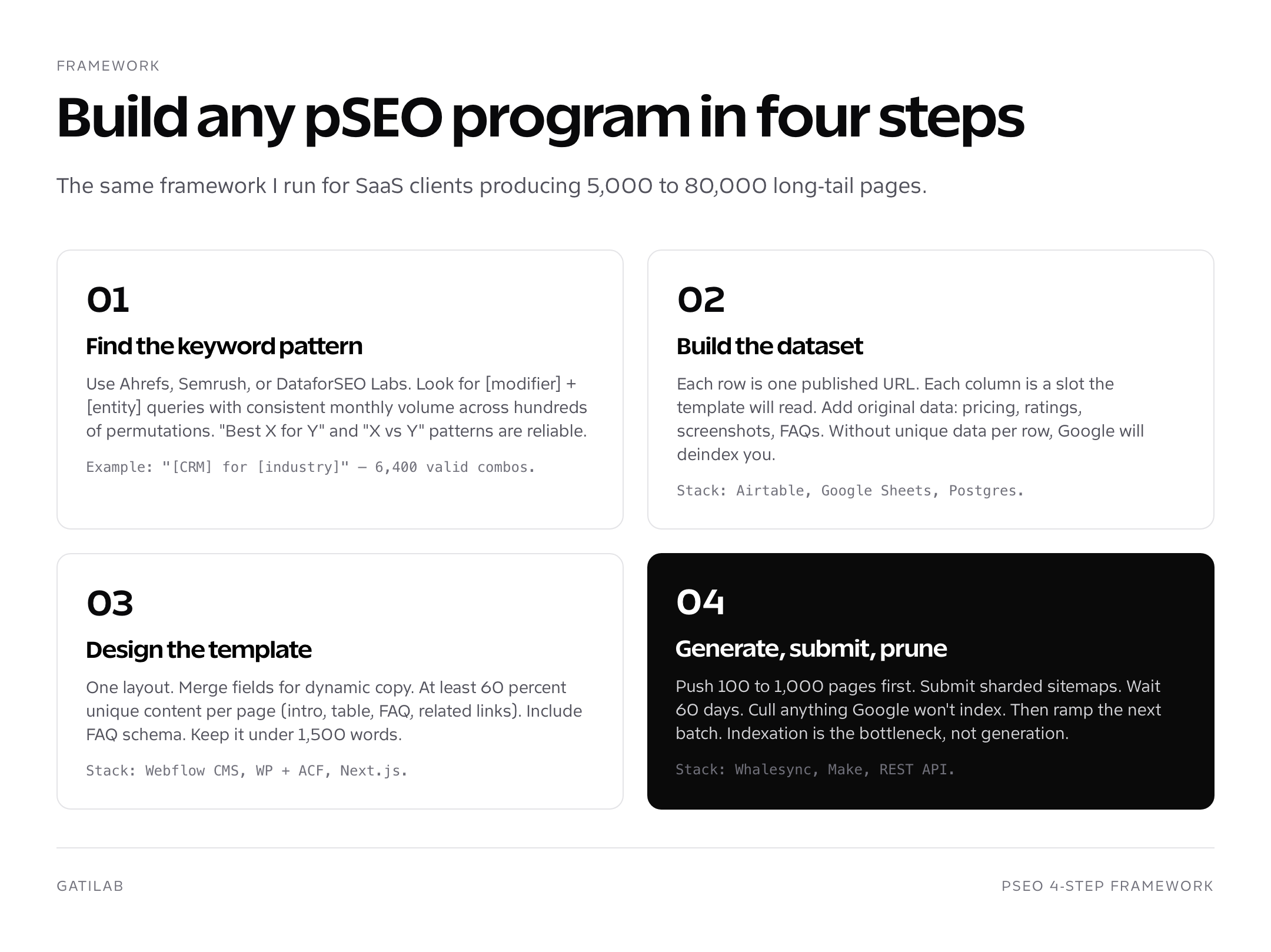
Every programmatic SEO program runs the same four steps. Skip any one and the program limps. The framework is the same whether you’re building 500 pages or 500,000.
Step 1: Find the keyword pattern
The keyword pattern is the [modifier] + [entity] structure your URLs target: “[App A] + [App B] integration,” “[Currency A] to [Currency B],” “[CRM] for [industry],” “[Tool] alternatives,” “[Hotel] in [City].” Pull permutations from Ahrefs Keyword Magic Tool, Semrush’s Bulk Keyword tool, or DataforSEO Labs. Discard any permutation under 10 monthly searches; the long tail dies fast.
Step 2: Build the dataset
Each row is one published URL. Each column is a slot the template will read. For a [SaaS] for [industry] page, columns might be SaaS name, primary use case, three industry-specific use cases, pricing, three competitor names, three customer logos in that industry, an FAQ, a screenshot URL. The more unique data per row, the better the page indexes.
Step 3: Design the template
One template, one CMS or framework. It pulls fields from the dataset, exposes them in scannable structure (tables, lists, FAQs), and adds non-merge content like internal navigation. Three rules I never break. The H1 contains the focus keyword for that row. Every page has one HTML table with row-specific data. An FAQ block carries FAQPage schema.
Step 4: Generate, submit, prune
Push 100 to 1,000 pages first. Submit sharded sitemaps. Wait 60 days. Cull anything Google won’t index. Then ramp the next batch. Indexation is the bottleneck, not generation. Programs that publish 50,000 pages and refuse to cull tend to get hit by site-wide quality demotion within six months.
What tools you actually need
Three honest stack patterns cover most programmatic SEO programs. Pick by program size and engineering capacity.
- Stack A (no-code starter, under 5,000 pages): Airtable for the dataset, Webflow CMS for pages, Whalesync for two-way sync. ~$80 to $180 per month all-in.
- Stack B (WordPress workhorse, 5,000 to 50,000 pages): WordPress + Advanced Custom Fields for schema, WP All Import for CSV ingest, Bricks Builder or a custom theme for rendering. ~$60 to $250 per month.
- Stack C (engineering build, 50,000+ pages): Postgres or BigQuery for data, Next.js with ISR for pages, Vercel for hosting. ~$200 to $2,000 per month plus engineering time.
Below 500 pages, build manually. The tooling overhead isn’t worth it. Above 500 pages and below 5,000, Stack A. Above 5,000 and below 50,000, Stack B. Above 50,000, only Stack C survives Google’s indexation latency. For a tool-by-tool breakdown with current pricing, see the programmatic SEO tools comparison.
When NOT to use programmatic SEO
Three situations where what is programmatic SEO is the wrong answer.
- You don’t have unique data per page. If every page would say the same paragraph with the city or product name swapped, Google’s Helpful Content system will demote 60 to 90 percent of the program within 60 days. Build the dataset first, or skip the tactic.
- The keyword pattern only covers head terms. Programmatic SEO is a long-tail tactic. Trying to rank “crm software” with a templated page is the wrong tool. Use editorial pillars for head terms.
- Your product is local and single-location. A bakery in Brooklyn doesn’t have the keyword permutation space to justify pSEO. Local single-location businesses should invest in Google Business Profile, citations, and a small handful of editorial pages.
If you can’t articulate one unique fact per row in your dataset, do not start the program. Helpful Content will find the duplication faster than you can ship the next batch.
What outcomes to expect from a programmatic SEO program
Honest expectations help. Here’s the curve I see across 11 client programs over the last 18 months.
- Months 0 to 1: Build phase. Dataset construction, template design, first 500 pages live. Zero traffic.
- Months 1 to 3: Indexation phase. 30 to 60 percent of pages get indexed; the rest sit in ‘Discovered’ or ‘Crawled, not indexed.’ Traffic starts trickling on the most-demand permutations.
- Months 3 to 6: Ranking phase. Pages that indexed start ranking on long-tail queries. Most programs hit 30 to 50 percent of expected traffic.
- Months 6 to 12: Scale phase. Internal linking matures, prune cycle runs once or twice, traffic compounds. The 80/20 of the program emerges; 20 percent of pages drive 80 percent of traffic.
Plan for six months before the program produces meaningful traffic. Programs that get pulled at month four because “it’s not working” miss the inflection point. The math compounds slowly and then quickly.
How what is programmatic SEO fits into a broader content program
Programmatic SEO is one of three SEO investments most B2B and SaaS companies should run in parallel: editorial pillars for head-term authority, programmatic long-tail capture, and generative engine optimization for AI search. Each does something the others don’t.
Editorial pillars build topical authority and earn the backlinks. Programmatic SEO captures the long-tail demand at scale. GEO ensures your content shows up in ChatGPT, Perplexity, and AI Overviews. For the GEO playbook, see generative engine optimization. For the cluster strategy that ties pillars and programmatic together, see content cluster strategy. For SaaS-specific applications, the SaaS SEO guide covers conversion side once traffic arrives, with deeper coverage in best CRO tools.
Bottom line
Programmatic SEO is template-driven publishing at scale, pointed at long-tail demand. It works in 2026 if your dataset carries unique facts per row, your internal linking is dense, and you prune ruthlessly. It fails fast if you skip the data layer. Most B2B and SaaS companies should run a small programmatic SEO program alongside their editorial pillars, sized to their dataset, not their ambition.
A worked example: building a 500-page pSEO program in 30 days
Concrete example to make the framework tangible. Suppose you run a B2B SaaS for HR teams. Your product is a candidate assessment platform. You decide to build a programmatic SEO program targeting the [Assessment type] for [Role] pattern: cognitive assessment for software engineers, personality assessment for sales reps, situational judgement test for nurses, and so on.
Day 1 to 5: keyword research. Pull permutations from Ahrefs Keyword Magic Tool. Filter to permutations with 20+ monthly searches. Twelve assessment types times 80 roles equals 960 raw permutations; 540 survive the volume filter. Cut another 40 for legal compliance reasons (assessments for protected categories). Final dataset: 500 rows.
Day 6 to 15: dataset construction. Each row needs assessment name, role name, three role-specific use cases, average completion time, sample question type, scoring methodology, three competitor products, an FAQ with three Q’s templated and answers authored. Build in Airtable. Use Apify to scrape competitor data. Use a GPT-4 class model to draft the answers, then a human editor reviews the first 100 rows to lock voice.
Day 16 to 22: template design. Webflow CMS collection. H1 = ‘[Assessment type] for [Role]: 2026 Guide.’ H2 sections: What this assessment measures, How [Role]s use it, Sample questions, Scoring, Comparison with three named competitors, FAQ. Add an internal-link block that pulls 5 related rows. Add FAQPage schema that reads from the FAQ rows.
Day 23 to 28: sync and ship. Whalesync connects Airtable to Webflow. First sync pushes 500 records as 500 CMS items. Webflow auto-publishes. Submit a sitemap with all 500 URLs to Search Console. Add the program slug to the main site nav for crawl-discovery.
Day 29 to 30: monitoring. Coverage report shows 180 of 500 URLs indexed within 72 hours of submission. Wait for 60 days for the rest to settle. Total cost so far: ~$4,000 in labour, $130/mo in tooling. Expected month-six traffic: 1,500 to 4,000 organic sessions per month, depending on niche competition.
Common questions newcomers actually ask
Three questions I get on every intro call about programmatic SEO that the textbook definitions tend to skip.
Is programmatic SEO different from “AI SEO”?
Yes. Programmatic SEO is a publishing method, AI SEO is a content-generation tool. They’re orthogonal. You can run a pSEO program without any AI (Wise’s currency pages don’t need a language model). You can use AI to write articles outside any pSEO program. The two only overlap when AI is part of the dataset-construction pipeline.
Will programmatic SEO get me penalized?
Not by itself. Google’s Helpful Content system demotes thin and duplicate pages whether they’re handwritten or templated. The relevant signal is information gain per page. A pSEO page with 60 to 70 percent unique content per row, real proprietary data, and proper internal linking ranks fine. A pSEO page that’s 95 percent boilerplate gets demoted, regardless of how it was generated.
How big does my dataset need to be?
Below 200 rows, pSEO doesn’t beat hand-written articles on ROI. Above 500 rows, pSEO starts to make sense. Above 5,000 rows, it dominates. The crossover point depends on the value per page; high-conversion pages (ecommerce category, financial calculators) justify pSEO at lower row counts than low-conversion pages (informational explainers).
Programmatic SEO and Google’s helpful content updates
Google’s Helpful Content classifier, integrated into the core ranking system in 2024 and refined through 2025 and 2026, is the single biggest variable in whether a programmatic SEO program survives. It evaluates pages on whether they were created primarily for users or primarily to rank, whether they demonstrate first-hand expertise, and whether they leave the searcher feeling they’ve had a satisfying experience.
Three properties consistently survive Helpful Content updates in the pSEO programs I audit. First, unique data per page that a searcher couldn’t get faster elsewhere (live exchange rates, real API integrations, first-party reviews). Second, a clear primary intent for each page; pages that try to rank for two distinct intents at once get demoted faster. Third, dense internal linking to a topical hub, signalling that the program is one coherent body of work, not a content farm.
The programs that fail Helpful Content checks share three properties. Boilerplate intros that read identically across pages with only the keyword swapped. Empty FAQ blocks where the answers are paraphrased versions of the question. Templates that don’t differentiate between high-volume pages worth owning and zero-volume pages that should never have been published. Avoid all three from day one.
Common myths about programmatic SEO worth correcting
Five misconceptions show up in nearly every conversation I have with first-time programmatic SEO operators. Each one has a kernel of truth and a tail of confusion. Clearing them up early saves rebuild cost later.
Myth 1: “Programmatic SEO is just AI content at scale.”
AI is one tool inside the dataset-construction pipeline; it is not the program. The Wise currency pages were programmatic five years before ChatGPT shipped, sourced entirely from live exchange-rate APIs. The defining property of programmatic SEO is template-plus-dataset, not language-model output.
Myth 2: “You need 100,000 pages for it to work.”
Programs as small as 500 pages outperform comparable editorial efforts when the dataset has unique data per row. The minimum that justifies the tooling overhead is around 500 rows; below that, write the articles by hand. The maximum is whatever your dataset supports.
Myth 3: “Google penalizes programmatic SEO sites.”
Google does not penalize the tactic; it demotes thin, duplicate, or unhelpful pages whether handwritten or templated. The Helpful Content classifier is the relevant gate. Programs with proprietary data per row consistently rank fine across multiple algorithm updates in 2024 to 2026.
Myth 4: “Programmatic SEO replaces traditional SEO.”
It complements editorial pillars, it does not replace them. Editorial earns the head-term rankings and the backlinks; programmatic captures the long tail. Most B2B and SaaS organisations should run both in parallel, sized to the team capacity.
Myth 5: “Once it ranks, it ranks forever.”
Programmatic SEO programs need quarterly maintenance: dataset refreshes, template updates for new schema rules, prune cycles for underperforming pages, and re-internal-linking as new rows get added. Programs that ship and walk away tend to lose 30 to 60 percent of traffic within 18 months.
Frequently asked questions about programmatic SEO
What is programmatic SEO in one sentence?
Programmatic SEO is template-driven publishing where one template plus one dataset produces thousands of unique URLs targeting long-tail search demand.
Is programmatic SEO the same as AI content?
No. Programmatic SEO is a publishing method, AI content is a writing tool. You can run a programmatic SEO program without any AI, and you can use AI to write articles outside any programmatic SEO program.
Does programmatic SEO violate Google’s guidelines?
Not by itself. Google demotes thin or duplicate pages, whether handwritten or templated. Programs with unique data per row and helpful content rank fine. The Helpful Content system is the relevant gate.
How many pages do I need for a programmatic SEO program?
Programs range from 200 to 7 million pages. The minimum that justifies the tooling overhead is around 500 pages. Below that, write manually.
How long does it take to see results?
Indexation takes 30 to 90 days. Ranking takes another 60 to 180 days. Plan for six months before meaningful traffic.
Do I need an engineer to start a programmatic SEO program?
Not for programs under 5,000 pages. Stack A (Airtable + Webflow + Whalesync) runs without code. Above that, an engineer makes the project faster and cheaper.
What’s the cheapest programmatic SEO stack?
Notion plus DataFetcher for the dataset, Astro or Eleventy on Cloudflare Pages or Vercel free tier for rendering. Total under $20 per month for a 500-page test program.
Can programmatic SEO work for B2B SaaS?
Yes, especially for [Use case] for [Industry], [Tool] vs [Tool], and [Tool] alternatives patterns. Most B2B SaaS programs land in the 1,000 to 20,000 page range.
How do I know if my business is a programmatic SEO candidate?
Three checks: do you have a [modifier] + [entity] keyword pattern with hundreds of permutations and stable demand; do you have proprietary data per row; and is your buyer’s journey tolerant of long-tail entry points? If yes to all three, you’re a candidate.
What happens if my programmatic SEO pages don’t rank?
Some won’t. Plan to noindex or 410 any page that hasn’t indexed in 90 days or that’s indexed but earns zero clicks for 60 days. Pruning is a normal part of the workflow, not a sign of failure.
Tell Google you want more of this.
Add Gatilab as a preferred sourceOne tap, and this site shows up more often in your own Top Stories, AI Overviews and AI Mode. Remove it any time.