
Domain Registrar: What It Does and How to Pick One
A domain registrar is an ICANN-accredited company that sells you the right to use a domain name for a set period, usually one year at a time. The registrar handles the paperwork with the registry (Verisign runs .com, Afilias runs .info, ICANN sits above them), updates WHOIS records, and gives you the control panel where you manage DNS, transfers, and renewals.
That’s all a registrar is. It’s not your web host. It’s not your DNS provider by default (though most offer basic DNS as a bonus). It’s not your email host. And it doesn’t “own” your domain: you do, for the period you paid for, as long as you renew before expiration.
What does a domain registrar actually do?
A registrar registers, renews, and transfers domain names on your behalf through the official registry for each top-level domain (TLD). When you buy gauravtiwari.org for $15, the registrar keeps about $1-3 for their service and pays the rest to the registry (Public Interest Registry for .org) and ICANN (the nonprofit that coordinates the global domain system).
Beyond registration, the typical registrar provides WHOIS privacy protection (hides your personal info from public lookup), DNS management (A records, CNAMEs, MX records, TXT records for SPF/DKIM/DMARC), and a renewal reminder system. Some bundle SSL certificates, email forwarding, and parking pages. Premium registrars like Cloudflare Registrar charge at-cost pricing with no markup.
The registrar is also the company that handles transfer authorization codes, WHOIS contact updates, and domain lock settings. Losing access to your registrar account is how people lose domains, not getting hacked. Use 2FA.
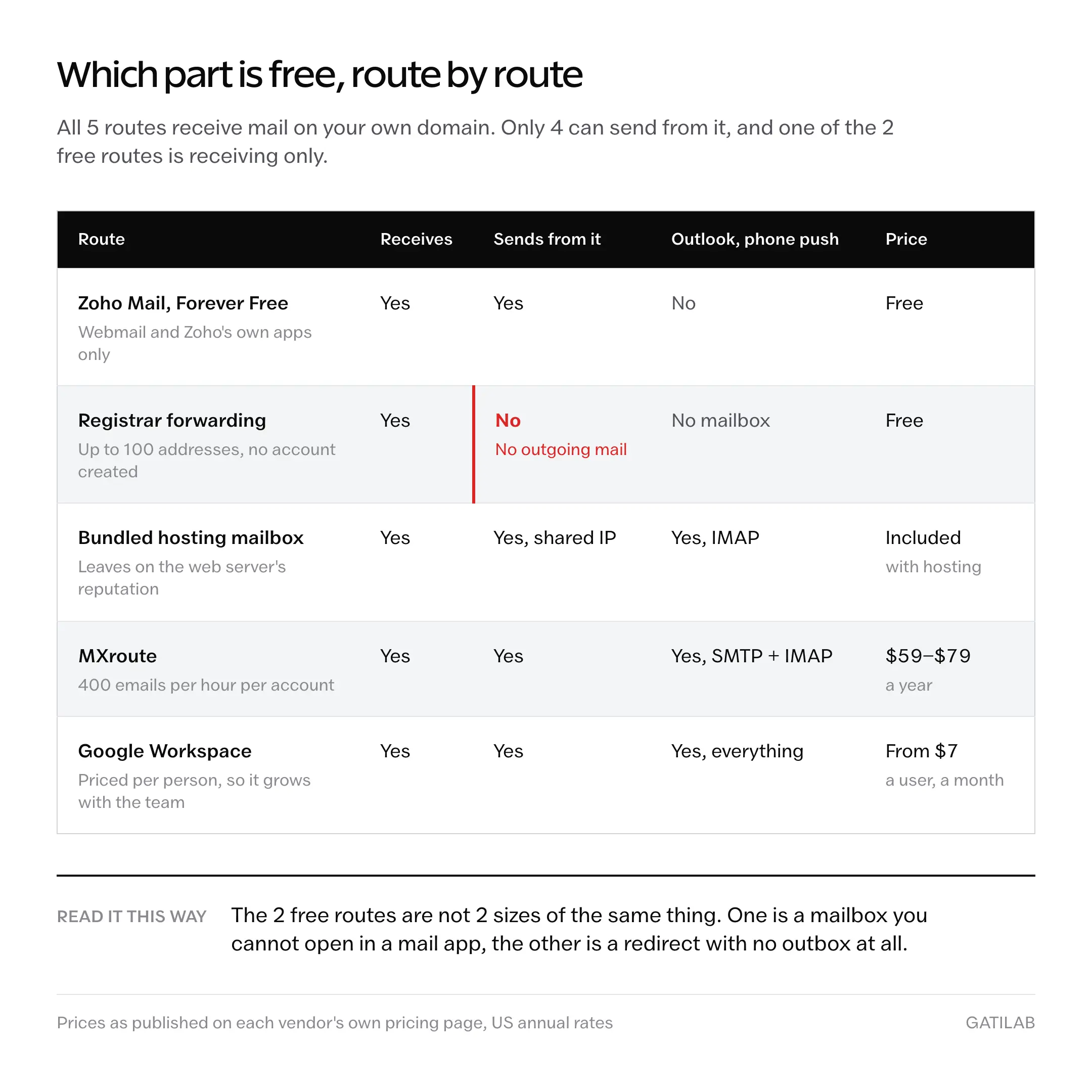
What a registrar is NOT
This is where first-time buyers get confused. A registrar is not:
A web host. Hosting runs the actual website (WordPress files, database, media). Registrars usually offer cheap hosting as an upsell, but it’s a separate service. You can register a domain at Namecheap and host it at Kinsta, Cloudways, or anywhere else. You should.
A DNS provider by default. Most registrars include basic DNS with the domain, but it’s rarely the best DNS. Cloudflare, AWS Route 53, and NS1 run faster, more reliable DNS than GoDaddy or Namecheap’s built-in service. You can point your domain’s nameservers to any DNS provider regardless of where you registered.
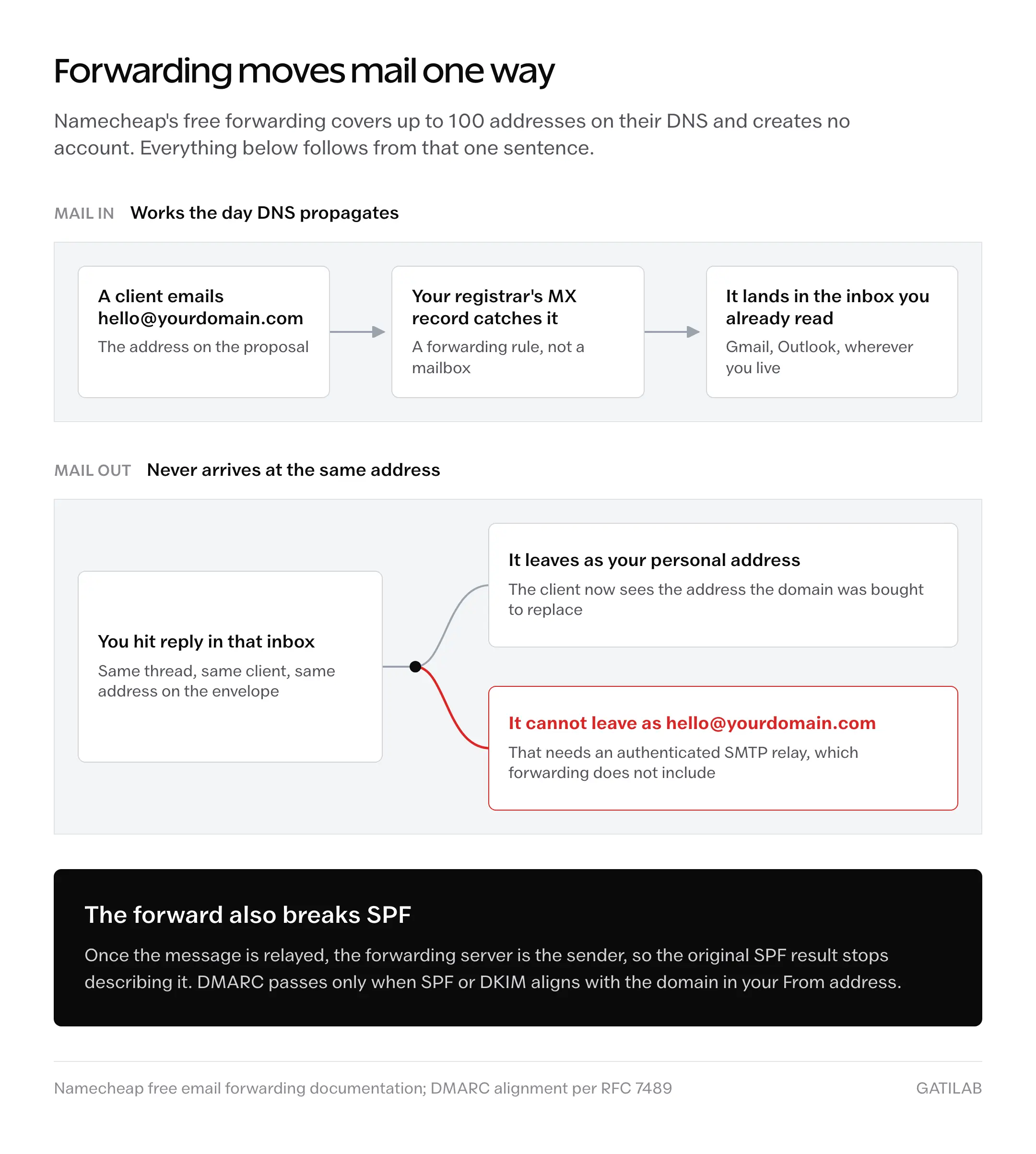
An email host. Domain registration doesn’t include email. You add MX records pointing to an email host (Google Workspace, Zoho, Titan, migadu). Registrars that offer “free email” usually mean forwarding, not full mailboxes with storage.
The permanent owner. You don’t “buy” a domain. You lease it, one year at a time, up to ten years at a time. Forget to renew and the domain expires, enters redemption period, and eventually returns to the open market. Registrars send reminders. Turn on auto-renew and keep the credit card current.
Domain vs hosting: what’s the difference?
A domain is the address people type to reach your site, and hosting is the server that stores the site and sends it to them. A working website needs both, and they’re separate services even when one company sells you the pair.
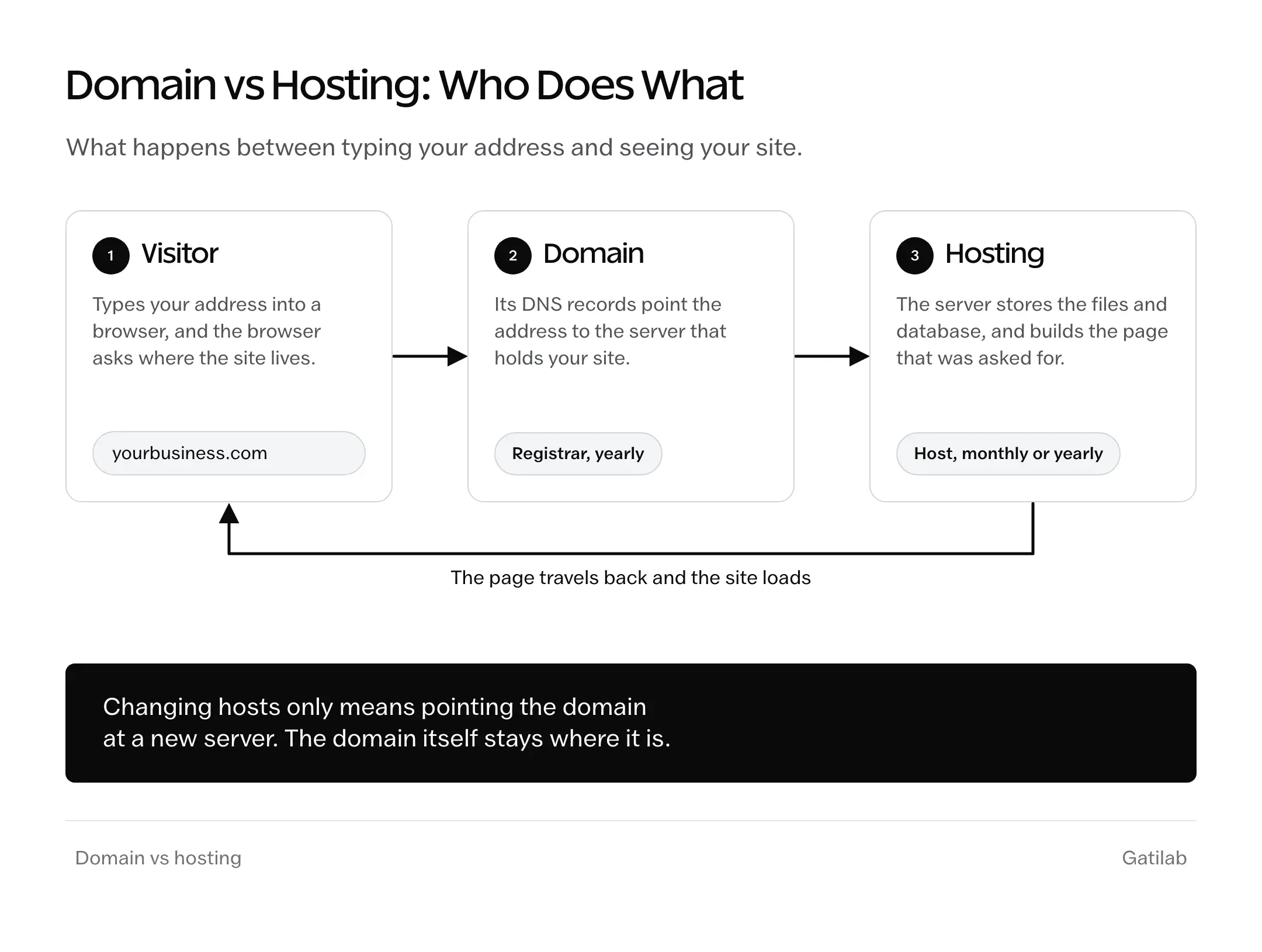
Here’s how the two compare side by side:
| Domain | Hosting | |
|---|---|---|
| What it is | Your site’s address, like yourbusiness.com | Server space where your site’s files and database live |
| Who sells it | A domain registrar | A hosting company |
| How you pay | Yearly, for up to ten years at a time | Monthly or yearly |
| What it controls | Where visitors and email get sent, through DNS | How fast the site loads and whether it stays online |
| If you stop paying | The domain expires and can eventually go to someone else | The site goes offline, though the domain is still yours |
| Moving it | Transfer it to another registrar | Migrate the site to another host |
The two connect through DNS. The nameservers you set at your registrar point either to your host or to a DNS provider like Cloudflare, which then points to the host. So when you change hosts, you update those records, and the domain itself stays where it is.
Should you buy the domain and hosting together?
You can, and plenty of hosts include a free domain for the first year. It’s convenient, but it ties two decisions together.
Keeping them separate is the safer setup for most sites:
- a problem with the hosting account never locks you out of the domain
- switching hosts is a DNS change instead of a domain transfer
- the free domain in a hosting deal can renew at a higher price than a registrar charges
Buying both from one company is fine for a small site where convenience matters more. Just make sure the domain is registered in your name and that you can log in to manage its DNS yourself.
How to pick a domain registrar
Five criteria matter. Most people obsess over the intro price and ignore the rest, which is how they end up stuck with GoDaddy for years.
1. Renewal pricing (not intro pricing)
.com domains cost the registry about $10.26/year wholesale as of 2026. Any registrar charging less than $11/year is absorbing margin to win the first purchase, which means the renewal rate will be higher. Normal .com renewal rates:
- Cloudflare Registrar: $10.44 (at-cost, no markup)
- Porkbun: $11.98
- Namecheap: $14.58
- Name.com: $12.99
- GoDaddy: $21.99 (plus privacy upsell)
Multiply by the years you plan to own the domain. A $4/year difference over 10 years is $40. Across 20 domains, that’s $800. Renewal pricing compounds.
2. WHOIS privacy included
Post-GDPR, WHOIS privacy is essentially mandatory. Domains registered without privacy get scraped and you get spam calls and phishing emails forever. Any registrar charging extra for WHOIS privacy in 2026 is behind the industry. Namecheap, Cloudflare, Porkbun, Name.com, and Gandi all include it free. GoDaddy still charges $9.99/year for the equivalent, which is the single loudest signal that GoDaddy is optimized for people who don’t know better.
3. Transfer-out ease
You will eventually want to move a domain. Maybe the registrar gets acquired and the service deteriorates. Maybe you consolidate domains. The question is how hard the registrar makes it.
Good registrars: click unlock, get auth code by email, done in 5 minutes. Namecheap, Porkbun, Cloudflare, Name.com, Gandi all work this way.
Bad registrars: require a support ticket for the auth code, enforce 60-day transfer locks after updates, charge “exit fees” disguised as renewal prepay. GoDaddy and Bluehost‘s domain service (Domain.com) fit this pattern.
4. DNS quality
If you’re going to use the registrar’s DNS, check its propagation speed and uptime. Cloudflare Registrar gives you free Cloudflare DNS, which is the best consumer DNS available. Namecheap’s FreeDNS is fine. GoDaddy’s DNS is mediocre. For production sites I recommend pointing nameservers to Cloudflare regardless of registrar, because the DNS is free and faster than most registrar-bundled services.
5. Two-factor authentication and account security
This one seems obvious. It’s not. Some registrars still don’t require 2FA and some have had credential-stuffing attacks that led to domain theft. Cloudflare Registrar requires 2FA. Namecheap supports 2FA with TOTP and SMS. Avoid any registrar that only offers SMS-based 2FA, because SIM swap attacks are real.
Never share the registrar account login with a web designer, a developer, or an employee. Use registrar-level 2FA plus a password manager. This account controls your digital identity more than your bank account does.
What TLDs should you actually register?
.com still rules. It’s the most recognizable, most trusted, and most memorable TLD for English-speaking audiences. If your exact .com is available at reasonable cost, get it. If it’s taken but available at aftermarket pricing up to a few hundred dollars, weigh it against long-term brand value.
.co is the second-best option for startups when .com isn’t available. Recognized enough, short enough, and usually cheaper to grab.
Country TLDs (.in for India, .uk for UK, .de for Germany) make sense for country-specific brands. They signal locality to search engines and users. The tradeoff: expanding internationally later requires a different domain.
New gTLDs (.app, .dev, .io, .ai, .studio) have matured. Registry pricing varies: .io is $30-60/year, .ai is $60-120/year, .dev is $15-25/year, .app is $18-25/year. Fine for specific use cases. Don’t register 14 new gTLDs hoping to build a brand.
Skip .info, .biz, .website, .online, .shop, and similar promotional TLDs unless there’s a specific reason. They carry spam connotations and most serious businesses avoid them.
The 7 domain registrars I recommend
| Registrar | .com renewal | WHOIS privacy | DNS quality | Best for |
|---|---|---|---|---|
| Cloudflare Registrar | $10.44 | Free | Excellent | Portfolio owners, technical users |
| Namecheap | $14.58 | Free | Good | Beginners, single-domain owners |
| Porkbun | $11.98 | Free | Good | Side projects, bulk registrations |
| Squarespace Domains | $20.00 | Free | Good | Former Google Domains users |
| Name.com | $12.99 | Free | Good | US-based owners wanting US support |
| Gandi | $17.65 | Free | Good | Privacy-conscious EU users |
| Hover | $17.99 | Free | Good | Users who hate upsells |
1. Cloudflare Registrar
At-cost pricing ($10.44 for .com), no markup, no upsells, and the best DNS in the industry bundled free. The catch: Cloudflare Registrar only accepts domains transferred in. You can’t register a brand-new domain there. You register elsewhere, then transfer to Cloudflare for the long-term ownership.
This is my top pick for anyone who already has a domain at another registrar. The transfer is free (you pay for one year of renewal, which you’d pay anyway) and you save 30-50% on future renewals.
2. Namecheap
Consistent industry leader for over 20 years. Renewal rates are reasonable, interface is clean, WHOIS privacy is free forever, and transfer-out is painless. I’ve registered over 80 domains at Namecheap across 15 years and never had an account issue.
The upsells during checkout are mild compared to GoDaddy. Decline SSL, decline premium DNS, decline hosting, and you get out for the listed price.
3. Porkbun
Newer registrar (launched 2014) with aggressive pricing and a sense of humor in the branding. .com renewals at $11.98 beat Namecheap, WHOIS privacy is free, and the interface is modern. I use Porkbun for .app, .dev, and .io domains where its pricing is stronger than Namecheap’s.
4. Squarespace Domains (former Google Domains)
Google sold its Domains business to Squarespace in 2023 and the service continues under Squarespace’s operation. .com pricing is higher than Namecheap ($20.00 renewal) but the interface is the cleanest of any registrar. Former Google Domains customers got migrated here by default.
Pick Squarespace Domains if you’re already a Squarespace customer or if UI matters more than $5/year in renewal savings.
5. Name.com
Owned by Donuts Inc., handles registration for hundreds of new gTLDs. US-based support, clean dashboard, fair renewal rates. A solid option if you want US phone support during US business hours and don’t want GoDaddy’s upsell experience.
6. Gandi
Paris-based registrar, founded 1999, strong European presence. “No bullshit” is part of their marketing and the interface matches. Pricing is higher than average ($17.65 for .com) but includes features other registrars charge for: two mailboxes per domain, SSL for the first year, and Gandi Hosting integration if you want it.
7. Hover
Owned by Tucows, positioned as the anti-GoDaddy. No upsells at checkout, clean UI, and email forwarding included free. Pricing is on the high end but the experience is genuinely pleasant. Pick Hover if you value not being sold to more than you value $3/year savings.
Who I don’t recommend and why
GoDaddy. Renewal pricing is the highest in the industry ($21.99 for .com), WHOIS privacy costs extra, and the checkout experience is 8 different upsell screens. Transfer-out requires support ticket. The only reason to use GoDaddy is if you’re already there and haven’t felt the pain yet.
Bluehost’s domain service (Domain.com, shared parent). Marked up registrations, bundled with hosting in ways that make transfers harder, and no meaningful advantage over Namecheap.
Registrars owned by your web host. Separate the domain from the host. If your host goes down, gets acquired, or jacks renewal prices, you want the domain at a different company so you can redirect or rebuild elsewhere.
How to transfer a domain the safe way
The transfer process is standardized by ICANN but the details trip people up. Here’s the sequence I follow every time.
First, confirm the domain is past the 60-day ICANN lock. New registrations and recent transfers can’t be transferred for 60 days. If you just registered, wait.
Second, unlock the domain at the current registrar. Every registrar has a “Transfer Lock” or “Registrar Lock” setting under the domain settings page. Turn it off.
Third, disable WHOIS privacy temporarily at the current registrar. Some registrars block transfer requests when privacy is on because the receiving registrar can’t verify contact details. Turn privacy off, start the transfer, turn privacy back on at the new registrar after transfer completes.
Fourth, request the auth code (sometimes called EPP code or transfer code). Good registrars email it instantly. Bad ones make you open a support ticket.
Fifth, initiate the transfer at the new registrar. Enter the domain, paste the auth code, and pay for one year of renewal (which gets added to your existing expiration date, so you don’t lose time). The transfer takes 5-7 days to complete by default, but you can approve it manually to speed it up.
Sixth, after transfer completes, re-enable WHOIS privacy and turn the Registrar Lock back on. Set up 2FA on the new registrar account immediately.
Domain registrar verdict
For a brand-new domain registration: Namecheap or Porkbun. Register there, enable 2FA immediately, and keep the account locked down.
For long-term ownership of domains you’ll keep for years: register at Namecheap or Porkbun, then transfer to Cloudflare Registrar after 60 days. You’ll pay at-cost renewal pricing forever and get the best DNS in the industry free.
For anyone still on GoDaddy: transfer out this weekend. You’ll save money on renewals, stop getting upsell emails, and get a cleaner management experience. The transfer takes 5 days but the work is 10 minutes on each side.
Whatever you pick, separate the domain from the hosting. The domain is your permanent identity. The host is a utility you change every few years. Treat them accordingly.
What’s the difference between a domain registrar and a web host?
A registrar sells and manages the domain name (gauravtiwari.org). A host runs the actual website (WordPress files, database). You can register a domain at Namecheap and host it anywhere. Keep them separate.
Do I own my domain or just lease it?
You lease it, one year at a time, up to 10 years maximum. Forget to renew and it enters redemption period, then goes back to the open market. Turn on auto-renew and keep the credit card current.
Why is GoDaddy’s .com so expensive at renewal?
GoDaddy charges $21.99/year for .com renewals. The wholesale cost from Verisign is $10.26. That gap pays for GoDaddy’s marketing budget and upsell infrastructure. Cloudflare Registrar charges $10.44 at-cost for the same thing.
Can I use Cloudflare Registrar for a brand-new domain?
No. Cloudflare Registrar only accepts transfers from other registrars. Register the domain at Namecheap or Porkbun first, then transfer to Cloudflare after the 60-day ICANN lock expires.
Is WHOIS privacy really necessary?
Yes. Without privacy, your registration email, phone, and address go into the public WHOIS database and get scraped by spammers within hours. Every reputable registrar now includes WHOIS privacy free. If yours charges for it, transfer.
How do I transfer a domain to a different registrar?
Unlock the domain at the current registrar, request the auth code (EPP code), then initiate the transfer at the new registrar and paste the code. The transfer completes in 5 days and includes one year of renewal paid to the new registrar.
Should I register multiple years upfront?
Buying 2-3 years of registration at once locks in today’s renewal rate and reduces accidental expiration risk. For domains critical to a business (primary brand, trademark-matching names), yes. For experimental domains, one year is fine.
What happens if my registrar goes out of business?
ICANN requires registrars to have a backup plan. Domains transfer to a designated successor registrar if the original fails. You still own the domain, but you may need to reset account access. This is rare but it’s why keeping domains at well-established registrars matters.
Can I buy a domain and hosting from the same company?
Yes. Many hosts sell domains and include one free for the first year. It is convenient, but keeping the domain at a separate registrar makes it easier to change hosts later, and the domain stays safe if something goes wrong with the hosting account.
Continue reading: Free Domain Email · Choose a Domain Name for Business · Buying Existing Domains
Tell Google you want more of this.
Add Gatilab as a preferred sourceOne tap, and this site shows up more often in your own Top Stories, AI Overviews and AI Mode. Remove it any time.