
Long Copy Ads: When More Words Produce More Sales
Long copy ads don’t work because people enjoy reading ads. They work when the buying decision needs more explanation than a headline can carry. Price, risk, novelty, proof, and buyer awareness determine the useful length.
The right question isn’t “Does long copy convert?” It is “What must a qualified buyer understand or believe before taking the next step?” Write enough to answer that. Cut everything else.
- Claim standard: FTC substantiation rules apply to objective claims whether an ad is ten words or a full sales letter.
- Length test: Useful length grows with unanswered questions about price, risk, novelty, mechanism, and proof.
- Recommendation: Let the ad earn qualified attention. Put the full argument on the landing page unless the feed itself needs to qualify the click.
Jump to: when long copy works · the seven parts · mobile formatting · the editing test
When do long copy ads work?
Long advertisements work when additional explanation reduces a real buying risk. If the buyer already understands the product, trusts the promise, and can take a low-risk action, shorter copy usually wins.
| Use short copy when | Use long copy when |
|---|---|
| The product is familiar | The category or mechanism is unfamiliar |
| The risk is low | The financial, technical, or reputational risk is high |
| The action is small | The action requires a call, application, or purchase |
| The visual explains the offer | Proof and qualification need words |
| The audience already wants it | The audience needs education |
| The message has one simple benefit | Several objections block the decision |
Long copy is not a license to repeat the same promise in six ways. Every section needs a job.
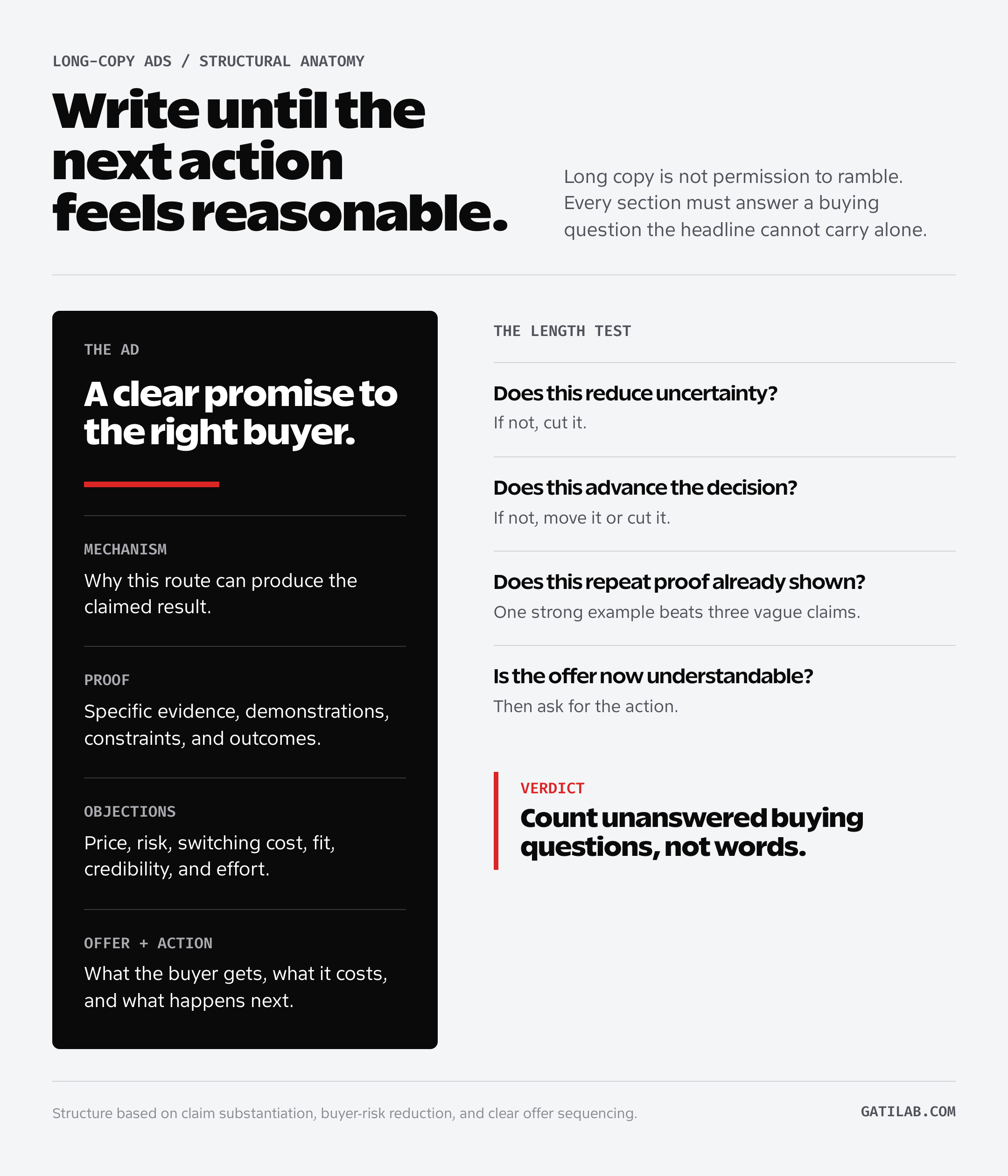
How does buyer awareness change copy length?
A buyer can be:
- Unaware of the problem
- Aware of the problem
- Aware that solutions exist
- Aware of your product
- Ready for the offer
The less aware the buyer, the more context the message may need. The more ready the buyer, the faster you should get to the offer.
A branded-search ad for a known product can be short. A LinkedIn Ads campaign introducing an unfamiliar B2B category may need a stronger explanation before the click. A landing page for a high-cost implementation needs more proof after the click.
This is why ad length can’t be decided in isolation from the conversion-optimized web page that receives the visitor.
Why do price and risk make copy longer?
Long copy earns its space when it reduces decision risk.
Common buyer questions include:
- Is this for a company like mine?
- What exactly do I get?
- Why is this different?
- How does it work?
- What proof supports the claim?
- What must I change?
- How long will it take?
- What can go wrong?
- What is excluded?
- What happens if it doesn’t fit?
If the ad or landing page ignores those questions, the buyer doesn’t become curious. They become cautious.
What are the seven parts of useful long copy?
Useful long copy moves through a sequence. Each part earns the next part.
1. Hook
Name a specific problem, result, or tension. Don’t lead with the company.
Weak: One platform for modern teams
Stronger: Client approvals are taking longer than the work itself
2. Problem
Show the operational cost without turning the copy into theater.
Name:
- The repeated failure
- Who feels it
- What it delays
- Why common fixes fail
3. Mechanism
Explain how the product creates the result.
“AI-powered” is not a mechanism. “The system reads each support ticket, classifies the issue, and routes it using rules your team can review” is closer.
4. Proof
Use evidence appropriate to the claim:
- Demonstration
- Before-and-after artifact
- Product data
- Customer result with context
- Technical explanation
- Independent standard
- Clear limitation
The Federal Trade Commission requires a reasonable basis for objective advertising claims. Its advertising substantiation policy is the source I trust for this rule because the FTC enforces US advertising law: proof should exist before the claim is published.
5. Offer
State what the buyer receives, the price or next step when appropriate, and any real deadline or limit.
6. Objection handling
Answer the two or three objections that repeatedly appear in sales calls. Don’t add a 20-question FAQ because the page feels short.
7. Call to action
Match the ask to readiness:
- View an example
- Calculate the cost
- Start a trial
- Book a technical review
- Buy now
Which buying situations earn long copy?
These decisions usually need more than a headline and a button.
A new category
The buyer needs a language for the problem and a reason the old method no longer works.
A high-ticket service
The buyer needs scope, process, proof, roles, and risk controls.
A technical product
The buyer needs enough mechanism and compatibility detail to trust the next step.
A skeptical market
The buyer has seen similar promises fail. Specific proof and limits matter more than confidence.
A comparison decision
The buyer needs trade-offs, not a feature pile. A good product-page SEO structure can serve search intent and conversion without hiding the important details.
When does long copy become waste?
Length becomes a liability when it adds volume without reducing uncertainty.
The offer is already obvious
A familiar low-risk product doesn’t need a manifesto.
The copy repeats benefits
More sections don’t create more persuasion if they say the same thing.
Proof is missing
Length amplifies unsupported claims. It doesn’t replace evidence.
Mobile formatting is ignored
A long block of text is not long-form persuasion. It is a wall.
The ad tries to close the entire sale
Some ads should earn the click, not carry the landing page, demo, proposal, and contract.
How should you format long copy for mobile?
Most long-copy ads are read in narrow columns and interrupted environments.
Use:
- A clear first line
- Short paragraphs
- Descriptive subheads
- Bullets for facts and criteria
- Specific numbers
- Proof near the claim
- One primary CTA
Avoid:
- Single-sentence paragraphs all the way down
- Fake urgency
- All-caps emphasis
- Ten emoji bullets
- Hidden qualifications
- A link before the reader understands the offer
If a disclosure is necessary to prevent deception, the FTC says it should be clear, conspicuous, and close to the relevant claim. Fine print can’t repair a misleading main message.
How should copy length change by channel?
Use the ad to earn the next action and the landing page to carry the full argument. Search ads have hard space limits, while feeds, newsletters, print, and landing pages give explanation different amounts of room.
| Channel | Useful role for long copy | Main limitation |
|---|---|---|
| Meta Ads feed | Story, mechanism, proof before click | Attention is fragile |
| LinkedIn Ads feed | Professional problem and qualification | Dense copy can feel like a memo |
| Google Ads Search | Usually concise message tied to intent | Limited ad space |
| Landing page | Full argument, proof, objections, offer | Needs strong structure |
| Newsletter sponsorship | Trusted context and specific fit | Publisher voice and space constraints |
| Print or direct mail | Detailed offer with physical attention | Harder attribution and iteration |
Podcast ads are a useful contrast. The message may be longer in time but must be easy to follow without visual structure. Our podcast advertising guide covers the format, CPM model, and conversion issues.
How do you test and edit copy length?
Don’t test “short vs long” by writing a clear short version and a bloated long version.
Test two complete arguments:
- Same audience
- Same offer
- Same claim
- Same proof
- Same CTA
- Different amount of explanation
Then measure:
- Qualified click-through rate
- Landing-page conversion
- Lead quality
- Sales acceptance
- Purchase or pipeline value
The winner is not the version with the cheapest click. It is the version that creates the best business result at an acceptable cost.
For every paragraph, ask:
- Does this explain the problem?
- Does this clarify the mechanism?
- Does this prove a claim?
- Does this reduce risk?
- Does this help the buyer act?
If the answer is no to all five, remove it.
If your offer needs a longer conversion path, a focused landing page design service should make the argument easier to follow, not merely make it look expensive.
FAQs
Copy length is a decision about buyer understanding, not a universal best practice.
What is a long-copy ad?
A long-copy ad uses more space to explain the problem, mechanism, proof, offer, and objections. It is useful when the decision needs education or risk reduction.
Do people read long advertisements?
Qualified buyers read as much as they need when the problem matters and the copy helps them decide. Unqualified readers leaving early is not automatically a failure.
How long should ad copy be?
Long enough to make the next action reasonable. Familiar, low-risk offers can be short. New, expensive, technical, or skeptical decisions often need more explanation.
Is long copy better for B2B?
It is often useful in B2B because several stakeholders, technical requirements, and financial risks can shape the decision. The copy still needs structure and a clear next step.
Should the ad or landing page carry the long copy?
Usually, the ad should earn qualified attention and the landing page should carry the full argument. Some feed formats can support a longer pre-click explanation when it improves qualification.
Tell Google you want more of this.
Add Gatilab as a preferred sourceOne tap, and this site shows up more often in your own Top Stories, AI Overviews and AI Mode. Remove it any time.