
“We Have No Competitors” Is a Research Failure
When a founder says, “We have no competitors,” I don’t hear confidence. I hear a market definition that is too narrow. Customers already solve the problem somehow, even if the solution is a spreadsheet, an assistant, a WhatsApp group, an agency, or doing nothing.
No competitors usually means no identical product. That is a much smaller claim. Your real competition is every alternative that can receive the customer’s money, time, attention, or tolerance.
- Research standard: The US Small Business Administration tells founders to examine direct and indirect competitors, saturation, pricing, strengths, weaknesses, and barriers.
- Buyer reality: If a customer can keep a spreadsheet, hire an agency, or tolerate the problem, your product already has competition.
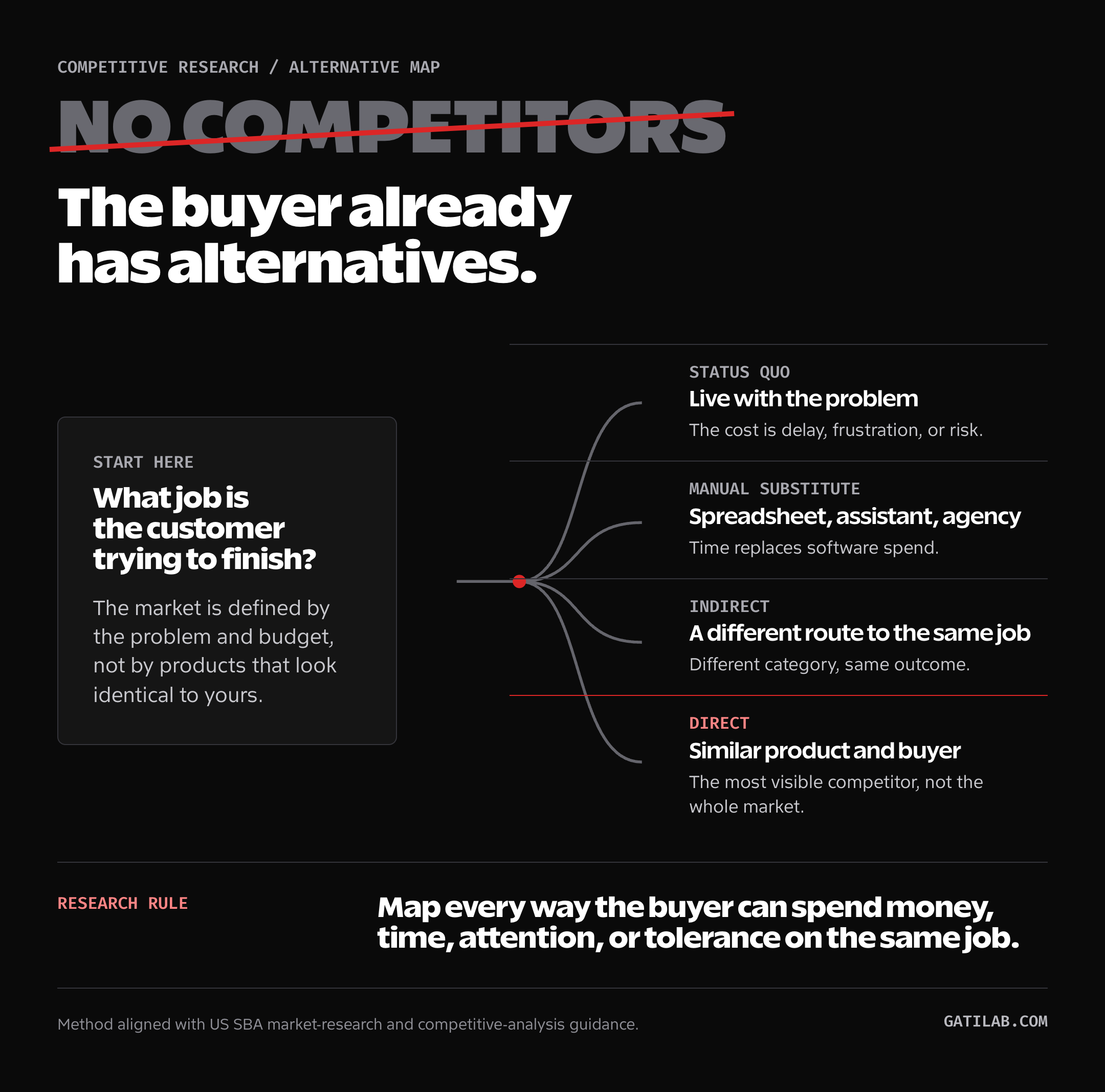
What competitors should you map when you think you have no competitors?
Map direct products, indirect products, manual or outsourced substitutes, and the status quo. Together, those four categories show where the buyer’s money, time, attention, or tolerance goes today.
| Type | What it means | Example for project-management SaaS |
|---|---|---|
| Direct | Similar product for a similar customer | Another project-management platform |
| Indirect | Different product that solves part of the job | Shared docs, chat, or calendar tools |
| Substitute | Manual or outsourced workaround | Spreadsheet, assistant, agency |
| Status quo | The customer lives with the problem | Missed deadlines and informal follow-up |
The US Small Business Administration tells businesses to assess direct and indirect competitors, market saturation, pricing, strengths, weaknesses, and barriers. Its market research and competitive analysis guide is the source I trust here because it is written for actual business planning, not category marketing.
If you only want the search-ranking workflow, use our SEO competitor analysis framework. This article is about the wider buying decision.
How do you find competitors when the category is new?
Categories are convenient for companies. Customers think in progress.
A founder might describe a product as “AI-assisted knowledge orchestration.” A buyer may describe the job as “stop the team from asking me where the latest file is.”
That job can be solved by:
- A knowledge-base product
- Better file naming
- A shared drive
- A team assistant
- A weekly documentation ritual
- Fewer projects
- Tolerating the confusion
Once you name the job, competitors appear.
Why is the status quo a competitor?
Doing nothing has several advantages:
- No purchase approval
- No migration
- No training
- No implementation risk
- No new subscription
- No visible owner if the change fails
The existing pain may be expensive, but it is familiar. Your product asks the buyer to exchange a known inconvenience for a new risk.
This is why feature comparisons often underperform. You are proving that your tool has more checkmarks than another tool. The buyer is still deciding whether the problem deserves action.
To beat the status quo, show:
- The cost of the current process
- The trigger that makes delay dangerous
- The smallest credible path to change
- The time to first useful result
- The risk controls
How do you build a category and substitute map?
Use four columns:
| Customer job | Current method | Why they keep it | Trigger to switch |
|---|---|---|---|
| Coordinate client approvals | Email threads | Everyone already uses email | Missed deadline or lost decision |
| Report marketing performance | Spreadsheet | Flexible and cheap | Manual reporting takes too long |
| Capture leads | Basic contact form | Already installed | Poor routing or spam volume |
| Share internal knowledge | Chat search | No migration needed | Repeated questions and lost context |
Don’t write this table from imagination alone. Pull evidence from:
- Sales calls
- Lost-deal notes
- Cancellation reasons
- Support tickets
- Search queries
- Review sites
- Community discussions
- Customer interviews
Our content gap analysis guide can show what competitors publish. It won’t tell you why a buyer kept using a spreadsheet. You need both kinds of research.
Which questions reveal real switching behavior?
Avoid asking, “Would you buy a product that…?” People are generous with hypothetical interest and careful with real money.
Ask about the last real decision:
- How do you handle this today?
- When did this last cause a problem?
- What did you try before?
- Why did you stop?
- Who owns the current process?
- What does the workaround cost in time or money?
- What would have to happen before you replace it?
- Who else needs to approve a change?
- Which part can’t be disrupted during migration?
- If you did nothing for six months, what would happen?
The answer “we use nothing” needs another question. It may mean the problem isn’t important, the buyer hasn’t recognized it, or the cost of change is higher than the pain.
Is an admired company really a competitor?
Founders often name large admired companies as competitors because the comparison feels impressive.
A company is a meaningful competitor only when it appears in the same decision.
Ask:
- Does the same buyer evaluate both?
- Does the same budget pay for both?
- Do both solve the same job?
- Can one replace the other?
- Has a real prospect named the alternative?
If not, the company may be a reference brand, inspiration, partner, or future competitor. Don’t build today’s positioning around a hypothetical fight.
How should competitor research change your positioning?
Competitor research should change the words on your page.
Against a direct competitor
Explain the meaningful difference for a defined customer. “Simpler” is weak unless you show what has been removed and why.
Against an indirect tool
Show the cost of assembling several tools. Be fair about the flexibility the current stack provides.
Against a manual substitute
Quantify recurring work, errors, handoffs, and dependence on one person. Then show the migration path.
Against the status quo
Make the problem visible without manufacturing fear. Use a calculator, audit, checklist, or diagnostic that helps the buyer measure their current state.
This is positioning work, not an excuse to attack competitors. A strong niche selection process for consultants starts with a market you can understand and serve, not a claim that nobody else exists.
What should you learn without copying a competitor?
Finding competitors doesn’t mean copying their content, pricing table, or feature language.
Use research to find:
- Assumptions everyone repeats
- Customer groups everyone ignores
- Expensive features buyers don’t need
- Important risks competitors hide
- Workflows that cross category boundaries
- Proof the market lacks
A keyword gap analysis may reveal queries you haven’t covered. The strategic question is whether those queries belong to the customer’s decision and your business.
What belongs in a one-page competitor worksheet?
For each alternative, complete:
Alternative:
Type: Direct, indirect, substitute, or status quo
Customer job:
Why buyers choose it:
Why buyers keep it:
Switching trigger:
Switching cost:
Our meaningful advantage:
Proof required:
Where we should not compete:
The final line is important. You don’t need to win every customer. A company that can’t name a bad-fit buyer hasn’t finished positioning.
FAQs
These answers help keep the research grounded in real buying alternatives.
Can a business genuinely have no competitors?
It can have no close product match, especially in a new category. It still competes with substitutes, internal workarounds, budget alternatives, and the decision to do nothing.
What is an indirect competitor?
An indirect competitor solves the same customer job through a different product or service category. A spreadsheet can indirectly compete with specialist software.
Why is the status quo a competitor?
Change has cost and risk. The customer may prefer a familiar inefficient process to buying, migrating, training, and defending a new system.
How many competitors should a startup analyze?
Start with alternatives named in real buying conversations. A useful first map may include three direct competitors, three indirect options, two manual substitutes, and the status quo.
Should I mention competitors on my website?
Mention them when the comparison helps a buyer decide and you can be accurate. Do not create a comparison page only to repeat feature grids or make claims you cannot prove.
Tell Google you want more of this.
Add Gatilab as a preferred sourceOne tap, and this site shows up more often in your own Top Stories, AI Overviews and AI Mode. Remove it any time.