
Link Building Strategies That Generate Results in 2026
Most of what you read about link building online is recycled advice from 2019 that doesn’t work anymore. Some of it never worked. Below are the link building strategies that still earn links in 2026, with sourced benchmarks where they exist and honest opinions about what’s worth your time.
Here’s what I know for sure: links still move the needle more than any other off-page factor. Google’s algorithm has changed a lot over the years, but the core logic hasn’t. Sites with strong, relevant backlinks outrank sites without them. The difference in 2026 is that quality matters more than ever, and the old spray-and-pray outreach approach is dead.
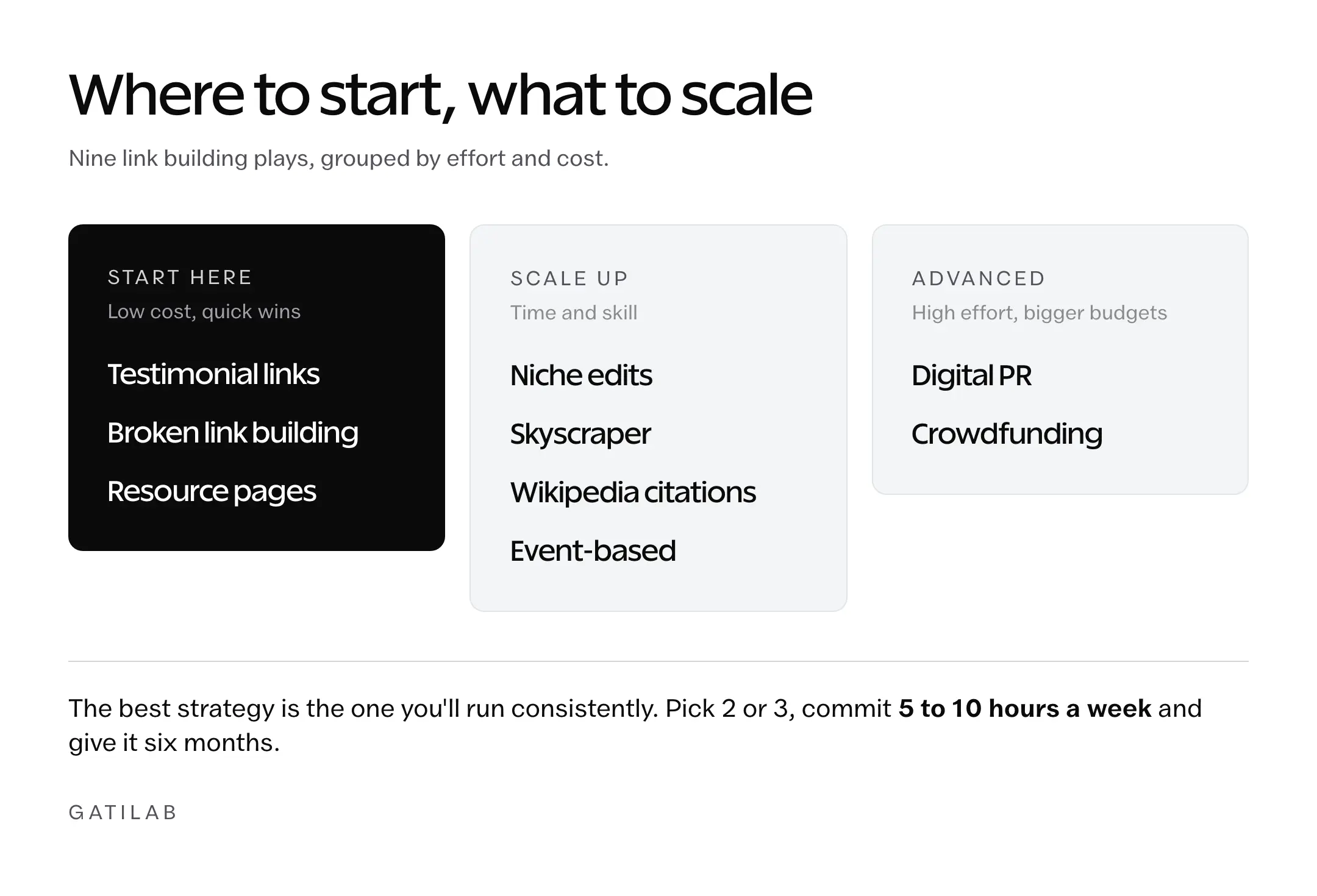
Let me walk you through 9 strategies I recommend, ranked roughly by how effective they are right now.
Broken Link Building
This is one of the oldest strategies in the book, and it still works. The concept is simple: you find broken links on authority sites, create content that replaces the dead resource, and ask the site owner to swap the broken link for yours. You’re doing them a favor by fixing their site while earning a link.
How to Find Broken Links on Authority Sites
Ahrefs works well for this. Go to Content Explorer, search for your topic, and filter by sites with high Domain Rating (DR 40+). Then run those URLs through Site Explorer and check the “Best by Links” report filtered to 404 pages. You’ll find pages that used to attract dozens of links but are now dead. That’s your opportunity.
The Chrome extension “Check My Links” is also useful when you’re manually browsing resource pages. It highlights every broken link on a page in red. A focused 30-minute session on competitor resource pages with this extension running can surface several broken link opportunities.
Outreach That Gets Responses
Your outreach email needs to be short and helpful. Don’t write a 500-word pitch about yourself. Here’s the structure I recommend: subject line mentions their broken link, first sentence identifies the specific broken URL on their page, second sentence offers your replacement resource, and that’s it. Three to four sentences total.
Expect most broken link building emails to go unanswered. Backlinko and Pitchbox’s analysis of 12 million outreach emails found that only 8.5% got any reply at all, and a reply isn’t always a link. Track your own reply and link rates from the first batch so you know how many emails a link costs you. It’s not glamorous, but when those links come from DR 50+ sites, the ROI is worth the volume.
The Honest Downside
Broken link building is time-intensive. Finding quality broken links, creating replacement content, and sending outreach takes real effort. If you’re a solo operator, expect to spend 8 to 10 hours per week to run this at scale. I recommend it for anyone willing to put in consistent effort, but it’s not a quick win.
Resource Page Link Building
Resource pages are curated lists of helpful links on a specific topic. Universities, industry blogs, and government sites all maintain them. Getting listed on these pages can earn you high-authority links with minimal friction.
Finding the Right Resource Pages
Use Google search operators to find resource pages in your niche. Try searches like “your keyword” + “useful resources” or “your keyword” + “recommended links” or “your keyword” + intitle:”resources”. Adding “site:.edu” or “site:.gov” to these searches tends to surface the highest-quality opportunities.
Not every resource page is worth pursuing. Look for three things: the page has been updated in the last 12 months, it has at least DR 30, and it’s actually relevant to your content. A resource page about “digital marketing tools” won’t help you if your content is about WordPress hosting. Relevance beats authority every time.
Creating Content Worth Linking To
Here’s where most people fail. They find great resource pages but have nothing worth adding. You need a genuine resource, something like an in-depth guide, a free tool, a detailed tutorial, or original research. Blog posts with 800 words of generic advice won’t get added to anyone’s curated list.
Take a WordPress speed optimization guide as an example. One built on original test data from several hosting providers gives curators something they can’t find anywhere else, and that’s what gets a page added to resource lists. An asset like that takes weeks to produce, but it keeps earning links for months after a quick post would have been forgotten.
Niche Edits and Link Insertions
Niche edits are links placed into existing, already-indexed content. Instead of getting a new article published, you’re getting your link added to a page that already ranks and has authority. This is one of the most effective strategies in 2026, and also one of the most misunderstood.
The Right Way to Do Niche Edits
There are two approaches: outreach-based and paid. I strongly recommend the outreach approach. You find relevant articles that mention your topic but don’t link to your resource, then you email the author and suggest adding your link as a helpful reference for their readers. It’s similar to broken link building but without needing a broken link as the entry point.
Target articles that rank on page one or two for related keywords. If someone wrote a guide about “WordPress security” and mentioned caching plugins without linking to a specific resource, reach out and suggest your caching comparison guide. Expect a lower hit rate than broken link building because there’s no broken link giving the editor a reason to act, but the links you get are incredibly powerful because the pages already have established authority and traffic.
Paid Niche Edits: My Honest Take
Let me be direct: paid niche edits exist in a gray area. Buying links violates Google’s guidelines. Some buyers of paid niche edits see short-term gains, others get penalized, and the quality varies wildly. If you go this route, you’re accepting risk. I recommend outreach-based niche edits instead because the links are more sustainable and don’t carry penalty risk.
The sites selling niche edits often reuse the same network of blogs. Google’s spam detection has gotten significantly better in 2025 and 2026. When a link network gets deindexed, every link it sold goes with it. Not worth the gamble when outreach-based methods work.
Testimonial Link Building
This is the most underrated link building strategy I know. Almost every software company and service provider features customer testimonials on their website, and most of those testimonials include a link back to the customer’s site. You’re already using tools and services. Turn that into links.
How to Execute This at Scale
Make a list of every tool, plugin, hosting provider, and service you pay for. Then write a genuine testimonial for each one. I’m talking 3 to 5 sentences about your real experience with the product. Submit it through their website, or email their marketing team directly. Most companies are hungry for social proof and will happily feature your testimonial with a link.
The effort is small. A batch of testimonials for the tools you already pay for can be written and submitted over a few weeks, a few hours of work in total. Not every company will publish yours, and not every published testimonial carries a dofollow link, so check each one after it goes live. Many software companies run high-authority sites, which is what makes those few hours worth it.
Picking the Right Products to Review
Focus on products where the company is actively collecting testimonials. Check their website for a testimonials page or a “wall of love” section. Newer companies and startups are especially receptive because they’re still building social proof. Enterprise companies tend to have slower processes and more requirements, so mid-market SaaS products are usually the better target.
One tip: if you can include a specific, real metric in your testimonial (“This tool reduced our page load time by [your result]”), companies are far more likely to feature it prominently. Numbers make testimonials more credible, and companies know this.
Event-Based Link Building
Events generate links naturally because they create something newsworthy. Hosting a virtual summit, sponsoring a local meetup, or creating a scholarship attracts mentions and links from attendees, sponsors, press, and community organizations.
Virtual Events and Webinars
Virtual events became mainstream during the pandemic, and they haven’t slowed down. Hosting a free webinar or virtual summit in your niche can earn you links from co-hosts, speakers, industry publications that cover the event, and attendees who write about what they learned. Speaker bios, event listings, and recap articles are where most of those links come from.
The key is making the event genuinely valuable. Nobody links to a thinly disguised sales pitch. Bring in real experts, cover topics your audience cares about, and make the recordings freely available afterward. The content continues to attract links long after the live event ends.
Scholarship Link Building in 2026
I need to be honest here: scholarship link building has been heavily abused and is less effective than it was three years ago. Google caught on to the pattern of businesses creating fake scholarships purely for .edu links. That said, if you create a legitimate scholarship with real money behind it and a genuine application process, it still works. Judge it by whether you’d fund the scholarship with no links at all. If the answer is no, skip it.
The difference between a legitimate scholarship and a spammy one is obvious. Real scholarships have real winners, actual application requirements, and meaningful award amounts. If you’re offering a $250 scholarship with no real selection process, universities will see through it. This strategy only makes sense for businesses genuinely willing to invest in supporting students.
Conference and Meetup Sponsorships
Sponsoring industry conferences and local meetups is a reliable way to earn links from event websites, press coverage, and attendee blogs. I typically recommend sponsoring 3 to 4 events per year in your industry. Costs vary widely, from a small local meetup to a major conference, but the links are high quality and come with real brand exposure.
Wikipedia Link Building
Wikipedia links are nofollow, so they don’t pass direct PageRank. But they drive referral traffic, build credibility, and can indirectly improve your SEO because Google uses Wikipedia as a trust signal. I include this strategy because, done correctly, it earns visibility that few other links can.
Finding Citation Opportunities
Wikipedia editors are constantly flagging articles that need citations. Search for “[your topic] site:wikipedia.org” and look for articles with “citation needed” tags. If you have original research, data, or a thorough resource that could serve as a citation, you can add it. The key is that your source must be genuinely authoritative and not self-promotional.
The best candidates are original data assets, such as an annual industry or threat report, that editors can cite as a primary source. A citation on a relevant Wikipedia article can send steady referral traffic, and the brand authority boost is hard to quantify but real.
Rules You Must Follow
Wikipedia has strict editing guidelines, and violating them will get your edits reverted and your account flagged. Never edit an article to add a link to your own company. Use a neutral tone. Only add citations that genuinely improve the article. And don’t create a new account just to add one link. Build editing credibility first by making helpful edits to unrelated articles.
Hiring Wikipedia editors to manipulate pages almost always backfires. The Wikipedia community is incredibly vigilant about detecting promotional editing. Play the long game here. Build a legitimate editing history, contribute genuinely useful citations, and the results will follow.
Digital PR for Link Building
Digital PR is the strategy I’m most bullish on in 2026. Creating newsworthy content, original research, and data-driven studies that journalists want to cover is the most scalable way to earn high-authority links. It’s also the most difficult, which is why most people avoid it. SEO professionals agree on its value: in Editorial.Link’s 2026 survey of 518 SEO professionals, 48.6% named digital PR the most effective link building tactic, well ahead of guest posting at 16%.
Creating Data-Driven Content
Journalists need data for their stories. If you can provide original research, survey results, or unique data analysis, you become a source they return to repeatedly. A survey of small business owners about their SEO spending habits is a good example. It gives reporters a fresh number to quote, and every story that cites it is a chance at a link. Budget for the survey panel and for the time to package the findings into a clean report with charts and quotable numbers.
The content doesn’t have to be expensive, though. A simple analysis of data you already have, such as anonymized Google Search Console queries compiled into a trends report, costs nothing but time and can earn links from industry blogs.
HARO Is Back, and Alternatives Exist
HARO (Help A Reporter Out) was rebranded as Connectively in 2024, and Cision shut Connectively down that December. In April 2025, Cision sold the HARO brand to Featured.com, which relaunched it as a free email of journalist queries. Journalist outreach is alive and well. In 2026, I’d use HARO alongside platforms like Qwoted, SourceBottle, and direct Twitter/X outreach to journalists covering your industry. It also pays to monitor hashtags like #journorequest and #prrequest.
Journalist queries reward genuinely expert commentary with specific data points. Generic responses get ignored. When a journalist asks about SEO trends, don’t send a vague statement. Send a specific, checkable line built on your own data: “Across the [number] sites we track, [your data point] since October 25, 2026.” That kind of specificity, backed by data you can share if asked, gets you quoted and linked.
The Skyscraper Technique
Brian Dean popularized this strategy years ago, and the core concept still works. Find content that’s already earning links, create something significantly better, and reach out to everyone linking to the original piece. But the bar for “significantly better” has risen dramatically in 2026.
What “Better” Means Now
In 2018, you could take a “50 SEO Tips” article, expand it to “100 SEO Tips,” and call it better. That doesn’t work anymore. Better in 2026 means more original data, better design, more practical examples, and a perspective that can’t be replicated by AI. Your skyscraper content needs to include something that required actual expertise to create.
Take a competitor’s WordPress migration guide as an example. Making it longer won’t beat it. Adding original screenshots from real migrations you’ve performed, a downloadable pre-migration checklist, and a video walkthrough gives linkers a reason to switch, because it offers something the original can’t: proof of real experience.
Outreach to Existing Linkers
The outreach component is straightforward. Use Ahrefs to find everyone linking to the original piece you’ve improved upon. Send a short email explaining that you’ve created an updated, more complete resource and thought they might want to check it out. Don’t ask for a link directly. Let the quality of your content do the convincing.
Skyscraper outreach converts worse than it used to. People get more outreach emails than ever, and many webmasters are numb to these requests. Still, the links you do earn come from sites that were already linking to similar content, so they’re highly relevant and topically appropriate. Quality over quantity.
Crowdfunding for Link Building
This one surprises people, but launching a product or project on Kickstarter or Indiegogo generates significant press coverage and backlinks. Even if the product isn’t your core business, a creative campaign can earn links from tech blogs, industry publications, and local media.
How This Works in Practice
Picture a WordPress development agency launching a free, open-source accessibility plugin on Kickstarter to fund its development. The money raised matters less than the coverage. Tech publications, accessibility advocacy sites, and WordPress community blogs all have a reason to write about it, and each write-up is a potential backlink you’d struggle to earn through cold outreach.
The campaign itself becomes a linkable event. Journalists cover interesting Kickstarter projects. Bloggers write about products they back. Community members share campaigns on forums and social media. You’re creating a story that people want to tell, and stories earn links naturally.
When to Use This Strategy
Crowdfunding link building isn’t for everyone. You need a product or project that’s genuinely interesting and fundable. A boring B2B SaaS tool probably won’t generate excitement on Kickstarter. But if you can frame your offering as something innovative or community-driven, this strategy can outperform months of traditional outreach in a single campaign.
This suits businesses launching something new and want maximum initial link velocity. The links come fast during and immediately after a campaign, which gives new products a strong SEO foundation from day one.
Measuring Link Building ROI
If you’re investing time and money in link building but not measuring results, you’re guessing. Track specific metrics for every campaign from the first week.
The Metrics That Actually Matter
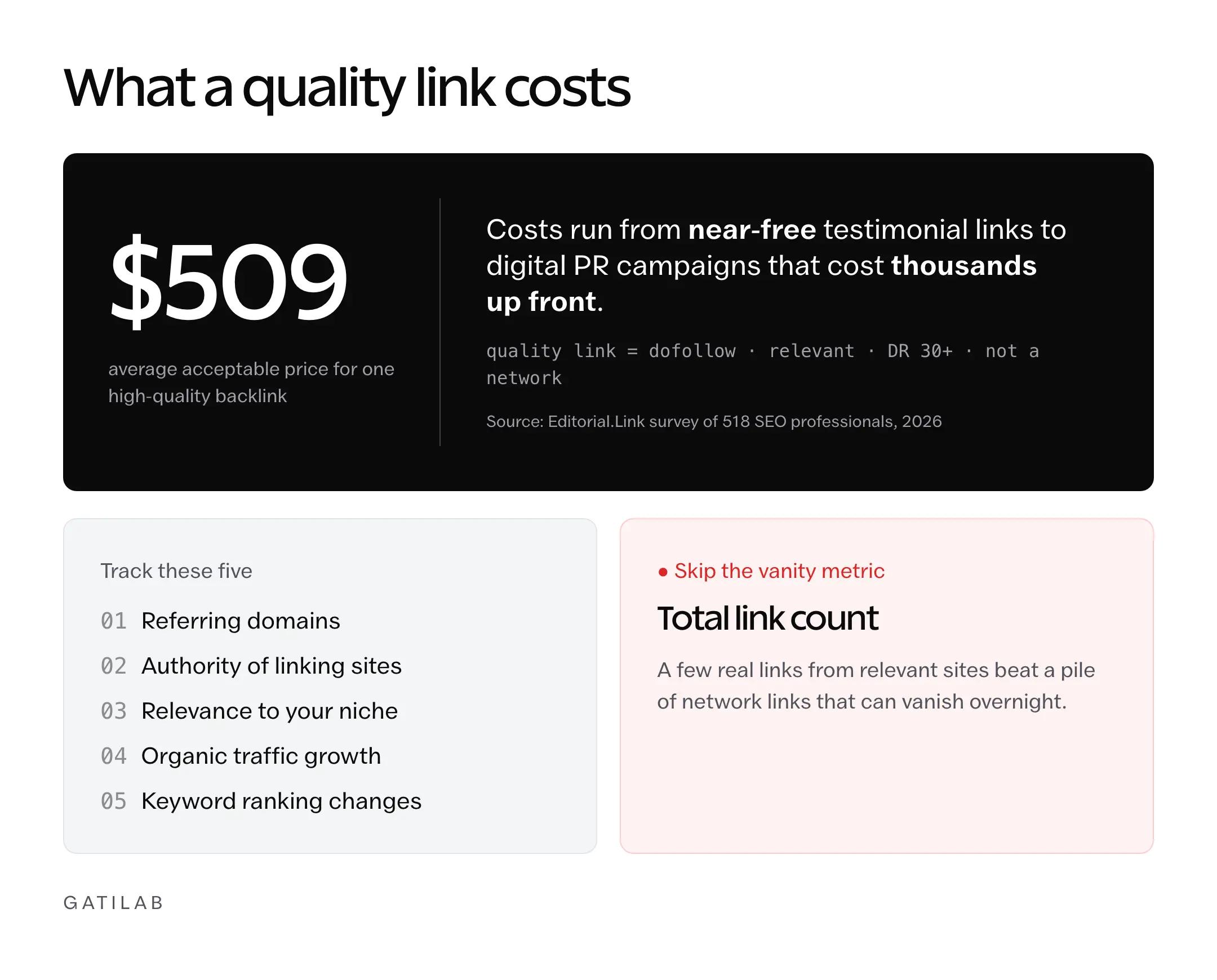
Forget vanity metrics like total number of links. Here’s what to track: referring domains (unique sites linking to you), domain authority of linking sites, relevance of linking sites to your niche, organic traffic growth correlated with link acquisition, and keyword ranking changes for target terms. Review these monthly.
The metric I care about most is cost per quality link. A “quality link” in my definition is a dofollow link from a relevant site with DR 30+ that isn’t part of a link network. Calculate it with labor, tools, and outreach costs included alongside any placement fees. For a market benchmark, the SEO professionals in the same Editorial.Link survey put the average acceptable price for one high-quality backlink at about $509. Some strategies are cheaper (testimonial links cost almost nothing), while digital PR campaigns cost thousands up front and need to land several links to pay off.
Tracking Link Acquisition
Ahrefs works well for tracking new and lost backlinks. Set up alerts for your domain so you get notified whenever a new referring domain links to you. Cross-reference this with your outreach log to see which strategies are producing results. Keep a simple spreadsheet for each campaign: date, strategy used, outreach sent, links earned, DR of linking site, and estimated value.
The attribution to rankings is where it gets tricky. Links rarely cause overnight ranking jumps. More often, you’ll see gradual improvements over 3 to 6 months as your link profile strengthens. I’d expect meaningful ranking movement about 90 days after a sustained link building effort begins. If you’re not seeing movement after 6 months, something about your strategy needs to change.
What I’d Do With a Limited Budget
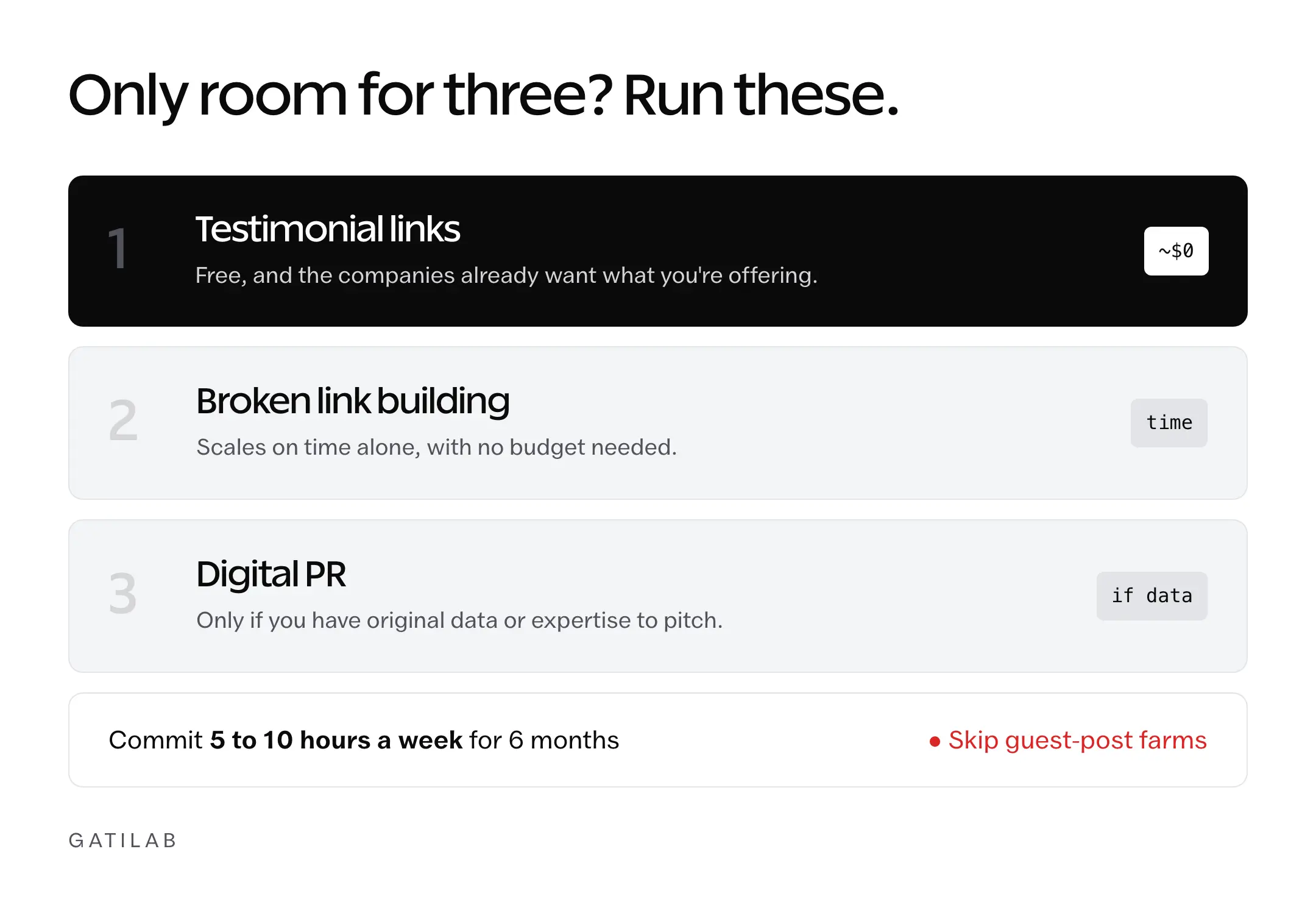
If you’re starting fresh and can only focus on 2 to 3 strategies, here’s exactly what I’d pick. First, testimonial link building because it’s free and the companies already want what you’re offering. Second, broken link building because it scales well with just time investment. Third, digital PR if you have any original data or expertise worth sharing with journalists.
Skip the paid link schemes. Skip the guest post farms selling cheap placements on no-name blogs. Focus on earning links from real sites through genuine value. It takes longer, but the results actually stick. Links bought from shady vendors disappear the day their link network gets deindexed. Links earned through outreach and PR from real sites don’t carry that risk, and they tend to stay in place for years.
The best link building strategy is the one you’ll execute consistently. Pick your 2 to 3 methods, commit to 5 to 10 hours per week, and run the playbook for at least 6 months before judging results.
Frequently Asked Questions
How many backlinks do I need to rank on the first page of Google?
There’s no magic number. Some pages rank #1 with a handful of referring domains, while others need hundreds. It depends on your niche competition, your site’s overall authority, and how well your content matches search intent. Focus on earning links from relevant, authoritative sites rather than hitting a specific count. Quality beats quantity every single time.
Is link building still important for SEO in 2026?
Yes. Links remain one of Google’s strongest ranking signals. The way you build links has changed (no more spammy directories or article spinning), but the fundamental principle hasn’t. Sites with strong backlink profiles consistently outrank those without them. Ranking for competitive terms without a deliberate link building effort is rare.
How long does it take for new backlinks to impact rankings?
Expect 60 to 90 days before you see meaningful ranking movement from new links. Google needs time to discover, crawl, and evaluate the linking page. I recommend committing to at least 6 months of consistent link building before judging whether a strategy is working. Short-term thinking is the biggest reason link building campaigns fail.
What’s the difference between dofollow and nofollow links?
Dofollow links pass PageRank and directly influence your rankings. Nofollow links include a rel=”nofollow” attribute that tells Google not to pass ranking value. That said, Google treats nofollow as a “hint” rather than a directive since 2019, so nofollow links from high-authority sites (like Wikipedia) can still provide indirect SEO benefits and referral traffic.
Should I buy backlinks to speed up my results?
I don’t recommend it. Buying links violates Google’s guidelines and carries real penalty risk. Google’s spam policies treat purchased links as link spam, and a manual action is expensive to undo. The cost to recover (disavow process, reconsideration requests, rebuilding trust) far exceeds what they saved by buying links in the first place. Earn your links through outreach and great content.
What tools do I need for link building?
At minimum, you need Ahrefs or Semrush for backlink analysis and prospecting (I prefer Ahrefs). A tool like Hunter.io or Apollo helps you find email addresses for outreach. Google Sheets or a simple CRM works for tracking your campaigns. The Check My Links Chrome extension is free and useful for broken link building. The SEO tool is the main monthly cost, so check current plans on the vendor’s pricing page before you budget.
How do I know if a backlink is high quality?
I look at four things: relevance (is the linking site related to your niche?), authority (DR 30+ is my minimum threshold), traffic (does the linking page get actual visitors?), and editorial placement (is the link placed naturally within content, not in a sidebar or footer?). A link that scores well on all four criteria is worth more than 50 low-quality links.
Can I do link building myself, or should I hire someone?
You can absolutely do it yourself if you have 5 to 10 hours per week to dedicate. Start with testimonial link building and broken link building since they’re the most beginner-friendly strategies. If your hours are worth more than what a vetted specialist charges, hiring one makes financial sense. Just vet them carefully because the link building industry has plenty of vendors selling low-quality links at premium prices.
Pick one strategy from this list and execute it this week. Not next month. This week. Send 10 outreach emails, write 3 testimonials, or start researching broken links in your niche. The difference between people who build strong backlink profiles and those who don’t isn’t knowledge. It’s action. You now have the knowledge. Go put it to work.
For the current playbook, see link building strategies that work in 2026.
Tell Google you want more of this.
Add Gatilab as a preferred sourceOne tap, and this site shows up more often in your own Top Stories, AI Overviews and AI Mode. Remove it any time.