
Advertising vs Promotion: How to Spend Your Budget
Advertising vs promotion is a reach-versus-activation decision, but the two tactics are related. Advertising pays to place a controlled message in front of an audience. Promotion gives that audience a reason to notice, try, buy, or return. One buys distribution. The other changes the offer or the moment.
That distinction matters because small businesses waste money when they ask one tactic to do the other’s job. A weak offer doesn’t become persuasive because you buy more impressions. A strong discount doesn’t help if nobody sees it.
- Claim standard: The US Federal Trade Commission requires advertisers to have a reasonable basis for objective claims before an ad runs.
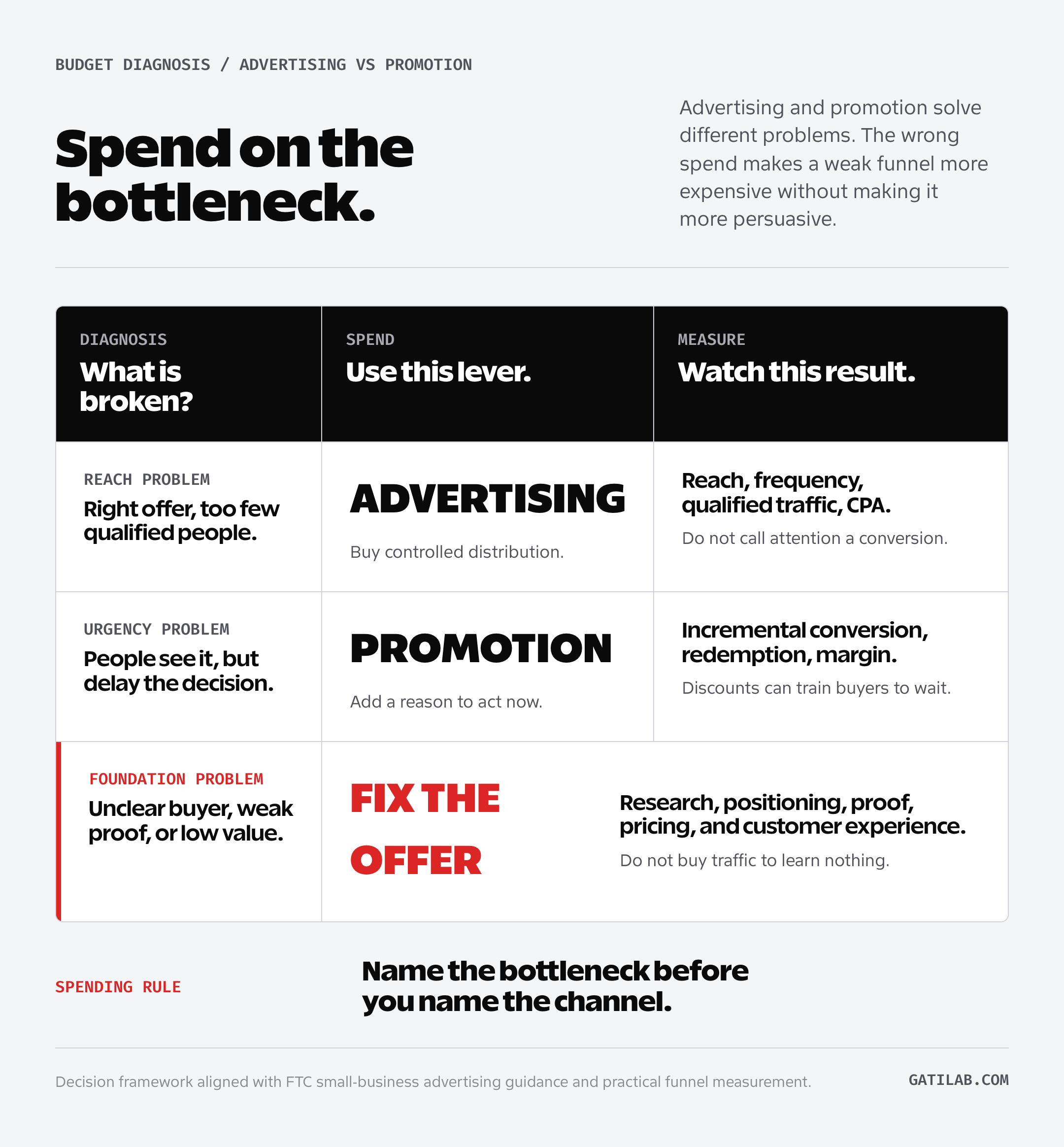
- Budget diagnosis: Advertising fixes a distribution problem. Promotion fixes a reason-to-act problem. Neither fixes a weak offer.
Advertising vs Promotion: What Is the Difference?
Advertising is the paid distribution layer. Promotion is the broader activation layer, which can include discounts, launches, events, partnerships, samples, email pushes, and even advertising itself.
| Factor | Advertising | Promotion |
|---|---|---|
| Primary job | Buy attention and reach | Create urgency, relevance, or action |
| Typical cost | Media spend plus creative | Margin, incentive, time, or distribution cost |
| Control | High control over message and targeting | Varies by channel and partner |
| Speed | Fast once the campaign is live | Fast for offers, slower for earned promotion |
| Credibility | The audience knows you paid for placement | Can be higher when carried by customers or partners |
| Best metrics | CPM, CPC, reach, frequency, CPA | Redemption, activation, conversion, repeat purchase |
| Main risk | Paying to amplify a weak message | Training buyers to wait for discounts |
If you need a clean definition of the paid side first, read what PPC means and how pay-per-click works. The important point here is that PPC is one advertising mechanism, not the whole promotional strategy.
What does advertising do?
Advertising gives you three things you usually can’t get quickly through organic distribution:
- A defined audience
- A predictable delivery mechanism
- A measurable cost for reaching or acquiring that audience
Google Ads can capture existing demand. Meta Ads can create or refresh demand. LinkedIn Ads can narrow delivery by company, role, and professional context. Podcast and newsletter sponsorships can borrow attention from a trusted publisher.
What advertising can’t do is manufacture proof. If your landing page is vague, your product lacks a reason to choose it, or your onboarding leaks customers, more traffic increases the speed at which you discover the problem. It doesn’t repair the problem.
My rule is simple: don’t increase ad spend until you can explain why the current traffic isn’t converting. “We need more leads” is a goal. It isn’t a diagnosis.
The US Federal Trade Commission also expects advertisers to have a reasonable basis for objective claims before an ad runs. Its small-business advertising guidance is the source I trust here because the FTC enforces US advertising law. Read it before you use testimonials, performance claims, or fine-print qualifications.
What makes a promotion work?
Promotion is the part that answers, “Why should this person care now?”
That reason doesn’t have to be a discount. In fact, discounts are often the laziest form of promotion. A useful promotion can be:
- A live workshop that demonstrates the product
- A limited onboarding cohort
- A partner bundle
- A free migration or setup service
- A product launch with a specific deadline
- A customer story distributed to the right segment
- A referral reward
- A seasonal offer tied to an actual buying moment
Organic distribution also belongs in this layer. A practical social media content promotion system can extend the life of a strong asset without paying for every impression.
The trap is confusing activity with activation. Posting the same link ten times isn’t a promotional strategy. A promotion needs a reason, an audience, a channel, and a measurable response.
What are the main promotion channels?
You can make better budget decisions by separating four levers.
| Lever | What you control | What you give up | Useful when |
|---|---|---|---|
| Paid media | Targeting, creative, budget, timing | Cash and platform dependence | You need reach or demand capture now |
| Sales promotion | Offer, deadline, bonus, bundle | Margin or operational capacity | Buyers need a reason to act |
| Owned distribution | Email, website, community, product | Time to build the audience | You want compounding access |
| Earned attention | Reviews, mentions, referrals, press | Message control and predictability | Trust matters more than speed |
A healthy strategy uses more than one lever. Advertising can send qualified traffic to a useful tool. Email can follow up with people who weren’t ready. A partner can introduce the offer with borrowed trust. A limited service bonus can remove the final objection.
This is why a complete social media marketing plan measures more than follower growth. Distribution, activation, and revenue need separate numbers.
Should you fund advertising or promotion first?
Start with the bottleneck, not the fashionable channel.
Choose advertising first when:
- People already search for the problem you solve.
- Your offer converts through a working landing page or sales call.
- You know the maximum acceptable acquisition cost.
- You need data quickly.
- Your sales capacity can handle more demand.
Choose promotion first when:
- You have an audience but weak response.
- Buyers understand the category but don’t see a reason to switch.
- A product launch, event, or deadline creates genuine relevance.
- Partners can reach the audience more credibly than ads can.
- The offer needs packaging, proof, or risk reversal before more traffic.
Fix the foundation before either when:
- Nobody can explain the target customer in one sentence.
- The product solves too many unrelated problems.
- Sales calls reveal the same unanswered objection.
- Retention is poor.
- You don’t know what a customer is worth.
For SaaS teams, the SaaS marketing strategy framework connects channels to funnel stages and metrics. That prevents a common reporting mistake: judging an awareness campaign by immediate purchases or judging a search campaign only by impressions.
How should the mix change by business model?
The same distinction looks different once the business model changes.
SaaS
Use advertising to capture high-intent searches and retarget product-aware visitors. Use promotion to offer a guided migration, a live implementation session, or a time-bounded onboarding cohort.
Don’t lead with a permanent 50% discount. It weakens pricing before the customer has understood the product.
Ecommerce
Use advertising for product discovery and remarketing. Use promotion for bundles, threshold-based shipping, seasonal merchandising, and loyalty rewards.
Track contribution margin, not just return on ad spend. A campaign can report attractive revenue while giving away the profit through discounts and fulfillment.
Local services
Use search advertising for urgent, high-intent needs. Use promotion through local partnerships, referral systems, workshops, and service packages.
Don’t buy broad awareness if your team can’t answer calls quickly or your reviews don’t support the promise.
Creator or educator
Use advertising to distribute a proven lead magnet or launch asset. Use promotion through collaborations, cohort deadlines, live sessions, and a useful email sequence.
Don’t pay to grow an audience you have no plan to serve after the campaign ends.
Which metrics show whether each is working?
Advertising metrics tell you whether distribution is efficient. Promotion metrics tell you whether the offer changed behavior.
Advertising metrics
- Reach and frequency
- Cost per thousand impressions
- Click-through rate
- Cost per qualified visit
- Cost per lead or acquisition
Promotion metrics
- Offer redemption or activation rate
- Incremental conversion rate
- Average order value
- Contribution margin
- Repeat purchase or retention after the promotion
The word “incremental” matters. If 100 people would have purchased anyway and all 100 use a coupon, the coupon recorded activity but created no additional demand.
What should you decide before spending?
Before spending, write down:
- The audience
- The behavior you want
- The reason they should act now
- The channel that can reach them
- The maximum cost of that action
- The evidence that supports the promise
If you can’t answer number three, you have a promotion problem. If you can answer it but the right people never encounter the offer, you have an advertising problem. If both answers are weak, keep the budget and fix the offer.
FAQs
These are the distinctions that cause the most confusion during budget planning.
Is advertising a type of promotion?
Yes. In the broad marketing mix, advertising is one form of promotion. In budget planning, separate paid media from the offer, incentive, partnership, or event that gives people a reason to act.
Is a discount advertising or promotion?
A discount is a sales promotion. Paying a media platform or publisher to distribute that discount is advertising.
Which is cheaper for a small business?
Promotion can require less cash, but it still costs margin, time, fulfillment, or partner effort. Advertising has a clearer media cost. Compare total economics, not only cash outlay.
Can promotion work without advertising?
Yes, if you already have owned or earned distribution through email, search traffic, customers, communities, partners, or referrals. Without distribution, even a strong promotion stays invisible.
What should a new business do first?
Clarify the audience, offer, proof, and conversion path. Then use the cheapest credible distribution available to learn. Paid advertising becomes useful after you can measure what happens after the click.
Tell Google you want more of this.
Add Gatilab as a preferred sourceOne tap, and this site shows up more often in your own Top Stories, AI Overviews and AI Mode. Remove it any time.