
Local Search Engine Marketing Services: Costs and Scope
Local search engine marketing services manage paid and organic visibility across Google, Bing, and Apple Maps for businesses that sell within a specific geographic area. A working engagement includes Google Ads Local campaigns, Bing Local Ads, Local Services Ads management, Google Business Profile optimization, landing page CRO, call tracking, and monthly reporting. Typical pricing: $1,000 to $2,500/month for single-location service businesses, $3,000 to $6,000/month for multi-location operators, $6,000 to $10,000+/month for regional chains or legal/medical practices competing in major metros.
Most agencies bundle local SEM with local SEO and sell them together. They’re different disciplines. SEM buys traffic through auctions. SEO earns traffic through ranking. This article is about the paid half, the channels that cost money on the ad platform side in addition to the management fee.
What’s actually included in a local SEM engagement
A complete local SEM service covers seven deliverables. Agencies that skip any of them are selling you an incomplete service.
Google Ads Local campaigns. Search campaigns targeted to the service area, with keyword research, ad copy, extensions (call, location, sitelinks, callout, structured snippets), bidding strategy, and daily optimization. This is the core of most engagements and typically 50 to 70 percent of ad spend.
Google Local Services Ads management. LSA is a separate platform with its own ad creation, lead dispute process, background verification, and bidding model. Running LSA alongside standard Google Ads creates the full upper-to-lower-funnel coverage on Google search.
Bing Local Ads. Bing owns 8 to 12 percent of US search depending on device and vertical. CPCs average 30 to 60 percent lower than Google. For home services and legal categories, Bing traffic converts at similar or better rates than Google. Skipping Bing means leaving 10 percent of conversions on the table at a 40 percent discount.
Google Business Profile optimization. GBP sits in the SEM conversation because Ads campaigns use GBP extensions, and LSA requires a claimed GBP. Weekly posts, Q&A monitoring, photo uploads, service updates, and review response management.
Geo-fencing and radius targeting. Display and YouTube ads targeted to specific ZIP codes, competitors’ addresses, or custom polygons. Best for branding and competitor conquesting, not direct response.
Landing page CRO. Dedicated landing pages for ad traffic, distinct from the main site. Dynamic keyword and city insertion, fast load times (under 2 seconds on 4G), single-focus CTAs, trust signals near the form.
Call tracking and lead attribution. CallRail, WhatConverts, or Invoca assigning dynamic numbers to each ad source, recording calls, and attributing leads to specific keywords and campaigns. Non-negotiable. You can’t optimize what you can’t measure.
Monthly reporting with lead quality scoring. Not just spend and clicks. Actual lead counts, lead-to-customer conversion, cost per customer, and revenue by channel. The agencies that won’t report on lead quality are usually hiding poor lead quality.
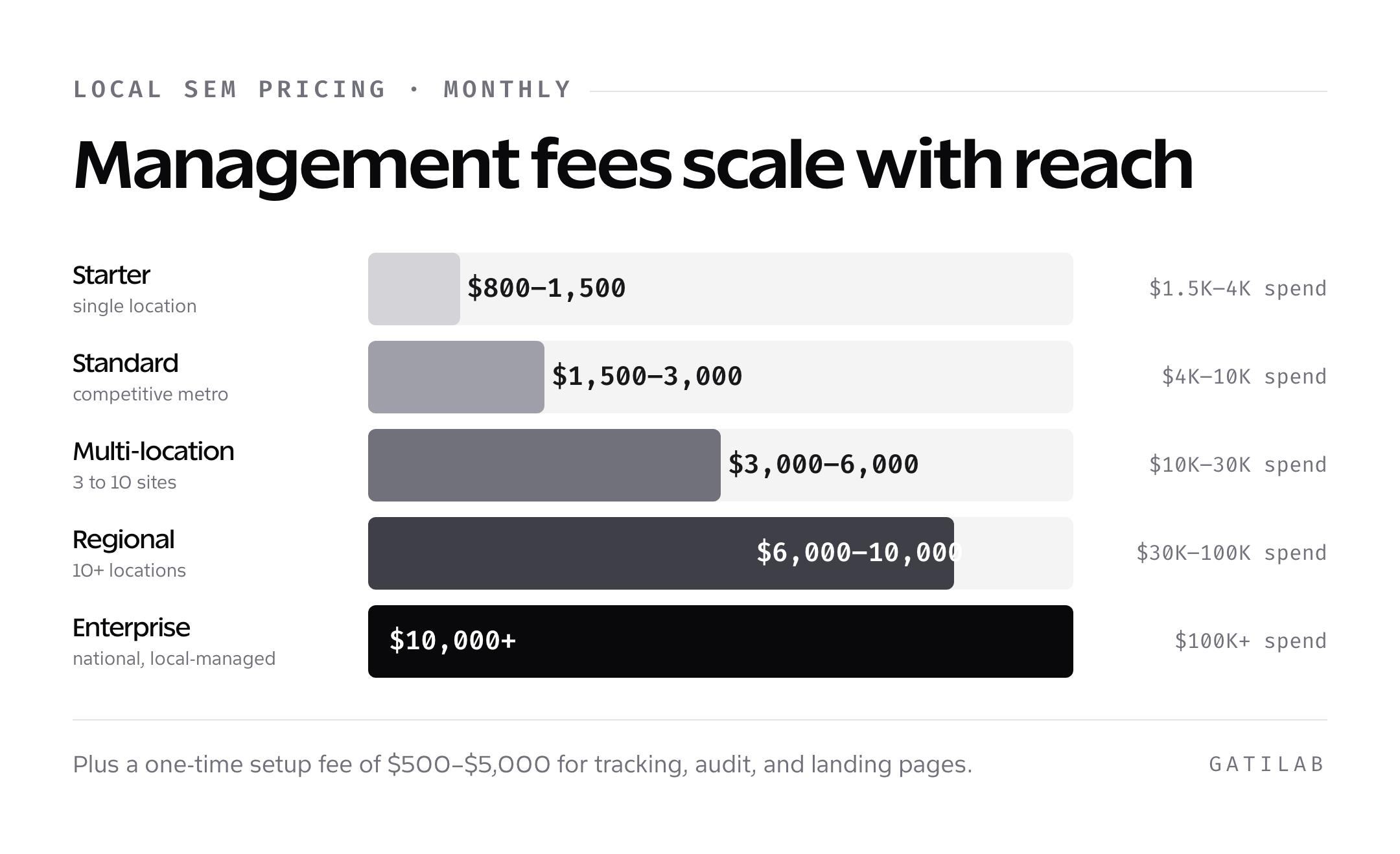
Typical pricing bands in 2026
| Service tier | Monthly management fee | Recommended ad spend | Best for |
|---|---|---|---|
| Starter (single location) | $800 to $1,500 | $1,500 to $4,000 | Solo practitioners, local service businesses under $500k revenue |
| Standard (single location, competitive metro) | $1,500 to $3,000 | $4,000 to $10,000 | Established local businesses in top-50 metros |
| Multi-location | $3,000 to $6,000 | $10,000 to $30,000 | Franchises, chains, 3 to 10 locations |
| Regional | $6,000 to $10,000 | $30,000 to $100,000 | 10+ locations, regional brands, law firms |
| Enterprise local | $10,000+ | $100,000+ | National franchises managed at local level, healthcare systems |
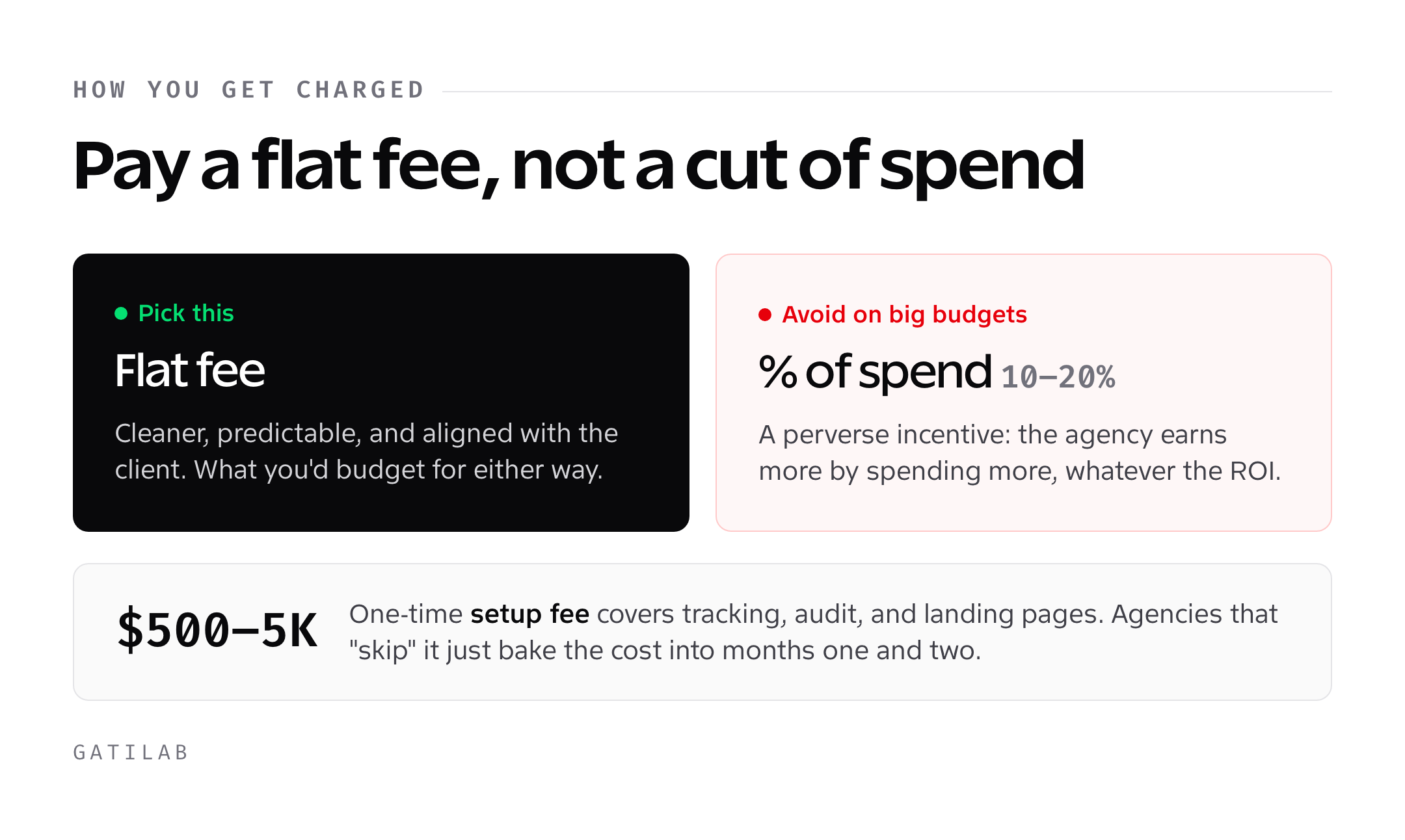
Management fees can be flat or percentage-of-spend. Flat is cleaner and better for the client. Percentage of spend (usually 10 to 20 percent) creates a perverse incentive: the agency earns more by spending more, regardless of ROI. Avoid percentage-of-spend on large budgets.
One-time setup fees range from $500 to $5,000 depending on complexity. That covers landing page builds, tracking setup, audit, initial campaign structure. Expect it. Agencies that don’t charge setup fees usually bake the cost into month one and month two, where you’ll see little actual output.
Google Ads Local campaign structure
Every local Google Ads account should be structured around these campaign types:
Core service search campaigns. One campaign per core service (“emergency plumbing,” “drain cleaning,” “water heater repair”). Ad groups segmented by intent modifier (“emergency,” “24 hour,” “same day”) and location (“phoenix,” “scottsdale,” “tempe”). Budget allocated based on margin and lead value.
Branded search campaigns. Bidding on your own brand name defensively. Competitors will bid on it if you don’t. Average CPC: $0.50 to $2. Conversion rate: 15 to 30 percent. Cheapest leads in the account.
Competitor conquest campaigns. Bidding on competitor names with targeted ad copy and comparison landing pages. Higher CPCs, lower conversion, but strategic value. Use this selectively, not on every competitor.
Call-only campaigns. Mobile-only ads that trigger a phone call instead of a website visit. 30 to 50 percent better performance on emergency service categories than standard search ads.
Performance Max for local. Google’s newer campaign type that mixes Search, Display, YouTube, Gmail, and Maps. Works well when layered on top of manual Search campaigns, not as a replacement. Set tight asset controls and keep Performance Max out of core brand terms.
Smart campaigns on GBP. The simplified Google Ads product that runs directly from the GBP dashboard. Skip it. The simpler interface hides performance data and auto-optimizes poorly compared to a proper Search campaign.
Local Services Ads management
LSA has a separate set of deliverables because it’s a separate product with different mechanics. A competent LSA service includes:
Onboarding through license, insurance, and background check verification. This takes 2 to 4 weeks and requires documentation from the business. The agency handles submission, the owner provides the docs.
Full setup of services, service areas, hours, and bid strategy. LSA uses a weekly budget cap and a “Max per lead” bid (or automated bidding). Getting the bid right takes 4 to 8 weeks of adjustment based on lead volume and quality.
Full breakdown of how the platform works: Google LSA Complete Guide.
Lead dispute management. Every invalid lead gets disputed inside the 30-day window. Spam, out-of-area, wrong service, no-answer from the lead, and quote-only-not-serious all qualify. Expect 15 to 30 percent of leads to be dispute-eligible. Good agencies run a 70 to 85 percent dispute win rate.
Review and rating management inside LSA specifically. LSA uses its own review system that feeds off GBP reviews. Maintaining a 4.5+ star rating is a hard requirement. Drop below it and your ad rank tanks.
Google Guarantee maintenance. Annual renewal, insurance updates, license updates. Miss a renewal and your Google Guarantee badge disappears, dropping CTR by 15 to 25 percent.
Weekly bid and service adjustments based on lead quality and volume targets.
Bing Local Ads and Microsoft Advertising
Bing’s share is smaller but not trivial. Desktop search on Windows 11, Edge browser, and Outlook.com all default to Bing. That skews toward older, higher-income, and more desktop-heavy audiences, which aligns well with legal, healthcare, and B2B local services.
Microsoft Advertising imports directly from Google Ads, which cuts setup time to minutes rather than hours. But imported campaigns underperform native Bing builds because audience behaviors differ. A properly built Bing campaign runs 20 to 40 percent cheaper CPCs than Google and converts at 70 to 90 percent of Google’s rate.
LinkedIn audience targeting layered on Bing Ads is a unique feature that works well for B2B local services (accountants, commercial lawyers, commercial real estate). Target by job title, company size, and industry at the search level. Google doesn’t offer this.
Bing’s LSA equivalent is still limited to a handful of verticals as of 2026. If it’s available in your category, run it. If not, standard Bing Search Ads are the play.
Google Business Profile optimization as a service
GBP optimization isn’t standalone in an SEM engagement, it’s woven into the ad strategy. Ads extensions pull from GBP. LSA uses GBP directly. GBP ranking signals influence Local Pack visibility that sits above paid ads in the SERP.
What GBP management looks like in an SEM service:
Weekly posts about offers, updates, events. 3 to 5 photos uploaded per week. Service updates when seasonal services change. Q&A monitoring and response inside 24 hours. Review response inside 48 hours. Monthly audit of categories, services, attributes, and service area polygons.
Call tracking integrated into GBP through the “Primary phone” field. Use a CallRail dynamic number here, not the business’s main line. That’s how you attribute calls from the free GBP listing separately from calls from paid ads.
Photos with geo-tagged EXIF data (latitude, longitude) send stronger local signals than photos without. Most agencies skip this. It’s a small but cumulative ranking factor.
Geo-fencing and radius display
Geo-fencing is display advertising targeted to people who are physically inside a specific location. It works for competitor conquesting (targeting people at a competitor’s address), event marketing (targeting attendees at a trade show), and hyper-local awareness (targeting specific neighborhoods).
Typical cost: $5 to $15 CPM on programmatic display, $2 to $8 CPM on Meta. Not a direct response channel. View-through conversions (people who saw the ad and later searched for the business directly) are how you measure it, not click-through.
Use geo-fencing selectively. It’s oversold by agencies because it sounds sophisticated. The actual conversion data rarely justifies the budget for small local businesses. It’s a legitimate tool for bigger budgets ($10k+/month) where brand lift matters.
Landing page CRO for ad traffic
Ad traffic should never hit the homepage. Every local Ads campaign needs dedicated landing pages with these elements:
Headline matching the ad promise. Dynamic keyword insertion ties the ad keyword to the headline. Someone searching “emergency plumber phoenix” lands on “Emergency Plumber in Phoenix, 30-Minute Response.”
Phone number at the top, clickable on mobile, tied to a CallRail dynamic number. 50+ percent of local Ads traffic converts via phone, not form. Make the call obvious.
Form above the fold with 3 fields max: name, phone, problem. Every extra field drops conversion 3 to 7 percent. Detailed qualification happens on the call, not in the form.
Social proof: star rating from Google, review count, Better Business Bureau badge, Google Guarantee badge if applicable. Trust signals near the form lift conversion 10 to 20 percent.
Page speed under 2 seconds on 4G mobile. Image compression, minimal scripts, no page builders that bloat output. Core Web Vitals pass on every metric.
One CTA per page. Not “Call or Fill Out Form or Download Brochure or Chat With Us.” Call OR form. Pick the primary. Everything else is secondary.
Call tracking and attribution
CallRail is the standard for local SEM. WhatConverts is a competitive alternative with slightly better form tracking and worse call recording. Invoca is enterprise-grade and priced accordingly.
The setup: one CallRail number per ad source (Google Ads, LSA, Bing, GBP, Facebook, website organic, direct mail). Dynamic Number Insertion (DNI) swaps the website’s displayed number based on the visitor’s traffic source. All calls get recorded, transcribed, and attributed to the source.
Integration with Google Ads and GA4 passes conversion data back for bid optimization. Without this, Smart Bidding has incomplete data and performs 20 to 40 percent worse than it should.
Call scoring through AI transcription flags which calls were qualified leads, spam, existing customers, or wrong numbers. That scoring feeds back into the optimization cycle. Cost per call is meaningless. Cost per qualified lead is the metric.
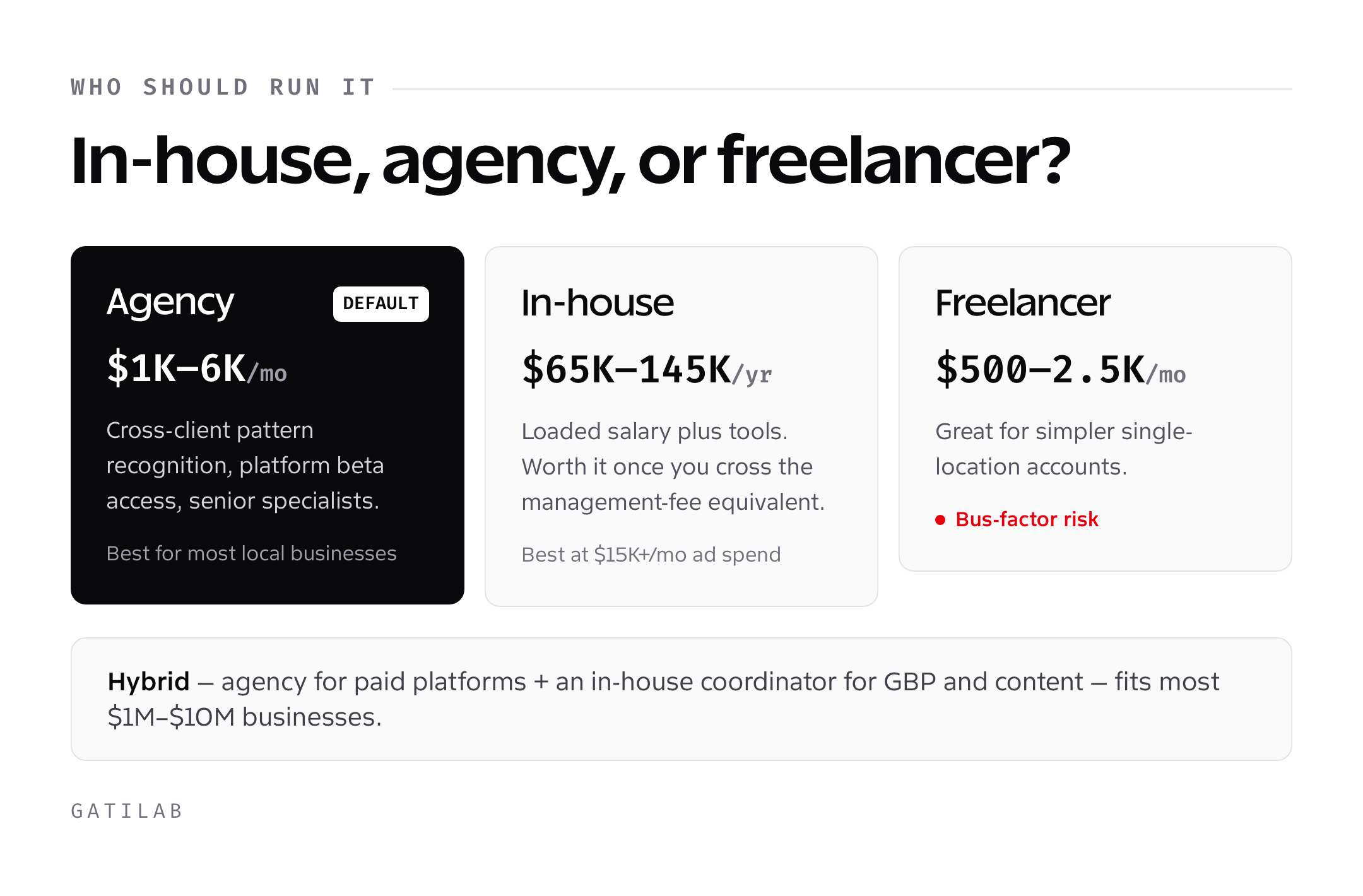
In-house vs agency vs freelancer
In-house SEM management costs $60,000 to $120,000 a year loaded, plus tools ($500 to $2,000/month). That’s $65,000 to $145,000 annually. Makes sense for businesses spending $15,000+/month on ads, because the management fee equivalent (15 to 20 percent of spend) crosses the loaded cost of a full-time specialist.
Agency management is the default for most local businesses. Flat fees between $1,000 and $6,000/month, depending on complexity. Good agencies bring cross-client pattern recognition, platform beta access (Google gives alpha features to top partners first), and senior specialists that a single hire can’t match.
Freelancer management works at the $500 to $2,500/month range for simpler accounts. Great for single-location service businesses. Risk: one-person operations have bus-factor issues. If your freelancer takes a 3-week vacation, your account drifts.
Hybrid: agency for strategy and paid platforms, in-house marketing coordinator for GBP, content, email, social. This is the best fit for most $1M to $10M local businesses. The agency handles the specialized work, the coordinator handles daily execution and owns the brand voice.
How to vet a local SEM service
Ask these 10 questions before signing a contract:
- Who owns the Google Ads, LSA, and GBP accounts? (Answer must be: the client.)
- Can I see a sample monthly report from a current client? (Anonymized.)
- What’s your average LSA dispute win rate?
- Do you charge flat fee or percentage of ad spend?
- Is call tracking included, and which provider?
- What’s your contract length, and what’s the cancellation policy?
- How many local SEM clients do you currently manage?
- Who specifically will work on my account, and what’s their background?
- Can I talk to two current clients in my industry?
- What’s the first 90-day plan, week by week?
Red flags: long contracts (12+ months), percentage-of-spend on large budgets, account ownership in the agency’s name, vague reporting (“dashboards” instead of actual numbers), no LSA experience if you’re in a home services or legal vertical, and pitch decks that emphasize “impressions” or “reach” over leads and revenue.
What realistic ROI looks like
Industry benchmarks for local SEM across typical service categories:
- Plumbing: $40 to $90 cost per lead, 30 to 50 percent close rate, $400 to $1,200 average job, 4 to 10x ROAS
- HVAC: $50 to $120 cost per lead, 25 to 40 percent close rate, $600 to $8,000 job value, 3 to 12x ROAS
- Law (personal injury): $100 to $400 cost per lead, 8 to 15 percent close rate, $5,000 to $50,000+ case value, 5 to 15x ROAS
- Dental: $30 to $90 cost per lead, 40 to 60 percent close rate, $200 to $2,000 first visit, 3 to 8x ROAS
- Roofing: $60 to $150 cost per lead, 20 to 30 percent close rate, $8,000 to $25,000 job, 6 to 15x ROAS
These are blended numbers across Google Ads, LSA, and Bing. Individual channels perform differently. LSA often beats Google Ads on cost per lead but loses on lead quality. Bing usually has the lowest cost per lead but lower volume.
Month-over-month: expect 10 to 20 percent improvement in cost per lead during months 2 to 6 as the account matures and Smart Bidding accumulates data. After month 6, gains get harder. 5 to 10 percent year-over-year improvement is realistic. 30+ percent claims are usually a rebaseline from a poorly-performing starting point, not sustained improvement.
Common SEM mistakes local businesses make
Running ads without call tracking. You can’t optimize what you can’t measure, and 50 percent+ of local conversions come by phone.
Sending Ads traffic to the homepage. Homepages are designed for general visitors, not campaign-specific intent. Conversion rate drops 40 to 60 percent compared to a dedicated landing page.
Bidding only on exact-match keywords. Too restrictive, misses long-tail intent variations. Use phrase match with strong negative keyword lists.
Ignoring negative keywords. “Free,” “cheap,” “DIY,” “training,” “jobs,” “salary” should all be negatives on a local service account. Each one that leaks through wastes budget on non-buyers.
No branded search campaign. Competitors bid on your brand, steal your customers, and you paid to build that brand awareness. A $5 to $20/day branded campaign plugs the leak.
Spending on Meta local ads for emergency services. Wrong channel. People in an emergency don’t browse Instagram looking for a plumber. They Google one. Meta works for brand-category awareness, not urgent response.
No lead quality feedback loop. Agencies can’t optimize for quality if the client doesn’t report back which leads turned into customers. Weekly or bi-weekly lead quality feedback (via a shared spreadsheet or CRM integration) is how good agencies improve over months.
How much should I spend on local SEM?
Starting floor: $2,000/month total (management + ad spend). Below that, management fees eat the budget and there’s no data to optimize on. The sweet spot for most single-location service businesses is $4,000 to $8,000/month total, split roughly 25 percent management and 75 percent ad spend. Scale from there based on ROAS.
How long before local SEM campaigns work?
First leads in 1 to 2 weeks. Meaningful optimization data in 4 to 6 weeks. Mature campaign performance in 3 to 4 months. Any agency promising results in week 1 either has unrealistic expectations or is planning to rebaseline existing traffic to claim credit. Plan for 90 days minimum before judging.
Is LSA better than Google Ads for local?
LSA has lower cost per lead on average but lower lead quality. Google Ads has higher cost but more control over targeting and landing pages. Run both together. LSA handles volume and urgency queries, Google Ads handles specific service intent and long-tail. Cutting one in favor of the other leaves conversions on the table.
What’s the difference between local SEM and local SEO?
Local SEM is paid (Google Ads, LSA, Bing Ads, Meta ads). You pay the platform for every click or lead. Results appear immediately and stop when you stop paying. Local SEO is organic (GBP, on-site content, citations, backlinks). Free to earn but takes 3 to 9 months and compounds over time. Run both. They solve different time-horizons.
Should a small local business use Performance Max?
Not on its own. Performance Max works as a layer on top of manual Search campaigns once you have conversion data. Used as a primary campaign, PMax burns budget on low-intent impressions. Start with manual Search and Local Services Ads. Add PMax in month 3 or 4 with tight asset controls and brand exclusions.
Do I need a separate landing page for each ad campaign?
At minimum, one landing page per service category per city. A plumber running campaigns in 4 cities for 3 services needs 12 landing pages. Dynamic keyword and city insertion can reduce that to 3 templated pages with variable fields. But the homepage is never the right destination for paid ads. Conversion rate delta is 40 to 60 percent.
How do I know if my local SEM agency is actually working?
Three leading indicators: monthly lead count trending up, cost per qualified lead trending down, and quality score on top keywords trending up. Three lagging indicators: customer acquisition cost by channel, lifetime value by channel, and year-over-year revenue from paid sources. If the agency can’t report on all six, they’re not set up to succeed or they’re hiding something.
What should a local SEM contract look like?
Month-to-month or 3-month commitment max. 30-day cancellation notice. Client owns all accounts (Google Ads, Bing, LSA, Meta, GBP, CallRail). Monthly reporting deliverable defined in the contract. Ad spend billed directly to the client’s card, not routed through the agency. Management fee flat, not percentage of spend above $10k/month. These terms are standard for any agency worth working with.
The decision that matters
Most local businesses overthink the agency selection and underthink the tracking setup. The agency is replaceable. The tracking infrastructure (CallRail, GA4, GBP, landing page templates) is yours. Build it clean in week 1 and every future agency, freelancer, or in-house hire inherits a working system instead of starting from zero.
The businesses getting the best local SEM results aren’t the ones with the cheapest management fees or the most sophisticated strategies. They’re the ones with the tightest feedback loop between ad spend, leads, and closed customers. Everything else is secondary to that loop.
Pick an agency or freelancer that builds the loop in month one. Anyone who skips straight to campaign launches without tracking setup is skipping the work that makes everything else measurable.
Tell Google you want more of this.
Add Gatilab as a preferred sourceOne tap, and this site shows up more often in your own Top Stories, AI Overviews and AI Mode. Remove it any time.