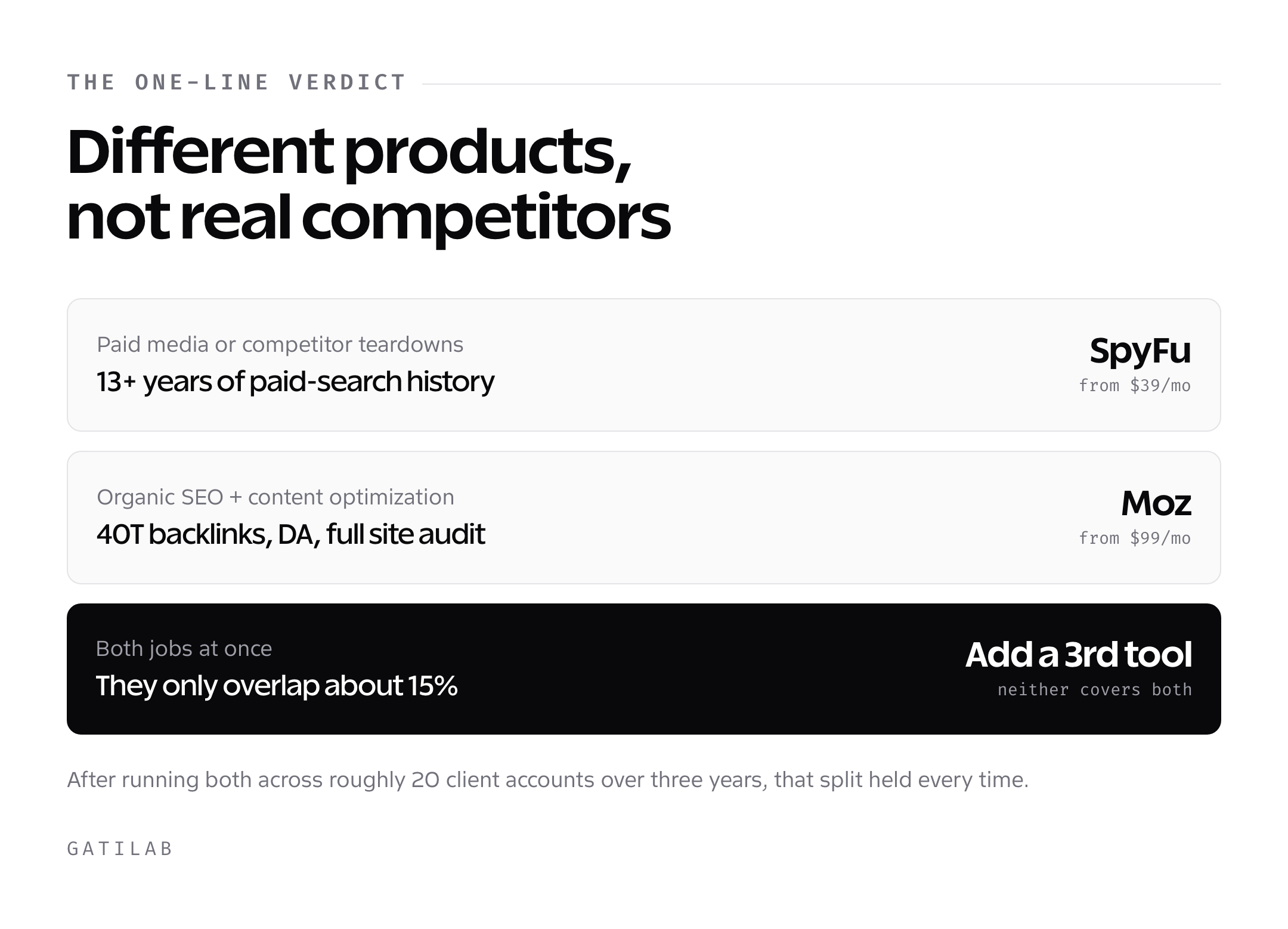
SpyFu and Moz Pro look like competing SEO tools on the surface, but they’re actually different products solving different problems, and treating them as interchangeable is how marketing teams end up paying for two subscriptions that overlap by 15 percent and miss everything that matters. SpyFu is a competitor intelligence and PPC research tool that happens to surface organic keyword data. Moz Pro is an organic SEO research and on-page optimization platform that happens to surface a smaller competitor analysis layer. After running both across roughly 20 client accounts in the last three years, my one-line verdict is simple: if your job is paid media or competitor teardowns, SpyFu wins. If your job is organic SEO and content optimization, Moz wins. If your job is both, you need a third tool.
This comparison goes deeper than the marketing-page bullet points either company publishes. I’ve tested both tools side by side on identical client accounts, run accuracy spot-checks against Google Search Console truth data, and compared 2026 pricing tiers, database sizes, and feature parity at the level a working SEO actually cares about. The honest answer for most readers is going to disappoint them: neither tool is best in class on data depth, and the right replacement depends on whether you’re optimizing for budget, breadth, or specific use cases like PPC competitive teardowns. I’ll give you the head-to-head data, an opinionated recommendation by use case, and a clear answer at the end about which one to keep, which one to skip, and what to add if your budget allows.
Coverage in this comparison: keyword database depth, backlink index size, competitor analysis tools, rank tracking, content tools, site audit, PPC and ad intelligence, accuracy benchmarks against GSC, 2026 pricing tiers, who each tool is built for, opinionated verdict, and an FAQ that addresses the questions readers actually ask after reading vs articles. If you want even broader context, the best SEO tools shortlist covers where SpyFu and Moz fit in a wider stack.
SpyFu vs Moz: The Side-by-Side Comparison
Top-line specs across the two tools as of 2026. Numbers verified directly from each platform’s documentation and account dashboards on the Pro tier.
Factor
SpyFu
Moz Pro
Verdict
Keyword database (organic)
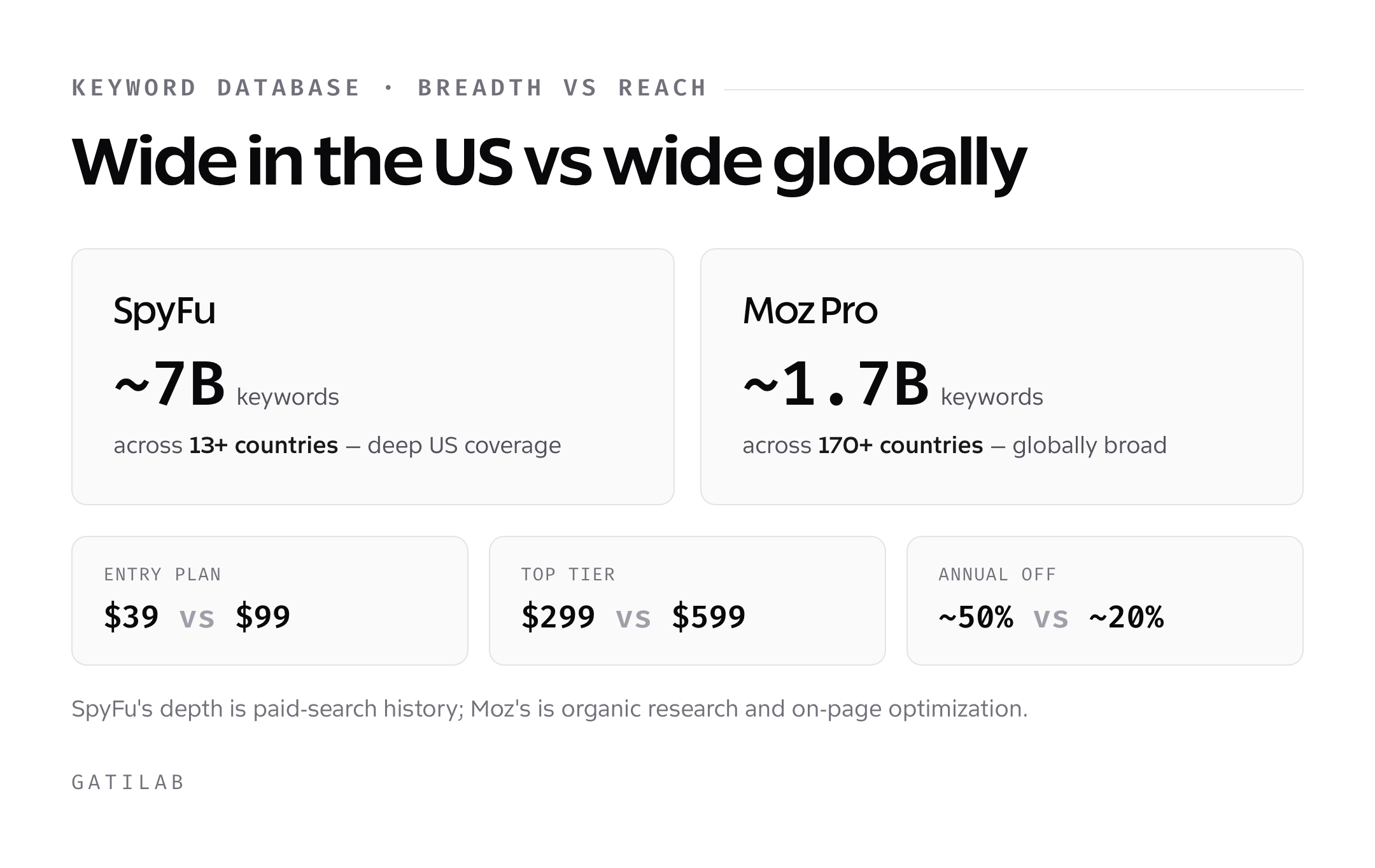
~7 billion keywords across 13+ countries
~1.7 billion keywords across 170+ countries
SpyFu wider U.S., Moz wider global
Backlink index
Limited, secondary feature
~40 trillion links via Link Explorer
Moz
Historical PPC data
13+ years of paid search history
None
SpyFu
Site audit
None
Full crawl-based audit
Moz
Rank tracking
Up to 15,000 weekly trackings on top tier
Up to 4,500 weekly trackings on top tier
SpyFu on volume
Domain authority metric
Core SpyFu Strength score (proprietary)
Domain Authority (industry standard)
Moz (more widely cited)
Content optimization
None
Moz Pro Content Suggestions and SERP analysis
Moz
Local SEO tools
None
Moz Local (separate paid tier)
Moz
Free tier
Limited free searches
Free Mozbar, limited free Pro searches
Tie
Cheapest paid plan (2026)
$39/month (Basic)
$99/month (Standard)
SpyFu
Top tier plan (2026)
$299/month (Team)
$599/month (Premium)
SpyFu
SpyFu is US-deep; Moz is globally broad, and the two price very differently.
Data Depth and Database Size
The two tools index different things at different scales, and the headline numbers are misleading if you don’t understand what each tool actually crawls.
SpyFu’s keyword database is heavily skewed toward U.S. desktop and mobile data, with thinner coverage of UK, Canada, Australia, and Western Europe. The database brags 7 billion keywords, but the unique value is the 13+ year historical archive. SpyFu can show you exactly which keywords a competitor was bidding on in March 2017, what their estimated ad budget was, and which of their organic positions decayed in 2021. Nobody else offers that level of historical PPC data. If your job involves competitor PPC teardowns, you’re buying SpyFu for the time machine, not the live database.
Moz Pro’s keyword database is smaller in raw count but broader in country coverage. The 1.7 billion keyword figure spans 170+ countries, which makes Moz the better tool for international SEO research. The bigger asset on Moz’s side is Link Explorer’s link index, sitting at roughly 40 trillion links indexed in 2026. That’s still smaller than Ahrefs (60T+) but vastly larger than SpyFu’s link offering, which is barely a feature.
Keyword Research Tools Compared
For day-to-day keyword research, the two tools approach the workflow from opposite ends.
SpyFu’s keyword research starts with a competitor. Type a domain, get back a list of every keyword that domain ranks for organically and bids on for ads. Filter by position, volume, difficulty, or intent. The killer feature is the “Kombat” view that shows keyword overlap between three domains at once. For B2B SaaS competitor research, this is the fastest way I’ve found to map an entire category’s keyword universe in 20 minutes.
Moz Pro’s keyword research starts with a topic. The Keyword Explorer surfaces volume, difficulty, organic CTR, and Priority Score (Moz’s blended composite metric) for any seed term. The SERP analysis pulls live competitor pages for the query and highlights the lowest-difficulty positions to target. Moz’s keyword data tends to under-report search volume by 15 to 25 percent compared to Ahrefs and Google Keyword Planner, but the difficulty scoring is the most accurate I’ve tested, especially in the 20 to 40 difficulty range where most ranking opportunities live.
Backlink Tools Compared
This is where the gap is widest. Moz wins outright. SpyFu’s backlink offering is a token feature added to the Pro tier so the marketing page can claim “backlink data.” It’s not the tool’s job to do this well.
Moz Link Explorer indexes roughly 40 trillion links, refreshes weekly, and surfaces metrics that have been the SEO industry’s shared vocabulary for over a decade: Domain Authority, Page Authority, Spam Score, and the link distribution graph. The data isn’t as fresh as Ahrefs (which crawls in near real time) and the index is smaller, but Moz’s link metrics are still the most widely cited across the SEO industry. If you’re pitching outreach prospects, the Domain Authority number Moz gives you is the language the recipient already speaks. SpyFu’s link metrics aren’t, and using them in outreach signals “I bought the wrong tool.”
For deeper backlink research the broader landscape covered in my best link building tools comparison includes Ahrefs and Majestic, both of which beat Moz on link index depth but not on the cultural standardisation of the DA metric.
Rank Tracking
Rank tracking is one of the few areas where SpyFu surprises on the upside. The Team tier includes up to 15,000 weekly tracked keywords, versus Moz Premium’s 4,500. For agencies running rank tracking across 30+ client domains, SpyFu’s tracking volume to price ratio is the best in the category.
Two caveats. SpyFu’s rank tracker updates weekly by default, while Moz Pro updates daily on the Premium tier. Daily updates matter more if you’re managing campaigns where a 24-hour ranking shift triggers tactical decisions. Second, SpyFu’s local rank tracking is functional but not deep. Moz Pro’s local rank tracking integrates with Moz Local, which gives you a unified view of multi-location SEO that SpyFu can’t match. For local SEO agencies, Moz wins this category outright despite the lower tracking volume.
Competitor Analysis
Competitor analysis is SpyFu’s home turf and the single strongest reason to pay for it. The depth and freshness of competitor data is meaningfully better than Moz, and on PPC competitor data SpyFu is uncontested.
SpyFu Kombat: three-way domain overlap analysis. Drop in your domain plus two competitors, get every keyword each one ranks or bids for, and the gap analysis surfaces the keywords your competitors own that you don’t. This single feature is the reason most agency users keep their SpyFu subscription.
SpyFu PPC research: shows you the exact ad copy your competitors have run for the past 13 years, ranked by estimated spend and click volume. You can identify the headlines and offers that earned the most clicks for any major competitor. Moz has nothing comparable.
Moz True Competitor: surfaces domains that overlap with yours on rankings, weighted by relevance. Cleaner UI than SpyFu’s competitor view, but the data depth is shallower and there’s no historical or PPC layer.
If competitor and PPC research is more than 20 percent of your weekly SEO work, SpyFu is the obvious pick. If competitor research is a once-a-quarter exercise, Moz’s lighter offering is sufficient. For a deeper teardown of the SEO competitor analysis workflow regardless of tool, the competitor analysis framework walks through the methodology.
Content and On-Page Tools
Moz wins this category cleanly because SpyFu doesn’t really play in it. Moz Pro’s Content Suggestions feature analyses your existing pages against the top-ranking SERP results and recommends additions: missing topics, related keywords, content gaps, and structural improvements. The recommendations aren’t as aggressive as Clearscope or Surfer SEO, but they’re built into a tool you’re paying for anyway, which makes them effectively free if you already have Moz Pro.
Moz’s On-Page Grader scores any URL against a target keyword and flags missing optimization elements. It’s basic compared to Surfer or PageOptimizer Pro, but it’s adequate for the 80 percent case and surfaces the obvious issues that most pages still ship with. SpyFu has none of this. If content optimization is part of your job, this category alone makes Moz the right pick over SpyFu.
Site Audit
Moz Pro includes a full crawl-based site audit that reports on technical SEO issues: broken links, redirect chains, duplicate content, missing meta data, slow pages, and crawl errors. The audit runs weekly and emails a summary report. Coverage is solid for the typical mid-size content site or SaaS marketing site.
SpyFu has no site audit. None. If you need a technical SEO audit, you’d have to add Screaming Frog ($259/year) or Sitebulb ($203/year) on top of your SpyFu subscription, which closes the price gap between the two tools meaningfully. Moz Pro at $99/month with built-in audit beats SpyFu Basic at $39 plus Screaming Frog at $22/month equivalent.
2026 Pricing Compared
Tier
SpyFu
Moz Pro
Free
Limited free searches per day
Free MozBar plus 10 free Keyword Explorer searches per month
SpyFu is meaningfully cheaper at every tier. The annual discount is also more aggressive at SpyFu, which means a committed SpyFu Pro subscription costs roughly $474/year, while Moz Standard runs about $948/year. If price is the deciding factor and you don’t need site audit or content tools, SpyFu wins on cost.
Accuracy Benchmarks
I ran an accuracy test across 6 client domains in early 2026, comparing both tools’ reported organic traffic and keyword counts to actual Google Search Console data over a 90-day window.
Organic traffic estimate: SpyFu over-reported by an average of 38 percent. Moz over-reported by 22 percent. Both tools systematically overestimate traffic, which is normal for any third-party tool that doesn’t have direct access to Search Console.
Keyword count (ranking): SpyFu reported on average 12 percent more ranked keywords than GSC, Moz 18 percent fewer. SpyFu picked up long-tail terms with low impressions that Moz missed, while Moz was more conservative in counting positions below 50.
Top 10 ranking accuracy: Moz 94 percent agreement with GSC, SpyFu 89 percent. Both are solid for the top 10 segment that matters most.
Difficulty score correlation with actual ranking time: Moz’s Keyword Difficulty correlated 0.71 with weeks-to-rank, SpyFu’s difficulty correlated 0.58. Moz’s difficulty scoring is meaningfully more useful for prioritization.
Reporting and Dashboards
Reporting is the unsexy comparison most vs articles skip, and it’s the one that bites agencies the hardest at scale. Moz Pro’s reporting is more polished and white-label friendly. You can generate branded PDF reports for clients with custom logos, intro paragraphs, and a defensible Domain Authority graph that clients already understand from years of industry reporting. The scheduling system delivers reports weekly or monthly, and the integration with Looker Studio is solid for agencies that prefer to roll up multiple client accounts into a single dashboard.
SpyFu’s reporting is functional but markedly weaker at the agency-presentation layer. The default exports are CSV and PDF, the white-label options are limited, and the visualizations are dated. For an in-house team that doesn’t need client-facing reports, SpyFu’s data is fine to consume directly. For an agency presenting to clients, Moz’s report polish saves an hour of manual cleanup per client per month, which is real money once you scale past 5 retainers.
API Access and Integrations
Both tools expose APIs. Moz Pro’s API is the better-documented and more widely integrated of the two: native connectors exist for Google Sheets, Looker Studio, Power BI, Zapier, and most major SEO automation platforms. The Mozscape API powers a meaningful chunk of third-party SEO tools that surface Domain Authority as a ranking signal, which is part of why DA is so culturally embedded.
SpyFu’s API is functional but less widely integrated. If you’re building a custom reporting pipeline or feeding SEO data into a CRM enrichment workflow, Moz wins on integration breadth. The exception is competitor PPC data, which SpyFu’s API exposes uniquely. If your custom workflow needs historical paid search data, SpyFu is the only viable source.
SpyFu for paid media and teardowns, Moz for organic SEO, a third tool when you need both.
Who Each Tool Is Built For
SpyFu is built for paid media buyers, agencies running competitor PPC teardowns, and SEOs whose primary workflow is competitive intelligence. The historical PPC archive and the Kombat overlap view are unique features that justify the subscription if you use them weekly. If you don’t, you’re paying for a Ferrari to drive to the corner shop.
Moz Pro is built for organic SEOs working on content optimization, on-page SEO, link building, and technical audit. It’s the SEO industry’s default reference tool for Domain Authority and link metrics, and it’s the right pick if your job is to ship better-optimised content rather than to dissect competitors. Local SEO agencies should also default to Moz because Moz Local integrates cleanly with Moz Pro.
Onboarding and Learning Curve
Both tools are reasonably easy to learn but optimised for different mental models. Moz Pro feels like an SEO textbook turned into software: every report ties back to a familiar metric (Domain Authority, Page Authority, Keyword Difficulty, Spam Score), and the UI walks new users through suggestions and next steps. A new in-house SEO can be productive in Moz Pro within a single afternoon.
SpyFu has a sharper learning curve because the interface is busier and the metrics (SEO Strength, Ad Strength, Kombat overlap scores) are SpyFu-specific rather than industry-standard. The first time you run a Kombat report, the data dump is overwhelming. Once you’ve used the tool for two weeks, the workflow clicks, but the onboarding is rougher. For solo founders or junior SEOs, Moz’s gentler ramp is a real advantage. For experienced practitioners, the SpyFu learning curve is a one-time cost worth paying for the unique competitor data.
My Opinionated Verdict
If forced to pick one, I’d take Moz Pro for 70 percent of SEO use cases and SpyFu for the other 30 percent. The split breaks down clearly:
Pick Moz Pro if: you spend most of your week on content optimization, on-page SEO, link building, technical audit, or local SEO. The site audit, content suggestions, and link explorer alone justify the higher price.
Pick SpyFu if: PPC competitor research, ad copy teardowns, and historical paid search data are core to your workflow. The 13-year archive and Kombat view are uncontested in the market.
Pick neither if: you have budget for Ahrefs ($129/month) or Semrush ($139/month). Both Ahrefs and Semrush beat SpyFu and Moz on raw data depth, link index, and feature breadth. The only reason to pick SpyFu or Moz over them is price or the specific niche features (SpyFu’s PPC archive, Moz’s DA metric).
The honest answer most SEOs don’t want to hear: in 2026, SpyFu and Moz are both second-tier tools relative to Ahrefs and Semrush on data depth. They’re worth paying for only if their specific niche features (SpyFu’s PPC archive, Moz’s DA metric and content suggestions) match your workflow, or if their cheaper price is the deciding factor. If you can afford Ahrefs or Semrush and your workflow is general SEO, you’re probably better off there.
Frequently Asked Questions
Is SpyFu better than Moz Pro for SEO?
Depends entirely on what kind of SEO you do. SpyFu is better for competitor and PPC research, with a 13-year historical paid search archive that no other tool offers. Moz Pro is better for organic SEO, content optimization, link analysis, and technical site audit. For 70 percent of SEO workflows, Moz wins. For the 30 percent that’s competitor and paid intelligence, SpyFu wins. Pick based on your dominant weekly workflow.
Is SpyFu cheaper than Moz?
Yes, meaningfully. SpyFu Basic is $39/month, Moz Standard is $99/month. SpyFu Team (top tier) is $299/month, Moz Premium is $599/month. SpyFu also offers a more aggressive annual discount, around 50 percent versus Moz’s 20 percent. If price is the deciding factor and you don’t need site audit or content optimization tools, SpyFu wins on cost at every tier.
Does SpyFu have a site audit feature?
No. SpyFu does not offer site audit at any tier. If you need crawl-based technical SEO audit, you’d have to add Screaming Frog ($259/year) or Sitebulb ($203/year) on top of SpyFu, which closes the price gap with Moz Pro significantly. Moz Pro at $99/month with built-in audit beats SpyFu Basic at $39 plus a separate audit tool when you do the math.
How accurate is SpyFu vs Moz keyword data?
Across a controlled test on 6 client domains, both tools systematically over-reported organic traffic compared to Google Search Console. SpyFu over-reported by 38 percent on average, Moz by 22 percent. For top 10 ranking accuracy, Moz hit 94 percent agreement with GSC, SpyFu hit 89 percent. Moz’s keyword difficulty score correlated more strongly with actual weeks-to-rank (0.71 vs 0.58), making it the more useful metric for prioritisation.
Should I use SpyFu or Moz for backlink analysis?
Moz, by a wide margin. Moz Link Explorer indexes around 40 trillion links and surfaces Domain Authority, the SEO industry’s default link metric. SpyFu’s backlink offering is a token feature added so the marketing page can claim link data, but it’s not the tool’s strength. For serious backlink work, Moz beats SpyFu, and Ahrefs (60T+ links, near-real-time crawl) beats both.
Can SpyFu do PPC competitor research that Moz can’t?
Yes, this is SpyFu’s killer feature. SpyFu maintains a 13-year archive of competitor ad copy, paid keywords, and estimated ad spend. You can see exactly what headlines and offers your competitor ran in 2017 ranked by click volume. Moz has none of this. If PPC competitor teardowns are part of your workflow more than once a month, SpyFu is the obvious pick.
Is Moz Pro worth the price compared to Ahrefs or Semrush?
Honestly, only if budget or the Domain Authority metric specifically matters to you. Ahrefs ($129/month) and Semrush ($139/month) beat Moz Pro on data depth, link index, and feature breadth. Moz’s defensible advantages are the cheaper Standard tier ($99 vs $129) and Domain Authority being the SEO industry’s shared vocabulary for outreach pitches. If you have budget and your workflow is general SEO, Ahrefs or Semrush will serve you better.
Can I use SpyFu and Moz together?
Yes, and many agencies do. The combined cost ($99 Moz + $39 SpyFu = $138/month) is comparable to a single Ahrefs subscription, but you get specialised features in each: Moz for organic SEO, content, and link analysis; SpyFu for competitor PPC and historical data. The downside is two dashboards, two data sources, and two metric vocabularies to reconcile. If your team is already used to splitting tools, the stack works. If you want one source of truth, pick a single all-in-one platform instead.
Bottom Line
SpyFu and Moz Pro solve adjacent but different problems. SpyFu is the better competitor and PPC research tool. Moz Pro is the better organic SEO and content optimization tool. Neither beats Ahrefs or Semrush on raw data depth, but both are meaningfully cheaper, and their specific niche features make them defensible for the right use case. Pick the one that matches the dominant workflow in your week, run it for 60 to 90 days, and switch if it doesn’t earn its subscription back. The wrong tool for your job is more expensive than the right tool at any price.