
Is Ahrefs More Accurate Than Moz?
Ahrefs is the more accurate choice for most SEO research, mainly because it covers more ground. Its keyword database lists 28.7 billion keywords against Moz’s 1.25 billion, so long-tail and non-US queries are far less likely to come back with no data at all, and Ahrefs refreshes its live backlink index every 15 to 30 minutes. Moz is the right answer in one case by definition: Domain Authority is Moz’s own score, so no other tool can measure it.
Neither tool measures Google, though. Both build estimates from their own crawls, clickstream data and sampled search results, so “more accurate” means “closer to your real numbers on your kind of site”. I want you to leave with a way to check that yourself, because a short comparison against your own Search Console data tells you more than any vendor’s headline figure.
If you’re new to either tool, Ahrefs is an SEO research suite built around a large backlink and keyword index, and Moz Pro is a lighter SEO suite best known for Domain Authority, with plans from $49 a month. Both include keyword research, rank tracking and site audits, so the real differences sit in data depth, freshness and price.
The Short Answer
Accuracy depends on the metric you care about, and the two tools trade places depending on which one you pick:
- Keyword coverage: Ahrefs, clearly, with a keyword database about 23 times the size of Moz’s.
- Backlinks: Ahrefs publishes a 15 to 30 minute refresh cycle for its live index, and Moz publishes no comparable figure. The two count links in different units, so their totals can’t settle the question.
- Search volume: neither, in principle. Both model volume rather than read it from Google, so a sample should be checked against Keyword Planner and Search Console before you trust either.
- Rank tracking: both check live results for the location and device you set. Settings and update frequency decide accuracy more than the brand does.
- Site audits: Ahrefs, especially on JavaScript-heavy sites. Its crawler can render JavaScript, while Moz says its own crawler has trouble parsing it.
- Domain Authority: Moz, by definition, because DA is Moz’s metric. Ahrefs’ Domain Rating is a different score.
What Accuracy Means for an SEO Tool
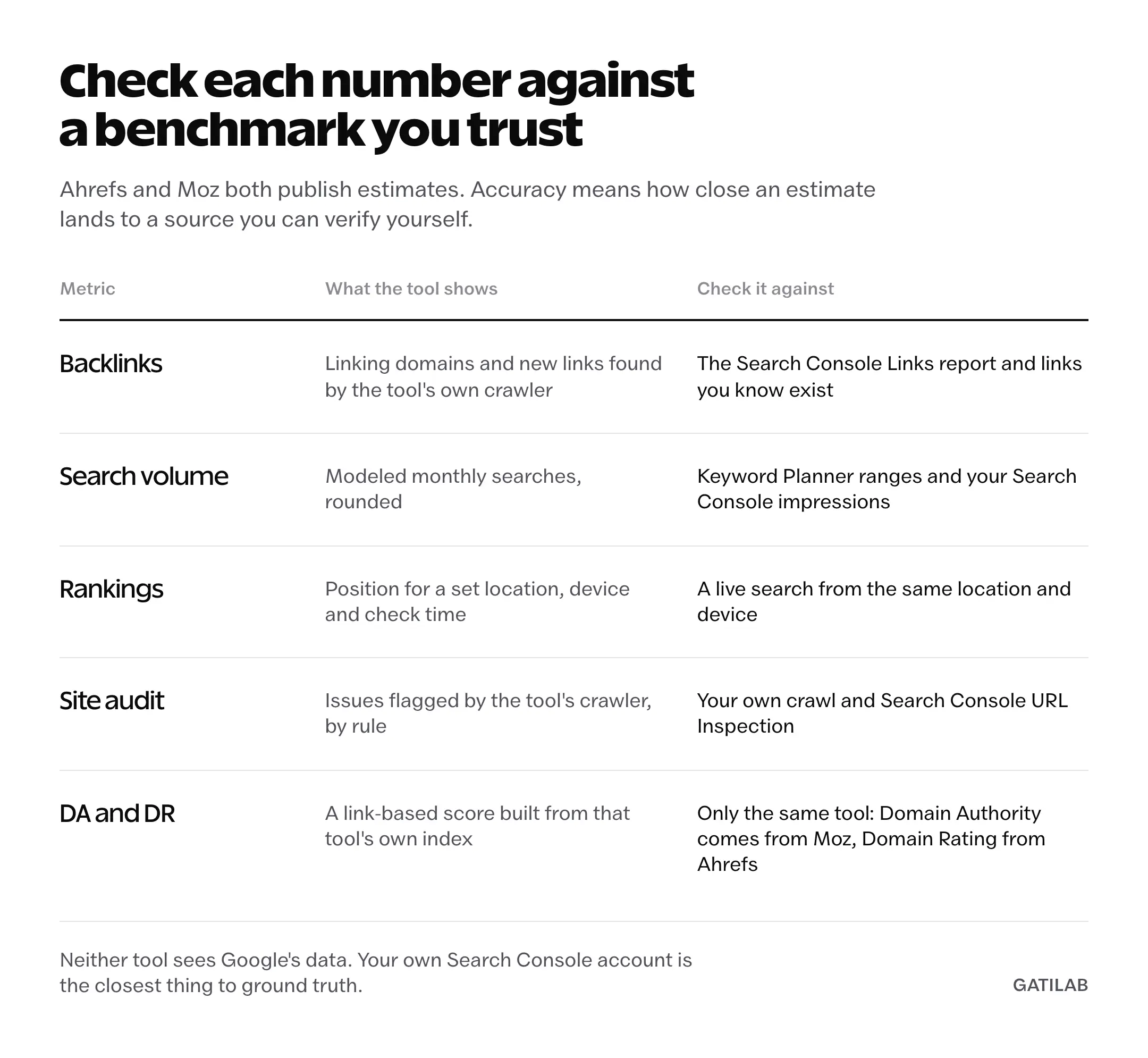
Before comparing numbers, it helps to be clear about what each number is. SEO tools don’t get Google’s data. They crawl the web themselves, model search demand from clickstream panels and sample search results, then publish estimates. Each estimate can only be judged against a source you trust, and that source is different for every metric:
- Backlinks should be checked against links you already know exist and the Links report in Google Search Console.
- Search volume should be checked against Google Keyword Planner and the impressions your own pages get in Search Console.
- Rankings should be checked against a live search from the same location and device the tool uses.
- Site audit warnings should be checked against your own crawl and a manual look at the flagged pages.
This is also why two careful reviewers can reach opposite verdicts on the same pair of tools. They are often measuring different metrics on different kinds of sites, and both can be right.
Backlink Data
Backlinks are where most accuracy arguments start, and where headline numbers mislead the most. The two vendors publish their index sizes in different units:
- Ahrefs reports 35 trillion records of external backlink history across 493.9 billion pages, and says its live index is updated with fresh data every 15 to 30 minutes.
- Moz says Link Explorer covers 45.5 trillion links across 8.7 trillion URLs and 1 billion domains.
A record of link history and a live link aren’t the same thing, so the bigger number on a vendor page doesn’t mean the bigger live index. Each tool also decides differently what counts as a separate link, how long a lost link stays in its reports and how often it recrawls a page.
What matters in daily work is narrower: does the tool show the links you know exist, and how soon after they go live? Freshness is the one area where Ahrefs publishes a clear figure and Moz doesn’t, so for link monitoring, outreach follow-up and lost-link recovery, I would lean on Ahrefs. For your own site, the free Links report in Google Search Console is the baseline worth checking both tools against, because it lists links Google itself has recorded.
Keyword Volume and Coverage
Coverage is the clearest gap between the two. Ahrefs lists 28.7 billion filtered keywords across 217 locations, and Moz lists 1.25 billion keyword suggestions across 170 Google search engines in Keyword Explorer. Both are counts of keywords, so this comparison is fair, and the gap is roughly 23 to 1.
That gap shows up in daily research as missing data. A long-tail query, a regional phrase or a keyword in a smaller market is more likely to exist in Ahrefs’ database, and a keyword the tool doesn’t have can’t be given a volume or a difficulty score at all. If most of your work is outside the US, UK, Canada and Australia, this is the strongest reason to pick Ahrefs.
Search volume itself is a different question. Neither tool reads it from Google. Both model it from clickstream panels and other data and then round it, so either one can be far off on a given keyword. Your checks have limits too: Google Keyword Planner shows ranges unless the account runs active campaigns, and Search Console impressions only cover queries your site already appears for.
Keyword difficulty scores don’t translate between the two tools. Ahrefs bases its score mainly on the backlinks of the pages already ranking, while Moz leans on the authority of those pages, so the same keyword can score 30 in one tool and 50 in the other. Both formulas are reasonable on their own terms; they simply weigh different things. It is wise to pick one tool’s scale and stay with it.
Rank Tracking
Rank tracking accuracy depends less on the brand and more on how closely the tool’s check matches what a real searcher sees. Both tools check live search results for the location, device and search engine you set. Rankings shift by city, by device and through the day, so a tool set to “United States, desktop” will often disagree with what you see on your phone in Delhi, and neither number is wrong.
Both tools update tracked rankings weekly, so a ranking that moved on Tuesday may not show up until the next update. The practical difference is how many keywords each plan tracks:
- Ahrefs tracks 750 keywords on Lite, 2,000 on Standard and 5,000 on Advanced.
- Moz tracks 50 keywords on its $49 Starter plan, 300 on Standard, 1,500 on Medium and 3,000 on Large.
If you need daily movement, neither tool is built for it; Semrush checks rankings daily on every plan, which my Ahrefs vs Semrush comparison covers.
Both now track visibility in AI answers as well, which a traditional rank tracker can’t see. Ahrefs does it through Brand Radar, with 5 tracked prompts on Lite, 10 on Standard and 20 on Advanced. Moz includes AI Visibility dashboards with weekly prompt tracking from its Standard plan: 150 prompts on Standard, 300 on Medium and 600 on Large. These reports are new and sample a fixed set of prompts, so I’d read them as direction rather than a precise share.
Site Audits
Audit accuracy comes down to two things: whether the crawler sees the page the way Google does, and whether its warnings are real problems.
Ahrefs’ Site Audit can render JavaScript, so it sees the content a React or Next.js site builds in the browser. Moz is open about its limit here: its help pages say its crawler doesn’t work well with JavaScript and sometimes has trouble parsing it. On a JavaScript-heavy site, that alone makes Ahrefs the more accurate auditor, and on a plain WordPress or HTML site the gap is much smaller. Moz also crawls each campaign once a week.
The crawl allowance decides how much of a large site each audit covers:
- Ahrefs includes 100,000 crawl credits on Lite, 500,000 on Standard and 1.5 million on Advanced.
- Moz crawls 400,000 pages a month on Standard, 2 million on Medium and 5 million on Large.
Moz’s allowance is generous for the price. On warnings, both tools flag issues by rule, so every audit carries some findings that don’t matter for a given site. Before fixing anything that looks serious, it is a good idea to confirm it in Search Console’s URL Inspection tool, which shows how Google actually rendered the page.
Domain Authority vs Domain Rating
Asking whether Ahrefs is more accurate than Moz on Domain Authority doesn’t quite work, because Domain Authority is Moz’s own metric. Moz describes it as a score from 1 to 100 that predicts how likely a site is to rank compared with its competitors, calculated by a machine-learning model that runs mainly on link data. Ahrefs doesn’t calculate DA. Its equivalent is Domain Rating, which scores the strength of a site’s backlink profile against the other sites in Ahrefs’ index on a 100-point logarithmic scale.
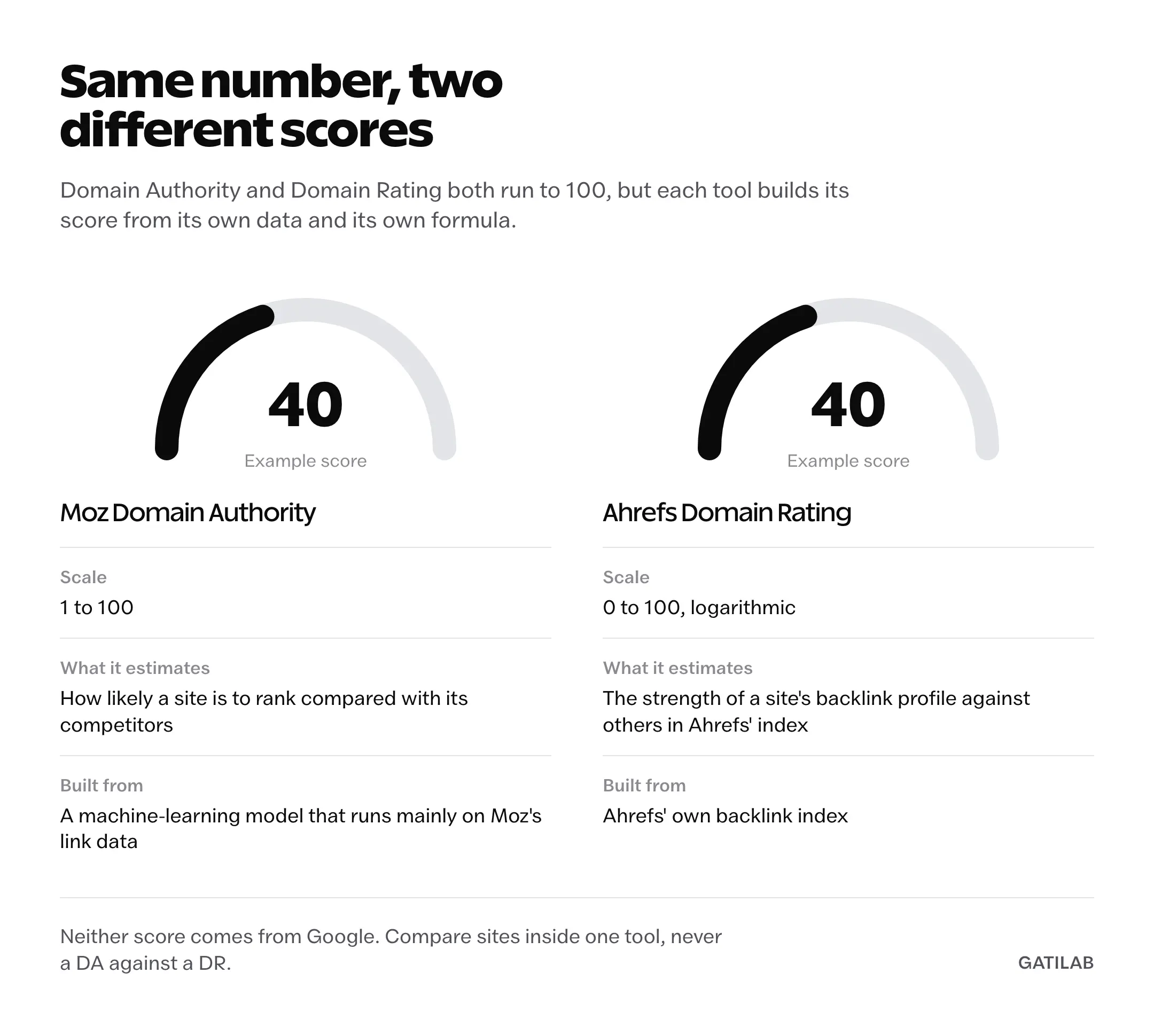
Both scores are useful for comparing sites inside the same tool. Neither is a Google metric, and neither should be compared across tools, because a DA of 40 and a DR of 40 come from different calculations on different data. When a client, publisher or guest-post buyer asks for DA, Moz or its free MozBar extension is the only source that can answer.
How to Check Accuracy on Your Own Site
The only accuracy figure worth trusting is one you measured against your own data. You can run this check without paying for either tool: Ahrefs Free, formerly Ahrefs Webmaster Tools, gives free data for sites you’ve verified, and Moz offers a 7-day free trial of its Medium plan, which needs a card on file.
- Pick a site you can verify in Google Search Console, ideally one with a few hundred referring domains and steady traffic.
- Export the “Top linking sites” list from the Search Console Links report. Count how many of those domains each tool shows, and note which one picks up a newly earned link first.
- Take 20 to 30 queries with steady impressions from the Search Console Performance report. Compare each tool’s volume with the Keyword Planner range, and note how many of the queries each tool doesn’t have at all.
- Check a handful of rankings in a clean browser session set to the tool’s location and device, close to the time the tool last updated.
- Crawl the site with a desktop crawler such as Screaming Frog, which is free up to 500 URLs, and compare its findings with each tool’s audit. A problem both tools miss tells you more than either audit score.
Write the results down with the date. Both indexes change all the time, so a result from last year says little about either tool today.
Ahrefs and Moz Pricing
You don’t need a paid plan to run the check above. If you’re choosing one, the cheapest full suites sit close together:
| Tool | Plan | Monthly | What You Get |
|---|---|---|---|
| Ahrefs | Starter | $29 | Limited research access |
| Ahrefs | Lite | $129 | 5 projects, 750 tracked keywords, 100K crawl credits |
| Ahrefs | Standard | $249 | 20 projects, 2,000 tracked keywords, 500K crawl credits |
| Moz Pro | Starter | $49 | One website, 50 tracked keywords |
| Moz Pro | Standard | $99 | 3 sites, 300 tracked keywords, 400K pages crawled a month |
| Moz Pro | Medium | $179 | 10 sites, 1,500 tracked keywords, 2M pages crawled a month |
Annual billing saves up to 17% on Ahrefs and 20% on Moz. Ahrefs Starter at $29 is a limited research plan rather than a full suite, and Moz’s $49 Starter plan covers a single website with 50 tracked keywords and no AI visibility tracking.
Which One Should You Trust?
For keyword research and backlink work, I would trust Ahrefs more. Its keyword database is far larger and its link index refreshes on a published 15 to 30 minute cycle, and those two things cause most of the accuracy problems people actually run into: keywords that return nothing and links that show up late.
Moz is the better pick when Domain Authority is the number your clients or partners ask for, when your work is mostly US English and you want a simpler interface, or when the budget points to the $49 or $99 plan. My Moz Pro vs Ahrefs comparison covers the rest of the feature set, and Semrush vs Ahrefs vs Moz adds the third big suite.
Whichever one you lean towards, judge it on your own Search Console data before you pay for a year. A tool that matches your sites well is accurate enough, whatever a forum thread says about it.
FAQs on Ahrefs and Moz Accuracy
Is Ahrefs more accurate than Moz for backlinks?
Ahrefs publishes a 15 to 30 minute refresh cycle for its live backlink index, and Moz publishes no comparable figure. The two count links in different units, so the fairest test is how many of the linking domains in your Search Console Links report each tool shows.
Which tool’s search volume is closer to Google Keyword Planner?
Neither is consistently closer. Both model search volume from clickstream and other data, so either can be far off on a given keyword. Ahrefs has a much larger keyword database, so it returns data for more long-tail and non-US keywords.
Is Moz Domain Authority accurate?
Domain Authority is Moz’s own score, so Moz is the only accurate source for it. It predicts how well a site is likely to rank from link data, and it isn’t a Google metric.
Is Ahrefs Domain Rating the same as Domain Authority?
No. Domain Rating scores the strength of a site’s backlink profile using Ahrefs’ data, while Domain Authority is Moz’s prediction of ranking ability. Sites should be compared inside one tool, never across both.
Can I test Ahrefs and Moz for free?
Partly. Ahrefs Free, formerly Ahrefs Webmaster Tools, gives free data for sites you verify. Moz offers a 7-day free trial of its Medium plan, which needs a card on file, along with free tools such as MozBar.
Which tool is better for SEO outside the US?
Ahrefs. Its keyword database covers 217 locations and is about 23 times larger than Moz’s, so smaller markets and regional phrases are far more likely to have data.
Tell Google you want more of this.
Add Gatilab as a preferred sourceOne tap, and this site shows up more often in your own Top Stories, AI Overviews and AI Mode. Remove it any time.