
Technology Blog Rankings: 20 Publications Tracked in 2026
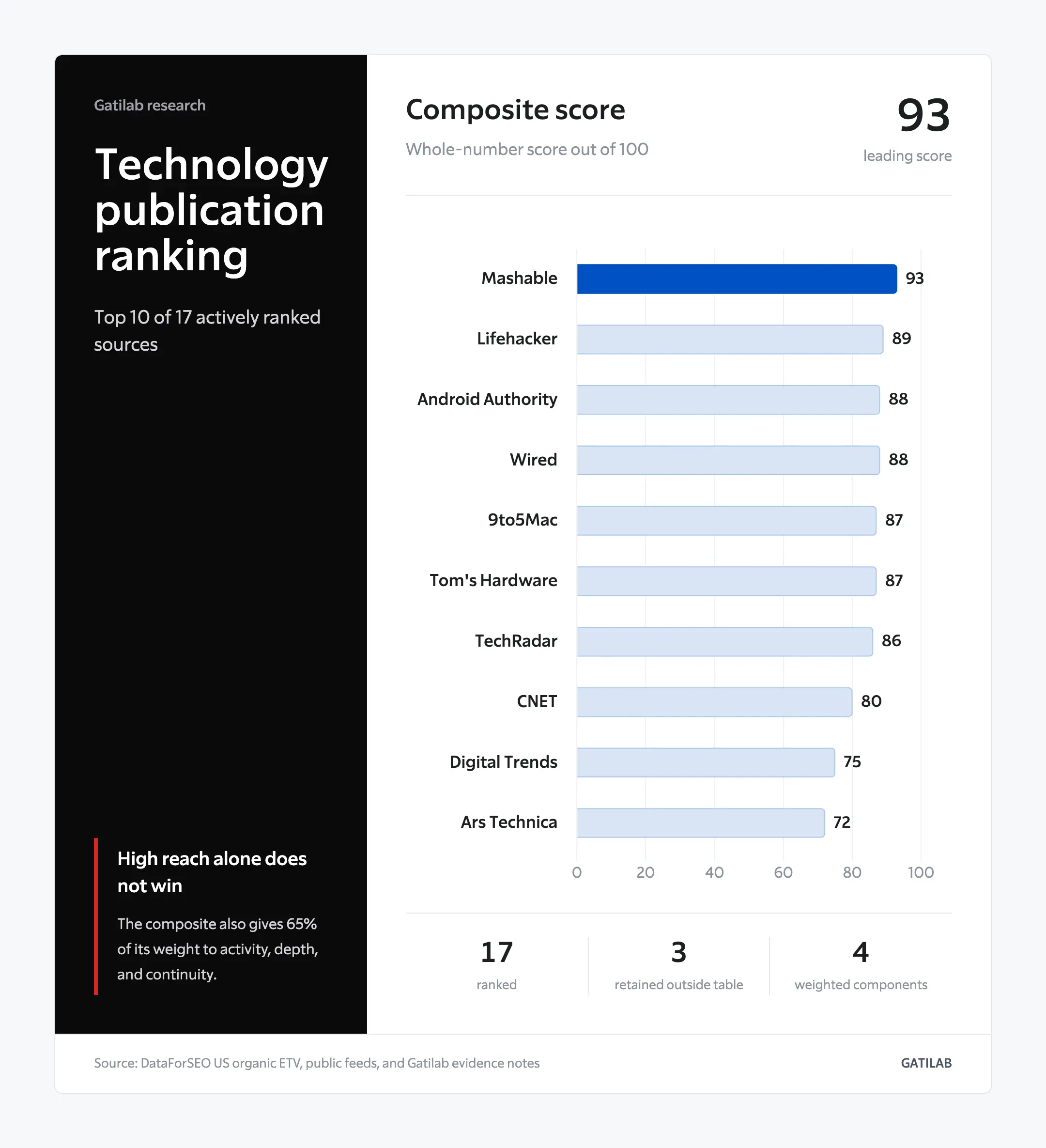
Technology blog rankings need more than a list of famous names. This analysis tracks 20 publications and ranks the 17 with both current activity evidence and a usable organic-search estimate.
The score combines estimated search reach, recent publishing activity, topical depth, and editorial continuity. A blocked, slower, or measurement-limited site stays visible outside the active table rather than disappearing from the history.
If you want a reading recommendation instead of a measurement table, use Gaurav Tiwari’s guide to technology publications worth following.
Table of Contents
Current ranking
The table uses whole-number scores because the source data does not justify decimal precision. Reach is directional, activity comes from public feeds when available, and the two editorial components use the evidence notes behind each profile.
| Rank | Publication | Score | Estimated reach | 30-day posts |
|---|---|---|---|---|
| 1 | Mashable | 93/100 | 28.0M | 100 |
| 2 | Lifehacker | 89/100 | 3.7M | 100 |
| 3 | Android Authority | 88/100 | 1.8M | 80 |
| 4 | Wired | 88/100 | 11.5M | 50 |
| 5 | 9to5Mac | 87/100 | 983.8K | 100 |
| 6 | Tom's Hardware | 87/100 | 7.1M | 50 |
| 7 | TechRadar | 86/100 | 10.1M | 50 |
| 8 | CNET | 80/100 | 31.9M | 25 |
| 9 | Digital Trends | 75/100 | 3.4M | 30 |
| 10 | Ars Technica | 72/100 | 1.3M | 20 |
| 11 | Gizmodo | 71/100 | 3.7M | 20 |
| 12 | TechCrunch | 71/100 | 1.4M | 20 |
| 13 | Engadget | 70/100 | 1.7M | 20 |
| 14 | The Verge | 69/100 | 2.5M | 10 |
| 15 | ZDNet | 66/100 | 3.0M | Feed unavailable |
| 16 | Slashdot | 60/100 | 602.6K | Feed unavailable |
| 17 | ReadWrite | 53/100 | 4.0K | 20 |
How to read the score
- Search reach, 35%: a US organic ETV estimate, normalized on a logarithmic scale inside this category.
- Publishing activity, 25%: dated feed items in the last 30 and 90 days, with caps that stop high-volume newsrooms from overwhelming every other signal.
- Topical depth, 20%: specialist coverage, reporting, testing, primary documentation, or durable instruction.
- Continuity, 20%: current publishing, accessible evidence, accountable authorship or ownership, and a stable editorial role.
Estimated reach is not audited visitor data. A score can change when search visibility, cadence, access, or editorial evidence changes.
Publication notes
1. Mashable
Best for: Digital culture and mainstream technology.
Tracks how platforms, entertainment, and technology meet popular culture.
Evidence: estimated organic reach 28.0M; 100 posts in the 30-day feed sample and 100 in the 90-day sample; component scores 97 reach, 100 activity, 78 depth, and 92 continuity.
Limitation: Its wide entertainment mix can dilute technical coverage. Visit the publication.
2. Lifehacker
Best for: Practical software and productivity guidance.
Turns consumer software and devices into actionable everyday workflows.
Evidence: estimated organic reach 3.7M; 100 posts in the 30-day feed sample and 100 in the 90-day sample; component scores 83 reach, 100 activity, 84 depth, and 92 continuity.
Limitation: It is a practical-living publication, not a complete technology newsroom. Visit the publication.
3. Android Authority
Best for: Android devices, apps, and platform coverage.
Combines Android news, product testing, and practical explainers.
Evidence: estimated organic reach 1.8M; 80 posts in the 30-day feed sample and 80 in the 90-day sample; component scores 78 reach, 97 activity, 90 depth, and 92 continuity.
Limitation: Its value drops if Android is not central to your work or buying decisions. Visit the publication.
4. Wired
Best for: Technology, science, policy, and culture.
Invests in reporting and narrative explanation beyond product launches.
Evidence: estimated organic reach 11.5M; 50 posts in the 30-day feed sample and 50 in the 90-day sample; component scores 91 reach, 75 activity, 95 depth, and 92 continuity.
Limitation: Some reporting sits behind a subscription. Visit the publication.
5. 9to5Mac
Best for: Apple news and product coverage.
Fast, specialist reporting across the Apple ecosystem.
Evidence: estimated organic reach 983.8K; 100 posts in the 30-day feed sample and 100 in the 90-day sample; component scores 73 reach, 100 activity, 90 depth, and 92 continuity.
Limitation: The narrow Apple focus is a poor fit for a broad technology briefing. Visit the publication.
6. Tom's Hardware
Best for: PC components and hardware benchmarks.
Publishes component tests, benchmarks, and build-oriented reference material.
Evidence: estimated organic reach 7.1M; 50 posts in the 30-day feed sample and 50 in the 90-day sample; component scores 87 reach, 75 activity, 96 depth, and 92 continuity.
Limitation: The hardware specialization leaves software and business coverage elsewhere. Visit the publication.
7. TechRadar
Best for: Product reviews and buying guides.
Covers a wide device range with accessible comparison-led advice.
Evidence: estimated organic reach 10.1M; 50 posts in the 30-day feed sample and 50 in the 90-day sample; component scores 90 reach, 75 activity, 88 depth, and 92 continuity.
Limitation: Commercial buying-guide intent is stronger than original industry reporting. Visit the publication.
8. CNET
Best for: Consumer technology buying decisions.
Large testing and how-to archive across mainstream consumer technology.
Evidence: estimated organic reach 31.9M; 25 posts in the 30-day feed sample and 25 in the 90-day sample; component scores 98 reach, 38 activity, 90 depth, and 92 continuity.
Limitation: Broad coverage makes the experience less specialist than a focused vertical. Visit the publication.
9. Digital Trends
Best for: Consumer gadgets and lifestyle technology.
Connects device reviews with practical home, automotive, and entertainment use.
Evidence: estimated organic reach 3.4M; 30 posts in the 30-day feed sample and 30 in the 90-day sample; component scores 82 reach, 45 activity, 82 depth, and 92 continuity.
Limitation: Readers seeking engineering detail should pair it with a specialist source. Visit the publication.
10. Ars Technica
Best for: Technical analysis and science.
Explains systems, policy, science, and computing below the headline layer.
Evidence: estimated organic reach 1.3M; 20 posts in the 30-day feed sample and 20 in the 90-day sample; component scores 75 reach, 30 activity, 97 depth, and 92 continuity.
Limitation: The technical depth can be more than a casual reader needs. Visit the publication.
11. Gizmodo
Best for: Technology, science, and digital culture.
Brings technology stories into science, culture, and policy.
Evidence: estimated organic reach 3.7M; 20 posts in the 30-day feed sample and 20 in the 90-day sample; component scores 82 reach, 30 activity, 82 depth, and 92 continuity.
Limitation: The editorial mix is less predictable than a specialist beat. Visit the publication.
12. TechCrunch
Best for: Startups, funding, and venture capital.
Pairs startup news with access to founders, investors, and technology companies.
Evidence: estimated organic reach 1.4M; 20 posts in the 30-day feed sample and 20 in the 90-day sample; component scores 76 reach, 30 activity, 94 depth, and 92 continuity.
Limitation: Its venture lens is not a substitute for consumer testing or deep engineering coverage. Visit the publication.
13. Engadget
Best for: Fast gadget and product news.
Maintains a quick, readable stream of product news and reviews.
Evidence: estimated organic reach 1.7M; 20 posts in the 30-day feed sample and 20 in the 90-day sample; component scores 77 reach, 30 activity, 84 depth, and 92 continuity.
Limitation: Its pace favors current awareness over long-lived technical reference material. Visit the publication.
14. The Verge
Best for: Consumer technology and digital culture.
Combines reporting, reviews, podcasts, and explanatory coverage.
Evidence: estimated organic reach 2.5M; 10 posts in the 30-day feed sample and 10 in the 90-day sample; component scores 80 reach, 15 activity, 92 depth, and 92 continuity.
Limitation: Its broad culture lens will not satisfy every technical specialist. Visit the publication.
15. ZDNet
Best for: Enterprise technology and IT operations.
Targets business technology, security, cloud, and professional IT decisions.
Evidence: estimated organic reach 3.0M; no dated feed count posts in the 30-day feed sample and no dated feed count in the 90-day sample; component scores 81 reach, 25 activity, 90 depth, and 65 continuity.
Limitation: The feed did not expose usable dates for the activity calculation. Visit the publication.
16. Slashdot
Best for: Community discussion among technical readers.
Reader submissions and comments expose perspectives beyond a conventional newsroom.
Evidence: estimated organic reach 602.6K; no dated feed count posts in the 30-day feed sample and no dated feed count in the 90-day sample; component scores 70 reach, 25 activity, 80 depth, and 65 continuity.
Limitation: Community discussion quality varies and the feed did not expose usable dates. Visit the publication.
17. ReadWrite
Best for: Emerging technology and business trends.
Focuses on how new technologies may affect work and business.
Evidence: estimated organic reach 4.0K; 20 posts in the 30-day feed sample and 20 in the 90-day sample; component scores 34 reach, 30 activity, 76 depth, and 92 continuity.
Limitation: Coverage is narrower and less consistent than the largest newsrooms. Visit the publication.
Outside the active ranking
These publications remain in the tracked set. They do not receive an active rank when current activity, public access, or a comparable reach value is missing.
GigaOM
Status: Slower archive. Its archive retains useful strategic analysis.
Why it remains: Archive research on technology and business. Limitation: Recent publishing activity is too limited for an active ranking. Visit the publication.
PCMag
Status: Access-limited check. Its long-running review system supports fast comparisons across device categories.
Why it remains: Standardized product testing. Limitation: Automated access was restricted, so current publishing activity needs manual review. Visit the publication.
VentureBeat
Status: Rate-limited check. Its specialist beats connect technology shifts with commercial decisions.
Why it remains: AI business and games industry coverage. Limitation: Automated access was rate-limited, so current activity needs manual review. Visit the publication.
Frequently asked questions
What do these technology blog rankings measure?
They measure estimated organic search reach, recent public publishing activity, topical depth, and editorial continuity. The score does not measure private revenue, subscriber loyalty, or an individual reader’s trust.
Are the traffic figures exact visitor counts?
No. The reach column is a third-party US organic ETV estimate. It is useful for directional comparison, not as an audited visitor count.
Why are some publications outside the active ranking?
A publication remains outside the active table when its current activity cannot be verified, automated access is restricted, its cadence is slow, or a comparable reach estimate is unavailable.
Does a higher score mean every reader should follow that publication?
No. The score compares market and publishing signals. Use the best-for and limitation notes to choose the source that fits your job.