
Ahrefs vs Semrush: Which SEO Tool Should You Buy?
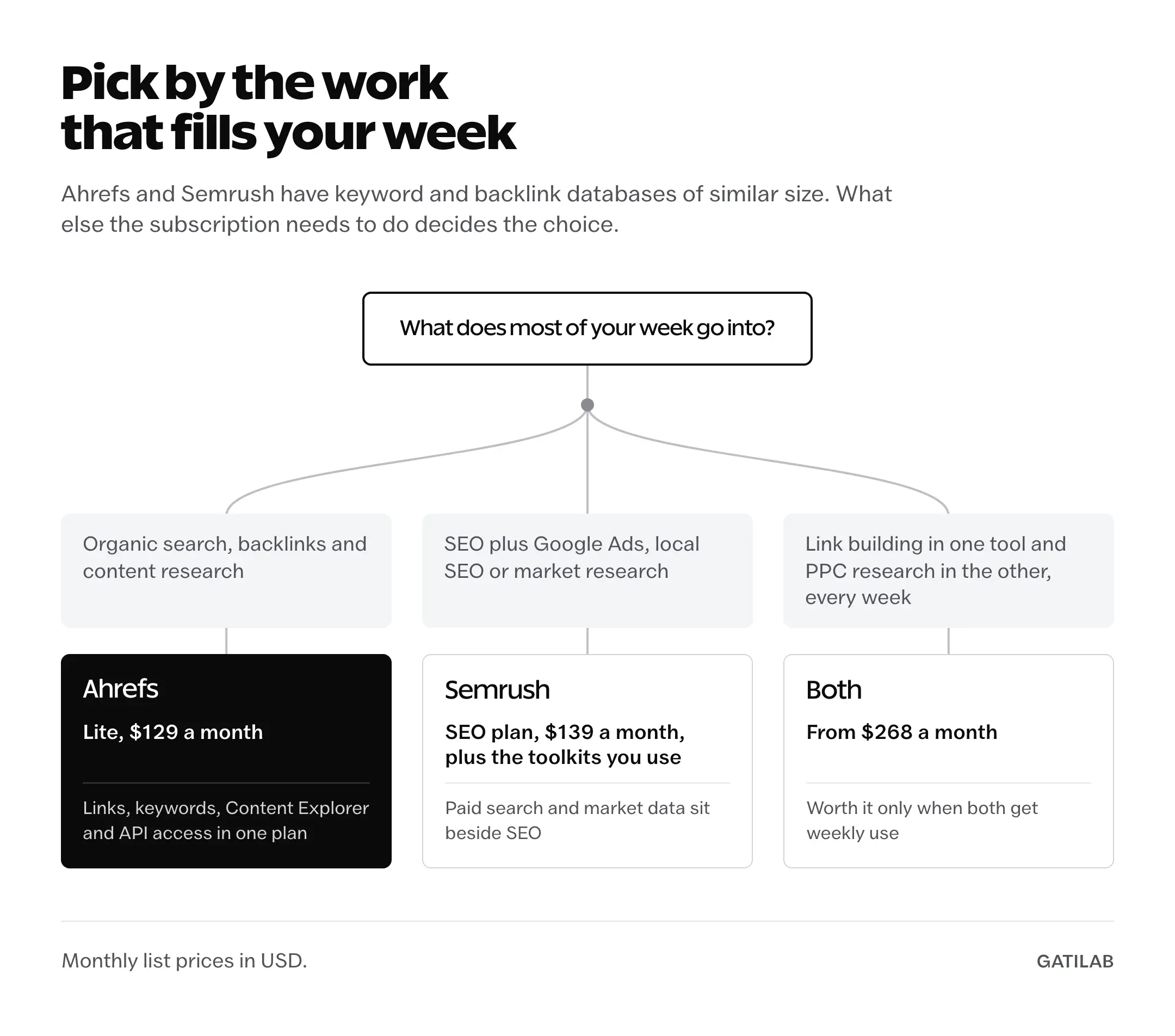
If most of your week goes into organic search, backlinks and content research, Ahrefs is the better buy. If SEO sits beside Google Ads, AI visibility and market research in the same week, Semrush fits better. Both have keyword and backlink databases of roughly the same size, so the decision comes down to what else you need the subscription to do.
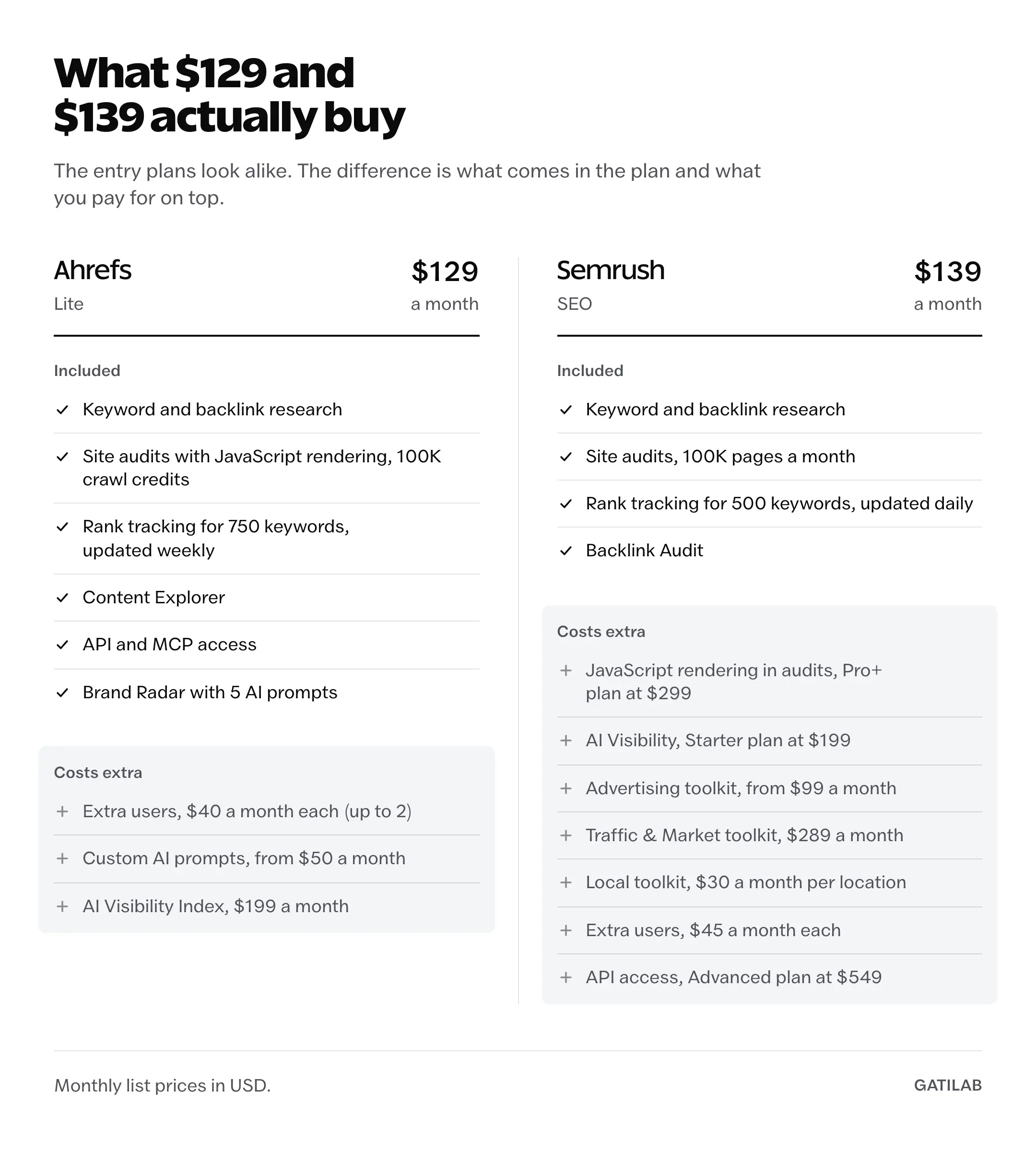
The entry prices make the two look almost identical, $129 a month for Ahrefs Lite against $139 for the Semrush SEO plan. They buy different things. Semrush now sells its advertising, traffic and market, local and content tools as separate toolkits, while Ahrefs keeps most of its research inside one plan and charges extra mainly for extra users and wider AI visibility data.
Ahrefs is an SEO research suite built around one of the largest backlink and keyword indexes, with site audits, rank tracking and Content Explorer in the same plan. Semrush is a broader marketing platform that covers SEO, AI visibility, paid search and competitor research, sold as a core SEO plan plus optional toolkits.
The Quick Verdict
Most people asking this question are buying one subscription, so the right pick depends on the work you do most often:
- Ahrefs is the one to buy if backlinks, content research and organic competitor analysis fill your week. API and MCP access are included from the Lite plan.
- Semrush fits agencies and in-house teams that run SEO next to Google Ads, local SEO or market research, and anyone who needs daily rank tracking, as long as they budget for the toolkits they’d actually open.
- Both make sense only when Semrush’s paid search or market data is something you’d use every week, because otherwise you pay twice for the same keyword and backlink work.
Ahrefs vs Semrush at a Glance
The table compares both tools on the same fields. Prices are monthly list prices in USD, and data figures are what each vendor publishes about itself.
| Factor | Ahrefs | Semrush |
|---|---|---|
| Lowest paid plan | Starter, $29 | SEO, $139 |
| Full SEO suite from | Lite, $129 | SEO, $139 |
| Free option | Ahrefs Free for verified sites | Free plan, 10 reports a day |
| Rank tracking updates | Weekly | Daily |
| JavaScript rendering in audits | Yes | From Pro+ |
| Entry-suite tracking | 750 keywords, 5 projects | 500 keywords daily, 5 websites |
| Backlink data (vendor figure) | 35T backlink history records | 43T+ backlinks |
| Keyword data (vendor figure) | 28.7B keywords, 217 locations | 28.8B keywords, 142 databases |
| PPC research | Paid keywords and ads in Site Explorer | Advertising toolkit, sold separately |
| AI visibility | Brand Radar, 5 to 20 prompts by plan | AI Visibility, 50 to 200 prompts from Starter |
| API access | Lite and above, plus MCP | Advanced only, MCP from Starter |
| Annual saving | Up to 17% | Up to 17% |
| Signature metric | Domain Rating | Authority Score |
| Best for | Organic, link and content research | SEO plus paid search and market research |
Ahrefs vs Semrush Pricing
Pricing is where most comparisons go wrong, because the cheapest plan on each page buys a different product. It helps to separate 3 questions: the cheapest way in, the cheapest full SEO suite and what an agency would actually pay.
| Tool | Plan | Monthly | What You Get |
|---|---|---|---|
| Ahrefs | Starter | $29 | Limited research access |
| Ahrefs | Lite | $129 | 5 projects, 750 tracked keywords, 100K crawl credits |
| Ahrefs | Standard | $249 | 20 projects, 2,000 tracked keywords, 500K crawl credits |
| Ahrefs | Advanced | $449 | 50 projects, 5,000 tracked keywords, 1.5M crawl credits |
| Semrush | SEO | $139 | 5 websites, 500 tracked keywords |
| Semrush | Starter | $199 | 5 websites, 500 keywords, 50 AI prompts |
| Semrush | Pro+ | $299 | 15 websites, 1,500 keywords, 100 AI prompts |
| Semrush | Advanced | $549 | 40 websites, 5,000 keywords, 200 AI prompts, API |
The cheapest way in is Ahrefs Starter at $29 a month, a limited research plan with 50 tracked keywords and no exports, or the free Semrush plan, which allows 10 reports a day. Neither replaces a full suite for regular work. If you only need the occasional check, my guide to free SEO tools covers what you can do without paying.
The cheapest full SEO suite is Ahrefs Lite at $129, then the Semrush SEO plan at $139. Lite tracks 750 keywords across 5 projects with 100,000 crawl credits. The Semrush SEO plan tracks 500 keywords daily across 5 websites.
For agency work, I would budget for Ahrefs Standard at $249 or Semrush Pro+ at $299. Standard covers 20 projects and 2,000 tracked keywords, and Pro+ covers 15 websites, 1,500 tracked keywords and 100 AI prompts.
Semrush’s toolkits are where the bill grows. The Advertising toolkit starts at $99 a month, Traffic & Market costs $289, Local costs $30 a month per location and the Content toolkit costs $60. A team that wants Google Ads research on top of the SEO plan pays $238 a month before any extra users, which changes the comparison with Ahrefs a lot.
Both tools include 1 user on every plan. Extra Ahrefs users cost $40 a month on Lite (up to 2 more), $60 on Standard and $80 on Advanced. Extra Semrush users cost $45 a month on the SEO and Starter plans, $80 on Pro+ and $100 on Advanced. Ahrefs Lite also caps usage at 1,000 credits per user a month, while Standard and above have unlimited credits, so heavy keyword research is a common reason to move up to Standard.
Annual billing saves up to 17% on both. Semrush offers a 7-day free trial on its SEO, Starter and Pro+ plans, with exports switched off during the trial. Ahrefs has no trial: Ahrefs Free, formerly Ahrefs Webmaster Tools, gives free data for sites you verify, and Starter at $29 is the cheapest paid way in.
Backlink Analysis
Both tools publish huge backlink figures, but in different units, so the headline totals can’t sit on one scale:
- Ahrefs reports 35 trillion records of external backlink history across 493.9 billion pages, and says its live index is updated every 15 to 30 minutes.
- Semrush reports more than 43 trillion backlinks, collected by a crawler that processes about 10 billion pages a day, and says its backlink data refreshes every 15 minutes.
On paper the freshness is close, so the difference shows up in the workflow. Ahrefs puts Site Explorer, link intersect (sites that link to your competitors but not to you), broken backlinks and Content Explorer, a searchable database of about 22.4 billion pages, in one place, which suits outreach and link prospecting. My guide on how to build backlinks covers that workflow in more detail. Semrush covers the same ground with Backlink Analytics and Backlink Gap, and its Backlink Audit gives each link a Toxicity Score from 0 to 100 based on more than 45 markers, which helps when you’re cleaning up an old link profile or preparing a disavow file.
The signature metrics are Domain Rating in Ahrefs and Authority Score in Semrush. Both are useful for comparing sites inside one tool and neither is a Google metric, so a DR of 50 and an Authority Score of 50 shouldn’t be read as the same thing. For your own site, the free Links report in Google Search Console is worth checking alongside either tool, because it lists links Google itself has recorded.
For link building as a core service, I would pick Ahrefs. For cleaning up an old link profile, Semrush’s audit is the handier tool.
Keyword Research
The keyword databases are close enough that size shouldn’t decide this:
- Ahrefs reports 28.7 billion filtered keywords across 217 locations.
- Semrush reports about 28.8 billion keywords across 142 geographic databases.
Ahrefs covers more countries and Semrush has a slightly bigger total, so the real difference is in how each tool helps you plan. Ahrefs Keywords Explorer adds Traffic Potential (the traffic the top-ranking page gets from all its keywords) and Parent Topic, which help you decide whether a keyword deserves its own page. Semrush’s Keyword Magic Tool labels search intent on every keyword and groups large lists by topic, which helps when you’re building content clusters from thousands of terms.
Keyword difficulty scores don’t translate between the two. Ahrefs bases its score mainly on the backlinks of the pages already ranking, while Semrush adds other SERP signals, so the same keyword can land far apart in the two tools. It is wise to pick one tool’s scale and stay with it. If keyword research is new to you, my guide on how to do keyword research covers the process before the tool, and my list of the best keyword research tools includes cheaper options.
Rank Tracking
Rank tracking limits follow the plan, so the cheapest plans run out first:
- Ahrefs updates tracked keywords weekly on every plan and tracks 750 keywords on Lite, 2,000 on Standard and 5,000 on Advanced.
- Semrush tracks 500 keywords daily on its SEO and Starter plans, 1,500 on Pro+ and 5,000 on Advanced.
This is one of Semrush’s clearest wins. A daily update shows a drop the day after it happens, while a weekly check can take up to a week to show the same drop. If you report rankings to clients or run campaigns where timing matters, that difference is worth paying for.
Both tools also track visibility in AI answers now, which no classic rank tracker could see. That’s covered in the AI section below.
Site Audits
Both tools include a site audit crawler, but JavaScript rendering, which matters for sites built on React or Next.js, isn’t on every plan. Ahrefs’ Site Audit can render JavaScript, while Semrush adds it only from the Pro+ plan. Ahrefs says its audit checks for more than 170 issues and Semrush says more than 140, though the count matters less than whether the crawler sees the page the way Google does.
The crawl allowance is the limit agencies hit first. Ahrefs includes 100,000 crawl credits on Lite, 500,000 on Standard and 1.5 million on Advanced. Semrush audits 100,000 pages a month on its SEO and Starter plans, 300,000 on Pro+ and 1 million on Advanced. Before fixing anything an audit flags as serious, it is a good idea to confirm it in Search Console’s URL Inspection tool, which shows how Google actually rendered the page.
PPC, Traffic and Market Research
This is where Semrush pulls away. Its Advertising toolkit covers competitor ad copy, paid keywords and ad history, and its Traffic & Market toolkit estimates a competitor’s traffic sources and audience. Both are sold separately from the SEO plans, so they belong in the budget if paid search is part of your job.
Ahrefs shows a competitor’s paid keywords, paid pages and ads in Site Explorer, drawn from a Google Ads database of about 7 million paid keywords. That is enough for an SEO who wants to see what a competitor bids on. It isn’t enough to plan and run ad campaigns, and a team that manages Google Ads budgets will get far more from Semrush. Traffic estimates in either tool are models built from rankings and click-through rates, so they show direction rather than exact visits; my guide to website traffic checkers explains how far to trust them.
AI Visibility
Both tools now help you see how a brand shows up in AI answers, but they package it differently:
- Ahrefs Brand Radar includes 5 tracked AI prompts on Lite, 10 on Standard and 20 on Advanced. Custom prompt tracking starts at $50 a month and the wider AI Visibility Index costs $199 a month. It covers AI Overviews, AI Mode, ChatGPT, Gemini, Perplexity and Copilot.
- Semrush builds AI Visibility into its SEO + AI Search plans, with 50 tracked prompts on Starter, 100 on Pro+ and 200 on Advanced. Semrush says it covers ChatGPT, Google AI Mode, Gemini, Perplexity and SearchGPT.
If AI search tracking is a big reason you’re shopping, Semrush includes more prompts in the plan price, while Ahrefs covers the widest set of AI platforms once you pay for the add-ons. My roundup of AI visibility tools compares dedicated options too.
API and MCP Access
Data access is a real difference for anyone feeding SEO data into reports, dashboards or AI agents:
- Ahrefs includes API and MCP access on its Lite, Standard and Advanced plans, with tier-specific limits, and Enterprise removes the API cap.
- Semrush includes API access only on Advanced, while MCP access starts on Starter.
For a developer or a small team building its own reporting, Ahrefs Lite is the cheaper route to programmatic data.
Which Should You Choose?
Find the row that matches your work. The second column is the plan I’d start with.
| Your Situation | Start With | Why |
|---|---|---|
| Content site or blog growing on organic search | Ahrefs Lite | Keyword, content and backlink research in one plan |
| Link builder or outreach team | Ahrefs Standard | Link intersect, Content Explorer and more projects |
| Agency running SEO and Google Ads | Semrush Pro+ with the Advertising toolkit | Paid search research beside SEO and AI visibility |
| Brand tracking AI answers on a budget | Semrush Starter | 50 tracked prompts included in the plan |
| Developer pulling SEO data into tools | Ahrefs Lite | API and MCP access without an enterprise plan |
| Team that reports rankings to clients | Semrush Pro+ | Daily updates for 1,500 tracked keywords |
| Occasional checks on your own site | Ahrefs Free or the Semrush free plan | Free data for sites you control |
Should You Use Both?
For most solo SEOs and small teams, one tool is enough. The base price of both together is $268 a month, Ahrefs Lite plus the Semrush SEO plan, before any Semrush toolkits or extra users.
A second subscription earns its place only when it fills a gap you hit every week. The common case is an agency that does link building in Ahrefs and runs Google Ads research in Semrush. If you’d open the second tool once a month, its free tier or a short trial will cover it.
Final Verdict
Ahrefs is my pick for backlink research, content research and organic competitor analysis, and it gives you API access at the lowest price. Semrush is the stronger platform when SEO has to live beside paid search, AI visibility tracking and market research, as long as you add up the toolkits you’d actually use.
Before paying, run your own site and one competitor through the tool you’re leaning towards, using Ahrefs Free or Starter on one side and Semrush’s free plan or 7-day trial on the other. If the reports you’d open every week make sense to you, that’s your tool.
If you want to look wider before deciding, these guides go further:
- My comparison of Ahrefs, Semrush, Moz and Majestic adds the other two big names.
- My roundup of SEO tools like Ahrefs covers cheaper alternatives.
- The best SEO tools guide sorts the wider field by task.
FAQs on Ahrefs vs Semrush
Is Ahrefs or Semrush better for SEO?
Ahrefs is better for organic search work, especially backlink and content research. Semrush is better when SEO sits beside paid search, AI visibility and market research. Their keyword and backlink databases are similar in size, so the deciding factor is how much of your work goes beyond organic search.
Is Semrush cheaper than Ahrefs?
No. Ahrefs Lite costs $129 a month and the Semrush SEO plan costs $139, and Semrush sells its advertising, traffic and market, local and content toolkits separately. Ahrefs also has a $29 Starter plan for light research.
Which has more keyword data, Ahrefs or Semrush?
They are almost level. Ahrefs reports 28.7 billion keywords across 217 locations and Semrush reports about 28.8 billion across 142 databases, so Ahrefs covers more countries and Semrush has a slightly bigger total.
Does Ahrefs do PPC research like Semrush?
Partly. Ahrefs shows a competitor’s paid keywords, paid pages and ads in Site Explorer, which is enough to see what they bid on. Semrush’s Advertising toolkit goes much deeper into ad history and campaign research, but it is sold separately from the SEO plans.
Which is better for backlink analysis?
Ahrefs suits link building and outreach better, because its link reports, link intersect and Content Explorer sit in one workflow. Both publish huge indexes with refresh cycles of about 15 minutes, so check either one against the links in your Google Search Console account.
Do Ahrefs and Semrush have free trials?
Semrush has a 7-day free trial on its SEO, Starter and Pro+ plans, plus a free plan with 10 reports a day. Ahrefs has no trial, but Ahrefs Free gives free data for sites you verify and the Starter plan costs $29 a month.
Which tool is easier to learn?
Ahrefs is easier to learn if you only do SEO, because there is less outside SEO to find your way around. Semrush covers far more ground, including ads and market research, so its menus take longer to learn even though each tool inside is straightforward.
Which is better for tracking AI search visibility?
Semrush includes more tracked prompts in its plans, from 50 on Starter to 200 on Advanced. Ahrefs Brand Radar covers the widest set of AI platforms, but custom prompts and its full AI Visibility Index cost extra.
Tell Google you want more of this.
Add Gatilab as a preferred sourceOne tap, and this site shows up more often in your own Top Stories, AI Overviews and AI Mode. Remove it any time.