
List of Search Engines by Type: 24 Engines Compared
Most people who go looking for a list of search engines want one thing: results Google isn’t giving them. The catch is that a new search box doesn’t always mean a new set of results. Yahoo, DuckDuckGo and several privacy engines get most of their web links from Bing, so switching between them changes the interface and the privacy policy while the pages underneath stay largely the same.
So this list groups 24 different search engines by type and, more usefully, by where their results actually come from. If you want genuinely different results, you should pick an engine with its own index. If you want privacy, a Bing or Google front end can be enough. These are two separate decisions and it is wise to make them separately.
If you only want a short set of switching recommendations, our guide to search engines other than Google covers the picks worth moving to. This page is the full map.
Types of Search Engines
There are 7 broad types of search engines. The type tells you what the engine is built to do, and the tradeoff you are accepting before you type a single query:
- General search engines crawl and rank the open web for any query. Google, Bing and Yahoo Search are the big 3 by worldwide share.
- AI answer engines write a summarized answer with source links instead of handing you 10 blue links. Google AI Mode, Copilot Search, ChatGPT search and Perplexity sit here.
- Privacy search engines don’t build a search history profile on you. Most of them rent results from Bing or Google rather than crawling the web themselves.
- Paid search engines charge a subscription instead of showing ads. Kagi is the main one.
- Regional search engines lead in one country or language, such as Yandex in Russia and Seznam in the Czech Republic.
- Metasearch engines keep no index of their own and forward your query to other engines. SearXNG is the open-source example.
- Specialized search engines search one kind of material, such as academic papers, openly licensed media or archived web pages.
One distinction cuts across all 7 types, and it matters more than any of them: does the engine run its own index, or does it show results from someone else’s? If you want the basics of crawling and indexing first, I have explained how search engines work separately.
Who Powers Whose Results
An index is the stored copy of the web that a search engine ranks results from. Building one means running a crawler like Googlebot across billions of pages, and very few companies pay that cost. Everyone else licenses results from Google or Bing, or mixes several sources.
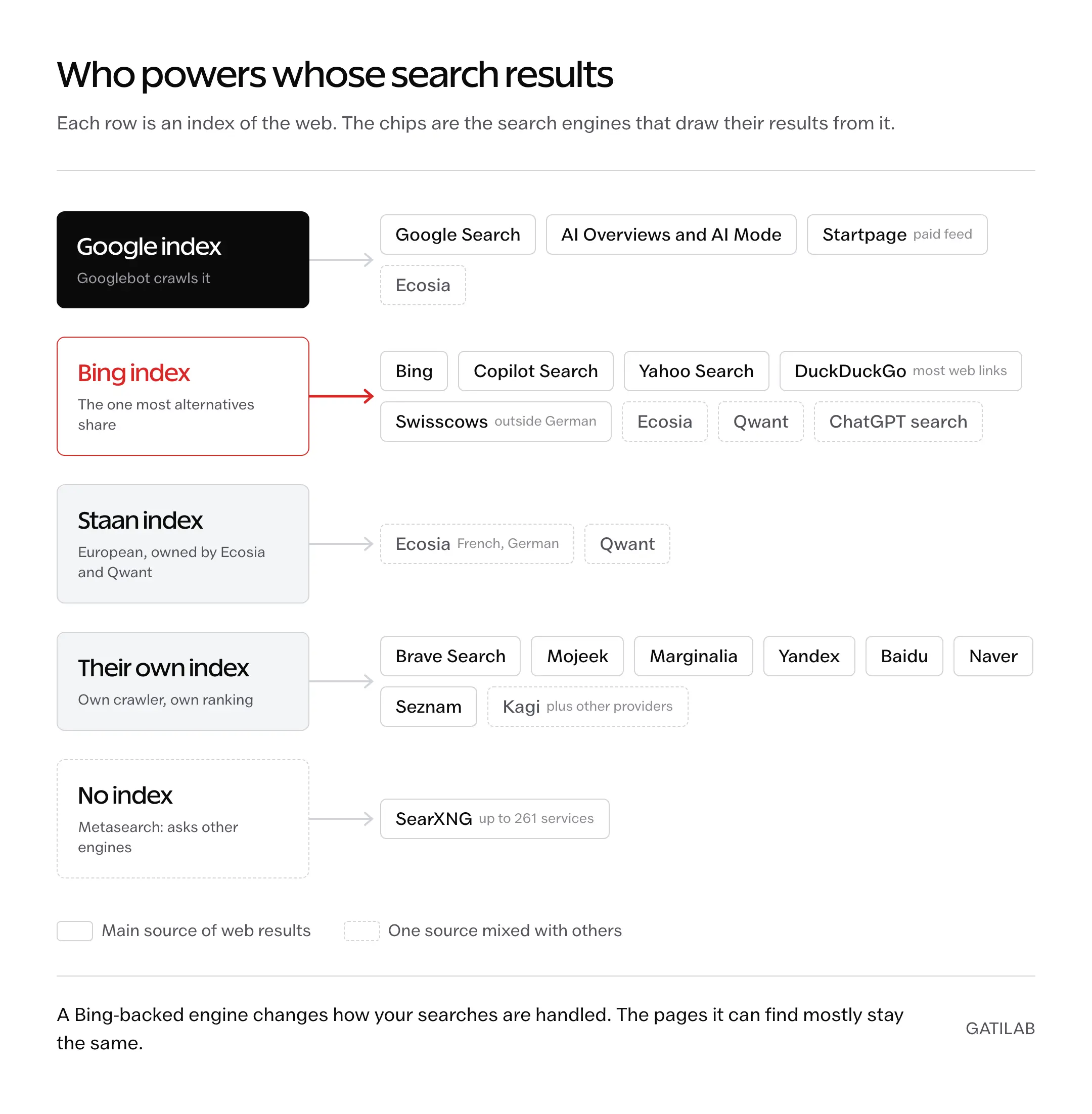
Here is how the main engines are wired, according to their own documentation:
- Bing index: Bing and Copilot Search, plus Yahoo Search, which draws on Bing’s crawler alongside its own, and DuckDuckGo, which largely sources its traditional links from Bing.
- Google index: Google Search with its AI Overviews and AI Mode, and Startpage, which shows Google results under a paid agreement.
- Mixed sources: Ecosia blends Google and Bing and adds the European Staan index for French and German, Qwant combines its own index with Bing, and ChatGPT search queries third-party providers that include Microsoft.
- Own index: Brave Search, Mojeek, Marginalia, Yandex, Baidu, Naver and Seznam crawl and rank the web themselves. Kagi runs its own index and blends it with other providers.
- No index: SearXNG passes your query to other engines and merges what comes back.
So if a page doesn’t show up on Bing, it generally won’t show up on Yahoo or DuckDuckGo either. That is the practical reason I’d keep at least one own-index engine, such as Brave Search or Mojeek, in your rotation.
Search Engine Market Share
Google still handles close to 9 in 10 searches worldwide. These are StatCounter’s figures for September 2026, with the US and India alongside for comparison:
| Search engine | Worldwide | United States | India |
|---|---|---|---|
| 89.94% | 85.19% | 96.63% | |
| Bing | 5.29% | 9.89% | 1.92% |
| Yahoo | 1.36% | 2.64% | 0.57% |
| Yandex | 1.30% | 0.33% | 0.16% |
| DuckDuckGo | 0.74% | 1.75% | 0.64% |
| Baidu | 0.44% | Not in top 6 | Not in top 6 |
Bing’s US share is nearly double its worldwide share, and Windows and Edge both default to Bing there. And India is close to a one-engine market, so anyone doing SEO for Indian traffic is really doing SEO for Google. StatCounter measures page views from sites running its tracking code, so treat these as a good directional picture rather than an exact count of queries.
List of Search Engines by Type
This table covers all 24 engines on this page. The “results from” column is the one to read if you are hunting for different results:
| Search engine | Type | Results from | Cost |
|---|---|---|---|
| General | Own index | Free, ads | |
| Bing | General | Own index | Free, ads |
| Yahoo Search | General | Mostly Bing | Free, ads |
| Google AI Mode | AI answer | Free | |
| Copilot Search | AI answer | Bing | Free |
| ChatGPT search | AI answer | Third-party providers, including Microsoft | Free, no sign-in needed |
| Perplexity | AI answer | Web retrieval with cited sources | Free, paid tiers |
| DuckDuckGo | Privacy | Mostly Bing, plus own crawler | Free, ads |
| Startpage | Privacy | Free, ads | |
| Brave Search | Privacy | Own index | Free, ads |
| Ecosia | Privacy, cause-based | Google, Bing and Staan | Free, ads |
| Qwant | Privacy | Own index and Bing | Free, ads |
| Swisscows | Privacy, family-safe | Mostly Bing, own German index | Free |
| Mojeek | Privacy | Own index | Free |
| Kagi | Paid | Own index plus other providers | From $5 a month |
| Yandex | Regional (Russia) | Own index | Free, ads |
| Baidu | Regional (China) | Own index | Free, ads |
| Naver | Regional (South Korea) | Own index and Naver services | Free, ads |
| Seznam | Regional (Czech Republic) | Own index | Free, ads |
| SearXNG | Metasearch | Up to 261 other services | Free, self-hosted |
| Marginalia | Independent | Own small-web index | Free |
| Google Scholar | Specialized | Scholarly literature | Free |
| Openverse | Specialized | Openly licensed media | Free |
| Wayback Machine | Specialized | Internet Archive captures | Free |
How Many Search Engines Are There?
There is no fixed number, because it depends on what you count. Hundreds of search boxes exist if you include every site search, metasearch instance and AI chat tool. StatCounter’s monthly worldwide table lists only the top 6, and only a handful of companies crawl the whole web at scale.
The count that matters for finding different results is the number of independent indexes. Google and Bing are the 2 giants. Brave, Yandex, Baidu, Naver and Seznam run large ones of their own, and smaller independent indexes like Mojeek, Marginalia and the European Staan index fill in the edges. Most other names on any list of search engines sit on top of one of these.
General Search Engines
General engines are the right starting point when you don’t yet know which website or collection has the answer. All 3 below cover the whole web, but only 2 of them run their own index.
Google is the default for 89.94% of searches worldwide (StatCounter, September 2026) and it has the largest index, the deepest local data through Maps and the most mature handling of misspelled or vague queries. AI Overviews now sit above many results pages, and AI Mode adds a full conversational search tab.
The limitation is the one that sends people looking for alternatives in the first place: the first screen is often ads, AI summaries and large publishers before you reach a smaller site. For a site owner, Google is still where the traffic is, which is why ranking in AI Overviews has become its own job.
Bing
Bing is Microsoft’s search engine and the second-largest independent index, with 5.29% of searches worldwide and 9.89% in the US in September 2026. Its bigger role is behind the scenes, because Yahoo, DuckDuckGo and several privacy engines draw on it.
For site owners, Bing Webmaster Tools shows how Bing crawls your pages and supports IndexNow for pinging new URLs. Getting indexed on Bing quietly gets you onto every engine that rents its results.
Yahoo Search
Yahoo Search is still the third-largest search engine worldwide at 1.36%, ahead of Yandex and DuckDuckGo. Yahoo’s help pages say its results come from Bing’s crawler and its own Slurp crawler, and they send site owners to Bing Webmaster Tools to get listed.
That makes Yahoo a sensible choice if you already live in Yahoo Mail or Yahoo Finance. As a second opinion on Bing, it adds very little.
AI Answer Engines
AI answer engines read several pages and write a summary with citations. They are good for comparison questions and follow-ups, and weak wherever an exact price, date or instruction matters, because a fluent summary can still misread its source. You should open the cited page before acting on anything important.
Google AI Mode
AI Mode is a separate tab inside Google Search that answers with a Gemini model, lets you ask follow-up questions and links to the pages it used. Google opened it to all US users at I/O in May 2025 and has since expanded it to more than 200 countries and territories.
It runs on Google’s index, so it widens the answer format without widening the pool of sources.
Copilot Search
Copilot Search is Microsoft’s AI answer mode inside Bing, launched on April 4, 2025. Bing Chat had already been renamed Copilot in late 2023, and Copilot Search brings that AI into the results page itself, citing sources inline with the regular web results still above and below the answer.
It is Bing’s index with an AI layer on top, which is useful when you want Bing’s results summarized and redundant when you have already checked Bing.
ChatGPT Search
ChatGPT search is the web search built into ChatGPT, and it is available on the Free plan and even to people who are not signed in. OpenAI says it rewrites your question into targeted queries and sends them to third-party search providers, including Microsoft, and sites that block its crawler, OAI-SearchBot, won’t appear in its answers.
“SearchGPT” was only the 2024 prototype name. If you publish content, getting cited in ChatGPT starts with not blocking OAI-SearchBot in robots.txt.
Perplexity
Perplexity is the best known standalone AI answer engine. It answers with numbered citations and suggested follow-ups, and CEO Aravind Srinivas said it handled 780 million queries in May 2025. The free tier covers everyday use, and paid plans add more advanced models and higher limits.
It works best for research questions that need several sources put together. For site owners, getting cited in Perplexity follows a different playbook from classic rankings.
Privacy Search Engines
Privacy describes how an engine treats you. Independence describes where its results come from. The 7 engines below all avoid building a personal search profile, but only Brave Search and Mojeek run fully independent indexes.
DuckDuckGo
DuckDuckGo is the most used privacy engine, at 0.74% worldwide and 1.75% in the US in September 2026. It doesn’t store a search history tied to you, runs its own crawler called DuckDuckBot for instant answers and pulls most traditional web links and images from Bing.
It is the easiest switch for someone who wants Google-like convenience without the tracking. If a narrow query returns the same links you saw on Bing, that is expected, and Brave Search or Mojeek is the next place to look.
Startpage
Startpage shows Google’s results without passing your IP address or search history to Google. It launched in the Netherlands in 2006, and its Anonymous View feature can open a result through a proxy so the destination site doesn’t see you either.
It is the closest thing to private Google. One thing worth knowing before you trust it with sensitive searches: Startpage is majority-owned by US ad-tech company System1, so you should read its privacy policy rather than relying on the Dutch address alone.
Brave Search
Brave Search runs one of the largest independent indexes outside Google and Bing. Brave removed its last Bing API calls in April 2023, so every web result now comes from its own index, and the company says Brave Search handles over 2.2 billion queries a month as of July 2026.
Goggles let you re-rank results with your own rules, and Ask Brave adds AI answers on top. If I had to pick one engine for genuinely different results at no cost, this would be it.
Ecosia
Ecosia is a Berlin-based engine that puts its profits into tree planting and climate projects. Its results come from a mix of Google and Bing, and through the European Search Perspective joint venture with Qwant it has added its own Staan index for French and German searches.
The old line that Ecosia is “Bing with trees” is out of date. Choose it for the cause and the European ownership, and compare a few searches in your own language before you judge its quality.
Qwant
Qwant is a French privacy engine that runs its own crawler and index and, by its own account, uses Bing to fill in where its index lacks relevant results and for images. It co-owns the Staan index with Ecosia, and Qwant Junior is a filtered version for children.
Qwant and Ecosia are the 2 answers I’d give to anyone who wants a search engine that isn’t American.
Swisscows
Swisscows is a Swiss engine built around family-safe filtering and privacy. Outside its own German-language index, it passes queries to Bing through an anonymizing layer, so most of its results are Bing’s.
The built-in filter is the reason to choose it for a shared family computer. The same filter makes it a poor fit for adult research, and it shouldn’t replace proper parental controls on the device.
Mojeek
Mojeek is a UK search engine that has built its own crawler and index from scratch since 2011 and doesn’t track searches. Its index passed 9 billion pages in 2025 and the team reported about 9.76 billion in May 2026.
That is a fraction of Google’s coverage, so Mojeek won’t answer every query well. It earns its place when the big engines keep returning the same large publishers and you want a different set of pages to look through.
Paid Search Engines
A paid engine trades a monthly fee for no ads and more control. The model is hard to sustain: Neeva, the best known ad-free challenger, shut its consumer search engine in 2023 and was bought by Snowflake.
Kagi
Kagi is an ad-free search engine paid for by its users. It blends its own web index, called Teclis, with anonymized calls to major search providers, and it lets you raise, lower or block any domain in your results. Its public stats page showed 75,537 members and about 999,500 queries a day on October 2, 2026.
These are the current plans:
- Trial: free, 100 searches
- Starter: $5 a month, 300 searches
- Professional: $10 a month, unlimited searches
- Ultimate: $25 a month, unlimited searches plus the full Kagi Assistant with premium AI models
Kagi is worth paying for if you search all day for work and keep filtering out the same low-quality domains. For a few searches a week, the free engines above are good enough, and the 100-search trial will tell you which camp you are in.
Regional Search Engines
Regional engines matter when the answer lives in another language or on a local platform. All 4 below run their own indexes, and their home-market shares from StatCounter for September 2026 show how far they are from the global picture.
Yandex
Yandex leads in Russia with 70.33% of searches against Google’s 28.12%. Since the 2024 split, Yandex search belongs to a Russian-owned company, and the Dutch former parent continues as Nebius Group.
It is the right tool for Russian-language research. Results and data handling should be judged with that jurisdiction in mind.
Baidu
Baidu is China’s largest search engine at 46.65%, which is lower than most lists claim. Bing holds a surprising 21.76% in China, followed by Yandex at 14.98% and Haosou at 12.26%.
Baidu works within mainland China’s content rules and leans heavily on its own services, so it is a research tool for the Chinese web and not a substitute for unrestricted global search.
Naver
Naver is South Korea’s homegrown portal, and it now sits second there with 43.06% against Google’s 47.97%. Much of its value is in Naver Blog, Cafe and Knowledge iN, where Korean users post content that standalone websites never have.
A business targeting Korea should plan for those Naver platforms as well as its own website.
Seznam
Seznam has served Czech users since 1996 and holds 15.05% of searches in the Czech Republic, behind Google at 78.71%. Few local engines in Europe have kept that much share for that long.
A few more regional names show up in StatCounter’s country tables for September 2026:
- Haosou (360 Search): 12.26% in China
- Sogou: 2.61% in China
- Cốc Cốc: 5.92% in Vietnam
- Daum: 0.73% in South Korea
Metasearch and Independent Search Engines
These 2 suit readers who want more control over where results come from or want the pages that mainstream results bury. Both come with tradeoffs in coverage and upkeep.
SearXNG
SearXNG is free, open-source metasearch software that aggregates results from up to 261 search services without tracking or profiling users. You can run your own instance or use a public one, and you choose which engines it asks.
The privacy depends on whoever runs the instance, so a random public instance isn’t automatically private. Upstream engines also rate-limit busy instances, which is why results on public ones can be patchy.
Marginalia
Marginalia is a small independent engine from Sweden with its own crawler, built to surface personal websites, hobby pages and text-heavy writing while pushing commercial content down.
Its narrow coverage is deliberate. It is a discovery tool for the small web and won’t help you find a plumber or compare prices.
Specialized Search Engines
A specialized engine beats a general one when you already know the kind of material you need.
Google Scholar
Google Scholar searches papers, theses, books and court opinions, and shows who cites what. A result may be a preprint, a published paper or only a citation record, so you should check the publication status before treating it as settled evidence.
Openverse
Openverse searches openly licensed images and audio. Check the license on the original item and meet its attribution terms before you use anything, because “found on Openverse” is not a license for every use.
Wayback Machine
The Wayback Machine from the Internet Archive retrieves saved copies of web pages. It is the tool for a page that changed or disappeared, though captures can be incomplete, so note the capture date whenever you cite one.
Which Search Engine Should You Use?
There are broadly three ways people handle this. Some stay on Google for everything and accept whatever the first screen shows. Some switch completely to a privacy engine and then find they are still reading Bing’s results. And some keep a small rotation, which is the approach I recommend.
A sensible rotation has 3 parts:
- Google or Startpage for local searches, maps and anything obscure, because nothing else has Google’s coverage.
- Brave Search or Mojeek when Google keeps showing the same big publishers, because their own indexes surface different pages.
- An AI answer engine like Perplexity or ChatGPT search for questions that need several sources put together, with the citations checked before you act.
Privacy is a separate layer on top: DuckDuckGo, Startpage or Qwant can each stand in for the first slot if tracking bothers you. And if you run a website, the same map tells you where to show up. Bing covers several engines at once, and AI search optimization covers the answer engines that now sit between searchers and your pages.
FAQs on Search Engines
Which Search Engines Have Their Own Index?
Google, Bing, Brave Search, Mojeek, Marginalia, Yandex, Baidu, Naver and Seznam crawl and rank the web themselves. Qwant and Kagi also run their own indexes but mix in results from other providers, and Ecosia and Qwant share the European Staan index. Yahoo, DuckDuckGo, Startpage and Swisscows mainly show results from Bing or Google.
Which Search Engine Is the Most Popular?
Google, by a wide margin. StatCounter put it at 89.94% of searches worldwide in September 2026, followed by Bing at 5.29%, Yahoo at 1.36%, Yandex at 1.3%, DuckDuckGo at 0.74% and Baidu at 0.44%.
Do Different Search Engines Give Different Results?
Only when they use a different index or rank it differently. Yahoo and DuckDuckGo draw heavily on Bing, so their results overlap with Bing’s. Brave Search, Mojeek and Google each run their own index, so comparing them shows you genuinely different pages.
Which Search Engines Are Not Based in the US?
Ecosia (Germany), Qwant (France), Startpage (Netherlands), Mojeek (UK), Swisscows (Switzerland), Seznam (Czech Republic) and Marginalia (Sweden) are European. Yandex, Baidu and Naver are based in Russia, China and South Korea. Startpage is Dutch but majority-owned by the US company System1.
What Is the Safest Search Engine to Use?
For not being profiled, DuckDuckGo, Startpage, Brave Search and Mojeek all avoid building a personal search history. Startpage is the pick if you want Google’s results privately. For children, Swisscows and Qwant Junior filter results. No search engine makes your browsing anonymous, because the sites you visit and your network provider can still see you.
Is DuckDuckGo as Good as Google?
For common queries the gap is often small, because DuckDuckGo’s traditional links come largely from Bing’s large index. Google usually has the edge on local searches, maps and very specific or obscure queries, where its bigger index and local data matter most.
Tell Google you want more of this.
Add Gatilab as a preferred sourceOne tap, and this site shows up more often in your own Top Stories, AI Overviews and AI Mode. Remove it any time.