Ahrefs vs Semrush vs Moz vs Majestic (2026): Which SEO Tool Is Best?
If you’re comparing Ahrefs vs Semrush vs Moz vs Majestic, the biggest mistake is treating them as four versions of the same SEO tool. They overlap, but each one is built around a different job, and the cheapest plan on each pricing page buys very different things.
I would choose Ahrefs for backlink research, organic competitor analysis and content research. Semrush makes more sense when SEO sits alongside paid search, AI visibility and broader marketing work. Moz is the easiest of the full suites to adopt and now has a $49 entry plan. Majestic is the specialist here: it doesn’t try to replace a full SEO suite, but its Trust Flow, Topical Trust Flow, Link Context and historical link data are still useful for serious backlink analysis.
This comparison uses each vendor’s own documentation and pricing pages, checked on October 6, 2026. Where database sizes or update speeds appear, I label them as vendor-published figures, because the four companies measure their indexes in different units. That distinction matters more than whichever company can print the largest number.
The 30-Second Verdict
Most people asking this question are buying one subscription, so the right pick depends on the work you do most often:
- Ahrefs is the one to buy if backlinks, competitor research and content gaps fill your week.
- Semrush fits teams where SEO, Google Ads, AI visibility and market research need to live in one account.
- Moz Pro suits small businesses and newer SEOs who want a gentler interface and lower entry price.
- Majestic is for link builders and auditors who need Flow Metrics and historical link data more than keyword tools.
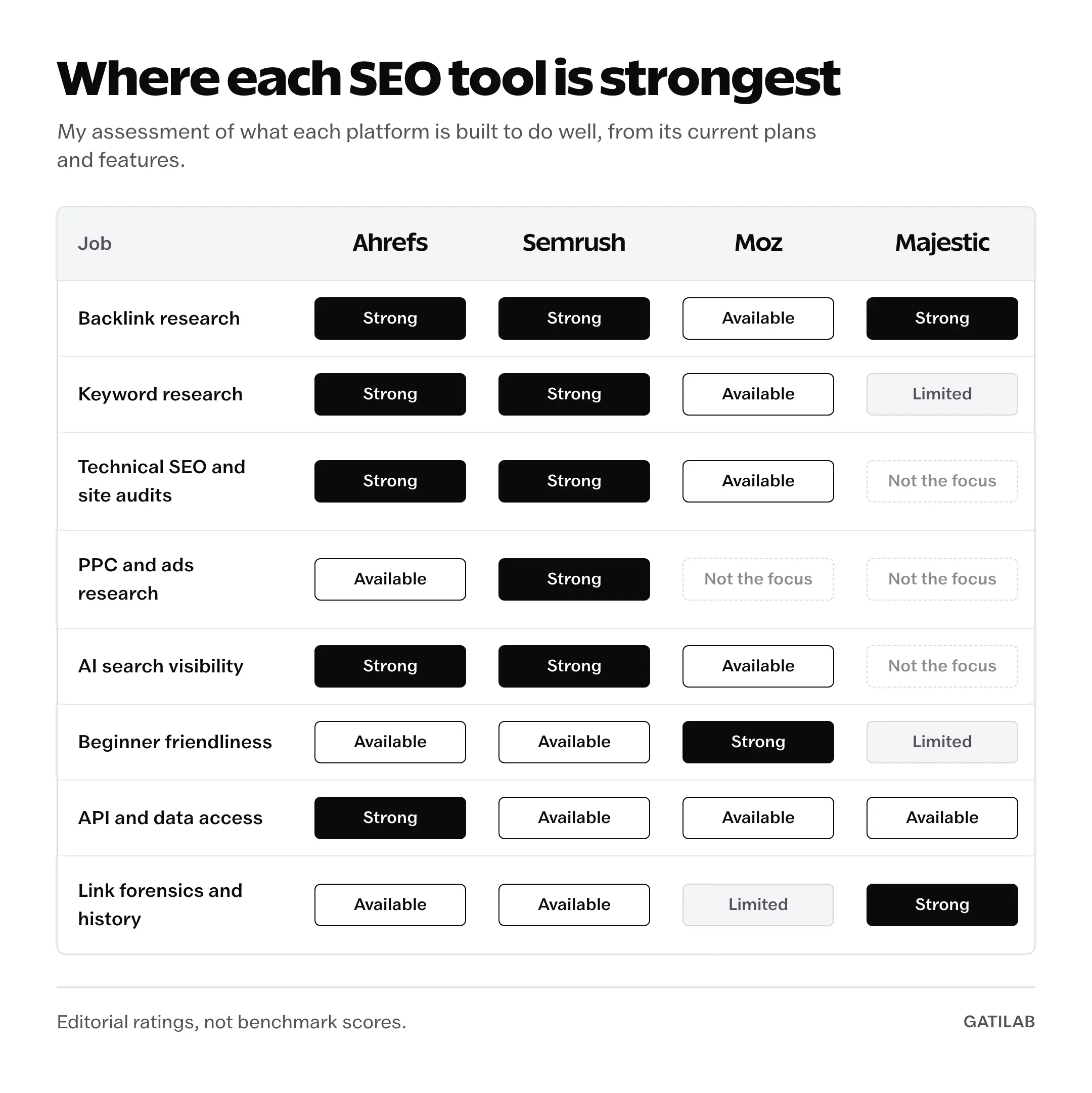
Ahrefs vs Semrush vs Moz vs Majestic at a Glance
The table compares each tool on the same fields. Prices are monthly list prices in USD, and data figures are what each vendor publishes about itself.
| Factor | Ahrefs | Semrush | Moz | Majestic |
|---|---|---|---|---|
| Lowest paid plan | Starter, $29 | SEO, $139 | Entry plan, $49 | Lite, $49.99 |
| Full SEO suite from | Lite, $129 | SEO, $139 | Standard, $99 | Not a full suite |
| Annual saving | Up to 17% | Up to 17% | 20% | About 17% |
| Backlink data (vendor figure) | 35T backlink history records | 43T+ backlinks | 40T+ links | 185B Fresh URLs crawled, 4.5T Historic |
| Keyword data | 28.7B keywords, 217 locations | 28.8B keywords, 142 databases | 1.25B+ keywords | Keyword Checker and Search Explorer |
| Site audit | Yes | Yes | Yes | No |
| PPC research | Paid keywords and ads | Advertising toolkit, sold separately | Not a focus | No |
| AI visibility | Brand Radar | AI Visibility in main plans | AI Visibility in every plan | Not a focus |
| API access | Lite and above, plus MCP | Advanced only, MCP from Starter | Separate Moz API | Separate API plan, $399.99 |
| Signature metric | Domain Rating | Authority Score | Domain Authority | Trust Flow and Citation Flow |
| Best for | Organic and link research | SEO plus PPC and marketing | Accessible SEO suite | Link intelligence |
How I Compared These Tools
Every price, plan limit and feature claim here comes from the vendor’s own pricing page, product page or documentation, checked on October 6, 2026. I didn’t run a lab benchmark across the four tools, so this article doesn’t rank them on speed or index size with numbers that were never measured side by side.
The recommendations are my judgment of where each tool fits, based on what its plans include and what each platform is built to do. When a vendor figure appears, it carries that vendor’s own unit, because a “backlink” in one index and a “URL found” in another aren’t the same thing.
Pricing and Plan Limits
Pricing is where most comparisons go wrong, because the cheapest plan on each page buys a different product. There are three questions worth separating: the cheapest way in, the cheapest comparable full SEO suite and what I’d actually pay for client work.
| Tool | Plan | Monthly | What You Get |
|---|---|---|---|
| Ahrefs | Starter | $29 | Limited research access |
| Ahrefs | Lite | $129 | 5 projects, 750 tracked keywords, 100K crawl credits |
| Ahrefs | Standard | $249 | 20 projects, 2,000 tracked keywords, 500K crawl credits |
| Ahrefs | Advanced | $449 | 50 projects, 5,000 tracked keywords, 1.5M crawl credits |
| Semrush | SEO | $139 | 5 websites, 500 tracked keywords |
| Semrush | Starter | $199 | 5 websites, 500 keywords, 50 AI prompts |
| Semrush | Pro+ | $299 | 15 websites, 1,500 keywords, 100 AI prompts |
| Semrush | Advanced | $549 | 40 websites, 5,000 keywords, 200 AI prompts, API |
| Moz | Entry plan | $49 | One website |
| Moz | Standard | $99 | 3 sites, 300 keywords, 400K pages crawled a month |
| Moz | Medium | $179 | 10 sites, 1,500 keywords, 2M pages crawled a month |
| Moz | Large | $299 | 25 sites, 3,000 keywords, 5M pages crawled a month |
| Majestic | Lite | $49.99 | Fresh Index, Trust Flow, Topical Trust Flow |
| Majestic | Pro | $99.99 | Adds the Historic Index and higher data limits |
| Majestic | API | $399.99 | Full API access, 5 users |
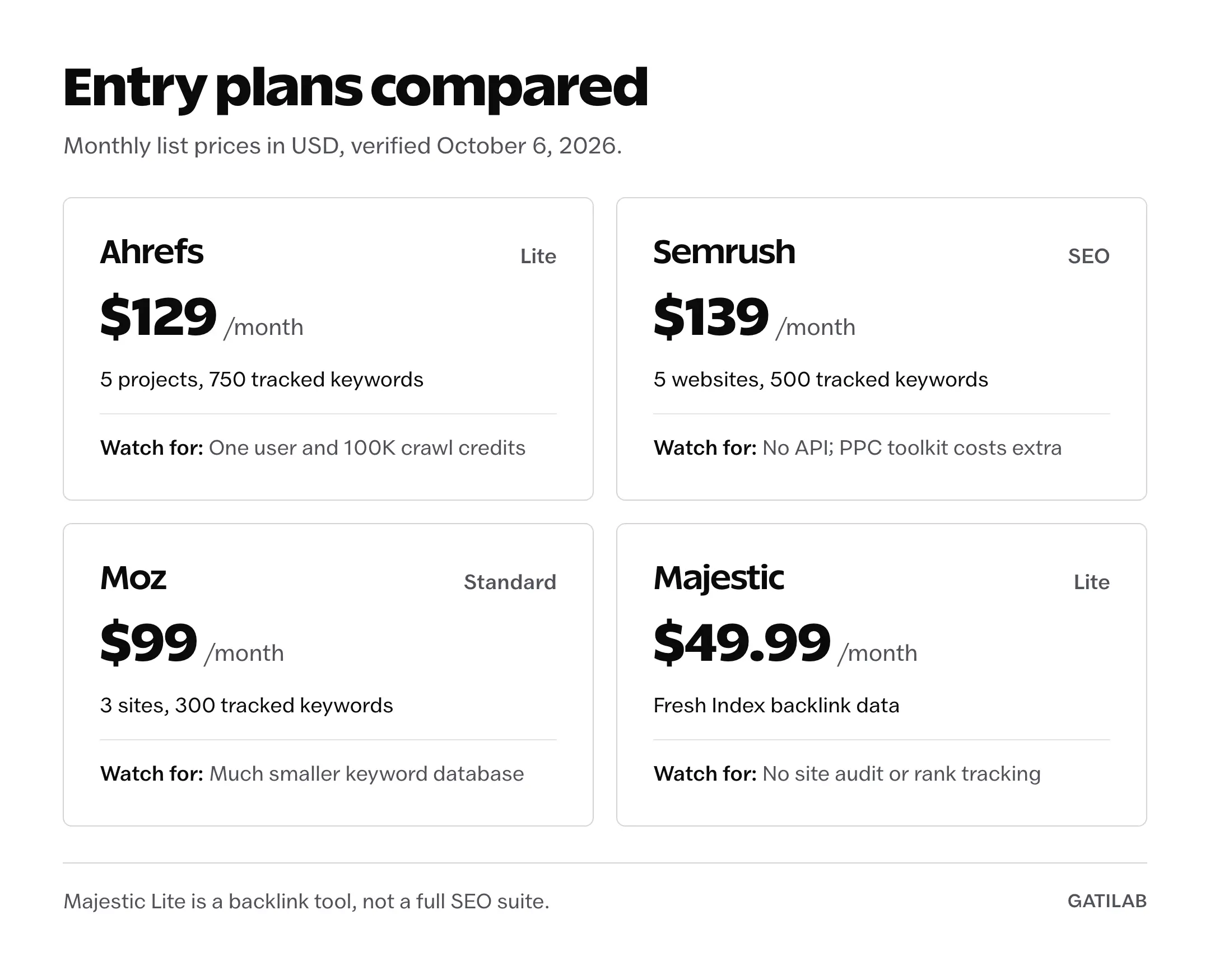
The cheapest way in is Ahrefs Starter at $29 a month, then Moz’s $49 entry plan for a single website and Majestic Lite at $49.99. Semrush also has a free plan with 10 reports a day. These aren’t equivalent products. Ahrefs Starter is a limited research plan, Moz’s entry plan covers one site and Majestic Lite is a backlink tool with no site audit or rank tracking. If you only need occasional checks, my guide to free SEO tools covers what you can do without paying.
The cheapest comparable full SEO suite is Moz Standard at $99, followed by Ahrefs Lite at $129 and the Semrush SEO plan at $139. Each includes keyword research, backlink data, rank tracking and site audits, with different limits. Moz Standard tracks 300 keywords across 3 sites, Ahrefs Lite tracks 750 keywords across 5 projects and the Semrush SEO plan tracks 500 keywords across 5 websites.
For client work, I would budget for Ahrefs Standard at $249 or Semrush Pro+ at $299, because the entry plans run out of projects and tracked keywords quickly once you manage more than a handful of sites.
Annual billing saves different amounts at each vendor. Ahrefs and Semrush advertise savings of up to 17%, Moz advertises 20% and Majestic’s annual Lite and Pro plans work out to about 17% less than paying monthly.
Semrush has also changed how it sells. Its SEO + AI Search plans cover SEO and AI visibility, while the Traffic & Market toolkit, the Advertising toolkit and its local, content and social tools are priced separately. So the SEO plan price isn’t the price of everything Semrush offers, and you should add up the toolkits you’d actually use.
Backlink Analysis
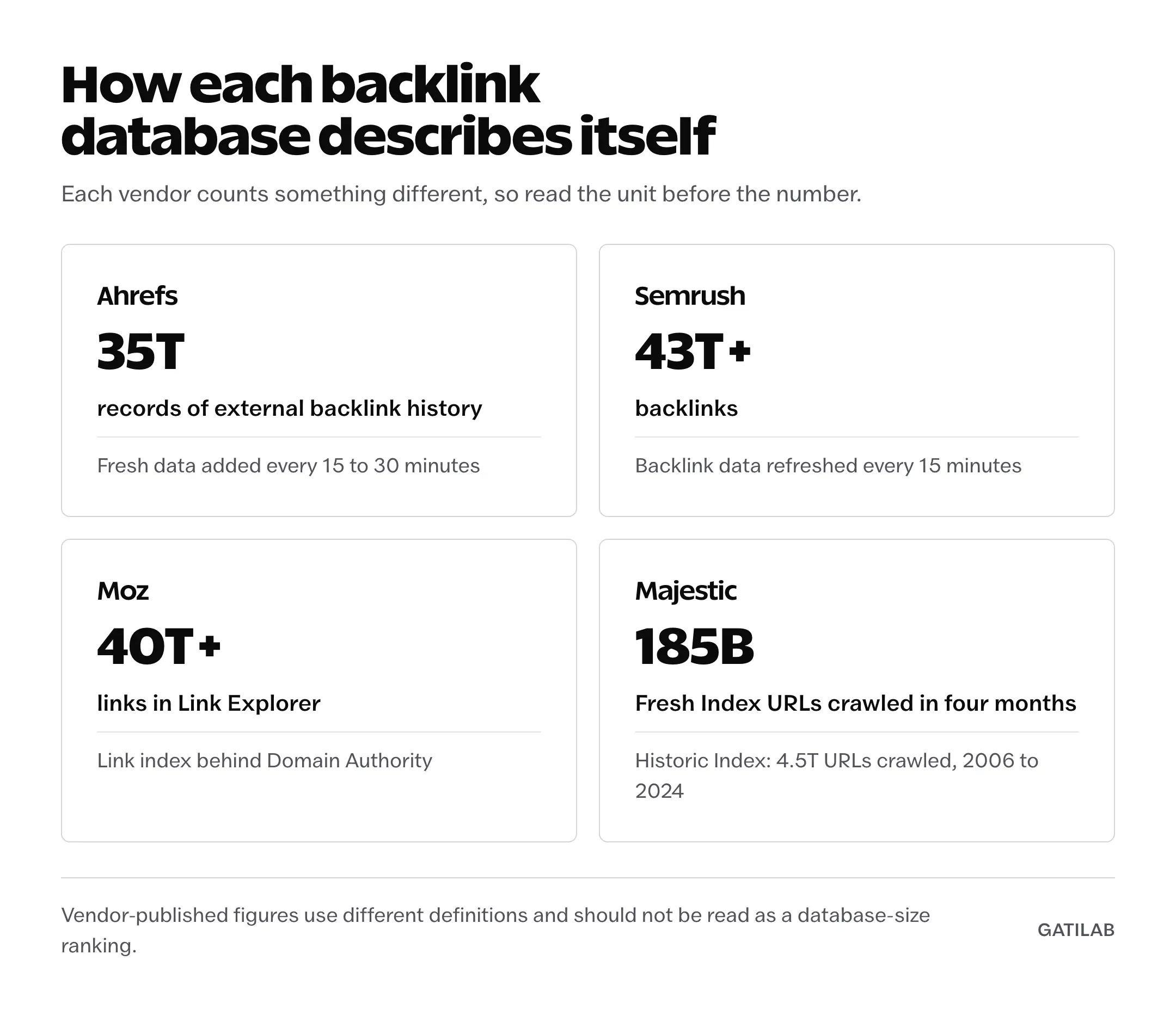
All four tools show who links to a site, but they describe their indexes in different units, so the headline numbers can’t sit on one scale:
- Ahrefs reports 35 trillion records of external backlink history across 493.9 billion pages, and says its index is updated with fresh data every 15 to 30 minutes.
- Semrush reports more than 43 trillion backlinks, collected by a crawler that processes about 10 billion pages a day, and says its backlink data refreshes every 15 minutes.
- Moz describes Link Explorer as covering more than 40 trillion links.
- Majestic splits its data into a Fresh Index, about 185 billion URLs crawled over the last four months and updated continuously, and a Historic Index of about 4.5 trillion URLs crawled from June 2006 to March 2024, last updated in May 2024.
An update cadence also isn’t the same as how fast a brand-new link shows up for your site. That depends on when the crawler reaches the linking page, so I wouldn’t pick a tool on a freshness claim alone.
What matters more in daily work is the metric each tool builds on top of its links. Ahrefs uses Domain Rating and URL Rating, Semrush uses Authority Score, Moz uses Domain Authority, Page Authority and Spam Score, and Majestic uses Citation Flow for link volume and Trust Flow for links close to trusted seed sites. Topical Trust Flow then splits Trust Flow by subject, so you can see whether a site is trusted for health, finance or something else. No other tool here has an equivalent topic-level link metric, and it is included even in Majestic Lite.
For historical work, such as a penalty clean-up on an old site, Majestic’s Historic Index reaches back to 2006 and is available on the Pro plan. For your own site, the free links report in Google Search Console is worth checking alongside any of these tools, because it reflects the links Google has actually recorded.
Keyword Research and Rank Tracking
Ahrefs and Semrush are in a different league from Moz and Majestic on keyword data:
- Ahrefs reports 28.7 billion filtered keywords across 217 locations.
- Semrush reports about 28.8 billion keywords across 142 geographic databases.
- Moz reports a keyword index of more than 1.25 billion keywords in Keyword Explorer.
- Majestic has Keyword Checker and Search Explorer, which look at keywords through its link and web graph, not as a full keyword research suite.
Keyword difficulty scores don’t translate between tools. Ahrefs leans on the backlinks of the pages already ranking, Moz leans on the authority of those pages and Semrush adds other SERP signals, so the same keyword can get noticeably different scores in each tool. None of them is “right.” It is wise to pick one tool’s scale and stick to it rather than cross-comparing.
Rank tracking limits follow the plan, so the cheapest plans run out first. Ahrefs tracks 750 keywords on Lite and 2,000 on Standard, Semrush tracks 500 daily on its SEO and Starter plans and 1,500 on Pro+, and Moz tracks 300 on Standard and 1,500 on Medium. If keyword research is new to you, my guide on how to do keyword research covers the process before the tool.
Technical SEO and Site Audits
Ahrefs, Semrush and Moz all include a site audit crawler. Majestic doesn’t, because it focuses on links.
The crawl allowance is the limit that matters for agencies auditing several sites:
- Ahrefs includes 100,000 crawl credits on Lite, 500,000 on Standard and 1.5 million on Advanced.
- Moz crawls 400,000 pages a month on Standard, 2 million on Medium and 5 million on Large.
- Semrush includes Site Audit in its SEO + AI Search plans, with page limits that rise by tier.
Moz’s crawl allowance is generous for the price, which makes Medium at $179 a sensible pick for consultants auditing many small sites. Ahrefs can render JavaScript in its audits and Semrush can from its Pro+ plan, which matters for sites built on React or Next.js. For deeper rendering problems, I’d still confirm a finding in Google Search Console’s URL Inspection before treating it as fact.
Competitor, PPC and Market Research
This is where Semrush pulls away from the others. Its Advertising toolkit covers competitor ad copy, paid keywords and ad history, and its Traffic & Market toolkit estimates a competitor’s traffic sources and audience. Both are sold separately from the SEO + AI Search plans, so you should price them in if PPC is part of your work.
Ahrefs shows paid keywords and ads inside Site Explorer, which is enough for an SEO checking what a competitor bids on but not for running ad campaigns. Moz and Majestic don’t focus on paid search.
AI Search, AEO and GEO Tracking
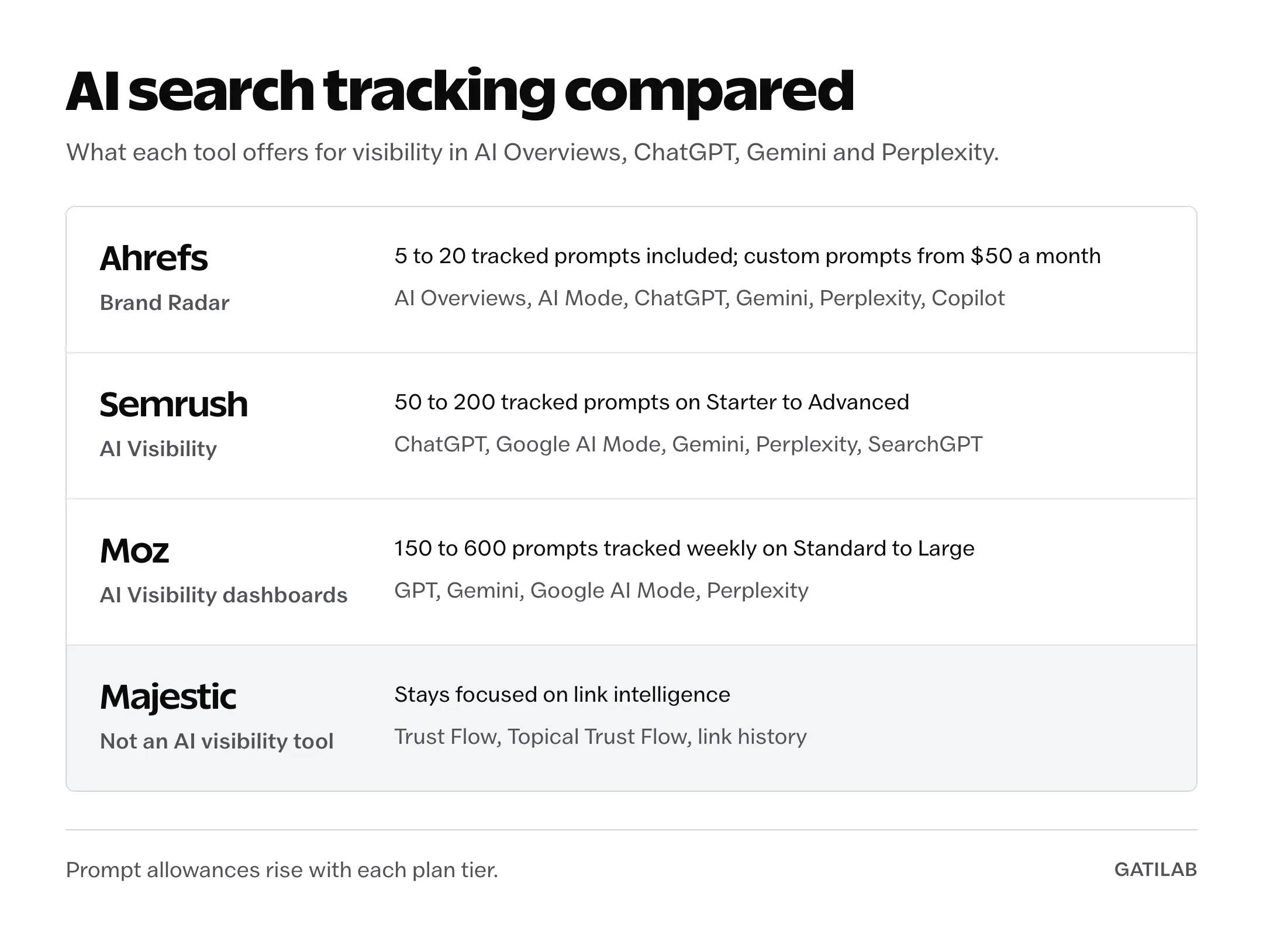
The useful question here is whether a tool helps you see your visibility beyond Google’s blue links, in AI Overviews, ChatGPT, Gemini and Perplexity answers. Three of the four now do:
- Ahrefs Brand Radar includes 5 tracked AI prompts on Lite, 10 on Standard and 20 on Advanced. Custom prompt tracking starts at $50 a month and the wider AI Visibility Index costs $199 a month. It covers AI Overviews, AI Mode, ChatGPT, Gemini, Perplexity and Copilot.
- Semrush built AI Visibility into its SEO + AI Search plans, with 50 tracked prompts on Starter, 100 on Pro+ and 200 on Advanced. Semrush says the toolkit covers ChatGPT, Google AI Mode, Gemini, Perplexity and SearchGPT.
- Moz includes AI Visibility dashboards and weekly prompt tracking in every Pro plan: 150 prompts on Standard, 300 on Medium and 600 on Large, across GPT, Gemini, Google AI Mode and Perplexity.
- Majestic doesn’t position itself as an AI visibility tool. It stays focused on link intelligence.
| Capability | Ahrefs | Semrush | Moz | Majestic |
|---|---|---|---|---|
| AI visibility product | Brand Radar | AI Visibility | AI Visibility dashboards | Not a core focus |
| Custom prompt tracking | Paid add-on from $50 a month | Included, 50 to 200 prompts | Included, 150 to 600 prompts | No |
| SEO and AI in one account | Yes | Yes | Yes | Links only |
| Best reason to use it | Search and content research plus AI | Broad SEO and AI workflow | Simpler SEO plus AI monitoring | Link graph analysis |
If AI search is a big part of why you’re shopping, my guides to AI search optimization and AI visibility tools go further than these four platforms.
APIs, MCP and Integrations
Data access has become a real difference between the four, especially for anyone feeding SEO data into reports, dashboards or AI agents:
- Ahrefs includes API and MCP access on its Lite, Standard and Advanced plans, with tier-specific limits, and Enterprise removes the API cap.
- Semrush includes API access only on Advanced, while MCP access starts on Starter.
- Moz sells the Moz API separately from Moz Pro.
- Majestic’s Lite and Pro plans don’t include API access. The Full API plan costs $399.99 a month and includes 5 users.
Strengths and Limitations
Here is how I’d sum up each tool, separate from the vendor figures above.
Ahrefs
Ahrefs is the sharpest single tool for organic research. Site Explorer, Content Explorer and link intersect (sites that link to your competitors but not to you) make competitor and outreach research fast, and the API and MCP access on paid plans is generous.
- What I like: backlink and keyword data in one clean workflow, Content Explorer for topic research and API access from Lite.
- What I don’t: entry plans run out of projects and tracked keywords quickly, and wider AI visibility data costs extra.
- Who should buy it: SEOs and content teams whose work is mostly organic search and links.
Semrush
Semrush is the broadest marketing platform of the four. It puts SEO, AI visibility, competitor ads and market research under one login, which suits agencies serving clients across channels.
- What I like: strong keyword and backlink data, deep PPC research and AI visibility built into the main plans.
- What I don’t: the modular pricing means the full toolkit costs well above the SEO plan, and API access needs the Advanced plan.
- Who should buy it: agencies and in-house teams where SEO sits alongside paid search and wider marketing.
Moz
Moz Pro is the easiest full suite to start with, and Domain Authority is still the metric many non-technical clients recognize. Its crawl allowances are generous for the price, and AI prompt tracking is now part of every plan.
- What I like: the lowest-priced full suite, generous site crawls and a gentle learning curve.
- What I don’t: a much smaller keyword database than Ahrefs or Semrush, and the API is a separate product.
- Who should buy it: small businesses, newer SEOs and consultants reporting to clients who already know DA.
If Moz and Ahrefs are your final two, my Moz Pro vs Ahrefs comparison goes deeper on that choice.
Majestic
Majestic is a link intelligence specialist. Trust Flow, Topical Trust Flow, Link Context and the Historic Index make it the tool I’d open for link audits, disavow work and judging whether a linking site is trusted in your niche.
- What I like: topic-level trust metrics, historical link data back to 2006 and a low Lite price.
- What I don’t: no site audit or full keyword suite, the Historic Index hasn’t been updated since May 2024 and the API is a separate plan.
- Who should buy it: link builders, backlink auditors and domain buyers, usually alongside a full SEO suite.
Which Tool Should You Choose?
Find the row that matches your work. The second column is the plan I’d start with.
| Your Situation | Start With | Why |
|---|---|---|
| Content site or blog growing on organic search | Ahrefs Lite | Keyword, content and backlink research in one tool |
| Agency running SEO and Google Ads | Semrush Pro+ with the Advertising toolkit | PPC research sits beside SEO and AI visibility |
| Small business new to SEO | Moz Standard | Lowest-priced full suite with a gentle learning curve |
| Consultant auditing many small sites | Moz Medium | 2M pages crawled a month for $179 |
| Link builder or backlink auditor | Majestic Pro, plus a full suite | Flow Metrics, Topical Trust Flow and historical data |
| Brand tracking AI answers | Semrush Starter or Moz Standard | Prompt tracking included in the plan |
| Developer pulling SEO data into tools | Ahrefs Lite or above | API and MCP access without an enterprise plan |
Should You Use More Than One?
For most solo SEOs and small teams, one tool is enough. A second platform earns its place when it solves a recurring gap that is worth more than the subscription.
The most common useful pairing is a full suite plus Majestic. Ahrefs or Semrush covers keywords, audits and day-to-day backlink checks, and Majestic Lite or Pro adds Flow Metrics and historical data for link audits. Pairing Ahrefs with Semrush makes sense only when PPC research or Semrush’s market data is something you’d use every week, because otherwise you pay twice for the same keyword and backlink work.
If you want more options beyond these four, my roundup of SEO tools like Ahrefs covers cheaper and more specialized alternatives, the head-to-head Ahrefs vs Semrush comparison goes deeper on those two and Semrush vs Ahrefs vs Moz covers the three full suites without Majestic.
Final Verdict
Ahrefs is my pick for backlink research and organic competitive research. Semrush is the stronger broad marketing platform, particularly when SEO, paid search, AI visibility and other marketing workflows need to live together. Moz is the easiest conventional SEO suite to get into at a lower price. Majestic remains the specialist choice when link graph analysis, Trust Flow, Topical Trust Flow and historical backlink investigation matter most.
Before paying, use the free tier or trial to run your own site and one competitor through the tool you’re leaning towards. If the reports you’d open every week make sense to you, that’s your tool.
FAQs on Ahrefs, Semrush, Moz and Majestic
Is Ahrefs or Semrush better in 2026?
Ahrefs is better for organic search and backlink research, and Semrush is better when SEO sits alongside paid search, AI visibility and market research. Both have large keyword and backlink databases, so the deciding factor is how much of your work goes beyond organic search.
Which tool has the best backlink database?
There’s no fair single answer, because each vendor counts something different. Ahrefs publishes backlink history records, Semrush publishes backlinks and Majestic publishes URLs crawled and found. Ahrefs and Semrush are the strongest all-round choices, and Majestic is the strongest for historical and topic-level link analysis.
Is Majestic better than Ahrefs for backlinks?
Majestic is better for Flow Metrics, Topical Trust Flow and historical link investigation. Ahrefs is better for an everyday backlink workflow that also covers keywords, content research and site audits.
Is Moz Pro still worth paying for?
Yes, if you want an easy full SEO suite at a lower price. Moz Standard at $99 includes rank tracking, site audits, Domain Authority and AI prompt tracking. Its keyword database is much smaller than Ahrefs or Semrush, so heavy keyword researchers should compare limits first.
Which SEO tool is cheapest?
Ahrefs Starter at $29 a month is the lowest paid plan, followed by Moz’s $49 entry plan and Majestic Lite at $49.99. For a comparable full SEO suite, Moz Standard at $99 is cheapest, then Ahrefs Lite at $129 and the Semrush SEO plan at $139.
Which tool is best for agencies?
It depends on the services you sell. Agencies doing SEO plus PPC usually get the most from Semrush, link-building agencies from Ahrefs plus Majestic and agencies auditing many small sites from Moz Medium’s crawl allowance.
Which tool is best for AI search tracking?
Semrush and Moz both include AI prompt tracking in their plans. Ahrefs Brand Radar covers the widest set of AI platforms, but custom prompts and its full AI Visibility Index cost extra. Majestic doesn’t track AI search.
Can Majestic replace Semrush or Ahrefs?
Usually not. Majestic has no site audit or full keyword research suite, so most people use it alongside Ahrefs, Semrush or Moz rather than instead of them.
Which tool has the best API?
Ahrefs includes API and MCP access from its Lite plan, which is the most accessible. Semrush includes API access only on Advanced, Moz sells its API separately and Majestic’s Full API plan costs $399.99 a month.
Can I use any of these tools for free?
Yes, in a limited way. Ahrefs Free (formerly Ahrefs Webmaster Tools) covers your own verified sites, Semrush’s free plan allows 10 reports a day, Moz offers MozBar, free tools and a Pro trial, and Majestic has a free backlink checker. None of these replace a paid plan for competitor research.
Tell Google you want more of this.
Add Gatilab as a preferred sourceOne tap, and this site shows up more often in your own Top Stories, AI Overviews and AI Mode. Remove it any time.