
Build a Six-Figure Service Business From Scratch
I crossed $100,000 in annual service revenue during year three of running my WordPress development practice. Not because I found some secret growth hack. Because I stopped charging $50/hour and started pricing projects at $5,000 to $15,000 based on what they were worth to the client. That single decision cut my required client count from 40+ per year down to 12.
After 16 years building and scaling service businesses, I’ve watched dozens of consultants, freelancers, and agency owners hit this number. The ones who get there share the same traits: they pick a niche, they price on value, they build recurring revenue, and they stop saying yes to everything. This guide covers the exact arithmetic, pricing models, acquisition systems, and capacity math that make $100,000+ predictable rather than aspirational.
The Arithmetic Behind $100K
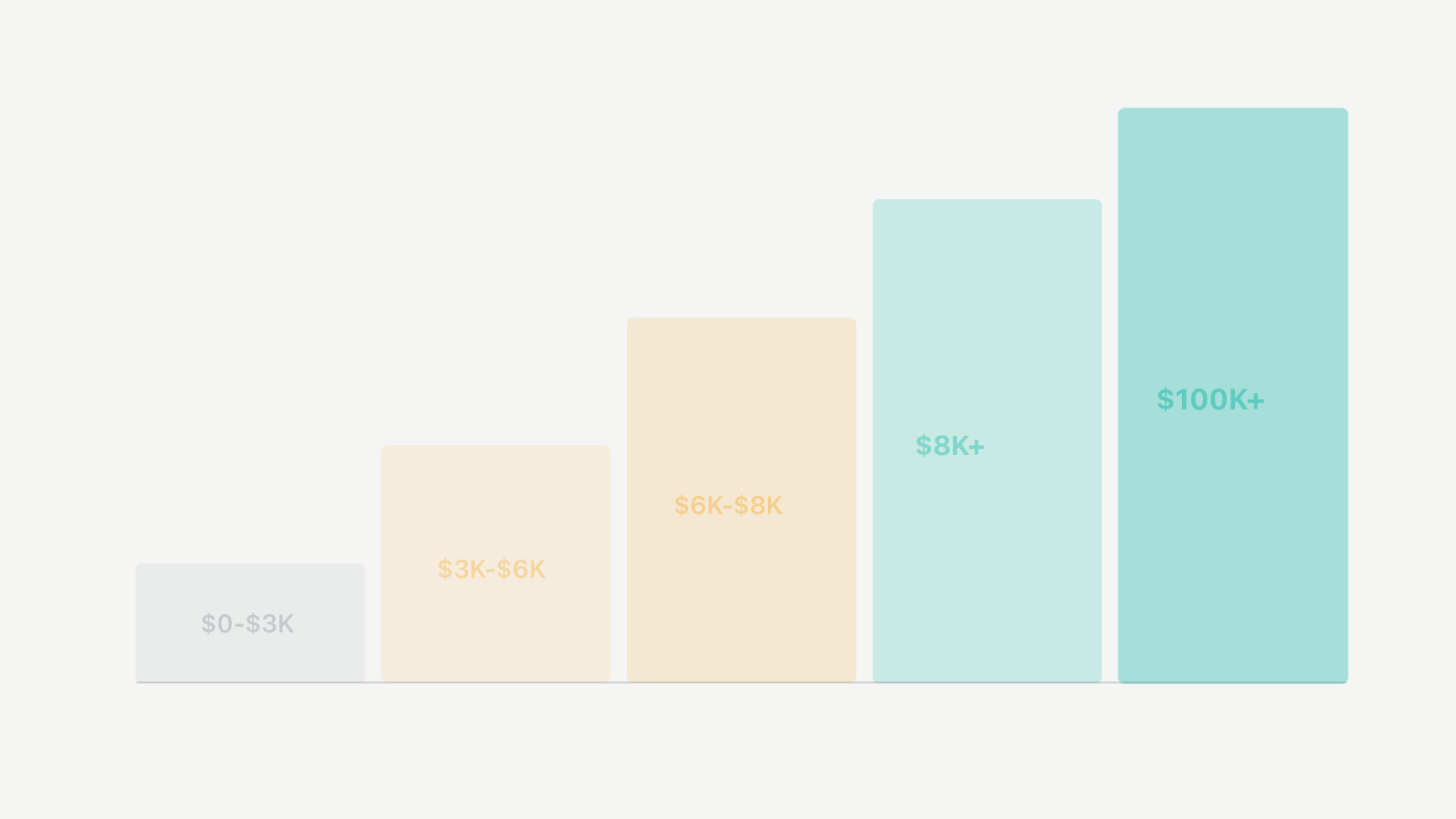
Six figures isn’t an abstract milestone. It’s a math problem with exactly four solutions.
Here’s what each path actually looks like in practice:
| Revenue Model | Clients Needed | Price Per Client | Monthly Revenue | Practical For Solo? |
|---|---|---|---|---|
| High Volume | 100 | $1,000 | $8,333 | Rarely. Requires team or productized delivery. |
| Premium | 4 | $25,000 | $8,333 | Possible. High concentration risk if you lose one. |
| Balanced | 10 to 20 | $5,000 to $10,000 | $8,333 | Yes. Sweet spot for most solo providers. |
| Monthly Retainer | 10 | $833/mo | $8,333 | Yes. Best for predictable cash flow. |
I tried the high-volume path first. Took on 8 to 10 small WordPress projects per month at $500 to $1,500 each. I was pulling 60-hour weeks, drowning in revisions, and netting about $72,000 annually after accounting for scope creep I never billed for. Switching to 10 to 15 clients at $7,500 average got me past $100K while working 40-hour weeks.
The retainer model is the one I recommend for anyone who wants stability. 10 clients paying $1,000/month equals $120,000 annually. You don’t start from zero every month. You don’t constantly hustle for the next project. And your clients get better results because you have continuity with their business.
Positioning That Commands Premium Prices
Six figures is mathematically brutal at commodity rates. If you’re the “$50/hour WordPress developer,” you need 2,000 billable hours annually just to hit the number. That’s 40 billable hours per week for 50 weeks with zero time for sales, admin, or learning. Impossible.
Premium positioning fixes the math. Here’s how each lever works:
Niche selection. “Marketing consultant” competes with 2.3 million results on LinkedIn. “B2B SaaS demand generation specialist” competes with a few hundred. I went from “web developer” to “WordPress performance optimization for publishers” and my average project value jumped from $2,000 to $8,500 within 6 months. Narrower focus means less competition, higher perceived expertise, and pricing power.
Problem specificity. Don’t sell services. Sell solutions to expensive problems. “I help ecommerce stores reduce cart abandonment by fixing checkout UX” beats “I do UX consulting.” When you’re the answer to a problem costing the client $500,000/year in lost revenue, charging $25,000 to fix it feels like a bargain.
Outcome framing. “I implement email marketing” is an activity. “I build email systems that increase customer lifetime value by 40%” is an outcome. Outcome framing enables value-based pricing because the client can calculate ROI before signing.
Credibility signals. Case studies with specific numbers. Testimonials from recognizable companies. Published content demonstrating depth. One detailed case study showing how you generated $200,000 in client revenue does more for your positioning than 50 generic testimonials saying “great to work with.”
Target client selection. Bootstrapped startups have $500 budgets. Funded Series A companies have $50,000 budgets. Your target client determines your pricing ceiling. I wasted 18 months pitching small business owners before I realized enterprise marketing teams would pay 5x more for the same work.
Pricing Strategy That Makes the Math Work
Pricing is the highest-leverage decision in a service business. Double your prices and you need half the clients. Here’s how to structure it.
| Pricing Model | How It Works | Revenue Ceiling | Best For |
|---|---|---|---|
| Value-Based | Price = % of client outcome value | Unlimited | Consultants, strategists |
| Project Fixed | Flat fee per deliverable | $150K to $250K solo | Developers, designers, writers |
| Monthly Retainer | Recurring fee for ongoing access | $120K to $200K solo | Any service with ongoing needs |
| Hourly | Time x rate | $125K max at $100/hr | Only when clients require it |
Value-based pricing. If your work generates $500,000 in client value, charging $50,000 is a 10:1 ROI for the client. That’s an easy yes. Time-based pricing caps your income at hours available times hourly rate. Value-based pricing breaks that ceiling entirely.
Project minimums. Set floors. My minimum engagement is $5,000. That means I need 20 projects for six figures. When my minimum was $1,500, I needed 67 projects. Higher minimums mean fewer projects to manage, more time per client, and better work. Every time I raised my minimum, total revenue went up because I attracted more serious clients.
Raising rates. I raised rates 30% for new clients in 2019. Lost 2 prospects out of 15. The 13 who stayed generated more revenue than the previous 15 would have at old rates. Most service providers undercharge by 30% to 50%. Test it. You’ll keep more clients than you expect.
Saying no to underpriced work. Every $1,500 project consumes capacity that could serve a $10,000 client. I track opportunity cost now. If I’m booked at $7,500 average and someone offers $2,000, that’s not revenue. That’s a $5,500 loss.
Packaging and productization. Defined offerings close faster than custom proposals. My “WordPress Performance Audit” is a fixed $3,500 package with clear deliverables. Closes in 1 to 2 calls versus 4 to 6 calls for custom projects. Productized services improve both revenue and sales efficiency.
Client Acquisition Systems That Scale
Consistent revenue requires consistent client flow. Hoping for referrals isn’t a system.
Referral cultivation. Most service businesses run on referrals, but passive referrals plateau. I send a specific email to every client after project completion asking for 2 introductions. That single practice generates about 35% of my annual pipeline. The difference between businesses that get referrals and those that don’t is simply asking.
Content marketing. I publish 2 detailed technical articles per month on my site. Each one ranks for 3 to 8 long-tail keywords and generates 1 to 3 qualified leads monthly. Over 16 years, that content library compounds. Prospects arrive pre-sold on my expertise because they’ve already read my thinking.
Network development. Strategic partnerships with complementary providers generate warm introductions that close at 3x the rate of cold outreach. I have standing relationships with 4 design agencies that send me WordPress development work. I send them design work. Everyone wins.
Direct outreach. Works when combined with visible credibility. I identify 10 ideal prospects per month, personalize each message with something specific I noticed about their site, and offer one concrete observation. Conversion rate: about 8% to calls, 3% to projects. Not high, but 3 to 4 projects per year from 120 personalized emails is solid ROI.
Speaking and podcasts. One conference talk at WordCamp generated $47,000 in project revenue over the following 6 months. Podcast appearances reach audiences you can’t access through content alone. I aim for 4 to 6 guest appearances per year.
Inbound systems. Your website needs to convert visitors into conversations. Mine has a clear service page, 3 detailed case studies, and a single call-to-action: book a 30-minute strategy call. No newsletter pop-ups. No lead magnets. Just a direct path from “this person knows what they’re doing” to “let’s talk.”
You don’t need all channels. You need 2 to 3 working consistently. Mine are content, referrals, and partnerships. Yours might be different. Pick what fits your personality and work it hard.
Service Delivery That Generates Repeat Business
Revenue depends on delivering results that justify your prices and trigger referrals. Cut corners here and the entire model collapses.
Clear scope and expectations. I document every deliverable, deadline, and revision limit in a 1-page project brief before starting. Scope creep destroyed my margins for the first 2 years. I was doing 30% more work than I quoted because I never defined boundaries. Now, change requests outside scope get a quick estimate and a separate invoice.
Consistent processes. I have checklists for every service I deliver. WordPress site launch: 47-point checklist. Performance audit: 23-point checklist. Processes free mental energy for client-specific problem solving instead of reinventing the basics every time.
Communication cadence. Weekly status updates every Monday morning. Clients who don’t hear from you worry. Clients who get predictable updates trust the process. I’ve had clients tell me my communication was the main reason they referred me, not the technical work.
Outcome measurement. Track and report results with specific numbers. “Your site now loads in 1.8 seconds, down from 6.2 seconds. That’s a 71% improvement” is infinitely more powerful than “we optimized your site.” Evidence of impact supports future pricing, generates testimonials, and builds case studies.
Systematic testimonial collection. I send a 3-question feedback form after every project. 70% of clients respond. Those responses become testimonials, case study material, and Google reviews. Every completed project is marketing material for the next one.
Time and Capacity Math
Solo service providers have a hard ceiling. Understanding it prevents burnout and informs pricing.
| Activity | Hours/Week | % of Total | Revenue Impact |
|---|---|---|---|
| Billable client work | 25 | 62.5% | Direct revenue |
| Sales and proposals | 5 | 12.5% | Pipeline generation |
| Marketing and content | 4 | 10% | Future pipeline |
| Admin, invoicing, email | 4 | 10% | Business operations |
| Learning and skill development | 2 | 5% | Future rate increases |
| Total | 40 | 100% |
25 billable hours per week is realistic. Aiming for 40 leaves zero time for the work that generates future clients. At $100/hour, 25 hours per week for 50 weeks gives you a ceiling of $125,000. To go higher, you increase rates or build a team. There’s no third option.
High-leverage activities. Every hour spent on a $50 administrative task is an hour not spent earning $200 on client work. I hired a virtual assistant at $15/hour for 10 hours/week in year two. Cost: $7,800/year. Revenue recovered by redirecting those hours to billable work: roughly $50,000. Best investment I made.
Saying no. I turn down about 40% of incoming inquiries now. Wrong fit, wrong budget, wrong timeline. Every bad client prevents a good one. The courage to say no creates space for the right opportunities.
Batching. I do all proposal writing on Tuesdays. All content creation on Thursdays. Client calls are Monday, Wednesday, Friday only. Reducing context switching increased my effective output by roughly 20% without adding hours.
Strategic automation. Scheduling tools, proposal templates, automated invoicing, and CRM workflows handle the repetitive work. I estimate automation saves me 6 to 8 hours weekly that I’d otherwise spend on administrative tasks.
Building Recurring Revenue
Project work creates a revenue rollercoaster. You finish, get paid, start from zero. Recurring revenue is the fix.
I shifted from 100% project-based to 55% recurring over 3 years. The month I hit $6,500 in monthly retainer revenue was the first month I stopped feeling financial anxiety. Here’s what worked:
Retainer offerings. Monthly WordPress maintenance, security monitoring, and performance optimization. I charge $500 to $2,000/month depending on site complexity. Low-touch work that takes 2 to 4 hours per client monthly. 12 retainer clients at $1,000 average equals $144,000 in annual recurring revenue.
Post-project conversion. After every successful project, I offer an ongoing engagement. “Now that we’ve rebuilt your site, want us to maintain it, monitor performance, and handle updates monthly?” Conversion rate from project to retainer: about 45%. Easier than new client acquisition because trust is already established.
Subscription products. Productized services with regular payment. Templates, training, tools, or resources that provide ongoing value. Lower touch than client work but scalable.
Membership models. Community access and ongoing training for groups of clients with similar needs. Works well when combined with consulting for those wanting more personalized help.
Even 30% to 40% of revenue as recurring significantly stabilizes cash flow. Build toward a higher recurring percentage over time. The service business with strong recurring revenue operates from confidence rather than desperation.
The Typical Three-Year Progression
Most service providers don’t hit six figures in year one. Here’s what a realistic timeline looks like based on patterns I’ve seen across dozens of service businesses:
Year one: $20,000 to $50,000. Find initial clients. Validate positioning. Figure out what you’re actually selling. I made $34,000 my first year and thought I was failing. I wasn’t. I was building the foundation that everything else stood on. You’ll underprice, overdeliver, and learn what clients actually value versus what you think they should value.
Year two: $50,000 to $80,000. Reputation builds. Referrals start flowing. Pricing improves as credibility grows. Systems develop. I crossed $70,000 in year two, mostly because I raised rates 40% and started saying no to projects under $3,000.
Year three: $100,000+. Premium positioning established. Recurring revenue developed. Referrals flow consistently. This is where the compounding effect of reputation, content, and relationships produces exponential returns on the linear effort of years one and two.
Some reach it faster with existing networks, premium niches, or exceptional positioning. A developer I mentored hit $100K in 14 months because she came in with 8 years of corporate experience and an established LinkedIn following of 12,000. Others take 4 to 5 years. The key is consistent progress on positioning, pricing, and acquisition rather than expecting overnight success.
Mistakes I Made (and Watched Others Make)
I’m not writing this from a position of “I did everything right.” I made every mistake on this list.
Underpricing for 2 years. I charged $50/hour for WordPress development when the market rate for my skill level was $125 to $150. I left roughly $80,000 on the table across those 2 years. The fix was simple: I raised my rates. The clients who left were the ones I didn’t want anyway.
Generalist positioning for too long. “I build websites” got me clients, but they were price-shopping clients who compared me against $500 Fiverr sellers. Specializing in WordPress performance tripled my average project value.
Ignoring marketing during busy periods. When I had plenty of work, I stopped writing, stopped networking, stopped building pipeline. Then the projects ended and I had nothing. Now I treat marketing like brushing teeth: it happens regardless of how busy I am.
Scope creep tolerance. One client’s “small tweak” turned into $12,000 in unbilled work over 6 months. I was too afraid of conflict to enforce boundaries. That single client cost me 2 other projects I had to turn down because of capacity. Boundaries protect profitability and sanity.
Keeping toxic clients. I held onto a client who paid $4,000/month but consumed 60% of my mental energy. Firing them felt terrifying. Within 6 weeks I replaced the revenue with 2 clients who paid more and demanded less. Sometimes subtraction is the fastest path to growth.
No systems until year three. I reinvented my delivery process for every single project. No checklists. No templates. No standard workflows. Building systems felt like overhead. It was actually the highest-ROI investment I could have made. Systematizing delivery cut my per-project time by 25%.
Fear of specialization. I was convinced that niching down meant turning away money. The opposite happened. Specializing attracted more work because I became the obvious choice for a specific problem. Generalists compete. Specialists get chosen.
No recurring revenue until year two. Starting from zero every month created unsustainable pressure. I took bad projects because I was scared about next month. Building retainers eliminated that fear and let me be selective about project work.
Beyond Solo: Scaling Past Six Figures
Reaching $100K solo is achievable. Going significantly beyond usually requires structural changes.
Subcontractors. I brought on my first subcontractor when I hit capacity at $110,000. Paid them $60/hour for work I billed at $150/hour. That margin funded business growth while expanding capacity. Test team models before committing to employees.
Virtual assistant team. Delegate administrative work to focus on high-value activities. Every hour freed from admin can earn revenue. My VA handles scheduling, invoicing, and email triage for $1,200/month. That buys me 40+ hours monthly that I redirect to billable work.
Agency model. Build a team that delivers while you sell and manage. This changes the business fundamentally. Revenue ceiling jumps to $300K to $500K+ but complexity increases proportionally. It’s a different business, not just a bigger one.
Productized offerings. Systematized services that don’t require your direct involvement for delivery. My WordPress maintenance plans run largely on automation and a junior developer. $8,000/month in revenue with about 8 hours of my time per month.
Multiple income streams. Products, courses, and resources that generate revenue beyond service delivery. I earn about $1,500/month from a WordPress optimization course I built in 2022. It took 200 hours to create and has generated $54,000 with zero additional production time.
The Decision That Changes Everything
Six figures in a service business isn’t complicated. Pick a niche. Price on value. Build recurring revenue. Systematize delivery. Say no to bad-fit work. Market consistently regardless of how busy you are.
The providers who don’t reach it usually aren’t lacking skill. They’re lacking pricing courage, positioning clarity, or the discipline to say no. The math is on your side. 10 clients at $10,000 each. 10 clients at $833/month for a year. 20 clients at $5,000 each. Pick a path. Do the work.
I’ve watched people with less experience, smaller networks, and fewer skills hit this number. Not because they were better. Because they committed to the fundamentals and didn’t quit during the hard first 18 months. You’re reading this article, which means you’re already thinking about it seriously. Stop thinking. Start pricing.
Frequently Asked Questions
How many clients do I need for six figures?
u003cpu003eIt depends on pricing. At u003cstrongu003e$10,000u003c/strongu003e per project, you need u003cstrongu003e10u003c/strongu003e clients. At u003cstrongu003e$5,000u003c/strongu003e, you need u003cstrongu003e20u003c/strongu003e. On u003cstrongu003e$1,000/monthu003c/strongu003e retainers, u003cstrongu003e10u003c/strongu003e clients gives you u003cstrongu003e$120,000u003c/strongu003e annually. Most solo providers find the balanced approach of u003cstrongu003e10u003c/strongu003e to u003cstrongu003e20u003c/strongu003e clients at u003cstrongu003e$5,000u003c/strongu003e to u003cstrongu003e$10,000u003c/strongu003e each most achievable. The high-volume path of u003cstrongu003e100u003c/strongu003e clients at u003cstrongu003e$1,000u003c/strongu003e each rarely works for solo providers.u003c/pu003e
How long does it take to build a six-figure service business?
u003cpu003eTypically u003cstrongu003e2u003c/strongu003e to u003cstrongu003e3 yearsu003c/strongu003e. Year one: u003cstrongu003e$20,000u003c/strongu003e to u003cstrongu003e$50,000u003c/strongu003e while validating positioning. Year two: u003cstrongu003e$50,000u003c/strongu003e to u003cstrongu003e$80,000u003c/strongu003e as reputation and referrals build. Year three: u003cstrongu003e$100,000+u003c/strongu003e with premium positioning and recurring revenue established. Providers with existing networks or premium niches can compress this to u003cstrongu003e12u003c/strongu003e to u003cstrongu003e18 monthsu003c/strongu003e.u003c/pu003e
What is the biggest mistake preventing six figures?
u003cpu003eUnderpricing. Low prices make the math nearly impossible regardless of effort. At u003cstrongu003e$50/houru003c/strongu003e, you need u003cstrongu003e2,000 billable hoursu003c/strongu003e annually. At u003cstrongu003e$150/houru003c/strongu003e, you need u003cstrongu003e667u003c/strongu003e. Other major mistakes include generalist positioning, ignoring marketing during busy periods, tolerating scope creep, and not building recurring revenue.u003c/pu003e
Should I specialize or offer multiple services?
u003cpu003eSpecialize. Specialists command higher prices. Going from “web developer” to “WordPress performance optimization for publishers” can increase average project value by u003cstrongu003e3xu003c/strongu003e to u003cstrongu003e4xu003c/strongu003e. The fear of turning away work produces the opposite effect. Specialization attracts more work because you become the obvious choice for a specific problem.u003c/pu003e
How important is recurring revenue for six figures?
u003cpu003eCritical for sustainability. Project work creates revenue volatility where you start from zero each month. Even u003cstrongu003e30%u003c/strongu003e to u003cstrongu003e40%u003c/strongu003e recurring revenue significantly improves cash flow. u003cstrongu003e10u003c/strongu003e retainer clients at u003cstrongu003e$1,000/monthu003c/strongu003e equals u003cstrongu003e$120,000u003c/strongu003e annually with more predictability than project work. Convert project clients to retainers at a target rate of u003cstrongu003e40%u003c/strongu003e to u003cstrongu003e50%u003c/strongu003e.u003c/pu003e
What is the best way to raise my rates?
u003cpu003eStart with new clients by quoting higher rates immediately. For existing clients, raise at contract renewal with value justification. Test a u003cstrongu003e30%u003c/strongu003e increase first. Most providers keep u003cstrongu003e85%u003c/strongu003e to u003cstrongu003e90%u003c/strongu003e of clients after raising rates. The clients who leave are typically the highest-maintenance, lowest-value ones. Raising rates often increases total revenue more than increasing client volume.u003c/pu003e