Beyond MRR Growth: Building a Sustainable SaaS Business
For years, I checked my MRR dashboard daily. Sometimes hourly. Every new subscription felt like validation. Every churn notification felt like failure. I’d wake up, reach for my phone, and check the numbers before I even made coffee.
Then I realized something uncomfortable. MRR growth was making me miserable while not actually building a better business.
Here’s what changed when I stopped optimizing for the metric everyone celebrates and started optimizing for metrics that actually matter. This shift applies whether you’re running a SaaS business or a consultancy.
The MRR Obsession Problem
Monthly Recurring Revenue is the default success metric for subscription businesses. Higher MRR means you’re winning. Growing MRR means you’re doing something right.
Gaurav Tiwari@gauaborat
I stopped tracking MRR as my primary metric 8 months ago.
My stress levels dropped. My actual profit went up. Here's why 👇
5h
34
123
456
Gaurav Tiwari@gauaborat
1/ MRR growth at all costs leads to:
– Discounting to close deals
– Taking on bad-fit customers
– Ignoring retention for acquisition
All things that destroy a business slowly.
5h
12
78
267
Gaurav Tiwari@gauaborat
2/ What I track instead:
– Net revenue retention (are existing customers growing?)
– Profit per customer
– Time to value
– Support ticket volume
These tell you if you're building something sustainable.
5h
19
91
312
Except it doesn’t. Not always.
What MRR actually measures is how much money subscribers commit to paying this month. That’s it. It doesn’t tell you if they’re happy. It doesn’t tell you if they’ll stay. It doesn’t tell you if you’re profitable. It definitely doesn’t tell you if you’re enjoying building the business.
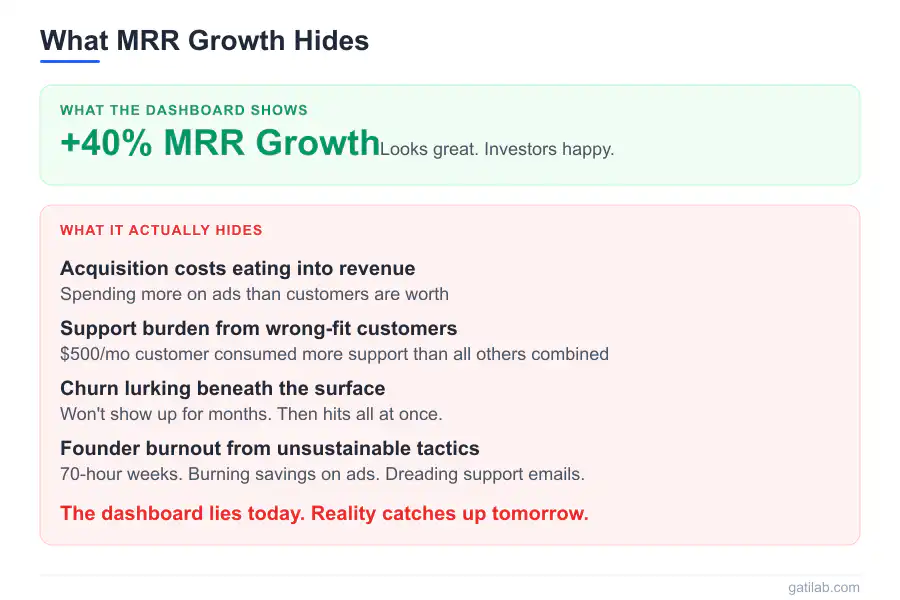
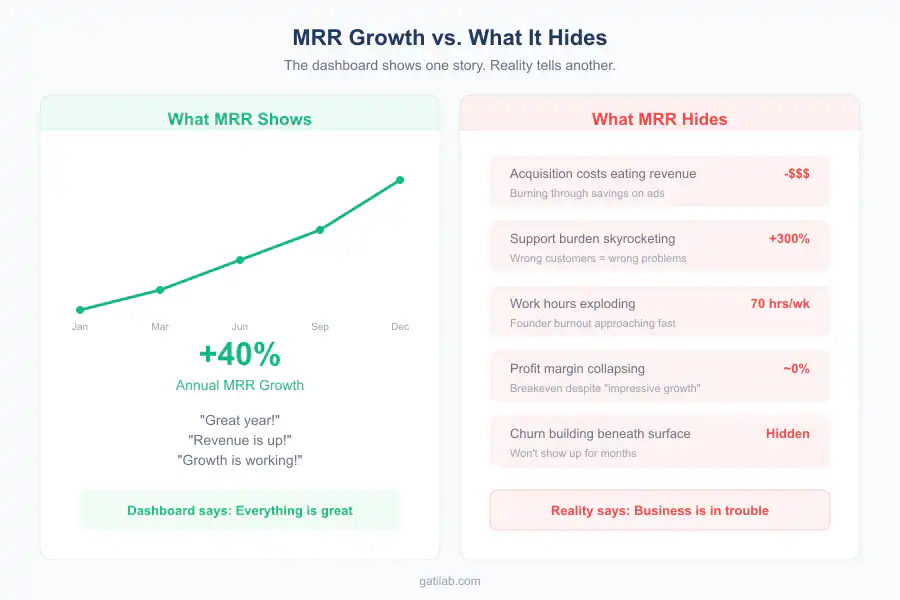
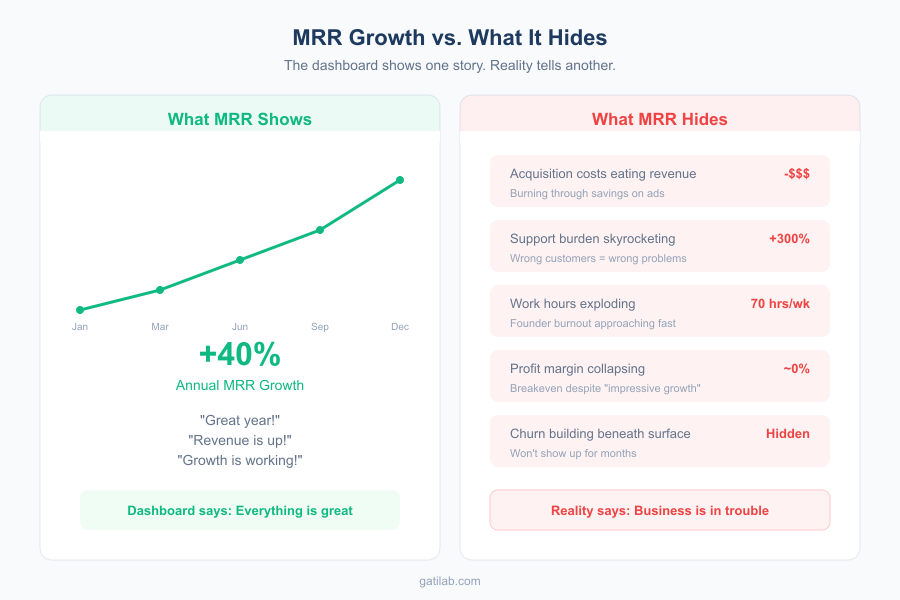
What MRR hides is often more important than what it shows. Acquisition costs eating into revenue. Support burden from unhappy customers who signed up for the wrong reasons. Churn lurking beneath the surface that won’t show up for months. Founder burnout from unsustainable growth tactics that seemed necessary to keep the number moving up.
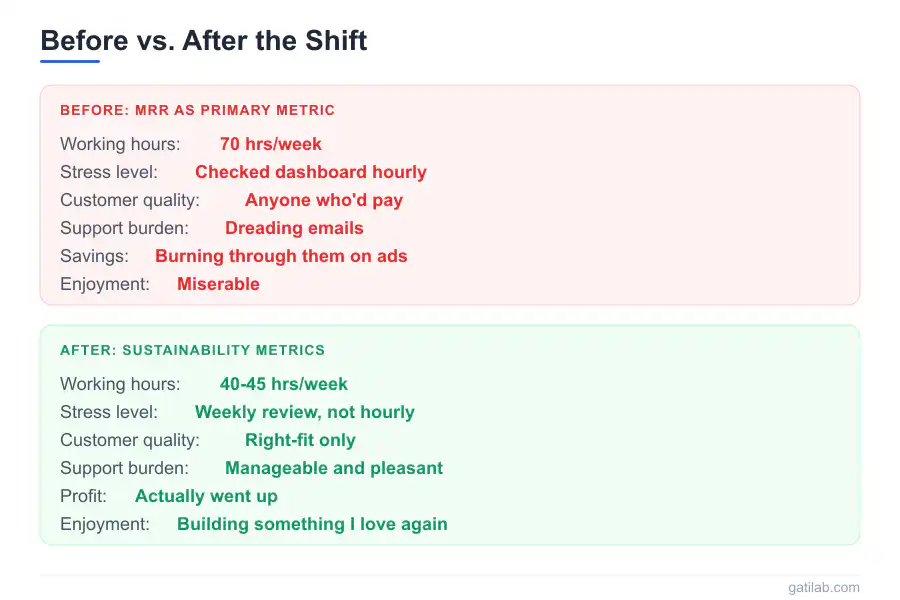
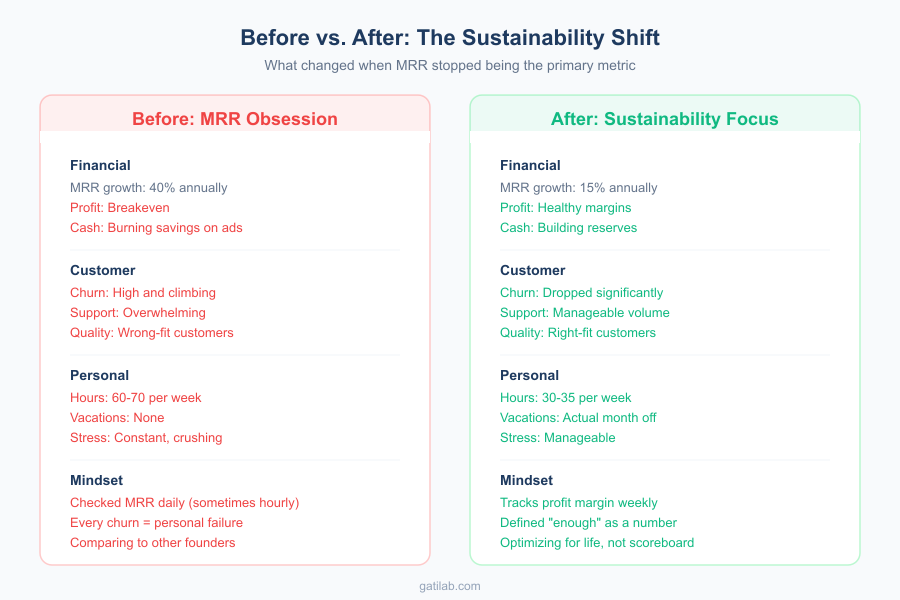
I grew MRR 40% one year while working 70-hour weeks, burning through savings on ads, and dreading customer support emails. The dashboard looked great. The reality was terrible. My accountant congratulated me on the growth. My body was telling me something completely different.
The Vanity Metric Trap
MRR growth becomes toxic when it’s the primary optimization target. And in the SaaS world, it almost always becomes the primary target.
Warning Sign
When MRR becomes your only metric, you’ll discount to close deals, add features for the wrong customers, and spend on acquisition channels that don’t pay back. Revenue goes up. Profit goes down. Stress goes up. The dashboard lies to you today. Reality catches up tomorrow.
Growth at any cost is what happens when MRR is king. Every decision filters through “will this increase MRR?” You discount heavily to close deals. You add features to win enterprise contracts you shouldn’t be chasing. You spend on acquisition channels that don’t pay back. Revenue goes up. Profit goes down. Stress goes up. The dashboard keeps looking better while the business gets worse.
Chasing MRR also attracts the wrong customers. Customers who want the lowest price, the most features, and the most attention. These customers churn faster and cost more to serve. I once celebrated closing a $500/month customer. Within three months, they’d consumed more support time than all other customers combined. Net impact on the business: negative. Actually, significantly negative when I counted the opportunity cost of all those support hours.
The delayed reckoning is what makes this especially dangerous. MRR problems compound quietly. Unsustainable growth eventually hits a wall. Bad-fit customers eventually churn. Acquisition costs eventually catch up. The dashboard lies to you today. Reality catches up tomorrow. And when it catches up, it catches up all at once.
What I Optimize Instead
I replaced MRR as my primary metric. Now I track different things, and the shift changed everything about how I run my business.
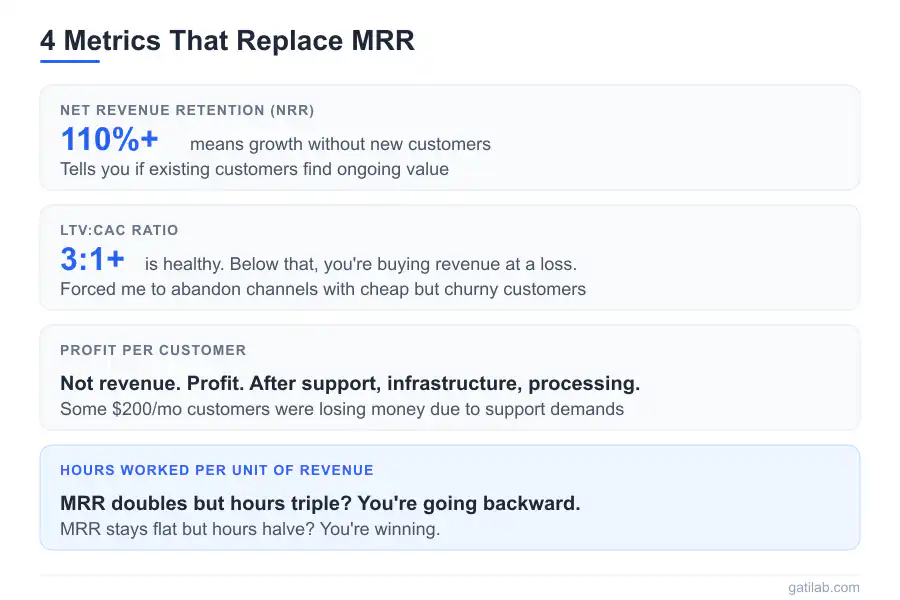
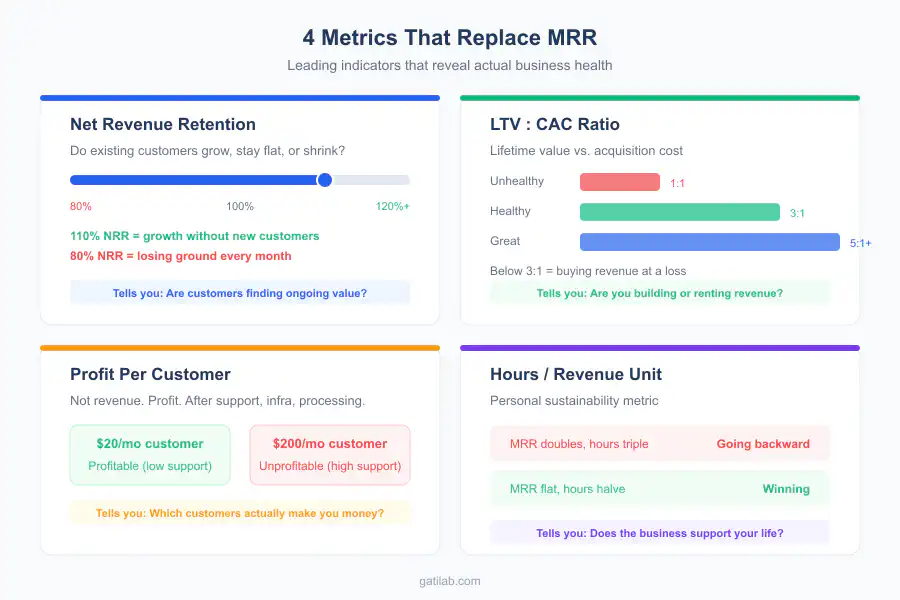
Net revenue retention tells me whether existing customers grow, stay flat, or shrink. A business with 110% NRR grows even without new customers. A business with 80% NRR is losing ground every month regardless of how much it spends on acquisition.
NRR tells me if customers find ongoing value. It reveals whether the product improves lives or just captures initial enthusiasm. When I started tracking this seriously, I realized some of my best “acquisition” months were also my worst retention months. The customers I attracted with aggressive marketing weren’t the customers who stayed. Understanding key financial KPIs helps put retention in context.
Customer lifetime value to CAC ratio measures how much customers pay over their lifetime compared to what it costs to acquire them. A 3:1 ratio is healthy. Below that, you’re buying revenue at a loss.
This metric forced me to abandon advertising channels that looked effective by cost-per-acquisition but terrible by lifetime value. The customers were cheap to acquire and quick to leave. I was essentially renting revenue, not building it.
Profit per customer is the one that really changed my perspective. Not revenue. Profit. After support costs, infrastructure costs, and payment processing. Some customers are profitable at $20/month. Others are unprofitable at $200/month. I had customers paying $200/month who were losing me money because their support demands were insatiable.
Understanding this changed how I priced, who I targeted, and which customers I actively discouraged. Yes, I actively discouraged certain customers from signing up. That felt wrong at first. Then it felt liberating.
Hours worked per unit of revenue is my personal sustainability metric. If MRR doubles but hours triple, I’m going backward. If MRR stays flat but hours halve, I’m winning.
Business exists to support life, not consume it. This metric keeps me honest about that.
I spent two years optimizing for a number instead of optimizing for a business. The moment I replaced MRR with profit-per-customer on my dashboard, I started making better decisions. Not every metric that goes up means things are getting better. Sometimes the most important metric is the one you stopped obsessing over.
Gaurav Tiwari
Founder, Gatilab
From running a SaaS business
The Sustainability Framework
I now evaluate opportunities through a sustainability lens. Three questions, applied consistently.
Will this customer stay? Not “will they sign up” but “will they still be here in two years?” Features and pricing that attract long-term customers differ from what attracts trial-hunters.
I’d rather have 100 customers who stay five years than 500 customers who churn after three months. The MRR looks smaller initially. The business is vastly stronger. And my stress level is vastly lower.
Will this scale without me? Growth that requires my personal involvement at every step isn’t growth. It’s a trap. Every new customer should require slightly less of my time than the last.
I stopped doing custom implementations, one-on-one onboarding calls, and personalized demos. Revenue dipped temporarily. Freedom increased permanently. The dip lasted about two months. The freedom has lasted years.
Will this be fun in five years? Business decisions compound. The customers you attract today shape support tomorrow. The features you build now require maintenance forever. The pricing you set creates expectations indefinitely.
I ask whether future-me will thank present-me for this decision. Usually the answer is “only if I’m thoughtful about it.” The decisions I made during the MRR-obsession phase still haunt me occasionally.
The Slow Growth Advantage
Slower growth has hidden benefits that the growth-at-all-costs crowd never talks about.
Better customers. When you’re not desperately chasing growth, you can be selective. You can say no to bad-fit customers. You can charge prices that attract serious buyers. My best customers found me through referrals and content, not ads. They chose the product because it solved their problem, not because a discount made it irresistible.
Better product. Fast growth means reactive development. Customers demand features. You build them to prevent churn. The product becomes bloated and unfocused. Slow growth means intentional development. You build what makes the product better, not what the loudest customer demands. My product got significantly better once I stopped adding features to win individual deals.
Better life. I took a month off last year. MRR stayed flat. No fires. No emergencies. No 3 AM wake-ups. That stability is worth more than growth. You can’t take a month off from a business that needs you to keep growing. I tried. It didn’t go well.
Practical Implementation
Here’s how to shift from MRR obsession to sustainability optimization. The change isn’t instant, but it’s straightforward.
Change your dashboard. Stop checking MRR daily. Start tracking NRR weekly and LTV:CAC monthly. Put profit visibility front and center. What you measure is what you manage. Change the metrics, change the behavior. I literally removed MRR from my home screen and replaced it with profit margin. That small act changed more than I expected.
Audit customer profitability. Export customer data. Calculate actual profit per customer including support time, infrastructure usage, and payment processing. Find the customers who cost more than they pay. Then decide what to do about them. Raise their prices. Reduce their support access. Or let them go. This audit was uncomfortable. The results were transformative.
Set revenue floors, not ceilings. Instead of “grow MRR 30% this year,” try “maintain MRR above X while keeping profit above Y and hours below Z.” Floors create stability. Ceilings create pressure. The shift from ceiling-thinking to floor-thinking changed how I made decisions almost overnight.
Build recurring revenue systems. Focus on things that create ongoing value: content that attracts customers for years, products that customers genuinely need monthly, referral systems that compound. Sustainable growth comes from systems, not sprints. Building recurring revenue thoughtfully beats aggressive acquisition tactics every time.
The Mental Shift
Changing metrics is easier than changing mindset. The metrics took a week to set up. The mindset took months.
Comparison is the thief. Other founders post their MRR milestones. Podcasts celebrate “from zero to $100K MRR” stories. Indie hacker Twitter is a highlight reel of growth. None of that shows the full picture. The burned-out founder with impressive MRR. The profitable founder with modest MRR. The comparison is misleading, and I was comparing myself to a curated fiction.
Enough is a number. What MRR would genuinely be enough? Not “enough to feel successful” but “enough to live the life you want?” For me, the number was much lower than I expected. I was chasing growth past the point of diminishing returns because I never defined enough. Once I did, the pressure evaporated.
Time is the real metric. How do you spend your days? Are you building something you enjoy or feeding a metric that owns you? A business that makes $20K/month with 20 hours of enjoyable work beats a business that makes $100K/month with 60 hours of grinding. I’ll fight anyone who disagrees.
What I Actually Track Now
My monthly review includes four categories, and MRR isn’t in any of them.
Financial sustainability: net revenue after all costs, cash runway in months, profit trend over 6 months. These tell me whether the business is healthy, not just whether it’s growing.
Customer health: net revenue retention, support ticket volume per customer, referral rate. These tell me whether customers are happy and whether the product is delivering value.
Personal sustainability: hours worked, days fully off, enjoyment rating. That last one is subjective but important. If I dread Monday, something is wrong regardless of what the numbers say.
Growth indicators: organic traffic trend, email list growth, content publishing consistency. These are leading indicators of future revenue. They compound slowly and reliably.
MRR appears nowhere on this list. It’s a lagging indicator. The metrics above are leading indicators. Fix those, and MRR takes care of itself.
The Results
Since making this shift, the changes have been clear across every dimension.
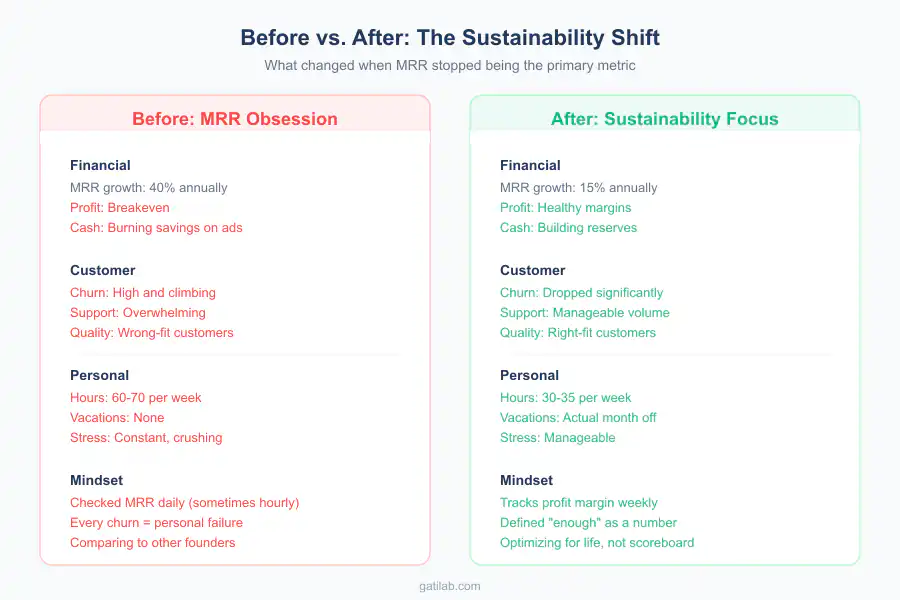
Financial: MRR growth slowed from 40% annually to 15%. Profit increased from breakeven to healthy margins. Stress decreased from constant to manageable. I’m making more money while growing slower. That sounds contradictory until you do the math.
Customer: Churn dropped significantly. Support volume dropped more. Customer satisfaction increased. Better customers create a better business. It’s not complicated.
Personal: Work hours dropped from 60+ to 30-35. Took actual vacations. Rediscovered hobbies. My partner noticed the difference before I did.
The business is smaller by MRR standards. It’s larger by every measure that matters.
When MRR Growth Makes Sense
I’m not anti-growth. I’m anti-growth-obsession. The distinction matters.
MRR growth matters when you’re building toward an exit, when you have investors expecting returns, when you haven’t reached minimum viable revenue, or when you’re in a winner-take-all market. In those situations, growth might genuinely be the most important thing.
MRR growth is secondary when you want lifestyle sustainability, when you’re profitable and comfortable, when you’re building for the long term, or when you value freedom over scale.
Know which category you’re in. Optimize accordingly. The tragedy is founders in the second category optimizing as if they’re in the first. For those choosing sustainability, our guide on building a sustainable freelance career offers relevant principles.
The Uncomfortable Truth
Most MRR growth advice comes from people selling MRR growth advice. Courses, tools, consulting… all monetized by convincing you that more MRR is always better.
It’s not.
More MRR with more stress is a bad trade. More MRR with less profit’s a worse trade. More MRR with less freedom is the worst trade of all.
The metric that matters is the life you’re building. MRR is just one input. It’s not even the most important one.
I stopped chasing MRR growth because I realized I was winning a game I didn’t want to play. The scoreboard looked impressive. The experience was terrible. Now I optimize for sustainability. The numbers are less impressive. The business is better. The life is better.
That’s the trade I’d make every time. Understanding value-based pricing helps you capture appropriate revenue without burning yourself out chasing volume.
Business Growth FAQ
Frequently Asked Questions
Why is MRR considered a vanity metric?
MRR only measures what subscribers commit to paying. It doesn’t reveal whether they’re happy, profitable to serve, or will stay. It hides acquisition costs eating into revenue, support burden from bad-fit customers, lurking churn, and founder burnout from unsustainable growth tactics. I grew MRR 40% one year while working 70-hour weeks and barely breaking even. The dashboard looked great. The reality was terrible.
What metrics should I track instead of MRR?
Net revenue retention (do existing customers grow or shrink?), LTV:CAC ratio (does customer value exceed acquisition cost, ideally 3:1 or better?), profit per customer (actual margin after support, infrastructure, and processing costs), and hours worked per revenue unit (your personal sustainability check). These metrics reveal business health far better than raw MRR growth. Fix these leading indicators and MRR takes care of itself.
How does MRR obsession lead to bad business decisions?
When every decision filters through “will this increase MRR?” you discount heavily to close deals, add features for wrong-fit customers, and spend on acquisition channels that don’t pay back. You attract price-sensitive customers who churn faster and cost more to serve. I once celebrated a $500/month customer who consumed more support time than all others combined within three months. Net impact: significantly negative.
What is net revenue retention and why does it matter?
Net revenue retention measures whether existing customers grow, stay flat, or shrink over time. A business with 110% NRR grows even without new customers. A business with 80% NRR loses ground monthly regardless of acquisition spending. NRR reveals whether your product delivers ongoing value or just captures initial enthusiasm. When I started tracking it, I discovered my best acquisition months were also my worst retention months.
How does slower growth actually benefit a SaaS business?
Slower growth attracts better customers who chose your product for value, not discounts. It enables intentional product development instead of reactive feature building. It creates stability where you can take time off without emergencies. Since shifting from 40% to 15% annual growth, my profit increased from breakeven to healthy margins, churn dropped significantly, work hours went from 60+ to 30-35, and I took actual vacations for the first time in years.
When does MRR growth actually matter?
MRR growth matters when building toward an exit, satisfying investor expectations, reaching minimum viable revenue to sustain the business, or competing in winner-take-all markets. It’s secondary when you want lifestyle sustainability, are already profitable and comfortable, building for the long term, or value freedom over scale. The tragedy is founders in the second category optimizing as if they’re in the first.
How do I shift from MRR obsession to sustainable metrics?
Change your dashboard: remove MRR from your home screen, replace it with profit margin. Audit customer profitability to find who costs more than they pay. Set revenue floors (“maintain above X”) instead of growth ceilings (“grow 30%”). Define what “enough” means for your life. Build recurring value systems rather than sprinting for growth. I literally swapped MRR for profit on my dashboard and the behavioral change was almost immediate.
What results can I expect from focusing on sustainability over growth?
In my experience: profit increased while growth rate slowed. Customer churn dropped significantly. Support volume decreased. Work hours went from 60+ to 30-35 per week. I started taking real vacations. The business is smaller by MRR standards but larger by every measure that actually matters. More money, less stress, better customers, better life. That trade-off is worth making every single time.