
TikTok vs YouTube: Reach, Creator Pay and Which to Pick
TikTok vs YouTube comes down to what you want the next 12 months to build. Pick TikTok if you want reach and speed with a younger audience. Pick YouTube if you want revenue and videos that keep getting found for years. Most creators who try to run both from day 1 end up doing neither well.
The two platforms reward different work. TikTok rewards a strong hook and frequent posting, while YouTube rewards a searchable topic, a clear title and a video people watch to the end. I’d make the decision on 5 factors:
- who your audience is and where they live
- how each platform pays creators, and when you become eligible
- how long a video keeps working after you post it
- how many hours each post takes you
- whether you can sustain two formats at once
TikTok vs YouTube: The Short Verdict
Here is the quick version for the most common goals.
| If you’re optimizing for | Pick | Why |
|---|---|---|
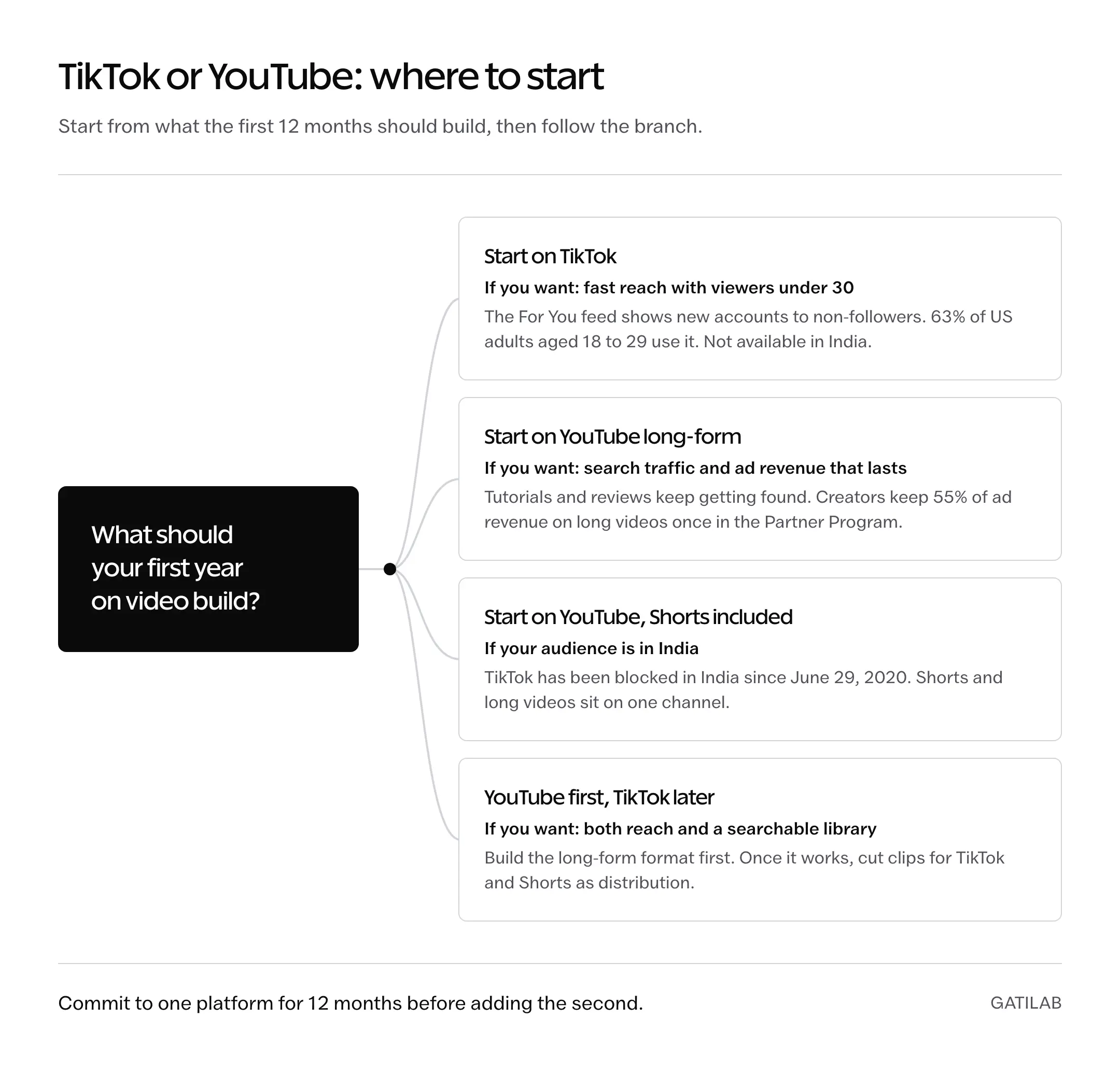
| Fastest audience growth from zero | TikTok | The For You feed shows new accounts to people who don’t follow them |
| Revenue per view | YouTube long-form | Creators keep 55% of ad revenue on long videos; TikTok publishes no rate |
| Content longevity | YouTube | Search keeps tutorials and reviews findable long after upload |
| US audience under 30 | TikTok | 63% of US adults under 30 use it |
| US audience over 30 | YouTube | Used by a majority of US adults in every age group |
| Audience in India | YouTube, Shorts included | TikTok has been blocked in India since June 2020 |
| Low editing time per post | TikTok | Phone-shot vertical clips are the native format |
| A library that keeps working | YouTube | Old videos keep pulling views from search and suggestions |
| Search-driven traffic | YouTube | Videos rank in YouTube search and show up in Google results |
| Ad-based brand campaigns | Depends | TikTok for awareness, YouTube for consideration and conversion |
Reach and Audience
YouTube reaches more people, and TikTok reaches younger people more often. Neither company publishes a global monthly user count. The big round numbers you see on other blogs come from ad-planning tools and third-party estimates, so I don’t build a decision on them.
The numbers that do come from a named source tell a clear story:
- 84% of US adults use YouTube and 37% use TikTok, according to Pew Research Center’s 2025 social media survey of 5,022 adults (fielded February 5 to June 18, 2025).
- 63% of US adults aged 18 to 29 use TikTok, against 44% of those aged 30 to 49, 30% of those aged 50 to 64 and 12% of those 65 and older.
- YouTube and Facebook are the only platforms a majority of US adults use in every age group.
- About half of US adults visit YouTube daily, while 24% use TikTok daily.
- YouTube says Shorts now average over 200 billion daily views and over 20 million videos are uploaded to YouTube every day.
How people arrive matters as much as how many arrive. On YouTube, a lot of viewers come looking for something specific: a how-to, a review, a comparison. They have chosen the video and they give it time. On TikTok, people open the app to be shown something, so the first 2 seconds decide whether they stay. A YouTube video has to deliver on the promise in its title, while a TikTok has to earn the next swipe. You should write for whichever of those two viewers you actually want.
TikTok in India
TikTok is still banned in India. The government blocked it on June 29, 2020 under Section 69A of the Information Technology Act, and in August 2025 an IT Ministry official told Storyboard18 that the ban had not been lifted. TikTok’s own site still shows the block notice to visitors in India in October 2026.
If your audience is in India, the comparison is really YouTube Shorts against Instagram Reels. A global TikTok audience doesn’t help you reach people who can’t open the app.
Who Owns TikTok in the US Now?
A new US joint venture runs TikTok for American users. The deal that separated TikTok’s US business from ByteDance closed on January 22, 2026, which ended the ban-or-sell deadline that hung over US creators for nearly 2 years.
- About half of the joint venture belongs to a consortium of Oracle, Silver Lake and the Emirati investment firm MGX.
- Just over 30% is held by affiliates of existing ByteDance investors.
- ByteDance keeps 19.9%.
- Oracle oversees the storage of US user data, and the joint venture handles content moderation for US users.
- The joint venture licenses the recommendation algorithm from ByteDance and plans to retrain it on US user data.
- ByteDance’s global TikTok business still runs e-commerce, advertising and marketing on the US app.
For a creator, the risk has changed shape. Losing the app overnight is no longer the live worry in the US. The thing to watch is the retrained algorithm, because a feed that serves your videos differently next quarter changes your reach without any announcement.
How YouTube and TikTok Pay Creators
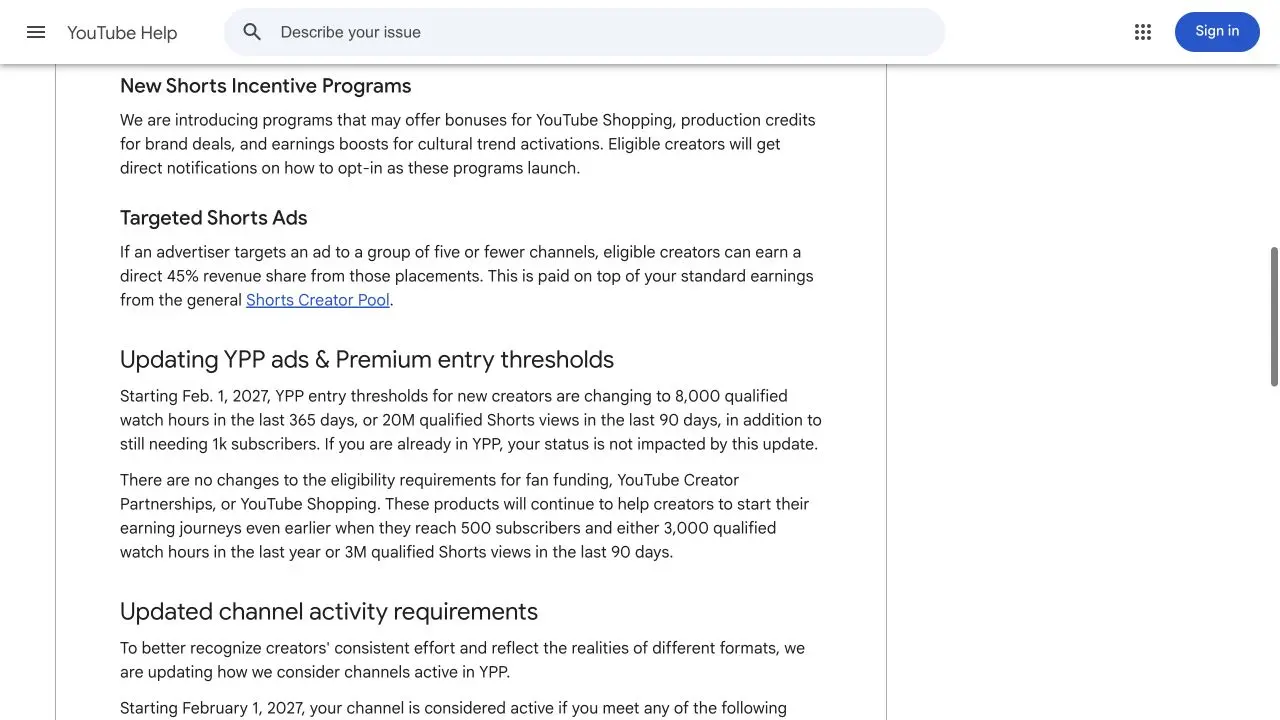
Eligibility comes before revenue. Views on a channel that hasn’t qualified earn nothing from the platform, so the entry bar is the first number to know. YouTube is also raising that bar: on August 10, 2026 it announced changes to the YouTube Partner Program that take effect on February 1, 2027.
| Program | Entry requirement | What you can earn |
|---|---|---|
| YouTube Partner Program, ad revenue (today) | 1,000 subscribers plus 4,000 public watch hours in 12 months, or 1,000 subscribers plus 10 million Shorts views in 90 days | Long-form ad revenue, Shorts Creator Pool share, YouTube Premium revenue |
| YouTube Partner Program, ad revenue (new applicants from February 1, 2027) | 1,000 subscribers plus 8,000 watch hours in 365 days, or 1,000 subscribers plus 20 million Shorts views in 90 days | Same as above; channels already in the program keep their status |
| Shorts revenue, every partner channel (from February 1, 2027) | 10 million qualified Shorts views in the trailing 90 days, checked every month | That month’s Shorts Creator Pool share; long-form earnings are not tied to it |
| YouTube fan funding tier (unchanged) | 500 subscribers plus 3,000 watch hours in the last year, or 500 subscribers plus 3 million Shorts views in 90 days | Fan funding (memberships, Super Chat, Super Thanks), YouTube Shopping and Creator Partnerships, with no ad revenue |
| TikTok Creator Rewards Program | 18 or older (19 in South Korea), personal account, 10,000 followers, 100,000 video views in the last 30 days, in an eligible country | Rewards on qualified views of original videos longer than 1 minute |
A few details in those rules change the decision:
- Watch hours from the Shorts feed don’t count toward the long-form watch-hour route, as the YouTube Partner Program eligibility page states.
- Existing partners have to accept the updated terms in YouTube Studio by January 31, 2027 to keep monetizing fully.
- From February 2027, a channel that earns mainly from Shorts has to keep hitting 10 million qualified views every 90 days, or its Shorts payout stops for that month. Under the Shorts monetization policy, each month is judged on the 90 days ending on the 15th of the month before.
- TikTok’s Creator Rewards Program pays only on videos longer than 1 minute, so a 30-second clip can grow your account but earns nothing from that program.
If you’re starting a new YouTube channel today, you’re likely to apply after February 1, 2027, so plan around the 8,000-hour bar. That alone pushes the case for long-form videos that people search for, because those are the views that add up to watch hours.
Which Pays More: RPM and Revenue Share
YouTube long-form pays the most per view for most creators, and the reason is the revenue split. For long videos, YouTube gives creators 55% of net ad revenue from ads on their own videos. Shorts work differently, and TikTok doesn’t publish a share or a rate at all.
- YouTube long-form: ads run on your video and you keep 55% of the net revenue from them.
- YouTube Shorts: ad revenue from the Shorts feed goes into a Creator Pool, which is split by each creator’s share of engaged views. You keep 45% of what is allocated to you, and Shorts that use music send part of their revenue to music licensing first.
- TikTok Creator Rewards: payouts are based on qualified views of eligible videos, but TikTok doesn’t publish the rate, so every per-1,000 figure online is creator-reported.
RPM is the number to compare, and it is per 1,000 views, not per view. YouTube’s RPM definition counts what you earned per 1,000 views after YouTube’s share, including ads, memberships, Premium and Super Chat. CPM is the other side of the same money, what advertisers pay per 1,000 ad impressions before any split. If you want to see how an advertiser’s CPM turns into a budget, our CPM calculator does that arithmetic.
Here is how RPM turns into income. The rates in this table are assumptions to show the units, not rates either platform promises:
| Assumed RPM | Views | Revenue |
|---|---|---|
| $0.05 per 1,000 views | 1,000,000 | $50 |
| $1 per 1,000 views | 1,000,000 | $1,000 |
| $5 per 1,000 views | 1,000,000 | $5,000 |
The formula is views divided by 1,000, multiplied by RPM. A Shorts RPM is a few cents per 1,000 views, not per view, so a figure like “$0.05 per view” is off by a factor of 1,000. Platform averages also hide a lot:
- A view isn’t the same event on long-form YouTube, Shorts and TikTok. Shorts RPM uses engaged views and TikTok uses qualified views.
- RPM moves with the viewer’s country, the season, advertiser demand and your niche.
- Brand deals, memberships, affiliate sales and your own products sit outside both payout programs, and for many creators they are the bigger income line.
So when someone says one platform pays “10 times more,” ask which format, which country and which month. Nobody publishes a dataset that supports a fixed multiple.
Content Lifespan
A useful YouTube video keeps working long after the upload week, and that is the biggest practical difference between the two platforms. A tutorial that answers a question people keep asking gets found through YouTube search, Google results and suggested videos month after month. Each new view adds to your watch hours and, once you’re in the partner program, to your ad revenue.
TikTok’s feed is built around showing people something new, so an account’s reach depends heavily on what it posted recently. Older videos can resurface when they suddenly match what people are watching, but you can’t plan a business around that. The result is a treadmill, and missing a few weeks shows up in your numbers.
Neither platform publishes a “half-life” for videos, and the topic matters more than the platform. A reaction to yesterday’s news fades on YouTube too. Still, if you spend 8 hours on a video, it is wise to put it where search can keep sending people to it.
Search vs Discovery
YouTube is where people search, and TikTok is where people browse. Every “how to,” “review” and “best of” query has YouTube results, and YouTube videos also appear in Google’s results, so a searchable video picks up traffic from two places.
Younger users do search on TikTok as well. In July 2022, Google’s Prabhakar Raghavan told Fortune’s Brainstorm Tech conference, as TechCrunch reported, that “almost 40% of young people, when they’re looking for a place for lunch, they don’t go to Google Maps or Search. They go to TikTok or Instagram.” That figure came from Google’s internal survey of US users aged 18 to 24, and it was about finding places to eat.
My rule of thumb follows from that. If your content teaches, reviews or compares, YouTube is the better home, because people go looking for it. If your content is entertainment, trends or quick visual demos, TikTok is the better home, because people need to be shown it.
Algorithm Behavior
TikTok’s For You feed gives a new account a real chance from its first post. When TikTok explained its recommendation system in June 2020, it said follower count and past hit videos are not direct factors; what you watch, like, share and comment on is. A bigger account still gets more views because more people follow it, but a good first video can travel.
YouTube recommends videos based on what each viewer is likely to watch and enjoy, according to its discovery guidance. In practice, that puts the weight on whether people click your title and thumbnail and whether they keep watching. New channels usually grow slower because they have few videos for search and suggestions to find.
- TikTok rewards volume and hooks. You post often and the first 2 seconds decide most of the result.
- YouTube rewards titles, thumbnails and retention. You post less often and make each video something people will still search for.
Creators who bring TikTok habits to YouTube (daily short posts, low effort, no search topic) usually stall. Creators who bring YouTube habits to TikTok (slow intros, long setups) lose viewers before the point arrives. If you’ve picked YouTube, our guide on how to promote a YouTube video covers the work after you hit publish.
Creative Workload
TikTok is cheaper to produce per post, and YouTube long-form asks for more of everything. A phone, decent light and a free editing app can carry a TikTok account. A long YouTube video needs a script, more footage, a thumbnail and a longer edit, and a good one takes hours.
| Format | Usual kit | Where the time goes | Posting rhythm that suits it |
|---|---|---|---|
| TikTok video | Phone and a free editor | Finding the hook, recording takes, captions | Several times a week |
| YouTube Short | Phone and a free editor | Same as TikTok | Several times a week |
| YouTube long-form | Camera or phone, microphone, screen recorder | Research, script, editing, title and thumbnail | 1 or 2 a week, or fewer and better |
| YouTube podcast episode | Microphones and a recorder | Booking, recording, editing audio and video | Weekly or every 2 weeks |
Short doesn’t automatically mean easy. A product demo that lands in 20 seconds can take a dozen takes. Before you promise yourself a daily schedule, make a batch of 5 videos and time it. Your own number should set your cadence, whatever other creators say they post.
YouTube Shorts vs TikTok
YouTube Shorts vs TikTok is a closer fight than TikTok against long-form YouTube. Both carry vertical short videos, and both are built around a swipe feed. The differences are where the views lead and how the money works:
- Where the viewer can go next. A Short lives on the same channel as your long videos, so a viewer who likes it is one tap from a 15-minute tutorial. A TikTok viewer mostly stays inside TikTok.
- Availability. Shorts work in India, where TikTok is blocked.
- Pay. Shorts pay 45% of a pooled share, and from February 2027 only while a channel keeps 10 million qualified Shorts views per 90 days. TikTok’s Creator Rewards pays only on videos longer than 1 minute.
- Reposts. YouTube excludes non-original Shorts from engaged views, so a reupload with nothing added doesn’t earn from the Creator Pool.
Cross-posting the same clip to both feeds is fine as distribution, and that is all it is. Shorts rarely earn much, and a clip with another platform’s watermark or no original contribution can be shut out of Shorts revenue entirely, so export a clean version and adapt the opening for each feed.
Can You Run Both?
Yes, but almost nobody runs both well from the start. The native formats need different skills. YouTube long-form rewards scripting, structure and patient pacing. TikTok rewards hooks, trends and fast cuts. The creators who run both successfully treat them as two different products.
The common mistake is cross-posting TikToks to Shorts and calling it a YouTube strategy. The approach that works better is to build one core format, usually YouTube long-form, and then cut highlights for TikTok and Shorts as a way to reach new people. The long video is the asset, and the short clips are marketing for it.
MrBeast, Emma Chamberlain and Marques Brownlee all built on YouTube for years before they spread to other platforms. None of them started with “everywhere from day 1.” Once your core format works, a content repurposing workflow keeps the clipping from eating your week.
Who Should Pick What
TikTok is the better start if:
- your audience is under 30 and lives where TikTok is available
- you can post several times a week without burning out
- your content is visual, trend-driven or entertainment
- you plan to earn from brand deals or your own products more than platform payouts
- you want the fastest possible reach from zero
YouTube is the better start if:
- your audience is over 25 and researches before it buys
- your content teaches, reviews or compares things people search for
- you can put several hours into each video and post weekly
- you want ad revenue per view, not just reach
- your audience is in India
- you’re building a business that needs searchable authority
Both make sense only after one works: your core format is already producing results, you can hand the short cuts to an editor, and you treat each platform as its own product.
The Bigger Picture
In the long run, the strongest creator businesses give each platform a different job:
- TikTok finds new people who have never heard of you.
- YouTube turns interested viewers into subscribers who trust you.
- An email list turns those subscribers into buyers, on a channel no algorithm controls.
That last layer matters more now. TikTok’s US feed is being retrained under new owners and YouTube is raising its partner bar, so an audience you can reach directly is the part nobody can change on you. If you don’t have a list yet, pick a newsletter platform early, and read how a personal brand survives algorithm changes.
For most creators and small businesses, I’d start with YouTube to build the searchable library, then layer TikTok on top once YouTube is producing results. Skip the idea that you need to be everywhere at once.
Next Steps
If you’ve been putting this decision off, make it this week. Every week you split attention between both is a week neither one grows.
- Write down your target audience: age, country and what they search for.
- Match that audience to the platform where they spend time, and check it is available to them.
- Commit to that platform for 12 months.
- At the 12-month mark, if it has traction, add the other platform as distribution.
If you’d rather have a team plan and run the channel with you, that is what our YouTube marketing services cover. Either way, pick one platform and give it a year. The other one will still be there when you’re ready.
FAQs on TikTok vs YouTube
Which pays more, TikTok or YouTube?
For most creators, YouTube long-form pays more per view. YouTube gives creators 55% of net ad revenue on long videos, while TikTok’s Creator Rewards Program doesn’t publish a rate and pays only on qualifying videos longer than 1 minute. Rates move with country and niche, so compare your own RPM per 1,000 views over the same period before deciding.
Who pays more, TikTok or YouTube Shorts?
Neither platform publishes a per-view rate, so there is no official answer. Shorts pay creators 45% of their allocated share of the Shorts Creator Pool, and from February 1, 2027 only while the channel keeps 10 million qualified Shorts views in 90 days. TikTok’s Creator Rewards pays only on videos longer than 1 minute, so the two programs reward different video lengths.
How many YouTube views do I need to make $2,000 a month?
It depends on your RPM, the revenue you earn per 1,000 views. At an assumed RPM of $5, you’d need 400,000 views a month. At $2 it is 1 million, and at $1 it is 2 million. Your real RPM shows in YouTube Studio once you’re in the Partner Program, and it changes with your niche and your audience’s country.
Is TikTok still banned in India?
Yes. India blocked TikTok on June 29, 2020 under Section 69A of the Information Technology Act, and the ban is still in force in October 2026. Creators who target India use YouTube Shorts and Instagram Reels for short video.
Who owns TikTok in the US now?
Since January 22, 2026, a US joint venture runs TikTok for American users. A consortium of Oracle, Silver Lake and MGX owns about half, affiliates of existing ByteDance investors hold just over 30% and ByteDance keeps 19.9%. Oracle oversees US data storage, and the venture plans to retrain the recommendation algorithm on US data.
Is it easier to grow on TikTok or YouTube?
Getting your first views is usually easier on TikTok, because the For You feed shows new accounts to people who don’t follow them. Lasting growth is usually easier on YouTube, because searchable videos keep bringing in viewers long after the upload week. Early views on TikTok don’t guarantee an audience that sticks.
Is TikTok more popular than YouTube?
Not by the numbers that are public. Pew Research Center’s 2025 survey found that 84% of US adults use YouTube and 37% use TikTok. Among adults aged 18 to 29, TikTok use rises to 63%. Neither company publishes a global monthly user count.
Should a new creator start on TikTok or YouTube?
Start where your audience is and where your format fits. Teaching, reviews and comparisons belong on YouTube, while trends, entertainment and quick demos suit TikTok. Whichever you pick, commit to it for 12 months before adding the second platform.
Tell Google you want more of this.
Add Gatilab as a preferred sourceOne tap, and this site shows up more often in your own Top Stories, AI Overviews and AI Mode. Remove it any time.