
Selling to Developers vs Marketers: Positioning and Messaging Differences
I’ve sold software to developers. I’ve sold services to marketers. These experiences taught me something crucial: they’re completely different games with different rules.
What works for one audience fails spectacularly with the other. The messaging that resonates with developers makes marketers suspicious. The tactics that convert marketers alienate developers. I learned this the hard way by trying to use the same pitch for both audiences. The developer version felt too salesy for developers. The marketer version felt too vague for marketers. Now I treat them as entirely separate problems.
Here’s what I’ve learned about these two very different buyer types. Understanding your audience is crucial whether you’re building a SaaS marketing strategy or positioning consulting services.
The Developer Buyer Psychology
Developers approach purchases analytically. Getting this wrong means losing them before they even look at your product.
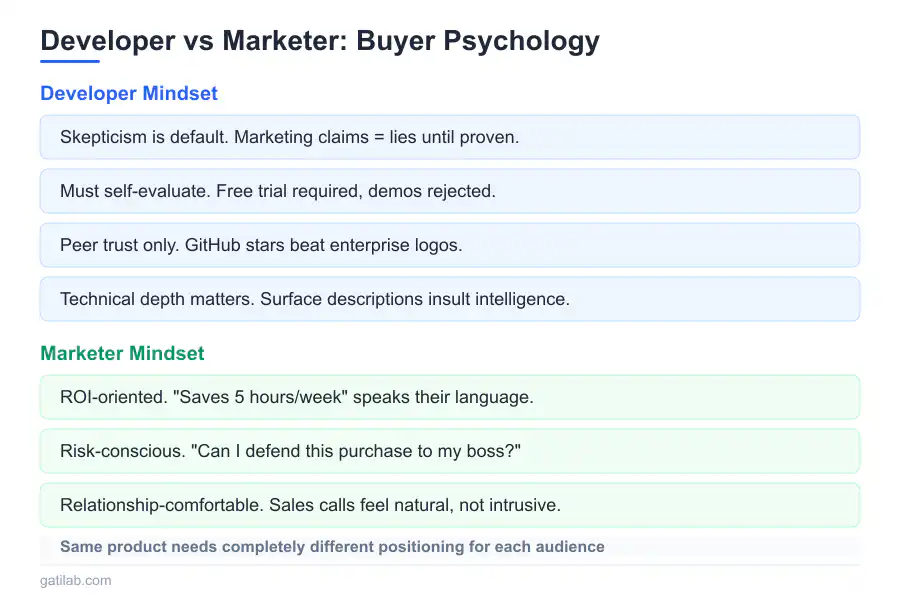
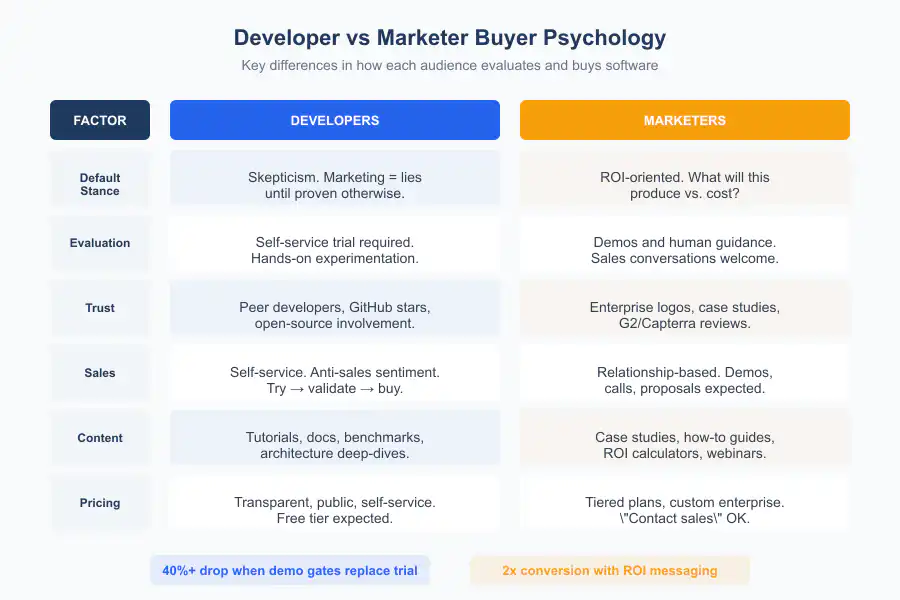
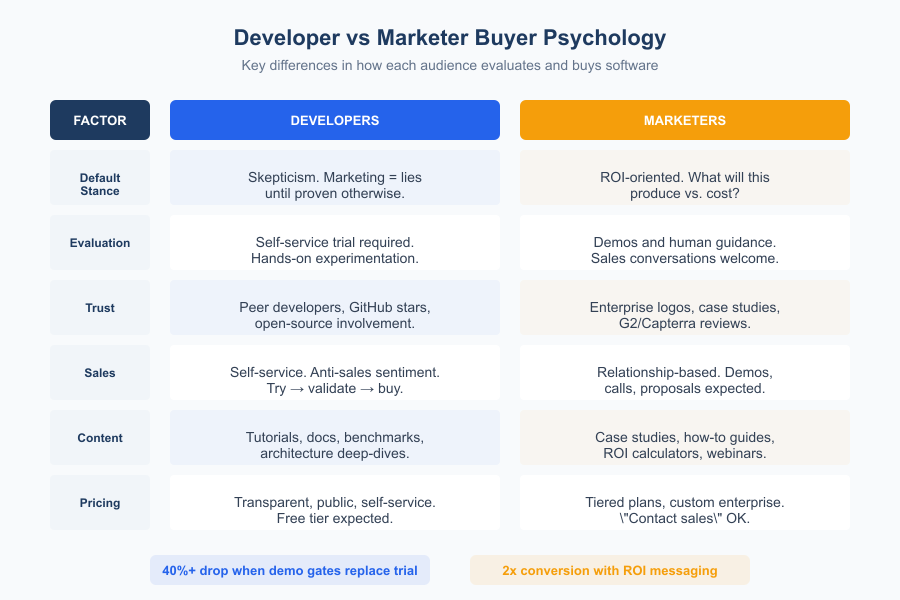
Developers assume marketing is lies until proven otherwise. Marketers think in ROI. The messaging that resonates with one audience makes the other suspicious. These are fundamentally different games with different rules.
Skepticism is default. Developers assume marketing is lies until proven otherwise. Bold claims trigger suspicion, not interest. “Revolutionary” means “probably doesn’t work.” I’ve watched developer eyes glaze over the moment they smell marketing speak. They’ve been burned by overpromising before. Their defense mechanism is doubt, and honestly, it’s a rational response given how much terrible software gets hyped.
Self-evaluation required. Developers want to test before buying. Trials, sandboxes, open-source versions… they need hands-on experience. Demos don’t convince; personal experimentation does. Forcing developers to talk to sales before trying the product creates friction that often kills deals. I’ve seen conversion rates drop by 40% or more when a “book a demo” gate replaces a free trial.
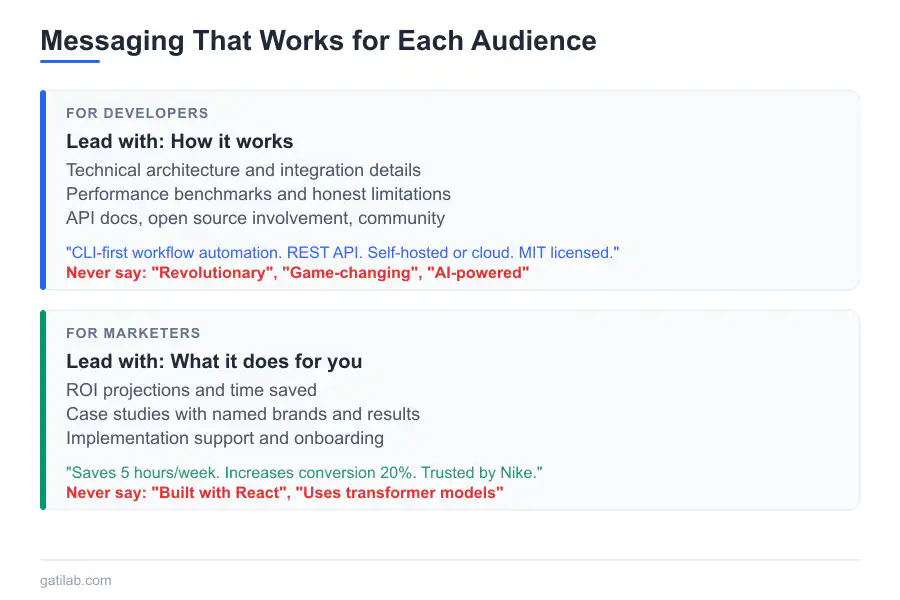
Technical depth matters. Surface-level descriptions insult their intelligence. They want to know how it works, what it’s built with, what the limitations are. “Uses AI” is empty. “Uses transformer models with fine-tuning on your codebase” is meaningful. When I write for developers, I include the technical details that I’d want to see myself.
Peer validation. Developers trust other developers. GitHub stars, developer testimonials, community adoption… these matter more than enterprise logos. A respected developer’s tweet carries more weight than a Fortune 500 case study. I’ve seen a single endorsement from a well-known open-source maintainer drive more signups than a month of paid advertising.
Anti-sales sentiment. Many developers actively hate being sold to. Calendly links, demo requests, and “Let’s hop on a quick call” make them close tabs. Self-service isn’t just preferred. It’s required for significant portions of the audience.
The Marketer Buyer Psychology
Marketers approach purchases differently. The decision framework is fundamentally different.
ROI orientation. Marketers think in returns. What will this cost? What will it produce? The calculation is explicit, not implied. Features matter only as they connect to outcomes. “Saves 5 hours per week” or “increases conversion by 20%” speaks their language. I’ve tested landing pages where switching from feature descriptions to ROI projections doubled conversion rates for marketer audiences.
Risk consciousness. Marketers justify purchases to bosses. They need protection against looking bad. Case studies, testimonials, and proof points reduce perceived risk. The question isn’t “is this technically sound?” It’s “can I defend this purchase?”
Relationship comfort. Unlike developers, marketers often prefer human interaction. Demos, calls, and consultative selling feel natural, not intrusive. Sales conversations aren’t barriers. They’re part of the evaluation process.
Brand and social proof. Logos matter. “Trusted by Nike” impresses marketers in ways it doesn’t impress developers. Enterprise validation signals safety.
Timeline sensitivity. Marketers work on campaigns, quarters, and deadlines. Urgency is a real factor in their decisions. “Launch next month” creates genuine pressure that developers rarely feel.
Messaging Differences
The same product needs different positioning for each audience. I’ve seen this play out dozens of times with my own products and client projects.
For developers:
Focus on:
- Technical capabilities and architecture
- Integration details and API documentation
- Performance benchmarks
- Transparency about limitations
- Community and open-source involvement
Example: “CLI-first workflow automation with a REST API. Self-hosted or cloud. MIT licensed.”
For marketers:
Focus on:
- Business outcomes and ROI
- Ease of use and time savings
- Success stories and case studies
- Support and onboarding
- Integration with existing marketing stack
Example: “Automate your content workflow and save 10 hours per week. Used by 500+ marketing teams.”
Same product. Different frame. Each resonates with its audience. Get the framing wrong and you’ve lost them in the first sentence.
Pricing Model Differences
Pricing strategies vary by audience, and getting this wrong creates immediate friction.
Developer expectations:
- Free tier or open-source version
- Transparent, public pricing
- Usage-based or seat-based models
- Self-service purchasing
- No “contact sales” gates on basic plans
Developers expect to see pricing immediately. Hidden pricing suggests enterprise complexity and sales processes they want to avoid. I put pricing on every developer-facing product page. The transparency itself builds trust.
Marketer expectations:
- Clear tiered plans with feature differentiation
- Annual discounts and enterprise options
- Demos and trials with human guidance
- Custom pricing for larger needs
- “Contact sales” is acceptable for enterprise
Marketers are comfortable with sales processes. Custom pricing based on company size feels normal, not suspicious.
Pricing presentation: Developers want usage calculators and detailed breakdowns. Marketers want simple tiers with clear upgrade paths. Building both views of the same pricing is worth the extra effort.
Acquisition Channels
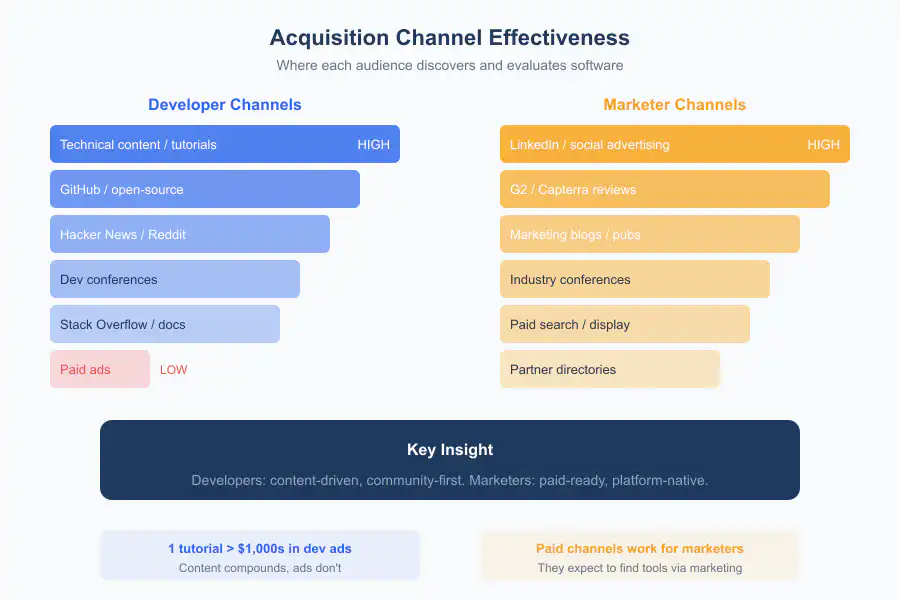
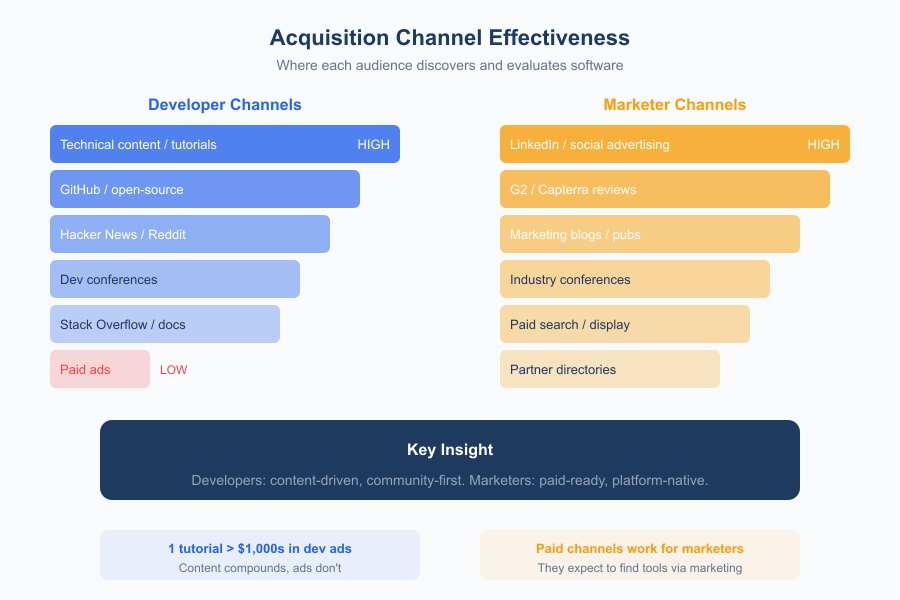
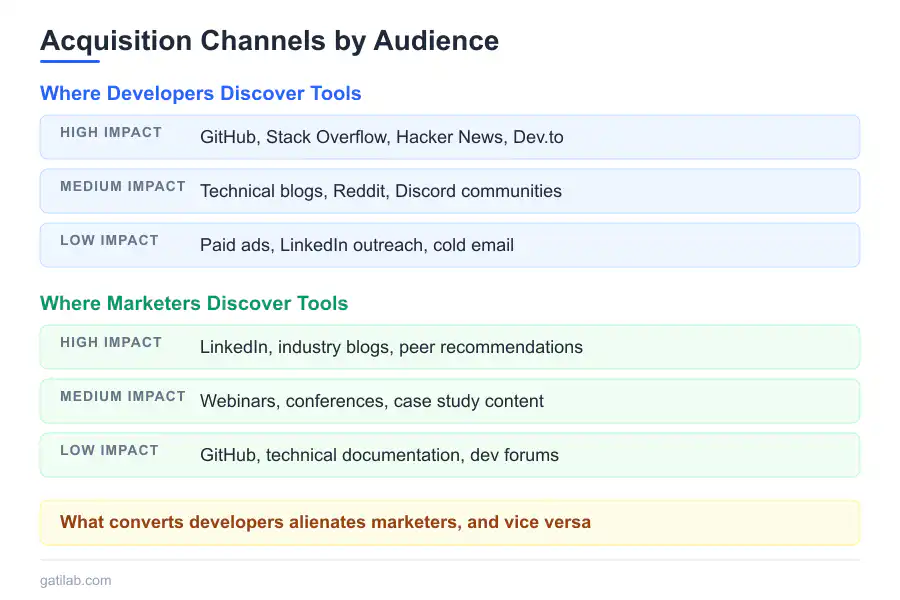
Where you find each audience differs dramatically.
Developer channels:
- Technical content and tutorials
- GitHub and open-source communities
- Hacker News and Reddit
- Developer-focused conferences
- Stack Overflow and documentation sites
- Word of mouth through developer networks
Paid advertising often underperforms for developer audiences. Content and community drive developer acquisition. I’ve found that a single well-written technical tutorial generates more developer signups than thousands of dollars in paid ads.
Marketer channels:
- LinkedIn and social media advertising
- Marketing-focused blogs and publications
- Industry conferences and webinars
- G2, Capterra, and review sites
- Paid search and display
- Partner and integration directories
Paid channels work well. Marketers expect to discover tools through marketing. Getting your content marketing strategy right matters for reaching either audience.
Content Strategy Differences
Content that works for each audience varies significantly.
Developer content:
- Technical tutorials with code examples
- Architecture deep-dives
- Performance comparisons with benchmarks
- Open discussions of tradeoffs
- Contribution guidelines and roadmaps
Documentation is content. API references matter as much as blog posts. I’ve seen developer tools succeed purely on the strength of their documentation. No marketing budget, no ads. Just exceptional docs.
Marketer content:
- How-to guides for common challenges
- Case studies with specific results
- ROI calculators and templates
- Trend reports and industry analysis
- Webinars and video walkthroughs
Success stories and practical guides dominate. Technical depth is unnecessary and can actually alienate this audience.
Sales Process Differences
How deals close varies dramatically between these two audiences.
Developer deals: Often close without sales involvement. Developer finds product, tests it, adopts it, maybe upgrades later. When sales involvement happens, it’s technical. Solutions engineers, not traditional salespeople. Questions focus on capabilities, not relationships. The buying process: try, validate, buy. I’ve had developer customers use our products for months before anyone on the team even knew they existed. That’s normal in developer sales.
Marketer deals: Sales involvement is normal and expected. Discovery calls, demos, proposals, and negotiations are part of the process. Relationship matters. Trust in the vendor matters. The buying process: research, evaluate, discuss, buy. Marketers often want to talk to a person before spending significant money. That human touchpoint isn’t friction. It’s reassurance.
Support Expectations
Post-purchase expectations differ in ways that affect your entire support operation.
Developers expect:
- Detailed documentation
- Community forums and GitHub issues
- Self-service troubleshooting
- Fast, technically competent support when needed
- Changelog transparency
Most issues should be solvable through documentation. Human support is for edge cases. Developers get frustrated by scripted support responses. They want someone who understands the code.
Marketers expect:
- Onboarding assistance
- Training and walkthroughs
- Responsive human support
- Success management for larger accounts
- Best practices guidance
Hand-holding is valued, not resented. White-glove service justifies premium pricing. I’ve found that offering onboarding calls for marketer products increases retention significantly, while the same offer for developer products gets largely ignored.
Trust Signals That Work
What builds credibility differs between audiences.
Developer trust signals:
- Open-source codebase or components
- Technical blog posts showing expertise
- Active GitHub presence
- Speaking at developer conferences
- Endorsements from respected developers
- Transparent pricing and practices
“Our CTO” matters more than “Our CEO” for developer credibility.
Marketer trust signals:
- Case studies with named companies
- Industry awards and recognition
- G2 and Capterra reviews
- Customer logos, especially recognizable brands
- ROI documentation
- Professional marketing materials
Production quality matters. Rough edges suggest unreliability. Using proper CRM software helps you track and nurture both developer and marketer relationships.
Objection Handling
Common objections differ by audience, and the responses that work are equally different.
Developer objections:
- “I could build this myself”
- “It’s too expensive for what it does”
- “I don’t trust closed-source”
- “The documentation is insufficient”
- “It won’t integrate with my stack”
Technical objections require technical responses. Show how it works, not why to trust you. The “I could build this myself” objection is the most common and the most important to handle well. The answer isn’t “no you can’t.” It’s “yes, but here’s what that actually costs in time.”
Marketer objections:
- “I can’t justify the budget”
- “We’ve been burned by vendors before”
- “How do I know it will work for us?”
- “What happens if it doesn’t work?”
- “Our team won’t adopt it”
Risk and ROI objections require proof and reassurance. Case studies and guarantees help. Marketers want to see that someone like them succeeded with your product.
Product Design Implications
These differences affect product decisions profoundly.
For developer products:
- API-first design
- Extensive customization
- Self-service everything possible
- Developer experience (DX) as priority
- Transparent limitations
Control matters. Developers want to configure, extend, and integrate. They’ll choose the less polished tool with better extensibility over the beautiful tool that’s rigid.
For marketer products:
- UI-first design with templates
- Guided workflows and wizards
- Pre-built solutions for common needs
- Onboarding and education built-in
- Polished visual design
Ease of use matters. Marketers want to accomplish tasks, not build systems. They’ll choose the simpler tool that works immediately over the powerful tool that requires configuration.
The Hybrid Challenge
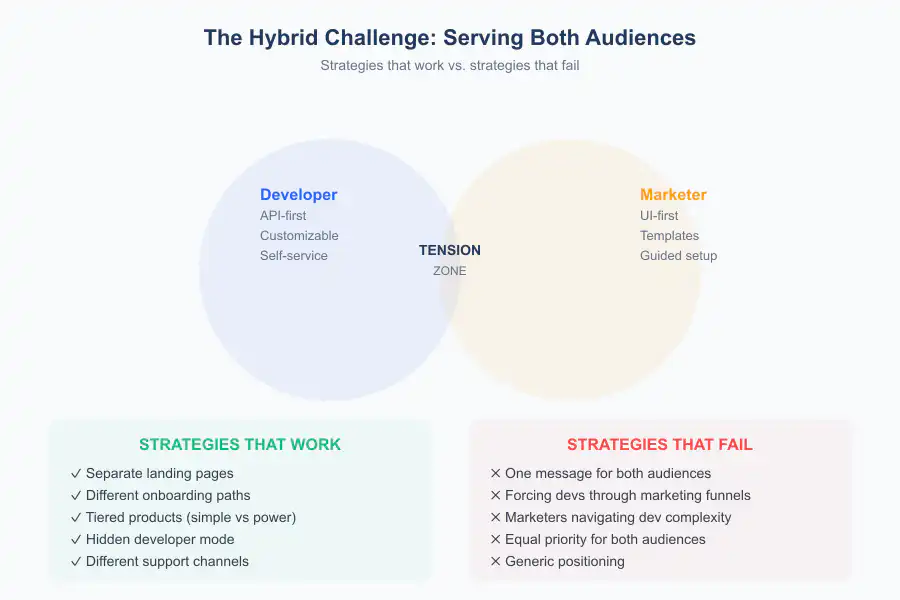
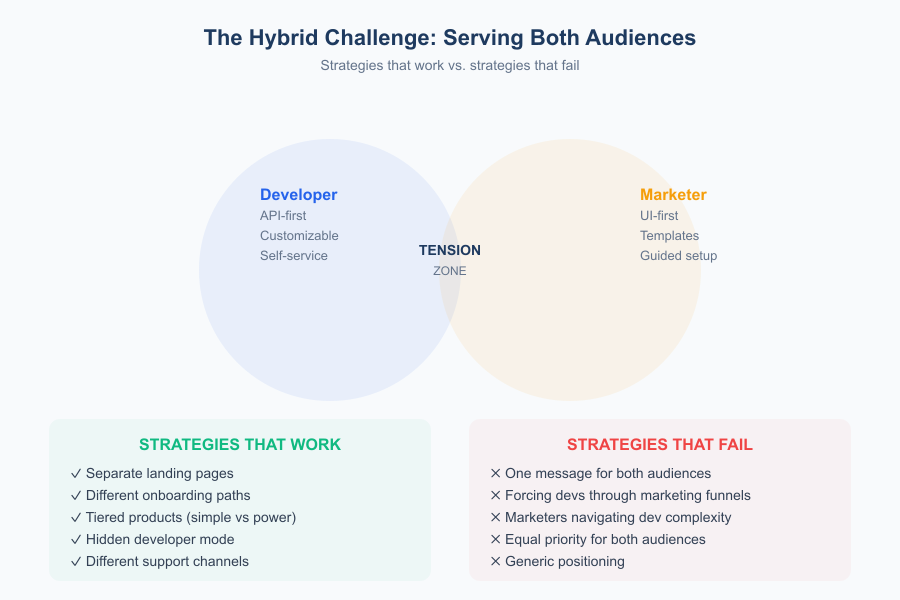
Some products serve both audiences. This is hard. I’ve tried it, and the tension is real.
I’m a developer who primarily sells to marketers, and it took me years to understand their buying psychology. A single well-written technical tutorial generates more developer signups than thousands in paid ads. But for marketers, switching from feature descriptions to ROI projections doubled conversion rates. Now I use that cross-domain knowledge as an advantage.
The tension: Simplicity for marketers conflicts with flexibility for developers. Self-service for developers conflicts with relationship selling for marketers. You end up building two products, two websites, and essentially two businesses under one roof.
Strategies that work:
- Separate landing pages and messaging
- Different onboarding paths
- Tiered products (simple vs power user)
- Developer mode hidden from regular UI
- Different support channels
Strategies that fail:
- One message attempting to please both
- Forcing developers through marketing-style funnels
- Expecting marketers to navigate developer complexity
Pick your primary audience. Accommodate the secondary one without compromising for the primary. WordPress does this reasonably well. The admin dashboard is marketer-friendly. The hooks, filters, and REST API serve developers. But notice how the developer features don’t clutter the marketer experience.
Choosing Your Audience
When building a product, the audience choice shapes everything.
Choose developers if:
- You have technical credibility
- The product is technical infrastructure
- You can build great documentation
- You’re comfortable with self-service sales
- You want community-driven growth
Choose marketers if:
- You have marketing credibility
- The product solves marketing problems
- You’re comfortable with sales processes
- You can invest in polish and production quality
- You want to charge premium prices
The founder-market fit: Your background matters. Developers selling to developers have built-in credibility. Marketers selling to marketers understand the psychology. Crossing over is possible but harder. The implicit knowledge isn’t transferable through research. I’m a developer who primarily sells to marketers, and it took me years to understand their buying psychology. Now I use that cross-domain knowledge as an advantage, but the learning curve was steep. This is where niche selection becomes critical for service providers.
Final Thoughts
These aren’t stereotypes. They’re patterns observed across hundreds of interactions.
Individual developers can appreciate great marketing. Individual marketers can dig into technical specs. But at the aggregate level, the differences hold. I’ve tested this across my own products and with dozens of client projects. The patterns are consistent.
Understanding which game you’re playing shapes every decision: messaging, pricing, channels, content, and product design.
Don’t try to play both games equally. Pick your primary audience. Optimize for them. Accommodate others where you can without compromising your core approach.
Developers and marketers both buy software. They just buy it very differently. If you’re freelancing and serving both audiences, understanding these differences is essential for building a sustainable business.
Selling to Different Audiences FAQ
Frequently Asked Questions
How do developer buying habits differ from marketer buying habits?
Developers are skeptical of marketing claims by default and require self-evaluation through trials. They want technical depth, trust peer validation over enterprise logos, and actively dislike being sold to. Marketers think in ROI, need to justify purchases to bosses, are comfortable with relationship selling and demos, value brand logos for social proof, and work under timeline pressure. The messaging that resonates with one audience makes the other suspicious.
What messaging works best when selling to developers?
Focus on technical capabilities, architecture details, API documentation, performance benchmarks, and transparent limitations. Developers respond to specifics like “CLI-first workflow automation with a REST API. Self-hosted or cloud. MIT licensed.” They want to know how it works and what trade-offs exist. Avoid buzzwords and marketing superlatives since saying “revolutionary” triggers suspicion. A well-written technical tutorial generates more developer signups than thousands of dollars in paid ads.
What acquisition channels work best for reaching developers?
Developer channels include technical content and tutorials, GitHub and open-source communities, Hacker News and Reddit, developer conferences, Stack Overflow, and word of mouth. Paid advertising typically underperforms for developer audiences. Content and community drive developer acquisition far more effectively. Documentation is content for developers. Great docs with zero marketing budget can outperform heavy ad spend.
How should pricing differ for developer versus marketer products?
Developers expect free tiers or open-source versions, transparent public pricing, usage-based models, and self-service purchasing with no “contact sales” gates. Hidden pricing triggers suspicion. Marketers expect clear tiered plans with feature differentiation, demos and trials with human guidance, custom enterprise pricing, and are comfortable with “contact sales” for larger purchases. Sales processes feel normal to marketers, not suspicious.
Can a single product successfully serve both developers and marketers?
It’s possible but genuinely hard. Simplicity for marketers conflicts with flexibility for developers. Strategies that work include separate landing pages, different onboarding paths, tiered products with developer mode, and different support channels. Strategies that fail include one message for both audiences, forcing developers through marketing funnels, or expecting marketers to navigate developer complexity. Pick a primary audience and accommodate the secondary one without compromise.
What trust signals work for developers versus marketers?
Developer trust signals include open-source codebase, technical blog posts, active GitHub presence, endorsements from respected developers, and transparent practices. “Our CTO” matters more than “Our CEO.” Marketer trust signals include case studies with named companies, industry awards, G2 and Capterra reviews, recognizable customer logos, and ROI documentation. Production quality matters for marketers because rough edges suggest unreliability.
How do sales processes differ between developer and marketer products?
Developer deals often close without sales involvement. Developers find, test, adopt, and upgrade products entirely through self-service. When sales involvement happens, it’s technical with solutions engineers, not traditional salespeople. Marketer deals follow traditional sales patterns with discovery calls, demos, proposals, and negotiations. Relationship and vendor trust matter. The human touchpoint for marketers isn’t friction, it’s reassurance they’re making the right choice.
How do I choose whether to target developers or marketers?
Choose developers if you have technical credibility, your product is technical infrastructure, you can write great documentation, and you’re comfortable with self-service sales and community-driven growth. Choose marketers if you have marketing credibility, your product solves marketing problems, you’re comfortable with sales processes, and you can invest in polish. Founder-market fit matters: developers selling to developers have built-in credibility, and crossing over takes years of learning.