
Market Research Examples by Type (With Real Cases)
Market research examples are only useful when they show the method and the decision it led to. Most examples you find online skip one of the two. You get a list of 10 research types with nothing you could run yourself, or a famous brand story with “method” details nobody can trace back to the company.
That leaves you with vocabulary and no plan. So I have organized the market research examples below by type, from surveys and interviews to A/B tests, test markets and census data. Each type gets a small business example you could actually run, and 5 real company cases show the same methods at scale, each linked to the company’s own report, filing or a named press source.
A market research example, in plain words, is any case where someone collected evidence about customers, competitors or a market to make one specific business decision. The decision is what makes the research useful. “Should we open on Sundays?” tells you whom to ask and when you have heard enough. “Learn about our customers” gives you no stopping point at all.
Types of Market Research With Examples
Two questions place any research method. Who collected the data: you, for this decision (primary), or someone else, for their own purpose (secondary)? And does it explain why people act the way they do (qualitative) or count how many of them do it (quantitative)?
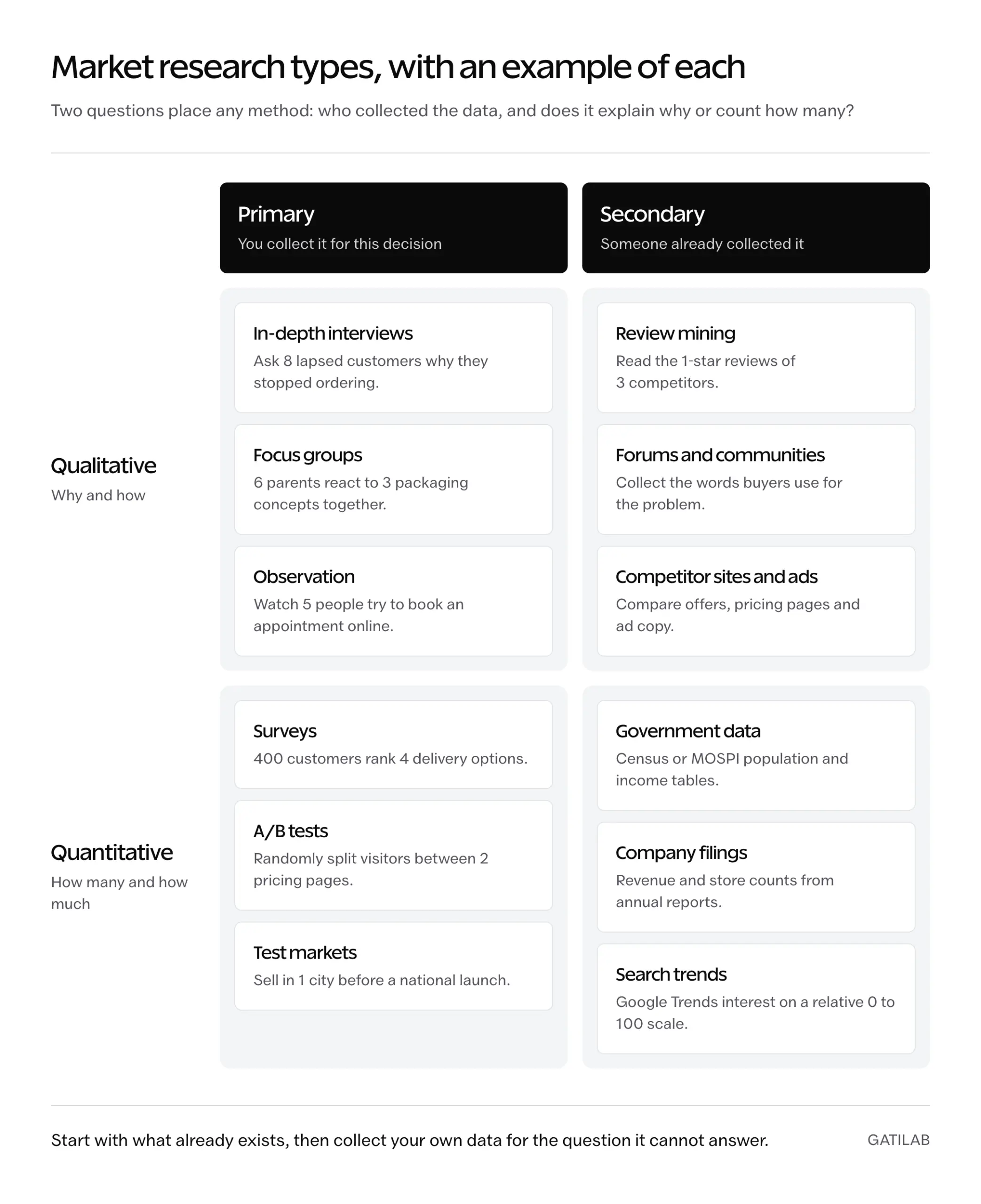
These labels overlap more than textbooks admit. A survey you run yourself is primary and quantitative, but its open-ended answers give you qualitative material too. The table below is the quick reference I’d keep open while planning a project.
| Method | Type | Best For | Small Business Example |
|---|---|---|---|
| Survey | Primary, quantitative | Measuring how common a need or preference is | 400 customers rank 4 delivery windows |
| In-depth interview | Primary, qualitative | Understanding why someone bought, stayed or left | 8 calls with customers who cancelled in their first 90 days |
| Focus group | Primary, qualitative | Reactions to concepts, names and packaging | 6 parents discuss 3 lunchbox designs |
| Observation | Primary, qualitative | Finding friction people don’t mention | Watching 5 people try to book online |
| A/B test | Primary, quantitative | Proving one change moves behavior | 2 pricing pages shown to randomly split visitors |
| Test market | Primary, quantitative | Checking demand and operations before a full launch | A new menu item sold in 1 branch for 8 weeks |
| Product or concept test | Primary, both | Choosing between versions before you build or switch | Blind tasting of 2 coffee blends |
| Secondary data | Secondary, quantitative | Sizing a market or a location | Census population by age for 3 neighborhoods |
| Competitive analysis | Secondary, both | Seeing what buyers already get and pay elsewhere | Comparing 5 rivals’ pricing pages and reviews |
Primary Market Research Examples
Primary research is data you collect yourself for the decision in front of you. It costs time and sometimes money, and it is the only way to hear what your own customers think about your own offer. The 7 methods below cover most primary research projects a small business runs.
Surveys
A survey asks many people the same fixed questions so you can count the answers. It is the right tool once you know what the options are and need to know how common each one is.
Example: a meal-kit company is choosing between a weekday evening delivery window and a Saturday morning one. It emails 2,000 recent customers, and 400 answer a 6-question survey that asks when they last missed a delivery, which window they would actually pick and what they would do if neither worked.
Surveys break in two places. Wording can push people toward an answer, and the people who reply are rarely a perfect copy of the people who don’t. Dove’s 2004 beauty study, covered in the company cases below, is a good model of a survey that publishes its sample, fieldwork dates and margin of error so readers can judge both.
In-Depth Interviews
An in-depth interview is a 30 to 60 minute one-on-one conversation about a real past decision. It tells you why something happened, in the customer’s own words, which is exactly what a survey can’t do.
Example: a small SaaS company sees that many trial users cancel within 90 days. Instead of guessing, it calls 8 of them and asks each person to walk through the week they signed up, what they tried first, where they got stuck and what they used instead after cancelling.
The questions should be about what people already did. “Would you pay for this?” invites a polite yes. “What did you pay for the last tool that solved this?” gets you a fact. Interviews also can’t tell you how common a reason is. 5 of 8 people mentioning setup time is a strong lead that a survey can then size.
Focus Groups
A focus group puts 5 to 8 people in a room (or a video call) with a moderator to react to something together. It works best for first reactions to concepts, names, ads and packaging, where hearing people build on each other’s comments is useful.
Example: a bakery planning a kids’ lunchbox range shows 6 parents 3 packaging designs and asks what each one says about the food inside, which they’d pick up in a shop and what would make them put it back.
The weakness is the group itself. One confident voice can pull the room, and people say what sounds reasonable in front of strangers, so a focus group is good at showing which concept confuses people and much weaker at predicting which one they’ll buy.
Observation and Ethnography
Observation means watching people do the real task instead of asking them about it. Ethnography is the longer version, where researchers spend time in people’s homes or workplaces to see how a product fits their day.
Example: a physiotherapy clinic asks 5 first-time visitors to book an appointment on its website while a staff member watches silently and notes every pause. Three of them may hunt for the price before they ever reach the calendar, a problem none of them would have mentioned in a survey.
Observation catches the friction people have stopped noticing. It still needs interpretation, because you see what someone did and have to infer why, so pairing it with 2 or 3 follow-up questions at the end is wise.
A/B Tests and Experiments
An A/B test shows 2 versions of one thing to randomly split groups and measures which one changes behavior. It is the closest market research gets to proof, because the random split removes most of the other explanations.
Example: an online course seller shows half its visitors a pricing page with a single plan and the other half a page with 3 plans, then compares purchases and refunds over 4 weeks. If you need software for this, our guide to the best A/B testing tools compares the main options.
The catch is traffic. A page with 40 visitors a week can run a test for months without a clear answer, and stopping early on a lucky streak is a common way small tests mislead. Netflix’s artwork tests, covered below, show the method done carefully.
Test Markets
A test market launches a product or change in a limited area before rolling it out everywhere. It answers two questions at once: will people buy it, and can the business deliver it without breaking something else?
Example: a 4-branch café chain adds a breakfast menu in 1 branch for 8 weeks and tracks breakfast sales, total daily sales, kitchen wait times and staff overtime. If breakfast sales come mostly from customers who used to buy lunch, the new menu has moved revenue around instead of adding any.
McDonald’s All Day Breakfast, covered below, is the large-scale version of this, kitchen questions included.
Product and Concept Tests
A product test puts versions in front of people before you commit: a blind taste test, a prototype trial or a concept page with a “join the waitlist” button. It tells you which version people prefer under test conditions.
Example: a coffee roaster considering a new house blend serves 60 regulars 2 unmarked cups and asks which they prefer and why. The test also needs one more question: how would you feel if your current blend disappeared? Coca-Cola’s 1985 reformulation is the reason that question matters.
Secondary Market Research Examples
Secondary research uses data someone else already collected. It is cheap or free and fast, which makes it the right first step for almost any project. You should check what already exists before paying anyone to answer a question that a government table answers for free.
Here are the secondary sources I’d reach for first, with an example of each:
- Government statistics: a gym owner choosing between 2 neighborhoods compares population by age and household income in the US Census Bureau’s data portal, or in India through the Ministry of Statistics and Programme Implementation.
- Company filings and annual reports: a coffee start-up reads a listed competitor’s annual report on SEC EDGAR to see its store count, average sales and where it says growth is slowing.
- Search data: a skincare brand compares seasonal interest in “sunscreen for oily skin” and “tinted sunscreen” on Google Trends, and checks the queries already bringing visitors to its site with Search Console keyword research.
- Competitor ads and websites: an agency reviews which offers rivals are running in the Facebook Ads Library and how long each ad has stayed live.
- Reviews and forums: a mattress seller reads the 1-star reviews of its 3 biggest competitors and lists every complaint that appears more than twice.
- Industry and trade association reports: a restaurant owner uses a national restaurant association’s annual outlook to see whether rising food costs are local or industry-wide.
Secondary data has one built-in weakness: it answers someone else’s question. Census tables describe everyone who lives in an area, whether or not they would ever buy from you. Google Trends scales interest from 0 to 100 relative to all searches in that place and period, so it shows direction and seasonality and has no count of buyers in it. Always note the geography and the date of a dataset before you lean on it.
Competitive analysis is the secondary research most founders skip, usually because they believe nobody else does what they do. Our piece on why “no competitors” is a research failure explains why that belief costs more than the research would, and the SEO competitor analysis framework shows how to turn rival websites into a list of gaps.
Qualitative vs Quantitative Research Examples
The easiest way to see the difference is to watch both methods work on the same question. Take a SaaS company asking why trial users don’t upgrade to a paid plan.
- Qualitative: interview 10 users who didn’t upgrade. You come away with reasons in their words, such as “I couldn’t connect it to our CRM” or “my manager has to approve anything over $50.”
- Quantitative: send an in-app survey to 500 non-upgraders listing those reasons as options, plus “other.” Now you know which reason is most common and whether it differs by company size.
The order matters. Qualitative research first tells you what the options are, and quantitative research then tells you how much each one matters. A survey written before any interviews can only count the reasons you already guessed.
Real Company Market Research Examples
These 5 cases each show one method, what the company learned and what it decided. I have kept only cases where the research itself is documented by the company or a named source, and each one says where the evidence stops. A launch that went well afterward doesn’t prove the research caused all of it.
Dove
Method: commissioned survey (primary, quantitative). In 2004, Dove commissioned “The Real Truth About Beauty: A Global Report” to understand how women saw their own looks. The report’s methodology section is unusually specific:
- Managed by the research firm StrategyOne with Dr. Nancy Etcoff of Harvard University and Dr. Susie Orbach of the London School of Economics.
- 3,200 telephone interviews with women aged 18 to 64 in 10 countries, 300 per country and 500 in the US, each lasting 20 to 25 minutes.
- Fieldwork ran from February 27 to March 26, 2004, and the data was weighted by age, marital status, income, ethnicity and region.
- Only 2% of women chose “beautiful” to describe their looks, and 68% strongly agreed that media and advertising set an unrealistic standard of beauty.
Dove still describes that 2% figure as the starting point of its Campaign for Real Beauty, launched the same year. What makes it a model survey is the reporting: it publishes a margin of error of plus or minus 1.7 points for the full sample and 5.7 points for each 300-person country sample, so you can see how much weight each number can carry. It is also a brand-commissioned study from 2004, so the figures describe those women at that time.
Netflix
Method: A/B test (primary, quantitative). Netflix’s technology blog described its artwork experiments in May 2016. The company says its studies found members look at a title’s artwork first, so it tested whether better images would help them find something to watch.
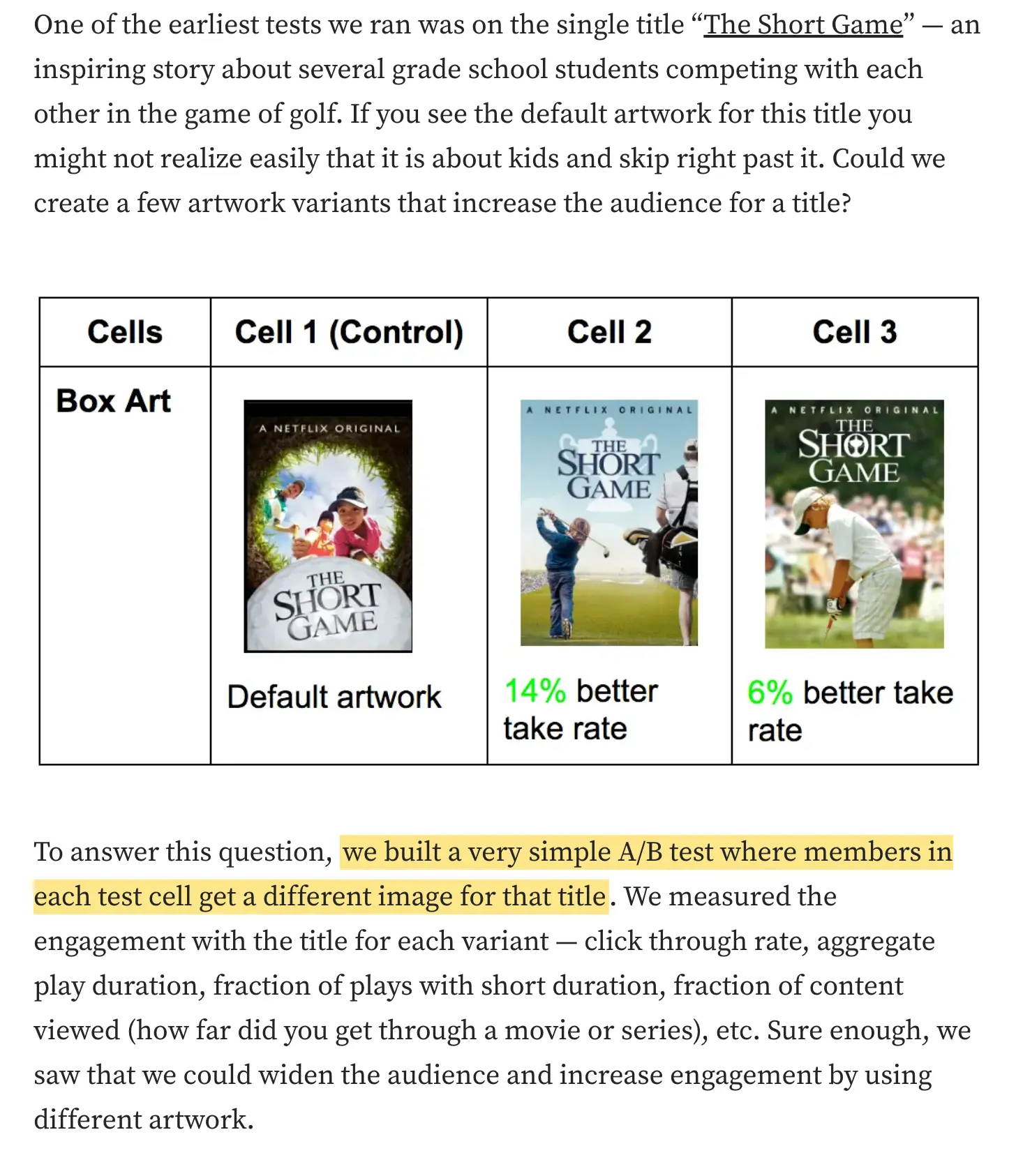
- The first test used a single title, “The Short Game,” a story about grade school students competing at golf, whose default artwork didn’t make it obvious the title was about kids.
- Members were split into test cells, each shown a different image, and Netflix measured click-through rate, play duration and how much of the title people watched.
- The 2 alternative images produced a 14% and a 6% better take rate than the default artwork.
- A larger follow-up test across many titles checked that total streaming hours rose, so the gain wasn’t just viewing moved from one title to another.
That last check is the part to copy. Netflix’s own post raises the obvious objection that a better image might only steal views from other titles, and then designs a second test to answer it. A small business testing a new homepage headline should ask the same question about total sales as well as clicks on one button.
McDonald’s
Method: social listening plus a test market (primary and secondary). When McDonald’s launched All Day Breakfast nationwide on October 6, 2015, it called breakfast all day the number one request it heard from customers and said it had replied to tens of thousands of people who had asked for it on Twitter since 2007.
- Before the national launch, the menu ran in test markets including San Diego and Nashville. A July 2015 memo to franchisees, reported by Nation’s Restaurant News, called the early results encouraging and said crews in the test markets found the changeover smoother.
- The national menu varied by location, with McMuffin or biscuit items chosen locally based on customer preference.
- In its fourth quarter 2015 results, McDonald’s reported US comparable sales up 5.7%, benefiting from the launch and, to a lesser extent, unseasonably mild weather.
- In March 2020, McDonald’s suspended All Day Breakfast to simplify kitchen operations during the pandemic.

The request data told McDonald’s what customers wanted. The test markets checked whether restaurants could serve it, which is why the memo talks about crews as well as customers. Five years later, kitchen simplicity was the reason given for pulling it. If you test a new offer, measure the strain on your team alongside the sales.
Coca-Cola
Method: taste tests (primary, product test). Coca-Cola’s own history of New Coke says the company changed its formula on April 23, 1985, after taste tests with nearly 200,000 consumers preferred the new version. After 79 days of consumer outcry, the original formula came back on July 11, 1985 as Coca-Cola classic.
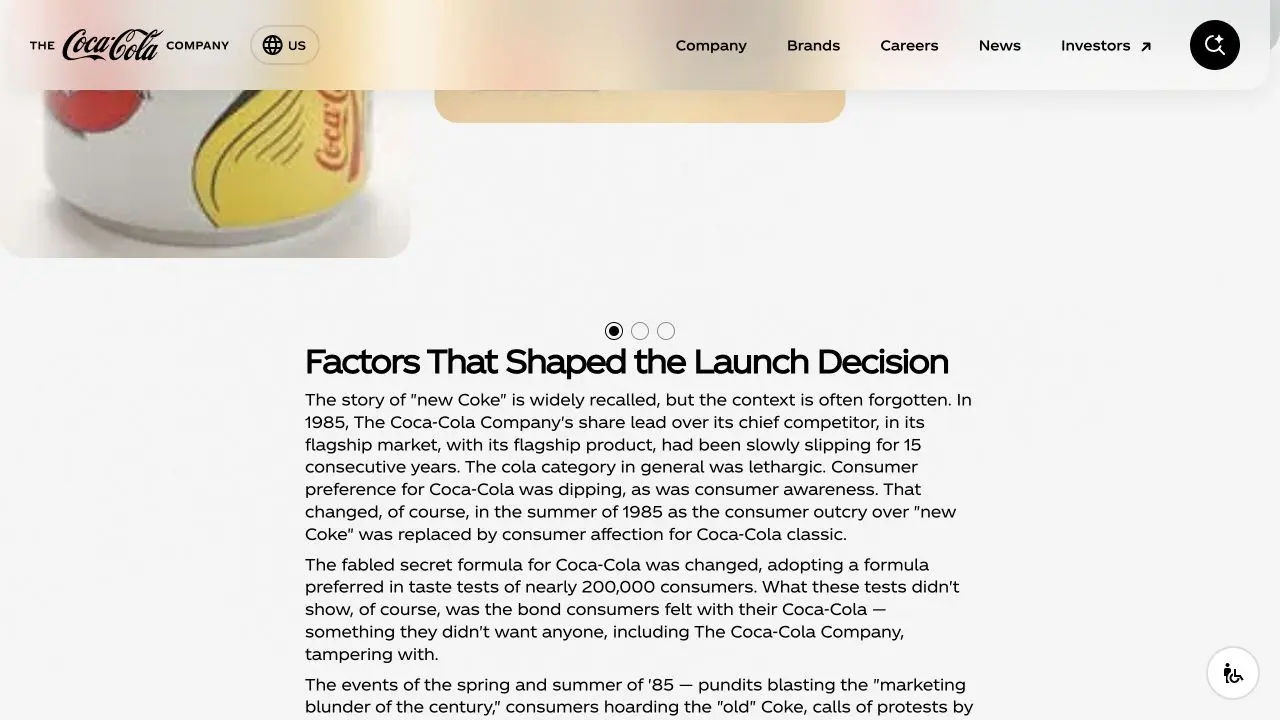
The company’s own explanation is that the tests didn’t show “the bond consumers felt with their Coca-Cola.” The research answered the question it asked, which taste people preferred in a sip test. The business decision was a different question: how people would react when the drink they already loved was taken away. When your change removes something familiar, your research has to ask about the removal too.
LEGO
Method: crowdsourced concept validation (primary, quantitative signal). LEGO Ideas lets fans submit set designs and collect support from other fans. Under LEGO’s published process:
- A project that reaches 10,000 supporters qualifies for an official review.
- The creator sends detailed build material, and the review takes several months.
- Reaching the milestone doesn’t guarantee production; the idea may be chosen as a LEGO Ideas set.
This is demand measured before any product exists, with a clear threshold and a second filter. Supporter counts show interest, and LEGO’s own review still decides whether a set gets made. A small business running a waitlist should treat sign-ups the same way, as a reason to look closer. Our guide to finding a minimum viable audience covers how many interested people you need before building makes sense.
Examples of Consumer Research
Consumer research is the part of market research that studies the people who buy and use a product: what they need, how they choose and how they use it after buying. Market research also covers competitors, pricing and market size; consumer research stays with the customer. Dove’s survey and LEGO’s supporter votes above are both consumer research.
Common examples of consumer research include:
- Usage and attitude survey: a pet food brand asks 1,000 dog owners how often they buy, where and what they look for on the label.
- Purchase decision interviews: a furniture store asks 6 recent buyers to describe the 2 weeks before they bought a sofa, including every site and showroom they checked.
- Diary study: a recipe app asks 12 users to note every meal they cook for 2 weeks, with what they made and why.
- In-store or in-home observation: a cleaning brand watches 5 households clean a kitchen to see which products they reach for and which ones stay under the sink.
- Review and support-ticket analysis: an electronics seller tags 300 support tickets by problem type to find the 3 issues behind most returns.
- Satisfaction survey after purchase: a hotel asks guests 2 questions at checkout and follows up with anyone who scores it 6 or below.
All of these work better when you know whom you are studying. If you haven’t done that yet, start by deciding how to define your target audience, and once results come in, split them using market segmentation. An average across very different customers can hide the one group that matters most.
Market Research Survey Example
Here is a short survey for a hypothetical home-cleaning service deciding whether to add weekend appointments. It asks about past behavior first and only then about the new idea, which keeps people from answering what they think you want to hear.
- How often have you booked home cleaning in the last 6 months? (Never / Once / 2 to 3 times / Monthly or more)
- On which day did your last cleaning take place?
- Was that the day you wanted? If not, which day did you want?
- Have you ever not booked because no suitable slot was available? (Yes / No)
- If yes, what did you do instead? (Booked another company / Cleaned myself / Waited / Other)
- What did you pay for your last cleaning? (Price ranges)
- If we offered Saturday slots at the same price, how likely is it you’d book one in the next 3 months? (5-point scale)
- Would a weekend surcharge change that? Up to what amount?
- Anything else that would make booking easier for you? (Open text)
Questions 4 and 5 do the real work. They tell you how many bookings you are losing today and where those customers go, which is a much firmer number than anyone’s guess about the future in question 7. For more wording ideas, our list of survey question examples covers satisfaction, feature and churn questions.
Market Research Report Example
A market research report doesn’t need 40 slides. One page that connects the evidence to the decision is enough for most small business projects. Here is the structure, filled in for the weekend-cleaning survey above with hypothetical numbers:
| Section | What Goes In | Example |
|---|---|---|
| Decision | The choice the business has to make | Add Saturday appointments from next quarter? |
| Research question | What you need to learn first | Are we losing bookings because of weekday-only slots? |
| Method and sample | Who took part, how they were chosen, what was measured | Email survey to 1,200 past customers, 210 replies |
| Findings | Counts with their denominators | 64 of 210 skipped a booking for lack of a slot; 41 of those booked a competitor |
| Limits | Who is missing and what the data can’t show | Only past customers asked; people who never booked are not included |
| Recommendation | The action the evidence supports | Run Saturday slots in 1 area for 8 weeks |
| Next check | What would confirm or change the call | At least 15 Saturday bookings a week, with no drop in weekday bookings |
The findings row is where most reports go wrong. “64 of 210 respondents” is honest; “30% of customers” quietly turns 210 replies into a claim about everyone, including the 990 who didn’t answer. Keeping the denominator visible is the core of statistical thinking for business decisions, and it is wise to keep it in every report you write.
If you take one thing from these market research examples, let it be the order: write the decision first, check what secondary data already answers, then collect only the primary data that closes the gap.
FAQs on Market Research
What Are the 3 Main Types of Market Research?
Textbooks usually split market research by purpose into 3 types. Exploratory research finds the problem and the options, usually through interviews and focus groups. Descriptive research measures how common something is, through surveys and secondary data. Causal research tests whether one change causes another, through A/B tests and test markets. Most real projects move through them in that order.
Can ChatGPT Do Market Research?
It can help you plan a study, draft survey questions, summarize public sources and organize interview notes. It can’t replace evidence from real customers. When it describes what customers think, that is a prediction with no customers behind it, so check every fact it gives you against the original source before it goes into a report.
What Are Some Free Websites for Market Research?
Good free starting points are data.census.gov for US population and business data, data.gov.in and MOSPI for India, SEC EDGAR for US company filings, Google Trends for relative search interest, Pew Research Center for consumer and technology surveys and the Meta Ad Library for competitor ads.
How Many Interviews or Survey Responses Do I Need?
It depends on the method. For usability testing, Nielsen Norman Group’s widely cited finding is that 5 users uncover about 85% of the usability problems in a design, with more needed when you serve distinct user groups. For a survey, precision depends on the number of responses: about 400 random responses give a margin of error of roughly plus or minus 5 percentage points at 95% confidence. Interviews have done their job when new conversations stop producing new reasons.
What Is the Difference Between Market Research and Marketing Research?
Market research studies a market: customers, competitors, demand and prices. Marketing research is broader and also studies your marketing itself, such as ad performance, pricing tests and channel results. In everyday use, most people treat the two terms as the same thing.
How Do I Do Market Research for a Student Project or Business Plan?
Start with one decision, such as whether a campus cafe should add vegan options. Use secondary data to size the group, such as enrollment figures and nearby menus, run 5 to 10 short interviews to find the reasons and then survey 50 to 100 students to count them. Report your sample size and its limits; a realistic recommendation backed by a small, clearly described sample is more convincing than a big claim.
Tell Google you want more of this.
Add Gatilab as a preferred sourceOne tap, and this site shows up more often in your own Top Stories, AI Overviews and AI Mode. Remove it any time.