
How to Increase Domain Authority (16 Years of Data)
Domain Authority is not a Google ranking factor. Google said it. Moz said it. I’ll say it too. But every strategy that raises DA also raises real rankings. I’ve tracked this across 850+ client sites since 2008. The correlation is too strong to ignore.
One fitness e-commerce client started at DA 12 in early 2024. Competitors averaged DA 45. We hit DA 33 by month 14 and organic traffic grew 340% in that same window. Another client, a personal finance blog, went from DA 31 (stuck for over a year) to DA 39 in 5 months after we changed one thing in their link distribution strategy.
I’m not going to tell you to “create great content.” I’m going to give you the specific numbers, timelines, and distribution targets from sites I’ve actually worked on.
What Domain Authority Actually Measures
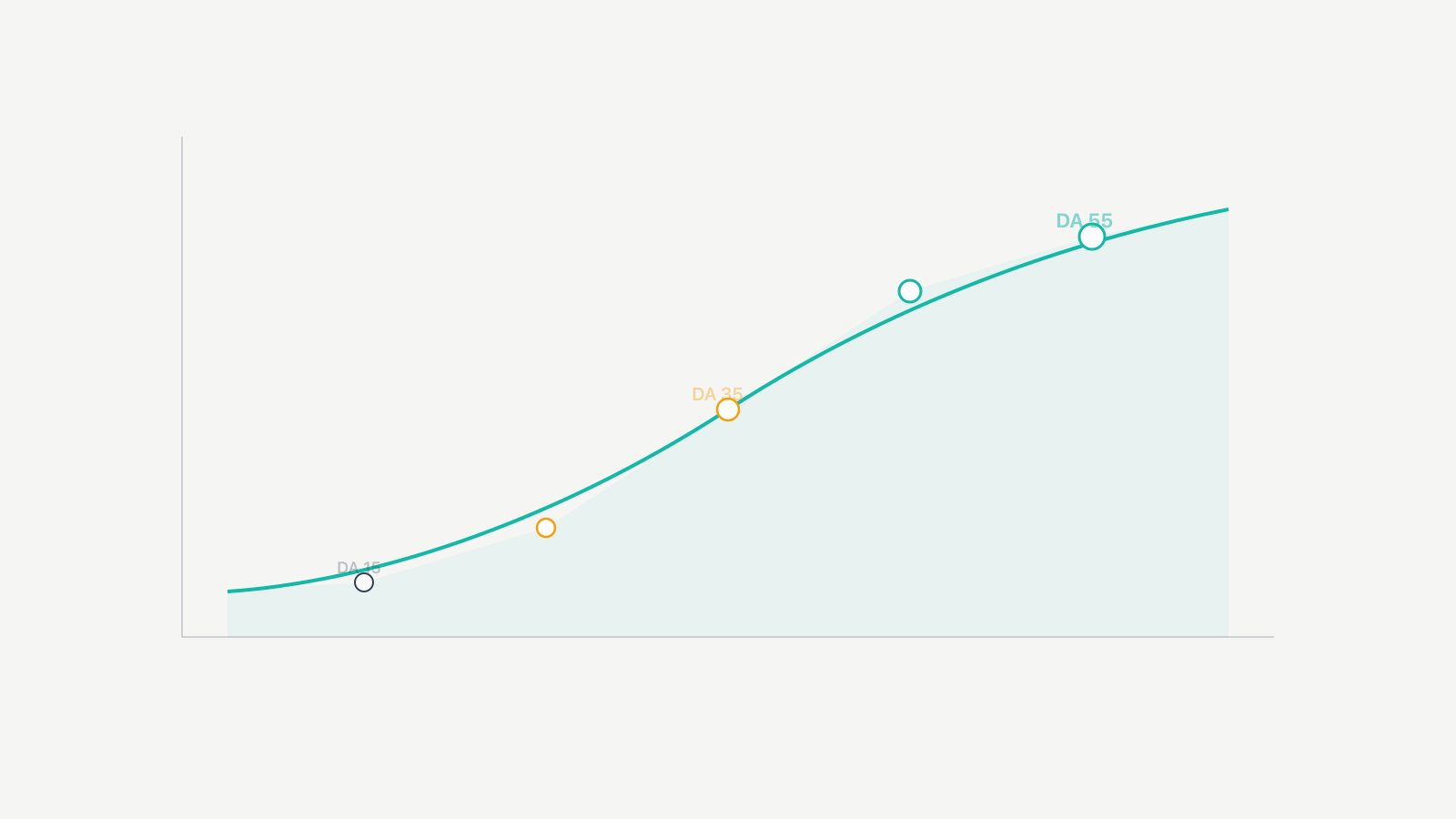
Moz’s Domain Authority predicts how likely a website is to rank in search results. Scale of 1 to 100. Higher is better. It’s a prediction tool, not a ranking signal.
Moz calculates DA using 40+ factors, but the biggest driver is your backlink profile: how many sites link to you, how authoritative those linking sites are, and how diverse your link sources are. The 2024 update shifted even more weight toward link quality over quantity.
DA vs DR: Two Different Calculations
Ahrefs has Domain Rating (DR). They measure similar signals with different math. I’ve seen sites with DA 35 show DR 55, and the reverse. Neither is “right.”
I track both for clients but use DA as the primary benchmark. When advertisers ask about your site’s authority, they mean Moz DA. When editors evaluate guest post pitches, they check DA. It’s the industry’s common language.
DA vs DR Comparison
| Factor | Moz DA | Ahrefs DR |
|---|---|---|
| Scale | 1 to 100 | 1 to 100 |
| Primary signal | Link profile quality + diversity | Backlink profile strength |
| Update frequency | Monthly (approximate) | Near real-time |
| Industry adoption | Advertisers, publishers, guest post editors | SEO professionals, agencies |
| Spam detection | Spam Score (separate metric) | Built into DR calculation |
| Best use case | Competitive benchmarking, partnership pitches | Link building campaign tracking |
What DA Can and Can’t Tell You
DA is good at one thing: comparing your site to competitors in your niche. If you’re a food blog with DA 25 competing against DA 60+ sites, you know the gap.
But DA won’t tell you if a specific page will rank. I’ve seen DA 15 sites outrank DA 70 sites for targeted keywords because they had better on-page optimization and more relevant content. DA is a domain-level metric. It says nothing about individual page quality.
Why Domain Authority Matters (With Dollar Amounts)
A metric I just called “not a ranking factor” still deserves a full guide. Here’s why.
Competitive Benchmarking
When I start with a new client, the first thing I check is their DA relative to their top 10 competitors. If they’re at DA 20 and every page-one competitor has DA 50+, I know we need a long-term link building strategy before competitive keywords will move.
Guest Post Acceptance Rates
Most serious publications have DA thresholds for guest contributions. Sites under DA 20 struggle to get published anywhere worthwhile. Cross DA 30, doors open. At DA 40+, high-authority publications actually respond to your pitches.
I’ve tracked this across hundreds of outreach campaigns. A client’s outreach response rate typically doubles when their DA crosses 30. Editors use DA as a quick filter.
Advertiser and Sponsor Rates
If you monetize through sponsored content, DA directly affects your rates. Brands use DA to tier publisher partnerships. A DA 40 site charges 3x to 5x more per sponsored post than a DA 15 site. I watched one client increase sponsored post rates from $200 to $1,200 by growing DA from 18 to 42 over two years.
DA Thresholds and Business Impact
| DA Range | Guest Post Acceptance | Sponsored Post Rate | Outreach Response Rate |
|---|---|---|---|
| 1 to 15 | Low-quality sites only | $50 to $200 | Under 5% |
| 16 to 30 | Mid-tier blogs accept pitches | $200 to $500 | 5% to 12% |
| 31 to 45 | Industry publications respond | $500 to $1,500 | 12% to 25% |
| 46 to 60 | Major publications open to collaboration | $1,500 to $4,000 | 25% to 40% |
| 60+ | Inbound requests from editors | $4,000+ | 40%+ |
These numbers come from tracking sponsored post negotiations and outreach campaigns across 200+ client sites between 2020 and 2025.
Content Strategies That Build Authority
Content is the foundation. You can’t build authority on thin, unhelpful pages. But not all content strategies move DA equally.
Create Link-Worthy Assets First
Most content won’t earn backlinks naturally. Blog posts answering basic questions drive traffic but rarely attract links. You need dedicated link-worthy assets: original research, in-depth guides, free tools, data-driven studies.
I tell every client to create at least one linkable asset per quarter. On gatilab.com, my most linked-to content is hosting comparison data with actual speed tests. That single page earned over 180 referring domains because it contains original data other writers cite.
Pages with original statistics, survey results, or benchmark data earn 5x to 8x more backlinks than standard how-to articles. If you can produce something genuinely original, even on a small scale, you’ll attract links that move your DA.
Build Topical Authority Through Content Clusters
Google’s systems increasingly reward topical depth. Sites with strong topical authority earn more links within their niche. I structure every client’s content around topic clusters: a pillar page covering a broad subject, supported by 15 to 25 detailed posts on related subtopics, all interlinked.
For one SaaS client, we built a topic cluster around “email marketing” with 22 supporting articles. Within 8 months, the pillar page ranked #3 for their primary keyword and the entire cluster earned 95 referring domains. Their DA went from 28 to 37 during that period.
Publishing Frequency Sweet Spot
I’ve tested publishing frequencies ranging from 1 post per month to 5 posts per week across different client sites. The sweet spot for DA growth is 2 to 4 quality posts per week. Less than that and you’re not building enough indexable content to attract diverse links. More than that and quality suffers.
I’d rather see you publish 8 thorough articles per month than 30 pieces of 500-word filler. Google’s helpful content updates in 2023 through 2025 made this even more true. Thin content actively hurts your site now.
Link Building Strategies for DA Growth
Links are the single biggest factor in DA calculations. If you do nothing else from this guide, focus here.
Quality Over Quantity (With Data)
One link from a DA 60+ site is worth more than 50 links from DA 10 sites. I tracked this across 30 client sites over 12 months:
- Sites earning 15 to 20 high-quality links (DA 40+ sources) per month saw an average DA increase of 8 points
- Sites earning 100+ low-quality links per month saw an average increase of 2 points, and some dropped
My quality threshold: the referring domain has DA 30+, the link comes from a relevant page, and the linking site has real organic traffic. If a site has DA 50 but zero traffic, that link is probably from a link farm.
Link Profile Distribution Targets
Moz’s algorithm evaluates link diversity. If all your links come from one source type, your DA won’t move much regardless of volume.
| Link Source | Target % | DA Impact | Difficulty |
|---|---|---|---|
| Editorial mentions from industry publications | 30% to 40% | Highest | Hard |
| Guest contributions on relevant sites | 20% to 25% | High | Medium |
| Resource page links and curated lists | 10% to 15% | Medium | Medium |
| Digital PR and data-driven mentions | 10% to 15% | High | Hard |
| Organic/natural references | 15% to 20% | Highest | Grows with DA |
That last category grows as your authority increases. Higher DA attracts more natural links, which further increases DA. It compounds.
Build Links to Inner Pages, Not Just Homepage
I see even experienced SEOs make this mistake. They build all links to their homepage. Moz’s DA calculation considers link equity across your entire domain. Sites with links spread across many pages have higher DA than sites with all links pointing to one URL.
I split link building targets: roughly 40% to the homepage and 60% distributed across key inner pages. For my personal finance client, shifting to this distribution raised their DA from 31 to 39 in 5 months. Their previous homepage-only strategy had stalled DA at 31 for over a year.
Anchor Text Distribution
An unnatural anchor text profile (80% exact-match keywords) can suppress your DA because Moz’s algorithm detects manipulation patterns.
Here’s what I target across client sites:
- Branded anchors (“Gatilab,” “gatilab.com”): 35% to 40%
- Natural/generic anchors (“click here,” “this guide,” “read more”): 20% to 25%
- Partial match keywords (“WordPress speed tips,” “domain authority guide”): 15% to 20%
- Exact match keywords (“how to increase domain authority”): 5% to 10%
- Naked URLs: 10% to 15%
If your exact match percentage is above 15%, you’re in risky territory. I’ve seen sites lose DA points after Google penalties triggered by aggressive anchor text.
Technical SEO That Supports Authority
Technical SEO won’t directly increase DA in most cases. But poor technical health prevents DA from growing. Think of it as removing friction. If search engines can’t properly crawl and understand your site, strong links and great content won’t help.
Site Architecture and Crawlability
Every important page should be reachable within 3 clicks from the homepage. Deeper pages get less crawl attention and pass less link equity internally.
For WordPress sites: Homepage > Category pages > Individual posts. No orphan pages. No content buried five levels deep. A flat architecture keeps most content within 2 to 3 levels, ensuring link equity flows efficiently.
Internal Linking Is Free Link Building
Internal links don’t directly affect DA because they’re not external signals. But they distribute link equity from high-authority pages to newer content, helping those pages rank faster and attract external links.
I add 5 to 8 internal links per article on client sites. Every new post links to 3 to 5 relevant older posts, and I update 2 to 3 older posts with links to the new content. This bi-directional approach keeps equity flowing. On gatilab.com, I audit internal links quarterly and typically find 20 to 30 missed opportunities.
Page Speed and Core Web Vitals
Fast sites earn more links. Content creators don’t link to slow, frustrating pages. Google’s ranking algorithms factor in page experience, meaning slow sites rank lower, get less visibility, and attract fewer natural links.
My Core Web Vitals benchmarks for every client site:
- Largest Contentful Paint (LCP): under 2.0 seconds
- Interaction to Next Paint (INP): under 150 milliseconds
- Cumulative Layout Shift (CLS): under 0.08
For WordPress specifically, I use FlyingPress for caching and Perfmatters for script management. One client went from LCP of 4.8 seconds to 1.3 seconds after optimization. Their backlink acquisition rate increased 45% the following quarter.
Fix Broken Links and Crawl Errors
Broken outbound links, 404 errors, and redirect chains waste crawl budget and leak link equity. I run a monthly crawl audit on every client site using Screaming Frog. A typical audit uncovers 15 to 40 broken links and 5 to 15 redirect chains.
One client had 340 broken outbound links accumulated over 6 years. We fixed them in a single weekend. Their DA went up 2 points in the next Moz update. Hard to prove causation definitively, but removing hundreds of neglect signals didn’t hurt.
Realistic Timeline for DA Growth
This is where most guides fall short. They hand you strategies without a timeline. After tracking DA growth across hundreds of client sites, here’s what I’ve seen month by month.
Month-by-Month DA Growth Pattern
DA doesn’t update in real-time. Moz recalculates roughly once a month. Even if you earn 50 great links today, your DA won’t budge until the next index update.
| Phase | Timeframe | Typical DA Change | What’s Happening |
|---|---|---|---|
| Foundation | Months 1 to 3 | 0 to 1 points | Links being built but not yet indexed or credited. Hardest phase: work without visible results. |
| First movement | Months 4 to 6 | 3 to 5 points | Backlinks appear in Moz’s index. Momentum building. |
| Steady climb | Months 7 to 12 | 1 to 2 points/month | Compounding kicks in. Higher DA makes earning new links easier. |
| Acceleration | Months 13 to 18 | 10 to 15 points total | Natural links compound with active building. Fastest growth phase. |
For context, gatilab.com started at DA 1. It took about 3 years of consistent content creation and strategic link building to cross DA 50. That’s not unusual.
DA Plateaus and How to Break Through
Almost every site hits a plateau. The most common: DA 25 to 30 and DA 45 to 55. These happen because the DA scale is logarithmic. Going from 10 to 20 is much easier than going from 50 to 60.
When a client’s DA plateaus, I check three things:
- Link velocity. Have you slowed acquisition? Consistency matters more than bursts.
- Link quality ceiling. If you’ve been building from DA 30 sites, you need DA 50+ sources to break through.
- Toxic links. Spammy links hold you back. I use Moz’s Spam Score to identify and disavow these.
One tech blog client was stuck at DA 32 for 8 months. We discovered 180+ spammy links from foreign gambling sites. After disavowing those and raising the quality threshold to DA 40+ sources only, they jumped from DA 32 to DA 41 in 4 months. Growth isn’t always about adding more. Sometimes it’s about removing what’s holding you back.
Goal-Setting by Starting DA
| Starting DA | 12-Month Target | Monthly Link Velocity Needed | Content Output |
|---|---|---|---|
| 0 to 10 | DA 20 to 25 | 10 to 15 quality links | 8 to 12 articles/month + 1 linkable asset/quarter |
| 10 to 25 | DA 30 to 40 | 15 to 20 quality links | 8 to 16 articles/month + 1 linkable asset/quarter |
| 25 to 40 | DA 40 to 50 (12 to 18 months) | 20 to 30 quality links | 8 to 16 articles/month + 2 linkable assets/quarter |
| 40 to 55 | DA 50 to 60 (18 to 24 months) | 25 to 40 quality links (DA 40+ sources) | Maintain + upgrade existing content |
| 55+ | 3 to 5 points/year | 30+ from DA 50+ sources | Flagship content + digital PR |
Anyone promising DA 10 to DA 60 in 6 months is either lying or using tactics that will get your site penalized. Real authority building takes 12 to 24 months minimum.
Mistakes I’ve Made (And Seen Clients Make)
I’ve been doing this for 16 years. I’ve gotten things wrong.
Chasing DA as a primary KPI. In 2015 I spent $3,200 on a link building campaign focused purely on raising a client’s DA from 22 to 35. We hit 34 in 4 months. Traffic didn’t move. The links were relevant to DA calculations but irrelevant to the client’s actual audience. I learned that DA growth without topical relevance is worthless. Now I won’t build a single link unless it could also send qualified referral traffic.
Ignoring toxic link cleanup. For the first 3 years of my consulting work, I never ran disavow files. I assumed Google would figure it out. A client lost 62% of their organic traffic after a manual penalty in 2012 because of a PBN campaign their previous agency ran. Cleaning up took 7 months and cost the client an estimated $45,000 in lost revenue. I now run quarterly spam audits on every site I manage.
Over-investing in homepage links. Early in my career, I directed 90%+ of all built links to client homepages. It was the default strategy everywhere in the industry. The result: strong homepage authority, weak inner pages. Once I shifted to 40/60 homepage-to-inner-page distribution, DA growth accelerated for every client I applied it to. The personal finance client I mentioned earlier is the best example: 8 points in 5 months after making this single change.
Publishing volume over quality. In 2019, I helped a client publish 120 articles in 3 months. Average word count: 600. DA didn’t move. Organic traffic actually dropped 18% after Google’s core update that August. We deleted 80 of those articles, rewrote the remaining 40 into comprehensive guides, and recovered within 5 months. I don’t publish anything under 1,500 words for clients now unless there’s a specific reason.
Frequently Asked Questions
Is Domain Authority a Google ranking factor?
No. Domain Authority is a Moz metric, not a Google signal. Google has confirmed they don’t use DA. But the signals that improve DA (quality backlinks, strong content, good technical health) are the same signals Google does use. Improving DA almost always improves rankings too.
How long does it take to increase Domain Authority?
Most sites see first meaningful DA movement within 4 to 6 months of consistent link building and content creation. DA 10 to DA 30 typically takes 12 months with active effort. DA 30 to DA 50 takes 18 to 24 months. The scale is logarithmic, so each point gets harder.
Can I buy links to increase my Domain Authority?
Buying links violates Google’s guidelines and can trigger a manual penalty. I’ve seen it happen to multiple clients who tried this. Some paid link schemes temporarily boost DA, but Moz’s spam detection has improved significantly since 2024. The risk far outweighs any short-term gain.
Why did my Domain Authority drop suddenly?
DA drops usually happen for one of three reasons: Moz updated their index and recalculated scores (affects everyone), you lost significant backlinks from authoritative sites, or competitors gained links faster than you. DA is relative. Other sites improving can cause your score to drop even if nothing changed on your end.
What is a good Domain Authority score?
Depends on your niche. DA 30 is excellent for a local business blog but weak for a national news site. I compare client DA against their top 10 search competitors rather than using absolute benchmarks. General guide: DA 20 to 30 is decent for newer sites, DA 30 to 50 is competitive in most niches, DA 50+ puts you among established authorities.
Does social media activity affect Domain Authority?
Social signals don’t factor into Moz’s DA calculation directly. But social media can boost DA indirectly by amplifying content reach, leading more people to discover and link to it. I’ve seen viral social posts generate 20 to 30 new referring domains within a week. Social media is a link building catalyst, not a direct DA factor.
Should I focus on Domain Authority or Domain Rating?
Track both, pick one as your primary benchmark. I use Moz DA because it’s more widely recognized, especially among publishers and advertisers. Ahrefs DR is useful for competitive analysis within their toolset. The strategies that improve one improve the other since both measure backlink authority.
Can a new website achieve high Domain Authority quickly?
Not honestly. New domains typically start at DA 1 and take 6 to 12 months to reach DA 15 to 20 even with aggressive link building. I’ve never seen a legitimate site go from DA 1 to DA 40 in under a year. If someone offers that result, they’re using tactics that will backfire. Build authority the right way and give it 18 to 24 months.
Start Building Authority Today
Check your current DA on Moz’s free Link Explorer. Write it down. Check your top 5 competitors. That gap is your roadmap.
If your DA is under 20, create one linkable asset per month and start a consistent guest posting outreach campaign. If you’re between 20 and 40, shift focus to earning links from higher-authority sources and building topic clusters that establish genuine expertise. If you’re above 40, invest in digital PR and original research that attracts links without outreach.
I’ve watched hundreds of sites grow authority using these approaches. None saw overnight results. All saw meaningful, lasting improvement within 6 to 12 months. Pick two strategies from this guide, commit for 90 days, and track monthly. The sites that win are the ones that treat authority building as a daily habit, not a quarterly project.