
Shipping Good Enough Products: When to Launch and When to Wait
Your product isn’t ready. It’s missing features. The design needs work. There are bugs you know about. You want more time.
Ship it anyway.
I’ve shipped products that made me cringe. WordPress plugins with rough edges I could see from space. Client deliverables that were functional but ugly. Every single time, the feedback I got from real users was more valuable than another month of polishing would have been.
Perfectionism kills more products than competition does. The founders who succeed learn to ship before they’re comfortable. Whether you’re bootstrapping vs seeking funding, the same principle applies. Here’s how to know when “good enough” is actually good enough.
The Perfectionism Trap
Perfectionism disguises itself as quality standards. It feels virtuous. It isn’t.
What perfectionism looks like:
- “Just one more feature and we’ll launch”
- “The onboarding isn’t smooth enough yet”
- “I’m embarrassed to show this to people”
- “We need to fix X before we can charge for this”
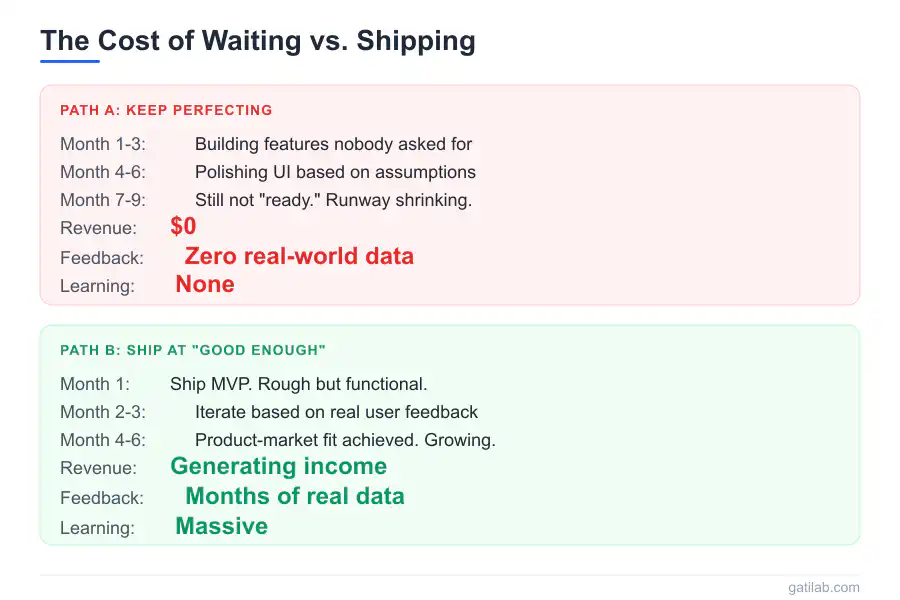
Each delay feels justified. Months pass. The product still isn’t launched. And here’s the part that really hurts… the product you’re perfecting today will feel outdated three months from now anyway.
The real cost:
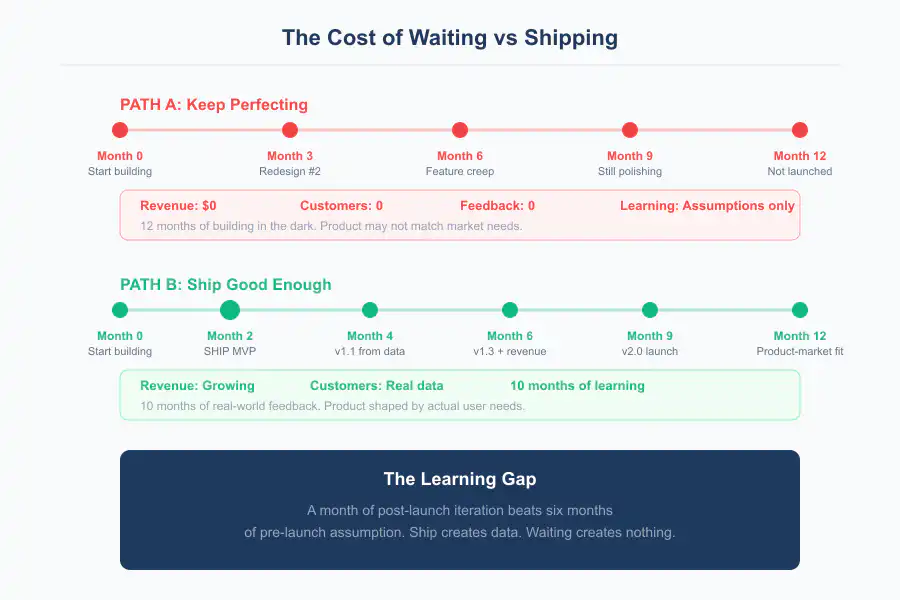
While you perfect, you’re not learning. You’re not getting customer feedback. You’re not generating revenue. You’re burning runway on assumptions. Every week you spend polishing in isolation is a week of real-world data you’re missing.
Perfectionism is expensive. Shipping is education. I’ve learned more from one week of real user feedback than from months of internal testing.
Why “Ready” Is a Myth
No product is ever truly ready. I’ve been building products since 2011 and not one has launched in the state I wanted.
The moving target:
Every feature you add creates new expectations. Fix the bugs, and you notice new ones. Polish the design, and you see new imperfections. Ready is a horizon that keeps receding. You’ll never reach it because it doesn’t exist.
Perfect in isolation:
What you think is perfect might not be what customers want. Features you prioritized might be irrelevant. Problems you ignored might be critical.
You can’t know what perfect is until customers tell you. And they can’t tell you until they use the product. I spent three weeks perfecting a dashboard feature on a WordPress plugin once. Turned out nobody used dashboards. They just wanted the widget. Three weeks, gone.
Market timing:
While you perfect, competitors ship. Market conditions change. Customer attention shifts. The SaaS marketing landscape moves especially fast.
The product you’re perfecting might be perfect for a market that no longer exists when you finally launch. I’ve watched this happen to others. It’s painful to see.
The Minimum Viable Standard
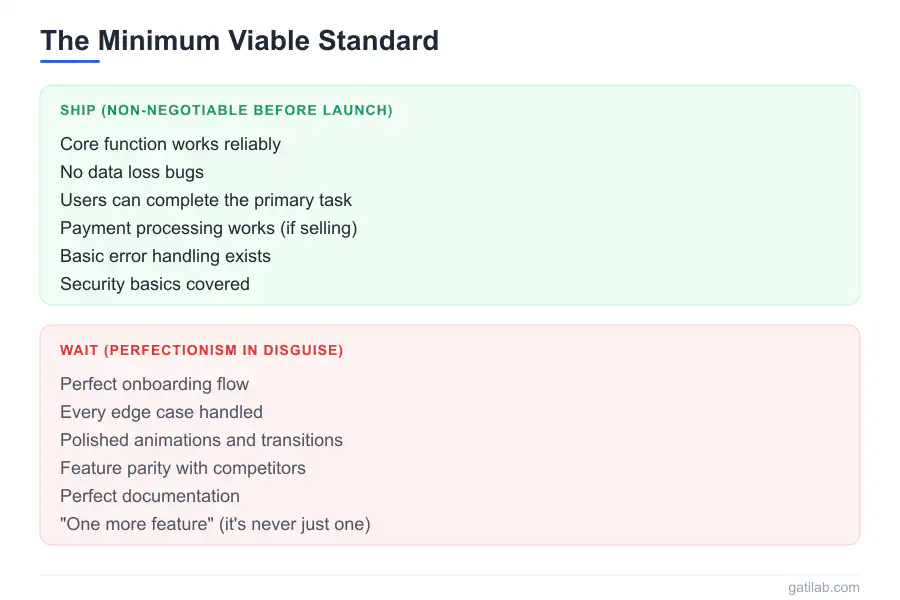
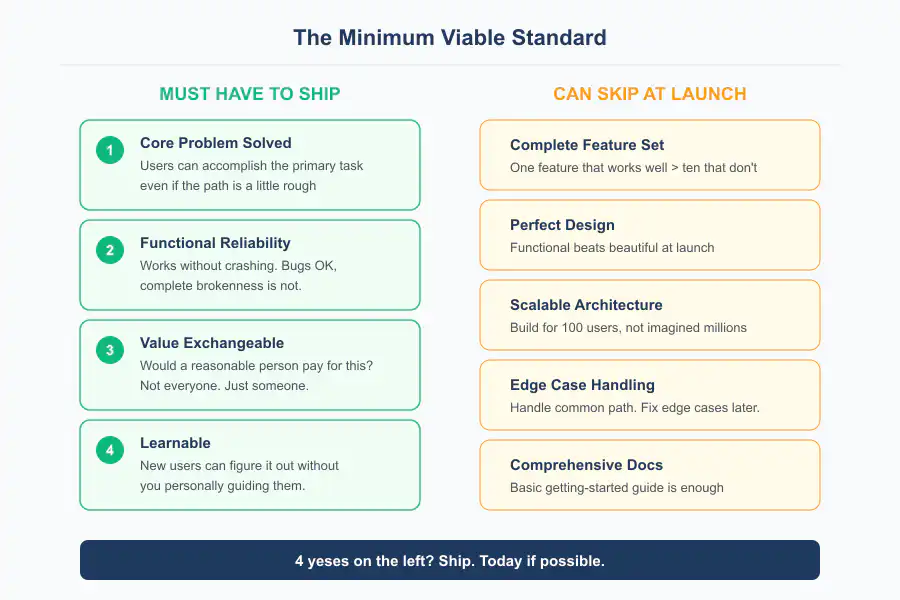
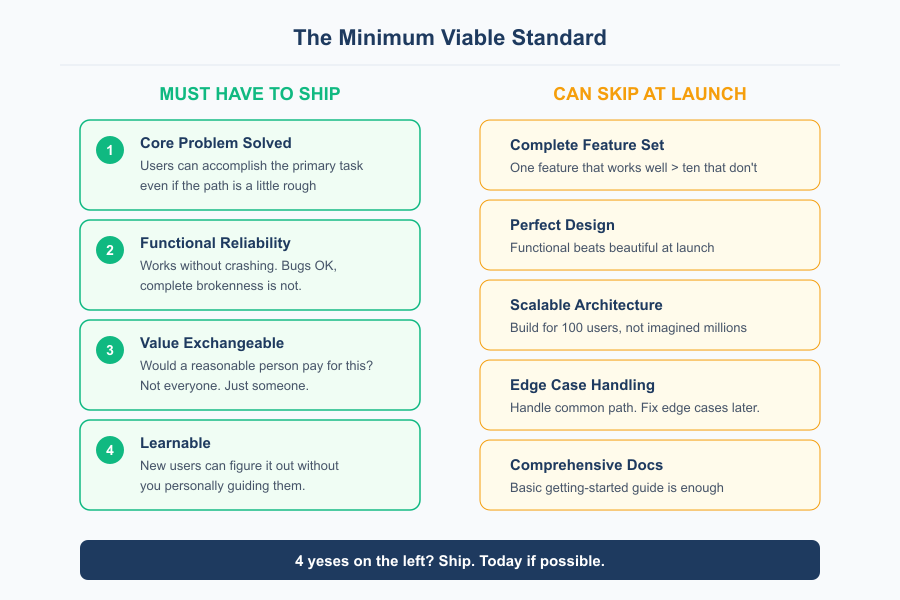
Good enough has specific characteristics. It’s not “whatever you can throw together.” It’s a deliberate standard.
Core problem solved:
Does the product solve the main problem it’s designed to solve? Not every problem. Not elegantly. Just: can users accomplish the primary task?
If yes, it might be ready. If users can get from A to B, even if the path is a little rough, you have something shippable.
Functional reliability:
Does it work without crashing? Can users complete core workflows without hitting walls?
Bugs are acceptable. Complete brokenness isn’t. There’s a real difference between “this button placement is awkward” and “this button doesn’t work.” Ship the first. Fix the second.
Value exchangeable:
Would a reasonable person pay money (or time) for this? Not everyone. Just someone.
If the value proposition is clear to anyone, the product has viability. You don’t need mass appeal at launch. You need one person who says “yes, this helps.”
Learnable:
Can new users figure out how to use it without you personally guiding them? Basic onboarding or documentation counts.
If users need you to operate it, you have a service, not a product. That’s an important distinction.
What You Can Skip
Some things feel essential but aren’t. Not at launch.
Complete feature set:
Launch with one feature that works well rather than ten features that work poorly. Expand based on demand, not assumption.
Twitter launched without direct messages. Instagram launched without video. My first WordPress plugin launched with exactly one function. Features came later, informed by what users actually asked for.
Perfect design:
Functional beats beautiful at launch. Users tolerate ugly if it solves their problem. They don’t tolerate beautiful if it doesn’t.
Craigslist still looks like 1998. It still works. The early version of Basecamp looked rough. Didn’t matter. It solved a real problem.
Scalable architecture:
Build for your first 100 users, not your imagined million. You can refactor when scaling problems actually exist.
Premature optimization wastes time on problems you might never have. I’ve seen founders spend months building infrastructure for millions of users, then launch to twelve people. Build for what’s real, not what’s possible.
Edge case handling:
Handle the common path. Let edge cases fail gracefully (or even ungracefully). Fix them when they actually occur.
Most edge cases are rarer than you think. The weird scenario you spent two days building for? It might happen once a year. Or never.
Comprehensive documentation:
Basic getting-started guide is enough. Detailed documentation follows usage. You’ll write better docs after seeing where users actually struggle. Focus on conversion-ready pages first.
The Embarrassment Test
If you’re not embarrassed by the first version of your product, you’ve launched too late. Some embarrassment is healthy. Paralyzing shame isn’t. If the product makes you cringe a little, ship it. The cringe fades. The data you get back doesn’t.
Reid Hoffman’s famous quote: “If you’re not embarrassed by the first version of your product, you’ve launched too late.”
What embarrassment indicates:
You’ve prioritized shipping over ego. You’ve accepted that learning requires exposure. You’ve chosen progress over perfection. That takes courage, and it’s the right call nearly every time.
What lack of embarrassment indicates:
You’ve over-invested before validation. You’ve built based on assumptions. You’ve delayed learning in favor of comfort. You feel good about the product but have zero market data to support that feeling.
The balance:
Some embarrassment is healthy. Paralyzing shame isn’t. If the product is so broken it will actively harm users or your reputation permanently, wait.
If it just makes you cringe a little? Ship. The cringe fades. The data you get back doesn’t.
The Feedback Loop
Shipping creates information. Waiting creates assumptions. The difference between these two things is the difference between building something people want and building something you hope people want.
What you learn by shipping:
- Which features people actually use (often not the ones you expected)
- Where users get stuck (often not where you predicted)
- What they wish existed (often something you never considered)
- Whether they’ll pay (the only validation that matters)
- Who your real customers are (usually different from who you imagined)
What you learn by waiting:
Nothing. You’re just building in the dark. Every assumption you make before shipping is a guess, no matter how educated.
Velocity of learning:
Fast shipping creates fast learning. Fast learning creates fast improvement. Fast improvement creates competitive advantage. The best project management tools can help you ship faster without sacrificing the basics.
Slow shipping creates slow learning. Slow learning creates slow improvement. Slow improvement creates vulnerability to anyone who ships faster than you. And in most markets, someone will.
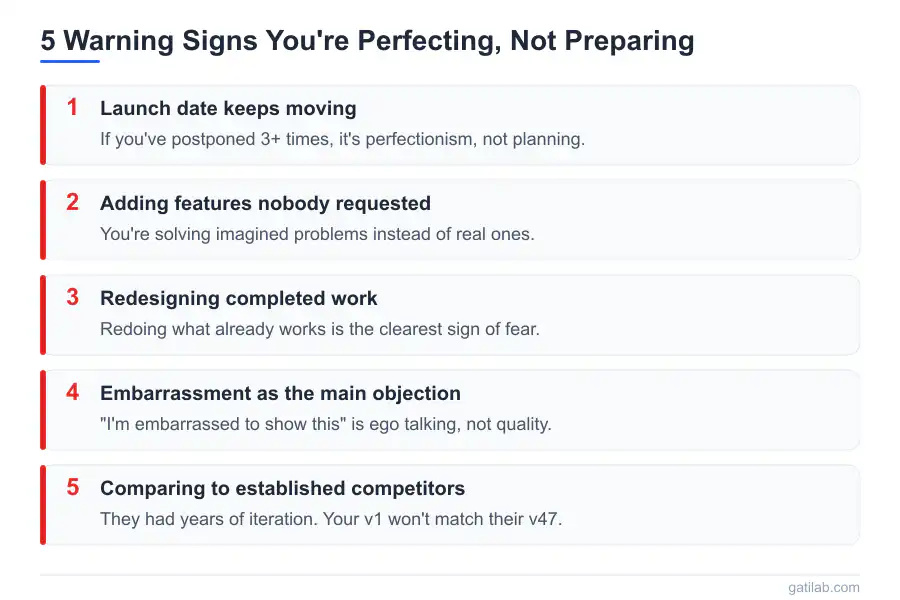
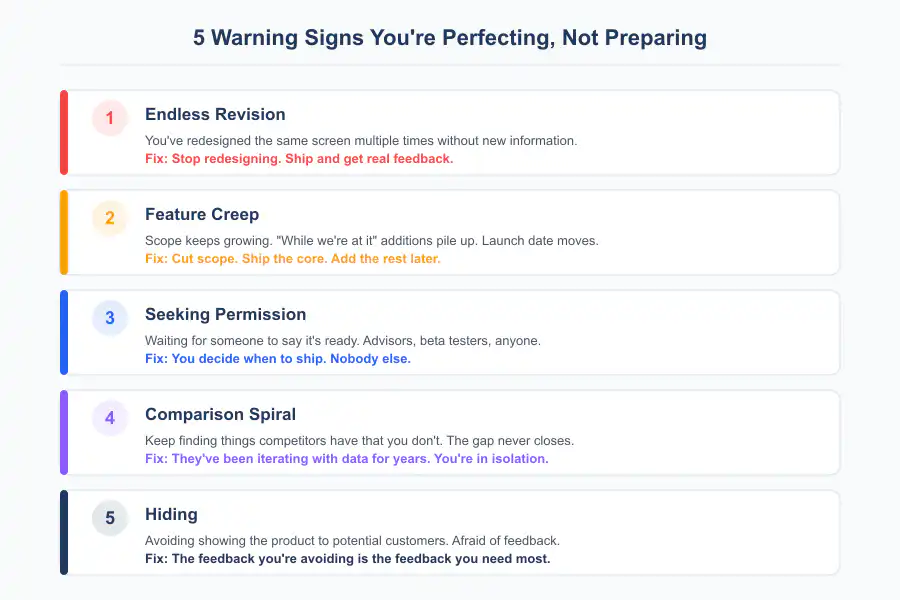
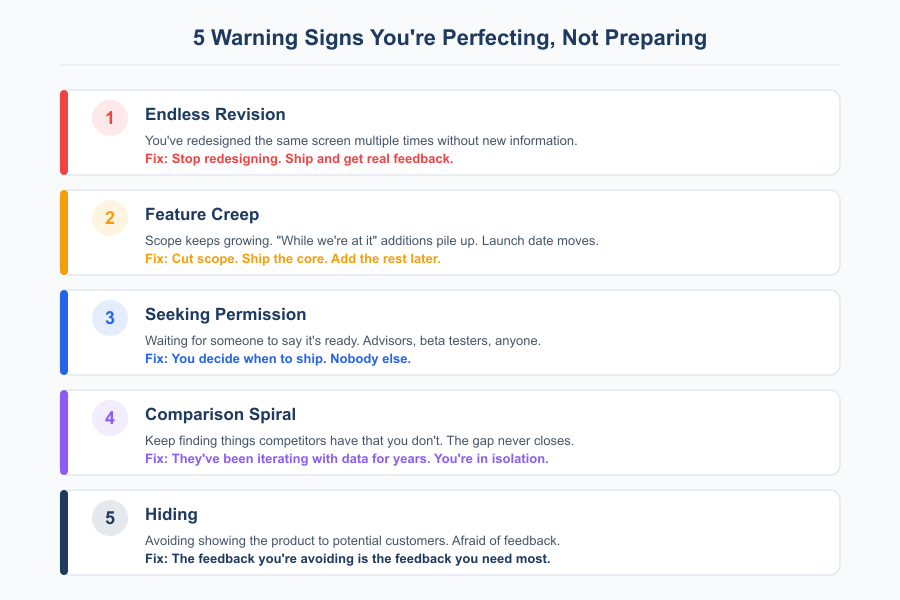
Signs You’re Perfecting, Not Preparing
Watch for these patterns. I’ve caught myself in every one of them at some point.
Endless revision:
You’ve redesigned the same screen multiple times. You’re iterating without new information. If nothing has changed in the external world, why are you redesigning?
Stop redesigning. Ship and get feedback. Real feedback, not your own opinion for the fifth time.
Feature creep:
The scope keeps growing. “While we’re at it” additions pile up. The launch date keeps moving. This is particularly dangerous because each individual addition feels small and reasonable. Collectively, they add months.
Cut scope. Ship the core. Add the rest later.
Seeking permission:
You’re waiting for someone to say it’s ready. Advisors, beta testers, potential customers. Nobody will give you permission to ship. That permission has to come from you.
You decide when to ship. Nobody else.
Comparison spiral:
You keep looking at competitors and finding things they have that you don’t. The gap never closes because you’re not comparing fairly.
They’ve been iterating with customer feedback for years. You’re iterating in isolation. Of course their product looks more polished. They have a head start of real-world data.
Hiding:
You avoid showing the product to potential customers. You’re afraid of feedback because it might confirm your fears. I get it. Showing something imperfect is vulnerable. But the feedback you’re avoiding is the feedback you need most.
How to Actually Ship
Practical steps to get past the block. These work. I’ve used them.
Set a date:
Pick a launch date. Make it soon. Two weeks from now, not two months. Make it public if that helps create accountability.
The date forces decisions. Without it, everything is negotiable. “We’ll launch when it’s ready” means you’ll never launch.
Define the minimum:
Write down what absolutely must work for launch. Be ruthless. Cut everything else. Your list should have 3-5 items, not 15. If it’s long, you haven’t been ruthless enough.
Kill your darlings:
That feature you love but isn’t essential? Cut it. That design detail you’ve obsessed over? Ship without it. You can add things later. You can’t un-not-launch.
I had to cut a feature from a plugin that I’d spent 40 hours building. It was a good feature. It just wasn’t essential for launch. Cutting it hurt. Launching without it was the right call. I added it in version 1.2 when I actually knew people wanted it.
Accept imperfection:
Say it out loud: “This will not be perfect and that’s okay.”
Internalize this. Make peace with shipping something imperfect. The alternative isn’t perfection. The alternative is never shipping at all.
Launch quietly if needed:
Soft launches are valid. Ship to a small group first. Get feedback. Expand gradually. The pressure of a “big launch” kills many products. Quiet launches preserve optionality. Most successful products launched quietly to a handful of people before anyone heard of them.
Post-Launch Reality
What actually happens after you ship imperfect products. Because it’s rarely as bad as you feared.
Most concerns don’t materialize:
The bugs you worried about? Many users never encounter them. The missing features? Many users don’t need them. The rough design? Users care about function more than aesthetics.
You overestimate what matters to users. What matters to you as a builder is different from what matters to someone trying to solve a problem.
Real problems surface:
Issues you never anticipated become obvious within days. These are actually valuable because they’re real, not imagined. You can fix real problems. You can’t fix imagined ones because they’re infinite.
Shipping reveals reality. Reality is useful. Assumptions are not.
Iteration accelerates:
With live users and real feedback, improvements become obvious. You fix what actually matters instead of guessing what might matter.
A month of post-launch iteration beats six months of pre-launch assumption. I’ve seen this play out on every product I’ve launched. The learning curve after shipping is almost vertical.
Momentum builds:
Revenue, testimonials, case studies… these only come after shipping. Each benefit makes the next easier. Understanding pricing strategies helps you monetize once you ship.
Shipping creates its own momentum. Waiting creates its own inertia. Choose momentum.
When to Wait
Despite everything above, sometimes waiting is correct. This isn’t a blanket “ship everything immediately” message.
Safety critical:
If the product could harm users physically, financially, or legally in serious ways, get it right. Medical devices, financial tools handling real money, security software. Caution is warranted when the stakes are high.
Reputation-destroying bugs:
If a bug would create viral negative feedback, fix it first. A payment system that charges wrong amounts damages trust permanently. A data leak destroys credibility. Some mistakes you can’t iterate your way out of.
Single-shot launches:
Some launches can’t be undone. Physical products, major PR campaigns, irreversible commitments. Software can iterate. Hardware can’t. Know which one you’re building.
Contract obligations:
If you’ve promised specific features to paying customers, deliver them. Broken promises destroy relationships. This is different from launching to new users with a limited feature set.
The Good Enough Checklist
Good Enough Checklist
Before launch, ask these five questions:
- Does it solve the core problem?
- Can users complete the main task?
- Is it stable enough to use without constant crashing?
- Would someone pay for this value?
- Can I support the users this launch will bring?
Five yeses? Ship. Today if possible.
Any nos? Address specifically that issue. Nothing else. Don’t use a single “no” as an excuse to revisit everything.
The Long-Term View
Products that launch imperfect and improve beat products that launch perfect and stagnate. Every time.
The trajectory matters:
Users forgive early roughness if improvement is visible. They remember the direction, not the starting point. Show them you’re getting better and they’ll stick around.
Amazon was a clunky website that sold books. Now it’s everything. Nobody remembers version one. Nobody cares about version one.
Competition shapes around you:
Once you’re in the market, competitors react to you. While you wait, they define the space without you. Presence in market is strategic advantage, even if your presence is imperfect.
Compounding improvements:
Improvements after shipping compound. Each iteration builds on real learning from real users. Products get better faster when they’re live.
Improvements before shipping are guesses. Products in development improve slowly because feedback is limited to your own perspective. And your own perspective has blind spots. Always.
I’ve shipped products that made me cringe. Every single time, the feedback from real users was more valuable than another month of polishing would have been. Perfectionism kills more products than competition does.
The Final Push
You know what needs to happen. You know the product is probably good enough. You know waiting is costing you learning, revenue, and momentum.
The only thing stopping you is the discomfort of exposure. Of putting something imperfect into the world with your name on it.
That discomfort is the price of progress. Every successful founder paid it. Every product you admire started imperfect. The WordPress plugins I use daily were rough at version 1.0. The SaaS tools I recommend were clunky at launch. They shipped anyway, and they got better because they shipped.
Ship the good enough product. Learn from reality. Improve from feedback. Repeat.
The perfect product is the one that ships.
Product Launch FAQ
Frequently Asked Questions
How do I know when my product is good enough to launch?
Ask five questions: Does it solve the core problem? Can users complete the main task? Is it stable without constant crashing? Would someone pay for this value? Can you support the users this launch brings? Five yeses means ship today. You don’t need a complete feature set, perfect design, or comprehensive documentation at launch. You need functional core value that someone will exchange money or time for.
Why does perfectionism kill more products than competition?
While you perfect in isolation, you’re not learning from customers, not generating revenue, and burning runway on assumptions. Every feature added creates new expectations. Every week of delay is a week of real-world data you’re missing. The product you’re perfecting today will feel outdated three months from now anyway. Competitors are shipping and iterating with real feedback while you iterate on guesses. More products die in development than in the market.
What can I safely skip when launching an MVP?
Complete feature set (launch with one feature that works well), perfect design (functional beats beautiful), scalable architecture (build for first 100 users, not imagined millions), edge case handling (handle common paths, fix outliers when they occur), and comprehensive documentation (basic getting-started guide is enough). My first WordPress plugin launched with exactly one function. Features came later, informed by what users actually asked for.
What’s the embarrassment test for product launches?
Reid Hoffman’s principle: if you’re not embarrassed by your first version, you launched too late. Some embarrassment means you’ve prioritized shipping over ego and chosen progress over perfection. No embarrassment means you’ve over-invested before validation. The balance: a product making you cringe a little should ship. A product causing paralyzing shame or one that could genuinely harm users should wait. The cringe fades fast. The data you get back doesn’t.
What actually happens after shipping an imperfect product?
Most concerns don’t materialize. Users rarely encounter the bugs you worried about. Missing features often go unnoticed. Rough design matters less than function. But real problems you never anticipated surface within days, and those are actually valuable because they’re based on reality, not imagination. Iteration accelerates dramatically. A month of post-launch improvement beats six months of pre-launch assumption. Momentum builds through revenue, testimonials, and real feedback.
How do I overcome the fear of launching an imperfect product?
Set a launch date two weeks out, not two months. Make it public for accountability. Define your absolute minimum (3-5 items, not 15) and cut everything else ruthlessly. Consider a soft launch to a small group first to reduce pressure. Say out loud: “this will not be perfect and that’s okay.” Remember the alternative to shipping imperfect isn’t shipping perfect. It’s not shipping at all. Every successful product started imperfect.
When should I actually wait before launching?
Wait when the product is safety-critical and could cause physical, financial, or legal harm. Wait when bugs would create permanent reputation damage (payment systems charging wrong amounts, security tools leaking data). Wait for single-shot launches like physical products that can’t iterate after shipping. Wait when you’ve made contractual promises to paying customers for specific features. Software can iterate. Hardware can’t. Know which you’re building.
How do I tell if I’m perfecting versus genuinely preparing?
Warning signs of perfecting: redesigning the same screen multiple times without new information, feature scope growing with “while we’re at it” additions, waiting for someone’s permission to ship, comparing endlessly to competitors who have years of user data, and avoiding showing the product to potential customers. If nothing has changed externally but you keep iterating, you’re perfecting, not preparing. Ship and get real feedback instead.