Lifetime Deals in SaaS: Economics, Risks, and Revenue Impact
Few topics divide the software world like lifetime deals. To some founders, LTDs are a quick path to cash, market validation, and early users. To others, they’re a trap that destroys long-term business value and attracts the worst possible customers.
Both views contain truth. That’s exactly what makes the lifetime deal decision so difficult.
I’ve watched this play out from multiple angles. As a plugin developer, as someone who’s purchased LTDs, and as an advisor to founders considering them. The math is never as simple as the marketing suggests.
This guide breaks down the economics of lifetime deals from every angle. Not to tell you whether to do one, that depends on your specific situation, but to give you the analytical framework to make an informed decision. We’ll cover when LTDs make sense, when they don’t, how to structure them if you proceed, and what to do if you’re having second thoughts about a deal you’ve already run. Understanding the economics of lifetime deals before you launch one can save you years of pain.
Understanding Lifetime Deals
Before the math, the basics. Because I’ve found that most founders who struggle with LTDs didn’t fully understand what they were getting into.
What Is a Lifetime Deal?
A lifetime deal is a one-time purchase that grants perpetual access to a software product. Instead of paying $30/month forever, a customer pays $99 once and uses the product indefinitely.
The “lifetime” typically means the lifetime of the product (as long as the company keeps it running), though some deals specify the customer’s lifetime or include specific terms about feature access and limitations.
LTDs are typically distributed through:
Aggregator platforms (AppSumo, PitchGround, SaaSMantra) that have large audiences of deal seekers
Direct sales on your own website or to your existing audience
Partner promotions through affiliates or complementary products
Why Customers Love LTDs
From a customer perspective, the appeal is obvious.
Financial predictability. One payment, no ongoing commitment. The lifetime cost is known upfront and typically much lower than subscription alternatives.
No cancellation friction. They don’t have to worry about forgetting to cancel or negotiating renewals.
Deal-seeking satisfaction. Getting $1,000+ in lifetime value for $99 feels like a win. And for the customer? It genuinely is one.
Risk reduction. If the product disappears, they’ve only lost the upfront payment rather than monthly payments plus switching costs.
The AppSumo Ecosystem
AppSumo dominates the LTD space and deserves special attention. If you’re considering this route, you need to understand their ecosystem.
AppSumo has 1M+ deal seekers. They typically take 50-70% of revenue. Deals run 2-4 weeks. Popular products can generate $100K-$500K+ in gross revenue. But the audience is heavily price-sensitive, more likely to request refunds, and often collects tools they never actively use. Some subset becomes genuine fans and advocates.
AppSumo is essentially selling your product to an audience of deal-hunters. This matters enormously for understanding who you’ll actually be acquiring. These aren’t your typical customers. They’re a specific segment with specific behaviors.
The Basic Economics of Lifetime Deals
Let’s break down the math. Because the math is where most founders either get it right or get it catastrophically wrong.
Gaurav Tiwari@gauaborat
I've bought 50+ lifetime deals over 10 years.
2/ The ones that survived? All had one thing in common:
The company found a sustainable revenue model beyond LTDs.
AppSumo launch money → recurring revenue from non-LTD users.
4h
9
45
234
Lifetime Value Comparison
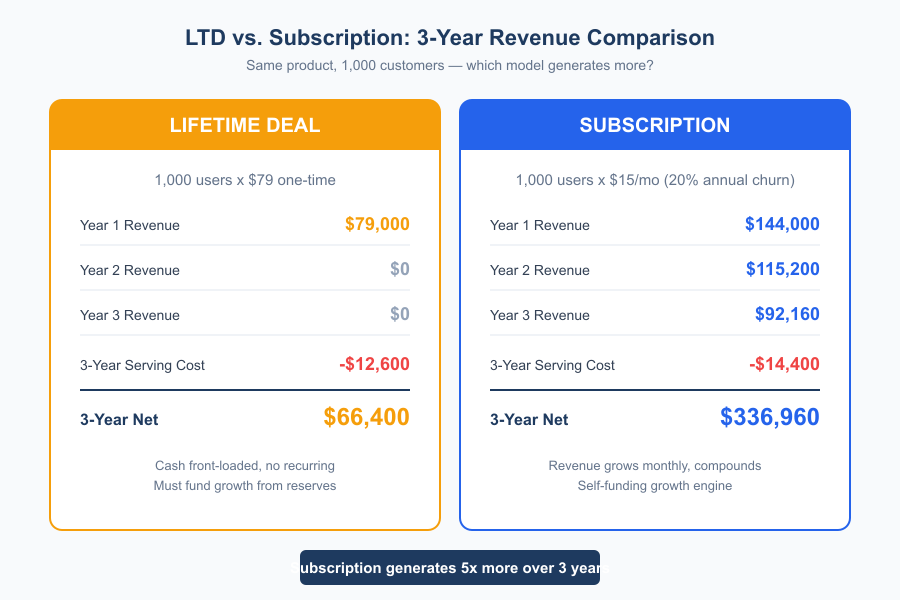
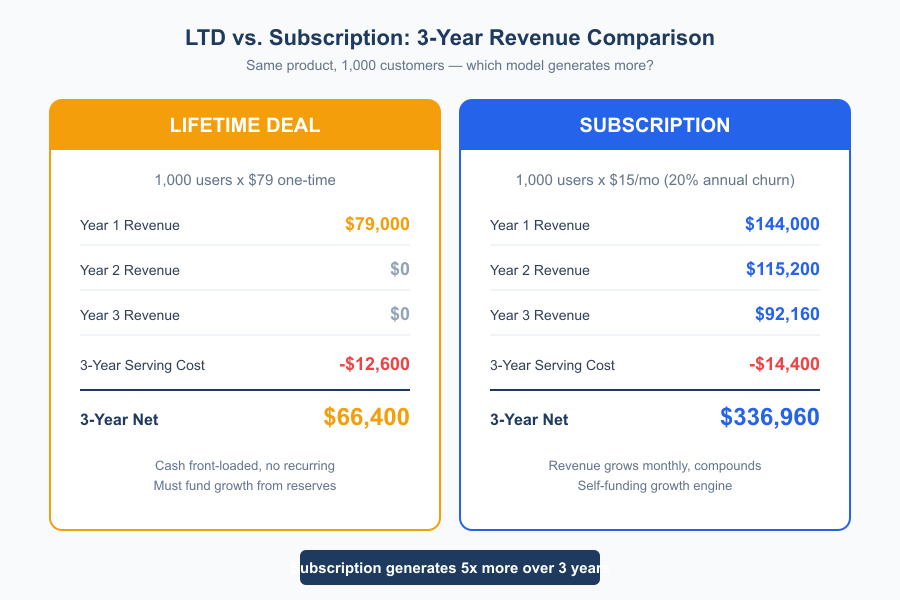
The fundamental question: is the LTD payment greater or less than what you’d earn from this customer over time?
Traditional subscription math:
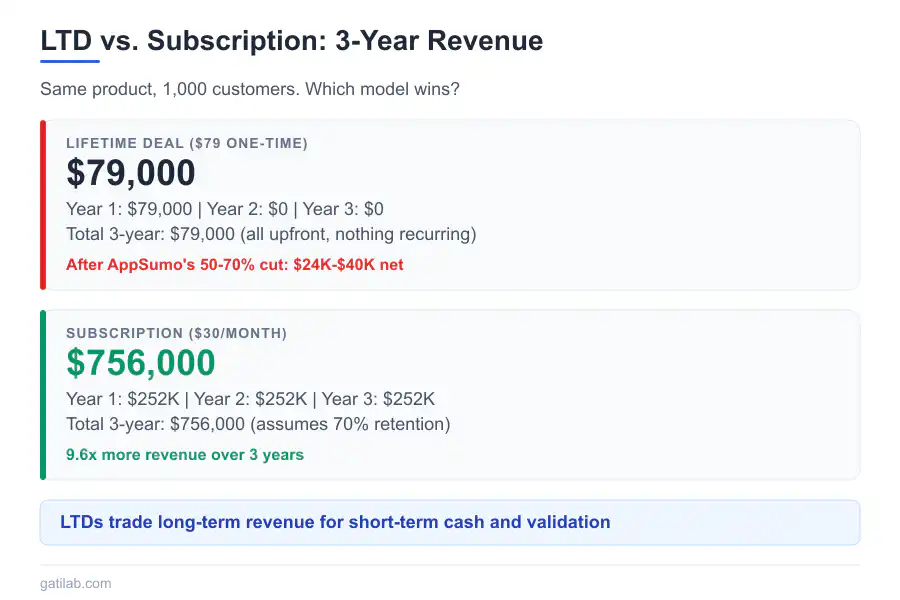
If your SaaS costs $50/month and average customer lifetime is 18 months: Lifetime Value = $50 x 18 = $900
If you sell an LTD for $99 (after platform fees), you’re getting 11% of the lifetime value you’d receive from a full-paying customer. Eleven percent. Let that sink in.
But it’s more complicated than that:
Not everyone who buys an LTD would otherwise become a subscriber. Many LTD buyers would never discover your product, would choose competitors, or simply wouldn’t pay subscription prices. Your customer lifetime might be shorter, revenue recognition faster, and market penetration aided by deal buyers.
The real comparison isn’t LTD revenue vs. subscription revenue from identical customers. It’s LTD revenue vs. the probability-adjusted value of acquiring that customer through other means. And that calculation is much harder to do honestly.
Customer Acquisition Cost Comparison
LTDs are essentially a customer acquisition channel. Compare them to your alternatives.
If you run an LTD on AppSumo:
Gross revenue: $200,000
AppSumo takes: $120,000 (60%)
Net revenue: $80,000
Customers acquired: 2,000
Each customer paid you $40 net
With LTDs, the customer is paying YOU. Your acquisition cost is technically negative because customer acquisition generates immediate revenue. That’s the seductive part.
Compare to paid acquisition:
Facebook ads might cost $150 per trial signup
Of those trials, maybe 10% convert
Effective cost per paying customer: $1,500
LTDs acquire paying customers far more cheaply than paid advertising. But they pay much less over their lifetime. You’re trading lifetime value for acquisition cost efficiency. Whether that trade is worth it depends on what you need right now versus what you’ll need later.
The Cash Flow Trade-off
LTDs trade future revenue for immediate cash. This is the core trade-off, and being honest about it matters.
Subscription model: Receive $50/month over 18 months = $900 over 1.5 years. Revenue is spread out, predictable. Churn reduces actual received revenue. Cash arrives slowly.
LTD model: Receive $99 immediately. All cash upfront. No churn impact on that customer. Immediate capital access.
You get ~$99 now instead of ~$900 over 18 months. Is that trade worth it?
It depends on:
Your discount rate (how much you value present vs. future money)
Your cash needs (do you need capital now to survive?)
Your confidence in customer retention
Your growth plans and funding situation
For a bootstrapped founder needing capital to improve the product, $99 now might genuinely be worth more than a theoretical $900 later that requires 18 months of sustained execution to achieve. For a funded startup with runway? Almost certainly not.
Cost of Serving LTD Customers
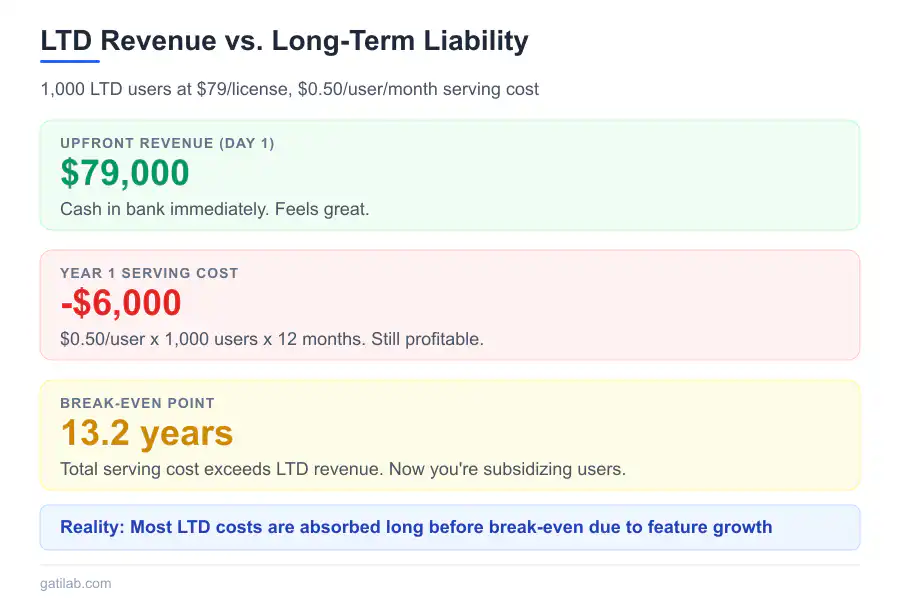
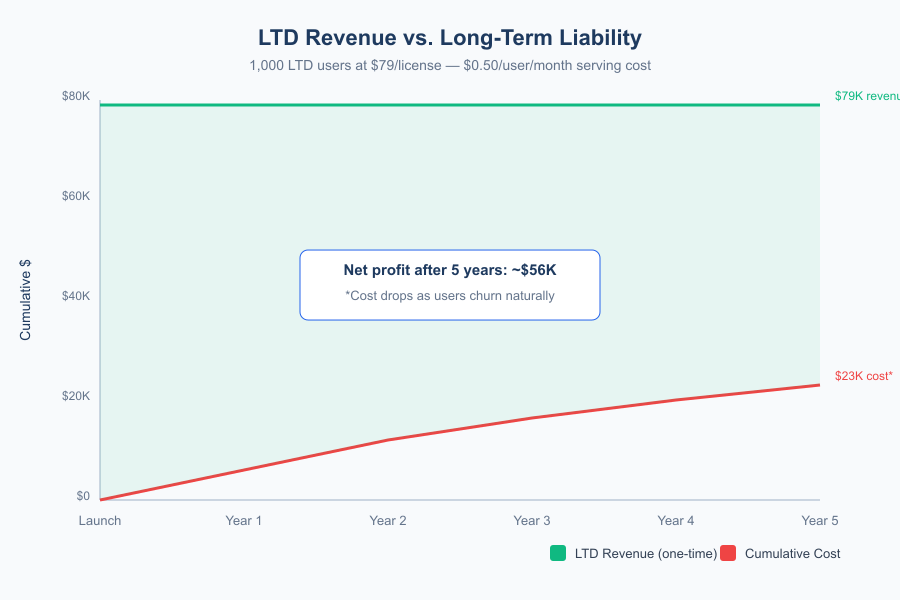
This is where founders get blindsided. LTD customers aren’t free to serve. They cost you:
Infrastructure costs. Server resources, storage, bandwidth, forever, with no ongoing revenue to cover it.
Support costs. LTD customers often need more support due to lower technical sophistication. Forever, with no ongoing revenue.
Feature costs. Product improvements benefit LTD customers who aren’t paying for them.
Here’s the calculation that matters most: what does it cost to serve a user per year? If your cost is $10/year per user and your LTD price is $99, you have about 10 years before you’re underwater. Assuming zero cost inflation. Costs rarely stay flat.
I’ve bought 50+ lifetime deals over 10 years. Eight still active and useful. That’s a 16% long-term success rate. The other 84% either died, degraded, or I never properly used them.
Gaurav Tiwari
When Lifetime Deals Make Sense
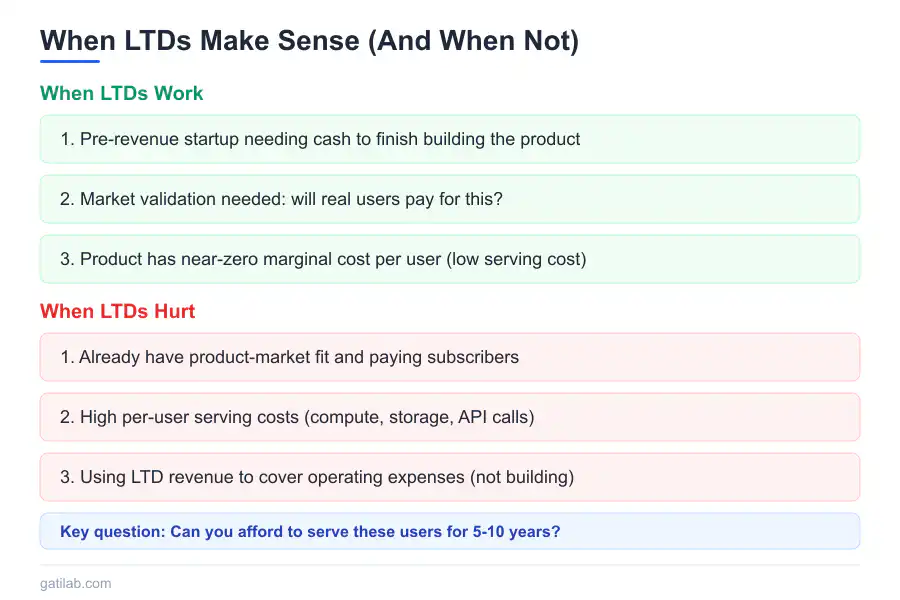
Despite the economics often favoring subscriptions, there are legitimate scenarios where LTDs are strategically sound.
Scenario 1: Validation and Early Traction
Situation: You’ve built an MVP and need to validate that people will pay for it. You have no audience and limited marketing budget.
Why LTD makes sense:
Paying customers (even at discount) validate willingness to pay
User feedback accelerates product development
Some revenue is better than no revenue
Testimonials and case studies for future marketing
Key considerations: Limit the number of LTD licenses sold. Be prepared to learn from feedback and iterate quickly. Plan your transition to full pricing after validation. Don’t mistake LTD demand for full-price demand (this trap catches many founders).
This is using an LTD as a funded beta program. You’re exchanging future revenue for present validation and improvement. That’s a legitimate trade if you go in with eyes open.
Scenario 2: Need for Immediate Capital
Situation: You need cash to fund development, cover runway, or make critical investments. Traditional fundraising isn’t available or desirable.
Why LTD makes sense:
Immediate injection of capital
No dilution (unlike investment)
No debt to repay
Capital comes from people who want your product to succeed
Key considerations: Calculate how much capital you actually need. Structure the LTD to raise that amount, not more. Have a specific plan for how you’ll use the capital. Understand you’re trading future value for present cash.
This is essentially selling future revenue at a discount for present liquidity. Sometimes that trade is smart. Sometimes it’s desperate. Know which one you’re doing.
Scenario 3: Market Share Land Grab
Situation: You’re in a competitive market where user volume and network effects matter. Getting users now is strategically important.
Why LTD makes sense:
Rapidly acquire users before competitors establish dominance
Build network effects if your product has them
Establish market presence and brand recognition
Create switching costs before alternatives emerge
Key considerations: Be sure volume actually matters for your business model. Have a plan to monetize the user base eventually. Don’t confuse LTD users with the market you actually need.
This works when user quantity creates defensibility through network effects, data, or market positioning. Using CRM software to manage these relationships becomes essential at scale.
Scenario 4: Product with Minimal Marginal Costs
Situation: Your product costs virtually nothing to serve additional users. Marginal cost approaches zero.
Why LTD makes sense:
Revenue from LTD customers is nearly pure profit
No infrastructure cost trap
Support burden is manageable
LTD customers don’t crowd out higher-value customers
Information products, one-time utilities, and products with inherent scaling advantages fit this scenario best. If adding a user costs you essentially nothing, the LTD economics look very different than if each user costs $10-15/year to serve.
Scenario 5: Complementary Product Strategy
Situation: Your product is part of a broader ecosystem. LTD users might buy other products or services.
Why LTD makes sense:
Acquire users cheaply for upselling
Build audience for future products
Create ecosystem lock-in
Lifetime deal works as a loss leader
This is using LTDs as a customer acquisition channel for other revenue streams. For example, a blogging platform might offer an LTD to acquire users who later purchase premium themes or services. The LTD itself doesn’t need to be profitable if it feeds a profitable funnel.
When Lifetime Deals Are Dangerous
Just as there are legitimate scenarios, there are situations where LTDs are genuinely harmful. I’ve seen all of these play out.
You’re already profitable and growing. You have high marginal costs per user. Your target customers are enterprises. Your product is still evolving significantly. Your exit strategy depends on recurring revenue metrics. Any one of these should make you pause. Multiple should make you stop.
Scenario 1: Sustainable Business Without Capital Needs
If your business is growing profitably and you don’t need immediate capital, an LTD is giving away revenue you’d otherwise capture. Discounting signals uncertainty about value. LTD customers dilute your paying customer base. You’re optimizing for the wrong metric.
If you can acquire paying customers through other channels, why acquire cheaper ones that cost almost as much to serve?
Scenario 2: High Marginal Costs
If each user costs you significant ongoing resources (computing, storage, API costs, support), LTD revenue might not cover lifetime serving costs. Your infrastructure costs grow without corresponding revenue. Success might actually hurt you.
The math here can be brutal. If it costs you $15/year to serve a user and you sold them a $99 LTD, you’re underwater in 7 years. And infrastructure costs tend to rise, not fall.
Scenario 3: Enterprise-Focused Products
Your product targets enterprises with large contracts, custom needs, and long sales cycles. LTD buyers are almost by definition not your target market. You’ll spend resources on non-target users. Product development gets pulled toward deal-seeker needs instead of enterprise needs. Positioning gets confused.
Enterprise products need enterprise customers. LTDs attract the opposite.
Scenario 4: Product Still Evolving Significantly
You’re still figuring out the product. Core features will change significantly based on what you learn. LTD buyers lock in expectations based on current features. Product pivots alienate them. You can’t take back features without backlash.
This is subtly different from the validation scenario. If you’re using LTDs to validate, you’re prepared to pivot. If you’ve sold LTDs expecting continuity and then need to pivot, you have angry customers and a PR problem.
Scenario 5: Building for Acquisition
Your goal is to build the company to sell. Acquirers care deeply about metrics like MRR, LTV, and growth rates. LTD revenue doesn’t count as MRR. LTV is compressed by definition. LTD customer base is a liability, not an asset.
If your exit strategy depends on recurring revenue metrics, LTDs directly undermine that strategy. Tracking these metrics in accounting software should clearly separate LTD revenue from recurring revenue so you’re never fooling yourself.
Pricing and Structuring Your Lifetime Deal
If you decide to proceed, structuring matters enormously. Get this wrong and even a smart LTD strategy fails.
Pricing Strategy
Multiple of monthly price: Common: 10-24x monthly price. $30/month product becomes a $300-720 LTD. Simple to communicate and understand.
Based on average customer lifetime: If average customer stays 14 months at $30 = $420. Price LTD at 25-50% of that = $105-210. Ensures you’re not losing money on average.
Based on deal platform norms: AppSumo deals cluster around $49-$199. Price for the platform’s audience expectations. Higher prices need more justification on these platforms.
Based on your goals: Need $100K capital? How many deals at what price achieves this? Want 500 users maximum? Price higher to limit quantity. Goal is maximum users? Price lower.
Tiering Your LTD
Multiple tiers capture different willingness to pay.
Common tier structure:
Tier 1: Basic features, limited capacity ($49)
Tier 2: More features, more capacity ($99)
Tier 3: Full features, unlimited ($199)
Stacking: Many deals allow buying multiple codes that “stack” for additional features or capacity. This increases revenue per buyer and works well for power users who want more.
Limiting Your LTD
This is critical. Unlimited LTDs create unlimited risk.
Quantity limits: “Only 500 LTD licenses available.” Creates urgency and scarcity. Caps your risk exposure. Can always do another round if desired.
Time limits: “LTD available for 2 weeks only.” Natural constraint on deal size. Enables clear messaging.
Feature limits: “LTD includes features as of April 3, 2026.” New features may require upgrade. Protects future development costs. Needs careful communication.
Usage limits: Bandwidth, storage, team size limits. Aligns cost with heavy usage. Prevents infrastructure abuse.
Terms and Conditions
Clear terms protect you and set appropriate expectations.
Essential terms to define:
What “lifetime” means (product life, specific term, etc.)
What features are included (now and in future)
What happens if product pivots significantly
Refund policy and timeline
Support level for LTD customers
Transferability of licenses
Don’t over-restrict, though. Excessive limitations create customer resentment and support burden. Find the balance between protecting yourself and delivering real value.
Managing LTD Customer Experience
LTD customers present unique management challenges. Here’s what I’ve seen work.
Setting Expectations
Clear expectations from the start reduce problems later. What LTD customers should know:
They’re supporting an early-stage product
Features will evolve
Support priority may differ from full-paying subscribers
Their feedback matters and will be heard
Frame the LTD as a partnership, not just a transaction. The customers who understand this become your biggest advocates.
Support Considerations
LTD customers often need more support while generating less revenue. This is the most common operational surprise founders report.
Strategies:
Create excellent documentation and self-service resources
Build community support (users helping users)
Define support levels clearly (email only, no phone, etc.)
Set response time expectations appropriately
Consider tiered support (LTD vs. premium)
Don’t let LTD support burden crowd out paying customer support. That’s how you lose your best revenue while servicing your cheapest.
Handling LTD Customer Complaints
LTD communities can be vocal. Prepare for this.
Common complaints:
Features promised but not delivered yet
Development slower than expected
New features not included in LTD
Product direction changing from what they bought
Response approach: Acknowledge concerns genuinely. Explain your perspective and constraints. Find reasonable accommodations where possible. Be firm but kind when accommodations aren’t possible. Don’t let the loudest voices dictate your product strategy.
Some LTD customers will never be satisfied. Don’t let them consume disproportionate attention. That’s a trap I’ve seen pull entire teams off productive work.
After the LTD: What Comes Next
The LTD is a phase, not an end state. Plan what follows.
Transitioning to Full Pricing
After your LTD window, you need sustainable pricing.
Clearly end LTD availability (and mean it)
Announce regular pricing
Consider “early adopter” pricing for those who just missed the LTD
Be firm about the transition
Don’t keep extending LTDs indefinitely. That’s not an LTD. That’s your actual price. And it’s probably too low.
Converting LTD Customers to Higher Tiers
Some LTD customers will want more than their deal provides.
Conversion opportunities:
Additional seats or capacity
Premium features not in LTD
Priority support
Add-on products
Services and consulting
Fair conversion pricing: Don’t punish LTD customers with excessive prices. Don’t give away so much that they never pay more. Find upgrades that feel like genuine value.
Tracking LTD Economics Long-Term
Continue monitoring whether your LTD made sense.
Track:
Cost to serve LTD customers over time
LTD customer engagement (are they actually using the product?)
Support burden from LTD customers vs. paying customers
Conversion of LTD customers to other revenue streams
Whether LTD customers become advocates who refer paying customers
This data tells you whether you’d do another LTD and how to price it if you did.
Case Studies: LTDs That Worked and Didn’t
Successful LTD Strategy
Company: Early-stage design tool. Situation: Built MVP, needed validation and capital for development.
Strategy: Ran AppSumo deal at $69/license, capped at 2,000 licenses. Gross revenue: ~$180,000. Net revenue (after AppSumo): ~$63,000. Acquired 2,000 users for feedback.
Outcome: Capital funded 6 months of development. User feedback dramatically improved product. 15% of LTD users upgraded to team plans later. Built testimonials and case studies. Successfully raised seed funding 8 months later.
Why it worked: Clear capital need with specific use. Limited exposure through caps. Used feedback to genuinely improve the product. Had a plan for post-LTD growth.
Problematic LTD Strategy
Company: Analytics platform with significant infrastructure costs. Situation: Wanted to accelerate growth, saw competitors doing LTDs.
Strategy: Ran unlimited LTD at $99/license. No caps or limitations. Sold 10,000+ licenses. Gross revenue: ~$1,000,000.
Outcome: Infrastructure costs rose dramatically with usage. Support burden overwhelmed small team. LTD customers demanded features misaligned with roadmap. Couldn’t afford to serve all users properly. Eventually had to shut down, angering LTD customers.
Why it failed: High marginal costs not accounted for. No limits on deal size. Support requirements massively underestimated. No sustainable path post-LTD. The million dollars in revenue looked great until the cost of serving those users exceeded it within two years.
Alternatives to Lifetime Deals
If LTDs don’t fit your situation, consider these alternatives.
Extended Trials
Offer 30-60-90 day full-feature trials. Users experience full value without permanent revenue sacrifice. Better signal of willingness to pay at full price.
Annual Plans with Significant Discounts
Pay annually, get 40-50% off monthly pricing. Cash upfront without permanent discount. Revenue still recurring, just less frequent. First year special pricing for early adopters works well.
Founder Plans
“Founding member” pricing locked in for 2-3 years, not perpetually. 50% off for the first 2 years, then regular pricing. Rewards early supporters without permanent sacrifice. Has a clear end date.
Equity Crowdfunding
If you need capital, consider taking investment rather than selling lifetime access. Platforms like Republic and Wefunder enable small investors. Capital without revenue sacrifice. Different regulatory requirements to consider.
Using email marketing to communicate these alternatives can help test demand before committing to any approach.
Decision Framework: Should You Run a Lifetime Deal?
Cons
Pros
The Bottom Line
Lifetime deals are neither universally good nor universally bad. They’re a tool with specific use cases and significant trade-offs. The founders who succeed with LTDs understand the economics clearly, structure deals to limit risk, use the capital and users strategically, and have plans for sustainable growth afterward. Before running one, do the math. If you skip the analysis and just chase the revenue number, you might build a trap instead of a business.
The founders who get burned rush into them without understanding costs, fail to limit exposure, acquire users they can’t afford to serve, and have no path to sustainable economics.
Before running a lifetime deal, do the math. Understand your true costs per user. Define your strategic goals. Structure with hard limits. Plan your exit from LTD mode.
If you do all that and the numbers work? An LTD can genuinely accelerate your business. If you skip the analysis and just chase the revenue number, you might build a trap instead of a business. I’ve seen it go both ways. The difference is almost always in understanding the economics of lifetime deals before you commit.
The LTD Decision in One Sentence
If you can cap exposure, know your cost per user, and have a clear plan for transitioning to sustainable revenue afterward, an LTD can work. If you can’t answer any of those three questions, don’t do it.
Lifetime Deals FAQ
Frequently Asked Questions
What is a lifetime deal in SaaS and how does it work?
A lifetime deal (LTD) is a one-time payment that grants permanent access to a software product, replacing the typical monthly or annual subscription. Buyers pay once (usually $49-299) and get the product forever. Founders use LTDs to generate quick cash, validate products, and build an early user base. The economics depend heavily on how long users actually stay and what serving them costs over time.
Are lifetime deals good or bad for SaaS founders?
Both views contain truth. LTDs provide immediate cash flow, market validation, and early users who generate feedback and word-of-mouth. But they also create long-term liabilities since you must serve users forever on a one-time payment. The math works if your marginal cost per user is very low and you use LTD revenue to fund growth toward a sustainable subscription model. It breaks if LTD users become a permanent cost center.
How much revenue can you realistically expect from a lifetime deal launch?
Revenue varies enormously based on platform, product category, and pricing. AppSumo launches typically generate $50K-500K for products with strong appeal. Smaller platforms produce less. A well-positioned product at $59-79 per LTD license selling 1,000-5,000 units can generate $59K-395K in a compressed timeframe. But remember: that money needs to cover serving those users for years, not just months.
What percentage of lifetime deal buyers actually use the product long-term?
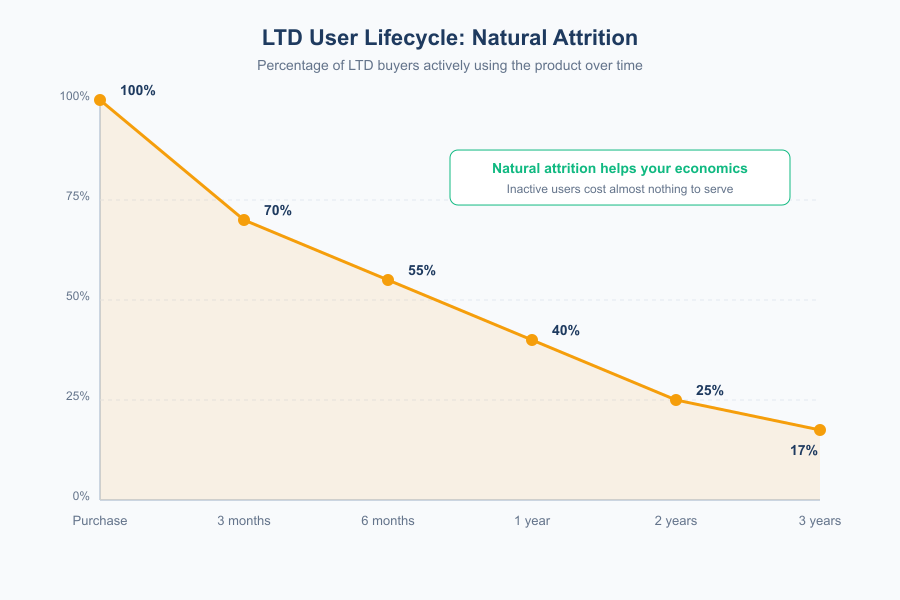
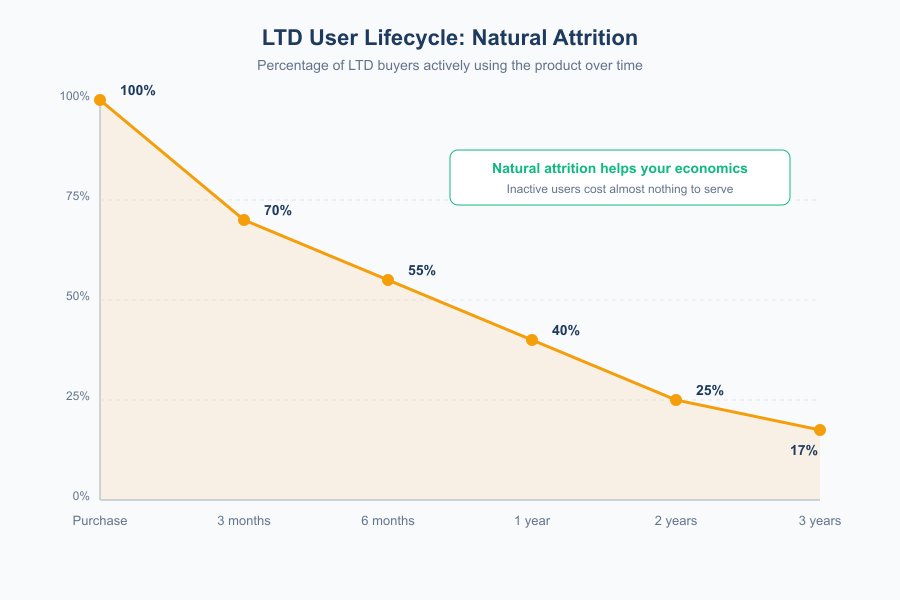
Industry data suggests 30-50% of LTD buyers become active users in the first year, and that drops to 15-25% by year three. Many LTD buyers are deal collectors who purchase heavily discounted software but never integrate it into their workflow. This natural attrition actually helps your economics since inactive users cost very little to serve, especially for products with usage-based infrastructure costs.
When should a SaaS founder consider running a lifetime deal?
LTDs make sense when you need cash to fund development, want rapid user acquisition for feedback, have very low marginal costs per user, and plan to transition to subscriptions within 12-18 months. They work best for early-stage products that need validation and momentum. LTDs don’t make sense if your product has high per-user costs, if you have no plan to transition to recurring revenue, or if the cash would just delay inevitable failure.
How do you structure a lifetime deal to minimize long-term risk?
Cap the number of LTD licenses sold to limit your long-term liability. Set clear feature boundaries so LTD users get the current product but not every future feature. Include fair-use policies on resource consumption. Price high enough that the revenue meaningfully funds development. And most importantly, have a written plan for transitioning to subscription pricing after the LTD window closes.
What is the difference between lifetime deals on AppSumo versus self-hosted deals?
AppSumo takes a significant revenue share (typically 30-50%) but provides massive distribution to their buyer base of deal-hunters. Self-hosted deals keep 100% of revenue but require you to drive all the traffic yourself. AppSumo works better for unknown products that need exposure. Self-hosted works better when you already have an audience or can generate traffic through content and partnerships.
Can you transition from lifetime deal pricing to subscription pricing successfully?
Yes, but it requires careful handling. Honor all existing LTD commitments. Launch subscriptions for new users only. Optionally offer LTD users special upgrade paths to premium tiers. The transition works when LTD users see you’ve invested their money into building a better product. It fails when LTD users feel abandoned or when the subscription product doesn’t deliver enough value over what they already paid for.