
Recurring Revenue for Solo Developers: 5 Business Models
Project-based work is a treadmill. You finish a site, get paid, and immediately need another client. The income roller coaster, feast during projects, famine between them, makes planning impossible and stress inevitable. Every month starts at zero.
I lived this cycle for years. Some months I’d earn $12,000. The next month? $2,000. The anxiety of never knowing what’s coming next was worse than the bad months themselves.
Recurring revenue changes everything. Wake up on the first of the month already knowing a significant portion of your income is secured. Plan expenses, take vacations, make investments… all because predictable money shows up predictably. For a deeper look at recurring models, see the guide on building a retainer-based business model.
For solo WordPress developers, recurring revenue isn’t just a nice-to-have. It’s the foundation of a sustainable business. Here’s how to build it.
The Case for Recurring Revenue
Numbers illustrate the difference better than any argument I can make.
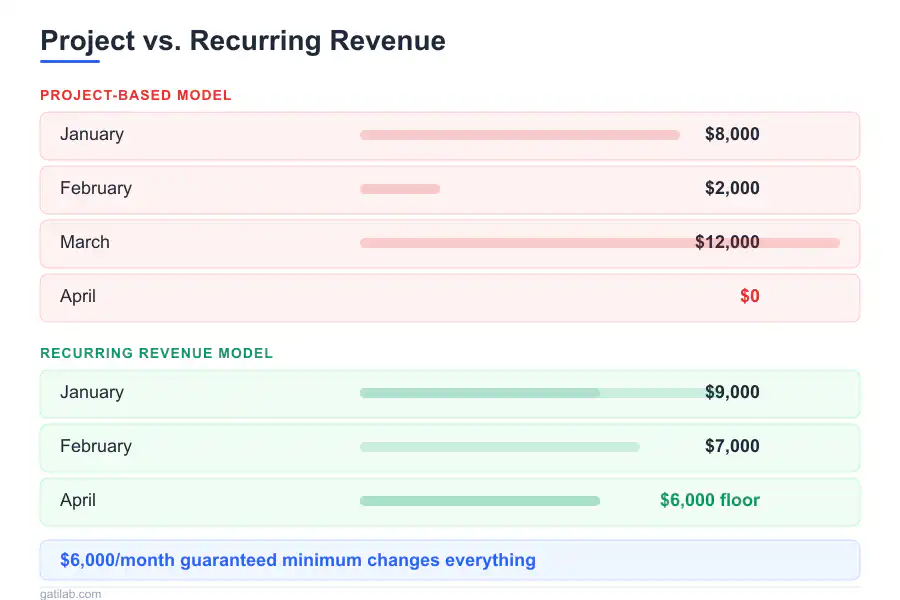
Project-based model:
January: $8,000 (one project)
February: $2,000 (small fixes)
March: $12,000 (two projects)
April: $0 (gap between projects)
May: $6,000 (one project)
Average: $5,600/month
Predictability: Zero
Recurring revenue model:
Monthly recurring: $6,000
January: $6,000 + $3,000 project = $9,000
February: $6,000 + $1,000 fixes = $7,000
March: $6,000 + $4,000 project = $10,000
April: $6,000 + $0 project = $6,000
May: $6,000 + $2,000 project = $8,000
Average: $8,000/month
Minimum guaranteed: $6,000/month
Same clients, roughly same work, but completely different experience. That $6,000 floor changed my entire relationship with money. I stopped waking up anxious about pipeline. I stopped taking bad projects out of fear.
Why recurring matters:
Financial stability allows:
- Saying no to bad projects (because you can afford to)
- Taking time off without income panic
- Investing in your business
- Planning beyond next month
Mental clarity from:
- Knowing bills are covered before you do anything
- Reduced sales pressure
- Focusing on quality over volume
- Long-term thinking instead of month-to-month survival
Maintenance and Care Plans
The most common WordPress recurring revenue model. And honestly? The easiest to sell because clients already understand why they need it.
What’s included typically:
- WordPress core updates
- Plugin and theme updates
- Security monitoring
- Regular backups
- Uptime monitoring
- Monthly reporting
- Limited support hours (2-4 hours)
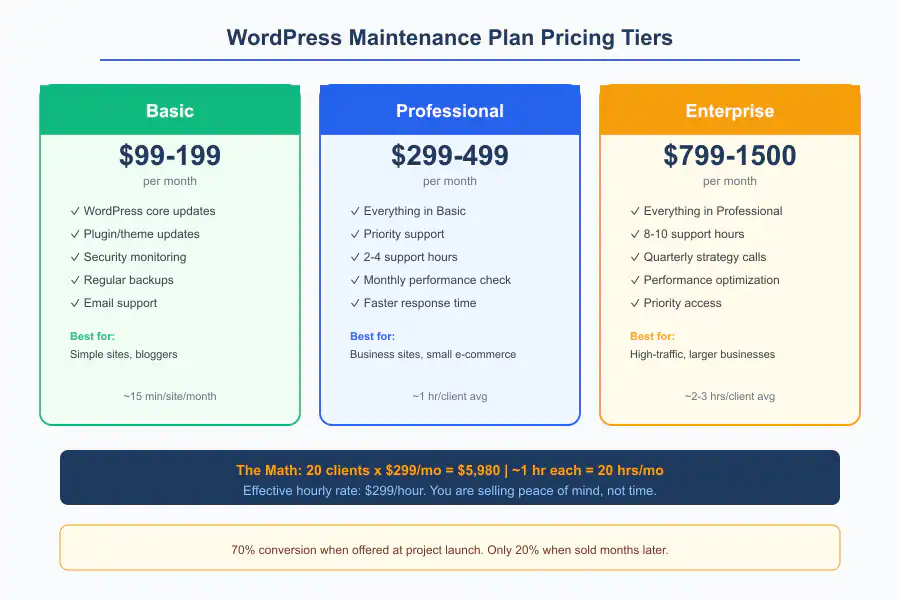
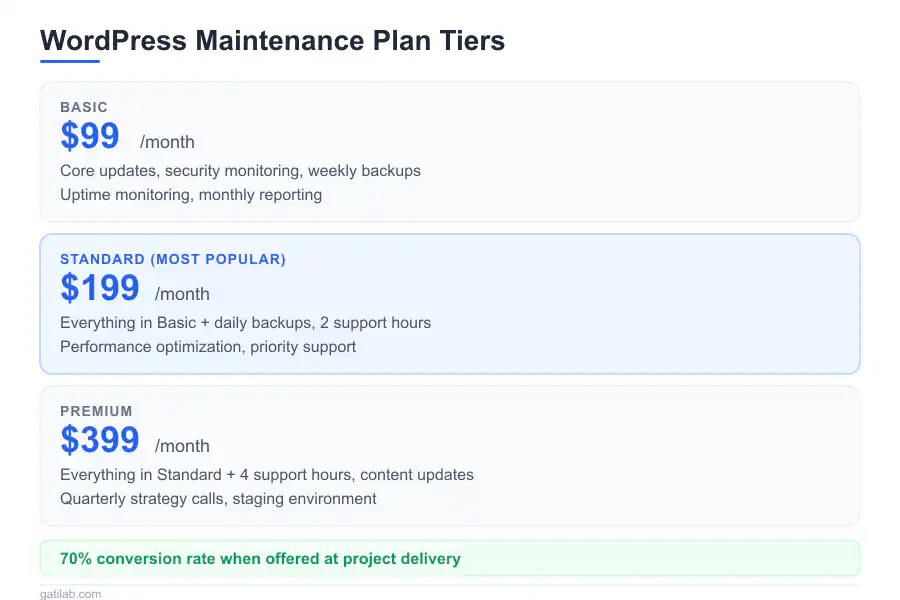
Pricing tiers:
For help structuring your pricing, see the guide on how to price your services.
Basic ($99-199/month):
- Updates and backups
- Security monitoring
- Email support
- Best for: Simple sites, bloggers
Professional ($299-499/month):
- Everything in Basic
- Priority support
- Faster response time
- Included support hours (2-4)
- Monthly performance check
- Best for: Business sites, small e-commerce
Enterprise ($799-1500/month):
- Everything in Professional
- More support hours (8-10)
- Quarterly strategy calls
- Performance optimization
- Priority access
- Best for: High-traffic sites, larger businesses
What makes maintenance profitable:
- Updates take 15-30 minutes per site
- Monitoring is automated
- Support hours often go unused
- One process serves many clients
The math:
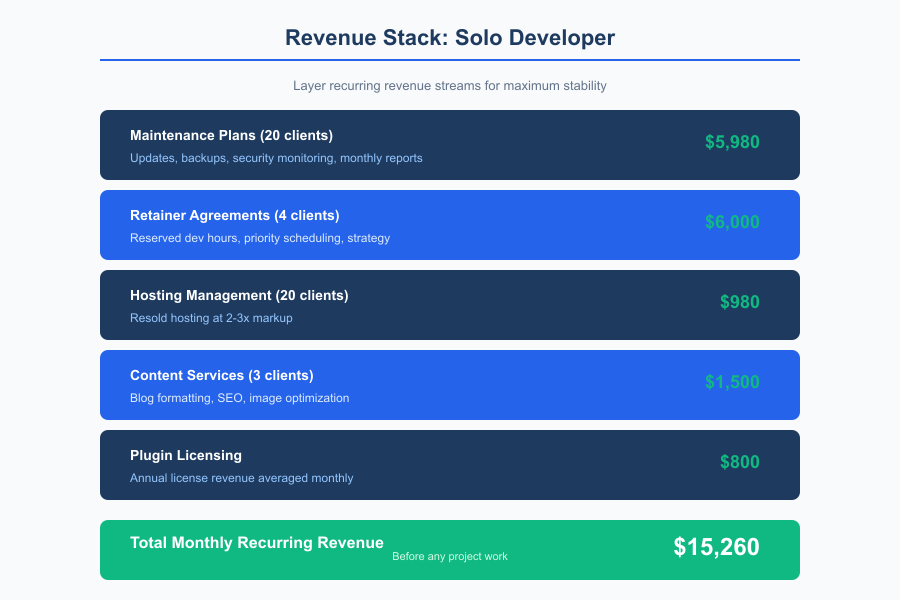
20 clients x $299/month = $5,980/month
Time per client: ~1 hour average
Total time: 20 hours/month
Effective hourly rate: $299/hour
Read that last line again. $299/hour. That’s the power of productized services. You’re not selling time. You’re selling peace of mind.
Retainer Agreements
Ongoing development relationships beyond maintenance. This is where the real money lives for solo developers.
What retainers cover:
- Reserved development hours
- Priority scheduling
- Strategic consultation
- Ongoing improvements
- New feature development
Retainer structures:
Hours-based:
10 hours/month at $150/hour = $1,500/month
Unused hours expire (or roll over limited amount)
Additional hours available at standard rate
Value-based:
$2,500/month for ongoing development partnership
Includes strategy calls, priority access, reasonable development
Major projects quoted separately
I prefer value-based retainers. They remove the clock-watching dynamic and let me focus on outcomes instead of tracking every 15-minute increment. Clients prefer them too because they don’t feel like they’re being nickel-and-dimed.
Best retainer clients:
- Completed a project with you (proven relationship)
- Active businesses that need regular changes
- Value speed and reliability over lowest cost
- Have budget for ongoing investment
Retainer vs maintenance:
Maintenance is operational (keeping things running). Retainers are developmental (making things better). Some clients need both. Charge for both. These are fundamentally different services, and treating them that way in your pricing helps clients understand the value of each.
Hosting and Infrastructure
Becoming the technical backbone for clients. This is lower-margin but extremely sticky revenue.
Managed hosting reselling:
- Partner with hosting providers (Cloudways, WP Engine, Flywheel)
- Resell at markup (2-3x is common)
- Bundle with maintenance for simplicity
Example:
Hosting cost to you: $30/month
Price to client: $79/month (bundled with maintenance)
Or: $99/month standalone with your support layer
Why clients pay premium:
- Single point of contact for all technical issues
- Your expertise managing their hosting
- No need to understand hosting themselves
- Included in one simple monthly payment
Infrastructure beyond hosting:
The hidden revenue:
Small margins on many clients add up fast:
20 clients x $49/month hosting margin = $980/month
Minimal additional work (hosting provider handles heavy lifting)
That’s almost $12,000 a year from hosting margins alone. Not life-changing on its own, but layered on top of maintenance and retainers? It compounds. Using CRM software helps track all these recurring relationships effectively.
Plugin and Tool Licensing
Managing software for clients. Small revenue, but it adds friction to leaving you. That stickiness has real value.
What you can manage:
- Premium plugin licenses (ACF Pro, Gravity Forms, etc.)
- Theme licenses
- Security tools (Sucuri, Wordfence premium)
- Performance tools
Two approaches:
Agency licensing:
Buy agency licenses, deploy across client sites, include in maintenance fee.
ACF Pro: $49/year for unlimited sites
Your cost per client: ~$2.50/year
Included in $299/month maintenance
License management service:
"We manage all your WordPress plugin licenses for $50/month"
Includes renewals, updates, compatibility checking
Client pays you instead of tracking 10 different subscriptions
This might sound trivial, but clients love not having to think about plugin renewals. It’s one more reason they stay.
Content and Marketing Services
Adjacent services that complement development. If you’re already managing a client’s WordPress site, you’re in the perfect position to handle their content too.
Monthly content retainers:
- Blog post publishing and formatting
- Content updates and revisions
- Image optimization and upload
- SEO adjustments
Why developers offer this:
- Clients need it done and you already know their site
- Natural extension of maintenance
- Higher touch equals stickier relationship
- Often the easiest sell after a client trusts your technical work
See the guide on WordPress freelancing for more on combining content services with development.
Content service example:
$500/month includes:
- 4 blog posts formatted and published
- Image optimization
- Internal linking
- Basic on-page SEO
Marketing-adjacent services:
- Monthly analytics reporting
- Conversion optimization tweaks
- A/B testing management
- Email template updates
Building a Product
The ultimate recurring revenue: software. This is harder than services, but the leverage is unmatched.
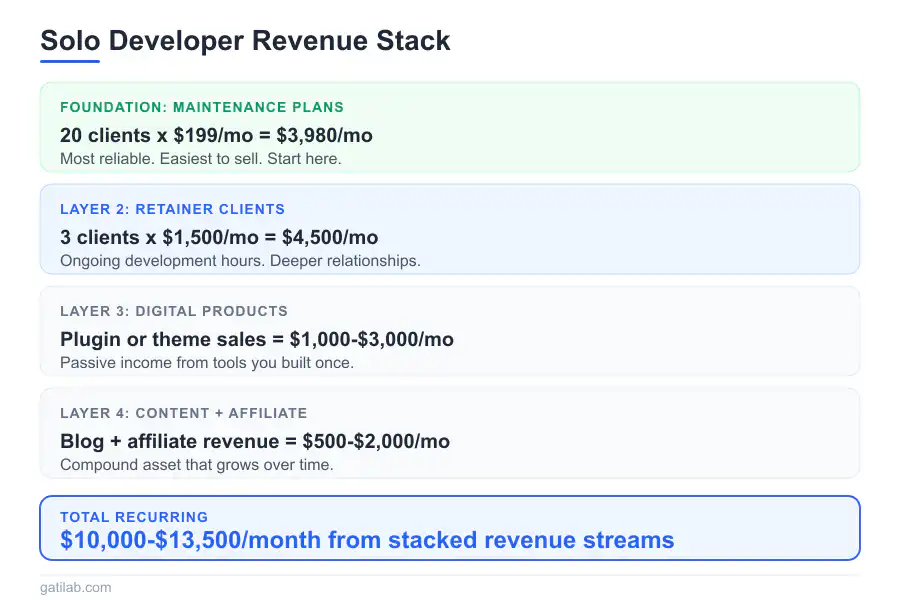
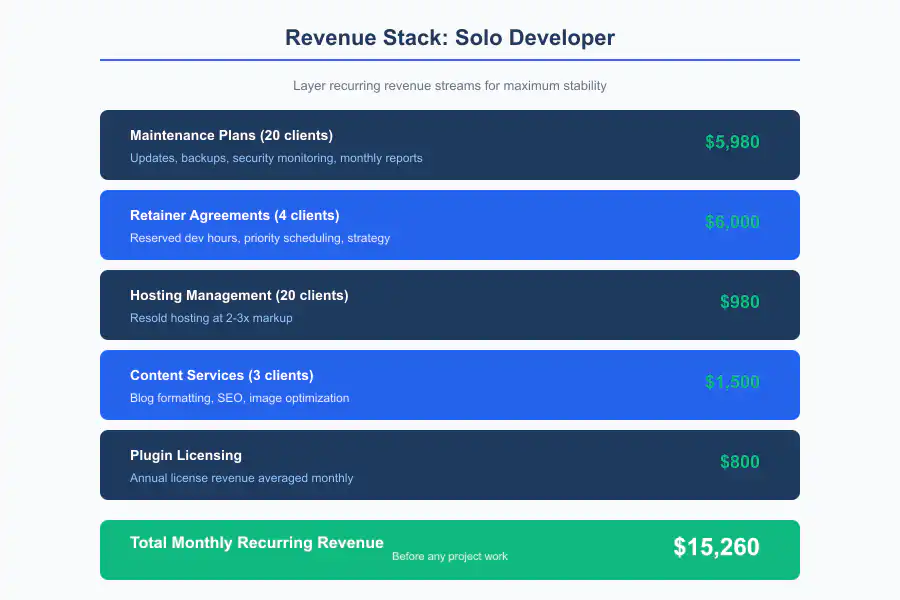
Plugin development:
- Solve a problem you see repeatedly across client sites
- Build once, sell many times
- Annual license model
- Updates and support included
WordPress product ideas:
- Niche-specific plugins (real estate, restaurants, etc.)
- Admin tools for agencies
- Integration plugins
- Reporting tools
I built my first plugin because I was solving the same problem on every client site. Seemed wasteful to keep rebuilding from scratch. Now it runs on thousands of sites and generates revenue without me touching it most months.
Product reality check:
- Significant upfront investment (100-300+ hours)
- Ongoing support obligation
- Marketing is a separate skill entirely
- Competition from free alternatives is real
Hybrid approach:
Build a simple plugin for your own use, then:
- Use it across client sites (immediate value)
- Offer it to similar clients (limited market)
- Eventually sell publicly if it proves valuable
This path reduces risk because you’re building something useful before it needs to be marketable.
Why products work for solo developers:
- Income while you’re not working
- Scales without proportional time
- Demonstrates expertise
- Provides marketing content and credibility
Selling Recurring Services
Getting clients to commit monthly. This is where the rubber meets the road.
Timing matters:
The best time to sell maintenance is immediately after launching a project. The site is fresh in their mind, they understand its complexity, and they’re already spending money. I close about 70% of maintenance plans at project launch. After launch? Maybe 20%.
The launch conversation:
“Your site is live and working great. To keep it that way, secure, updated, performing well, I recommend a care plan. Most clients choose the Professional tier at $299/month. It includes…”
Bundling increases uptake:
“The project price is $8,000 for development. I also offer a care plan for ongoing maintenance at $299/month. If you commit to the care plan today, I’ll include the first three months free with the project.”
Three free months costs you very little (updates take 15 minutes) but anchors the client into the recurring relationship. Most don’t cancel after three months because they’ve gotten used to the safety net.
Framing the value:
- Not “paying for updates” but “protecting your investment”
- Not “hourly support” but “priority access when you need help”
- Not “monthly expense” but “predictable budget instead of surprise repair bills”
Overcoming objections:
“We can update WordPress ourselves.”
“You could, but updates sometimes break things. When that happens at 2am, you’ll be glad someone is monitoring and can fix it immediately. I’ve seen client sites go down for days because an update broke a plugin conflict nobody caught.”
“That seems expensive for just updates.”
“Updates are part of it, but you’re really paying for the monitoring, security, backups, and knowing someone’s responsible. Plus the support hours give you access for questions and small changes without a separate invoice every time.”
“Can we just call you when we need something?”
“Absolutely, at my hourly rate of $175. Most clients find the care plan more economical. You get predictable monthly costs instead of unpredictable invoices, plus proactive maintenance that prevents expensive emergencies.”
Managing Recurring Client Relationships
Keeping clients long-term is where recurring revenue goes from good to great. A client who stays for 3 years at $299/month is worth over $10,000. Keep that in mind with every interaction.
Monthly touchpoints:
- Send reports (even if automated, they show you’re working)
- Proactive communication about updates performed
- Check in beyond just invoicing
- Share relevant tips about their industry or technology
Annual reviews:
- Schedule yearly strategy calls
- Review site performance
- Discuss their goals for next year
- Opportunity to adjust pricing and scope
I do annual reviews with every recurring client. It’s the single best retention tool I have. The client feels heard. I learn about their upcoming needs. And it’s a natural moment to introduce new services or adjust pricing.
Preventing churn:
- Deliver consistent value every single month
- Respond quickly when contacted (same day minimum)
- Be proactive about problems before they call you
- Make them feel taken care of, not just managed
Recognizing churn signals:
- Support requests drop to zero (they’ve disengaged)
- Delayed payments begin
- Business changes (sale, pivot, downturn)
- Asking for contract details or cancellation policy
Addressing concerns proactively:
If a client seems disengaged, reach out: “I noticed we haven’t connected in a while. Is everything running smoothly? Any upcoming projects or changes I should know about?”
That one email has saved me at least a dozen client relationships over the years.
Growing Recurring Revenue
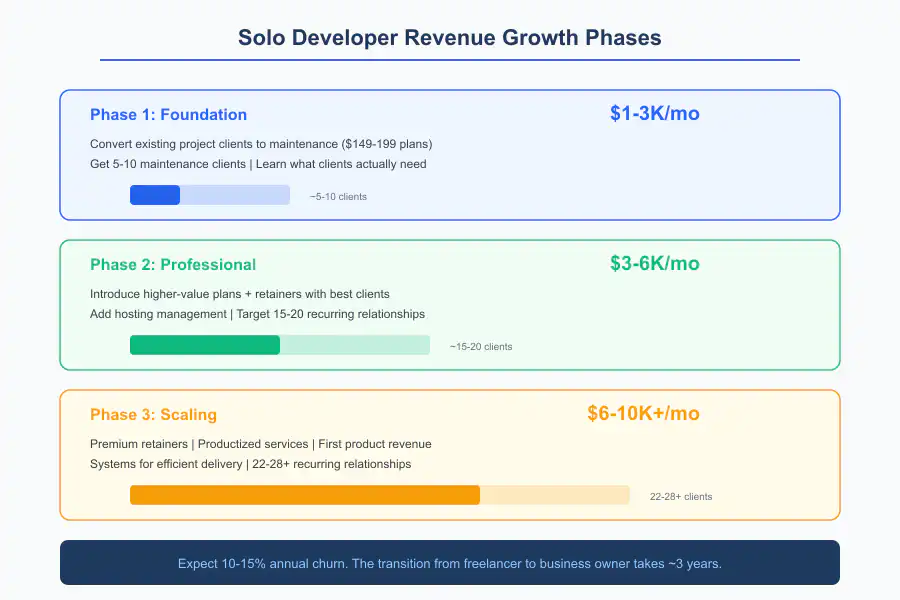
From a few hundred to a few thousand per month. Here’s the trajectory I followed.
Phase 1: Foundation ($1,000-3,000/month)
- Convert existing project clients to maintenance
- Start with simple $149-199 plans
- Get 5-10 maintenance clients
- Learn what clients actually need and use
Phase 2: Professional tier ($3,000-6,000/month)
- Introduce higher-value plans
- Add retainer relationships with your best clients
- Include hosting management
- Target 15-20 recurring relationships
Phase 3: Scaling ($6,000-10,000+/month)
- Premium retainers with best clients
- Productized services with clear deliverables
- Systems for efficient delivery
- Possibly first product revenue
The compounding effect:
Each project becomes a potential recurring client. Over years, this compounds:
- Year 1: 8 recurring clients
- Year 2: 15 recurring clients
- Year 3: 22 recurring clients
- Year 4: 28 recurring clients
Some churn happens. Expect 10-15% annually. But net growth continues if you’re delivering real value and closing new recurring relationships faster than you lose them.
Breaking the project addiction:
As recurring revenue grows, you become less dependent on new projects. This lets you:
- Be more selective about which projects you take
- Charge premium prices because you’re not desperate
- Take real breaks between projects
- Focus on quality over volume
This is the transition from freelancer to business owner. It doesn’t happen overnight. For me, it took about three years to get recurring revenue above 50% of my total income. But once it crosses that threshold? Everything changes. The stress drops. The quality rises. The clients improve.
Recurring revenue is the path from freelancer to business owner. Build it deliberately, deliver consistently, and watch your stress decrease as your stability increases. For more on the tools that make this work, check out must-have tools for freelancers.
Recurring Revenue FAQ
Frequently Asked Questions
How much recurring revenue should a solo developer aim for?
Target covering 50-70% of your base monthly expenses with recurring revenue. If you need $8,000 per month, aim for $4,000-5,600 in recurring income. This creates stability while leaving room for project work. Some developers push to 80% or more recurring, but too much can mean less interesting project variety. The key is having a floor that covers your bills so project revenue becomes growth rather than survival.
What should a WordPress maintenance plan include?
Core elements: WordPress core, plugin, and theme updates, security monitoring, regular backups, uptime monitoring, and monthly reporting. Higher tiers add priority support, included support hours of 2-4 hours, performance optimization, and quarterly strategy calls. Never include unlimited development as that is unsustainable. Define clearly what counts as maintenance versus new development work to prevent scope creep.
How should I price WordPress maintenance plans?
Three typical tiers: Basic at $99-199 per month for updates, backups, and email support. Professional at $299-499 per month including priority support and 2-4 included hours. Enterprise at $799-1500 per month with 8-10 hours, strategy calls, and performance optimization. With 20 clients at $299 per month, you earn $5,980 monthly while spending roughly 1 hour per client, yielding an effective rate of $299 per hour.
When is the best time to sell maintenance plans?
Immediately after launching a project. The client understands the site complexity, trusts your work, and is already in spending mode. Conversion rates at project launch are around 70% compared to about 20% when selling months later. Include maintenance discussion in your project proposal from the start. Offering three free months bundled with the project anchors clients into the recurring relationship at minimal cost to you.
Should retainer hours roll over to the next month?
Generally no, or limit rollover to one month maximum. Unlimited rollover creates liability. A client could bank 30 hours and then demand a project completed using their hours, which disrupts your capacity planning entirely. If clients consistently do not use their hours, discuss reducing their plan rather than banking unused time. The goal is sustainable value delivery, not accumulating obligations.
How do I handle clients who want to cancel maintenance?
Watch for churn signals first: support requests dropping to zero, delayed payments, or questions about cancellation policy. Proactively reach out to disengaged clients. If they want to cancel, offer alternatives like a pause option, tier downgrade, or reduced-scope plan. Some revenue is better than none, and a downgraded client can upgrade later. Conduct exit conversations to identify systemic issues you can fix for other clients.
Can I build a WordPress plugin for recurring revenue?
Yes. Build a plugin that solves a problem you see repeatedly across client sites. Use it across your own clients first, offer it to similar clients, then sell publicly if it proves valuable. Expect 100-300 hours of upfront development plus ongoing support obligations. The hybrid approach reduces risk because you are building something useful before it needs to be marketable. Annual licensing creates true recurring revenue that scales without proportional time.
What does the growth trajectory look like for solo developer recurring revenue?
Phase 1 ($1,000-3,000 per month): convert existing project clients to basic maintenance plans, get 5-10 clients. Phase 2 ($3,000-6,000 per month): introduce higher-value plans, add retainers, include hosting management, target 15-20 recurring relationships. Phase 3 ($6,000-10,000+ per month): premium retainers, productized services, possibly first product revenue. Expect 10-15% annual churn but net growth if you deliver real value. The transition from freelancer to business owner typically takes about three years.