
What WordPress Developers Actually Charge (Real Numbers)

You’re about to send a WordPress proposal and you don’t know what number to put on it. Too high and the client ghosts you. Too low and you’re working 60-hour weeks for $2,100. Every rate guide you’ve found quotes Upwork averages from salary surveys that tell you nothing about what actual developers charge for actual projects.
That guessing game costs real money. A developer billing $50/hr on Codeable when they should be charging $120/hr on Toptal is leaving $128,000+ on the table every year. And the longer you underprice, the harder it is to raise rates without losing your existing client base. Most freelancers stay stuck at their first rate tier for 3-5 years because nobody shows them the ladder.
This guide has the real numbers from 800+ projects, from $35/hr beginner work to $46,580 fixed-fee enterprise builds.
WordPress developer rates in 2026 range from $25/hr for beginners on Upwork to $250+/hr for enterprise specialists on Toptal. The gap is enormous, and it’s not just about skill. It’s about positioning, client type, and how you structure your pricing.
I’ve hired WordPress developers. I’ve been hired as one. I’ve seen the invoices from both sides across platforms like Codeable ($70-$120/hr average), Toptal ($100-$200+/hr), and direct client engagements where rates go even higher because there’s no platform fee eating 10-20% of your earnings.
The numbers most guides cite come from aggregated survey data. My numbers come from actual projects.
Hourly Rates by Experience Level
Experience Level Hourly Rate (USD) Annual Equivalent (40hr/wk, 46wks) Where to Find Work Beginner (0-2 years) $25-$50 $46,000-$92,000 Upwork, local businesses, WordPress.org forums Mid-Level (2-5 years) $50-$100 $92,000-$184,000 Codeable, referrals, niche agencies Senior (5-10 years) $100-$175 $184,000-$322,000 Toptal, direct clients, enterprise RFPs Specialist/Expert (10+ years) $150-$250+ $276,000-$460,000+ Direct enterprise, consulting retainers
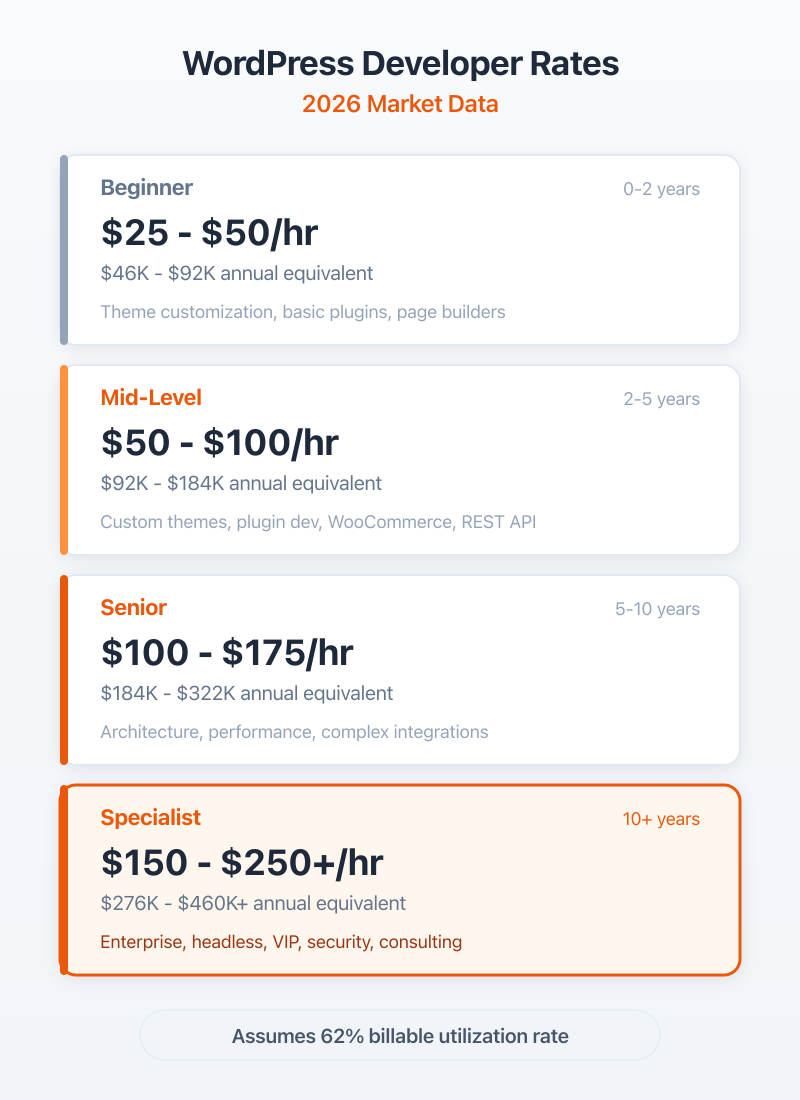
Those “annual equivalent” numbers look wild, I know. But they assume 40 billable hours per week, and no freelancer bills 40 hours. Realistically, you’re billing 20-28 hours and spending the rest on sales, admin, learning, and the occasional three-hour rabbit hole debugging a WooCommerce conflict. I track everything with time tracking tools, and my actual billable utilization averages 62%.
Fixed-Fee vs Hourly: When Each Makes Sense
Fixed-fee pricing earns more for experienced developers who can estimate accurately. I switched to fixed-fee for project work after my first 100 builds, when my estimation accuracy hit about 85%.
Hourly works better for:
- Ongoing retainers and maintenance
- Discovery and audit phases
- Clients who change scope frequently (it protects you)
- Projects where requirements are still vague
Fixed-fee works better for:
- Well-scoped builds with clear deliverables
- Clients who value certainty over flexibility
- Any project where your speed is an advantage (you earn more per hour)
- Enterprise clients who need a number for budget approval
The trap? Hourly billing punishes efficiency. When you get faster at your job, you earn less per project. I learned this the hard way… cut my build time in half and watched my project revenue drop by 30%. Think about that for a second.
My Rate History: $35/hr to $46,580 Projects
Look, the path from $35/hr to five-figure projects wasn’t linear. It was messy, full of mistakes, and took longer than it should have because nobody showed me the rate ladder. So I’ll show you mine.
Early Freelancing (2010-2014): Learning What the Market Pays
I started freelancing from Kushinagar, India. A small town where $35/hr felt like serious money… because, well, it was. The local market paid $5-$15/hr for web development. I was already earning above local rates by targeting international clients on freelance platforms.
Year one: $35/hr, mostly small business sites. Theme customization, plugin configuration, basic custom PHP. The kind of work every WordPress developer starts with.
By 2012, I’d bumped to $50/hr. Not because I asked for more, but because I stopped bidding on low-budget projects. That’s the first rate increase most freelancers miss… you don’t raise your rate. You raise your minimum project size.
By 2014, I was at $75/hr for custom development work. ACF Pro builds, custom post type architectures, REST API integrations. The shift happened when I stopped saying “I build WordPress sites” and started saying “I build custom WordPress applications.”
The difference in those two sentences? About $25/hr.
Agency Transition (2015-2026): How Rates Compound
Launching Gatilab changed everything. Not immediately, but the compounding started.
2015-2017: First enterprise clients. IBM, Adobe, HubSpot appeared in my client roster. Not because I pitched them cold. Because smaller clients I’d served well referred me up. The lesson… referrals price you into tiers you can’t reach through platforms alone.
2018-2020: Fixed-fee projects became the default. A $15,000 WooCommerce build that took 80 hours worked out to $187.50/hr. That same project billed hourly at my $100/hr rate would have been $8,000. Fixed-fee rewarded my speed.
2021-present: The $46,580 enterprise project I mentioned? WordPress multisite for an education company. Forty-seven sites sharing a custom theme, role-based access, and a content distribution system. The hourly equivalent was somewhere around $200/hr, but the client never thought about it that way. They thought about the ROI of replacing their $180,000/year proprietary CMS with a WordPress solution I built in four months.
That’s value-based pricing in practice. You’re not selling hours. You’re selling the gap between their current cost and your solution cost.
WordPress Project Pricing by Type
Every project type has a different pricing floor and ceiling. The ranges below come from my own projects and conversations with other senior WordPress developers in the Developer Advisory board at WordPress.org, Codeable, and Post Status communities.
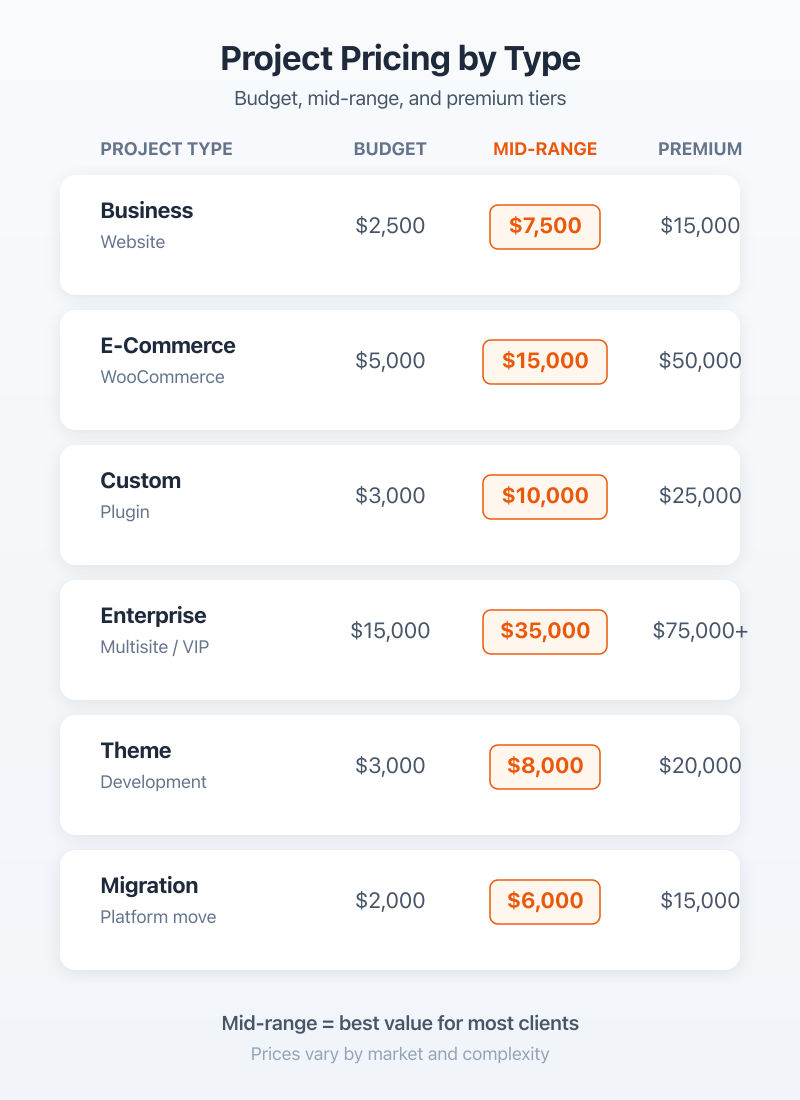
Project Type Low End Mid Range High End Typical Timeline Business Website $2,500 $7,500 $15,000 2-6 weeks E-Commerce (WooCommerce) $5,000 $15,000 $50,000 4-12 weeks Custom Plugin Development $3,000 $10,000 $25,000 3-8 weeks Enterprise / Multisite $15,000 $35,000 $75,000+ 2-6 months Theme Development (Custom) $3,000 $8,000 $20,000 3-8 weeks Migration / Redesign $2,000 $6,000 $15,000 2-4 weeks
Business Websites ($2,500-$15,000)
The bread and butter of WordPress development. A standard business site includes a custom theme (or heavily customized starter theme), 5-15 pages, contact forms via Gravity Forms or WPForms, basic SEO setup with Rank Math, and some kind of content management training for the client.
At the $2,500 level, you’re using a theme framework like GeneratePress with GenerateBlocks and customizing it with CSS and ACF fields. At $15,000, you’re building a custom theme from scratch with custom Gutenberg blocks, advanced ACF layouts, and API integrations.
The mistake most developers make here? Underpricing by treating every business site the same. A 5-page brochure site for a local bakery and a 30-page site with a resource library, team directory, and event calendar are not the same project. Price them differently.
E-Commerce / WooCommerce ($5,000-$50,000)
WooCommerce projects have the widest price range because the complexity varies so much. A simple store with 50 products and standard shipping costs $5,000-$8,000. A multi-vendor marketplace with custom checkout flows, subscription products, and integration with an ERP system… that’s $30,000-$50,000 territory.
I’ve built WooCommerce stores at every price point. The $50,000 builds always include: custom product configurators, payment gateway integrations beyond Stripe/PayPal, inventory management connections, and usually some kind of B2B pricing or wholesale plugin setup.
The key to pricing WooCommerce well? Count the integrations. Every third-party system connection adds 15-30 hours of development and testing. Most scope creep in e-commerce projects comes from integrations that weren’t in the original brief. You get the pattern.
Custom Plugin Development ($3,000-$25,000)
Plugin development pricing depends on one thing: does this plugin exist for one client, or will it be distributed? Client-specific plugins are simpler to scope. Distributed plugins need update mechanisms, settings pages, documentation, and way more testing.
I charge $3,000-$8,000 for client-specific plugins. A custom booking system for a single fitness studio. A property listing manager for one real estate agency. These are focused tools that solve one problem for one business.
At $15,000-$25,000, you’re building something that needs to work across different hosting environments, conflict with zero other plugins, and survive WordPress core updates for years. That’s a different engineering challenge entirely.
Enterprise / Multisite ($15,000-$75,000+)
Enterprise WordPress is where rates get serious. These projects involve WordPress Multisite, custom role management, content syndication between sites, advanced caching strategies, and usually an SSO integration with the client’s existing authentication system.
My $46,580 project fell in this category. The client had 47 department sites running on a legacy CMS that cost $180,000/year in licensing. My WordPress Multisite solution eliminated that licensing cost entirely. The $46,580 build fee paid for itself in 94 days.
When you can tie your price to a client’s cost savings, the conversation changes. You’re not defending your rate. You’re showing them how much money they’ll save.
The India-to-International Pricing Gap
I built Gatilab from Kushinagar, India. Population 22,000. Not exactly a tech hub. And yet most of my clients are in North America, Europe, and Australia. The geographic pricing gap is real, but it’s shrinkable.
Region Average Hourly Rate Typical Project Fee Market Access South Asia (India, Pakistan, Bangladesh) $15-$50 $500-$5,000 Upwork, Fiverr, direct outreach Eastern Europe (Ukraine, Poland, Romania) $30-$80 $2,000-$15,000 Upwork, Toptal, direct clients Western Europe (UK, Germany, France) $60-$150 $5,000-$40,000 Local agencies, direct clients North America (US, Canada) $75-$200 $5,000-$75,000 Direct clients, Codeable, Toptal Australia / New Zealand $80-$200 $5,000-$50,000 Direct clients, local agencies
Why Geography Still Matters (and Where It Doesn’t)
Purchasing Power Parity (PPP) means a dollar goes further in India than in the US. That’s just math. But PPP cuts both ways. Clients in the US expect US-quality output at any price point. If you’re charging $30/hr from India and delivering $30/hr quality, you’re competing on price. And competing on price is a race to the bottom.
Geography matters less when:
- You have a strong portfolio with recognizable brands (Canva, HubSpot, etc.)
- You can communicate in fluent English with zero timezone friction
- You position as a specialist, not a generalist
- Your online presence (blog, open source contributions, WordPress.org profile) signals expertise
Geography still matters when:
- You’re competing on platforms where clients sort by lowest price
- You don’t have case studies or testimonials from international clients
- Your communication happens entirely through text with no video calls
Positioning for International Rates from India
I went from Indian market rates to international rates in about three years. The formula wasn’t complicated, but it required patience.
Step one: Build a portfolio that shows range. I took on projects I was overqualified for, but at premium price points. A $3,000 site for a US-based SaaS company looks better in your portfolio than a $500 site for a local business, even if the $500 site was harder to build.
Step two: Contribute to open source. I became a WordPress Core Contributor. That’s a credential no amount of marketing can replicate. When clients Google your name and find your commits in WordPress itself, the pricing conversation changes.
Step three: Blog about what you know. My articles on gauravtiwari.org brought in clients who’d already seen my expertise. They weren’t hiring a “developer from India.” They were hiring a WordPress expert who happened to be in India. The positioning flip matters more than the rate itself.
Your rate isn’t set by your location. It’s set by how your clients find you. If they find you through a “cheap WordPress developer” search, you’ll earn cheap rates. If they find you through a technical blog post or an open source contribution, the pricing conversation starts at a different floor. Control the discovery channel, and you control the rate.
Value-Based Pricing for WordPress Projects
Value-based pricing means charging based on the outcome, not the hours. It’s the single biggest rate multiplier I’ve found in 16 years of WordPress development. And most developers never try it because it requires a different kind of conversation with clients.
Calculating ROI for the Client
When I pitched the $46,580 enterprise multisite project, I didn’t send a spreadsheet of hours. I sent a one-page comparison:
- Current CMS licensing: $180,000/year
- My WordPress build: $46,580 one-time + $24,000/year maintenance
- Year one savings: $109,420
- Year two savings: $156,000
The client didn’t negotiate my price. They fast-tracked the contract.
OK, this only works when you know enough about the client’s business to calculate the impact. That means asking questions most developers skip: What does your current system cost? How much revenue flows through this site? What’s the cost of downtime per hour?
For projects with IBM, Adobe, and HubSpot, the ROI framing was different each time but the principle held. A $15,000 WordPress project that replaces a $60,000/year process isn’t expensive. It’s cheap.
Anchoring Against Agency Rates
Here’s a pricing tactic that works especially well for independent developers. Agencies charge $150-$300/hr for WordPress work. Their overhead (project managers, account executives, office space, benefits) eats 40-60% of that. The developer doing the actual work might see $50-$80/hr.
When you’re an independent developer charging $120/hr, you can say this honestly: “An agency would charge you $45,000-$60,000 for this project. I’ll do it for $25,000, and you get direct access to the person writing the code. No middlemen.”
The client saves 40%. You earn more than you would at that agency. Everyone wins. I’ve used this framing on at least 30 proposals. It works because it’s true.
Retainer and Maintenance Revenue
Retainers are the most underrated revenue stream in WordPress development. One-off projects create feast-or-famine income. Retainers create a baseline that covers your bills whether or not a new project comes in.
I started offering retainers in 2016. By 2019, retainer revenue covered 60% of Gatilab’s monthly operating costs. That changed how I approached new projects… because I could be picky. I didn’t need to take every job that came along.
Monthly Retainer Structures ($500-$5,000/mo)
Tier Monthly Fee Hours Included Services Covered Basic $500-$1,000 5-8 hours Updates, security monitoring, uptime checks, minor fixes Growth $1,500-$3,000 10-20 hours Basic + content updates, SEO tweaks, performance tuning, monthly reporting Enterprise $3,000-$5,000 20-30 hours Growth + development sprints, strategy calls, priority response, staging environments
The trick with retainers? Don’t sell hours. Sell outcomes. “5 hours of support” means nothing to a client. “Your site stays updated, secure, and fast, and you can call me when something breaks” means everything.
I track hours internally (Toggl is my go-to), but the client never sees a time sheet. They see a monthly report showing uptime, speed scores, updates applied, and issues resolved. The right invoicing system makes this easy to automate.
Maintenance Plans as Baseline Revenue
Separate from retainers, maintenance plans cover the grunt work: WordPress core updates, plugin updates, daily backups, security scanning, uptime monitoring. Tools like ManageWP and MainWP make it possible to maintain 50+ sites with a few hours of work per week.
I charge $150-$300/month for maintenance-only plans. The margins are high because the work is mostly automated. But the value to the client is real. They don’t have to think about their WordPress site breaking after an update. I’ve seen a single bad plugin update take down a WooCommerce store for 72 hours. The client’s maintenance plan paid for itself in that one incident.
When to Raise Your Rates (and How)
Most WordPress developers raise rates too slowly. I did this for years. The result? I was doing $100/hr work for $50/hr because I was afraid of losing clients. Well, spoiler: the clients I was afraid of losing weren’t the ones worth keeping.
Rate Increase Triggers
Raise your rates when any of these are true:
- You’re booked 3+ months out. If demand exceeds capacity, your price is too low.
- You haven’t raised rates in 12 months. Costs go up. Your rates should too.
- Your last 3 clients said yes without negotiating. You’re underpriced.
- You can point to measurable results (revenue increase, cost savings, performance improvements) from recent projects.
- You’ve added a new skill (WooCommerce, headless WordPress, performance optimization) that commands a premium.
Codeable developers earn $70-$120/hr specifically because the platform positions them as vetted specialists. Toptal developers earn $100-$200+/hr because the screening process filters for the top tier. If your skills match those tiers but your rate doesn’t, you’re leaving money on the table.
The Conversation Script That Works
I’ve raised rates on existing clients maybe 40 times. Lost three clients total. Here’s the approach that works:
“Starting April 3, 2026, my rate for new projects will be [$new rate]. For ongoing retainer clients like you, I’m holding the current rate through [end date], then moving to the new rate. I wanted to give you plenty of notice.”
No justification. No apology. No “because my costs have increased.” Just a clear statement with a generous transition period.
The developers who struggle with rate increases are the ones who over-explain. You don’t need to defend charging what you’re worth. A plumber doesn’t explain why they charge $150/hr. Neither should you.
Annual rate increases of 10-15% are standard in the WordPress development industry. If you haven’t raised your rates in over a year, you’re effectively earning less due to inflation. Track your project history and use it as evidence when the conversation feels uncomfortable.
Rate Mistakes That Cost Me Money
I’ve made every pricing mistake in the book. Some of them cost me thousands of dollars. Some cost me months of undervalued work. These are the big ones.
Undercharging Enterprise Clients
In 2017, I quoted $8,000 for a project that should have been $25,000. The client was a Fortune 500 company. Their budget for the project was $40,000. I know this because their project manager accidentally forwarded me an internal email with the budget line item.
I left $17,000 on the table because I priced based on my costs instead of their budget. Enterprise clients don’t think about your hourly rate. They think about their allocation. When you quote $8,000 for a project they budgeted $40,000 for, you don’t look affordable. You look inexperienced.
The fix? Ask about budget early. “What range are you working within for this project?” isn’t rude. It’s professional. And it prevents you from quoting a number that’s 60% below what they’re prepared to pay.
Hourly Billing on Fixed-Scope Work
For about two years (2013-2015), I billed everything hourly. Including projects with crystal-clear scope. A 10-page business site I could build in 40 hours, billed at $75/hr: $3,000. That same site as a fixed-fee project? I’d have quoted $5,000-$7,000, and the client would’ve said yes because the number was still below market rate.
Hourly billing cost me roughly $30,000-$40,000 in lost revenue over those two years. I did the math after switching to fixed-fee. Painful spreadsheet to look at, honestly.
The rule I follow now: if I can estimate the hours within 20% accuracy, I quote fixed-fee. If I can’t, I bill hourly with a cap and a re-evaluation point.
Tools That Help You Price Better
Good pricing starts with good data. If you don’t know how long things take, you can’t estimate. If you can’t estimate, you can’t price fixed-fee. And if you can’t price fixed-fee, you’re leaving money on the table.
Estimating Hours with Historical Data
I’ve tracked my time on every project since 2012. Not for billing purposes (most of my projects are fixed-fee now), but for estimation. After 800+ projects, I know that a standard business site takes 35-55 hours, a WooCommerce store takes 60-120 hours, and a custom plugin takes 40-80 hours.
Toggl and Harvest are the two tools I’ve used. Toggl won for simplicity. I hit start, I hit stop, I tag the project. At the end, I have data. Historical time data is the most valuable pricing asset you’ll build as a freelancer, and most developers never collect it.
Your home office setup matters here too. Tracking time works only if you’re in a focused environment. Distractions inflate your project hours, which then inflate your estimates, which then either cost you money on fixed-fee or make your hourly quotes look slow.
Proposal and Contract Software
FreshBooks handles my invoicing and basic proposals. For more complex contracts, Bonsai and HoneyBook both offer templates that cover scope, payment terms, IP rights, and revision limits.
The investment here is minimal ($20-$50/month) and the payoff is real. I stopped losing money on scope creep the day I started using detailed contracts. Before that… a “small change” from the client could add 20 hours to a project with no way to bill for them. You know how that goes.
One more thing worth knowing: your portfolio and how you present your work matters as much as your rate. I’ve seen developers with identical skills earn 2x different rates because one had a proper case study portfolio and the other had a list of technologies on their resume. Presentation sells the rate.
Frequently Asked Questions
How much should a beginner WordPress developer charge?
New WordPress developers with under 2 years experience should charge $25-$50/hr or $500-$2,000 per project. Start on Upwork or with local clients, build 10+ portfolio pieces, and raise rates every 6 months based on demand. Don’t anchor to Indian or Southeast Asian platform rates if you’re targeting international clients. Your portfolio quality sets the floor, not your geography.
Is WordPress development still profitable in 2026?
Yes. The average WordPress developer earns $60-$120/hr in 2026. Custom development, WooCommerce builds, and maintenance retainers remain high-demand services. AI coding tools like Claude Code and GitHub Copilot increase your output speed, they don’t decrease your rates. Developers who use AI effectively deliver faster, which makes fixed-fee pricing even more profitable.
How much does a custom WordPress website cost?
Custom WordPress websites range from $2,500 for a business starter site to $75,000+ for enterprise multisite builds. The median project cost is $5,000-$15,000 for a standard business site with a custom theme, ACF Pro fields, and WooCommerce integration. Enterprise clients should expect $25,000-$75,000 for multisite, custom plugin development, and third-party system integrations.
Should WordPress developers charge hourly or fixed fee?
Fixed-fee pricing earns more for experienced developers who can estimate accurately. Hourly works better for ongoing retainers, discovery phases, and projects with unclear scope. I switched to fixed-fee for project work after my first 100 builds, when my estimation accuracy hit 85%+. The hybrid approach works well too: fixed-fee for the build, hourly for post-launch support.
What is the highest-paid WordPress specialization?
Enterprise multisite architecture and WooCommerce custom development command the highest rates at $150-$250/hr. Performance optimization specialists and security audit experts also earn premium rates. Headless WordPress development (using Next.js or Astro as a frontend) is an emerging specialty paying $120-$200/hr as more companies adopt decoupled architectures.
How do WordPress developers on Upwork price differently than direct clients?
Upwork WordPress developers average $25-$75/hr due to platform competition and 10-20% service fees. Codeable developers earn $70-$120/hr with vetted positioning. Direct clients pay 30-50% more than marketplace rates for equivalent work because there’s no platform fee, and the trust factor from referrals or inbound leads means less price sensitivity. Moving from Upwork to direct clients is the single biggest rate multiplier for most freelancers.
Your rate isn’t just a number on an invoice. It’s a signal. Too low, and clients assume you’re junior. Too high without proof, and they go with the agency that has a fancier website. The sweet spot is a rate that reflects your actual impact, backed by work you can point to.
If I were starting over today, I’d charge $50/hr from day one, build 10 portfolio projects in the first six months, and switch to fixed-fee pricing the moment my estimates got accurate. I wouldn’t wait three years to raise rates like I did. And I’d start a maintenance retainer program from client number one.
The WordPress development market in 2026 is bigger than it’s ever been. There’s room for developers at every price point. But the developers earning $150+/hr aren’t doing fundamentally different work than the ones earning $50/hr. They’re pricing differently, positioning differently, and having different conversations with different clients. That’s the whole game, and now you know how it works.