
White Labeling WordPress Development for Agencies

You’re a WordPress developer tired of chasing direct clients. The proposal writing, the discovery calls where you explain what a CMS is, the invoices that sit unpaid for 45 days. You’ve heard white-label development is the answer: build sites for agencies, skip the sales cycle, get consistent project flow. But every guide about white-label WordPress is written for the agency side. How to hire a white-label partner. Nobody tells you how to actually be one.
And the supplier side has real traps. Price too high and agencies go to Upwork. Price too low and you’re earning $30/hour on projects the agency charges their client $150/hour for. Work without an NDA and your portfolio stays empty forever. Take on too many agency partners without SOPs and quality slips, the agency drops you, and you’re back to square one. The 40-60% discount agencies expect on retail rates only works if you know exactly where to recover that margin.
This guide covers the supplier’s playbook: finding agency partners on Clutch and Dribbble, pricing white-label WordPress work profitably, and scaling from one partner to ten.
What White-Label WordPress Development Actually Means
White-label WordPress development is contract work where your name never appears. You build websites, plugins, custom themes, and WooCommerce stores for agencies who present the work to their clients as their own. The end client never knows you exist. The agency gets a development team without hiring one. You get consistent project flow without doing sales.
The relationship is simple on paper. An agency sells a $15,000 website project to their client. They pay you $6,000-$9,000 to build it. They handle the client relationship, the design direction, and the project management. You write the code, set up the staging environments, and deliver production-ready WordPress sites.
Supplier vs Buyer Side
Most content about white-label services focuses on the buyer: “How to find a reliable white-label developer.” That’s useful for agencies, but it ignores the supplier’s perspective entirely.
From the supplier side, white-label development is a fundamentally different business model than direct client work. You don’t pitch. You don’t chase invoices from end clients. You don’t sit in discovery calls explaining what WordPress can do. Your “client” is another professional who speaks your language and knows what they want.
The tradeoff? Lower per-project margins. A project you’d charge a direct client $12,000 for might pay $6,000-$7,200 as white-label work. But you’re not spending 15-20 hours on proposals, sales calls, and client education to win that project. The agency already closed the deal. You just build.
Why Agencies Need White-Label Partners
Design agencies are the biggest source of white-label work. They have talented designers, strong client relationships, and zero WordPress development capacity. When a client asks “can you build this in WordPress?” the agency has two choices: hire full-time developers (expensive, risky) or partner with someone like you (flexible, scalable).
Marketing agencies are the second biggest source. They sell SEO, PPC, and content marketing. Their clients eventually need website work. Custom landing pages, WooCommerce setups, WordPress migrations. The agency doesn’t want to refer those projects to someone else and risk losing the client. White-label partnerships let them say “yes, we do that” without actually building an internal dev team.
Finding Agency Partners Who Need You
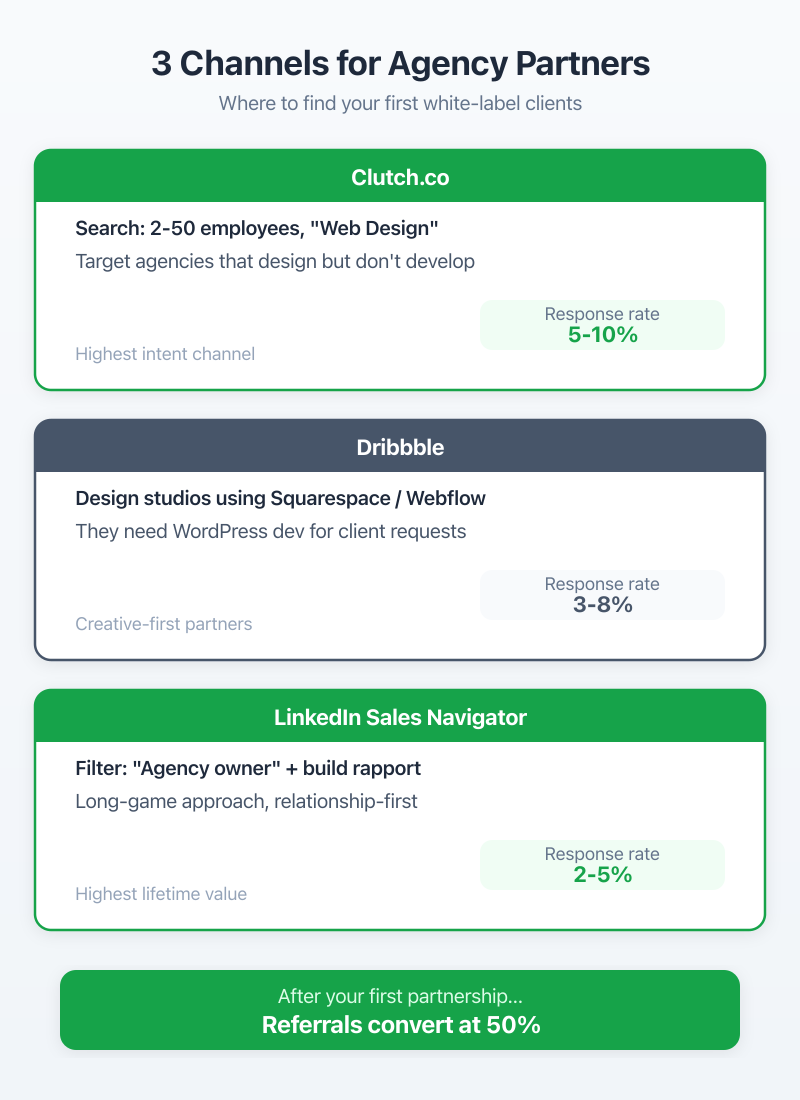
The hardest part of white-label development isn’t the work itself. It’s finding that first agency partner who trusts you enough to put their brand on your output. After that first partner, referrals do most of the heavy lifting. My agency relationships convert at roughly 50% through referrals from existing partners.
But you need that first one. And the second. And the third.
Design Agencies Without Dev Teams
Design agencies are your best-fit partners. They already have the client relationship and the visual direction. They just need someone to turn Figma files into functioning WordPress sites.
Search Clutch.co for design agencies in your target market. Filter by company size (2-50 employees) and services offered. If they list “web design” but not “web development,” that’s your signal. They’re either outsourcing already or turning down development projects.
Dribbble is another goldmine. Studios posting beautiful web designs but linking to Squarespace or Webflow portfolios often don’t have WordPress developers on staff. That’s your opening.
Marketing Agencies Offering WordPress as Add-On
Marketing agencies that offer WordPress as a secondary service are almost always outsourcing the development. They charge their clients for “full-service digital marketing including website design and development,” but the actual coding happens somewhere else.
These agencies tend to have higher volume and lower budgets per project than design agencies. You might build 3-5 smaller WordPress sites per month for one marketing agency instead of one large custom build per month for a design agency. Both models work. The marketing agency model just requires tighter processes because of the volume.
Where to Find Them (Beyond Cold Email)
Cold email works, but it’s a grind. I’ve found better channels:
LinkedIn Sales Navigator filtered by “agency owner” and industry keywords pulls up qualified prospects. Don’t pitch immediately. Comment on their posts. Share useful WordPress content. Build recognition before you reach out. When you do message them, reference something specific about their agency.
WordPress meetups and WordCamps are underrated. Agency owners attend these events looking for talent. Show up, present something useful, and the conversations happen naturally. I’ve picked up two long-term agency partners from a single WordCamp presentation.
Referrals from your existing network compound over time. One happy agency partner mentions you to another agency at an industry event. That referral already trusts you because their peer vouched. Close rates on referrals are 3-4x higher than cold outreach.
Start with one agency partner and deliver exceptional work for 90 days before actively seeking more. That first partnership becomes your case study, your testimonial, and your referral source. Trying to onboard five agencies at once before you’ve nailed the delivery workflow is how white-label operations fail in the first six months.
Pricing White-Label Work (The 40-60% Discount Reality)
White-label pricing follows a consistent pattern across the industry: agencies expect to pay 40-60% below retail rates. If you charge direct clients $150/hr, your white-label rate lands somewhere between $60-$90/hr. If a custom WordPress site costs a direct client $15,000, the white-label price to the agency is $6,000-$9,000.
That discount isn’t negotiable. It’s the economics of the relationship. The agency is providing the client, handling project management, taking the risk on the client relationship, and adding their margin on top. You’re providing technical execution with zero client acquisition cost.
Why Agencies Expect Wholesale Rates
Think of it like wholesale vs retail in any other industry. The agency is your distribution channel. They handle marketing, sales, client management, revisions, and scope changes with the end client. You handle code. That split justifies the discount because your cost of doing business drops significantly.
No proposals to write. No discovery calls. No educating clients about what WordPress can and can’t do. No chasing late payments from end clients (the agency pays you, regardless of whether their client paid them). No managing client expectations directly. All of those tasks cost time and money. White-label pricing accounts for those savings.
Making the Math Work on Your End
The 40-60% discount only works if your delivery costs are lower than your direct-client delivery costs. And they should be, significantly.
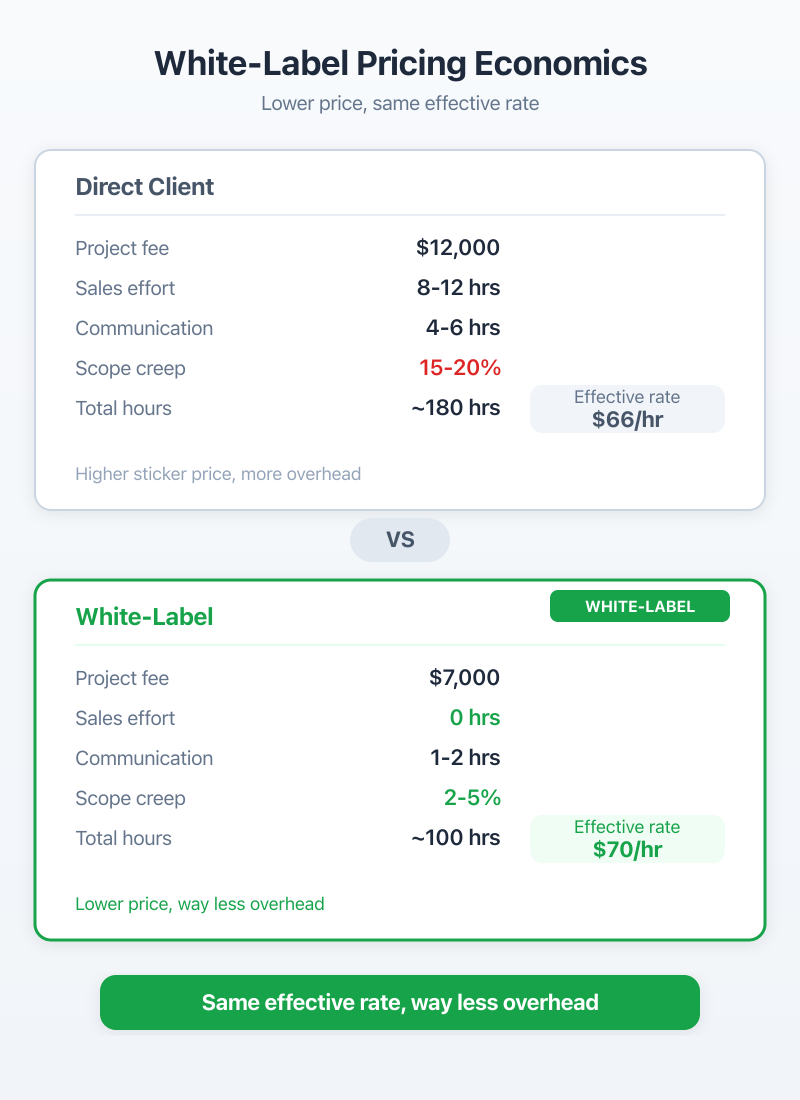
Direct client work: You spend 8-12 hours on sales (calls, proposals, follow-ups), 4-6 hours on client communication per project, and eat 15-20% of project time in scope creep management. A $12,000 direct client project might take 180 hours total including all that overhead. That’s $66/hr effective rate.
White-label work: Zero sales time. 1-2 hours of agency communication per project. Scope is defined by the agency’s SOW. A $7,000 white-label project takes 100 hours of pure development. That’s $70/hr effective rate.
The per-project revenue is lower. The effective hourly rate is often the same or higher. Volume makes up the rest.
| Metric | Direct Client Work | White-Label Work | Difference |
|---|---|---|---|
| Project fee | $12,000 | $7,000 | -42% |
| Sales hours | 8-12 hrs | 0 hrs | -100% |
| Client communication | 4-6 hrs | 1-2 hrs | -70% |
| Scope creep overhead | 15-20% | 2-5% | -75% |
| Total hours (incl. overhead) | ~180 hrs | ~100 hrs | -44% |
| Effective hourly rate | $66/hr | $70/hr | +6% |
| Payment reliability | Net 30, sometimes Net 60 | Milestone-based, predictable | Faster |
The NDA and Legal Framework
Every white-label relationship starts with an NDA. Not a generic template downloaded from the internet. A proper non-disclosure agreement that covers the specific dynamics of a white-label partnership.
I’ve seen developers lose agency partners because they accidentally mentioned the relationship on social media, or listed the agency’s client project in their portfolio. One Instagram story showing a staging site with the end client’s logo visible, and a two-year partnership ends.
What Your NDA Must Cover
Your NDA needs to address five specific areas that standard NDA templates miss:
Non-disclosure of the partnership itself. This is the core clause. You can’t tell anyone that you work with this agency. Not on your website, not on LinkedIn, not in casual conversations with other agencies. The relationship is invisible.
Non-solicitation of the agency’s clients. If you interact with an agency’s end client (on staging sites, in shared Slack channels, wherever), you can’t approach that client directly. This clause protects the agency’s business and builds trust faster than anything else. I add it proactively to every agreement, even when the agency doesn’t ask for it.
Confidentiality of client data. You’ll have access to the end client’s business data, customer information, and proprietary content. Standard GDPR/privacy protections apply, plus specific handling requirements.
Term and termination. How long does the NDA last after the working relationship ends? Two years is standard. Some agencies push for five.
Exclusivity (or lack of it). Can you work with competing agencies? Most white-label agreements are non-exclusive, meaning you can partner with multiple agencies. Clarify this upfront.
| NDA Clause | What It Covers | Must-Have or Nice-to-Have |
|---|---|---|
| Non-disclosure of partnership | Can’t reveal the working relationship exists | Must-Have |
| Non-solicitation | Can’t approach the agency’s end clients directly | Must-Have |
| Client data confidentiality | GDPR/privacy protections for end-client data | Must-Have |
| IP assignment | Code ownership transfers to agency on payment | Must-Have |
| Term and survival | NDA remains active 2-5 years post-termination | Must-Have |
| Non-compete scope | Defines whether you can work with competing agencies | Nice-to-Have |
| Portfolio rights | Whether you can show work samples (anonymized) | Nice-to-Have |
IP Assignment and Code Ownership
Code ownership in white-label work is straightforward: the agency owns everything you build, once they pay for it. This is a work-for-hire arrangement. The custom theme, the plugin modifications, the WooCommerce extensions… all of it belongs to the agency (and ultimately their client).
Your contract should include a clear IP assignment clause that transfers ownership upon full payment. Not upon delivery. Upon payment. This protects you if an agency doesn’t pay.
One exception worth negotiating: reusable code libraries and frameworks you’ve built before the engagement. If you have a starter theme or a set of utility functions you use across all projects, those remain yours. You’re licensing their use, not assigning ownership. Spell this out clearly.
Communication Protocols That Protect Both Sides
Communication is where white-label relationships either thrive or fall apart. The wrong email to the wrong person can expose the entire arrangement. I’ve built a communication protocol at Gatilab that’s been refined across dozens of agency partnerships, and it boils down to three rules.
Rule one: all communication goes through the agency’s project manager. Never email the end client directly. Never.
Rule two: use the agency’s tools, not yours. If they use ClickUp for project management, you use ClickUp. If they use Basecamp, you use Basecamp. Asking an agency to adopt your PM tool is a fast way to lose the partnership.
Rule three: every deliverable uses the agency’s branding. Staging site login screens, admin dashboards, documentation. If the end client ever sees a backend screen, your name shouldn’t be anywhere on it.
Direct Client Contact: When and How
Sometimes direct client contact is unavoidable. A complex migration might require database access that only the end client’s hosting provider can grant. A WooCommerce setup might need payment gateway credentials that the agency doesn’t have.
When this happens, the agency introduces you using a branded email address. You become “the development team at [Agency Name].” Some agencies set up email aliases on their domain for this purpose: [email protected] forwarding to your inbox.
Every interaction with the end client goes through or is visible to the agency PM. CC them on every email. Include them in every Slack thread. The moment you have a private conversation with an end client, the agency loses control and trust erodes.
Branded vs Unbranded Deliverables
Staging environments should run on the agency’s subdomain or a neutral domain, not yours. If the agency uses staging.agencyname.com, request access. If they don’t have staging infrastructure, set one up on a neutral domain that doesn’t trace back to you.
Documentation, training videos, and handoff notes all carry the agency’s branding. This sounds like extra work, but it’s really just a template swap. Create a documentation template with placeholder branding that you update per agency partner. Five minutes of setup saves hours of awkward conversations.
Quality Control for White-Label Delivery
White-label work demands higher quality standards than direct client work. When you deliver to a direct client, you can explain quirks, walk them through workarounds, and fix issues in real time. When you deliver to an agency, they’re presenting your work as their own. Any quality issue reflects on their brand, not yours.
If the code breaks, the agency looks incompetent in front of their client. That’s why agencies are picky about quality, and why you should be pickier.
Code Standards and Review Process
Every line of code should follow WordPress Coding Standards (WPCS). Not because it’s a nice-to-have, but because agencies will eventually hire other developers or bring development in-house. When they do, your code needs to be readable, maintainable, and standard-compliant.
At Gatilab, every project goes through a code review before delivery. We run PHPCS with the WordPress-Extra ruleset, check JavaScript with ESLint, and validate CSS against our internal standards. The review catches 90% of issues before the agency ever sees the work.
Version control through GitHub is non-negotiable. Every project gets a private repository. The agency gets read access (or full access if they want it). Commit history tells a story. If something breaks six months later, the agency can trace exactly what changed and when.
Staging, Testing, and Handoff
Every project gets a staging environment that mirrors the production setup. Same PHP version, same MySQL version, same server configuration. I’ve seen developers build on PHP 8.2 and deploy to a host running PHP 7.4. The staging environment prevents that.
The handoff process follows a checklist:
Cross-browser testing on Chrome, Firefox, Safari, and Edge. Mobile testing on iOS Safari and Android Chrome. Performance audit with PageSpeed Insights (target: 90+ on both mobile and desktop). Accessibility check with axe DevTools. Security scan with WPScan. Plugin update compatibility check.
The agency receives a handoff document listing everything: login credentials, plugin licenses, custom code documentation, known limitations, and recommended maintenance schedule. This document is what separates professional white-label operations from freelancers who just FTP files and disappear.
Scaling Your White-Label Operation
Scaling from one agency partner to ten is the inflection point where white-label development goes from “side income” to “primary business model.” It’s also where most operations break. The processes that work for one partner don’t work for five. The communication style that works for three doesn’t work for ten.
From 1 Agency Partner to 10
The progression looks like this:
1-2 agency partners: You’re doing everything. Development, project management, communication, quality control. This phase is about proving the model works and building your delivery playbook.
3-5 agency partners: You need a dedicated project manager. Not a developer who also manages projects. An actual PM whose job is agency communication, timeline management, and quality checks. This is the hardest hire because the PM needs to represent your work as if it’s the agency’s work. They need to understand the white-label dynamic.
6-10 agency partners: You need dedicated development resources per agency cluster. One senior developer handling three agency accounts, with junior developers supporting them. The PM role splits into account management (agency relationships) and project management (delivery coordination).
Dedicated Teams vs Shared Resources
Two models work at scale. Both have tradeoffs.
Shared resources: Your development team works across all agency partners. Project allocation happens based on skills and availability. This is more efficient (higher utilization rates) but creates scheduling conflicts during busy periods. If three agencies need rush projects simultaneously, something slips.
Dedicated teams: Each agency partner (or cluster of 2-3 partners) gets an assigned developer who learns their preferences, design patterns, and client expectations. Less efficient (some developers will have downtime), but the quality and consistency are noticeably higher. Agencies with $3,000-$8,000/month retainers usually warrant dedicated resources.
I’ve found the hybrid model works best. Dedicated senior developers for your top 3-4 agency partners (the ones generating 70%+ of revenue). Shared pool for smaller or project-based partners. As a smaller partner’s volume grows, they graduate to dedicated resources.
Track your effective hourly rate per agency partner separately. Some agencies are more profitable than others, and the difference isn’t always obvious from the project fees. Factor in revision rounds, communication overhead, and payment terms. I review these numbers quarterly and have dropped agency partners whose effective rate dipped below $45/hr consistently.
White-Label Pricing Models That Work
There’s no single right pricing model for white-label work. The best model depends on the agency’s project flow, your team structure, and how predictable the relationship is. I’ve used all three of these across different agency partnerships.
Per-Project Fixed Fee
Fixed-fee pricing works best for well-defined projects with clear scope. A 10-page business website. A WooCommerce store with specific product count and payment gateway requirements. A WordPress theme customization with detailed design files.
The agency sends a scope document. You estimate hours, multiply by your white-label rate, add a 15-20% buffer for unknowns, and quote a fixed price. The agency marks it up 40-100% for their client.
Typical range: $2,500-$15,000 per project depending on complexity. Simple business sites at the low end. Custom WooCommerce builds with integrations at the high end.
The risk: scope creep. Even with a clear SOW, projects expand. Protect yourself with a change order process. Any work outside the original scope gets a separate quote approved before you start. Agencies respect this because they do the same thing with their clients.
Monthly Retainer with Hour Bank
Retainers are where white-label income gets predictable. The agency pays a fixed monthly fee for a bank of development hours. They use those hours across multiple client projects however they want.
Common structures: $3,000/month for 40 hours. $5,000/month for 70 hours. $8,000/month for 120 hours. Unused hours don’t roll over (or roll over for one month max). Hours beyond the bank are billed at a slightly higher overflow rate.
This model works best with agencies that have consistent, ongoing WordPress work. Website updates, plugin customizations, new landing pages, WooCommerce tweaks. The agency benefits from guaranteed availability. You benefit from guaranteed income.
Track hours accurately. Use time tracking tools and send weekly reports showing hours used, hours remaining, and what was accomplished. Transparency builds trust and prevents disputes at month-end.
Dedicated Developer Model
For high-volume agencies, the dedicated developer model makes the most sense. The agency essentially “rents” a full-time developer from your team for a monthly flat rate. That developer works exclusively on the agency’s projects during business hours.
Pricing: $4,000-$8,000/month depending on the developer’s skill level and your market. Junior WordPress developer at $4,000. Senior full-stack with WooCommerce expertise at $7,000-$8,000. The agency gets a developer who knows their preferences, their clients, and their codebase. No onboarding time for new projects.
The risk here is utilization. If the agency has a slow month, that developer still costs you their salary plus overhead. Build a minimum commitment period (3-6 months) into the contract to smooth out fluctuations.
| Pricing Model | How It Works | Best For | Revenue Predictability | Typical Range |
|---|---|---|---|---|
| Per-Project Fixed Fee | Quoted price per project based on scope | Well-defined, one-off builds | Low (feast or famine) | $2,500-$15,000/project |
| Monthly Retainer | Fixed monthly fee for a bank of hours | Agencies with ongoing WordPress work | High (guaranteed monthly income) | $3,000-$8,000/month |
| Dedicated Developer | Full-time developer assigned to one agency | High-volume agencies, 30+ hrs/week | Very High (salary-like income) | $4,000-$8,000/month |
Agency Partner Types and Where to Find Them
Not all agencies are equal as white-label partners. The type of agency determines your deal size, project complexity, and how long the relationship lasts. Understanding these differences helps you target the right partners.
| Agency Type | What They Need | Deal Size | Relationship Duration | Where to Find Them |
|---|---|---|---|---|
| Design/UX agencies | Figma-to-WordPress, custom themes | $5,000-$15,000/project | 12-36 months | Clutch.co, Dribbble, Behance |
| Marketing/SEO agencies | Landing pages, WordPress updates, migrations | $1,500-$5,000/project | 6-24 months | LinkedIn, SEO conferences, referrals |
| Branding agencies | Full website builds to match brand identity | $8,000-$20,000/project | Project-based, repeat yearly | AIGA directories, industry events |
| Full-service digital agencies | Overflow work, specialized WordPress skills | $3,000-$8,000/month retainer | 18-36+ months | WordCamps, WordPress meetups |
The sweet spot in 2026 is design agencies with 5-20 employees. They’re big enough to have consistent project flow but small enough that hiring a full-time WordPress developer doesn’t make financial sense. These agencies become long-term partners because the cost of switching to a new white-label provider (onboarding, learning preferences, quality ramp-up) outweighs any minor price differences.
White-Label Maintenance: The Recurring Revenue Play
If you’re only doing white-label project work, you’re leaving the most profitable piece on the table. White-label WordPress maintenance plans are the highest-margin recurring revenue in this business model.
The setup is straightforward. You offer maintenance packages at $49-$99/month per site. The agency marks those up to $149-$299/month for their end clients. You handle updates, backups, security monitoring, uptime checks, and minor fixes. The agency keeps the client relationship and a healthy margin.
At 20 sites under management, that’s $980-$1,980/month in recurring revenue for 15-20 hours of work per month. At 50 sites, it’s $2,450-$4,950/month. The work is largely automated with the right tools and processes.
FreshBooks handles invoicing for the recurring billing. Automated invoices go out on the first of each month. The agency pays you; they invoice their client separately at their markup.
Scale matters here. Ten maintenance clients require roughly the same tooling investment as fifty. The marginal cost of adding each new site drops as you grow. That’s what makes maintenance the profit center for white-label operations.
Building Your White-Label Service Page
Your website needs a dedicated white-label services page, but it shouldn’t look like every other “we do white-label development” page. Agency owners are sophisticated buyers. They’ve seen the generic pitches.
What agency owners actually look for: evidence that you understand the white-label dynamic (confidentiality, branded deliverables, no credit taking), specific WordPress skills (custom theme development, WooCommerce, ACF, Gutenberg blocks), and social proof from other agencies (anonymized case studies with specific results).
What they don’t care about: your team’s headshots, generic technology logos, or vague promises about “pixel-perfect development.” They want to know three things. Can you build what their designer designed? Will you deliver on time? Will you disappear after the project?
Your website pricing structure for white-label work should be transparent. Agencies respect clear pricing because it lets them calculate their margin instantly. If an agency has to schedule a call just to learn your rates, they’ll move on to the supplier who published theirs.
Common Mistakes That Kill White-Label Partnerships
I’ve watched developers sabotage white-label relationships in ways that are completely avoidable. These mistakes come up repeatedly.
Taking credit publicly. Posting a project you built for an agency on your portfolio, even with good intentions, can end the relationship instantly. The entire premise of white-label work is that you’re invisible. Respect that.
Missing deadlines without communication. Deadlines slip. It happens. What kills the relationship isn’t the delay. It’s the surprise. If a project is going to be late, tell the agency three days before the deadline, not three days after. They need time to manage their client’s expectations.
Over-communicating with the end client. If the agency introduces you to their client for a specific technical reason, handle that specific issue and step back. Don’t start building a direct relationship. Don’t offer additional services. Don’t be more helpful than the agency asked you to be.
Inconsistent quality. Your third project with an agency should be better than your first. If quality fluctuates, the agency can’t confidently sell your services to their clients. Standardize your development workflow with checklists, code review processes, and testing protocols.
Pricing surprises. If you quote $6,000 and invoice $7,200 because of “additional scope,” you’ll have an angry agency partner. Any work outside the original scope needs a separate, pre-approved quote. No exceptions.
Frequently Asked Questions
How much do white-label WordPress developers charge?
White-label rates typically run 40-60% below retail. If an agency charges clients $150/hr, the white-label developer earns $60-$90/hr. Fixed project fees range from $1,500-$10,000 depending on scope. Volume commitments and retainer agreements get better rates because they reduce your sales overhead to nearly zero.
How do I find agencies that need white-label WordPress development?
Search Clutch.co for design and marketing agencies without in-house development teams. Check Dribbble for design studios posting web designs but lacking WordPress capabilities. LinkedIn Sales Navigator filtered by ‘agency owner’ plus ‘WordPress’ pulls qualified prospects. Referrals from existing agency partners convert at 50%+ and should be your primary growth channel after the first 2-3 partnerships.
What should a white-label NDA include?
Non-disclosure of the partnership itself, IP assignment to the agency upon payment, non-solicitation of the agency’s clients, code ownership transfer via work-for-hire clause, and confidentiality of end-client data. Standard NDA templates miss the non-solicitation clause. Add it proactively to build trust with agency partners.
Is white-label WordPress development profitable?
Yes, if you price correctly and maintain 3+ agency partners. Lower per-project margins (30-40% vs 50-60% for direct client work) are offset by eliminated sales costs, zero client acquisition overhead, and predictable project volume. The effective hourly rate on white-label work is often equal to or higher than direct client work once you factor in all the overhead you’re not doing.
How do you manage communication in white-label projects?
The agency remains the client-facing contact at all times. You communicate through the agency’s project manager via their preferred tools (Slack, ClickUp, Basecamp). Never contact the end client directly unless explicitly authorized by the agency. Use the agency’s staging environment and branding on all deliverables including documentation and training materials.
Should I offer white-label maintenance plans?
White-label maintenance is the highest-margin recurring revenue in the white-label model. Agencies mark up your $49-$99/month service to $149-$299/month for their clients. You manage updates, backups, and security. The agency keeps the client relationship and a healthy margin. At 50 sites under management, maintenance alone generates $2,450-$4,950/month in predictable recurring income.
White-label WordPress development isn’t a fallback when direct client work dries up. It’s a deliberate business model with its own economics, its own acquisition channels, and its own scaling path. The agencies that need you aren’t going away. If anything, the demand for white-label WordPress development is growing as more agencies offer digital services without building internal development teams.
Start with one partner. Nail the delivery. Build the trust. Then let the referrals do the rest. Three solid agency partnerships generating $5,000-$8,000/month each is a $15,000-$24,000/month business with zero cold outreach, zero proposals, and clients who actually understand what you do.
That’s the math that made me build Gatilab’s white-label operation. The same math works for solo developers and small teams too. You just need to start.