
eCommerce Pricing Strategies: 7 Models Compared
Pricing is the fastest lever for improving profitability. A 1% improvement in price typically improves profit more than a 1% improvement in costs or volume. Yet most e-commerce businesses spend more time on product photos than pricing strategy. They guess, copy competitors, or use simple cost-plus formulas without understanding what they’re leaving on the table.
A 1% improvement in pricing typically has 2-4x more impact on profitability than a 1% improvement in volume or costs. Pricing is the highest-leverage change most e-commerce businesses never optimize.
I’ve analyzed pricing across hundreds of e-commerce operations, both for my own businesses and for clients I’ve consulted with over the years. The pattern is consistent: businesses that approach pricing strategically outperform those that don’t. Not because they charge more, but because they understand when to charge more, when to discount, and how to structure prices for maximum value capture. Whether you’re running a Shopify store or using WooCommerce, these principles apply.
The Foundation: Cost Understanding
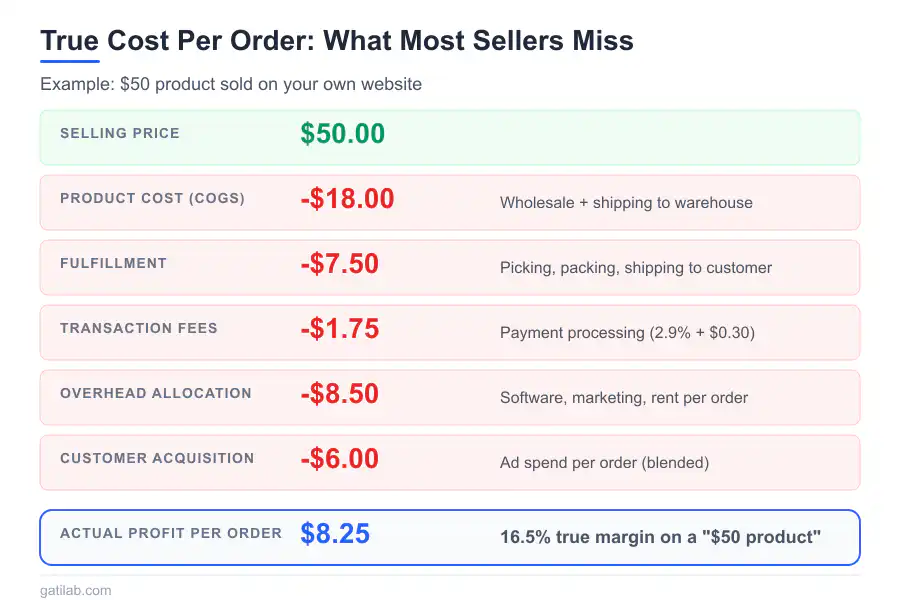
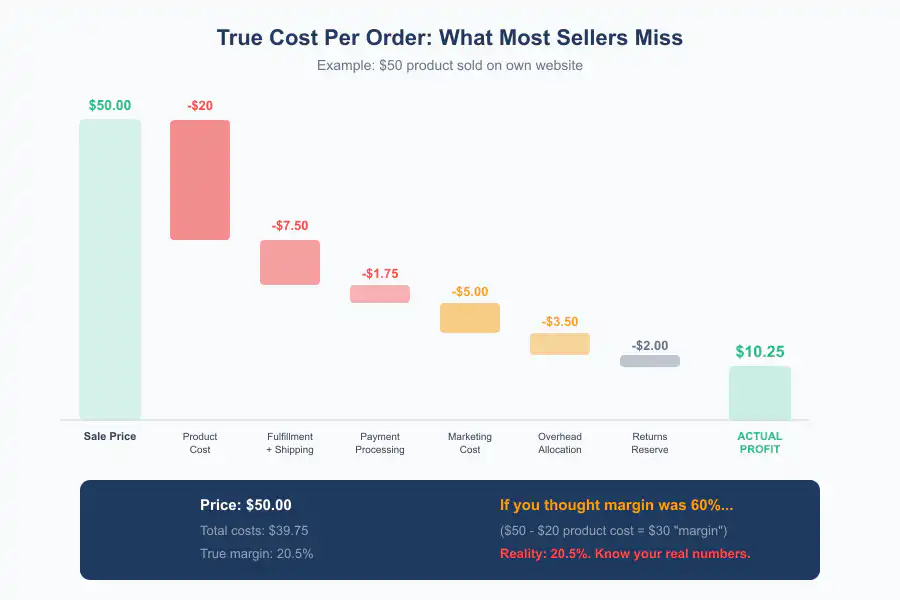
Before setting prices, know your costs completely. This sounds obvious, but I’ve audited e-commerce operations where the owner couldn’t tell me their actual cost per order within 20%. You can’t price intelligently when you’re guessing at costs.
Product costs include manufacturing or wholesale price, shipping to your warehouse, duties and tariffs, and inspection or quality control. These are your landed costs. Everything you spend before the product sits on your shelf (or your supplier’s shelf) ready to sell.
Fulfillment costs include picking, packing, packaging materials, and shipping to customers. These vary by product size and destination. A lot of sellers underestimate this category because they don’t track their own time as a cost.
Transaction costs include payment processing (typically 2.5-3% plus a per-transaction fee), platform fees, and fraud costs. These are invisible until you calculate them per order. On a $30 product, you’re losing roughly a dollar just to accept the payment.
Overhead allocation includes rent, staff, software, marketing, and other business costs. Divide by order volume or revenue for per-order allocation. This is where the real surprises live. When you divide your monthly software subscriptions and team costs across actual orders… the number is usually higher than expected.
Your total cost per order equals product cost plus fulfillment plus transaction fees plus overhead allocation. Your price must exceed total cost to generate profit. The margin between price and cost is your operating room for marketing, growth investment, and actual profit.
Calculate your break-even: at what price do you cover costs exactly? Everything above that’s margin. I recommend knowing this number cold for every product category.
Basic Pricing Approaches
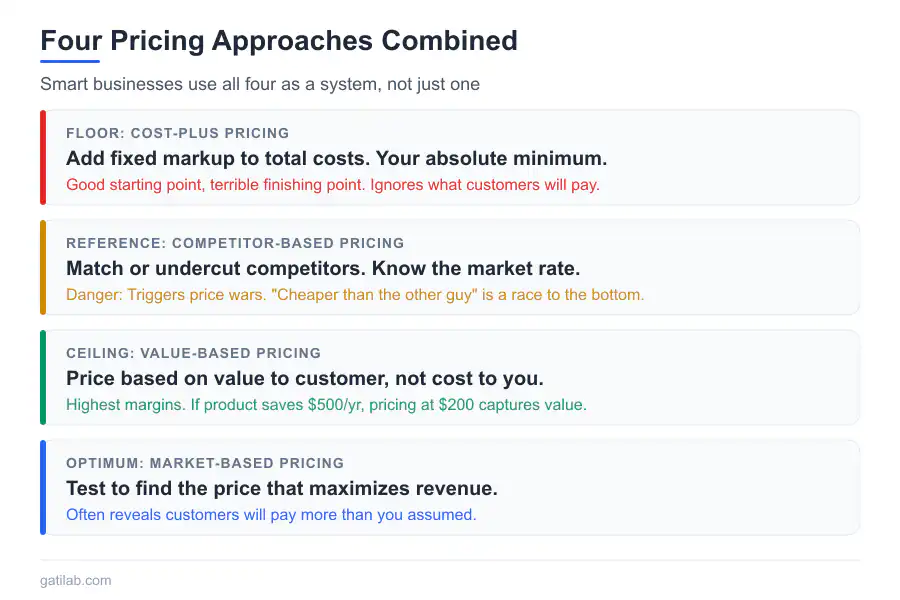
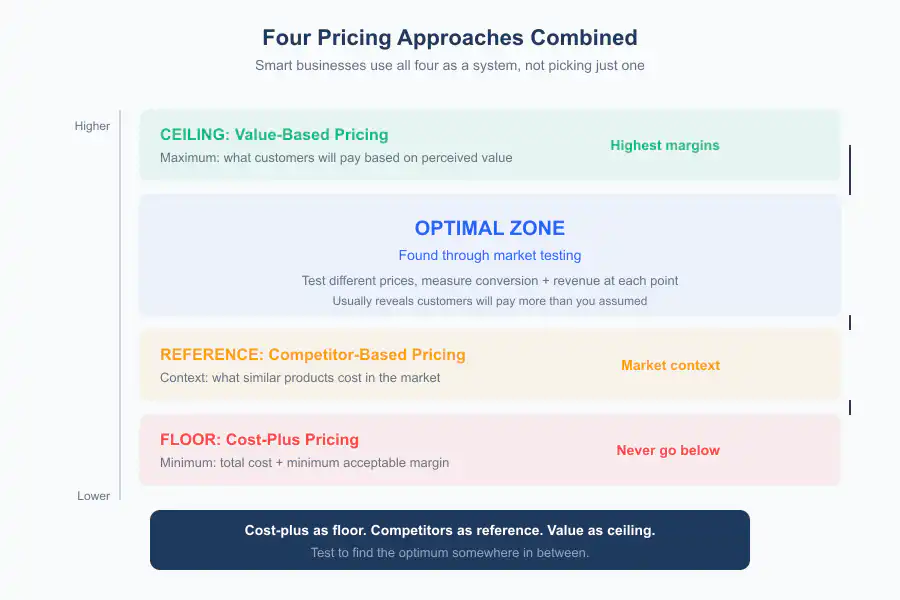
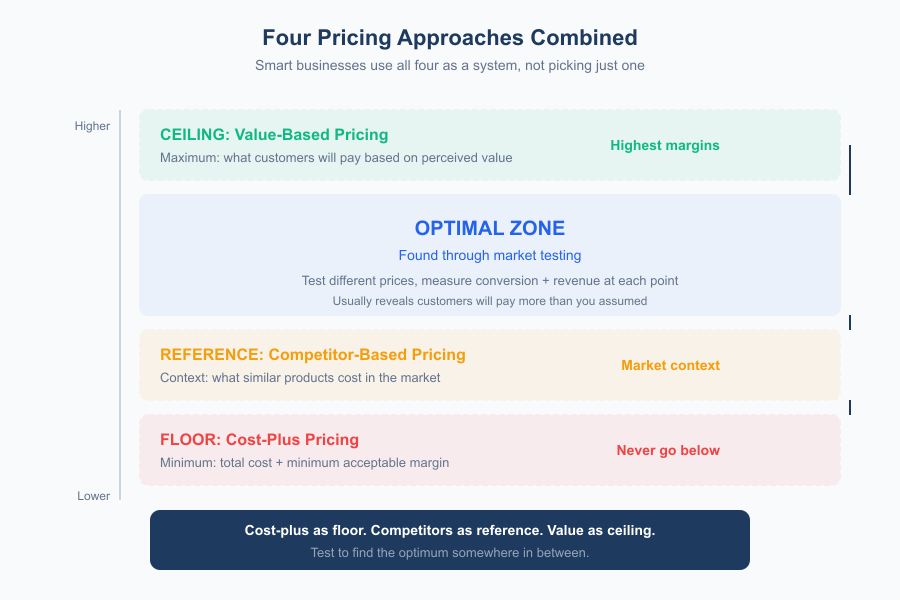
There are four fundamental approaches, and the smartest businesses use all of them together.
Cost-plus pricing adds a fixed markup to costs. If total cost is $30 and you want 50% margin on cost, you price at $45. Simple but it completely ignores what customers will pay or what competitors charge. I see this approach most often with new store owners. It’s a reasonable starting point but a terrible finishing point.
Competitor-based pricing matches or undercuts competitor prices. Appropriate for true commodities where products are identical. Dangerous when it triggers price wars that destroy industry margins for everyone. If your only strategy is “cheaper than the other guy,” you’re in a race to the bottom.
Value-based pricing sets price based on value to the customer, not cost to you. If your product saves customers $500 annually, pricing at $200 captures value while leaving substantial benefit for the buyer. Highest potential margins but requires understanding customer value perception deeply. For a detailed walkthrough of this approach, see our complete guide to value-based pricing.
Market-based pricing finds the price point that maximizes revenue given demand elasticity. This requires testing to discover. It often reveals that customers will pay more than you assumed. I’ve seen this surprise store owners repeatedly… they raise prices expecting a drop-off that never materializes.
Most successful e-commerce businesses use combinations: cost-plus as floor, competitor-based as reference, value-based as ceiling, and market testing to find the optimum somewhere in between.
Psychological Pricing Tactics
This is where pricing gets genuinely interesting, and where small changes produce outsized results.
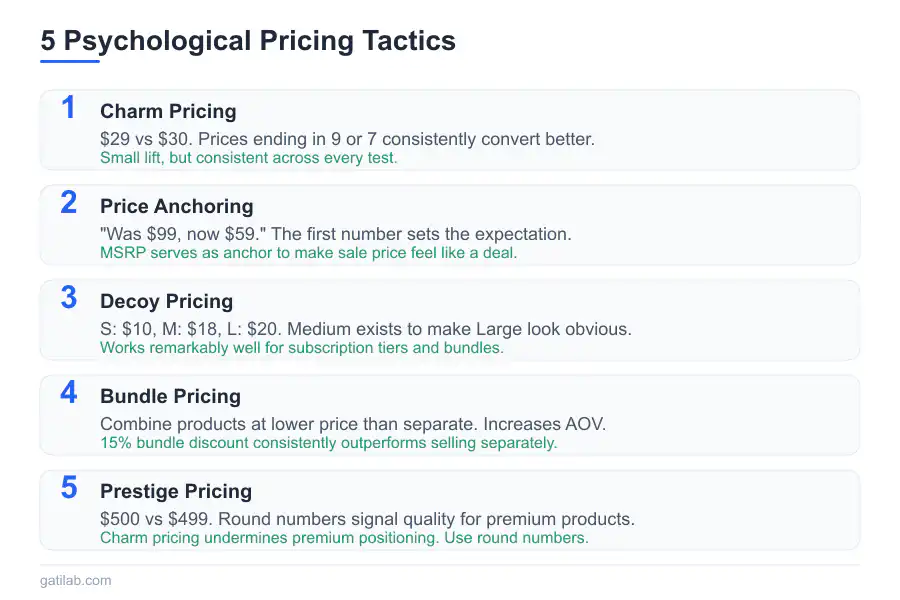
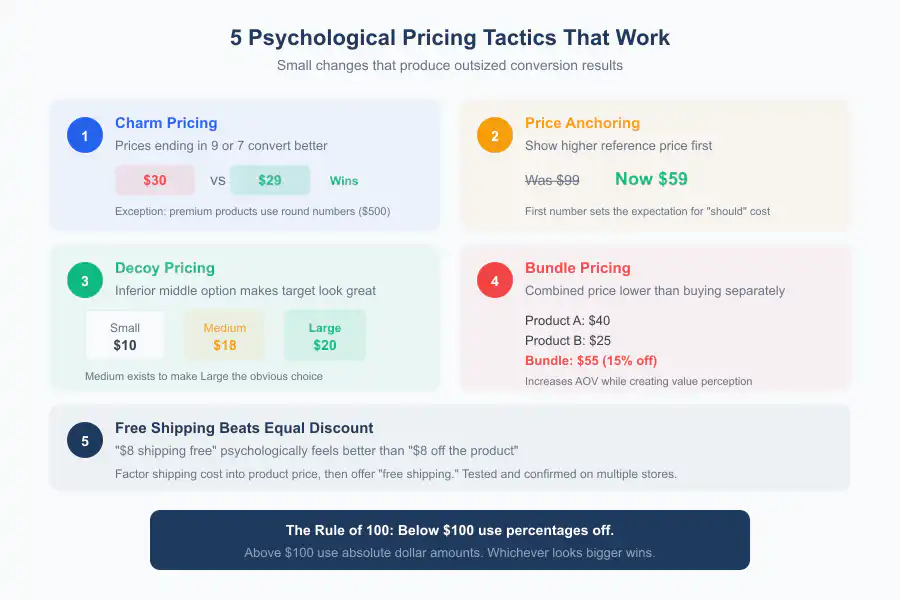
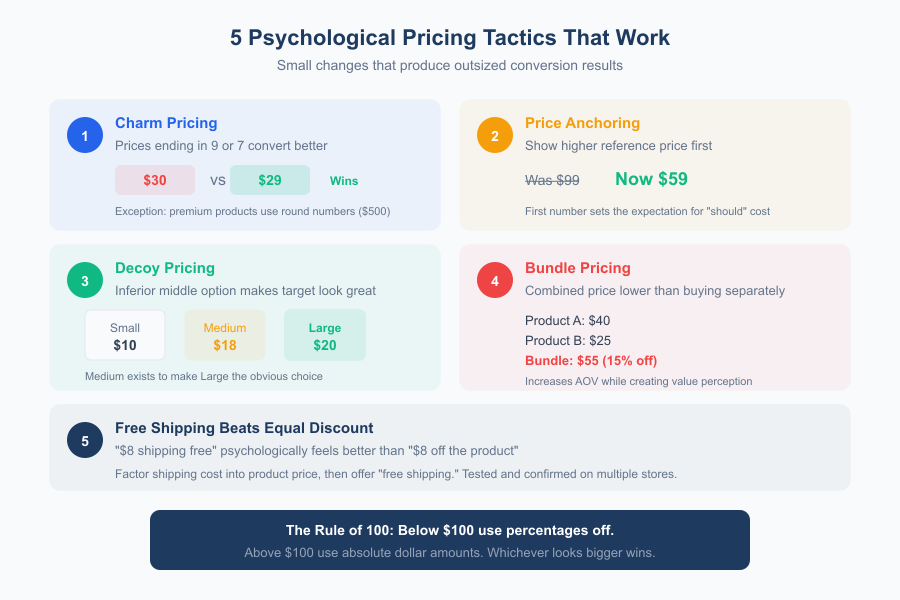
Charm pricing uses prices ending in 9 or 7. $29 versus $30. $47 versus $50. Research consistently shows these prices convert better despite minimal actual difference. I’ve tested this on client stores, and the conversion lift is real. Not massive, but consistent.
Price anchoring shows higher reference prices to make actual prices seem reasonable. “Was $99, now $59” uses the $99 anchor to make $59 feel like a deal. MSRP serving as anchor for sale prices works the same way. The first number a customer sees sets their expectation for what the product “should” cost.
Decoy pricing offers an inferior option that makes the target option look better. A small for $10, medium for $18, large for $20 makes large the obviously best value. The medium exists to make large look good. Nobody is supposed to pick the medium. This technique works remarkably well for subscription tiers and bundled products.
Bundle pricing combines products at a lower combined price than buying separately. Increases average order value while creating perception of value. I use this on my own product pages. Bundling a main product with a complementary accessory at 15% off the combined price consistently outperforms selling them separately.
Prestige pricing uses round numbers for premium products. $500 versus $499 signals quality and removes bargain-hunting associations. If you’re positioning something as premium, charm pricing actually undermines you. The round number communicates confidence.
Price perception matters beyond actual price. How prices are displayed, framed, and communicated affects willingness to pay in ways that most operators underestimate completely.
I’ve tested pricing changes on dozens of client stores. The single biggest mistake I see is pricing too low out of fear. In most cases, a 10-15% price increase results in zero measurable drop in conversions. Test it. You’re probably leaving money on the table right now.
Dynamic Pricing
Dynamic pricing means adjusting prices based on demand, competition, or customer characteristics. Airlines and hotels have used it for decades. E-commerce is catching up fast.
Demand-based adjustments are the most straightforward version. Raise prices when demand is high during holidays or viral moments. Lower prices when demand is weak in off-season periods or for overstocked items. This is basic supply and demand, applied in real-time.
Competitive response means monitoring competitor prices and adjusting accordingly. Maintain your position relative to competitors without constant manual monitoring. This matters most for commodity categories where customers comparison-shop aggressively.
Time-based pricing means different prices at different times. Flash sales, limited-time offers, seasonal adjustments. The urgency element drives conversion that static pricing can’t match.
Personalized pricing adjusts based on customer data. Returning customers might see different prices than new visitors. This is legal but increasingly controversial and subject to growing regulation. I’d approach this one carefully.
Implementation tools include platforms like Prisync, Competera, and Intelligence Node that automate price monitoring and adjustment. Many e-commerce platforms now include built-in dynamic pricing features as well.
The risk with dynamic pricing is real: customers notice inconsistent pricing and feel manipulated. Price matching promises and social media make price inconsistency visible quickly. Use dynamic pricing carefully and with clear rationale you could defend publicly.
Promotional Pricing
Discounts reduce price temporarily to stimulate sales. Effective for clearing inventory, acquiring customers, or driving volume. But dangerous when overused, because you end up training customers to wait for the next sale.
Percentage off (20% off) works better for low-price items. Absolute amounts ($50 off) work better for high-price items. The “Rule of 100” is useful here: below $100, use percentages. Above $100, use absolute amounts. The version that looks like the bigger number wins.
Free shipping often converts better than an equivalent dollar discount. “$8 shipping free” psychologically feels better than “$8 off the product.” I’ve tested this on multiple client stores, and free shipping wins almost every time. Factor shipping into product price so you can offer “free shipping” without eating the cost.
Buy-one-get-one (BOGO) increases volume effectively for consumables and gift-able items. Cost per item decreases, encouraging stocking up. Works particularly well for products with high repeat purchase rates.
Loyalty discounts reward repeat customers specifically. Early access, exclusive discounts, or points programs. These build retention without degrading prices for new customers. Your best customers should feel the value of coming back.
Flash sales create urgency through time limitation. Effective for clearing inventory and generating revenue spikes. But overuse diminishes impact fast. If every week has a “flash sale,” nothing feels urgent anymore.
A few discount rules I follow religiously: have clear objectives for every promotion. Set end dates and stick to them. Track true profitability after discounts, not just revenue lift. And always monitor whether discounts actually grow profit or just move the same revenue forward in time.
Price Testing
Assumptions about price sensitivity are often wrong. Customers may pay more than you think. I’ve seen store owners leave 20-30% margin on the table because they never tested higher prices. Testing reveals actual willingness to pay.
A/B testing prices shows different prices to different visitors and measures conversion and revenue at each price point. There are ethical concerns about showing different customers different prices, so be thoughtful about implementation.
Sequential testing changes prices over time and measures impact. Cleaner ethically but confounded by time-based factors like seasonality and market shifts. You need enough volume in each period for meaningful comparison.
Conjoint analysis surveys customers about product feature and price combinations. This reveals relative value of different attributes including price. Useful for new product launches where you have no sales data.
Elasticity measurement calculates how quantity demanded changes with price. Elastic products where quantity changes significantly with price require different strategies than inelastic products. Understanding your elasticity is one of the most valuable things you can learn about your market.
What should you test? Base price levels. Discount depth effectiveness. Free shipping thresholds. Bundle configurations. Subscription versus one-time pricing. Start testing on products where you have enough volume for statistical significance, then apply learnings across your catalog.
Multi-Channel Pricing
Selling across multiple channels creates a specific pricing challenge: same product, different prices, confused customers.
Channel-specific costs genuinely differ. Amazon takes 15%+ in fees. Your website has marketing costs but no platform fees. Wholesale accounts expect different margins. Prices may legitimately need to differ across channels.
Minimum Advertised Price (MAP) policies set floors for retailer pricing. They protect brand value and prevent the race to the bottom. Common in consumer electronics and other branded goods. If you’re a brand owner, having MAP policies is worth the effort.
A few channel strategies that work. Same price everywhere with different value-adds per channel. Different prices with clear rationale like exclusives or channel-specific bundles. Lowest price on owned channels to drive direct relationships. And market-specific pricing for international channels where purchasing power varies.
Price monitoring tools track how other retailers price your products. Essential for brand owners with distribution. You need to know when someone is undercutting your MAP.
Subscription and Recurring Pricing
Subscribe-and-save offers a discount for recurring orders. Amazon pioneered this at scale. It increases customer lifetime value and revenue predictability. Typically 5-15% discount for subscription commitment. The customer saves money. You gain predictable revenue. Both sides win.
Membership pricing, like Costco or Amazon Prime, charges upfront for access to better prices. Works when customers make enough purchases to justify membership cost. The membership fee itself becomes revenue with near-100% margin.
Subscription boxes deliver curated products on schedule. Pricing includes product value plus curation and convenience. Often positioned against the retail price of products purchased individually to demonstrate value.
Recurring revenue fundamentally changes business economics. Higher customer lifetime value justifies higher acquisition costs. Retention metrics become the numbers that matter most.
When pricing subscriptions, balance these tensions: low enough to minimize churn but high enough to maintain profitability. Offer flexibility for pause or skip options since they reduce cancellation better than discounts do. And annual options improve both retention and cash flow. I generally recommend offering both monthly and annual, with annual priced at roughly 10 months of monthly cost.
International Pricing
Going global adds layers of complexity to pricing decisions.
Currency matters. Should you price in local currency? It reduces friction for customers but creates exchange rate exposure for you. Larger markets justify local currency pricing. Smaller markets may not.
Purchasing power parity means the same USD price may be expensive in one country and cheap in another. Consider adjusting for local affordability, especially for digital products where marginal cost is near zero.
Regional pricing is common for digital products. Software costs less in India than the US. Physical products have different cost structures by market due to shipping, duties, and local competition.
The competitive landscape differs by market. Your premium positioning in one country may be commodity positioning in another where local alternatives dominate. Research each market independently before assuming your home-market pricing translates.
Transparency is worth noting: customers increasingly notice and resent large regional price differences. The internet makes pricing visible globally, so extreme disparities invite backlash.
Pricing for Profitability
Revenue isn’t the goal. Profit’s. A few frameworks that keep the focus where it belongs.
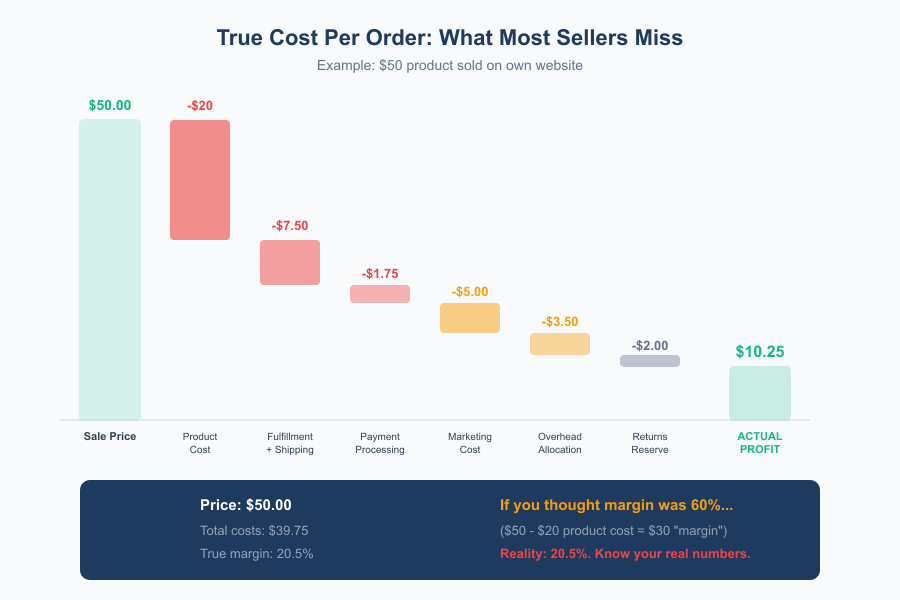
Contribution margin equals price minus variable costs. This is what each sale contributes to covering fixed costs and generating profit. Know this number for every product.
Your target contribution margin depends on your business model. High-volume, low-margin businesses might target 20-30%. Premium brands might target 60-70%. Neither is wrong. They’re just different strategies.
Lifetime value pricing means accepting lower margins on first purchase to acquire a customer you know will buy again. If customers average three purchases, you can afford to break even on purchase one. This is how many subscription businesses think about pricing.
Portfolio pricing recognizes that not every product needs to stand alone profitably. Loss leaders drive traffic. High-margin products subsidize low-margin ones. The portfolio as a whole must be profitable, not necessarily each individual SKU.
Price increases deserve special attention. Most businesses underprice and are afraid to raise prices. Test increases on segments of customers. Measure volume impact. Usually, volume loss is smaller than margin gain. I’ve helped clients raise prices 15-20% with single-digit percentage volume drops. Net result: significantly more profit.
Only compete on price when you have structural cost advantage. Otherwise, price competition destroys margins without creating sustainable advantage for anyone.
Common Pricing Mistakes
These are the patterns I see most frequently across the e-commerce operations I’ve analyzed.
Racing to the bottom. Matching every competitor price cut leads to margin destruction for the entire category. Compete on value, not just price. Someone will always be willing to go lower.
Ignoring costs completely. Pricing based only on competitors or customers without understanding your actual costs leads to unprofitable sales. I’ve seen stores generating impressive revenue and losing money on every order.
One-size-fits-all pricing. Same price for all customers regardless of volume, loyalty, or segment leaves money on the table. Enterprise customers will pay more for the same product if you add white-glove service.
Discounting as default strategy. Constant promotions train customers to wait for sales. It destroys brand value and margins simultaneously. If your store is always “on sale,” nothing is ever actually on sale.
Fear of price testing. Assuming customers won’t pay more without actually testing it. This is probably the most expensive mistake because it compounds quietly across every order you process.
Ignoring price presentation. How prices are displayed, framed, and communicated matters. Poor presentation undermines good pricing strategy. The same $49.99 price converts differently depending on context, visual design, and what it’s shown next to.
Not tracking true profitability. Revenue matters less than profit. Track margin after all costs, not just gross margin. Gross margin flatters. Net margin tells the truth.
Building Pricing Capability
Pricing deserves as much attention as product and marketing. The businesses that treat it seriously consistently outperform those that don’t.
Develop a pricing process. Set prices based on costs, competition, and value. Test and optimize regularly, not just at launch. Monitor competitive pricing changes. Review and adjust quarterly at minimum.
Create pricing governance. Who can change prices? Who approves discounts? What limits exist on promotional pricing? Clear authority prevents the chaotic discounting that destroys margins through well-intentioned but uncoordinated decisions.
Build pricing analytics. Track prices, margins, and volume over time. Understand what drives profitability. Identify optimization opportunities. Good accounting software helps you track the financial impact of your pricing decisions with precision.
Train anyone who touches pricing. Salespeople need discount authority limits. Marketing needs promotion guidelines. Everyone should understand the strategy and the guardrails. I’ve seen entire pricing strategies undermined by one team member offering unapproved discounts to close deals.
Ecommerce Pricing FAQ
Frequently Asked Questions
What is the best pricing strategy for e-commerce?
There is no single best strategy. Most successful e-commerce businesses combine approaches: cost-plus as a price floor so you never sell below cost, competitor-based pricing as a market reference, and value-based pricing as the ceiling based on customer willingness to pay. Then they run price tests to find the optimum. The best strategy depends on whether you sell commodities or differentiated products, your competitive position, and your brand positioning.
How do I know if my e-commerce prices are too low?
Test a 10-15% price increase on a product segment and measure conversion impact. In most cases, the volume drop is smaller than the margin gain. If raising prices does not significantly hurt conversion rates, your prices were too low. Other signs include high conversion rates with low margins, customers never mentioning price as a concern, and competitors charging significantly more for similar products. Most e-commerce businesses are underpriced because owners fear losing customers.
What is psychological pricing and does it actually work?
Psychological pricing uses cognitive biases to influence purchase decisions. Charm pricing ($29 vs $30) consistently converts better despite minimal actual difference. Price anchoring shows higher reference prices to make actual prices seem reasonable. Decoy pricing offers an inferior middle option that makes the target option look better. Bundle pricing increases average order value. Prestige pricing uses round numbers for premium products. These techniques produce small but consistent conversion lifts that compound across your catalog.
Should I match competitor prices in e-commerce?
Only if you sell identical commodity products where customers comparison-shop aggressively. For differentiated products, compete on value rather than price. Matching every competitor price cut triggers a race to the bottom that destroys margins for the entire category. Understand why competitors price as they do before reacting. They might be clearing inventory, buying market share at a loss, or operating with structurally lower costs. Compete on price only when you have a structural cost advantage.
How often should I run sales and discounts?
Less often than most businesses do. Constant discounting trains customers to wait for the next sale and destroys both margins and brand value simultaneously. Reserve promotions for specific objectives like clearing inventory, acquiring new customer segments, or driving seasonal volume. Have clear objectives for every promotion, set end dates and stick to them, and track whether discounts increase actual profit rather than just revenue. If your store is always on sale, nothing is ever actually on sale.
What is dynamic pricing and should I use it?
Dynamic pricing adjusts prices based on demand, competition, or time. Demand-based adjustments raise prices during peak periods and lower them during slow periods. Competitive response monitors competitor pricing and adjusts accordingly. Time-based pricing creates urgency through flash sales and seasonal offers. Dynamic pricing can optimize revenue but risks customer trust if prices seem inconsistent or manipulative. Use it carefully with defensible rationale. Personalized pricing based on customer data is increasingly controversial and subject to regulation.
How do I handle pricing across multiple sales channels?
Channel-specific costs genuinely differ. Amazon takes 15% or more in fees while your own website has marketing costs but no platform fees. Strategies that work include same price everywhere with different value-adds per channel, different prices with clear rationale like channel exclusives, and lowest price on your owned channels to drive direct relationships. If you are a brand owner, Minimum Advertised Price (MAP) policies protect brand value and prevent a pricing race to the bottom among your retailers.
What is contribution margin and why is it more important than revenue?
Contribution margin equals price minus all variable costs including product cost, fulfillment, transaction fees, and shipping. This is what each sale actually contributes toward covering fixed costs and generating profit. Many e-commerce businesses celebrate revenue milestones while losing money on every order. Know your contribution margin for every product category. A 1% improvement in pricing typically has 2 to 4 times more impact on profitability than a 1% improvement in volume or cost reduction.