
Burn Rate and Runway: How to Calculate and Manage Both
Every startup founder eventually learns these two numbers the hard way. Burn rate tells you how fast you’re spending money. Runway tells you how long before the money runs out. Together they determine whether you have time to succeed or whether you’re racing toward a cliff with your eyes closed.
I’ve watched companies with great products die because they misunderstood these metrics. They burned too fast assuming funding would come. They cut too late after the market turned. They celebrated revenue growth while their runway quietly shrunk to months. One client came to me excited about hitting $50K MRR… then I showed them their net burn meant they had four months of cash left. Understanding burn rate and runway isn’t optional for anyone building a business. These metrics are essential whether you’re a startup founder or a freelancer building a sustainable career.
What Is Burn Rate?
Burn rate measures how quickly your company spends cash. It’s typically calculated monthly. If you start the month with $500,000 and end with $450,000, your burn rate is $50,000 per month. Simple math. But the implications of that number are anything but simple.
There are two types, and confusing them is one of the most common mistakes I see.
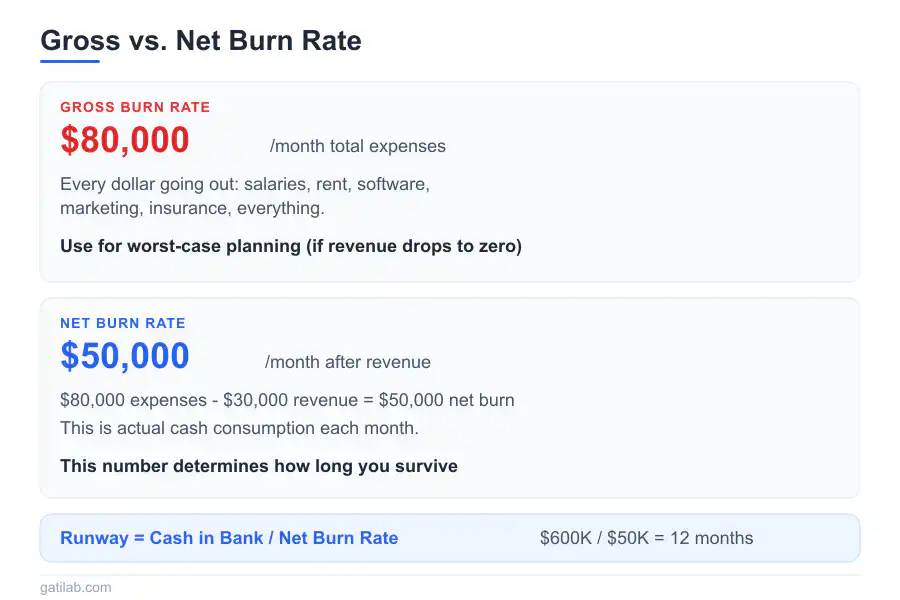
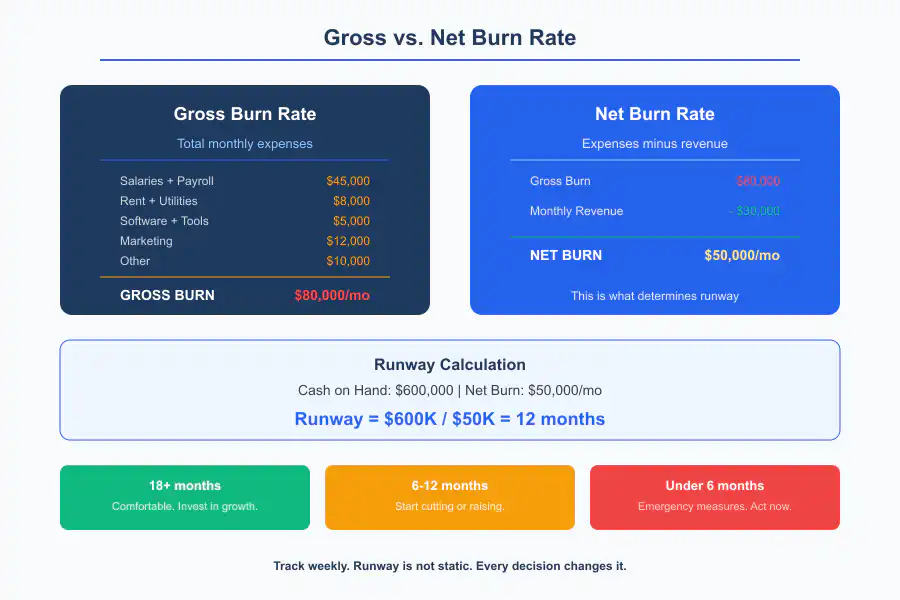
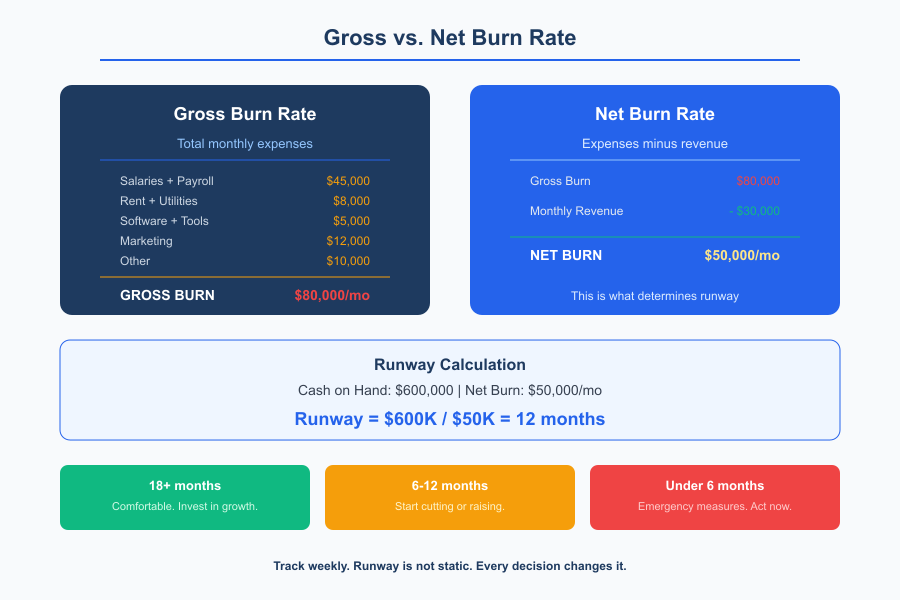
Gross burn rate is your total monthly expenses. Every dollar going out: salaries, rent, software, marketing, everything. This shows the full cost of operations. It’s the number you need for worst-case planning, because if revenue suddenly disappeared, this is what you’d still owe.
Net burn rate accounts for revenue. If you spend $80,000 monthly but bring in $30,000, your net burn is $50,000. This is the number that matters most because it shows actual cash consumption. It’s the number that determines how long you survive.
The formula is straightforward:
Net Burn Rate = Total Monthly Expenses – Total Monthly Revenue
Or equivalently:
Net Burn Rate = (Starting Cash – Ending Cash) / Number of Months
For early-stage companies with minimal revenue, gross and net burn are nearly identical. As revenue grows, net burn shrinks. Profitability means negative burn, meaning you’re generating more than you spend. That’s the goal. But getting there takes longer than almost everyone expects.
What Is Runway?
Runway is how long your money lasts at current burn rate. It’s your survival timeline.
Runway = Current Cash / Net Burn Rate
If you have $600,000 in the bank and burn $50,000 monthly, your runway is 12 months. You have a year to either become profitable or raise more funding.
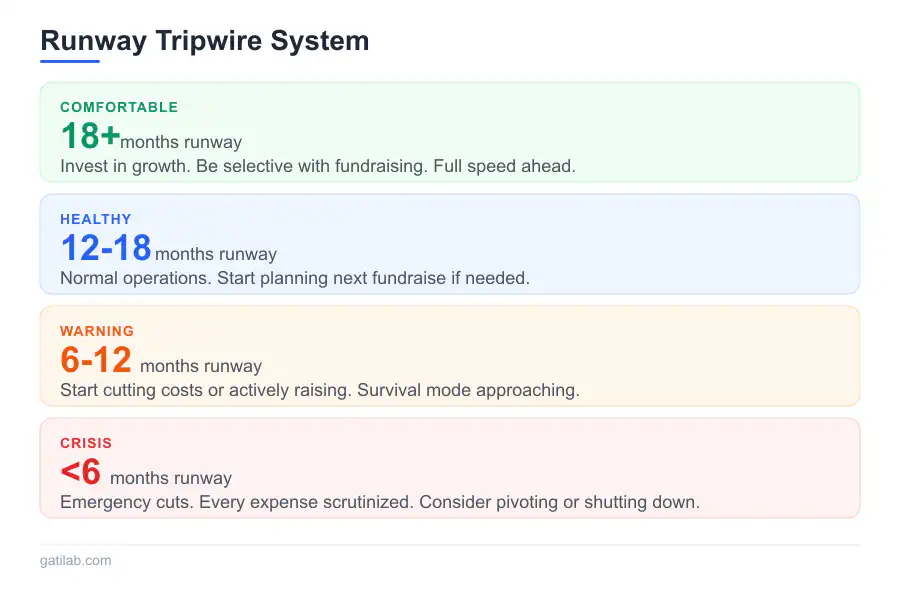
This simple calculation drives massive decisions. With 18 months of runway, you can invest in growth. With 6 months, you’re in survival mode. With 3 months, you’re in crisis. I’ve seen all three, and the decisions people make at each stage are completely different.
Runway isn’t static. It changes with every financial decision, every new customer, every hire. Smart founders track it obsessively. I check mine weekly. Not because I’m anxious, but because surprises in runway calculations are the kind you can’t afford.
Burn rate tells you how fast you’re spending. Runway tells you how long you can survive. Together, they’re the most important financial metrics for any startup or freelance business.
I check my burn rate monthly without exception. The businesses that fail aren’t the ones with bad ideas. They’re the ones that ran out of cash before the idea could work. Knowing your numbers isn’t optional.
Why These Metrics Matter
They determine survival. Companies don’t fail because they run out of ideas. They fail because they run out of cash. Burn rate and runway tell you exactly how much time you have. Every other business problem is solvable with enough runway. Without it, nothing else matters.
They drive fundraising timing. Raising capital takes 3-6 months typically. If you start with 8 months of runway, you might be raising from a position of desperation. Start with 18 months, and you can be selective. The difference in terms you’ll get is enormous.
They inform hiring decisions. Every hire increases burn rate. A $120,000 salary, with benefits and overhead, might add $15,000 monthly to burn. That’s meaningful when you’re watching runway. I’ve seen founders hire aggressively after a funding round only to realize each new hire shortened their runway by a month.
They signal to investors. Investors evaluate burn rate relative to progress. High burn with strong metrics suggests efficient growth. High burn with stagnant metrics suggests problems. I’ve sat in board meetings where the only question that mattered was “what are you getting for your burn?”
They force prioritization. Limited runway concentrates minds. You can’t pursue everything. Burn rate pressure clarifies what actually matters. Constraints breed focus, and there’s no constraint more clarifying than “we have 9 months of cash.”
Calculating Your Burn Rate
Start with a clear categorization of expenses.
Fixed costs don’t change much monthly. Salaries and payroll taxes, office rent and utilities, software subscriptions, insurance, loan payments. These are predictable and form the baseline of your burn.
Variable costs fluctuate. Contractor payments, marketing spend, sales commissions, hosting costs for usage-based services, travel and events. These are where you have the most control when you need to cut.
One-time costs shouldn’t be included in monthly burn. Equipment purchases, security deposits, legal fees for incorporation. Including these inflates your burn rate and gives you a misleading picture of ongoing expenses.
For accurate burn calculation: sum all regular monthly expenses, exclude one-time costs or amortize them across many months, calculate an average if months vary significantly, and subtract revenue for net burn.
A common mistake is using income statement data directly. Accounting expenses with depreciation, accruals, and other adjustments differ from cash expenses. Burn rate is about cash. Use actual bank account changes for accuracy. I learned this the hard way when my accounting showed healthy margins while my bank balance told a different story.
What’s a Good Burn Rate?
Context determines everything. A pre-revenue startup with $2 million raised burning $100,000 monthly has 20 months of runway, which is reasonable for finding product-market fit. A company with $50,000 MRR burning $100,000 monthly is losing $50,000 net. That might be fine if growth justifies it, or it might be a slow walk toward a cliff.
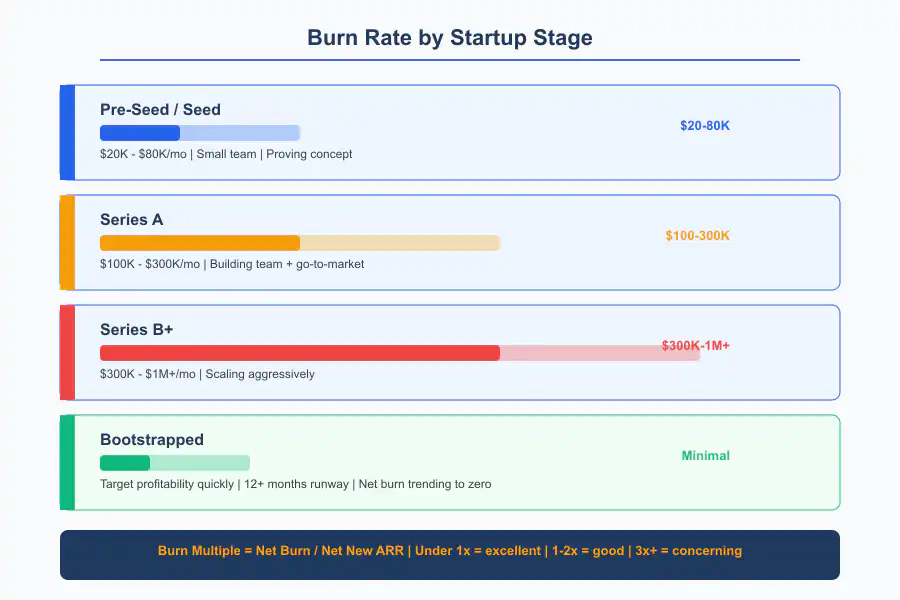
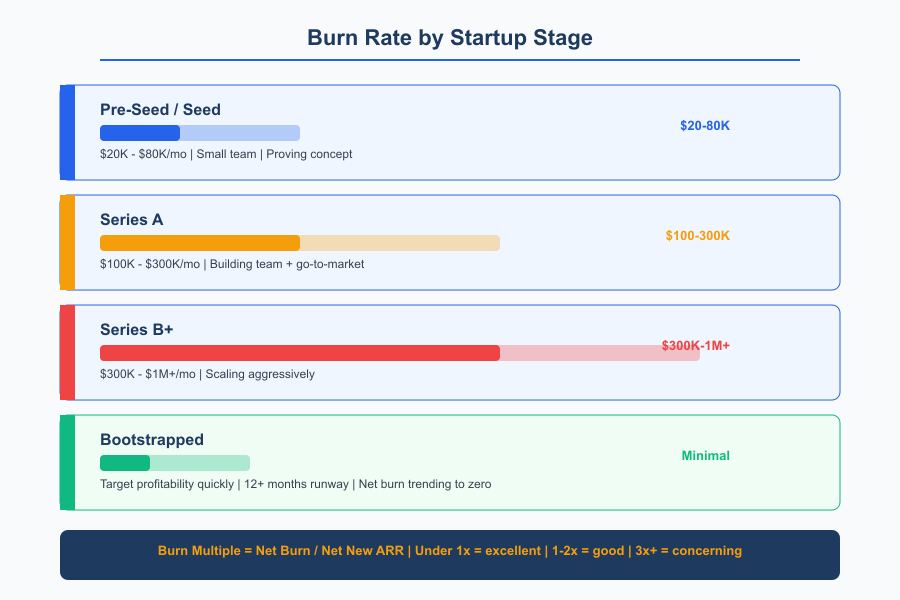
Some benchmarks for venture-backed companies.
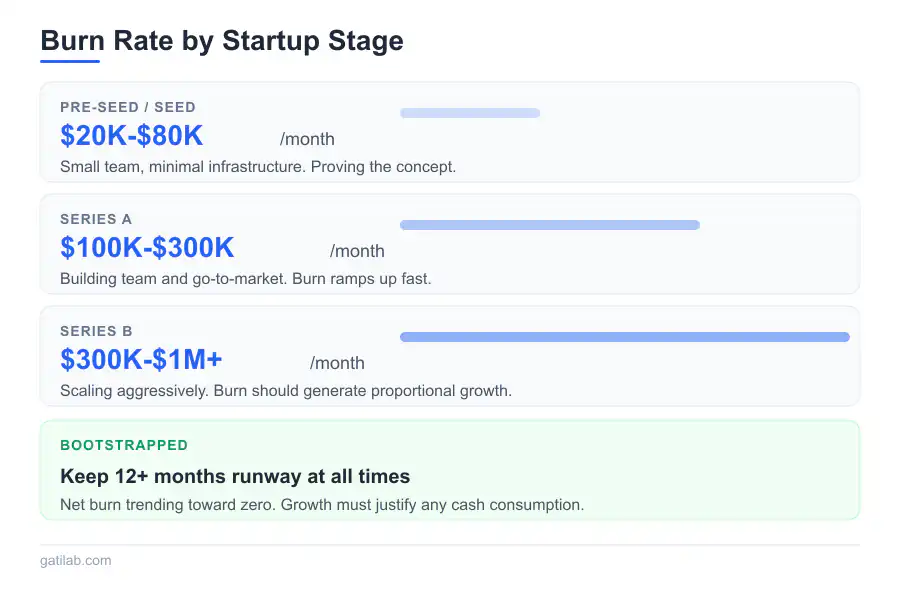
Pre-seed and Seed stage companies typically burn $20,000-$80,000 monthly. Small teams, minimal infrastructure. You’re proving the concept with as little overhead as possible.
Series A companies burn $100,000-$300,000 monthly. Building out team and go-to-market. This is where burn ramps up fast because you’re hiring.
Series B companies burn $300,000-$1,000,000+ monthly. Scaling aggressively. At this point, the burn should be generating proportional or better growth.
For bootstrapped companies, the calculus differs entirely. Without fundraising safety nets, many founders target keeping 12+ months runway at all times, net burn trending toward zero, and growth rate that justifies any cash consumption. I’ve always operated closer to the bootstrapped model, even when working with funded companies. It forces discipline that funded companies often lack.
The Rule of 40 offers another lens: growth rate plus profit margin should exceed 40%. High burn is acceptable if growth is proportionally high.
Managing Runway
Track weekly, not monthly. A lot changes in 30 days. Weekly cash position tracking catches trends early. I’ve seen situations where a monthly review would have missed a critical deterioration until it was too late.
Maintain buffer. Plans fail. Revenue projections miss. Target 18+ months runway when possible. Below 12 months, start cutting or raising. This buffer isn’t paranoia. It’s recognizing that business reality rarely matches the spreadsheet.
Know your break-even. Calculate the revenue needed to reach net-zero burn. This is your survival target if fundraising fails. Every founder should know this number cold and be able to recite it without looking at a spreadsheet.
Model scenarios. What if revenue grows 50% slower? What if a key customer churns? What if fundraising takes 9 months instead of 4? Stress-test your runway. The founders who survive downturns are the ones who already modeled them.
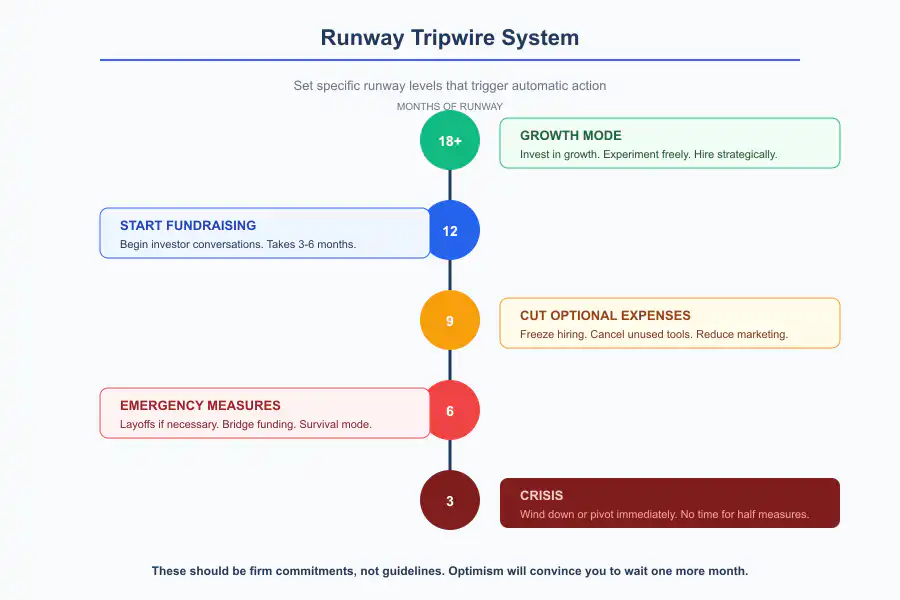
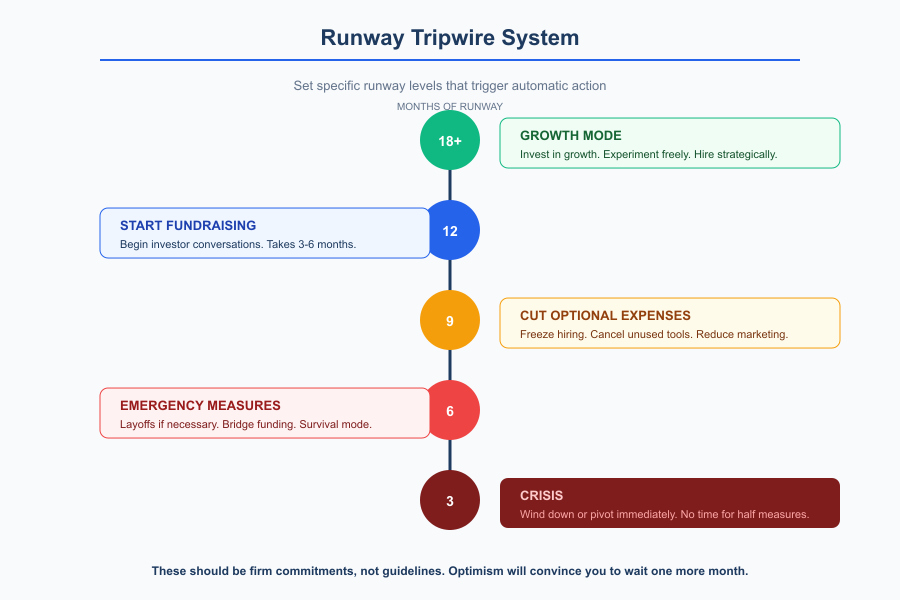
Have tripwires. Set specific runway levels that trigger action. At 12 months, start fundraising conversations. At 9 months, begin cutting optional expenses. At 6 months, emergency measures. These shouldn’t be guidelines. They should be firm commitments. Because when you’re in the moment, optimism will convince you to wait one more month.
Extending Runway
When runway gets uncomfortable, you have two options: increase revenue or decrease expenses. Usually both, simultaneously.
Revenue acceleration means shifting resources to sales and marketing, launching pricing experiments, targeting larger customers, reducing sales cycle time, and converting annual payments with discounts. The annual payment approach is one of my favorites because it immediately improves cash position even if the total contract value is slightly lower.
Expense reduction means freezing hiring, reducing marketing spend, renegotiating contracts, cutting non-essential tools, and considering salary reductions. I once audited a startup’s software subscriptions and found $12,000 per month in tools that nobody was actively using. That’s runway sitting in unused SaaS dashboards.
One-time cash injections include bridge funding from existing investors, revenue-based financing, convertible notes, asset sales, and government grants. These buy time, but they don’t fix the underlying economics. Think of them as breathing room, not solutions.
The hardest decisions involve people. Layoffs are painful but sometimes necessary. The alternative, running out of money entirely, is worse for everyone. I’ve seen founders delay layoffs for months out of loyalty, then lose the entire company because they ran out of cash. Cutting early and deep enough to survive is kinder than slow-rolling toward zero.
Burn Rate and Growth Trade-offs
Higher burn often means faster growth. Spending on marketing, sales, and product development accelerates revenue. But not always proportionally, and this is where founders get into trouble.
The key question: What’s your burn multiple?
Burn Multiple = Net Burn / Net New ARR
If you burned $600,000 last quarter and added $200,000 in ARR, your burn multiple is 3x. You spent $3 to generate $1 in recurring revenue.
Benchmarks tell the story clearly. Under 1x is exceptional efficiency. Between 1-2x is good. Between 2-3x is acceptable for early stage. Over 3x is potentially problematic. I’ve seen startups celebrate growth while operating at 5x burn multiple. That math doesn’t work, no matter how impressive the top-line numbers look.
High burn is justified when it generates proportional or better growth. Burning $1 million monthly while adding $500,000 monthly ARR might be reasonable. Burning $1 million while adding $50,000 isn’t sustainable no matter how you frame it.
Burn Rate Mistakes
Ignoring one-time costs. That $200,000 equipment purchase doesn’t repeat monthly. Including it overstates burn. But ignoring all one-time costs understates capital needs. Amortize them sensibly and track them separately.
Forgetting pending expenses. Annual payments, quarterly taxes, and upcoming hires affect future burn. Current monthly rate doesn’t capture these. I’ve seen founders project runway based on current burn while ignoring three planned hires that would increase burn 40%.
Celebrating gross metrics. Revenue grew 50%! But expenses grew 80%. Net burn increased even as the business looked healthier on the surface. This is how businesses grow themselves into bankruptcy.
Over-optimistic projections. Assuming revenue will grow 30% monthly while expenses stay flat. Revenue projections disappoint more often than expenses surprise. Model conservatively. Hope for the best, plan for what actually happens.
Delaying hard decisions. “We’ll cut next month if things don’t improve.” Things rarely improve magically. Early small cuts beat late desperate ones. Every month you wait’s a month of runway you won’t get back.
Runway for Different Business Types
Pre-revenue startups should have 18-24 months runway minimum. Everything takes longer than expected. Product development, first sales, iteration based on feedback. Burning through runway before finding product-market fit’s the most common startup failure mode, and it’s almost always because founders underestimated how long the search would take.
Post-revenue SaaS can operate with 12-18 months runway if growth is strong. Predictable recurring revenue makes planning easier. But even 20% MoM growth doesn’t help if burn is 3x revenue. The revenue has to be growing faster than the burn, or the math doesn’t converge.
Bootstrapped businesses should target profitability quickly. Without investor funding, runway is whatever personal savings the founder has plus any revenue. Most successful bootstrapped companies are profitable within the first year. That constraint, while scary, often produces better businesses.
Enterprise sales companies need longer runways. Sales cycles are 6-12 months. Runway needs to accommodate multiple sales cycles before revenue materializes. I’ve seen enterprise-focused startups die with a full pipeline because the deals closed one quarter after the cash ran out.
Communicating Burn to Stakeholders
Investors want context, not just numbers. “We burn $80,000 monthly” means nothing without knowing what you get for it. Growth rates, customer acquisition, product milestones… these justify burn. Present burn as investment, then prove the return.
Board members need trend information. Is burn increasing or decreasing? Is efficiency improving? Are you hitting milestones that justify the spend? They’ve seen enough companies to know when burn is productive and when it’s wasteful. Give them the data to see the difference.
Employees should understand the business reality without causing panic. Transparency about runway motivates focus. But framing matters. “We have 14 months to hit milestones” differs from “we’re running out of money.” Same information, completely different impact on morale and decision-making.
Yourself needs honest assessment. Founder optimism is valuable but dangerous when it blinds you to financial reality. I’ve had to force myself to look at worst-case scenarios rather than the scenarios I wanted to see.
Seasonal and Irregular Burn
Not all months are equal. Annual payments, quarterly bonuses, and seasonal hiring create lumpy expenses.
Calculate annual burn and divide by 12 for planning purposes. But track monthly actuals to catch trends. The average is useful for strategic planning. The actuals are what determine whether you survive this specific month.
Create a 12-month expense forecast including regular monthly expenses, quarterly items like tax payments and bonuses, annual items like insurance renewals and subscription bumps, and planned increases from new hires and expanded marketing.
This forward-looking view beats backward-looking averages for runway calculation. I update mine every two weeks. It’s not glamorous work, but it’s the kind of work that keeps businesses alive.
The Psychology of Burn
Limited runway creates pressure. This isn’t always bad.
Some pressure sharpens focus. Teams stop debating and start shipping. Nice-to-have features get cut. Sales velocity increases. The constraint of limited time produces clarity that unlimited time never does.
Too much pressure causes mistakes. Desperation deals at terrible terms. Premature pivots away from strategies that needed more time. Talent departures because good people can read the room.
The sweet spot is enough runway to think clearly but not so much that urgency disappears. Many investors deliberately fund 18-24 months rather than 36+ for this reason. They’ve learned that too much runway can be almost as dangerous as too little.
Building Burn Rate Discipline
Budget monthly. Set expected expenses and track against them. Variance analysis reveals where money goes. It’s tedious, but the businesses that survive long enough to succeed are the ones that know their numbers.
Approve expenses above thresholds. Not every purchase needs founder approval. But significant ones should. Set a threshold, say $500, below which team members can spend freely. Above that, require approval.
Review subscriptions quarterly. SaaS tools accumulate. That $50/month here and $200/month there adds up to real money. I make it a quarterly ritual to export every subscription charge and justify each one. Usually at least one or two don’t survive the review.
Tie spending to metrics. Marketing spend should connect to CAC and pipeline. Hiring should connect to capacity and output. If you can’t draw a line from the expense to a measurable outcome, question whether it’s necessary.
Make burn visible. When the team knows the numbers, they make better decisions. Hidden metrics create hidden inefficiency. Good accounting software makes tracking burn rate straightforward and keeps everyone honest.
Startup Finances FAQ
Frequently Asked Questions
What is the difference between gross and net burn rate?
Gross burn rate is your total monthly expenses, every dollar going out including salaries, rent, software, and marketing. Net burn rate subtracts revenue from expenses. If you spend $80,000 monthly but bring in $30,000, your net burn is $50,000. Net burn is what matters for runway calculations because it shows actual cash consumption. For early-stage companies with minimal revenue, both numbers are nearly identical.
How do I calculate my startup runway?
Runway equals current cash divided by net burn rate. If you have $600,000 and burn $50,000 monthly, your runway is 12 months. Track this weekly, not monthly, because a lot changes in 30 days. Use actual bank account changes for accuracy rather than accounting data with depreciation and accruals. Runway is about cash, not accounting profit.
How much runway should a startup maintain?
Pre-revenue startups should maintain 18-24 months minimum because everything takes longer than expected. Post-revenue SaaS companies can operate with 12-18 months if growth is strong. Bootstrapped businesses should target profitability quickly since runway is limited to personal savings plus revenue. Enterprise sales companies need longer runways because sales cycles run 6-12 months before revenue materializes.
What is burn multiple and why does it matter?
Burn multiple equals net burn divided by net new ARR. If you burned $600,000 last quarter and added $200,000 in ARR, your burn multiple is 3x, meaning you spent $3 to generate $1 in recurring revenue. Under 1x is exceptional. Between 1-2x is good. Between 2-3x is acceptable for early stage. Above 3x suggests you are spending inefficiently relative to growth and the math may not work long term.
When should I start raising more funding based on runway?
Start raising when you have 12-18 months of runway remaining. Fundraising typically takes 3-6 months. Starting early lets you negotiate from strength rather than desperation. The difference in terms you get is enormous between raising with 18 months of runway versus 6 months. Set specific tripwires: at 12 months start conversations, at 9 months begin cutting optional expenses, at 6 months take emergency measures.
How do I extend runway when cash is running low?
Two paths: increase revenue or decrease expenses, usually both simultaneously. Revenue acceleration includes shifting resources to sales, pricing experiments, targeting larger customers, and offering annual payment discounts. Expense reduction includes freezing hiring, cutting marketing spend, renegotiating contracts, and canceling unused tools. Bridge options include funding from existing investors, revenue-based financing, and convertible notes. These buy time but do not fix underlying economics.
What are the most common burn rate mistakes?
Five frequent mistakes: ignoring one-time costs versus ongoing costs and miscalculating true monthly burn, forgetting pending expenses like annual payments and planned hires, celebrating gross revenue growth while net burn actually increases, making over-optimistic projections that assume revenue grows 30% monthly while expenses stay flat, and delaying hard decisions with the hope that things will magically improve next month. Each wasted month is runway you cannot get back.
How should I communicate burn rate to investors and team?
Investors want context: present burn as investment and prove the return through growth rates, customer acquisition, and product milestones. Board members need trend information about whether efficiency is improving. Employees should understand business reality without panic. Frame it as milestones to hit rather than money running out. Be honest with yourself. Founder optimism is valuable but dangerous when it blinds you to financial reality.