
Freelance Pricing for Long-Term Sustainability: Rates and Models
Most freelancers underprice their work. Not dramatically, just enough to survive but not thrive. They charge what feels “reasonable,” cover immediate expenses, and never build the financial foundation that makes a career sustainable. Ten years in, they’re still worried about next month’s rent.
I know because I was one of them. For the first three years of freelancing, I charged rates that barely covered expenses. I told myself I was “building a portfolio.” What I was actually building was a habit of undervaluing my work that took years to break.
Sustainable pricing isn’t about maximizing every dollar. It’s about setting rates that support a long career: covering expenses, building reserves, funding retirement, handling slow periods, and leaving room for life outside work. Prices that let you work for decades without burnout, desperation, or constant financial anxiety.
Here’s how to calculate and implement rates that actually sustain a freelance career. For a broader foundation, see the guide on building a sustainable freelance career.
The True Cost of Freelancing
What you need to earn versus what employees earn. This is the math that changed everything for me.
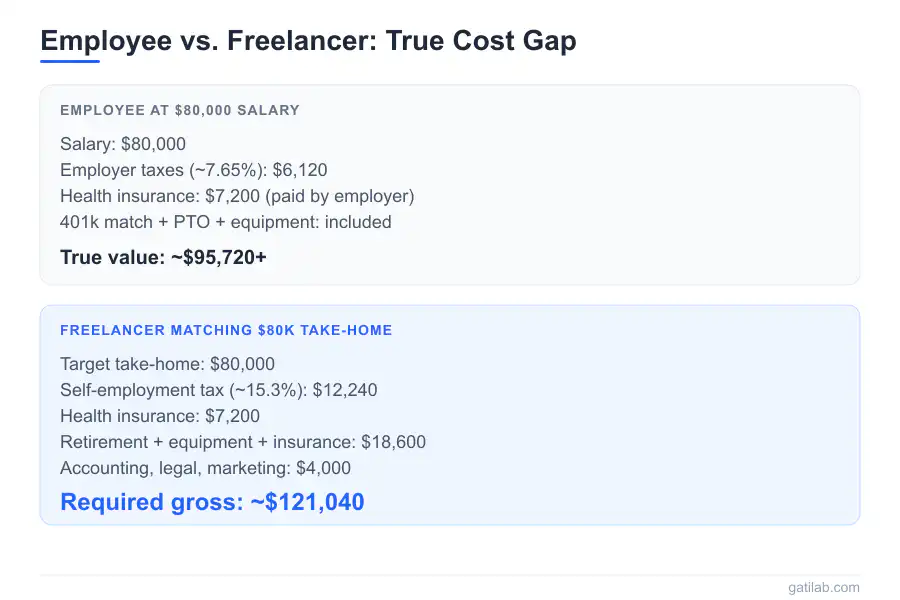
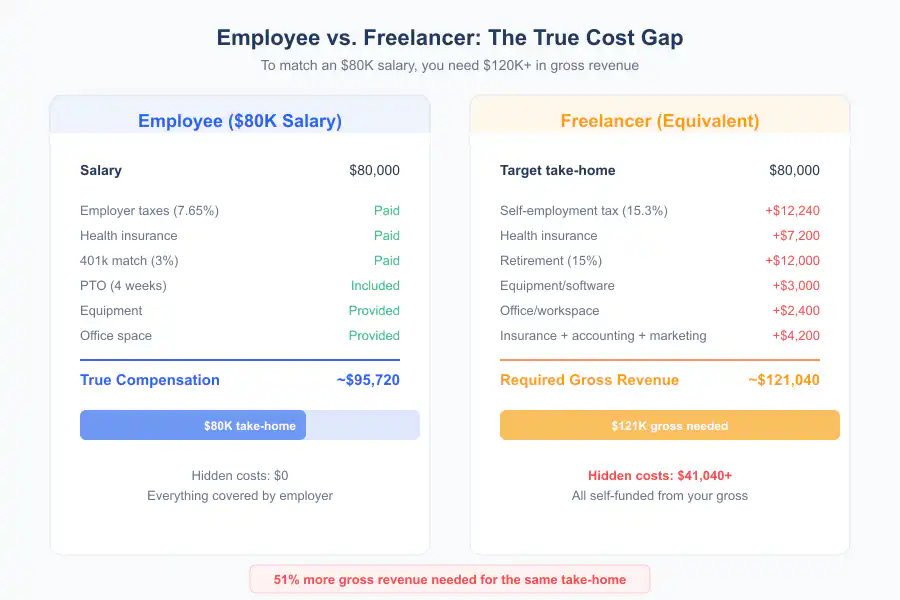
Employee at $80,000 salary:
Salary: $80,000
Employer taxes (~7.65%): $6,120
Health insurance (~$7,200/year): paid by employer
401k match (3%): $2,400
PTO (4 weeks): included
Equipment: provided
Office space: provided

True compensation value: ~$95,720+
Freelancer earning equivalent:
Target take-home: $80,000
Self-employment tax (~15.3%): $12,240
Health insurance: $7,200
Retirement contribution (15%): $12,000
PTO equivalent (4 weeks): need to earn in 48 weeks
Equipment/software: $3,000
Office/workspace: $2,400
Business insurance: $1,200
Accounting/legal: $2,000
Marketing: $1,000

Required gross revenue: ~$121,040
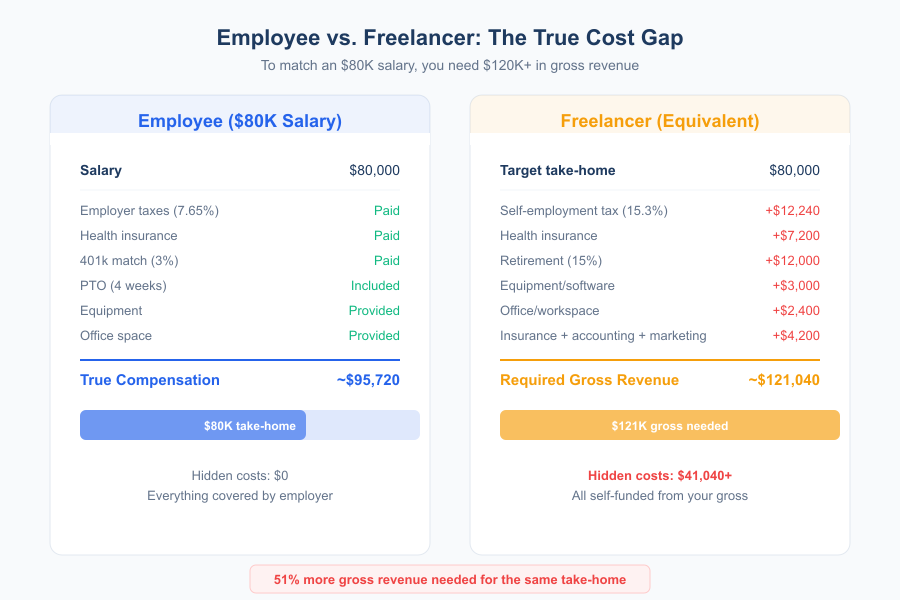
To match an $80,000 salary, you need to gross $120,000+. Most freelancers don’t account for this. I didn’t for years. When I finally ran these numbers honestly, I realized I’d been subsidizing my business with my savings account and calling it a career. That spreadsheet was a rough morning.
The Hidden Costs Most Freelancers Miss
Beyond the obvious expenses, several costs erode freelance income invisibly.
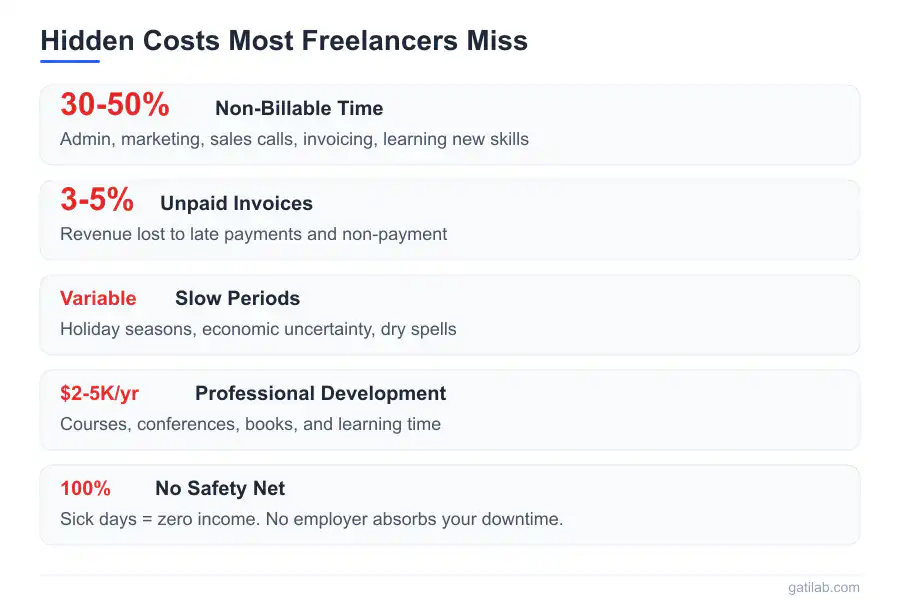
Non-billable time. You won’t bill 40 hours weekly. Administrative work, marketing, sales calls, invoicing, and professional development consume 30-50% of working time. If you bill 25 hours weekly, that’s your real capacity for calculating rates. Not 40. Not 35. Twenty-five.
Unpaid invoices. Some clients pay late. Some don’t pay at all. Factor in 3-5% of revenue lost to collection issues. This isn’t pessimism. It’s reality. I’ve written off about $15,000 in unpaid invoices over my career. It happens to everyone.
Slow periods. Even successful freelancers experience dry spells. Holiday seasons slow down. Economic uncertainty affects client spending. Build capacity for the months that don’t go as planned.
Professional development. Skills require maintenance and growth. Courses, conferences, books, and learning time cost money and time. Stagnant skills eventually mean stagnant (or declining) rates. The WordPress ecosystem moves fast. If you stop learning, you stop being worth premium rates.
Health and unexpected expenses. No employer absorbs your sick days. A week of illness is a week without income. Equipment failures, family emergencies, and unexpected costs all require financial cushion.
If you’re charging $50-75/hour right now, run the math above with your actual numbers. The gap between what you charge and what you need to sustain a career is probably wider than you think. I’ve seen this realization hit hundreds of freelancers, and it’s always uncomfortable. But it’s the first step to fixing it.
Calculating Your Sustainable Rate
Work backwards from your needs. Not your wants. Your actual, non-negotiable needs for a career that lasts.
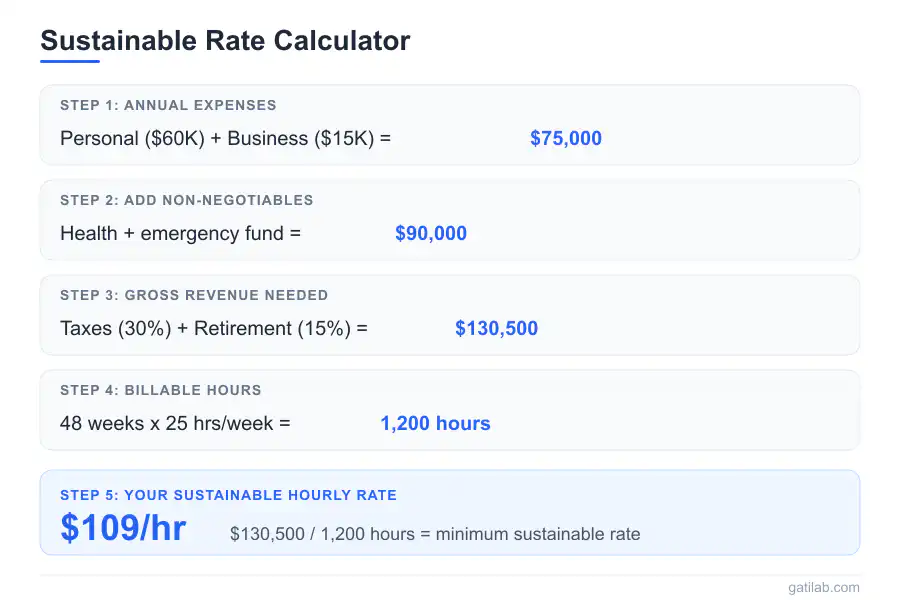
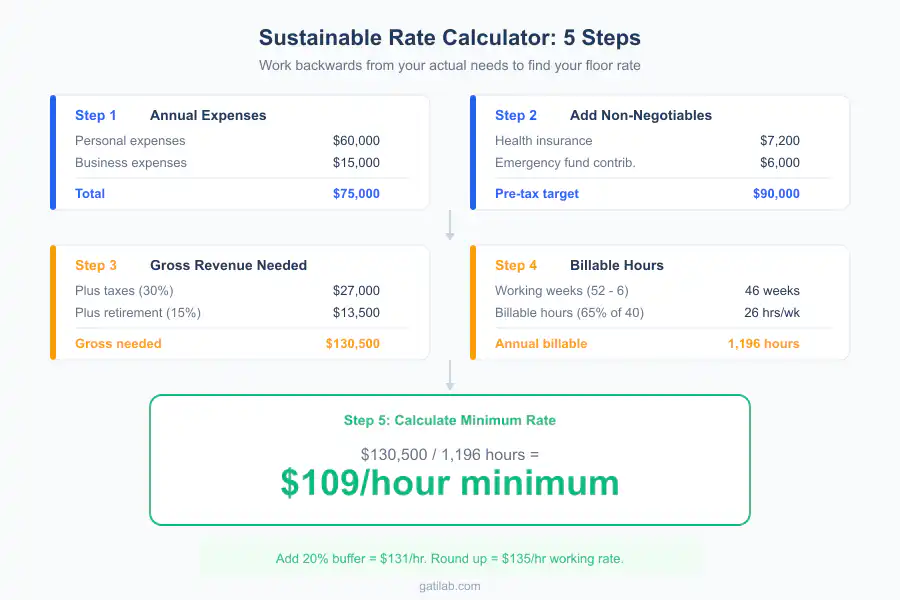
Step 1: Annual expenses
Personal expenses: $60,000
Business expenses: $15,000
Total: $75,000
Step 2: Add non-negotiables
Taxes (30% of gross): calculated after
Health insurance: $7,200
Retirement (15%): calculated after
Emergency fund contribution: $6,000
Annual: ~$90,000 pre-tax, pre-retirement
Step 3: Calculate gross needed
Pre-tax/retirement target: $90,000
Plus taxes (30%): $27,000
Plus retirement (15%): $13,500
Gross revenue needed: ~$130,500
Step 4: Determine billable hours
Weeks per year: 52
Vacation/holidays/sick: 6 weeks
Working weeks: 46
Hours per week: 40
Billable percentage: 65%
Billable hours per week: 26
Annual billable hours: 1,196
Step 5: Calculate minimum rate
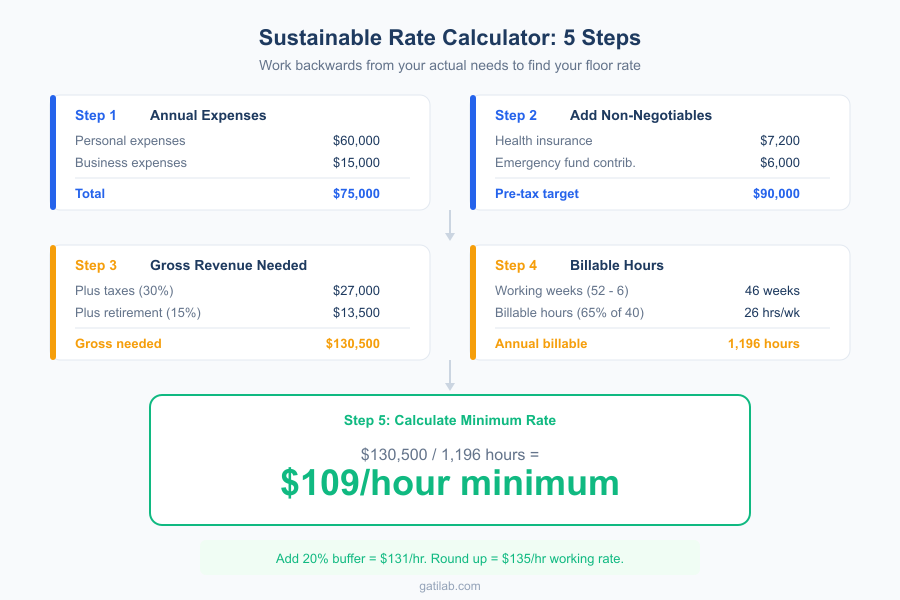
$130,500 / 1,196 hours = $109/hour minimum
That’s your floor. The minimum rate to cover a sustainable career. Not aspirational. Necessary. And if you’re charging $50-75/hour right now? The math doesn’t work. You’re slowly going broke and might not realize it yet.
Adjusting the Formula for Your Situation
Your numbers will differ. Here’s how to customize.
Higher cost of living. Urban freelancers in expensive cities need higher personal expense numbers. San Francisco or London rates should significantly exceed rural rates. Same work, different cost realities.
Family responsibilities. Dependents increase insurance costs, emergency fund needs, and financial obligations. Single freelancers with low expenses can work with lower minimums, but shouldn’t assume their situation stays that way forever.
Risk tolerance. Conservative freelancers want larger emergency funds and retirement contributions. Those with working spouses or alternative income can accept more risk. Know which category you fall into.
Career stage. Early-career freelancers building portfolios might accept lower rates temporarily. That’s a strategy, not a permanent state. Established freelancers with proven track records should command premiums.
Specialization premium. Rare skills in high demand justify rates well above the minimum. Your floor is your floor, not your target. The target should be significantly higher.
Building in Buffer
Your minimum rate isn’t your working rate. It’s your absolute floor. Here’s why you need buffer above it.
Why you need buffer:
Slow periods hit everyone. Not every month is fully booked. Client payments are sometimes late. Projects get cancelled or delayed.
Unexpected expenses happen. Equipment failures. Health issues. Business emergencies. Life doesn’t care about your billing schedule.
Growth investment matters. Training, better tools, marketing for future work. If every dollar goes to survival, nothing goes to growth. And without growth, you’re slowly falling behind.
The buffer calculation:
Minimum sustainable rate: $109/hour
Add 20% buffer: $131/hour
Round to professional number: $135/hour
Your actual rates should be $135/hour minimum. Less than that, you’re slowly depleting your resources. It might not show up this month or next month. But over 3-5 years, the gap compounds into real financial stress.
The Psychology of Buffer Pricing
Buffer isn’t padding for extra profit. It’s insurance against reality. Projects take longer than estimated. Scope creeps despite contracts. Clients need extra revisions. The buffer absorbs these realities without eroding your sustainability.
Freelancers without buffer end up working unpaid overtime, resenting clients, and burning out. Buffer protects both your finances and your professional relationships. I’ve seen the difference in my own work. When I’m not worried about money, I do better work. Better work leads to better clients. Better clients lead to better money. The cycle is either virtuous or vicious. Buffer is what tips it toward virtuous.
Rate Structures That Work
Different situations call for different approaches.
Hourly rates: Best for undefined scope, ongoing support, consulting.
Standard rate: $150/hour
Rush rate (< 1 week notice): $225/hour
Emergency rate (same day): $300/hour
Retainer rate (pre-purchased blocks): $135/hour
Project-based pricing: Best for defined deliverables, predictable scope.
Simple brochure site: $3,500-5,000
Standard WordPress site: $8,000-15,000
E-commerce (WooCommerce): $12,000-25,000
Custom development project: $15,000-50,000+
Value-based pricing: Best for high-impact projects with measurable ROI.
Instead of calculating hours, calculate value. What’s the project worth to the client? What problem does it solve? What revenue will it generate?
Price at a percentage of value delivered (10-20% is common). A website that generates $200,000 in annual revenue is worth more than an hourly calculation suggests. For a complete guide, see value-based pricing for services.
Retainer/recurring: Best for ongoing relationships, predictable revenue.
Maintenance plan: $299-799/month
Development retainer: $1,500-5,000/month
Strategic partnership: $5,000-10,000/month
Choosing the Right Structure
Match structure to project type and client relationship.
New clients with unclear scope: Hourly protects you from underestimating. Track time carefully. Use this data for future project pricing with similar clients.
Repeat clients with known patterns: Project or retainer pricing rewards your efficiency. You know how long things take. Capture the upside of your experience. Don’t punish yourself for being good at your job.
High-value transformational work: Value-based pricing captures appropriate compensation. A project that generates $200,000 for the client shouldn’t be priced at $5,000 just because it only took you 40 hours. Your expertise is what makes it possible.
Ongoing relationships: Retainers provide predictable income for you and predictable access for clients. Win-win when structured well. I converted most of my long-term clients to retainers. Best decision I’ve made for my business stability.
I converted most of my long-term clients to retainers, and it was the single best decision I’ve made for business stability. Predictable monthly revenue changes everything about how you plan, how you invest, and how well you sleep.
Raising Rates Strategically
Prices should increase over time. Your skills improve. Your efficiency increases. Inflation erodes buying power. If your rates haven’t gone up in two years, they’ve actually gone down in real terms.
When to raise rates:
Annually at minimum. Inflation alone justifies 3-5%. Your skills and efficiency improve yearly. Cost of living increases whether you raise rates or not.
After major skill increases. New specialization, significant training completed, portfolio-worthy project finished. These milestones justify bigger jumps.
When demand exceeds capacity. If you’re consistently booked out and turning away work, the market is telling you your rates are too low. Listen to it.
How to raise rates:
For new clients, simply quote higher rates. No explanation needed. They don’t know your old rates. I test new pricing with every new inquiry.
For existing clients, give advance notice:
Subject: Rate Adjustment for [Year]

Hi [Name],

I'm writing to let you know about an upcoming adjustment
to my rates, effective April 3, 2026.

My hourly rate will increase from $135 to $150. This
reflects increased expertise, improved processes, and
market adjustments.

For projects already in progress or quoted, current rates
will apply. New work starting after April 3, 2026 will use
updated pricing.

Thank you for your continued partnership.

[Your name]
Give advance notice (60-90 days). Frame as adjustment, not apology. Don’t over-explain. Expect some pushback. It’s normal.
Handling Objections to Rate Increases
“That’s more than we budgeted.” “I understand. These are my current rates. If budget is a concern, we could discuss adjusting scope to fit.”
“Can we keep the old rate?” “For ongoing work, I’m happy to honor current rates through April 3, 2026. New work after that will be at updated rates.”
“We’ll find someone cheaper.” “I understand. If budget is the primary constraint, that makes sense. I wish you well with the project.”
“Other freelancers charge less.” “There are freelancers at every price point. My rates reflect my experience, reliability, and the results I deliver. I’m confident in the value I provide.”
Don’t negotiate against yourself. State your rates. Some clients accept. Others don’t. Both outcomes are fine. The clients who stay at higher rates are almost always better to work with. I’ve seen this pattern across hundreds of conversations.
Avoiding the Race to the Bottom
Compete on value, not price. The price war is one you can never win because someone is always willing to work for less.
Why competing on price fails:
- Someone’s always cheaper (there’s always a newer freelancer willing to work for less)
- Cheap prices attract the most difficult clients
- You can’t sustain quality at bottom rates
- It’s a death spiral that ends in burnout or quitting
What to compete on instead:
Expertise. Deep specialization in specific areas. Problems you’ve solved before. Industry knowledge that generic freelancers don’t have.
Reliability. Consistent communication. Meeting deadlines. Predictable quality. I’ve won more clients through reliability than through any other factor. It’s shockingly rare.
Experience. Pattern recognition from past projects. Avoiding common mistakes. Efficient problem-solving that comes from doing this for years, not months.
The positioning statement: Instead of: “I build WordPress websites.” Try: “I build WooCommerce stores for subscription businesses that need reliable recurring billing.”
Specificity creates value perception. Value perception supports premium pricing. This is why WordPress freelancing works so well when you specialize within the platform. You stop being a commodity and start being a specialist.
Finding Your Premium Positioning
Track your wins. Which projects produced exceptional results? What do satisfied clients specifically praise? These patterns reveal your value proposition.
Identify your ideal client. Who pays well, refers others, and appreciates your work? Target more of them. Learn more about niche selection for consultants.
Document outcomes. Collect testimonials, case studies, and metrics. “Increased conversion by 34%” beats “built a nice website” every single time.
Invest in differentiation. Certifications, specialized training, and unique methodologies create justified premium positioning. The investment pays for itself within a few clients.
The Long-Term View
Sustainable pricing supports a decades-long career. Here’s what the trajectory looks like.
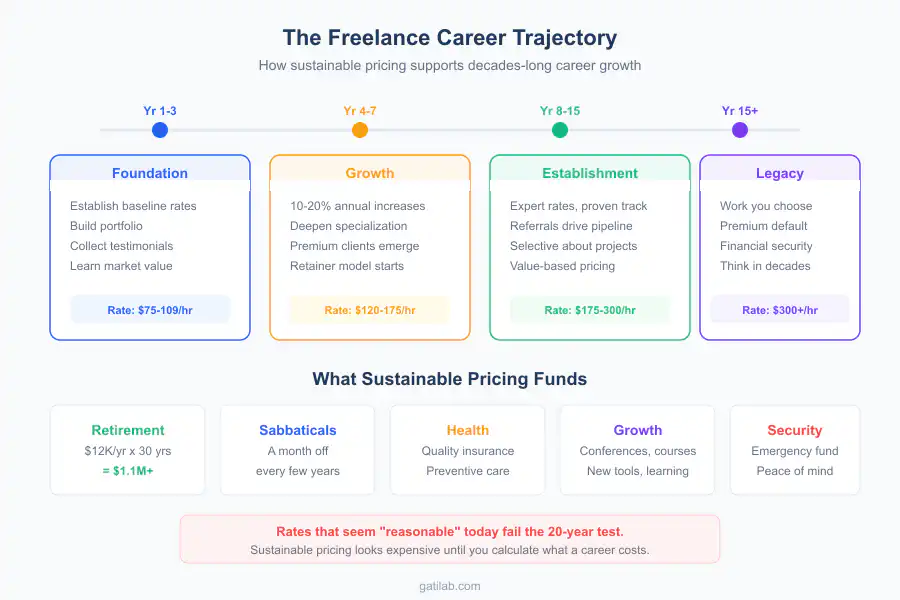
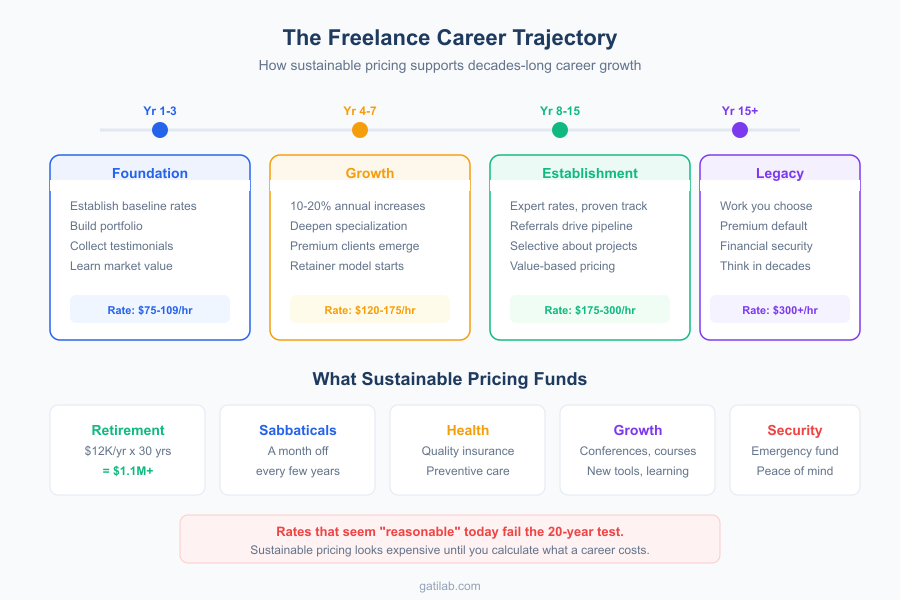
Year 1-3: Foundation
- Establish baseline rates above your calculated floor
- Build portfolio and collect testimonials
- Learn what you’re actually worth through market feedback
Year 4-7: Growth
- Regular rate increases (10-20% annually if demand supports it)
- Specialization developing and deepening
- Premium clients becoming your standard
Year 8-15: Establishment
- Expert rates justified by track record
- Strong reputation generating referrals
- Selectivity about which projects you take
Year 15+: Legacy
- Work you genuinely choose, not work you need
- Premium positioning as the default
- Financial security that lets you think in decades
What Sustainable Pricing Funds
Retirement:
$12,000/year for 30 years at 7% = $1.1+ million
Only possible with rates that allow 15% savings
This one keeps me up at night when I think about freelancers charging $40/hour. There’s no room for retirement savings at that rate. And the years pass faster than you think.
Sabbaticals. A month off every few years. Requires savings buffer. Impossible at survival rates.
Health. Quality insurance. Preventive care. Mental health support. These aren’t luxuries.
Family. Parental leave (self-funded). Flexibility for life events. Being present for important moments without checking email.
Professional development. Conferences and courses. New equipment and software. Time to learn and experiment without worrying about billable hours.
Security. Emergency fund for unexpected events. Cushion against slow periods. Peace of mind that enables better work. I can’t overstate how much better my work got once I stopped being anxious about money. The quality difference was immediate and obvious.
The Final Calculation
A career isn’t just next month’s bills. It’s:
- 20-40 years of work
- Transitions and pivots you can’t predict
- Health and family changes
- Retirement funding that compounds (or doesn’t)
- Unexpected challenges that arrive without warning
Rates that seem “reasonable” short-term often fail this long-term test. Sustainable pricing looks expensive until you calculate what it actually costs to have a career, not just a job.
Practical Implementation Steps
Starting the transition to sustainable pricing. This is the part where you actually do it.
Week 1: Calculate your numbers. Run through the formulas above with your actual expenses and goals. Know your minimum rate. Write it down. Look at it.
Week 2: Audit current clients. Which relationships are below your minimum? Which are sustainable? Categorize your portfolio honestly.
Week 3: Set new client rates. All new inquiries get your sustainable rate. No exceptions. Test the market’s response.
Week 4: Plan existing client transitions. Draft rate increase notices. Schedule them 60-90 days out. Begin with clients most likely to accept.
Month 2-3: Implement increases. Send notices. Have conversations. Accept that some clients will leave. The ones who leave were probably your most stressful clients anyway. That’s not a coincidence.
Month 4+: Evaluate and adjust. Are you booking at new rates? If yes, consider raising further. If struggling, examine positioning rather than cutting rates.
The transition takes time. Some short-term revenue may decrease as you shed underpriced work. Long-term sustainability requires this investment. Think of it as pruning. It looks like you’re losing something. You’re actually creating room to grow.
Set your rates for the freelancer you’ll be in 20 years, not just the bills you need to pay next month. Having the right tools for freelancers helps you work more efficiently at any rate. But no tool fixes rates that are fundamentally too low.
Pricing Strategy FAQ
Frequently Asked Questions
How do I calculate my minimum sustainable freelance rate?
Add all annual expenses (personal + business), then add taxes (~30%), health insurance, retirement savings (15%), and emergency fund contributions. Divide by realistic annual billable hours (typically 1,000-1,200). Add a 20% buffer for slow periods and unexpected costs. Most developers in developed countries calculate a minimum of $100-150/hour when they include everything honestly. Below that, you’re slowly depleting your financial resources.
Why do freelancers need to charge more than employees earn?
Freelancers pay self-employment tax (~15.3%), fund their own health insurance ($7,200+/year), retirement, equipment, software, and workspace. They also absorb 30-50% non-billable time for admin, marketing, and sales, plus face slow periods and unpaid invoice risk (3-5% revenue loss). To match an $80,000 salary’s true compensation value, a freelancer needs $120,000+ in gross revenue. The gap is much wider than most people realize.
What is a rate buffer and why do I need one?
A rate buffer is 20% added above your minimum sustainable rate. It absorbs reality: projects running over estimate, scope creep despite contracts, slow months, unexpected expenses, and growth investments. Without buffer, every small setback erodes sustainability. With it, your finances stay healthy through normal business volatility. If your minimum is $109/hour, your working rate should be $135/hour or higher.
How do I transition from low rates to sustainable rates?
Week 1: calculate your actual numbers. Week 2: audit which current clients are below your minimum. Week 3: quote sustainable rates to all new inquiries. Week 4: draft rate increase notices for existing clients, scheduled 60-90 days out. Months 2-3: send notices, have conversations, accept that some clients leave. Month 4+: evaluate and adjust. Some short-term revenue may decrease, but long-term sustainability requires this investment.
Should I use hourly, project-based, or retainer pricing?
Match structure to situation. Hourly protects you with new clients and undefined scope. Project-based rewards efficiency on defined deliverables. Retainers provide predictable recurring income for ongoing relationships. Many freelancers use all three: hourly for support requests, project pricing for builds, and retainers for long-term clients. The key is never going below your calculated floor regardless of structure.
How do I compete on value instead of price?
Specialize deeply in a specific area rather than being a generalist. Document outcomes with specific numbers: “increased conversion by 34%” beats “built a nice website.” Collect testimonials and case studies. Invest in certifications and specialized training. Position with specificity: “I build WooCommerce stores for subscription businesses” beats “I build WordPress websites.” Specificity creates value perception that supports premium pricing.
What if I lose clients when raising my rates?
Expect some turnover. This is healthy, not failure. Low-paying clients who leave create capacity for higher-paying ones. The math often works in your favor: losing two $50/hour clients and gaining one $100/hour client means same revenue with half the workload. Focus on replacing volume with value. The clients who leave are almost always the ones who caused the most stress. That correlation is not a coincidence.
What does sustainable pricing fund long-term?
Retirement savings ($12,000/year for 30 years at 7% equals $1.1+ million). Sabbaticals every few years. Quality health insurance and preventive care. Parental leave and family flexibility. Professional development through conferences and courses. Emergency funds for unexpected events. Peace of mind that enables better work quality. None of this is possible at survival rates of $40-50/hour. Sustainable pricing funds a career, not just next month’s bills.