
Saying No to Client Projects: When and How to Decline Work
Every freelancer eventually faces it: a project that doesn’t feel right. The scope is unclear, the budget is low, the client seems difficult, or you’re simply at capacity. But saying no feels risky. What if you need the money later? What if they badmouth you? What if this was actually a great opportunity in disguise?
Here’s what years of freelancing taught me: the projects you decline often matter more than the ones you accept. One bad project can consume months, damage your reputation, and crowd out work you actually want. Saying no isn’t just acceptable. It’s a professional skill you need to develop.
This guide covers when to decline, how to do it gracefully, and how to build the financial security that makes saying no possible. For foundational advice on building a sustainable freelance career, see the dedicated guide.
Red Flags That Signal “No”
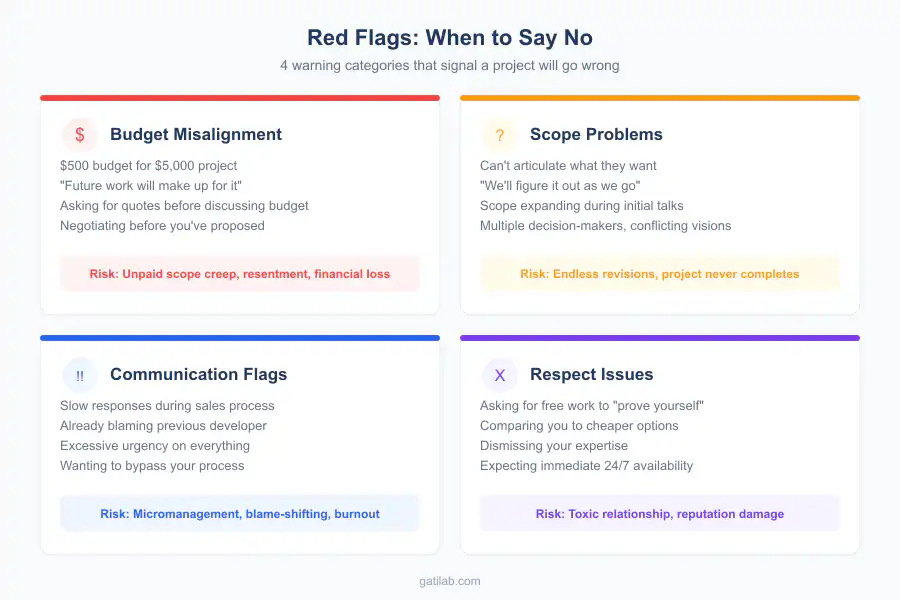
Learn to recognize warning signs before you’re committed. I’ve collected these over 16 years of client work, and they’re almost never wrong.
After enough projects, your subconscious processes signals your conscious mind misses. I’ve ignored my gut maybe five times. Regretted it every single time. Trust that instinct.
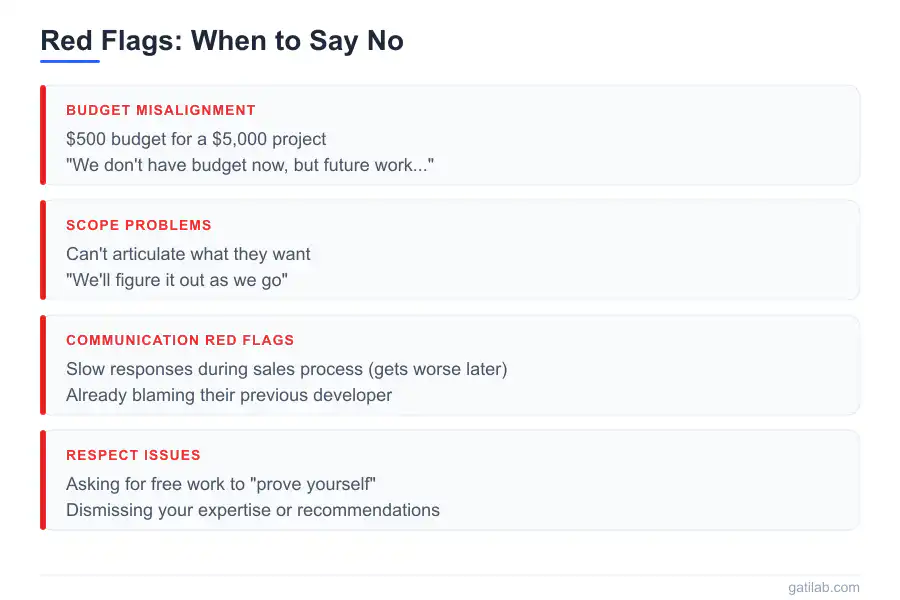
Budget misalignment:
- They have $500 for a $5,000 project
- “We don’t have much budget now, but future work…”
- Asking for detailed quotes before discussing budget at all
- Negotiating before you’ve even proposed
Scope problems:
- Can’t articulate what they want
- “We’ll figure it out as we go”
- Scope keeps expanding during initial conversations
- Multiple decision-makers with conflicting visions
Communication red flags:
- Slow responses during the sales process (it only gets worse during the project)
- Already blaming their previous developer
- Excessive urgency on everything
- Wanting to bypass your process
Respect issues:
- Asking for free work to “prove yourself”
- Comparing you unfavorably to cheaper options
- Dismissing your expertise or recommendations
- Expecting immediate availability at all hours
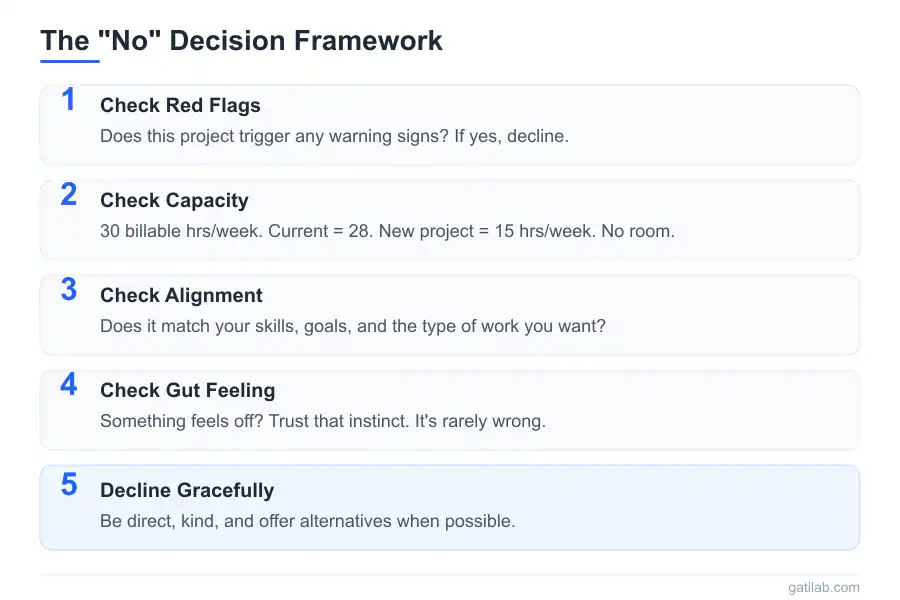
Gut feeling: Sometimes you can’t articulate why, but something feels off. Trust that instinct. After enough projects, your subconscious processes signals your conscious mind misses. I’ve ignored my gut maybe five times. Regretted it every single time.
When You’re at Capacity
Being too busy is a legitimate reason to decline. And honestly? It should be your most common one.
Signs you’re actually at capacity:
- Working more than your target hours consistently
- Missing deadlines on existing projects
- Quality suffering on current work
- No time for business development
- Personal life being neglected
Why overcommitting hurts everyone:
- Current clients get less attention
- New clients get rushed work
- You burn out
- Your reputation suffers on all fronts
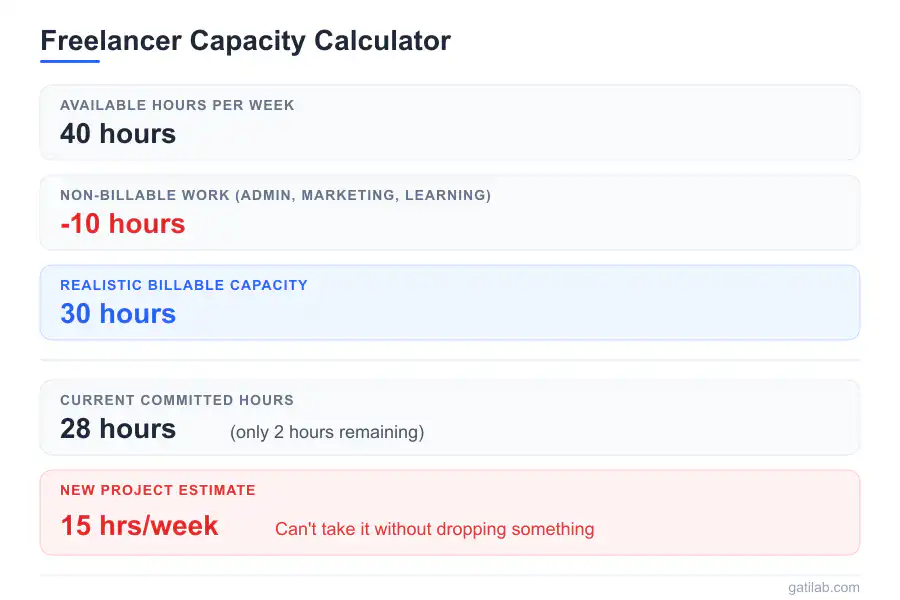
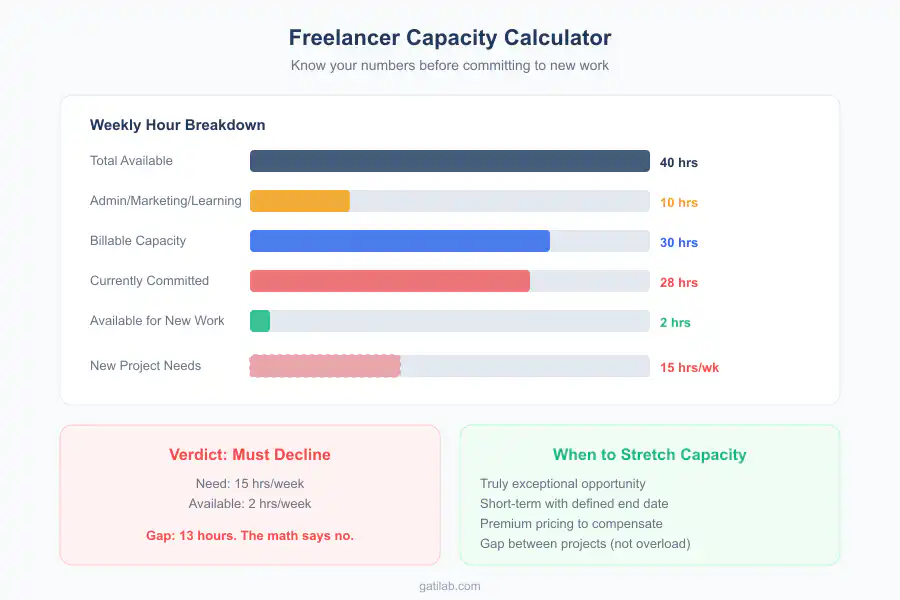
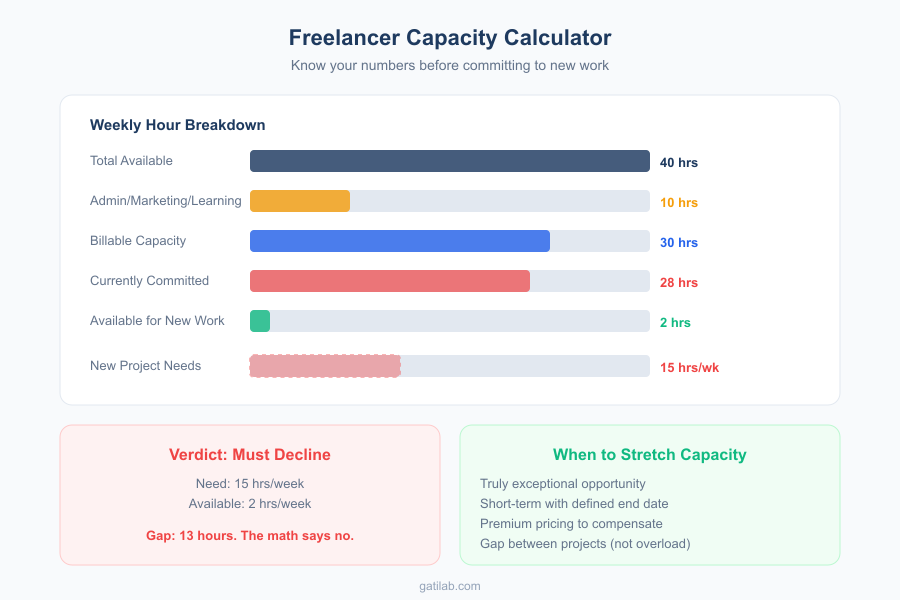
The capacity calculation:
Available hours per week: 40
Non-billable work (admin, marketing, learning): 10
Realistic billable capacity: 30 hours

Current committed hours: 28
New project estimate: 15 hours/week for 4 weeks
Decision: Can't take it without dropping something
Look, the math doesn’t lie. When the numbers say no, trust them.
When to stretch capacity:
- Truly exceptional opportunity (and you’re honest about what “exceptional” means)
- Short-term crunch with a defined end date
- Gap between projects, not ongoing overload
- Premium pricing to compensate for the squeeze
Financial Position Affects Your Choices
You can only say no when you can afford to. This is the part nobody wants to talk about.
Every saved dollar is a “no” you can say. Without reserves, you take questionable projects because you need money. With 3-6 months of expenses saved, you choose projects based on fit, not desperation.
Building the “no” fund:
- 3-6 months of expenses in reserve
- This is your freedom money
- Every saved dollar is a “no” you can say
How it changes decisions: Without reserves: “I should take this even though I have concerns because I need the money next month.”
With reserves: “I can pass on this questionable project because I’m not desperate.”
The difference between those two positions? Night and day.
The desperation trap: Taking bad projects because you need money leads to more bad projects because you’re too busy recovering from the first one to find good work. I’ve been in this cycle. It’s brutal. Break it by building reserves during good times.
Pricing supports saying no: Higher prices = fewer clients needed = more selectivity possible. Raise prices gradually, accept fewer projects, increase quality of work and clients. Our guide on value-based pricing explains how.
How to Actually Say No
The mechanics of declining gracefully. I’ve used each of these templates dozens of times.
The basic formula:
- Thank them for reaching out
- Decline clearly (no ambiguity)
- Brief reason (optional but helpful)
- Referral if possible
- Leave door open for future
Template: Budget mismatch
Hi [Name],

Thanks for sharing more about your project. After reviewing the requirements,
I don't think I'm the right fit for this one—my rates would put the project
well above your budget range.

I'd recommend checking [resource/person] for developers who might be better
aligned with your budget.

Best of luck with the project.

[Your name]
Template: At capacity
Hi [Name],

Thank you for thinking of me for this project. Unfortunately, I'm fully
committed to existing clients through [timeframe] and couldn't give your
project the attention it deserves.

If your timeline is flexible, I'd be happy to reconnect in April when
I have availability. Alternatively, [colleague name] does excellent work
and might have capacity.

[Your name]
Template: Red flags detected
Hi [Name],

I appreciate you taking the time to discuss this project. After our
conversation, I don't think I'm the right fit for what you're looking for.

I wish you the best in finding the right developer for your needs.

[Your name]
Note: You don’t owe detailed explanations for red flag situations. Keep it brief and professional. The less you explain, the less they can negotiate.
Template: Wrong type of work
Hi [Name],

Thanks for reaching out. This sounds like an interesting project, but it's
outside my area of focus. I specialize in [your specialty] and wouldn't be
able to deliver the expertise you need for [their need].

For [their need], I'd suggest looking at [resource/specialist].

[Your name]
What Not to Do
Common mistakes when declining. I’ve made most of these at least once.
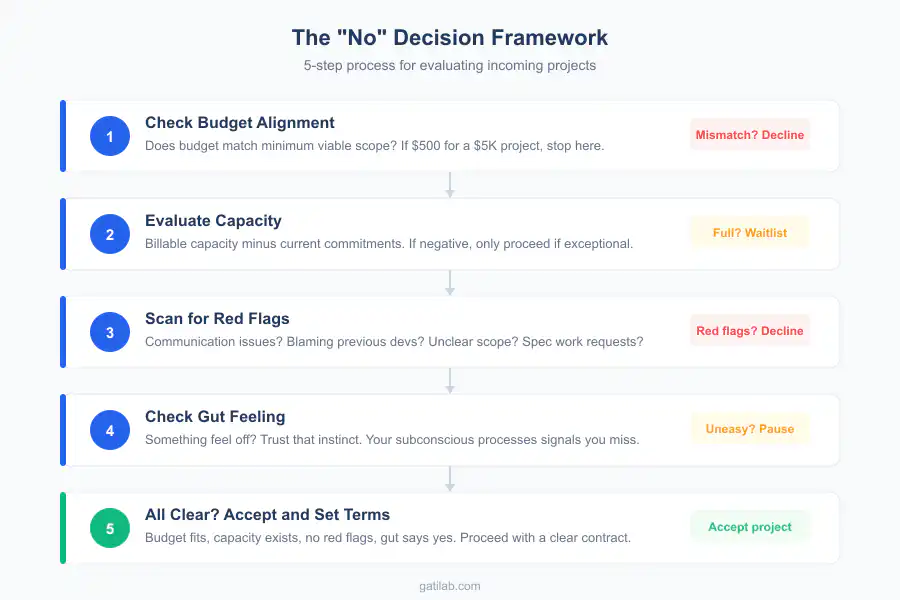
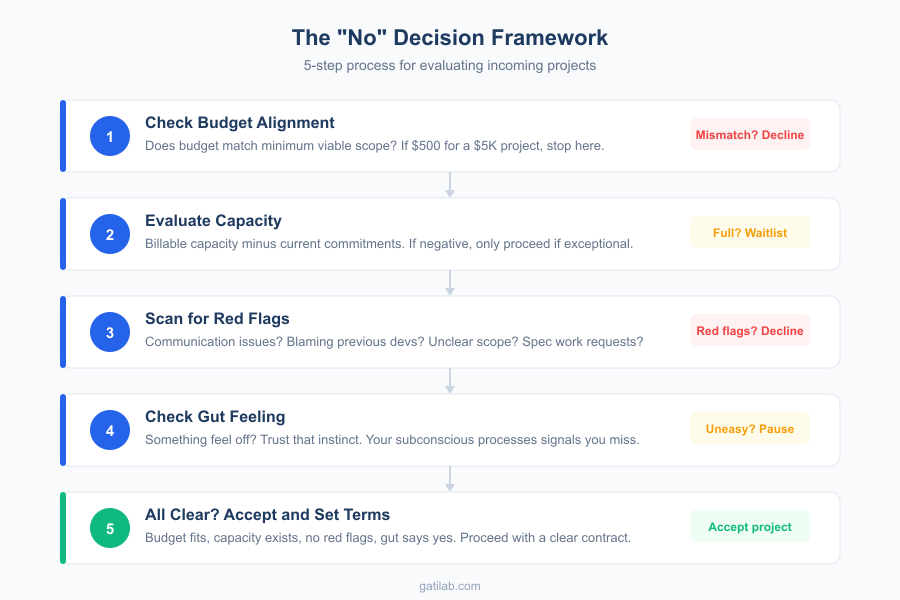
Don’t leave them hanging: “Let me think about it and get back to you” and then never responding. This damages your reputation. Decide and communicate. Even a quick no is better than silence.
Don’t over-explain: A paragraph explaining why leads to negotiation. “If the budget is the only issue, we could…” Keep it simple.
Don’t lie: “I’m too busy” when you’re actually just not interested. If they check back in a month and you took other work, you look dishonest. Better to say you’re not the right fit.
Don’t be harsh: Even if they were unreasonable, stay professional. The WordPress freelancing world is small. Communities are smaller. Don’t burn bridges unnecessarily.
Don’t apologize excessively: “I’m so sorry, I really wish I could, I feel terrible about this…” One brief expression of regret is fine. More than that makes you seem unsure of your decision. And it invites them to convince you otherwise.
The Referral Strategy
Declining with a referral softens the no and builds goodwill.
Benefits of referring:
- Helps the prospect (genuine goodwill)
- Helps your colleague (they’ll remember)
- Positions you as connected and generous
- Prospect might return when you’re available
Who to refer:
- Developers whose work you trust and have seen
- People at appropriate skill and price level for the project
- Those who refer work back to you
- Not competitors who might poach your best clients
How to refer:
"I can't take this on, but [name] does excellent work in this area.
I've collaborated with them before and can vouch for their quality.
Want me to make an introduction?"
Building referral relationships:
- Meet other developers in your space
- Understand their specialties and capacity
- Refer when appropriate, not just when you’re declining
- Track who refers work to you and reciprocate
Handling Pushback
Some prospects don’t accept no easily. This is itself a data point.
“Can you just do a small part?” If you declined for capacity, partial work is still work you can’t do. If you declined for red flags, they’ll still be red flags on a smaller project.
Response: “Unfortunately, my schedule wouldn’t allow even a reduced scope right now. I need to honor my commitments to existing clients.”
“What if we wait until you’re available?” This might be genuine, or it might be pressure. If genuine and you’d actually want the project later:
Response: “I’d be open to reconnecting in [specific month]. My situation may be different then. Feel free to reach out, or I can contact you when my schedule opens up.”
“We’ll pay more.” If you declined for budget, this might change things. If you declined for other reasons, more money rarely fixes red flags. I’ve learned this one the hard way. Twice.
Response: “I appreciate that, but the timing and fit still aren’t right. I don’t want to take on something I can’t fully commit to.”
Aggressive or rude responses: This confirms your decision was correct. Every time. Respond briefly or not at all.
Response: “I understand you’re frustrated. I wish you the best with your project.” Then disengage.
Projects to Always Decline
Some situations should be automatic nos. No deliberation needed.
Spec work: “Do a design/mockup and we’ll decide if we want to work with you.” Professional developers don’t work for free to compete for paid work. Full stop.
Equity instead of payment: Unless it’s your own startup, “we’ll give you 5% of the company” is almost always worthless. Five percent of zero is still zero.
Unclear ownership: Multiple bosses, committee decisions, no single point of contact. These projects go sideways. Always.
Competing with your clients: Taking on their direct competitor creates conflicts of interest that no amount of money justifies.
Ethically questionable: Anything that makes you uncomfortable or could damage your reputation. Trust that discomfort.
Massive scope creep baked into the contract: “Plus any additional features the client requests.” This isn’t a project. It’s an open-ended commitment with no defined end.
Building a Position to Say No
Long-term strategies that make selectivity possible.
The projects you decline often matter more than the ones you accept. One bad project can consume months, damage your reputation, and crowd out work you actually want. The ability to say no is the ultimate professional luxury. Build towards it deliberately.
Specialization: Generalists compete on price. Specialists compete on expertise. Expertise commands premium prices and better clients. See the guide on niche selection for consultants.
Reputation: Good work leads to referrals. Referrals from good clients lead to more good clients. Quality compounds over years.
Financial cushion: Every month you can survive without new income is a month of freedom to choose. Build it before you need it.
Pipeline development: Consistent marketing means you’re choosing between opportunities, not taking whatever comes through the door.
Clear positioning: “I build WooCommerce stores for subscription businesses” turns away poor-fit projects before they even inquire. That’s the point.
The ability to say no is the ultimate professional luxury. Build towards it deliberately. Having the right freelancer tools helps you work more efficiently on the projects you do accept. Because the projects you decline shape your business as much as the ones you accept.
Client Management FAQ
Frequently Asked Questions
How do I know when to say no to a freelance project?
Watch for red flags: budget misalignment ($500 for a $5,000 project), scope problems (“we’ll figure it out as we go”), communication issues (slow responses, blaming previous developers), and respect issues (asking for free spec work, dismissing your expertise). Also trust your gut. After enough projects, your instincts pick up signals your conscious mind misses. I’ve ignored my gut maybe five times and regretted it every single time.
How do I decline a project without burning bridges?
Follow a five-step formula: thank them, decline clearly with no ambiguity, give a brief reason (optional), offer a referral if appropriate, and leave the door open for future work. Keep it professional and concise. Don’t over-explain since detailed reasons invite negotiation. “I don’t think I’m the right fit” is a complete answer. Most graceful declines actually enhance your reputation by signaling you’re in demand.
What if I need the money and can’t afford to say no?
Sometimes you can’t decline. Financial survival comes first. Take the work, but recognize this as temporary. Build reserves (3-6 months of expenses) so you can be selective later. Even when money is tight, watch for truly dangerous red flags: clients who won’t pay upfront deposits, abusive behavior, or open-ended scope with no contract. Some projects genuinely cost more than they pay when you count the stress and opportunity cost.
Should I always offer a referral when declining a project?
Only if you’d feel comfortable associating your name with the client. For legitimate prospects who aren’t right for you (budget, timing, specialty mismatch), referrals are generous and build goodwill. For red flag clients, don’t refer them to colleagues. That does your colleagues a disservice. Some prospects simply don’t deserve referrals. Reserve referrals for people you’d want your network to work with.
What types of projects should always be an automatic no?
Spec work (“do a mockup and we’ll decide”), equity instead of payment (5% of zero is still zero), unclear ownership with multiple conflicting decision-makers, competing with your existing clients, ethically questionable projects, and contracts with open-ended scope (“plus any additional features the client requests”). These situations never improve once you’re committed. Decline without deliberation.
How do I handle clients who push back after I say no?
Persistence after a clear no is itself a red flag. Imagine how they’d behave during the actual project. Respond once, briefly restating your decision without new explanations. If they offer more money, remember that money rarely fixes red flags. If they get aggressive or rude, that confirms your decision was correct. Respond briefly (“I wish you the best with your project”) or not at all, then disengage.
How do I build the financial position to be selective about projects?
Build an emergency fund covering 3-6 months of expenses. Every saved dollar is a “no” you can say. Raise prices gradually so you need fewer clients. Develop consistent marketing so opportunities flow steadily rather than arriving as feast-or-famine. Specialize to attract premium clients. Build retainer relationships for predictable income. The difference between desperation and selectivity is usually just a few months of savings.
Does declining projects damage my reputation as a freelancer?
Professional, graceful declines rarely damage reputation. They often enhance it. Being unavailable signals demand. Offering referrals shows generosity. The bigger reputation risk is taking bad projects you deliver poorly, or accepting difficult clients who later complain publicly. Difficult clients don’t become easy just because you accepted them. The projects you decline shape your business as much as the ones you accept.