
One-Person Business Costs in India: A Complete Breakdown
When I started freelancing years ago, I thought the math was simple. Charge clients, receive money, pay taxes on profit. The real cost of running a one-person business in India was humbling. Between compliance costs, professional fees, software subscriptions, banking charges, and hidden expenses I didn’t anticipate, my actual take-home was significantly lower than my naive calculations suggested. That first year was a rude awakening.
Most articles about starting a business in India focus on registration procedures. Helpful, sure. But they skip the ongoing costs that determine whether your business is actually profitable. This guide covers the real numbers: what you’ll actually spend to run a legitimate one-person business in India, from registration through your first year of operations. No sugarcoating.
I’m focusing on service-based businesses like consultants, freelancers, developers, designers, writers, and coaches since that’s where one-person operations are most common. Product businesses have additional complexities around inventory, manufacturing, and logistics that deserve their own guide. For tax strategies, see our guide on tax planning for freelancers.

Business Structure: Your First Cost Decision in India
Before spending anything, you need to decide how you’ll legally operate. This decision affects every cost that follows, and it’s harder to change later than most people think.
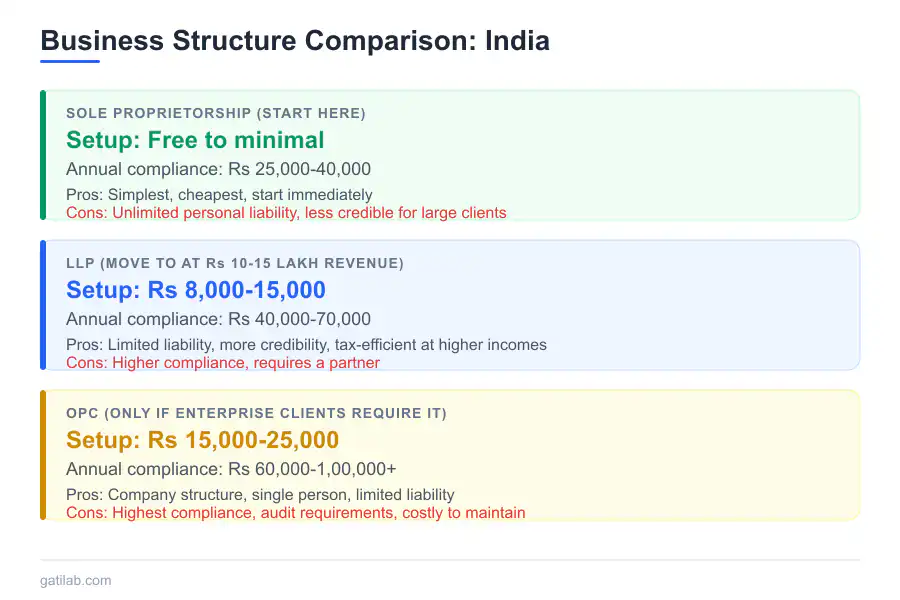
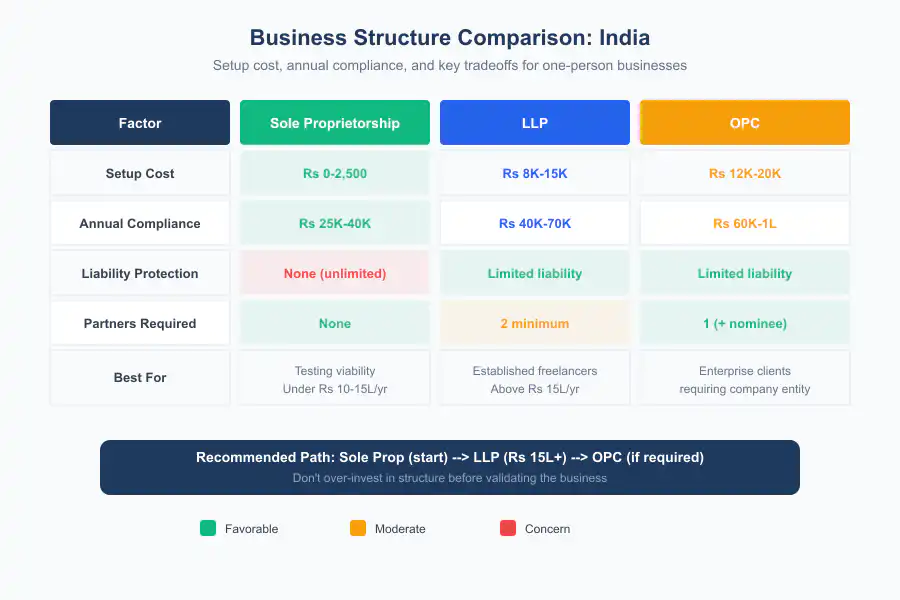
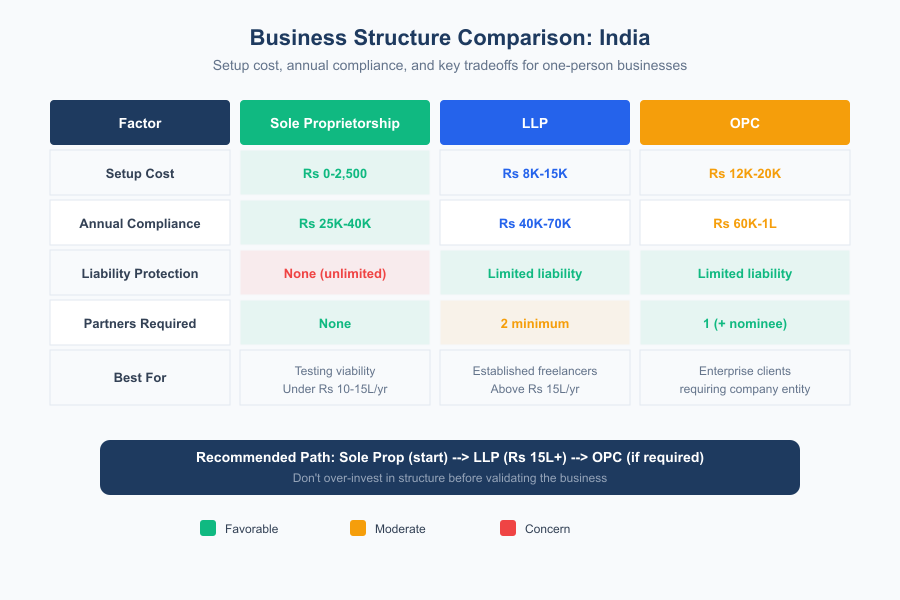
Start as Sole Proprietorship to test viability. Move to LLP once consistently earning over 10-15 lakh. Consider OPC only if enterprise clients require company structure. Don’t over-invest in structure before validating the business.
Sole Proprietorship
The simplest structure. No registration required with MCA. You and your business are legally the same entity. This is where I started, and it’s where most people should start.
Setup costs:
- GST registration: Free (if turnover exceeds ₹20 lakh, or ₹10 lakh for special category states, or if you want to collect GST)
- Current account opening: Free at most banks
- Professional tax registration: ₹200-500 depending on state
- Shop and establishment registration: ₹500-2,000 depending on state (often optional for home-based businesses)
Ongoing compliance costs:
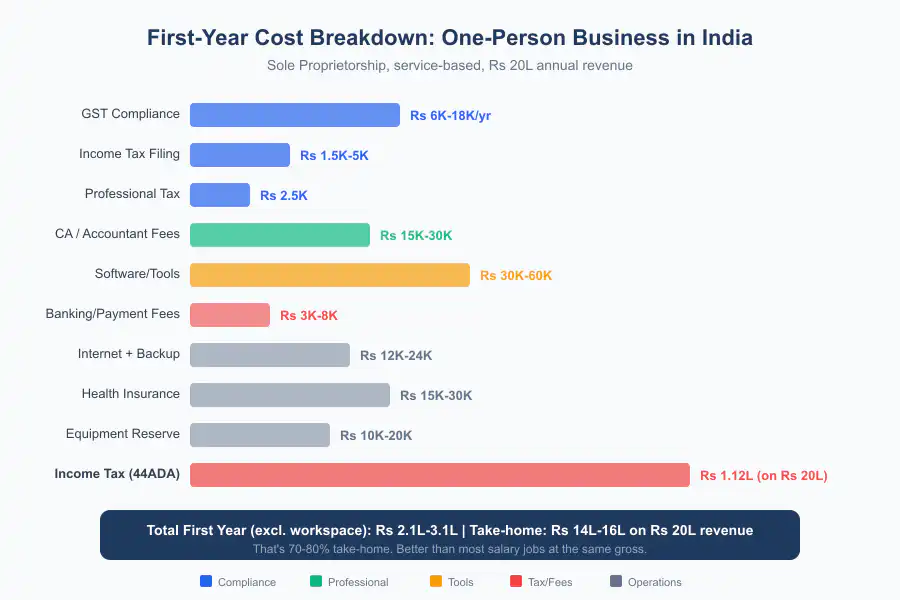
- GST filing: ₹500-1,500/month if outsourced (GSTR-1, GSTR-3B)
- Income tax filing: ₹1,500-5,000 annually
- Professional tax: ₹2,500/year in most states
Total first-year compliance: ₹25,000-40,000 if outsourcing filings
Advantages: Lowest cost, simplest compliance, easiest to wind up. You can start earning immediately without waiting for registration paperwork.
Disadvantages: Unlimited personal liability, less credible for large clients, mixing personal and business finances, harder to get business loans.
Limited Liability Partnership (LLP)
A hybrid structure requiring at least two partners. You and a family member works. Separate legal entity with limited liability. This is the structure I eventually moved to and recommend for most established freelancers.
Setup costs:
- LLP registration: ₹8,000-15,000 (including government fees and professional charges)
- DSC (Digital Signature Certificate): ₹1,000-1,500 per partner
- DIN (Director Identification Number): Included in registration typically
- LLP Agreement filing: Included in registration package
Ongoing compliance costs:
- Annual ROC filing (Form 8 + Form 11): ₹5,000-8,000/year
- GST filing: ₹500-1,500/month if outsourced
- Income tax return (ITR-5): ₹5,000-10,000 annually
- Annual CA attestation for Form 8: Included in filing usually
Total first-year compliance: ₹40,000-70,000
Advantages: Limited liability, more credibility, separate legal entity, tax-efficient for higher incomes. International clients often prefer working with an LLP over a sole proprietor.
Disadvantages: Higher compliance burden, requires a partner, more complex to wind up.
One Person Company (OPC)
A company structure for single owners. Separate legal entity with limited liability. Good on paper, but the compliance costs make it hard to justify for most one-person operations.
Setup costs:
- OPC registration: ₹12,000-20,000 (including government fees and professional charges)
- DSC: ₹1,000-1,500
- DIN: Included in registration
- Nominee director requirement: Must designate someone
Ongoing compliance costs:
- Annual ROC filings (AOC-4, MGT-7): ₹8,000-15,000/year
- Board meetings and resolutions: ₹3,000-5,000/year (drafting)
- GST filing: ₹500-1,500/month
- Income tax return (ITR-6): ₹8,000-15,000 annually
- Audit requirement if turnover exceeds ₹2 crore: ₹15,000-30,000/year
Total first-year compliance: ₹60,000-1,00,000
Advantages: Limited liability, single ownership, conversion path to Private Limited, credibility.
Disadvantages: Highest compliance, conversion to Pvt Ltd mandatory above ₹2 crore turnover, more expensive to maintain. The compliance overhead is real and ongoing.
Private Limited Company
Typically overkill for one-person businesses, but some choose it for maximum credibility or investment potential.
Setup costs: ₹15,000-25,000 Annual compliance: ₹80,000-1,50,000 minimum
I won’t detail Pvt Ltd further since it’s rarely optimal for true one-person operations. If you’re at the point where Pvt Ltd makes sense, you should be talking to a CA, not reading this article.
My Recommendation
For most one-person service businesses earning under ₹50 lakh annually, this is the progression I recommend:
Start as Sole Proprietorship. Lowest cost, test your business. Figure out if this is viable before spending money on structure.
Move to LLP once established and earning consistently over ₹10-15 lakh. You get liability protection and tax benefits that justify the additional compliance.
Consider OPC only if you specifically need company structure for clients or contracts that won’t work with an LLP. Some enterprise clients require a company entity. Outside of that, LLP is usually the better choice.
GST: The Compliance You Can’t Avoid
If your turnover exceeds ₹20 lakh (₹10 lakh in special category states), you must register for GST. Even below this threshold, you might want GST registration to claim input tax credits or appear more professional. Most serious clients expect to see a GSTIN on your invoice.
Don’t treat GST collections as income. That 18% you collect from clients isn’t your money. I’ve seen freelancers get into serious trouble because they spent the GST they collected. Keep it separate.
GST Costs Breakdown
Registration itself is free, but you’ll typically pay ₹2,000-5,000 if you use a CA or consultant to file the application and handle the verification process. Worth it to avoid the back-and-forth with the GST portal, which can be frustrating.
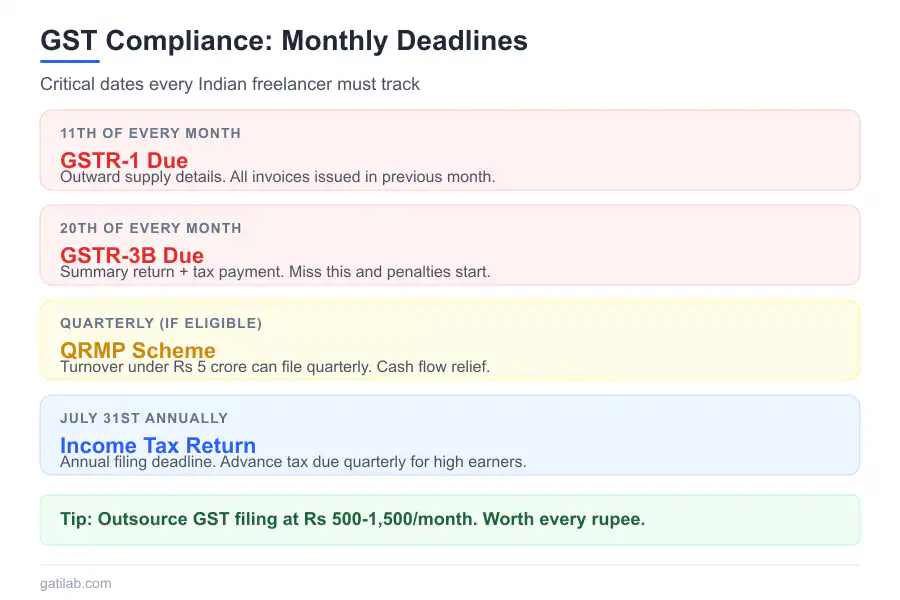
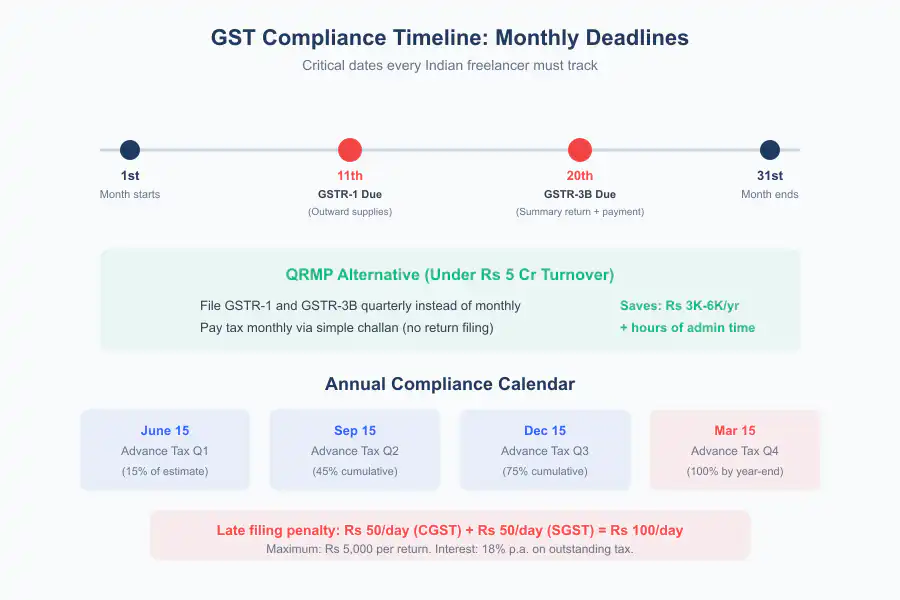
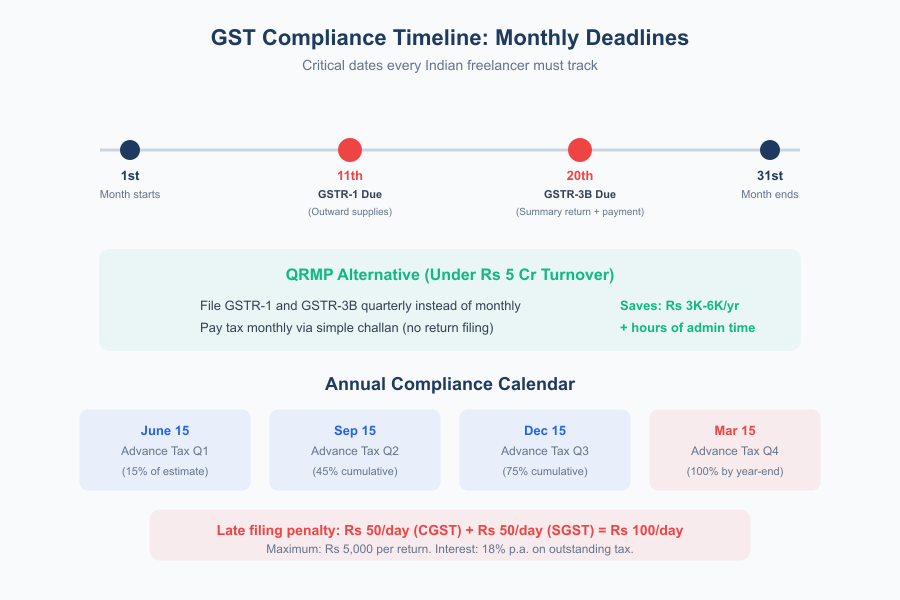
Monthly filing involves GSTR-1 for outward supplies, due on the 11th of the following month, and GSTR-3B for the summary return, due on the 20th. If you outsource filing like most people do, expect to pay ₹500-1,000/month for low-transaction businesses and ₹1,500-3,000/month for higher-transaction businesses.
The quarterly filing option under QRMP is available for turnover under ₹5 crore. You file GSTR-1 and GSTR-3B quarterly instead of monthly, and pay tax monthly using a challan. This reduces filing cost to ₹1,500-3,000/quarter and cuts the compliance headache significantly.
The annual return (GSTR-9) is due by December 31st and costs ₹3,000-8,000 for preparation and filing. GST audit is required if turnover exceeds ₹2 crore (GSTR-9C), costing ₹10,000-25,000 for audit and certification.
GST Cash Flow Impact
GST isn’t just a compliance cost. It affects cash flow in ways that catch new business owners off guard.
Output GST means you collect 18% (typical for services) from clients. This isn’t your money, but it sits in your bank until you remit it. The temptation to spend it is real. Don’t.
Input GST is what you pay on business purchases like software, services, and equipment. You can claim this as credit against output GST.
Net payment is output GST minus input GST, paid monthly or quarterly.
Here’s a concrete example. You invoice ₹1,00,000 + ₹18,000 GST = ₹1,18,000. You spend ₹20,000 + ₹3,600 GST on business expenses. Net GST liability: ₹18,000 – ₹3,600 = ₹14,400.
You keep ₹18,000 temporarily but must pay ₹14,400 to the government. Don’t spend that ₹18,000 as if it’s profit. I’ve seen freelancers get into trouble because they treated GST collections as income. That money was never yours.
Annual GST cost estimate for typical one-person service business:
| Item | Cost Range |
|---|---|
| Monthly/quarterly filing | ₹12,000-24,000/year |
| Annual return | ₹3,000-8,000/year |
| Audit (if applicable) | ₹10,000-25,000/year |
| Total | ₹15,000-57,000/year |
Income Tax and Professional Tax
Income Tax
As a sole proprietor, you pay individual tax rates, same as a salaried person. LLPs and OPCs have different tax structures, and understanding the difference matters for choosing your business structure.
Sole Proprietorship/Individual (New Regime):
- Income up to ₹3 lakh: Nil
- ₹3-6 lakh: 5%
- ₹6-9 lakh: 10%
- ₹9-12 lakh: 15%
- ₹12-15 lakh: 20%
- Above ₹15 lakh: 30%
Plus 4% Health and Education Cess on the tax amount.
LLP:
- Flat 30% on profits
- Plus surcharge if income exceeds thresholds
- Plus 4% cess
OPC:
- 25% if turnover under ₹400 crore (which yours is)
- Plus surcharge and cess
ITR filing costs:
- ITR-3/ITR-4 (Sole Proprietor): ₹1,500-5,000
- ITR-5 (LLP): ₹5,000-10,000
- ITR-6 (OPC): ₹8,000-15,000
Professional Tax
State-level tax on professionals and businesses. Varies by state but most cap at ₹2,500 annually:
- Maharashtra: ₹2,500/year (if income > ₹10,000/month)
- Karnataka: ₹2,500/year
- West Bengal: ₹2,500/year
- Gujarat: ₹2,500/year
- Tamil Nadu: ₹2,500/year
Registration costs ₹200-500 one-time. It’s a small amount but forgetting it leads to notices and penalties that cost more than the tax itself.
Advance Tax
If your tax liability exceeds ₹10,000/year, you must pay advance tax quarterly:
- 15% by June 15
- 45% by September 15
- 75% by December 15
- 100% by March 15
Failure to pay advance tax results in interest under Section 234B and 234C. Your CA should help you estimate and pay this. Missing these deadlines is one of the most common mistakes I see new freelancers make. Set calendar reminders. Better yet, have your CA send you estimates before each due date.
Accounting and CA/CS Fees
You need professional help unless you want to learn GST laws, tax provisions, and filing procedures yourself. I’ve tried both approaches. Outsourcing wins. The time you save is worth more than the fees you pay.
CA/Tax Professional Costs
Basic package (Sole Proprietor):
- ITR filing: ₹1,500-3,000
- GST filing: ₹500-1,500/month
- Book maintenance: ₹500-1,000/month
- Annual total: ₹15,000-35,000
Standard package (LLP/OPC):
- ITR filing: ₹5,000-15,000
- GST filing: ₹1,000-2,000/month
- Book maintenance: ₹1,000-2,000/month
- ROC filings: ₹5,000-15,000
- Annual total: ₹40,000-80,000
Comprehensive package (OPC/high turnover):
- All of the above plus
- Audit: ₹15,000-30,000
- TDS compliance: ₹5,000-10,000
- Advisory: Variable
- Annual total: ₹75,000-1,50,000
Find a CA who understands freelancers and digital businesses. Not all of them do. I went through three CAs before finding one who didn’t treat my international income and software expenses like alien concepts.
When You Need a Company Secretary
LLPs and OPCs don’t require a mandatory CS, but you might need CS services for compliance certifications, ROC filings, and annual compliance calendar management.
Typically ₹5,000-15,000/year for basic CS support. Not essential for most one-person businesses, but useful if you want someone tracking deadlines so you don’t have to.
Banking and Payment Processing
Current Account Costs
Banks don’t charge for opening current accounts, but they have hidden costs that add up over the year.
Minimum balance requirements at most banks are ₹10,000-25,000 quarterly average balance. Non-maintenance charges run ₹300-1,000/quarter if your balance falls short. This catches people during slow months when cash flow dips.
Transaction charges include NEFT/RTGS (often free for limited transactions), cash deposits (₹1-3 per ₹1,000 beyond free limit), cash withdrawals (limited free transactions, then ₹50-150 per withdrawal), and cheque books (₹50-200 for 25 leaves).
Recommended banks for small businesses include ICICI Instabiz, HDFC SmartUp, Kotak Business Account, RBL Business Account, and Open/Jupiter for fintech options. I’ve used ICICI for years and it handles international wire receipts without drama, which matters if you have foreign clients.
Expected annual cost: ₹2,000-5,000 in various charges
Payment Gateway Costs
If you accept online payments from Indian clients, you’ll use a payment gateway.
Razorpay charges 2% per transaction with no setup or annual fees. For ₹10 lakh annual collections, that’s ₹20,000 in fees. Cashfree is slightly cheaper at 1.9% per transaction. PayU charges 2% standard but it’s negotiable for higher volumes. Instamojo charges 2% + ₹3 per transaction and works well for smaller amounts.
Annual cost estimate: 1.9-2% of collections. For ₹20 lakh annual collections: ₹38,000-40,000 in payment gateway fees. That’s significant. Factor it into your pricing.
International Payment Processing
If you work with international clients, which many Indian freelancers do, processing fees are a major cost category.
Payoneer charges 1-3% for receiving depending on source, 2% for withdrawal to Indian bank, and 0.5% above mid-market rate for currency conversion. It’s widely accepted by international platforms and marketplaces.
Wise often offers cheaper conversion rates than banks with transparent fees shown upfront. I use Wise for most transfers now and the savings over bank wire are noticeable.
Bank wire transfers charge ₹300-500 per transaction for receiving, with 1-3% spread from mid-market rate on currency conversion. Fine for large one-off payments, expensive for regular smaller amounts.
PayPal charges 4.4% + fixed fee for receiving, ₹100 per transaction for withdrawal, and 3-4% for currency conversion. Expensive but sometimes required by clients who don’t want to deal with alternatives.
For ₹20 lakh in international payments, expect ₹60,000-1,00,000 in processing fees. That varies widely by method. The difference between using Wise and using PayPal on the same amount can easily be ₹30,000-40,000 annually. Choose wisely.
Tools and Software
Running a modern service business requires software. Here’s what most one-person businesses actually spend.
Essential Tools
| Tool Type | Options | Monthly Cost |
|---|---|---|
| Accounting | Zoho Books, ClearTax, QuickBooks | ₹500-2,000 |
| Email (custom domain) | Google Workspace, Zoho Mail | ₹125-500 |
| Project management | ClickUp (free tier), Trello, Notion | ₹0-500 |
| Video calls | Google Meet, Zoom | ₹0-1,000 |
| Cloud storage | Google Drive, Dropbox | ₹0-500 |
| Invoicing | Zoho Invoice, Refrens, Vyapar | ₹0-500 |
Industry-Specific Tools
Developers:
- Hosting: ₹500-3,000/month
- Domain names: ₹500-1,000/year each
- Dev tools: Variable
Designers:
- Adobe Creative Cloud: ₹1,700-4,000/month
- Figma: ₹1,200/month (Pro)
- Stock resources: ₹500-2,000/month
Writers/Content:
- Grammarly Premium: ₹1,000/month
- SEO tools: ₹1,500-8,000/month
- Stock images: ₹500-1,500/month
Consultants:
- CRM: ₹500-2,000/month
- Scheduling: ₹0-1,000/month
- Presentation tools: ₹0-500/month
Annual Software Estimate
Minimal stack: ₹15,000-25,000/year (you can run a lean business at this level) Moderate stack: ₹40,000-70,000/year (most established freelancers land here) Full-featured stack: ₹80,000-1,50,000/year (usually means you’re paying for tools you don’t fully use)
Using proper project management tools can actually save money through better efficiency. Track what you’re spending on software quarterly. You’ll find subscriptions you forgot about.
Workspace and Infrastructure
Working From Home
Most one-person businesses start here. Costs to consider:
Dedicated internet connection: ₹1,000-2,500/month for reliable broadband. Don’t cheap out on this. A dropped Zoom call during a client presentation costs more than a year’s worth of internet upgrades.
Electricity (proportional): ₹500-2,000/month additional, especially if you’re running AC during summer months.
Furniture and equipment: ₹20,000-50,000 one-time for a decent desk and chair. Your back will thank you. I learned this lesson after a year of working from a dining table.
Computer/laptop: ₹40,000-1,50,000 depending on your work. Developers and designers need more power. Writers and consultants can get by with less.
Coworking Space
If home doesn’t work or you need professional space for client meetings:
Hot desk (flexible seating):
- Tier 1 cities (Mumbai, Delhi, Bangalore): ₹4,000-8,000/month
- Tier 2 cities: ₹2,000-5,000/month
Dedicated desk:
- Tier 1: ₹8,000-15,000/month
- Tier 2: ₹4,000-8,000/month
Virtual office (address + occasional meeting room):
- ₹2,000-5,000/month
Popular options include WeWork (premium), Awfis, 91springboard, Innov8, and Cowrks. I’d recommend trying a hot desk for a month before committing to a dedicated desk. Many people find they don’t actually go often enough to justify the higher cost.
Annual Workspace Cost
Home office: ₹30,000-60,000/year (internet, electricity, equipment amortized) Coworking: ₹50,000-1,80,000/year
Insurance
Often neglected, sometimes essential. I ignored insurance for my first three years. That was foolish.
Professional Indemnity Insurance
Covers claims arising from professional negligence or errors. Important for consultants, developers, and designers whose work directly impacts client businesses.
Coverage: ₹10 lakh – ₹1 crore Annual premium: ₹5,000-25,000 depending on coverage and profession
Health Insurance
You don’t have an employer covering this. You need personal health insurance. One hospitalization without coverage can wipe out a year of earnings.
Individual coverage (₹5-10 lakh sum insured): ₹8,000-20,000/year Family floater (₹10-15 lakh): ₹15,000-40,000/year
Term Life Insurance
If dependents exist, this is critical for self-employed individuals. There’s no employer-provided life insurance to fall back on.
Coverage ₹1 crore: ₹10,000-20,000/year depending on age and health
Annual Insurance Estimate
Minimum (health only): ₹10,000-20,000/year Comprehensive: ₹30,000-60,000/year
Don’t skip health insurance. I know freelancers who’ve had to shut down their businesses because of medical expenses they couldn’t cover. The premium is a fraction of what a hospital stay costs.
Marketing and Business Development
Getting clients costs money, even if you rely primarily on referrals. And you should be investing in marketing even when referrals are flowing, because referrals dry up without warning.
Website and Online Presence
Domain: ₹500-1,000/year Hosting: ₹3,000-10,000/year Website design (one-time): ₹20,000-1,00,000 (or DIY if you have the skills) SSL certificate: Usually free with hosting
Marketing Spend
Content marketing: Your time (opportunity cost) or ₹10,000-30,000/month for help LinkedIn Premium: ₹1,500-6,000/month Advertising (if used): Highly variable Portfolio/case study development: Time or money Conferences/networking: ₹5,000-20,000/year
Annual Marketing Estimate
Minimal (referral-based): ₹10,000-25,000/year Active marketing: ₹50,000-2,00,000/year
I spend most of my marketing budget on content creation. It compounds over time in ways that advertising doesn’t. A blog post written three years ago still brings me leads. An ad from three years ago brought me nothing after I stopped paying.
The Hidden Costs of Running a Business in India
Things you don’t budget for but will spend. I guarantee you’ll hit at least three of these in your first year.
Opportunity Cost of Compliance
The hours you spend coordinating with your CA, gathering documents, understanding regulations, and handling compliance aren’t billable. If you bill ₹2,000/hour and spend 50 hours annually on compliance coordination, that’s ₹1,00,000 in opportunity cost.
This is the hidden cost that nobody includes in their business cost calculations, but it’s real. Those 50 hours are hours you could have been earning.
Late Fees and Penalties
Despite best intentions, you’ll probably miss a filing deadline somewhere. Late fees accumulate fast:
- Late GST filing: ₹50/day (CGST + SGST = ₹100/day) capped at ₹5,000
- Late ROC filing: Varies by form, can reach lakhs for persistent default
- Late ITR filing: ₹1,000-10,000 depending on income and delay
Budget ₹5,000-10,000/year for inevitable mistakes. It’s not pessimism. It’s realism.
Emergency Professional Fees
When something goes wrong, and something will go wrong, you’ll pay premium rates for urgent professional help. A notice from the GST department, income tax scrutiny, a legal issue with a client… these arise more often than new business owners expect.
Budget ₹10,000-30,000/year for unexpected professional fees. Think of it as insurance you’re almost certain to use.
Inflation on Subscriptions
Those ₹500/month tools become ₹700/month next year. Plan for 10-15% annual increases on software and services. SaaS companies raise prices regularly, and they rarely announce it with fanfare.
Client Non-Payment
Not all invoices get paid. Industry standard is 5-10% write-off for bad debts. If you invoice ₹20 lakh/year, budget ₹1-2 lakh for uncollectable invoices. I’ve had years where every client paid on time. I’ve also had years where 8% of invoices went uncollected. Average it out and budget accordingly.
Complete Annual Cost Summary for a One-Person Business
Here’s a realistic breakdown for a one-person service business with ₹20 lakh annual revenue:

Scenario 1: Sole Proprietorship (Minimal Setup)
| Category | Annual Cost |
|---|---|
| Compliance (GST + ITR + PT) | ₹25,000 |
| CA/Professional fees | ₹20,000 |
| Banking and payments | ₹30,000 |
| Software tools | ₹25,000 |
| Workspace (home) | ₹40,000 |
| Insurance (health) | ₹15,000 |
| Marketing | ₹15,000 |
| Unexpected/buffer | ₹20,000 |
| Total Operating Cost | ₹1,90,000 |
As percentage of revenue: 9.5%
Scenario 2: LLP (Standard Setup)
| Category | Annual Cost |
|---|---|
| Compliance (GST + ITR + ROC + PT) | ₹50,000 |
| CA/Professional fees | ₹40,000 |
| Banking and payments | ₹35,000 |
| Software tools | ₹50,000 |
| Workspace (coworking occasional) | ₹60,000 |
| Insurance (health + PI) | ₹30,000 |
| Marketing | ₹40,000 |
| Unexpected/buffer | ₹30,000 |
| Total Operating Cost | ₹3,35,000 |
As percentage of revenue: 16.75%
Scenario 3: OPC with Full Setup
| Category | Annual Cost |
|---|---|
| Compliance (GST + ITR + ROC + Audit) | ₹80,000 |
| CA/CS fees | ₹70,000 |
| Banking and payments | ₹40,000 |
| Software tools | ₹80,000 |
| Workspace (dedicated coworking) | ₹1,20,000 |
| Insurance (comprehensive) | ₹50,000 |
| Marketing | ₹60,000 |
| Unexpected/buffer | ₹50,000 |
| Total Operating Cost | ₹5,50,000 |
As percentage of revenue: 27.5%
What You Actually Take Home
Let’s complete the math for Scenario 2 (LLP, ₹20 lakh revenue). This is the scenario most established freelancers should be planning for.
Gross Revenue: ₹20,00,000 Operating Costs: ₹3,35,000 Net Profit Before Tax: ₹16,65,000 Income Tax (LLP 30% + cess): ₹5,18,000 approximately Net Take-Home: ₹11,47,000
Effective hourly rate calculation: If you work 2,000 hours/year (billable + non-billable), your effective hourly rate is ₹573/hour.
If you thought you were earning ₹1,000/hour based on your billing rate… the reality is roughly half that once all costs are accounted for. This isn’t meant to be discouraging. It’s meant to help you price properly. Most freelancers undercharge because they don’t account for these costs.

I spent three years thinking my freelance income was good. Then I tracked expenses properly and realized I’d been subsidizing my business with savings. That was a rough spreadsheet to look at.
Reducing Costs Intelligently
Not every expense deserves cutting. And not every saving is worth the trade-off. After years of optimizing, here’s what I’ve learned about where to save and where to spend.
What to Cut
Premium software with free alternatives is the first place to look. Do you really need Zoom Pro, or does Google Meet work? Many tools have free tiers that cover 80% of what you need.
Over-compliance wastes money. A simple proprietorship doesn’t need company-level documentation. Match your compliance to your actual structure.
Unused subscriptions accumulate quietly. Audit monthly and cancel what you don’t use. I found three subscriptions last quarter that I’d forgotten about entirely.
Premium coworking isn’t always necessary. Library, cafes, or home might work for most of your needs. Reserve coworking for client meetings.
What Not to Cut
Professional accounting help is worth every rupee. DIY mistakes cost more than CA fees. I’ve seen freelancers create ₹50,000 problems trying to save ₹15,000 in CA fees.
Insurance protects your business and your health. One emergency can wipe out years of savings. Skip almost anything else before you skip this.
Quality tools you actually use save more time than they cost. Productivity losses exceed subscription costs when you’re fighting with inadequate tools.
GST compliance is not optional. Penalties for non-compliance are severe, and the GST department has gotten much better at catching defaults.
Tax Efficiency Steps
Claim all legitimate deductions including home office expenses, equipment depreciation, travel, books, and courses. Many freelancers underclaim because they don’t know what’s deductible.
Time major expenses for maximum benefit. Buy equipment in a higher-income year for better deduction value.
Structure efficiently by switching to LLP when income justifies the compliance cost. The tax savings at higher income levels often pay for the additional compliance.
Consider presumptive taxation under Section 44ADA, which allows professionals to declare 50% of gross receipts as profit with simplified compliance. This is genuinely useful for freelancers with limited expenses.
Starting Up: Month-by-Month First Year Budget
Here’s what to actually expect spending:
Month 1-2: Registration, setup
- ₹10,000-20,000
Month 3-6: Ramping up tools and compliance
- ₹5,000-10,000/month
Month 7-12: Steady state
- ₹10,000-20,000/month
Year-end: ITR, annual returns
- ₹10,000-30,000
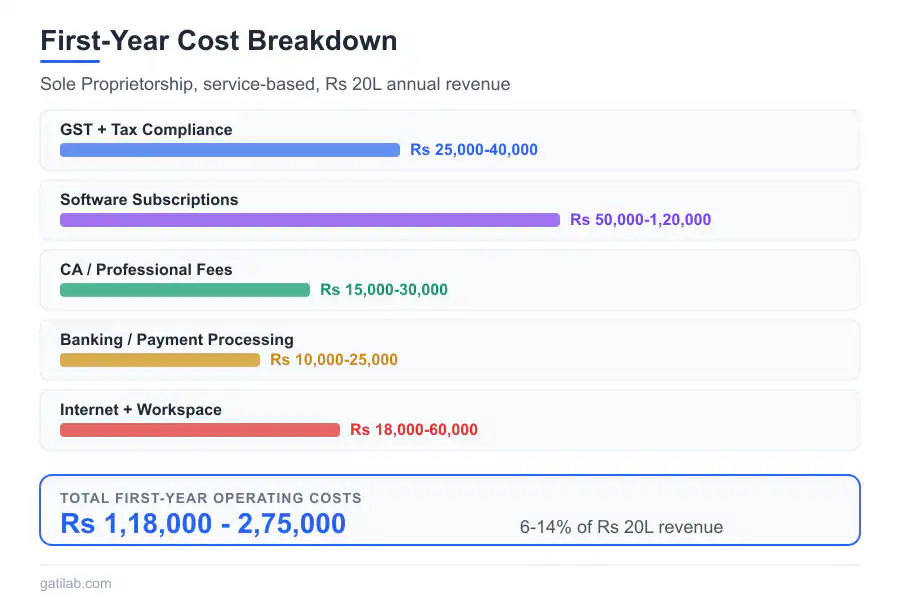
Total first year: ₹1,00,000-2,50,000 depending on structure and choices
Most new businesses underbudget by 50-100%. Plan for more than you expect. If you end up spending less, that’s a pleasant surprise. The alternative, running out of operating cash, is much worse.
The Bottom Line on Business Costs in India
Running a one-person business in India is absolutely viable and can be highly profitable. But the numbers only work if you’re realistic about costs. The self-employed status saves employer overhead but adds compliance complexity, software costs, and risks that employed people don’t face.
If you thought you were earning 1,000 rupees per hour based on your billing rate, the reality is roughly half that once all costs are accounted for. This isn’t discouraging. It’s meant to help you price properly. Most freelancers undercharge because they don’t account for these costs.
Know your numbers before you start. Track them monthly once you’re running. Adjust when reality differs from projections. The businesses that survive aren’t necessarily the ones with highest revenue. They’re the ones with clearest understanding of their actual costs and margins.
Build the business with eyes open. The real cost of a one-person business in India is manageable, but only if you plan for it. The freedom to choose your clients, set your schedule, and build something that’s genuinely yours is worth the complexity. You just need to price it properly. For more guidance, explore our complete guide on how to build a sustainable freelance career.
One-Person Business Setup Checklist (India)
Business Costs FAQ
Frequently Asked Questions
What is the best business structure for a one-person business in India?
Start as a Sole Proprietorship to test viability with the lowest cost and simplest compliance. Move to an LLP once you are consistently earning over 10-15 lakh annually for liability protection and tax benefits. Consider an OPC only if enterprise clients specifically require a company structure. The progression from sole prop to LLP to OPC matches increasing revenue and complexity. Do not over-invest in business structure before validating the business itself.
How much does GST compliance cost for a freelancer in India?
GST registration itself is free, but expect to pay 2,000-5,000 rupees if using a CA for the application. Ongoing monthly filing costs 500-1,500 rupees per month if outsourced for low-transaction businesses, and 1,500-3,000 for higher volumes. The quarterly filing option under QRMP reduces costs to 1,500-3,000 per quarter for businesses under 5 crore turnover. Never treat GST collections as income since that 18% belongs to the government.
What are the total first-year costs of running a one-person service business in India?
For a sole proprietorship: registration and setup costs of 2,000-8,000 rupees, annual compliance of 25,000-40,000, professional fees of 15,000-30,000, software subscriptions of 30,000-60,000, banking charges of 3,000-8,000, and workspace costs varying from zero for home-based to 60,000-1,20,000 for coworking. Total realistic first-year cost ranges from 75,000 to 2,50,000 rupees depending on structure and choices, before accounting for income tax.
Do I need a CA for my one-person business in India?
Practically yes, even though it is not legally required for all structures. A good CA handles GST filing, income tax planning, compliance deadlines, and keeps you out of trouble with authorities. Expect to pay 15,000-30,000 annually for a sole proprietorship and 25,000-50,000 for an LLP. The cost is worth it because tax penalties and compliance mistakes cost significantly more than professional fees.
What software subscriptions does a one-person business need in India?
Essential subscriptions include accounting software like Zoho Books at 1,000-2,500 per month, project management tools, communication tools, cloud storage, and domain and hosting. Industry-specific tools add to the cost. Budget 2,500-5,000 rupees monthly for essential software, plus another 2,000-5,000 for industry-specific tools. Annual total typically ranges from 30,000 to 60,000 rupees. Start with free tiers where possible and upgrade as revenue justifies the cost.
How much should I budget for income tax as a freelancer in India?
Under the old tax regime with Section 44ADA, professionals can presume 50% of gross receipts as profit and pay tax only on that amount. On 20 lakh gross income, taxable income would be 10 lakh, resulting in roughly 1,12,500 in tax under the old regime. The new regime has lower rates but fewer deductions. Advance tax payments are required in quarterly installments if your tax liability exceeds 10,000 rupees. Missing advance tax deadlines triggers interest penalties.
What hidden costs do new freelancers in India overlook?
The most overlooked costs include payment gateway and bank transaction fees of 2-3% on international payments, professional indemnity insurance, health insurance since there is no employer coverage, equipment depreciation and replacement, internet backup connections, penalty interest on late GST or tax filings, and the opportunity cost of compliance administration time. Banking charges for foreign currency conversion alone can eat 1-3% of international earnings.
When should a sole proprietor upgrade to an LLP in India?
Upgrade to an LLP when you consistently earn over 10-15 lakh annually, when you need liability protection for larger client contracts, or when international clients require a more formal business entity. The additional compliance cost of 15,000-30,000 per year is justified by liability protection, separate legal entity status, better tax efficiency at higher income levels, and improved credibility with enterprise clients. LLP registration costs 8,000-15,000 as a one-time expense.