
Minimum Viable Audience: How to Find the Right Size for Growth
“Go niche” is common advice. Find a specific audience. Serve them deeply. Avoid the trap of trying to appeal to everyone.
But how niche is too niche? At what point does specificity become a ceiling that caps your growth permanently?
This question haunts every founder choosing their market. I’ve wrestled with it myself multiple times. When I started focusing on WordPress development, people said it was too narrow. Then when I narrowed further to WordPress performance consulting, people said I was limiting myself even more. Turns out both niches were plenty large enough. The fear of going too narrow is almost always bigger than the actual risk.
Here’s a framework for evaluating whether your audience is large enough to support your business goals. Understanding this is crucial for niche selection.
The Niche Paradox
Niching down creates opposing forces that you have to balance.
The benefits of going small are real. Less competition means you’re not fighting established players for attention. Easier positioning means people immediately understand what you do and who you serve. Clearer messaging means your marketing actually resonates. Deeper customer understanding means you build better products. And stronger community means your customers talk to each other and reinforce your value.
The risks of going small are equally real. Limited total market means there’s a ceiling on revenue. Growth can stall once you’ve reached most of your addressable audience. Customer concentration risk means losing one or two key accounts hurts disproportionately. Acquisition costs can have hard floors because you’ve saturated the obvious channels. And exit opportunities become challenging because buyers want scale.
Both sides are true. The question is finding the right balance for your specific situation, goals, and business model.
Defining Minimum Viable Audience
Kevin Kelly’s “1,000 True Fans” concept established a useful baseline that gets quoted constantly.
The original concept: 1,000 people who will buy everything you create. If each spends $100/year, that’s $100,000 annually. Enough for many solo creators to live well.
The reality check: not everyone in your audience becomes a true fan. Not every fan buys everything. Payment failures happen. Life circumstances change. The actual math requires larger numbers than the 1,000 true fans concept suggests.
My working definition after years of observing this across my own businesses and clients’ businesses: Minimum Viable Audience is the smallest audience that can sustain your business goals through realistic conversion rates. Not optimistic rates. Not “if everything goes perfectly” rates. Realistic rates based on what actually happens when real people encounter your offers.
The Math Behind Market Size
Let’s work backward from business goals, because the math changes dramatically based on your business model.
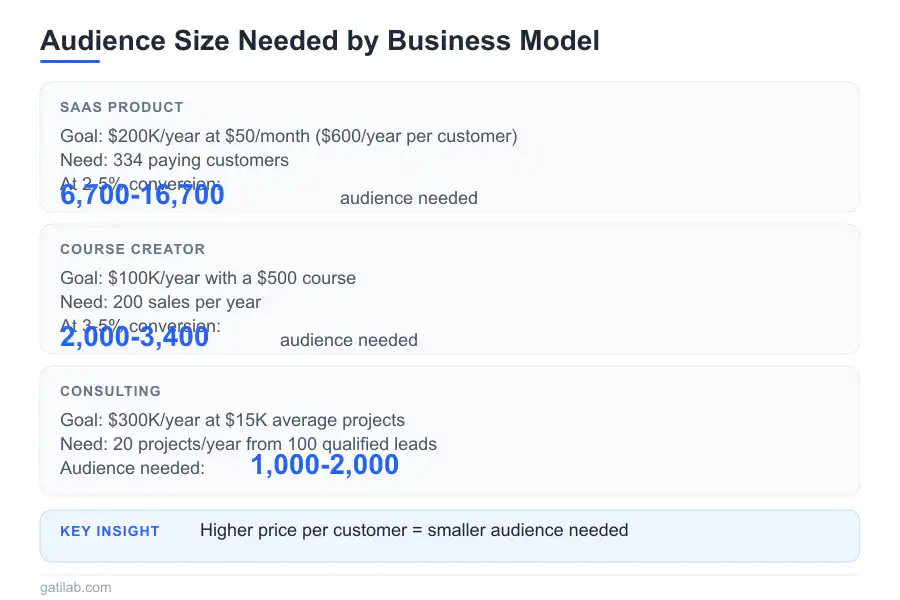
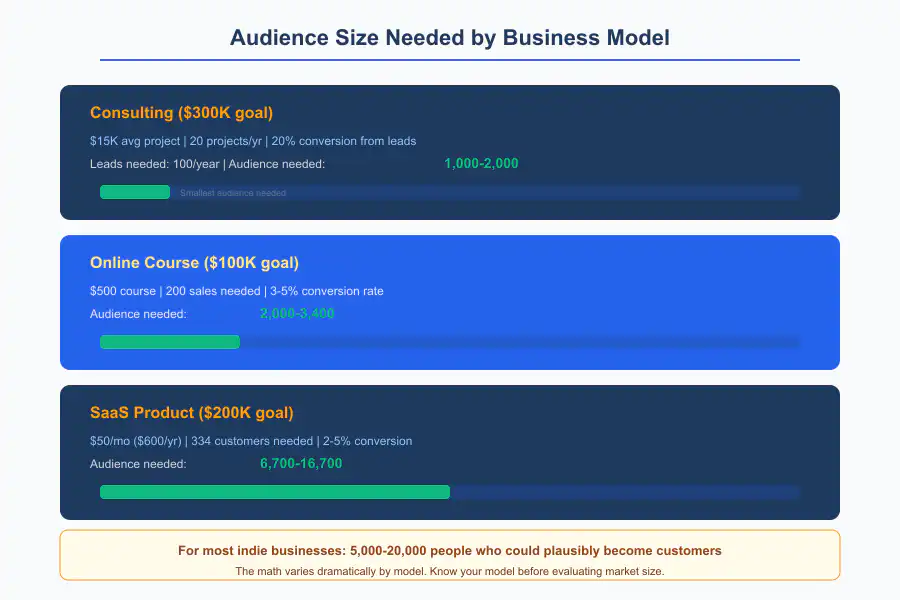
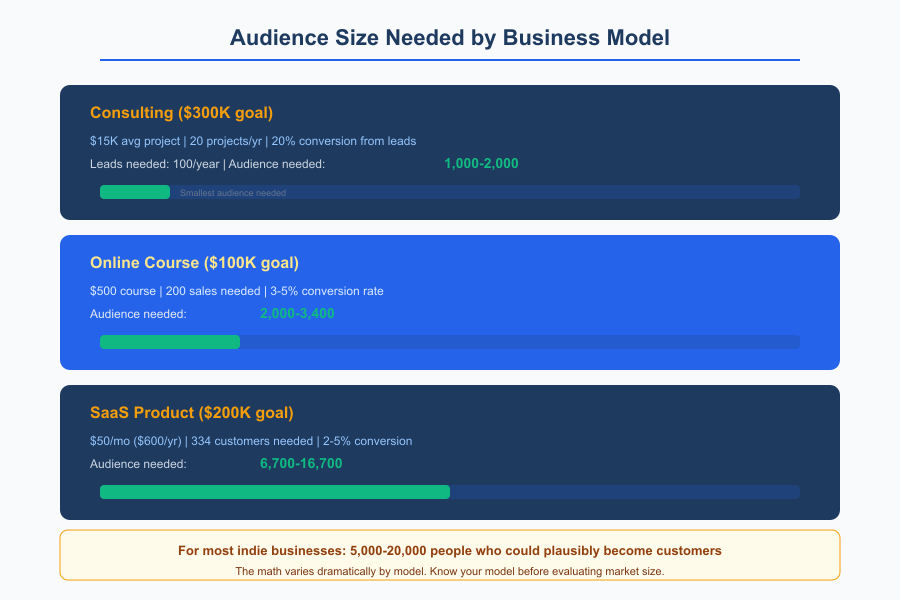
A consulting business targeting $300K annual revenue at $15K average projects needs only 20 projects per year. At 20% conversion from qualified leads, that’s just 100 leads annually. The audience needed might be as small as 1,000-2,000 people.
For a solo SaaS product with a goal of $200K annual revenue at $50/month ($600/year per customer), you need roughly 334 paying customers. With a realistic conversion rate from audience to paying customer of 2% to 5%, you need an audience of 6,700 to 16,700 people. That’s reachable for most niches that have genuine demand.
For a course creator targeting $100K annual revenue with a $500 course and a 3% to 5% conversion rate, you need an audience of 2,000 to 3,400 people. Even smaller. This is why courses are attractive as a business model for niche creators.
For a consulting business targeting $300K annual revenue with $15K average projects, you need 20 projects per year. At a 20% conversion rate from qualified leads, that’s 100 leads per year. The audience needed to generate 100 qualified leads annually might be as small as 1,000 to 2,000 people.
The math varies dramatically by business model. Know your model before evaluating market size. A SaaS business needs a much larger addressable market than a consulting business charging premium rates. For consulting specifically, see our guide on creating a consulting business from expertise.
Signs Your Niche Is Too Small
Watch for these warning signals because they’re usually visible before revenue problems surface.
You know everyone. If you can name most people in your target market, it’s probably too small. Markets where everyone knows everyone have limited growth potential and pricing pressure because information travels fast.
Keyword volume is negligible. Search volume reflects demand. If nobody searches for your topic or its variations, either the audience is too small or they use different language than you expect. Zero is concerning. Under 1,000 monthly searches across all related terms warrants investigation. Maybe the audience exists but searches differently. Maybe it doesn’t exist.
No adjacent competition. Some competition validates demand. If absolutely nobody serves this market, not even poorly, question whether the market exists at all. Empty markets are usually empty for reasons. I’ve seen people build products for markets that didn’t exist and call it “first mover advantage.” It wasn’t. It was “no market” dressed up as opportunity.
Customer concentration is dangerous. If losing one or two customers would devastate your business, the market is too concentrated. Healthy businesses can absorb customer churn without existential crisis.
Price ceiling problems emerge in very small markets that can’t support premium pricing. When everyone knows what everyone else pays and alternatives are limited, your negotiating leverage disappears.
Signs You’ve Niched Appropriately
These positive indicators suggest you’ve found the right market size.
You can reach thousands of people, not millions but thousands, who fit your target profile through reasonable means. If you can identify 10,000+ people and reach them through content, communities, and platforms, the math usually works.
Competition exists but isn’t dominant. Others serve this market but nobody owns it. There’s room for different approaches and positioning. This is the sweet spot.
Multiple acquisition channels are available. You can reach your audience through content, communities, industry platforms, events, and referrals. Multiple paths reduce dependency on any single channel.
Pricing flexibility exists. The market supports a range of price points. Some customers willingly pay premium. Others buy the basic offering. This diversity signals a healthy market with room for value-based pricing.
Natural expansion paths exist for when you’re ready. Adjacent audiences that you could grow into later without abandoning your core. The niche has walls you can expand through if and when you choose to.
The Niche Selection Process
Evaluating potential niches systematically prevents expensive mistakes.
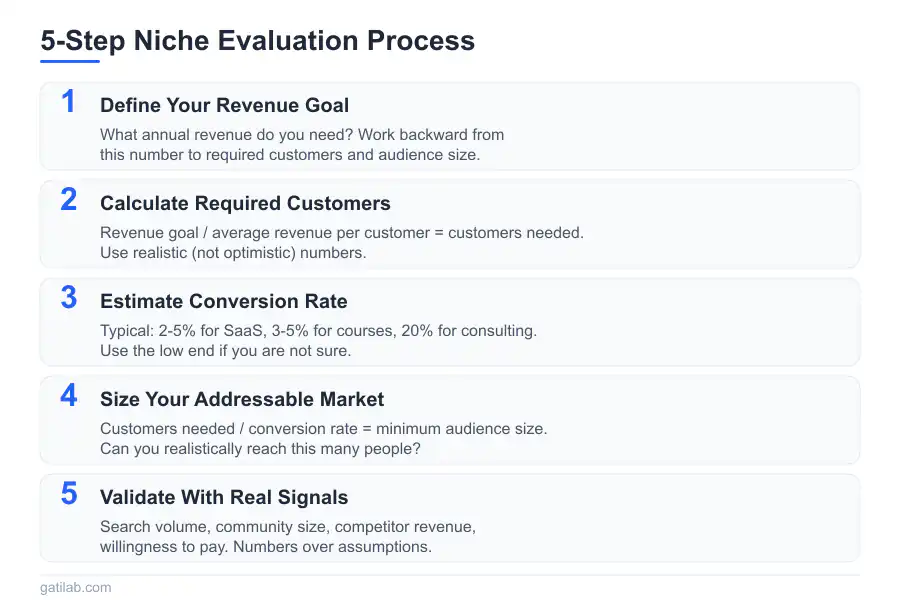
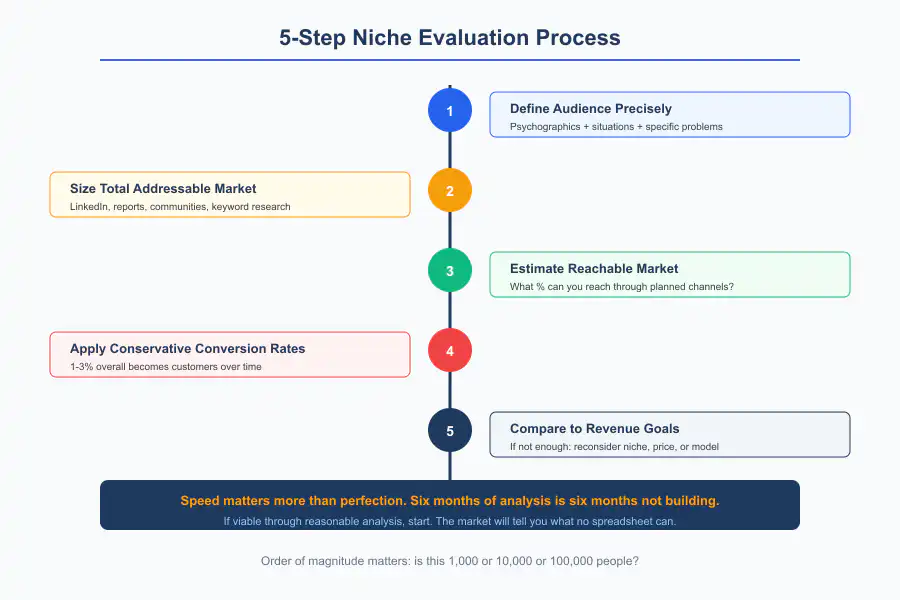
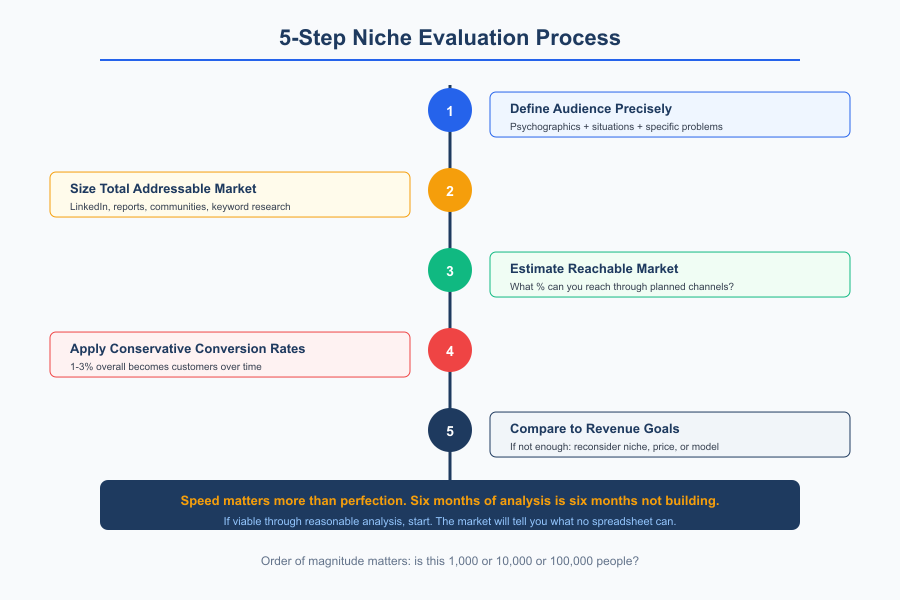
Step 1 is defining the audience precisely. Not just demographics. Psychographics, situations, and specific problems. The more specifically you can describe your ideal customer, the better you can reach them. “WordPress developers” is broad. “WordPress developers building client sites who struggle with performance optimization” is actionable. I can find those people. I can write content they’ll care about. I can build products they’ll buy.
Step 2 is sizing the total addressable market. How many people fit this description? Use LinkedIn searches for B2B audiences, industry reports, community membership numbers, competitor customer counts, and keyword research totals. You’re aiming for a rough estimate, not precision. Order of magnitude matters: is this 1,000 people, 10,000 people, or 100,000 people? That distinction drives every decision.
Step 3 is estimating your reachable market. You won’t reach everyone. What percentage can you realistically access through your planned channels? If the total addressable market is 50,000 but you can only reach 5,000 through content and communities, your working number is 5,000.
Step 4 is applying conservative conversion assumptions. What portion of your reachable audience becomes customers? Email subscribers typically represent 20% to 40% of regular readers. Buyers from email are 2% to 10% depending on price point. Overall, 1% to 3% of addressable market becomes customers over time for most businesses.
Step 5 is comparing the output to your revenue goals. Do the numbers work? If not, you have three options: reconsider the niche, change the price point, or adjust the business model.
Case Studies in Niche Sizing
Too narrow: “Left-handed developers working on Ruby accessibility projects in non-profit organizations.” Each qualifier shrinks the market exponentially. The intersection is probably dozens of people, not thousands. You can’t build a business on dozens of people.
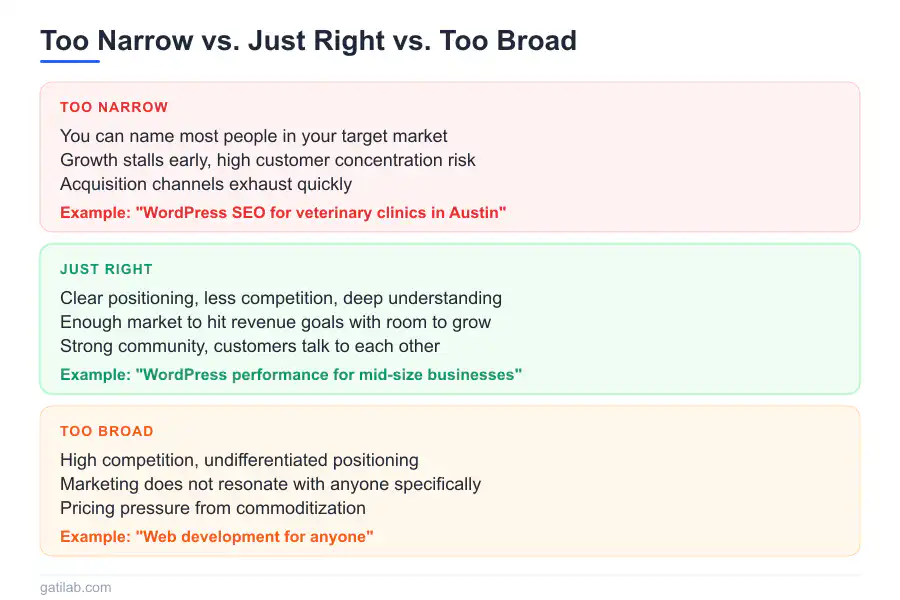
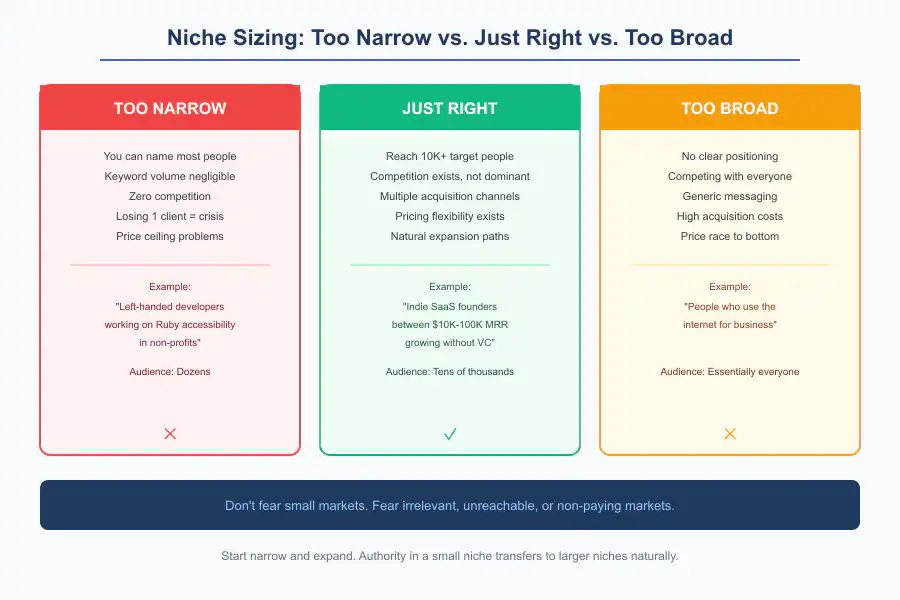
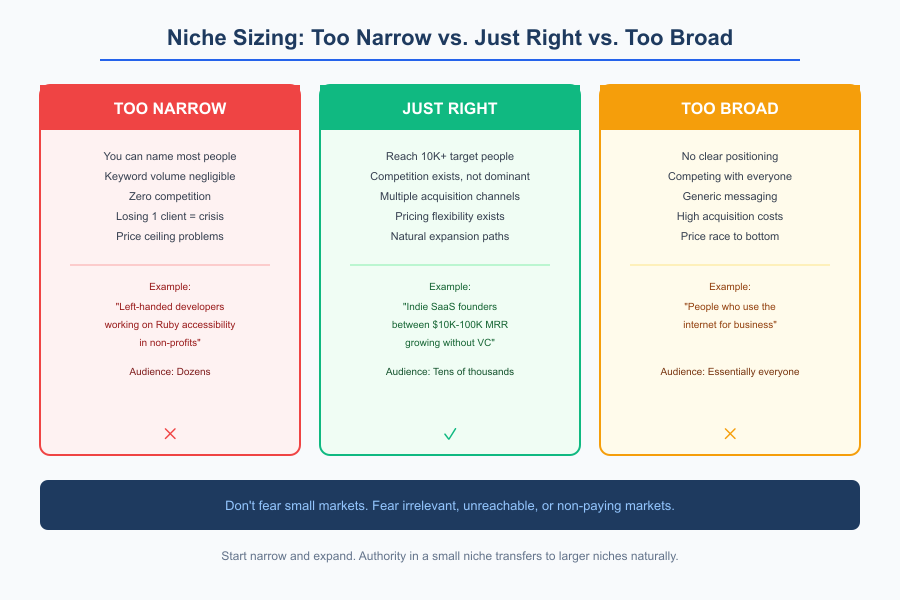
Too broad: “People who use the internet for business.” This is essentially everyone. No positioning. No specificity. No reason anyone would choose you over a million alternatives.
Just right: “Indie SaaS founders between $10K and $100K MRR trying to grow without VC funding.” Specific situation. Clear problems they’re facing. Identifiable audience you can find and reach. Probably tens of thousands globally. Large enough to build a serious business. Small enough to own a real position in.
The Expansion Question
Small audiences can grow with the business, and this is something most people overlook.
When I started focusing on WordPress development, people said it was too narrow. When I narrowed further to WordPress performance consulting, they said I was limiting myself even more. Both niches were plenty large enough. The fear of going too narrow is almost always bigger than the actual risk.
Natural evolution happens when you start serving one niche and gradually expand. You begin with “WordPress performance consultants” then expand to “WordPress developers” then to “web developers.” Each step broadens your reach while maintaining relevance because your core expertise still applies.
Layered products serve adjacent audiences without diluting your core positioning. Your flagship product serves the niche precisely. Additional products serve adjacent markets that overlap enough to find you through the same channels.
Reputation transfers from small niches to larger ones. The WordPress performance expert can credibly speak to general web performance topics. Authority in a focused area extends naturally to related areas.
Starting narrow and expanding is consistently easier than starting broad and trying to focus. I’ve done both and the narrow-first path worked dramatically better. When you start broad, you compete with everyone and differentiate from no one. When you start narrow, you own a space and expand from a position of strength.
The Depth vs. Breadth Tradeoff
Small audiences allow depth. Large audiences require breadth. Both approaches work, but they lead to very different businesses.
Deep niche benefits include becoming the undisputed expert, justifying premium pricing through specialization, building strong referral networks within a tight community, and creating defensible positioning that’s hard for generalists to compete with.
Broad market benefits include scale potential, diversified risk across many customer segments, multiple product opportunities, and attractiveness to acquirers who want large addressable markets.
Neither is universally better. Match the approach to your goals. Solo creators and lifestyle businesses usually benefit from depth because expertise matters more than reach. Funded startups usually need breadth because VC expectations require scale. Building a sustainable freelance career often means depth wins, especially early on.
Reality Checks
Questions to pressure-test your niche selection before committing.
Can you sustain content? If the niche is so narrow you’ll run out of things to say in six months, it’s too narrow. Sustainable niches support years of content creation. I’ve been writing about WordPress for over a decade and haven’t run out of topics. That’s a good sign.
Will they pay? Some audiences have money and willingness to spend. Others don’t. Developer tools can charge premium because developers have budgets. Hobbyist communities often can’t support premium pricing because spending feels discretionary.
Can you find them? Identifiable audiences can be reached. If there’s no clear way to get in front of your target market through existing channels, reconsider. Finding your audience should be a solvable problem, not a hope.
Do they self-identify? “WordPress developers” know they’re WordPress developers. “People who would benefit from time management systems” don’t self-identify that way. The first group is reachable through WordPress communities, events, and publications. The second requires education before they know they need you.
Is the pain acute? Mild inconveniences don’t drive purchases. Significant, urgent problems do. Niche around acute pain, not mild annoyance. People pay to solve problems that cost them money, waste their time, or threaten their livelihood. They don’t pay to solve things that slightly bother them.
The Personal Fit Factor
Market size isn’t the only criterion for choosing a niche.
Your expertise matters. A slightly smaller market where you have genuine, deep expertise beats a larger market where you’re learning publicly. People buy from experts, not from people who started researching last month.
Your interest has to sustain you. Can you create content about this topic for five years? Boredom kills businesses more reliably than competition does. Choose markets you find genuinely interesting, even fascinating. The passion gap shows up in content quality.
Your existing network provides built-in advantages. Markets where you already know people have a head start that money can’t buy. Relationships take years to build. If you already have them in a particular space, that’s a significant asset.
And your lifestyle goals determine how much revenue you actually need. A market that supports $100K per year might be perfect for some goals and insufficient for others. Match market to ambition, not to some generic standard of what constitutes “big enough.”
Making the Decision
When the analysis is done, you still have to decide. And perfect information never exists.
Market sizing is estimation. Conversion rates are educated guesses. You’ll never be 100% certain the niche is right until you try. Speed matters more than perfection. Six months of analysis is six months not building. A “good enough” evaluation followed by execution beats perfect evaluation followed by nothing.
You can adjust if you’re wrong. If the niche proves too small, expand. If too large, narrow. The initial choice is important but not permanent. I’ve pivoted my focus three times over my career and each pivot built on the previous one.
Bias toward action. If the niche seems viable through reasonable analysis, start. The market will tell you what no spreadsheet ever could.
The Bottom Line
The minimum viable audience is smaller than most people fear but not as small as “1,000 true fans” suggests for most business models.
For most indie businesses, you need 5,000 to 20,000 people who could plausibly become customers. Within that range, niche selection becomes about depth, expertise, and personal fit rather than pure numbers.
Don’t fear small markets. Fear irrelevant markets. Fear markets you can’t reach. Fear markets that don’t pay.
A focused, reachable, paying audience of 10,000 beats a theoretical audience of millions you can’t access. Building a personal brand helps you reach that audience effectively.
Size the opportunity. Check the math. Then go build something valuable for people who need it.
Building an Audience FAQ
Frequently Asked Questions
What is the minimum viable audience size for an indie business?
For most indie businesses, you need 5,000 to 20,000 people who could plausibly become customers. Work backward from revenue goals: if you need 300 paying customers at realistic conversion rates of 2-5%, you need an audience of 6,000-15,000. The 1,000 true fans concept is useful but oversimplified because not everyone becomes a true fan, not every fan buys everything, and payment failures happen.
How do I know if my niche is too small?
Warning signs include being able to name most people in your target market, negligible keyword search volume across all related terms, absolutely no adjacent competition, losing one or two customers would devastate your business, and the market cannot support premium pricing. Empty markets are usually empty for reasons. If nobody serves this audience even poorly, question whether the market exists at all before assuming you have found an untapped opportunity.
How do I estimate the size of a niche market?
Use LinkedIn searches for B2B audiences, industry reports, community membership numbers, competitor customer counts, and keyword research totals. Then estimate your reachable portion through planned channels. Apply conservative conversion rates of 1-3% overall. Compare the result to your revenue goals. You are aiming for rough estimates, not precision. The distinction between 1,000 people, 10,000 people, and 100,000 people is what drives every decision.
Should I start with a narrow niche or a broad market?
Start narrow and expand. Authority in a small niche transfers to larger niches naturally. Starting narrow lets you become the undisputed expert, justify premium pricing, and build strong referral networks. Starting broad means competing with established players without clear differentiation. Reputation transfers from small niches to larger ones, so the WordPress performance expert can credibly expand into general web performance topics later.
What makes a niche viable beyond just audience size?
Five factors beyond size: the audience must be reachable through identifiable channels, they must have money and willingness to pay, they should self-identify so you can find them in specific communities, the pain must be acute enough to drive purchases rather than mild annoyances, and you must be able to sustain content creation about the topic for years. Mild inconveniences do not drive purchases. Significant urgent problems do.
How does business model affect the audience size I need?
The math varies dramatically. A consulting business targeting $300K at $15K projects needs just 20 projects yearly, requiring an audience of only 1,000-2,000 people. A SaaS at $50 per month needs 334 customers, requiring 6,700-16,700 in audience. A $500 course needs an audience of 2,000-3,400 at 3-5% conversion. Know your model before evaluating market size because a SaaS needs a much larger addressable market than premium consulting.
What is the depth versus breadth tradeoff in niche selection?
Deep niches let you become the undisputed expert, justify premium pricing, build strong referral networks, and create defensible positioning. Broad markets offer scale potential, diversified risk, multiple product opportunities, and attractiveness to acquirers. Neither is universally better. Solo creators and lifestyle businesses usually benefit from depth. Funded startups usually need breadth for VC-scale returns. Match the approach to your actual goals.
How important is personal fit when choosing a niche?
Personal fit matters as much as market size. Your genuine expertise beats a larger market where you are learning publicly. Your interest must sustain you for five or more years because boredom kills businesses more reliably than competition. Your existing network provides built-in advantages that money cannot buy. And your lifestyle goals determine how much revenue you actually need, so a market supporting $100K per year may be perfect or insufficient depending on your ambitions.