
Pricing Elasticity: The Mathematics Behind Optimal Price Points
You raise prices 10% and lose 5% of customers. Net win or net loss?
You lower prices 20% hoping to double sales. Will it actually double? Or fall short?
These questions have mathematical answers. Price elasticity tells you exactly how quantity demanded responds to price changes. It’s the most useful economic concept for any business owner, and most people have never heard of it. I certainly hadn’t when I started freelancing. I was pricing by gut feeling and leaving money on the table for years.
Understanding elasticity turns pricing from guesswork into strategy. Combined with value-based pricing, this knowledge transforms how you price your freelance services.
What Is Price Elasticity?
Price elasticity of demand measures how sensitive buyers are to price changes. That’s it. One number that tells you whether raising prices will help or hurt your business.
The formula:
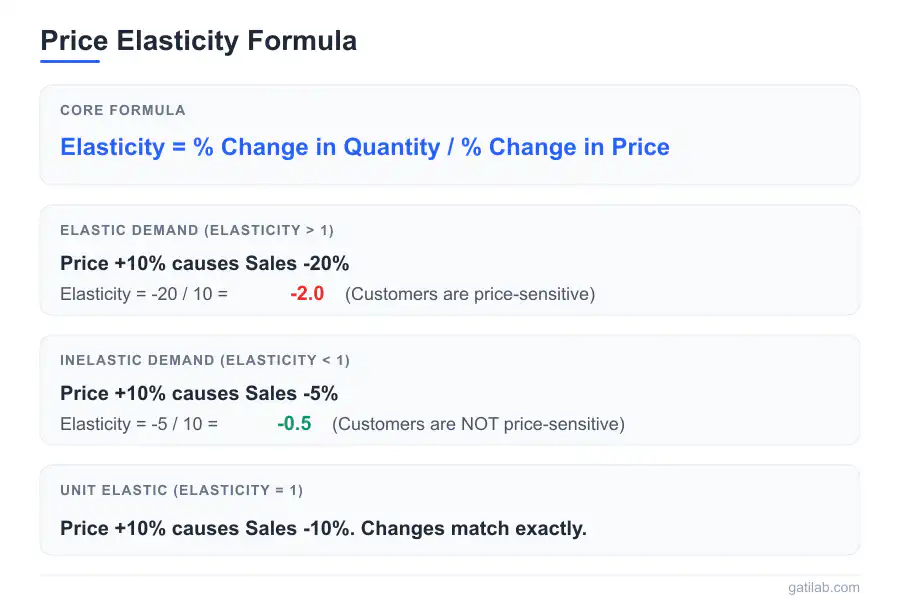
Elasticity = (% Change in Quantity Demanded) / (% Change in Price)
If you raise prices 10% and sales drop 20%, elasticity is -20/10 = -2.
If you raise prices 10% and sales drop 5%, elasticity is -5/10 = -0.5.
The negative sign indicates an inverse relationship. Higher prices mean lower quantity. We often drop the negative and discuss absolute values for simplicity.
Interpreting the number:
- Elasticity > 1: Elastic demand. Customers are price-sensitive. Quantity changes more than price.
- Elasticity < 1: Inelastic demand. Customers aren't price-sensitive. Quantity changes less than price.
- Elasticity = 1: Unit elastic. Percentage changes match exactly.
This single number determines whether raising prices increases or decreases your revenue. I wish I’d known this math when I was agonizing over my first rate increase. The answer was right there in the data I wasn’t collecting.
The Revenue Implications
Here’s where it gets practical. And where most pricing intuitions go wrong.
Most specialized freelance services have inelastic demand. Your clients chose you for your expertise, not your price. That means you’re probably undercharging.
Revenue = Price x Quantity
When you change price, both variables move. The net effect on revenue depends on which moves more.
Elastic demand (elasticity > 1):
Price increases reduce revenue. You lose more in quantity than you gain in price.
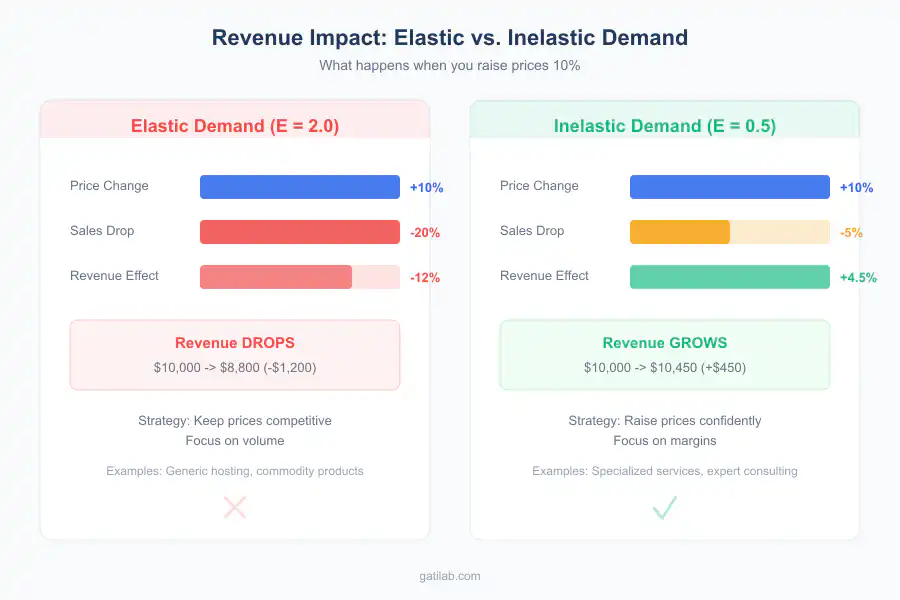
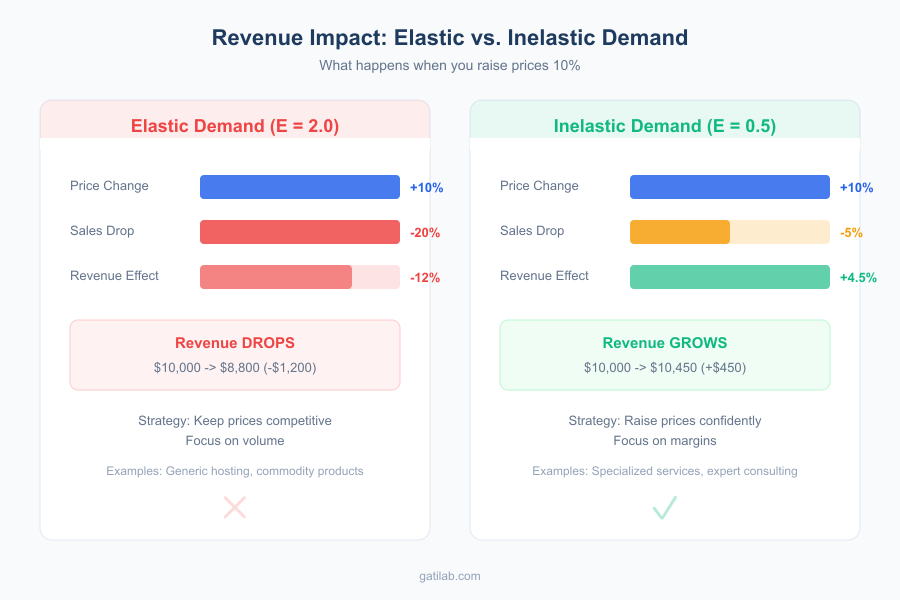
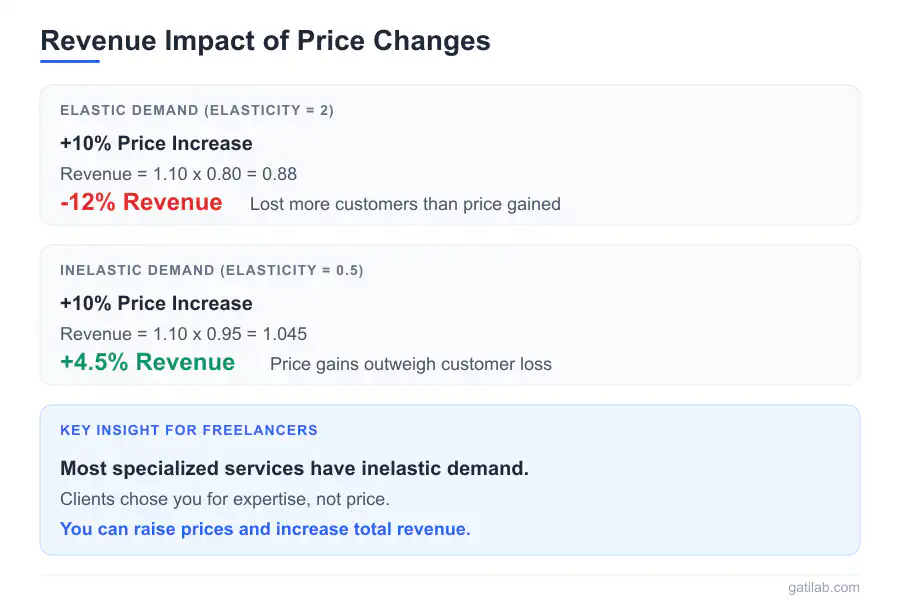
Example: Elasticity of 2. You raise prices 10%. Sales drop 20%. Revenue change: 1.10 x 0.80 = 0.88. Revenue dropped 12%.
For elastic products, lower prices increase revenue. This is the volume play.
Inelastic demand (elasticity < 1):
Price increases raise revenue. You lose some quantity but not enough to offset the higher price.
Example: Elasticity of 0.5. You raise prices 10%. Sales drop 5%. Revenue change: 1.10 x 0.95 = 1.045. Revenue increased 4.5%.
For inelastic products, higher prices increase revenue. This is where most service businesses should be operating.
Unit elastic (elasticity = 1):
Price changes don’t affect revenue. Gains and losses exactly offset.
The insight that changed my pricing approach: most specialized freelance services have inelastic demand. Your clients chose you for your expertise, not your price. That means you’re probably undercharging.
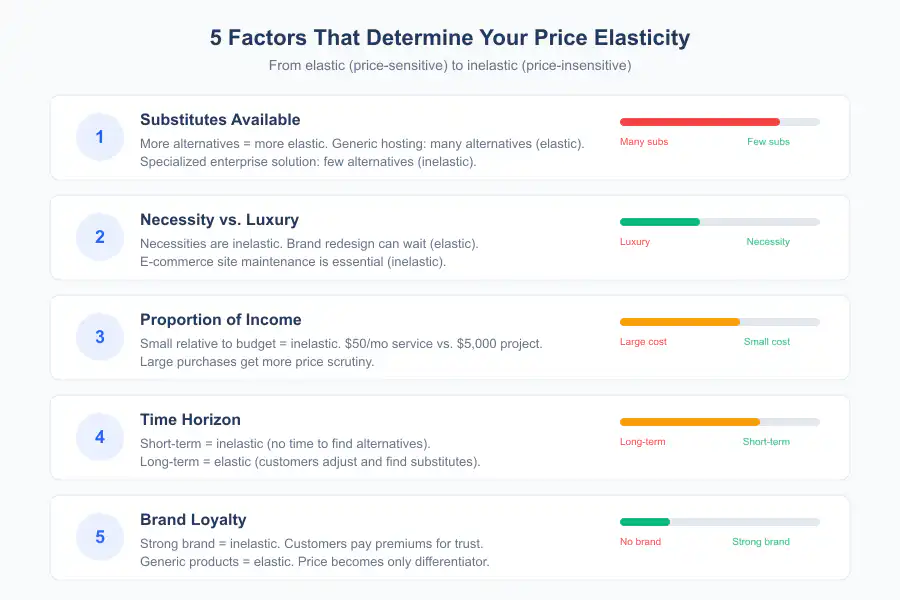
What Determines Elasticity?
Why are some products elastic and others inelastic? Several factors, and understanding them helps you position your services strategically.
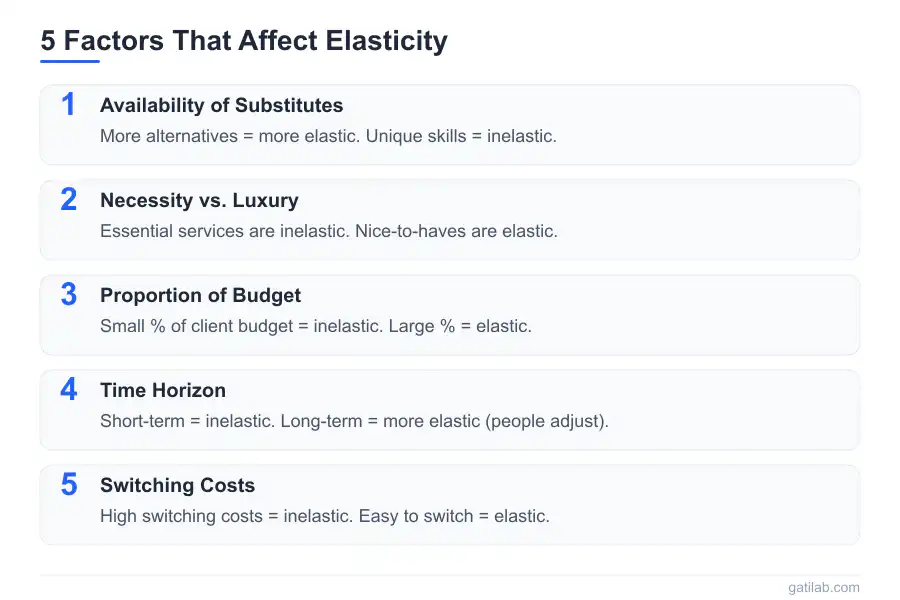
Availability of substitutes:
More substitutes means more elastic demand. If customers can easily switch to alternatives, they will when you raise prices.
Generic web hosting is elastic. Customers can switch to dozens of competitors with minimal effort. Specialized enterprise solutions are more inelastic. Fewer alternatives exist, and the switching costs are real.
Necessity vs. luxury:
Necessities are inelastic. People buy them regardless of price changes. Luxuries are elastic. Discretionary spending gets cut first when prices rise.
Website maintenance for an active e-commerce business is necessary. They’ll pay higher prices rather than let the site break. A brand redesign can wait. It’s more elastic.
Proportion of income:
Small purchases relative to the buyer’s budget are inelastic. Nobody compares prices for gum. Large purchases are elastic. Everyone shops around for cars.
A $50/month service feels different than a $5,000 project. The same percentage increase hits differently depending on how much of the buyer’s budget it represents. I think about this when pricing for enterprise versus small business clients.
Time horizon:
Short-term demand is more inelastic. People haven’t had time to find alternatives. Long-term demand is more elastic. Given time, people adjust their behavior and find substitutes.
If you raise prices suddenly, customers might stay in the short term. Give them six months, and they’ll evaluate alternatives.
Brand loyalty:
Strong brands have more inelastic demand. Customers pay premiums for brands they trust. Generic products are elastic. Price becomes the only differentiator when everything else looks the same.
This is why building a personal brand as a freelancer matters beyond ego. Brand loyalty reduces your price elasticity, which means more pricing power.
Calculating Your Elasticity
You can estimate your own price elasticity with historical data. You don’t need a PhD. You need a spreadsheet and honest numbers.
Method 1: Before/after analysis
If you’ve changed prices before, compare the periods.
Before: Price $100, sold 1,000 units After: Price $120, sold 850 units
% Price change: (120-100)/100 = 20% % Quantity change: (850-1000)/1000 = -15%
Elasticity: -15/20 = -0.75
Demand is inelastic. The price increase raised revenue (as this example shows: $100,000 before, $102,000 after). This is the kind of data I collect every time I adjust my rates.
Method 2: Market testing
Run price tests on segments. Offer different prices to different groups. Measure conversion rates.
Group A: $99 price, 5% conversion Group B: $129 price, 3.5% conversion
% Price change: 30% % Quantity change: -30%
Elasticity: approximately 1. Unit elastic.
Method 3: Survey-based estimation
Ask potential customers about purchase intent at different prices. Not as reliable as actual behavior, but provides directional data when you don’t have historical pricing changes to analyze.
“Would you buy at $X?” for various values of X. Plot the demand curve.
Applying Elasticity to Real Decisions
Here’s how this math changes actual business decisions. These scenarios play out constantly in freelance and service businesses.
Scenario 1: Raising prices for services
Your hourly rate is $100. You’re considering $125.
If your demand elasticity is 0.4 (inelastic, because you’re specialized), a 25% price increase loses roughly 10% of clients.
Before: 100 hours x $100 = $10,000 After: 90 hours x $125 = $11,250
Revenue increases 12.5%. Plus you work fewer hours. Clear win.
But if elasticity is 1.5 (elastic, because you’re competing with many alternatives), that 25% increase loses 37.5% of clients.
Before: 100 hours x $100 = $10,000 After: 62.5 hours x $125 = $7,812
Revenue drops 22%. Bad move.
The math tells you which scenario you’re in. I ran these numbers before my last rate increase and it gave me the confidence to go through with it.
Scenario 2: Discounting strategy
You’re considering a 20% discount to boost sales.
If elasticity is 0.5, a 20% discount increases quantity by only 10%.
Before: 100 units x $50 = $5,000 After: 110 units x $40 = $4,400
Revenue drops 12%. The discount failed to generate enough volume.
If elasticity is 2, that 20% discount increases quantity by 40%.
Before: 100 units x $50 = $5,000 After: 140 units x $40 = $5,600
Revenue increases 12%. The discount works because demand is price-sensitive.
Scenario 3: Product line pricing
Different products have different elasticities, even within the same business.
Commodity product: Elasticity 2.0. Keep prices competitive. Volume matters. Specialized product: Elasticity 0.6. Price for profit. You have pricing power. Premium product: Elasticity 0.3. Charge maximum. Brand value protects you.
Same company, three different pricing strategies based on elasticity. I’ve applied this to my own service tiers. Basic WordPress maintenance (elastic, priced competitively). Custom development (inelastic, priced for profit). Strategic consulting (very inelastic, premium pricing).
The Profit Perspective
Revenue isn’t profit. Costs matter too. And this is where the analysis gets even more useful.
The fuller equation:
Profit = (Price – Cost) x Quantity
Even with inelastic demand, you might not want maximum revenue if costs scale with quantity.
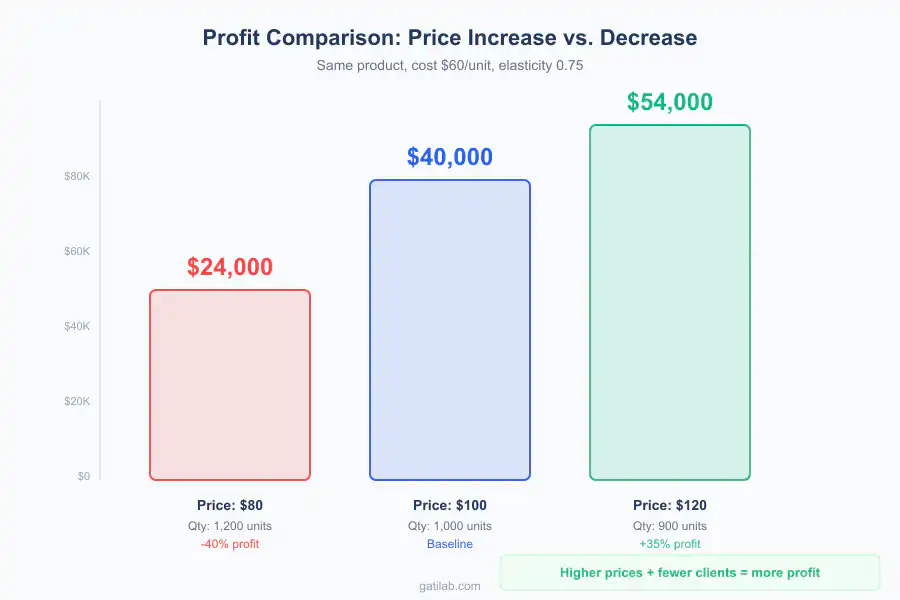
Example:
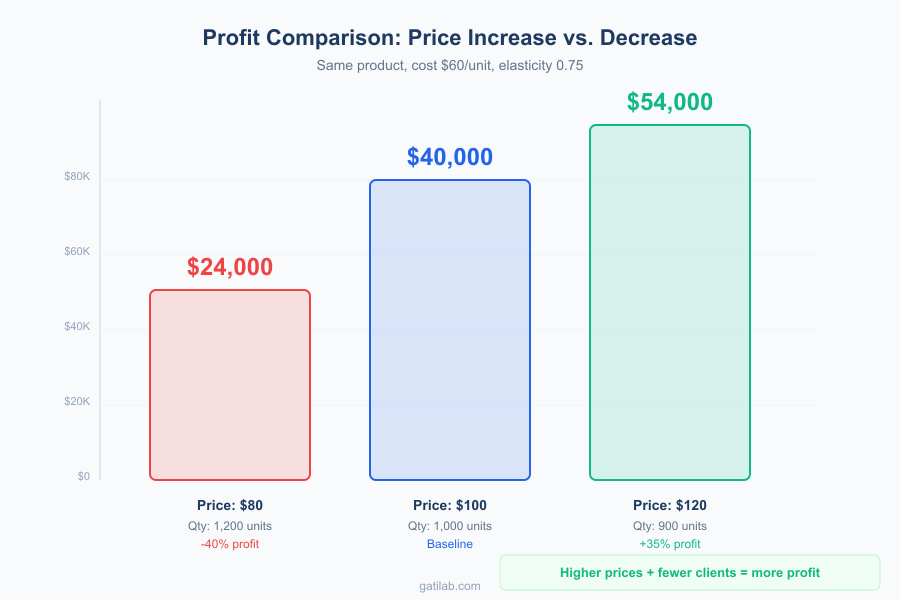
Current: Price $100, Cost $60, Quantity 1,000 Profit: $40 x 1,000 = $40,000
Option A (price increase): Price $120, Cost $60, Quantity 900 Profit: $60 x 900 = $54,000
Option B (price decrease): Price $80, Cost $60, Quantity 1,200 Profit: $20 x 1,200 = $24,000
Even though Option B might have higher revenue in some scenarios, profit clearly favors Option A. This is why I almost always recommend freelancers explore raising rates before chasing volume.
For service businesses where your time is the cost, fewer higher-paying clients often beats more lower-paying clients. You earn more and work less. This ties directly into sustainable pricing for long-term freelancing.
Common Pricing Mistakes
Understanding elasticity reveals why common strategies fail. I’ve made most of these mistakes myself before learning the math.
Mistake 1: Assuming volume compensates for margin
“If I cut prices 50%, I’ll more than double sales.”
This requires elasticity greater than 2. Most products don’t have that. You need extraordinary price sensitivity for deep discounts to increase revenue. Do the math before cutting prices. Know your elasticity first. I’ve watched freelancers race to the bottom on price, convinced that volume would save them. It rarely does.
Mistake 2: Competing purely on price
When you compete on price, you’re assuming elastic demand where price is the deciding factor. This is true for commodities but not for differentiated products or services.
If your service is genuinely better, demand might be inelastic. You’re leaving money on the table by pricing low. Worse, low prices can signal low quality.
Mistake 3: One-size-fits-all pricing
Different customers have different elasticities.
Enterprise clients: Low elasticity. They value reliability over savings. Startup clients: Higher elasticity. Budget-constrained and more price-sensitive. Individual buyers: Varies widely. Some pay any price for quality, others hunt deals.
Uniform pricing ignores this variation. Segment-based pricing captures value from inelastic segments while staying competitive in elastic ones. This is why I price enterprise work differently than small business work.
Mistake 4: Ignoring anchoring effects
Elasticity isn’t static. It depends on reference points.
If your product has always been $100, raising to $150 feels like a 50% increase. But if you launch a premium tier at $300, the $150 option feels reasonable by comparison. Higher-priced options make lower-priced options seem more accessible.
Anchors change perceived elasticity without changing the product itself.
Practical Ways to Reduce Elasticity
You can make demand more inelastic through strategy. This is where the real money is.
Build switching costs:
When customers are invested in your platform or process, leaving is costly. Data migration, learning curves, integration dependencies. These costs make demand less elastic because the “switch to a competitor” option involves real pain.
WordPress developers who build custom solutions create switching costs naturally. Clients don’t leave over price when leaving means rebuilding everything.
Differentiate genuinely:
Unique value reduces available substitutes. Fewer substitutes means lower elasticity. If you’re the only one offering a specific combination of skills, experience, and approach, customers can’t switch when you raise prices. They either pay or go without.
Build brand and relationships:
Loyal customers have lower elasticity. They pay premiums for trust and the relationship itself. Acquiring new customers might require competitive pricing. But keeping existing customers can tolerate higher prices because the relationship adds value beyond the deliverable.
Bundle strategically:
Bundles make price comparison harder. When customers can’t easily compare your bundle to competitors’ individual offerings, effective elasticity drops. I bundle strategy, implementation, and maintenance together specifically because unbundled alternatives are easier to price-compare.
Target inelastic segments:
Some customer segments are naturally less price-sensitive. Enterprise clients with substantial budgets. Businesses where your service is mission-critical. Customers who value time over money. Niche selection helps you find and focus on these segments.
Focus on these segments and let price-sensitive customers go to competitors. You’ll earn more and stress less.
The Limits of the Model
Elasticity is a useful model, not a perfect predictor. Real markets are messier than formulas.
Demand curves aren’t linear:
Elasticity often varies along the demand curve. You might be inelastic for small price changes but elastic for large ones. A 10% increase might not affect demand at all. A 50% increase might crash it. The relationship isn’t necessarily consistent across the full range.
Elasticity changes over time:
As markets evolve, substitutes appear, and customer preferences shift, elasticity changes. What was inelastic becomes elastic. Yesterday’s pricing power disappears when a new competitor enters the market.
Re-estimate periodically. Don’t rely on old elasticity data to make current pricing decisions.
Quality perceptions matter:
In some markets, higher prices signal higher quality. Raising prices might actually increase demand by changing perception. This violates the basic demand model but happens regularly in luxury goods and professional services. I’ve seen freelancers get more inquiries after raising rates because higher prices signaled expertise.
Competitors respond:
Your price changes don’t happen in isolation. If you lower prices, competitors might follow. The quantity increase you expected gets competed away. Game theory matters alongside elasticity.
The Strategic Takeaway
Price elasticity gives you a framework for thinking about pricing decisions mathematically instead of emotionally.
I ran the elasticity numbers before my last rate increase and it gave me the confidence to go through with it. Basic WordPress maintenance is elastic, so I price it competitively. Custom development is inelastic, so I price for profit. Strategic consulting is very inelastic, so it gets premium pricing. Same skills, three different strategies.
Don’t guess whether price changes will help. Calculate it. Estimate your elasticity. Model the scenarios. Make decisions based on expected outcomes rather than anxiety about losing clients.
The math often contradicts intuition. “Lower prices mean more customers” isn’t always true in revenue terms. “Higher prices scare customers away” isn’t always true in profit terms. Running the numbers removes the guesswork and the emotional stress.
Know your elasticity. Price accordingly. Let competitors make decisions without the math. Track your financial KPIs to keep refining your pricing over time.
Pricing Strategy FAQ
Frequently Asked Questions
What is price elasticity of demand in simple terms?
Price elasticity measures how much your sales volume changes when you change your price. The formula is simple: percentage change in quantity divided by percentage change in price. If the result is greater than 1, customers are price-sensitive (elastic). If less than 1, they’re not (inelastic). This single number tells you whether raising prices will increase or decrease your total revenue.
How do I calculate price elasticity for my freelance services?
Three practical methods: (1) Before/after analysis if you’ve changed rates before, comparing client volume at each price point. (2) Market testing by quoting different rates to different prospects and tracking conversion rates. (3) Survey-based estimation by asking potential clients about purchase intent at various prices. Actual behavior data from methods 1 and 2 is far more reliable than surveys.
Should freelancers raise or lower prices to increase revenue?
It depends entirely on your elasticity. Most specialized freelance services have inelastic demand (elasticity below 1), meaning raising prices increases revenue because you lose fewer clients than you gain per unit. If your services are commoditized with many alternatives (elasticity above 1), lowering prices may attract enough volume to increase revenue. Calculate your elasticity first before deciding.
What factors make demand more elastic or inelastic?
Five key factors: availability of substitutes (more alternatives means more elastic), necessity vs. luxury (necessities are inelastic), proportion of buyer’s budget (smaller relative costs are inelastic), time horizon (short-term is more inelastic), and brand loyalty (strong brands are inelastic). You can strategically reduce your elasticity by building switching costs, differentiating genuinely, and targeting less price-sensitive customer segments.
Why do discounts often fail to increase profit for service businesses?
Discounts need elasticity greater than 2 to compensate for the reduced margin, and most services don’t have that level of price sensitivity. A 20% discount with elasticity of 0.5 only increases quantity by 10%, dropping revenue 12%. Even when revenue increases, profit often doesn’t because Profit = (Price – Cost) x Quantity. Lower prices shrink your margin per unit, requiring huge volume increases that rarely materialize.
How does price elasticity differ for enterprise vs small business clients?
Enterprise clients typically have lower elasticity because they value reliability over savings, have larger budgets, and face higher switching costs. Startups and small businesses tend to have higher elasticity since they’re more budget-constrained and price-sensitive. This is why segment-based pricing works: charge premium rates for enterprise work while staying competitive for smaller clients.
Can raising prices actually increase demand?
Yes, in professional services and luxury markets. Higher prices can signal higher quality, changing buyer perception and actually increasing demand. This violates the basic demand model but happens regularly. I’ve seen freelancers get more inquiries after raising rates because the higher price communicated expertise. Anchoring effects also play a role: a $300 premium tier makes a $150 standard option feel reasonable by comparison.
How often should I re-evaluate my price elasticity?
At least annually, and after any major market change. Elasticity shifts as new competitors enter, customer preferences evolve, and your own brand strength changes. What was inelastic can become elastic when alternatives appear. Track your win/loss ratios at different price points continuously, and re-estimate formally whenever you’re planning a rate change or entering a new market segment.