
Scaling Beyond Time-for-Money: 5 Revenue Models That Work
The freelancer’s trap is elegant in its simplicity. You work, you get paid. You don’t work, you don’t get paid. Every dollar requires your hours.
This model has a ceiling. There are only so many hours in a week, and even raising rates eventually hits limits. At some point, you’re expensive enough that the market narrows, or you simply can’t work more without breaking.
Scaling beyond trading time for money means breaking the direct link between your hours and your income. It’s not about working less for less. It’s about earning without proportional time investment.
I’ve experimented with multiple versions of this over the past decade. Some worked beautifully. Some were expensive lessons. Here’s what actually moves the needle.
The Problem With Trading Time
Time-for-money isn’t inherently bad. Many people build comfortable careers this way. I did for years.
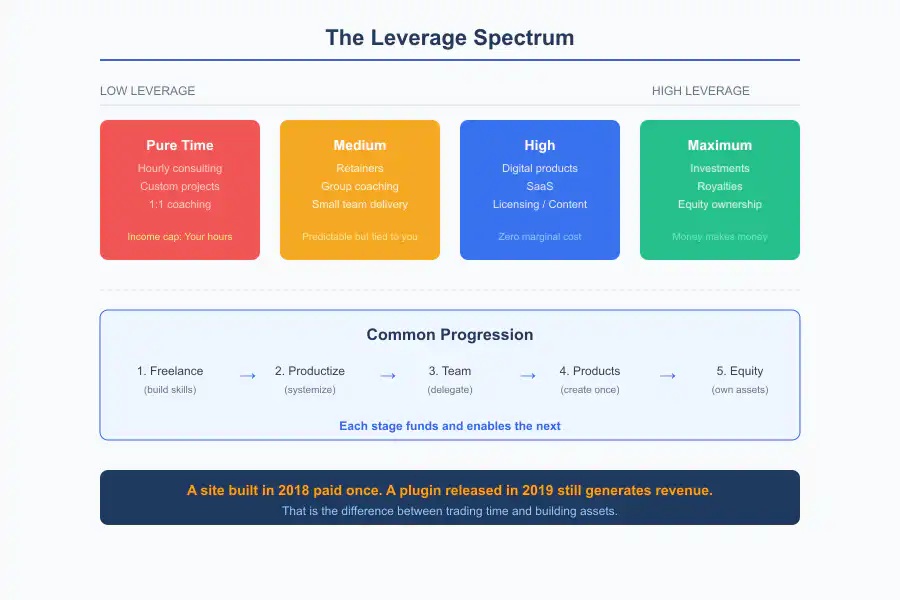
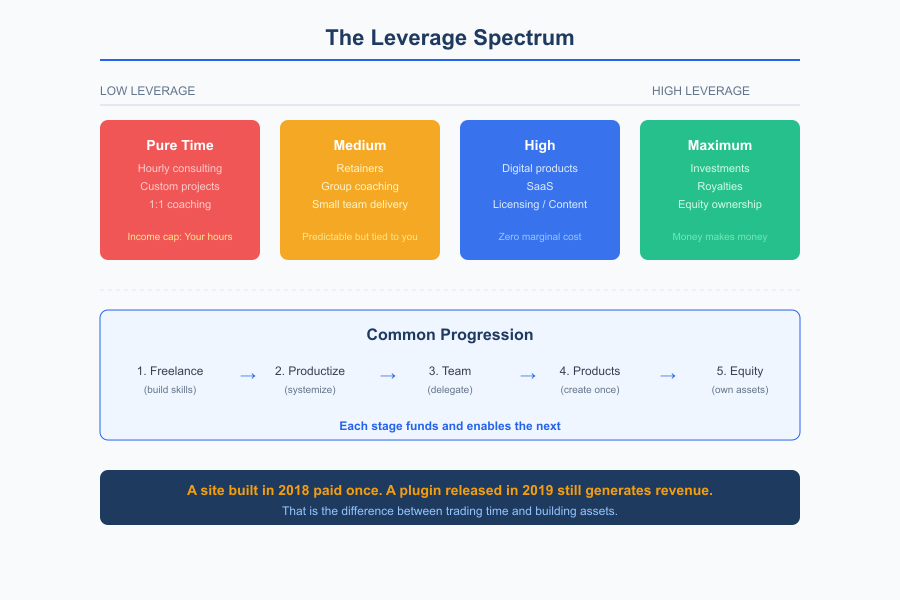
A WordPress site I built in 2018 paid once. A plugin I released in 2019 still generates revenue. That’s the difference between trading time and building assets.
But it has constraints that become painfully obvious the longer you operate under them.
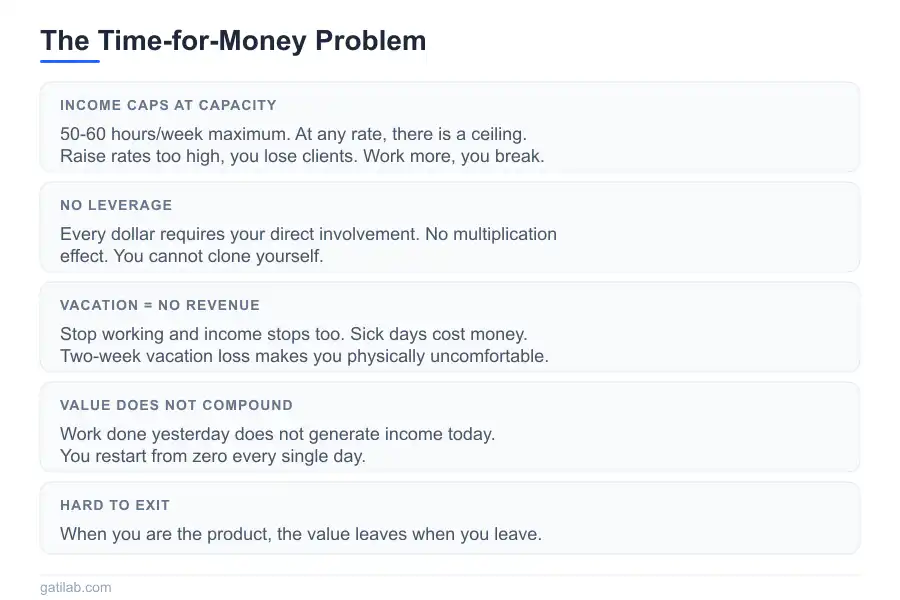
Income caps at capacity. You can work maybe 50-60 hours weekly before burnout. At any hourly rate, that creates a maximum income. I hit mine around year four. Raised my rates, hit it again. Raised them further, lost clients. The ceiling is real.
No leverage. Every dollar requires your involvement. There’s no multiplication effect. You can’t clone yourself, and outsourcing to others without systems just creates management overhead.
Vacation equals no revenue. Stop working and income stops too. Sick days cost money. I once calculated what a two-week vacation actually cost me in lost revenue. The number made me physically uncomfortable.
Value doesn’t compound. Work done yesterday doesn’t generate income today. You restart daily. That WordPress site I built in 2018? It paid once. The plugin I released in 2019? Still generating revenue.
Exit is hard. A business where you are the product is hard to sell. When you leave, the value leaves with you.
The goal isn’t to eliminate all time-based work. It’s to create income streams that don’t require your constant presence.
The Leverage Spectrum
Different business models have different leverage characteristics. Understanding where each falls helps you pick the right moves.
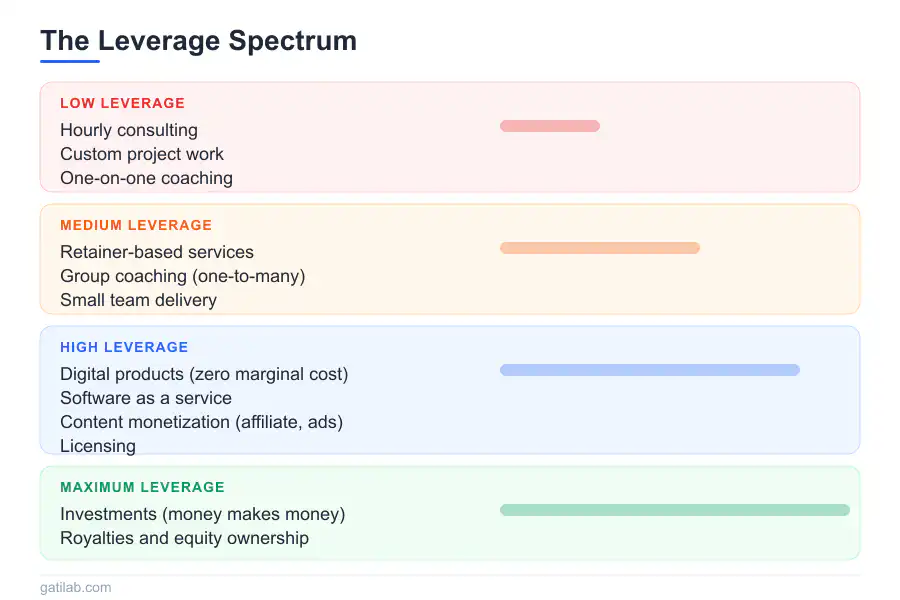
Pure time-for-money (low leverage):
- Hourly consulting
- Custom project work
- One-on-one coaching
Medium leverage:
- Retainer-based services (predictable but still tied to you)
- Group coaching (one-to-many)
- Small team delivery (others do work)
High leverage:
- Digital products (infinite replication at zero marginal cost)
- Software as a service (builds value independent of time)
- Licensing (get paid for what you’ve already created)
- Content monetization (advertising, affiliate income)
Maximum leverage:
- Investments (money makes money)
- Royalties (creative work pays forever)
- Equity (ownership in things others operate)
Moving up this spectrum requires different skills, assets, and risk tolerance. The higher you go, the less direct control you have over outcomes. That tradeoff is worth understanding before you jump.
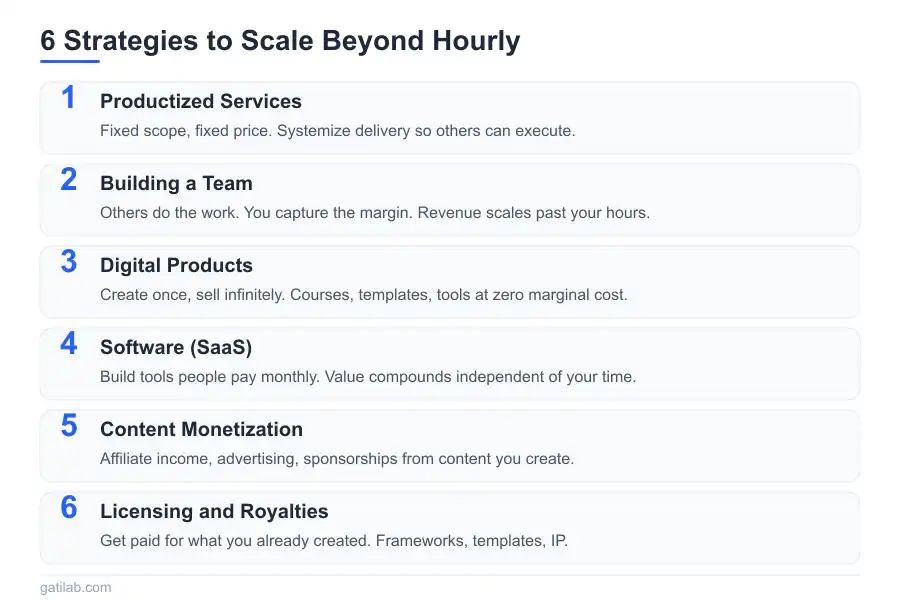
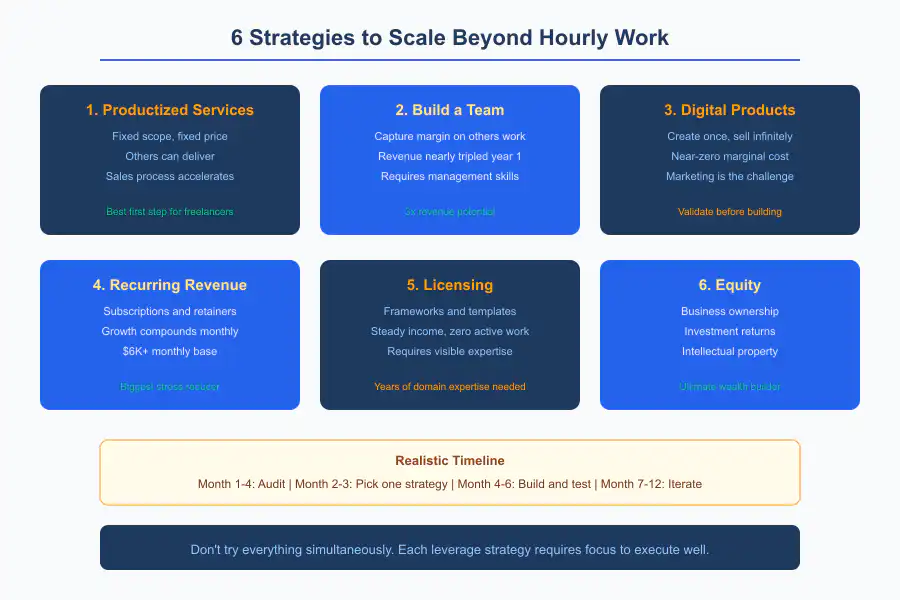
Strategy 1: Productized Services
Productized services standardize your expertise into fixed-scope, fixed-price offerings. This was my first real move away from pure time-for-money, and it changed everything about how I operated.
When you do custom work, every engagement requires scoping, proposal writing, and negotiation. Time spent before you even start working. I used to spend 30% of my productive hours just on sales activities. That’s insane when you think about it.
When you productize, clients buy a defined package. The sales process accelerates. Delivery becomes systematized. And here’s what really matters… with systems in place, others can deliver. A productized service operated by a team generates revenue without requiring your hours for each client.
Building a productized service:
- Identify work you do repeatedly with similar scope
- Define the package precisely
- Create delivery templates and processes
- Price based on value and efficiency
- Systematize until others can deliver
This isn’t fully passive. You still manage, sell, and maintain quality. But revenue can grow beyond your personal hours. Learn more in the complete guide to productized services.
Strategy 2: Building a Team
The classic agency model. Others do work. You capture the difference between what clients pay and what you pay the team.
This has real leverage. A 10-person agency can deliver $1 million in services. You as owner might work 40 hours weekly, but the output isn’t limited to your 40 hours. I watched my revenue nearly triple in the first year after bringing on my first two contractors.
The challenge? Management is its own job. You trade client work for people work. Different skills required. And honestly, not everyone enjoys it. I had to learn this the hard way.
Building a team that generates leverage:
- Start with one contractor or employee doing work you currently do
- Document your processes completely
- Train to your quality standards
- Add capacity as demand warrants
- Your role evolves to sales, operations, and leadership
Some people love this. Others discover they prefer doing the work themselves. Both are valid but lead to different outcomes. See how to transition from freelancer to agency owner for more details.
Strategy 3: Digital Products
A digital product is created once and sold infinitely at near-zero marginal cost.
E-books, courses, templates, software tools. You invest time upfront to create. Then sales potentially continue indefinitely.
The math is attractive. A course that takes 200 hours to create and sells for $200 needs 1,000 sales to reach $200,000 revenue. At $200/hour consulting, that’s 1,000 hours of work for the same money. The product wins. Not by a little. By a lot.
But the marketing challenge is significant. Products don’t sell themselves. Unlike services where clients hire you, products require distribution, visibility, and conversion. I’ve had products that took months to build and earned almost nothing because I didn’t plan the marketing before the development.
Building digital products:
- Identify knowledge you have that others need
- Validate demand before building (pre-sell if possible)
- Create minimum viable version
- Build marketing and distribution channels
- Iterate based on customer feedback
Success rates for digital products are low. Many never sell meaningfully. But winners can generate significant recurring revenue. The key is validating before you build, not after.
Strategy 4: Recurring Revenue Models
Recurring revenue means customers pay you regularly rather than once. This is the model that fundamentally changed my business economics.
SaaS businesses charge monthly for software access. Membership communities charge monthly for access and content. Retainers charge monthly for ongoing services.
The value of recurring is predictability and compounding. Each new subscriber adds to a base that keeps paying. Growth stacks rather than restarts. I went from starting every month at zero to starting every month at $6,000+. That single change reduced my stress levels more than anything else I’ve done professionally.
Building recurring revenue:
- Find problems that are ongoing rather than one-time
- Structure solutions as subscriptions rather than purchases
- Focus on retention as much as acquisition
- Monitor churn obsessively
- Grow the base steadily over time
Recurring revenue takes time to build but creates the most stable businesses.
Strategy 5: Licensing and Royalties
If you create something valuable, others might pay to use it rather than create their own.
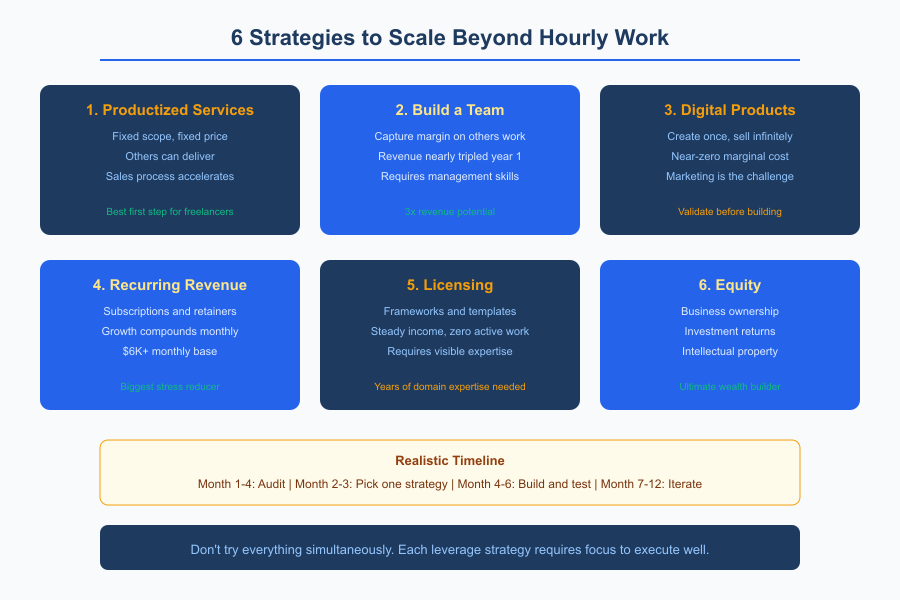
A framework you’ve developed could be licensed to consultancies. Designs could be sold as templates. Content could be syndicated. I license a few tools and templates that I built for my own workflow. Nothing massive, but steady income that requires zero active work most months.
This requires having created something others want to replicate. That usually means years of expertise in a visible domain.
Licensing opportunities:
- Frameworks and methodologies
- Design systems and templates
- Content libraries
- Proprietary processes
- Brand and persona
The upfront work is substantial. But once licensing agreements exist, income continues without proportional effort.
Strategy 6: Equity and Ownership
The ultimate leverage is owning things that grow in value.
This includes:
- Business equity (owning part of companies you or others build)
- Investment equity (stocks, real estate, other assets)
- Intellectual property (patents, trademarks, copyrights)
Equity isn’t something you create quickly. It’s built over years through business growth, strategic investing, or creative production.
But it’s how most significant wealth is built. Not by exchanging hours for dollars endlessly, but by owning things that appreciate. Understanding the simple math behind long-term growth explains why this works.
Combining Strategies
These approaches aren’t mutually exclusive. In fact, the most successful people I know combine several of them.
A common progression:
- Start trading time for money (freelancing, consulting)
- Productize services for efficiency and repeatability
- Build a small team for capacity beyond your hours
- Create digital products from your expertise
- Develop recurring revenue through subscriptions
- Accumulate equity through business value and investments
Each stage funds and enables the next. Time-for-money income provides capital to invest in products. Product revenue provides stability to take equity risk. That’s exactly how my own journey unfolded, though it took longer than I expected at every stage.
The Transition Mindset
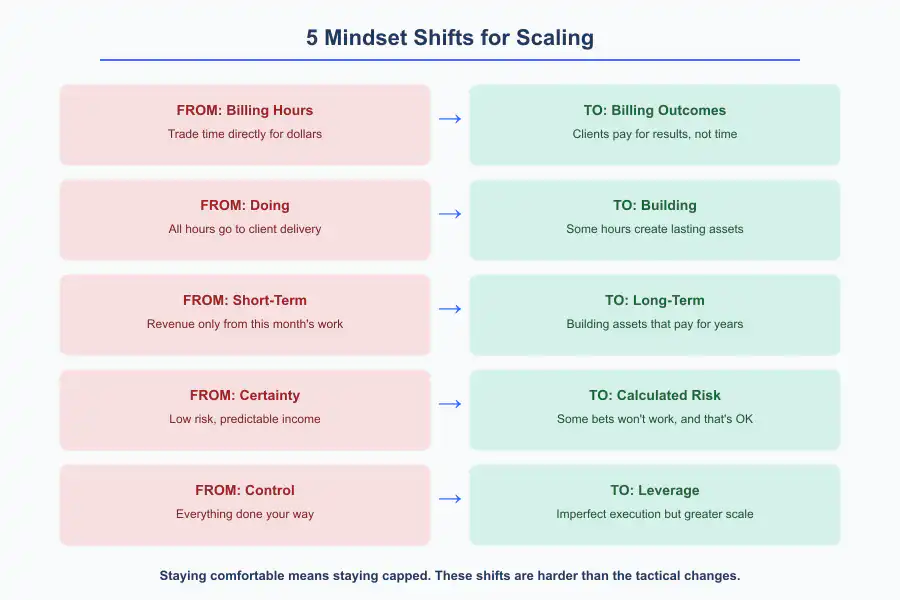
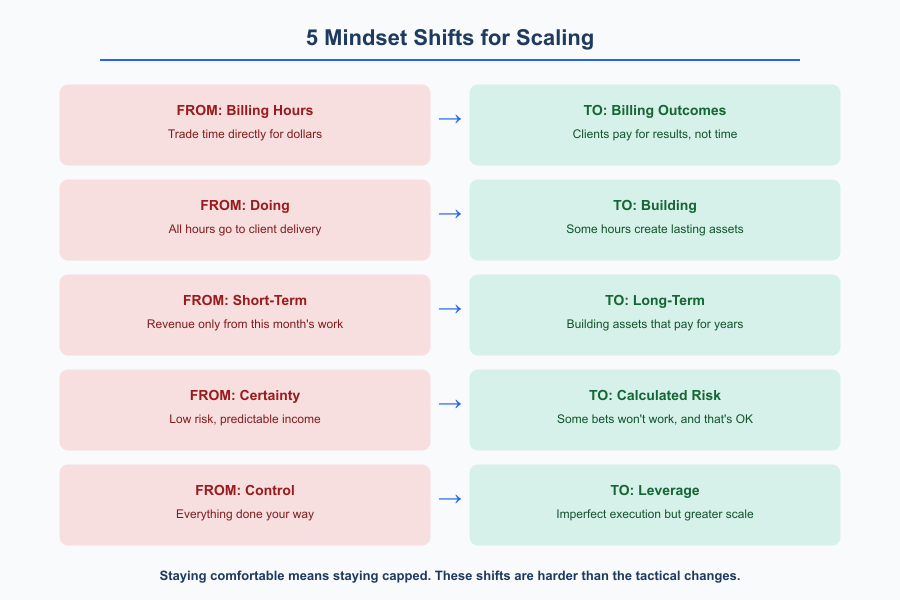
Moving away from time-for-money requires psychological shifts. These were harder for me than the tactical changes.
I went from starting every month at zero to starting every month at $6,000+. That single change, building recurring revenue, reduced my stress levels more than anything else I’ve done professionally. The shift from uncertainty to predictability changed everything about how I make decisions.
From billing hours to billing outcomes. Value-based thinking. Clients pay for results, not time. This felt risky at first, but it’s where the real money lives.
From doing to building. Some of your hours go to creating assets rather than delivering services. That means less short-term income for more long-term leverage. Uncomfortable? Yes. Necessary? Absolutely.
From short-term to long-term. Building a product won’t pay this month. It might pay for years. You have to be okay with deferred gratification.
From certainty to risk. Time-for-money is low risk. Building assets has more variability. Some bets won’t work out. That’s part of the game.
From control to leverage. Delegating means others do things imperfectly. The tradeoff is scale. You can’t have both perfect control and exponential growth.
These are hard shifts. They feel uncomfortable because you’re giving up what’s proven for what might work. But staying comfortable means staying capped.
How to Start
If you’re currently pure time-for-money, here’s a realistic timeline.
Week 1-4: Audit your work. What do you do repeatedly? What could become a product or system? What would others pay for if packaged differently? I spent a month just observing my own patterns before I made any changes.
Month 2-3: Pick one strategy. Productize one service, plan one digital product, make one hire, or establish one recurring offering. Focus on one path. Trying to do everything at once guarantees you finish nothing.
Month 4-6: Build and test. Create the asset, launch the offering, test the market. Learn what works. Expect the first version to be rough. Ship it anyway.
Month 7-12: Iterate and decide. Is this path worth pursuing? Double down or try another approach. Don’t be afraid to abandon something that isn’t working.
Don’t try everything simultaneously. Each leverage strategy requires focus to execute well.
Common Mistakes
Ignoring marketing. Building products nobody knows about. Hiring teams with no clients to serve. Leverage requires demand, not just supply. I built a tool once that was technically excellent. Three people bought it. I hadn’t spent a single hour on marketing before launch.
Moving too fast. Jumping to passive income before mastering active income. No foundation means no leverage. You need skills and reputation first.
Wrong personality fit. Building an agency when you hate managing. Creating courses when you hate marketing. Match the model to who you are, not who you think you should be.
Underestimating effort. “Passive” income isn’t passive to create. The building phase is intensive. Anyone who tells you otherwise is selling a course about passive income.
Not tracking the actual economics. That product that feels like success might be losing money when you count all costs. Know your numbers. I’ve had projects that looked profitable until I tracked my time honestly.
The Realistic Outcome
True passive income is rare. Even asset-heavy businesses require maintenance, updates, and attention. Let’s be honest about that.
What’s achievable is better leverage. Income that grows faster than hours worked. Revenue that continues when you’re not actively producing.
Some people build million-dollar product empires working 20 hours weekly. Some build agencies that run without them. These outcomes exist. They’re real. They’re also not the norm.
For most people, the realistic outcome is a mix. Some client work still, but supplemented by leverage income. Part of what you earn comes from hours, part from assets and systems.
That mix provides security, growth, and freedom. It’s worth building even if you never reach pure passive income.
The game isn’t all or nothing. It’s incrementally shifting the balance toward income that doesn’t require your constant presence.
Start that shift now. Future you will be grateful.
Scaling Your Business FAQ
Frequently Asked Questions
What does it mean to scale beyond trading time for money?
It means breaking the direct link between your hours and your income. Instead of earning only when you actively work, you create income streams through products, systems, teams, or assets that generate revenue without requiring your constant presence. The goal is not to eliminate all work but to create leverage where income grows faster than hours invested.
What is the leverage spectrum for business models?
Low leverage includes hourly consulting and custom project work. Medium leverage includes retainer-based services and group coaching. High leverage includes digital products, SaaS, licensing, and content monetization. Maximum leverage includes investments, royalties, and equity ownership. Moving up the spectrum requires different skills and risk tolerance but reduces the dependency between your hours and your income.
What are productized services and why are they a good first step?
Productized services standardize your expertise into fixed-scope, fixed-price offerings. Instead of custom scoping every engagement, clients buy a defined package. This accelerates sales, systematizes delivery, and eventually allows others to deliver the work. They are a natural first step because they build on existing skills while creating systems that scale beyond your personal hours.
How do digital products create leverage?
Digital products like courses, e-books, templates, and software are created once and sold infinitely at near-zero marginal cost. A course that takes 200 hours to create and sells for $200 needs just 1,000 sales to reach $200,000 in revenue, compared to 1,000 hours of consulting at $200 per hour. The catch is that marketing is a separate challenge and success rates for digital products are low without validated demand.
What is the typical progression for scaling beyond hourly work?
A common path: start freelancing or consulting for active income, then productize your services for efficiency, build a small team for capacity beyond your hours, create digital products from your expertise, develop recurring revenue through subscriptions, and accumulate equity through business value and investments. Each stage funds and enables the next. The progression typically takes years, not months.
What mindset shifts are needed to move away from hourly billing?
Five key shifts: from billing hours to billing outcomes (value-based thinking), from doing to building (investing hours in assets rather than delivery), from short-term to long-term thinking (deferred gratification), from certainty to risk tolerance (some bets will not work), and from direct control to leverage (delegating means imperfect execution but greater scale). These psychological shifts are often harder than the tactical changes.
What are the most common mistakes when trying to scale?
Five frequent mistakes: ignoring marketing when building products (building things nobody knows about), moving too fast before mastering active income, choosing models that do not fit your personality (building an agency when you hate managing), underestimating the effort required to create assets (passive income is not passive to create), and not tracking actual economics (products that look profitable may lose money when all costs are counted).
Is truly passive income realistic?
True passive income is rare. Even asset-heavy businesses require maintenance, updates, and attention. What is achievable is better leverage: income that grows faster than hours worked and revenue that continues when you are not actively producing. For most people, the realistic outcome is a mix of some client work supplemented by leverage income from assets and systems. That mix provides security, growth, and freedom worth building toward.