
Freelancer Pricing Guide: How to Set and Raise Your Service Rates
Most freelancers underprice themselves. Not by a little. By a lot.
I know because I did it for years. Charged $500 for projects that should have been $2,500. Felt grateful when clients paid on time. Wondered why I was working 60-hour weeks and still struggling to save money.
The problem wasn’t finding clients. The problem was math. My rates couldn’t support a sustainable freelance career. And if you’re reading this, yours probably can’t either.
Why Your Current Rates Are Wrong
If you set your freelance rates by looking at what competitors charge, you’re already losing. Those competitors are probably broke too. They’re just broke together.
The freelance market is flooded with two types of people: beginners who charge nothing because they don’t know better, and experienced professionals who’ve figured out how to charge 5-10x more for the same work.
There’s almost no middle ground. You’re either racing to the bottom or building something sustainable.
I’ve been on both sides. Started at $15/hour in 2009. Now I charge project rates that would have seemed insane to younger me. The quality of my work improved, sure. But the bigger change was understanding what my time was actually worth. And honestly, that took longer than it should have.
The Real Cost of Running Your Business
Before we talk about what to charge, let’s talk about what you actually need.
You won’t bill 160 hours a month. You’ll bill 80-100 if you’re efficient. The rest goes to finding clients, sending proposals, chasing invoices, and learning new skills. Factor this into every rate calculation.
Most freelancers calculate rates like this: “I want to make $60,000 a year. That’s $5,000 a month. If I work 160 hours a month, I need $31.25 an hour.”
This math is fatally flawed.
You won’t bill 160 hours a month. You’ll bill maybe 80-100 if you’re efficient. The rest goes to finding clients, sending proposals, chasing invoices, learning new skills, and dealing with scope creep.
It also ignores taxes. In most countries, you’re paying 25-40% on freelance income. That $60,000 gross is maybe $40,000 net. Now divide by actual billable hours. Your effective rate needs to be much higher than you thought.
And we haven’t even touched expenses. Software, equipment, health insurance if you’re in the US, retirement savings, professional development. These add up to thousands per year. Thousands that come out of your “hourly rate” if you haven’t accounted for them.
How to Calculate What You Actually Need
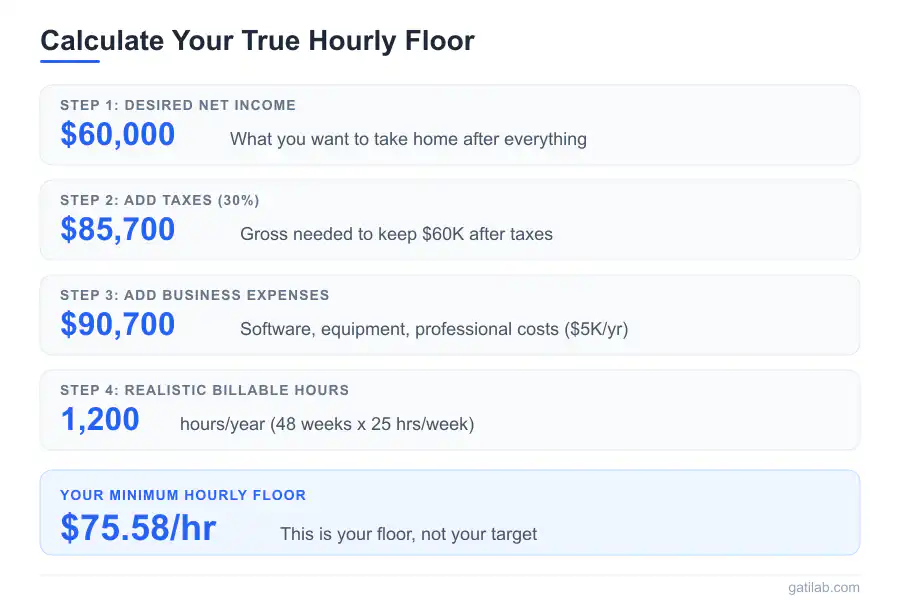
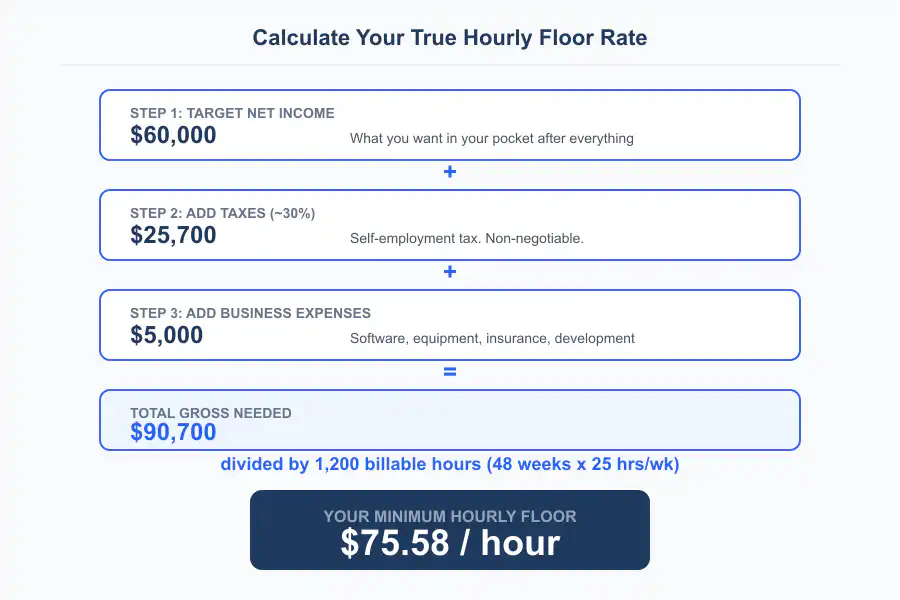
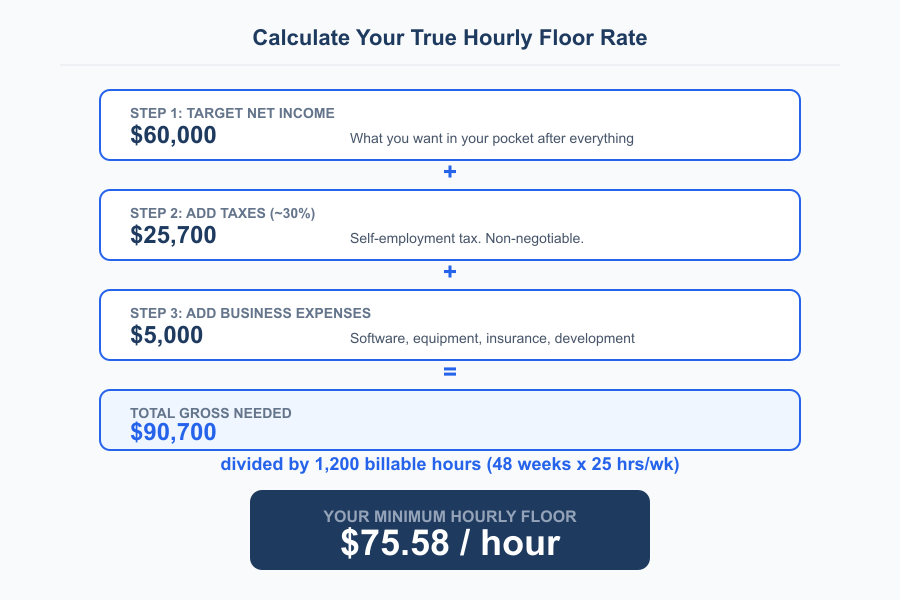
Start with what you want to take home after everything. Not revenue. Not gross income. Actual money in your pocket after taxes and business expenses.
Let’s say you want $60,000 net.
Add your estimated taxes. Call it 30%. That means you need $85,700 gross to keep $60,000.
Add business expenses. Let’s say $5,000/year for software, equipment, and professional costs. Now you need $90,700.
Now divide by realistic billable hours. If you work 48 weeks a year (you need vacations, you’re human) and bill about 25 hours per week (the rest is admin), that’s 1,200 billable hours.
$90,700 divided by 1,200 hours equals $75.58 per hour. Minimum. That’s your floor, not your target.
This is why freelancers charging $30-40/hour struggle to survive. The math literally doesn’t work. I wish someone had shown me this calculation in 2009 instead of letting me figure it out the expensive way.
Hourly vs Project Pricing
Hourly billing punishes efficiency. The faster you get, the less you make. The better your systems, the lower your income. Think about that for a second.
I switched to project pricing years ago. Best decision I’ve made for my freelance business.
With project pricing, you charge based on the value you deliver, not the time you spend. A logo that takes 4 hours is worth the same to the client as one that takes 40 hours. Both solve the same problem.
Here’s how I price projects:
First, understand the scope completely. What exactly does the client need? What formats? How many revisions? What’s the timeline?
Second, estimate your time honestly. Include meetings, revisions, admin, and a buffer for problems. Always a buffer.
Third, calculate your minimum based on hours. If the project will take 20 hours and your hourly floor is $75, you need at least $1,500.
Fourth, ask about the project’s value. What will this deliverable enable for the client? If your work helps them launch a product that generates $50,000, your $1,500 fee looks like a bargain.
Fifth, price based on value, with your time estimate as the floor. That $1,500 minimum might become $3,000 or $5,000 based on what it’s worth to the client. For more on this approach, see the complete guide to value-based pricing.
The Value Pricing Framework
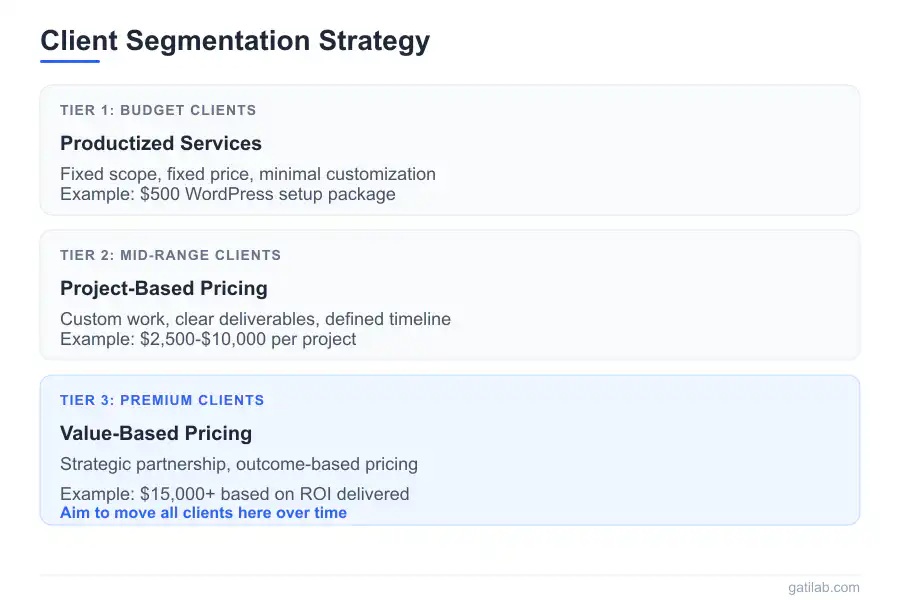
Not all clients are equal. A $1,000 project for a solopreneur means something different than a $1,000 project for a company doing $10 million in revenue.
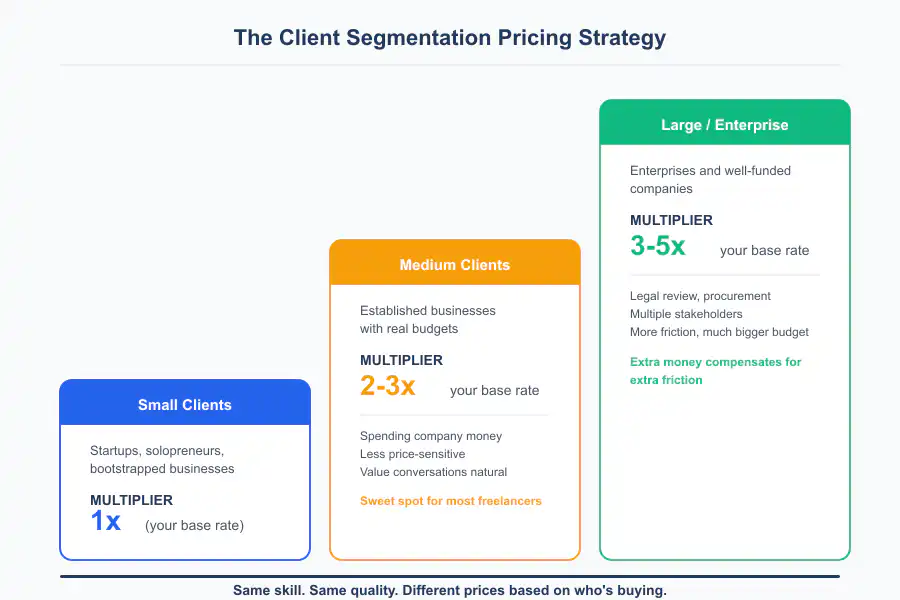
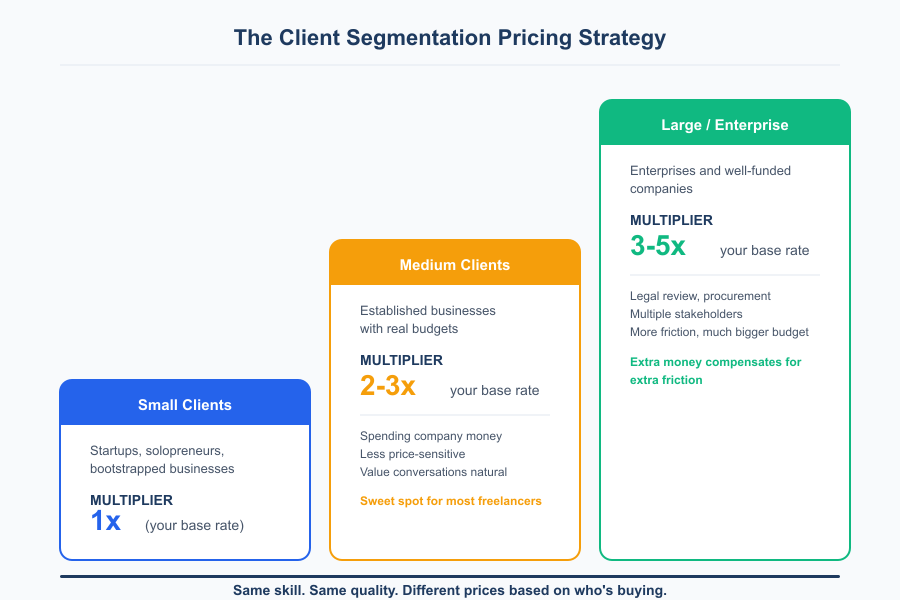
I segment clients into three buckets:
Small clients are startups, solopreneurs, and bootstrapped businesses. They’re price-sensitive because they’re spending their own money. I price competitively here, but I don’t go below my floor. These projects build experience and portfolio. I take them when I have capacity.
Medium clients are established businesses with real budgets. They’re spending company money, not personal money. Price sensitivity drops. Value conversations are more natural. I charge 2-3x what I’d charge small clients for similar work.
Large clients are enterprises and well-funded companies. Legal review, procurement processes, multiple stakeholders. More hassle, but much larger budgets. I charge 3-5x my small client rates. The extra money compensates for the extra friction.
Same skill. Same deliverable quality. Different prices based on who’s buying.
How to Actually Raise Your Rates
If you’re currently underpriced, raising rates feels terrifying. What if clients say no? What if you lose everyone?
Here’s what actually happens when you raise rates: you lose some clients and gain others. The new clients are usually better.
Low-paying clients are often the most demanding. They have tight budgets, which creates stress, which they transfer to you through constant revisions and scope changes. Higher-paying clients tend to be more professional, more trusting, and easier to work with. I’ve seen this pattern across hundreds of projects now.
Start by raising rates for new clients only. Keep existing clients at current rates for now. This lets you test the market without risking relationships.
Raise by at least 25%. Anything less isn’t worth the anxiety. You’ll second-guess a 10% increase just as much as a 30% increase, so go for the bigger number.
When you raise prices for existing clients, give them notice. Something like: “Starting next quarter, my rate for new projects will be X. I wanted to let you know in advance so you can budget accordingly.”
Some will accept it. Some won’t. That’s fine. You’re making room for clients who value your work more.
Handling Price Objections
When clients push back on price, you have options.
If they say it’s too expensive, ask what budget they had in mind. Sometimes there’s a real constraint you can work with. Sometimes they’re just negotiating. Sometimes you’re not the right fit.
If budget is genuinely limited, consider reducing scope rather than price. “I can’t do the full project for that budget, but I could do this portion. Would that help?”
Never apologize for your rates. Don’t explain them in detail unless asked. “That’s my rate for this type of work” is a complete sentence. A powerful one, too.
If someone wants a discount, offer something in exchange. Faster payment terms, case study rights, referrals. Don’t just give money away.
And sometimes? Let the client walk. Not every project is worth taking. A $500 project that drains your energy for two months isn’t worth the ten $5,000 projects you can’t take because you’re stuck.
The Retainer Model
One-off projects create income volatility. You’re always hunting for the next client. Feast or famine. It’s exhausting.
Retainers smooth this out. A client pays monthly for ongoing access to your work. Predictable income for you. Reliable support for them.
I converted most of my client relationships to retainers. Monthly payment, agreed number of hours or deliverables, ongoing relationship. It changed how I sleep at night. Literally.
To set retainer pricing, estimate what the client typically needs each month. Add a small buffer. Price it slightly lower than if they bought it all as one-off projects. The discount reflects the guaranteed income you’re getting.
Make retainer terms clear. What’s included? What’s extra? What happens to unused hours? How does either party cancel?
Retainers don’t work for every client or every freelancer. But if you can make them work, they transform your business stability. Learn more in how to build a retainer-based business model.
Pricing for Different Service Types
Different deliverables call for different pricing approaches.
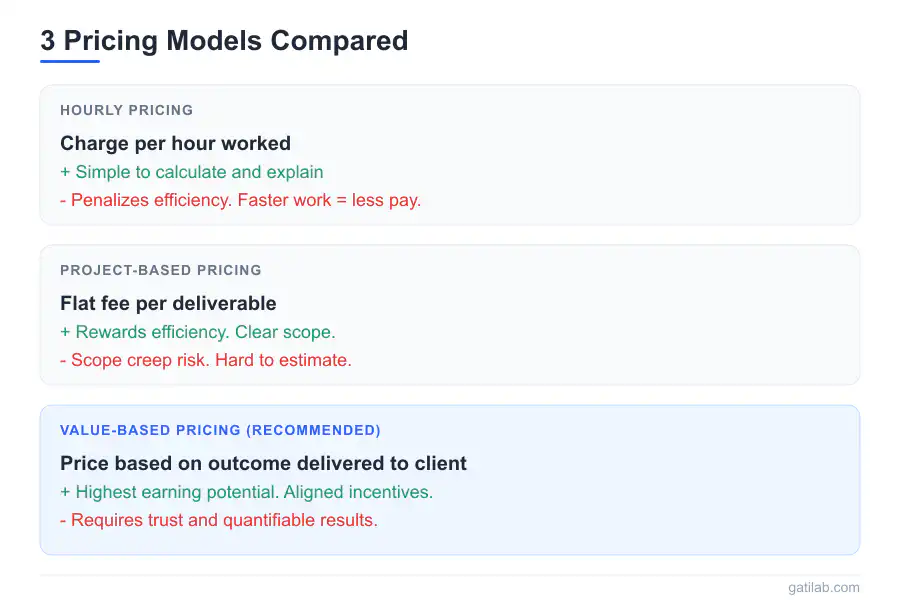
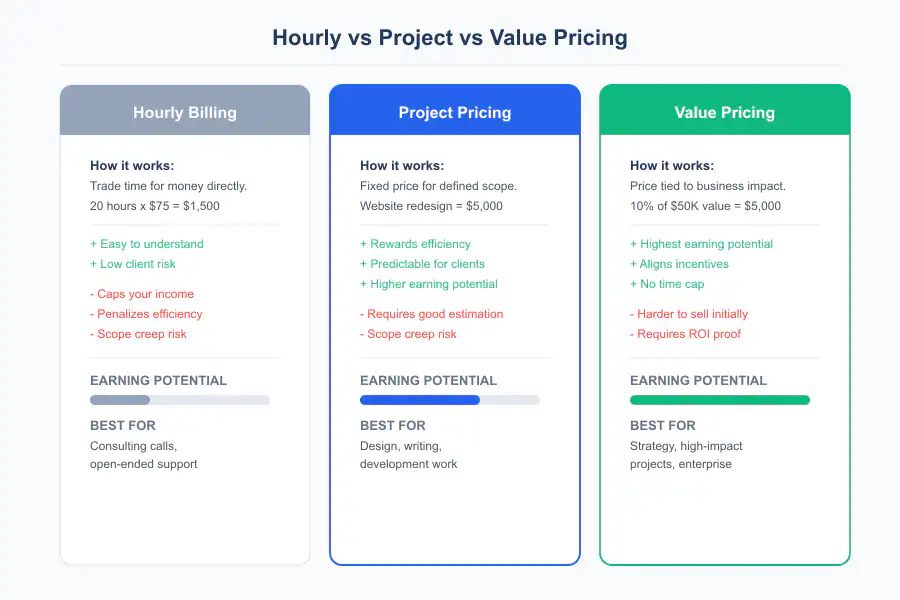
Time-based services like consulting sessions or coaching calls work well hourly or in packages. A one-hour call is easy to price. A package of four sessions gets a slight discount.
Deliverable-based services like design, writing, or development work better with project pricing. You charge for the outcome, not the time.
Strategy work should be priced highest relative to time invested. A marketing strategy that takes 10 hours to research and write could be worth more than a 40-hour implementation project. The thinking is the value, not the typing.
Maintenance and support work well as retainers. Ongoing website maintenance, monthly content, regular design needs. Predictable work, predictable payment.
What About Competitors?
I told you not to price based on competitors. But you can use competitor pricing as market intelligence.
If everyone in your niche charges $50-100/hour, and you want to charge $200, you need positioning to justify it. What makes you different? Faster? More specialized? Better track record?
If you’re just starting out, you might price lower temporarily while you build a portfolio. That’s different from permanently underpricing yourself. One is a strategy. The other is a habit that will quietly wreck your business.
Use competitor rates as one data point, not the decision. The decision comes from your costs, your value, and what the market will bear.
When to Work for Free (Almost Never)
Free work destroys your business in most cases. It sets expectations you can’t sustain. It attracts clients who don’t value what you do.
There are narrow exceptions:
Portfolio building at the very start of your career. Even then, charge something. $200 is better than free. It establishes that your work has value.
Strategic partnerships where the exposure has clear, measurable value. Not “exposure” from some random account with 500 followers. Actual exposure to your target market from established players.
Genuine charity where you’re donating to a cause you believe in. Not “charity” from a company trying to get free work by calling it a “collaboration.”
In most cases, if someone asks you to work for free, say no. If your work isn’t worth paying for, they shouldn’t want it. If it is worth paying for, they should pay.
Communicating Your Value
Price is easier to defend when value is clear.
Before discussing money, make sure the client understands what they’re getting. Walk them through your process. Show relevant past work. Explain why your approach produces better results.
When they see the value, price becomes context rather than obstacle.
Use specific outcomes whenever possible. “This website will load in under 2 seconds and follow all accessibility guidelines” is better than “I’ll build you a website.”
“This strategy document will give you a 12-month content roadmap with specific keywords to target” beats “I’ll write you a strategy.”
The more concrete you make the deliverable, the easier it is to justify the price. Vague scope invites vague objections. Specific scope invites specific agreement.
The Confidence Factor
Pricing is partly psychological. If you don’t believe your rates are fair, clients will sense it.
I started at $15/hour in 2009. Now I charge project rates that would have seemed insane to younger me. The quality improved, sure. But the bigger change was understanding what my time was actually worth. I wasted years learning this. You don’t have to.
You’ll hesitate when stating prices. You’ll over-explain. You’ll offer discounts before they even push back. I’ve done all of this. It doesn’t work.
Confidence comes from knowing your numbers. If you’ve calculated what you need, you can state it without apology. You’re not being greedy. You’re being realistic.
Confidence also comes from being willing to walk away. The best negotiating position is not needing every project desperately. Build a pipeline so you’re never in that position. Keep marketing even when you’re busy. A strong sales pipeline means the projects you accept when you have options are always better than the ones you accept when you’re scared.
The Annual Rate Review
Your rates should increase over time. Your skills improve. Your experience grows. Inflation erodes buying power.
I review rates annually. Usually raise by 10-20% depending on market conditions and demand.
If you’re fully booked constantly, that’s a signal to raise prices. The market is telling you your rates are too low.
If you’re struggling to find clients, your rates might need to stay flat while you improve your marketing or skills. Or maybe you’re targeting the wrong clients who can’t afford quality work. The answer isn’t always “lower your price.”
What Good Pricing Looks Like
Here’s a framework that works:
Know your floor rate based on actual math, not wishes. Price new clients at least 20% above your floor. Increase for larger clients who have bigger budgets. Package services for predictable income when possible. Review and increase rates annually. Walk away from projects that don’t meet your minimum. Build enough pipeline that you can afford to be selective.
The Real Bottom Line
Pricing isn’t about self-esteem or what you feel you deserve. It’s about math. What do you need to run a sustainable business? What is your work worth to the clients who buy it?
Underprice yourself, and you work too hard for too little. You burn out. You resent clients. You quit freelancing and go back to a job.
Price correctly, and you build something that lasts. You have energy for your best work. You attract clients who value quality.
I wasted years learning this. You don’t have to.
Calculate your real costs. Set your floor. Price based on value. Raise rates confidently. Your future self will thank you.
Freelance Pricing FAQ
Frequently Asked Questions
How do I know if my freelance rates are too low?
If you’re working full-time hours but can’t save money, take vacations, or fund retirement, your rates are too low. Calculate your true hourly rate: divide annual net income by total hours worked (not just billable hours). If it falls below $50/hour in developed markets, you’re underpricing. Another signal: every client accepts your first quote without negotiation. That means you’re leaving significant money on the table.
Should I charge hourly or per project as a freelancer?
Project pricing is better for most freelancers because hourly billing punishes efficiency. The faster you work, the less you earn. Project pricing rewards your expertise and lets you capture the value of speed. Use hourly only for open-ended work like consulting calls or ongoing support where scope is unpredictable. Many successful freelancers use both: project pricing for defined deliverables, hourly for support and ad-hoc requests.
How do I calculate my minimum freelance rate?
Start with your target take-home pay. Add estimated taxes (25-40%), business expenses ($3,000-10,000/year for software, equipment, insurance), and retirement savings (15%). Divide by realistic billable hours: about 1,200 per year (48 weeks x 25 billable hours/week). For example, $60,000 take-home requires roughly $90,700 gross, which divided by 1,200 hours gives a $75/hour floor. That’s your minimum, not your target.
How do I raise my freelance rates without losing clients?
Start by raising rates for new clients only while keeping existing clients at current rates. Raise by at least 25%, as anything less isn’t worth the anxiety. For existing clients, give 60-90 days notice. Some will leave, but higher-paying replacements tend to be less demanding and more professional. The clients who accept higher rates are almost always better to work with than the ones who leave.
What is value-based pricing and how does it work?
Value-based pricing ties your fee to the business impact you create rather than hours spent. If your work helps a client launch a product generating $50,000, a $5,000 fee is a bargain. First understand the scope, then estimate your time as a floor price, then ask about the project’s value to the client. Price between your floor and a percentage (10-20%) of the value delivered. This approach removes the income ceiling that hourly billing creates.
How should I handle clients who say my rates are too expensive?
Ask what budget they had in mind. If there’s a genuine constraint, reduce scope rather than price: “I can’t do the full project for that budget, but I could handle this portion.” Never apologize for your rates or over-explain them. If someone wants a discount, ask for something in return: faster payment terms, case study rights, or referrals. Sometimes the right answer is letting the client walk.
Is it ever okay to work for free as a freelancer?
Rarely. Free work signals your work has no value and attracts clients who won’t pay later. Even when building a portfolio, charge something. A $200 project establishes you as a professional. The only valid exceptions: genuine charity for causes you believe in, and strategic partnerships with measurable exposure value to your target market. Vague “exposure” from small accounts isn’t worth your time.
How often should freelancers raise their rates?
At least annually. Your skills improve, experience grows, and inflation erodes buying power. If you’re fully booked constantly, that’s a clear signal your rates are too low. I typically raise 10-20% per year depending on demand and market conditions. If you’re struggling to find clients, focus on improving marketing or targeting different clients rather than lowering rates. The answer to slow sales is rarely cheaper prices.