
Passive Income from Active Skills: 6 Monetization Paths
You’ve built valuable skills through years of practice. Clients pay well for your time. But there’s a ceiling. You can only work so many hours, and trading time for money has fundamental limits. I hit that ceiling around year eight of freelancing. I was earning well but couldn’t earn more without working more, and I was already working more than I wanted to.
The next level is transforming those active skills into assets that generate income without your direct involvement. Not easy. Not fast. But entirely possible if you’re willing to invest the upfront work.
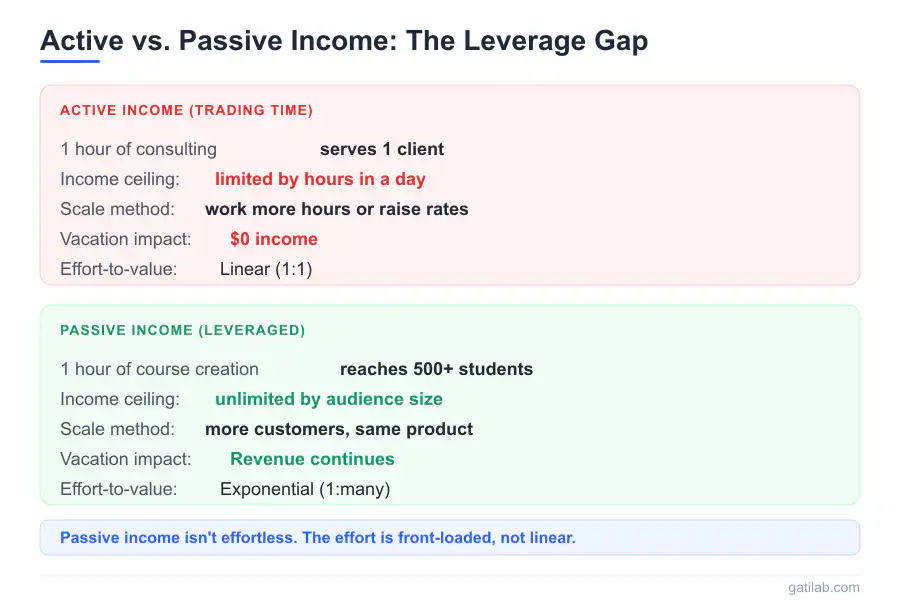
Passive income isn’t truly passive. Let’s get that out of the way immediately. It requires significant upfront effort and ongoing maintenance. But it creates leverage. An hour of work creates value once, then continues generating returns indefinitely. The consultant who packages expertise into a course can teach thousands while sleeping. The designer who creates templates earns from each sale without additional work. The developer who builds a plugin, and I know this one from personal experience, earns recurring revenue from something built once.
This guide covers how to transform what you know into income streams that outlast your billable hours.
The Reality of “Passive” Income
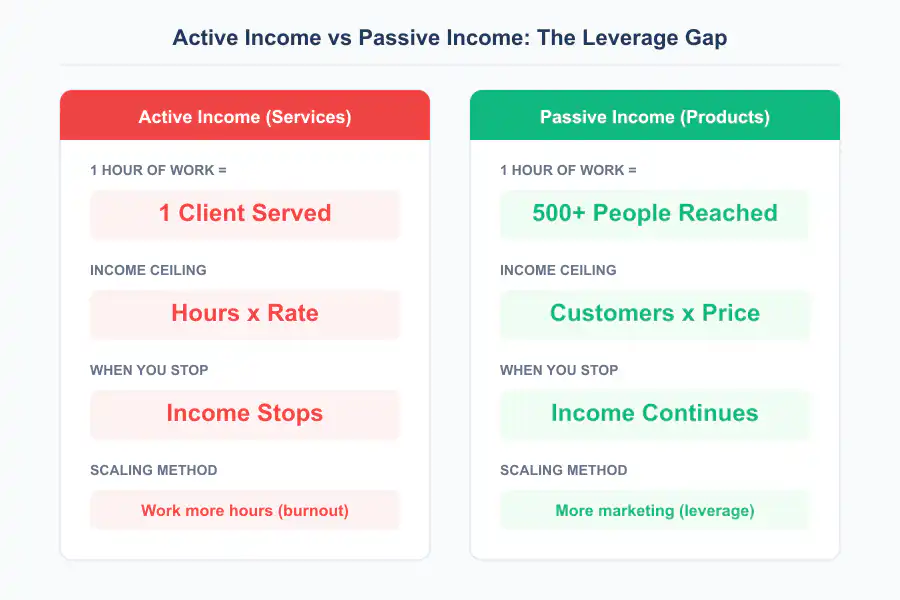
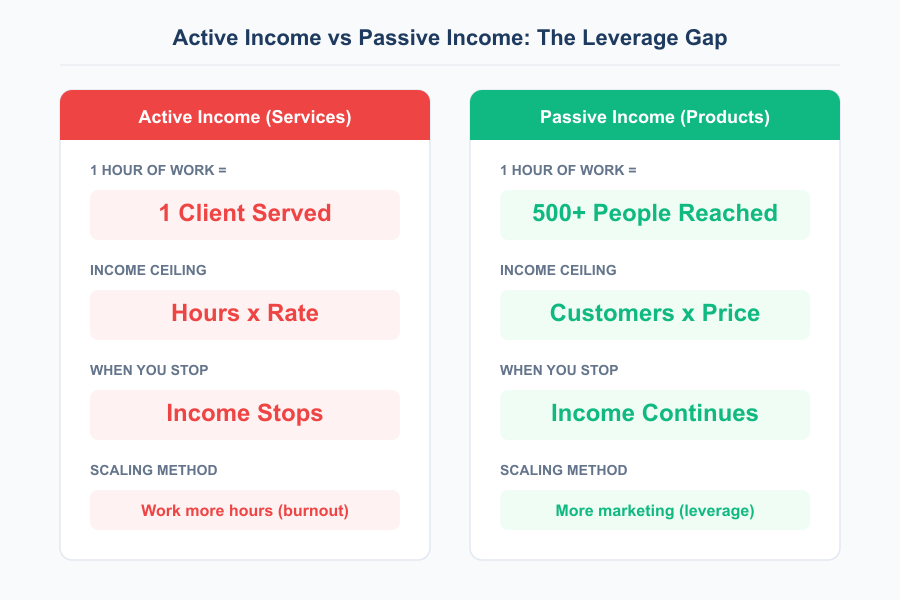
Passive income isn’t truly passive. It requires significant upfront effort and ongoing maintenance. But it creates leverage: an hour of work creating course content might reach 500 students. An hour of consulting serves one client. That’s the real difference.
Let’s clarify what passive income actually means in practice, because the internet has wildly distorted this concept.
Passive income requires significant upfront investment before generating any returns. The course takes months to create. The software takes even longer. The template pack needs design, testing, documentation, and marketing before anyone buys it. “Passive” doesn’t mean “effortless.” It means the effort is front-loaded rather than exchanged linearly for money.
Most passive streams need ongoing maintenance. Updates, customer support, marketing, platform changes. Truly set-and-forget income is rare. My WordPress plugins generate recurring revenue, but I spend time on updates, compatibility fixes, and support every month. It’s far less time than delivering equivalent value through consulting, but it’s not zero.
The best passive income comes from monetizing expertise you already have. You’re not starting from zero. You’ve spent years developing skills that people pay for. The question is whether you can package that expertise in ways that serve many people simultaneously rather than one at a time.
Each hour of passive-income work multiplies beyond what service hours can achieve. That’s the real benefit. One hour creating course content might reach 500 students over the next year. One hour of consulting serves one client.
Time to profitability is where most people get discouraged. Passive income often earns less than active income initially. Way less. The math works over years, not weeks. The myth of passive income is that it’s easy. The reality is that it’s valuable but requires patience and sustained effort before the payoff arrives.
Identifying Your Monetizable Skills
Skill Monetization Evaluation
Not every skill translates to passive income. You need to evaluate yours honestly across several dimensions.
Teachability is the first filter. Can you explain what you do in a way that others can replicate? Some skills transfer well through content. Others require hands-on mentorship that’s harder to scale. The skills I’ve had most success packaging are the ones where I can show a clear process: “do this, then this, then this, and here’s the result.”
Tool potential is the next consideration. Does your work involve repeatable processes? If you find yourself doing similar things for different clients, templates, frameworks, and tools can be productized. The proposal template you use for every project. The project management spreadsheet. The design system. All of these are potential products.
Market demand determines whether people will actually pay. Search volume for related topics, existing courses and their enrollment numbers, and competitor success all indicate demand. I’ve made the mistake of building a product I was excited about but nobody wanted. Validating demand before building saves enormous time.
Uniqueness matters for pricing power. Commodity knowledge competes on price. Generic “how to use Photoshop” competes with a million free YouTube videos. But “how to create WordPress themes that convert, based on 800+ client projects” has a unique angle that commands a premium. What do you know that others don’t?
List your skills, then evaluate each against these criteria. The best candidates combine high demand, strong teachability, and a unique perspective you’ve earned through experience.
Product Categories for Skill Monetization
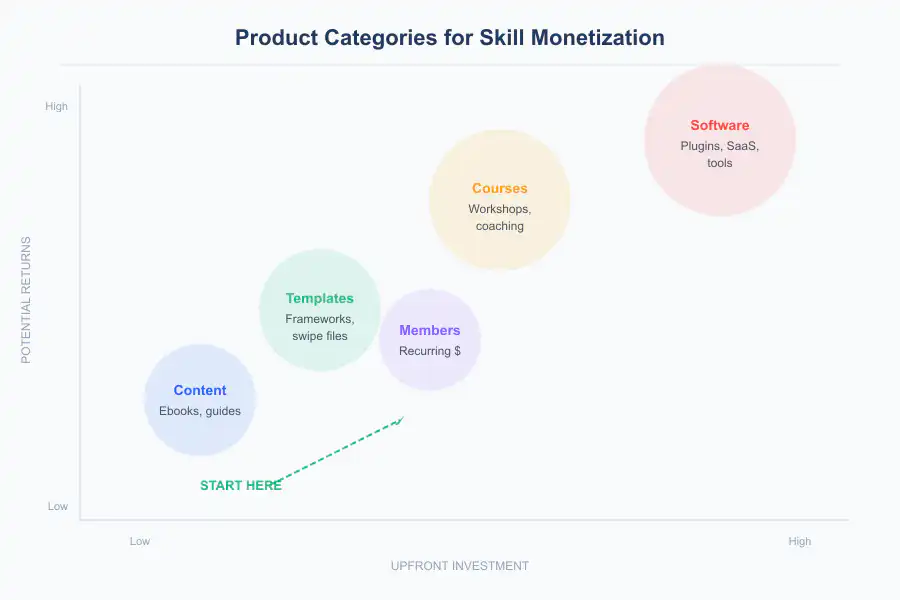
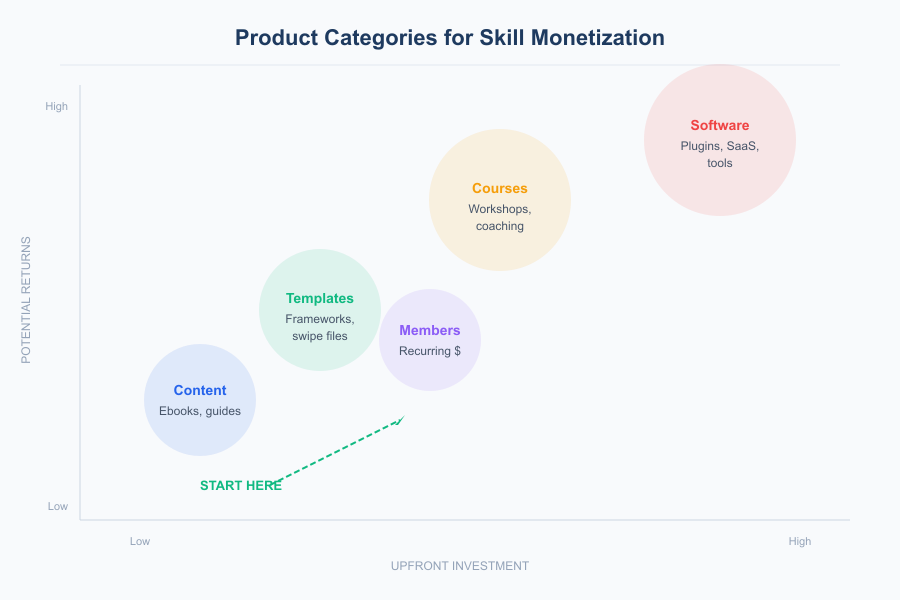
Different skills lend themselves to different product types, and matching them correctly matters more than most people realize.
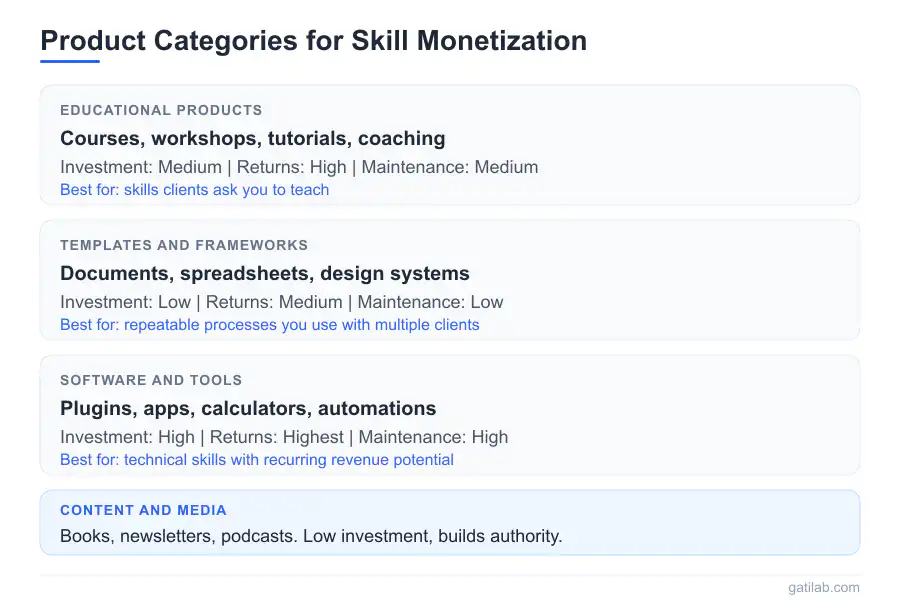
Educational products include courses, workshops, tutorials, and coaching programs. These work best for skills that can be taught step by step. If clients regularly ask you “how do you do that?” you probably have course material sitting in your head.
Templates and frameworks are perfect for repeatable work. Documents, spreadsheets, designs, processes. If you’ve built something for one client that you’ve adapted for others, you have a template product waiting to be formalized. My highest-margin products have been templates because the creation cost is low and the value to buyers is immediate.
Software and tools have the highest potential returns but also the highest investment. Apps, plugins, calculators, automation workflows. For technical skills or if you can partner with developers. My WordPress plugins fall into this category, and while they’ve been profitable, the development and maintenance investment is substantial.
Content products like ebooks, guides, reports, and research work well for knowledge that can be captured in writing. Lower individual price points but larger potential audiences and minimal ongoing costs.
Licensing arrangements let others use your methods, brand, or content for a fee. Communities and memberships provide ongoing access to your expertise and to peers. Both create recurring revenue if you can build the audience.
Match your skills to the right product type. A designer should create templates before trying to build software. A strategist should create frameworks before trying to write an ebook. Play to your strengths.
Creating Educational Products
Courses are the most common passive income vehicle for skilled professionals, and for good reason. The demand is massive and growing.
Course structure starts with identifying the specific outcome students want. Not “learn web design” but “build a professional WordPress site in two weeks.” The more specific the outcome, the easier it sells and the better the results. I’ve seen vague courses flop while highly specific ones thrive, even in crowded markets.
Break the content into logical modules and lessons. Include practical exercises and applications, not just theory. People buy courses to do something, not to know something. Provide downloadable materials and resources. The more tangible value you include, the more justified a premium price feels.
Production approach depends on your topic. Video courses work for complex, visual topics where seeing the process matters. Written courses work for reference-heavy content that students will revisit. Cohort-based courses add accountability and community, justifying higher prices. Self-paced courses are evergreen and sell continuously.
Platform choice matters. Self-hosted platforms like Teachable, Kajabi, or Thinkific give you control and better margins. Marketplaces like Udemy or Skillshare provide distribution but take larger cuts and pressure you on pricing. For smaller products, Gumroad or Payhip offer simple delivery.
Pricing should reflect the outcome, not the length. A $500 course that saves someone $10,000 is a bargain. A $20 course that teaches general knowledge competes with free YouTube content. Premium pricing for specific, valuable transformations. Mid-tier for targeted skills. Entry-level for introductions. And consider a free offering for lead generation that feeds into paid products.
Productizing Your Process
Transforming how you work into sellable assets is often easier than building courses because you already have the material.
Templates are documents, designs, or spreadsheets others can adapt. The proposal template you’ve refined over 50 client projects. The project management spreadsheet that keeps everything on track. The design system that ensures consistency. These are battle-tested tools other professionals would happily pay for.
Frameworks are the methodologies you’ve developed through experience. Your process for auditing a website. Your approach to pricing strategy. Your system for managing client communication. When you formalize these into teachable frameworks, your process becomes intellectual property.
Checklists and guides provide step-by-step instructions for processes you’ve mastered. People pay for certainty. A comprehensive checklist that says “follow these 47 steps and you won’t miss anything” has real value for someone doing something for the first time.
Swipe files, collections of examples and samples from your work, help others understand what good looks like. Calculators and interactive tools help with decisions or planning. Automation recipes using Zapier, Notion, or Airtable save others the time of building workflows from scratch.
Price these based on value delivered. A template saving someone 10 hours of work at $100/hour is worth at least $100 to $200. Don’t price based on your creation time. Price based on the buyer’s savings.
Building Software and Tools
Software has the highest potential returns but also the highest investment and risk. Approach this with eyes open.
SaaS applications, subscription software solving specific problems, require significant development but are highly scalable. If you see a tool that should exist and doesn’t, this might be your opportunity. But building software is expensive, ongoing maintenance is non-trivial, and competition is fierce.
Plugins and extensions for existing platforms like WordPress, Shopify, or Figma leverage built-in user bases. This is the path I took with WordPress plugins, and it worked because the audience was already there. You’re not building an audience from scratch. You’re serving an existing one.
No-code tools built with platforms like Bubble, Webflow, or Notion lower the technical barrier significantly. Complex spreadsheets solving specific problems are simple to create if you have strong Excel or Google Sheets skills.
The build-versus-partner decision is important. If you have the expertise but not the technical skills, partnering with a developer might make more sense than trying to learn to code. The reverse is true too. A developer without marketing skills should partner with someone who can sell.
Customer support needs for software are often underestimated. Budget for it. A product that generates $5,000/month but requires 80 hours of support isn’t passive. It’s a job.
Content-Based Products
Written and media products monetize expertise with relatively low production costs.
Ebooks remain viable despite what some people claim. Self-published through Amazon, Gumroad, or direct sales, a well-positioned ebook on a specific topic continues selling for years. The key is specificity. “The Complete Guide to Everything” doesn’t work. “SEO Auditing for WordPress Agencies” does.
Paid newsletters through platforms like Substack or Beehiiv provide regular insights for subscribers. The recurring revenue model is attractive, but you’re trading consistent content creation for income. It’s only “passive” relative to client work. You’re still on a publishing treadmill.
Research and reports command premium pricing when they contain data-driven insights your industry values. A comprehensive annual report on WordPress development trends could sell for $100+ if it contains original data and analysis others can’t easily replicate.
Content products typically have lower individual price points but can reach larger audiences with lower production investment. They’re often a good first product because the risk is low and the skills required, writing and expertise, are ones you already have.
The Productization Process
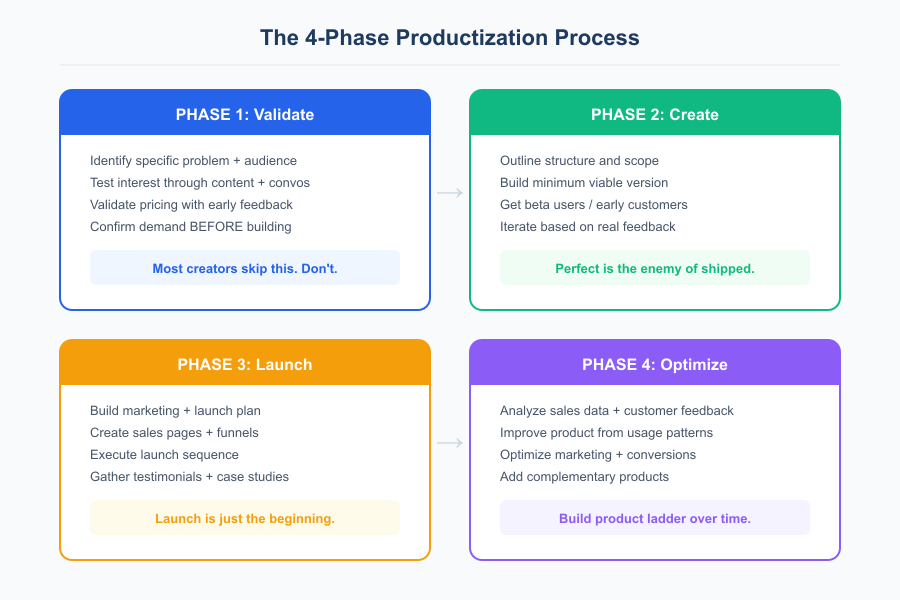
Moving from idea to income-generating product follows a pattern I’ve seen work repeatedly.
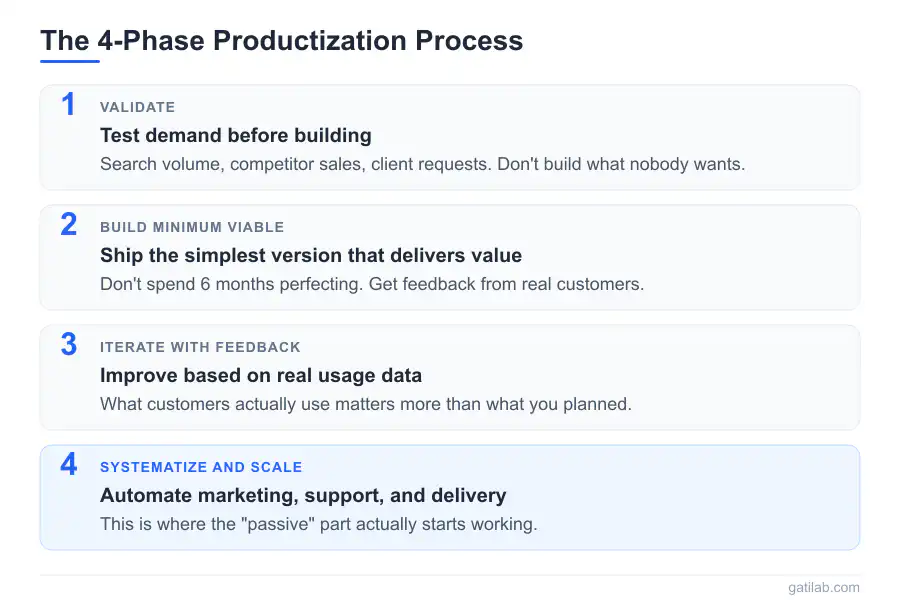
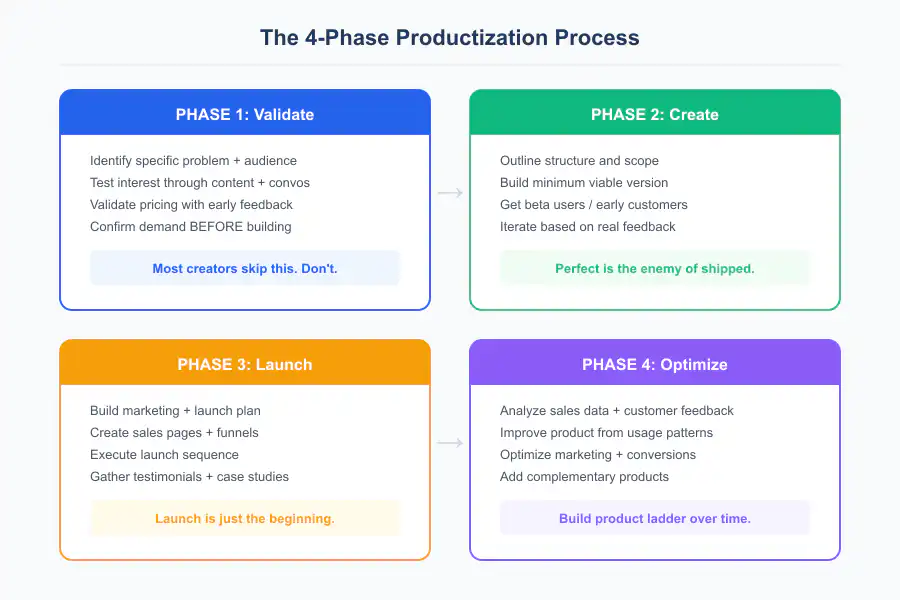
Phase 1 is validation. Identify a specific problem and audience. Test interest through content, conversations, and pre-sales. Validate pricing through early customer feedback. Confirm market demand before making a major investment. I’ve skipped this step and regretted it. I’ve done this step thoroughly and never regretted it. The correlation is perfect.
Phase 2 is creation. Outline the structure and scope. Create a minimum viable version. Get beta users or early customers. Iterate based on their feedback. Don’t try to make it perfect before launching. Perfect is the enemy of shipped.
Phase 3 is launch. Build your marketing and launch plan. Create sales pages and conversion funnels. Execute the launch sequence. Gather testimonials and case studies from early users. The launch is just the beginning, but a strong launch creates momentum.
Phase 4 is optimization. Analyze sales data and customer feedback. Improve the product based on actual usage patterns. Optimize marketing and conversion rates. And consider adding complementary products that serve the same audience.
Most creators spend too long in Phase 2 and not enough in Phase 1. Building what people will buy starts with understanding what they actually want, not what you think they should want.
Marketing Passive Products
Products don’t sell themselves. This is where the “passive” myth falls apart for most people.
Content marketing, creating free content that demonstrates expertise and attracts potential buyers, is the most sustainable approach. Blog posts, podcasts, and videos that solve smaller versions of the problem your product solves. People who get value from your free content trust you enough to buy the premium version.
Email marketing is non-negotiable. Build a list, nurture relationships through valuable emails, and sell to an engaged audience. Your email list is the asset. Everything else is a distribution channel you don’t control.
SEO and organic search provide compounding returns. Content that ranks well continues driving traffic and sales for years. This is genuine leverage: write once, attract buyers indefinitely.
Social media builds audience on platforms where your buyers spend time. Affiliates and partnerships let others promote your product for a commission, expanding reach without advertising spend. Paid advertising provides direct customer acquisition when your unit economics are positive.
Marketing requires ongoing effort, and this is where “passive” income isn’t passive. But marketing effort scales across many customers, unlike service delivery. One marketing campaign can drive hundreds of sales. One client engagement serves one client.
Balancing Active and Passive Income
The transition from active to passive income takes time, and rushing it is a mistake I’ve seen people make repeatedly.
Don’t abandon active income prematurely. Services pay the bills while products build. Maintaining cash flow during the transition is essential. I kept my consulting clients while building my first products. The consulting income funded the product development. Quitting consulting first would have created pressure that led to poor product decisions.
Use active work to inform products. Client work reveals what people actually need. The problems clients pay you to solve are the same problems your products should address. Services feed product ideas naturally. Pay attention to the patterns in your client work.
Allocate dedicated time for product work. Block it on your calendar and protect it from client demands. Without protected time, product development gets pushed to “someday,” which never comes. I block Friday mornings for product work. Non-negotiable.
Start small. One product, validated and launched, before expanding to the next. Avoid scattered diversification across five half-finished products. Focus creates results.
Expect year-plus timelines for meaningful passive income. 12 to 24 months to build something that generates consistent revenue. Patience is required, and most people quit before the compounding kicks in.
The most successful approach: continue services while building products on the side. Gradually shift the balance as products prove themselves. This isn’t glamorous. It’s effective.
Pricing for Passive Products
Value-based pricing applies to products just as much as it applies to services.
Frame pricing around outcomes, not hours of content. A course saving someone $10,000 can charge $500 and be a bargain. A template saving 20 hours of work at $150/hour can charge $200 and still represent massive value. Price based on what the buyer gains, not what it cost you to create.
Benchmark competitors to understand market expectations, but don’t let their prices set yours. Position on differentiation. If your product is uniquely valuable, it deserves unique pricing.
Tiered offerings at different price points serve different segments. A basic version, a standard version, and a premium version with additional access or bonuses. Let people self-select into the tier that matches their needs and budget.
Prices aren’t permanent. Test different price points and see what the market tells you. I’ve raised prices on products twice after realizing I was undercharging, and sales didn’t decrease either time. If anything, the higher price increased perceived value.
Most skill-based products are underpriced. What you know, built over years of practice and client work, has more value than you initially assume. Don’t discount your expertise because it feels easy to you. It’s only easy because you’ve invested thousands of hours becoming good at it.
Maintaining Passive Income Streams
Passive income requires ongoing attention that you should budget for honestly.
Product updates keep content current. Outdated products lose value and damage credibility. If your course references tools that no longer exist or strategies that no longer work, customers notice and reviews suffer.
Customer support is inevitable. People have questions, encounter problems, and sometimes need refunds. Build systems for efficient support. FAQ pages, automated responses, and clear documentation reduce per-ticket time.
Marketing doesn’t stop after launch. The initial launch creates a spike. Ongoing promotion sustains baseline sales. Content marketing, email sequences, and periodic promotions maintain revenue.
Platform maintenance is a hidden cost. Technology changes. Hosting platforms update. Payment processors change their terms. Products need technical upkeep to continue functioning.
Customer feedback is your product improvement roadmap. Listen to what buyers say, both complaints and compliments. Iterate based on real usage patterns.
Budget 5 to 10 hours monthly for maintaining each active product. More during the first few months. Potentially less as systems mature and the product stabilizes.
My WordPress plugins generate recurring revenue from something built once. I kept my consulting clients while building products. The consulting income funded the product development. Quitting consulting first would have created pressure that led to poor product decisions.
Long-Term Passive Income Strategy
Think in terms of a portfolio, not a single product.
Product ladders create offerings at different price points. A $29 template leads to a $199 course which leads to a $999 coaching program. Entry products lead to premium products naturally.
Complementary products serve the same audience in different ways. The course buyer also needs the template. The template buyer also needs the guide. Cross-selling within your product portfolio increases revenue per customer significantly.
Recurring revenue through subscriptions and memberships provides the most predictable income. If you can create something that delivers ongoing value, monthly or annual subscriptions compound over time into substantial recurring income.
Some products sell continuously as evergreen offerings. Others work best through periodic launches that create urgency and community. Both approaches have value, and mixing them provides both stability and spikes.
And build with potential exit in mind. Passive income assets can be sold. Digital products, software, and content businesses have active markets. A business generating $5,000/month in mostly-passive income is worth $100,000 to $200,000+ to a buyer.
The professional who builds passive income over years creates a fundamentally different financial reality. Active skills continue generating value long after you stop actively trading time for them. The investment in productization pays returns indefinitely, and those returns can compound into something that eventually replaces, or at least supplements, your active income in meaningful ways.
Passive Income FAQ
Frequently Asked Questions
Is passive income really passive?
Not entirely. Passive income requires significant upfront work to create products, plus ongoing maintenance including updates, customer support, and marketing. Budget 5-10 hours monthly per active product. The real benefit isn’t zero effort, it’s leverage: one hour creating course content can reach 500 students over the next year. One hour of consulting serves one client. That multiplication is what makes passive income worthwhile.
What skills work best for creating passive income?
Skills that are teachable (you can explain the process step by step), have proven market demand (people already pay to learn this), involve repeatable processes (you can template or systematize them), and where you have unique insights from real experience. The best candidates combine all four. If clients regularly ask “how do you do that?” you likely have course or product material ready to package.
How long does it take to build meaningful passive income?
Expect 12-24 months to build something generating consistent revenue. Product creation alone takes months, followed by marketing, optimization, and sales building. Don’t abandon active income prematurely. Continue services while building products on the side, then gradually shift the balance as products prove themselves. Most people quit before the compounding kicks in, which is exactly why the ones who persist do well.
What types of products can I create from my professional skills?
Educational products (courses, workshops, coaching programs), templates and frameworks (proposals, spreadsheets, design systems), software and tools (plugins, apps, calculators), content products (ebooks, paid newsletters, research reports), licensing arrangements, and memberships. Match product type to your strengths: designers create templates, strategists create frameworks, developers create tools. My highest-margin products have been templates because creation cost is low and buyer value is immediate.
How should I price my passive income products?
Price based on outcome achieved, not time to consume. A course saving someone $10,000 can charge $500 and be a bargain. A template saving 20 hours at $150/hour can charge $200. Create tiered offerings at different price points. Test prices since they aren’t permanent. Most skill-based products are underpriced because what feels easy to you (after thousands of hours of practice) is genuinely valuable to others.
Should I quit freelancing to focus on passive income?
No, not initially. Keep consulting clients while building products. Consulting income funds product development without financial pressure. Client work reveals what people actually need, feeding product ideas naturally. I kept my consulting clients while building my first products. Quitting consulting first would have created pressure leading to poor product decisions. Block dedicated time for product work (I use Friday mornings) but maintain your income floor.
What’s the best first passive income product to create?
Start with templates or a small digital guide, not a comprehensive course. Templates have low creation cost, immediate buyer value, and validate demand quickly. The proposal template you’ve refined over 50 projects, the project management spreadsheet you use daily, or a checklist for a process you’ve mastered. Validate demand before building anything large. One shipped product beats five half-finished ones every time.
How do I market passive income products without a large audience?
Content marketing is the most sustainable approach: create free content solving smaller versions of the problem your product solves. Build an email list since that’s your most important asset. Optimize for SEO to attract buyers through search over years. Partner with others who serve your audience. Use your existing client network for initial sales and testimonials. Products don’t sell themselves, but marketing effort scales across many customers unlike service delivery.