
Recurring Revenue Business Models: 8 Structures That Scale
The project treadmill is exhausting. Every month you start at zero, hunting for the next client, closing the next deal, delivering the next project. Cash flow is unpredictable. Vacations feel impossible. Growth requires constant hustle because revenue disappears the moment you stop working.
I’ve lived this reality. After years of project-based work, I realized I was building a job, not a business. Every dollar required active effort. Take a week off, lose a week of income. Get sick, watch revenue evaporate. The fundamental economics were broken, and I was too busy grinding to notice.
Recurring revenue changes everything. This is essential for anyone looking to build a sustainable freelance career. Predictable income arrives whether or not you close new business this month. Cash flow becomes plannable. The value of existing clients compounds rather than resets. I’ve helped businesses transform from project-dependent chaos to recurring revenue stability. The transition takes work, but the result is a fundamentally better business.
Why Recurring Revenue Matters
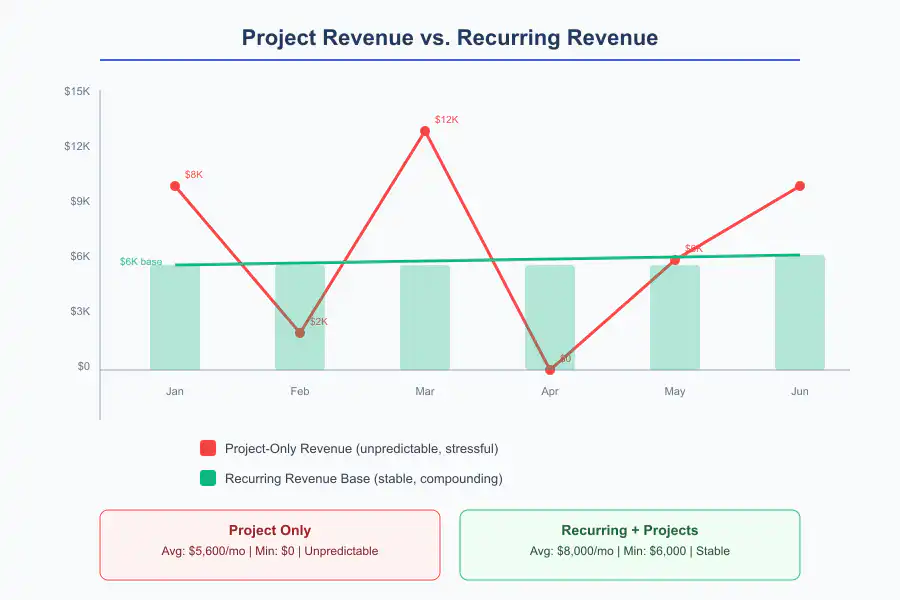
The difference between project revenue and recurring revenue isn’t just financial. It’s psychological, operational, and strategic. Once you experience it, you can’t go back.
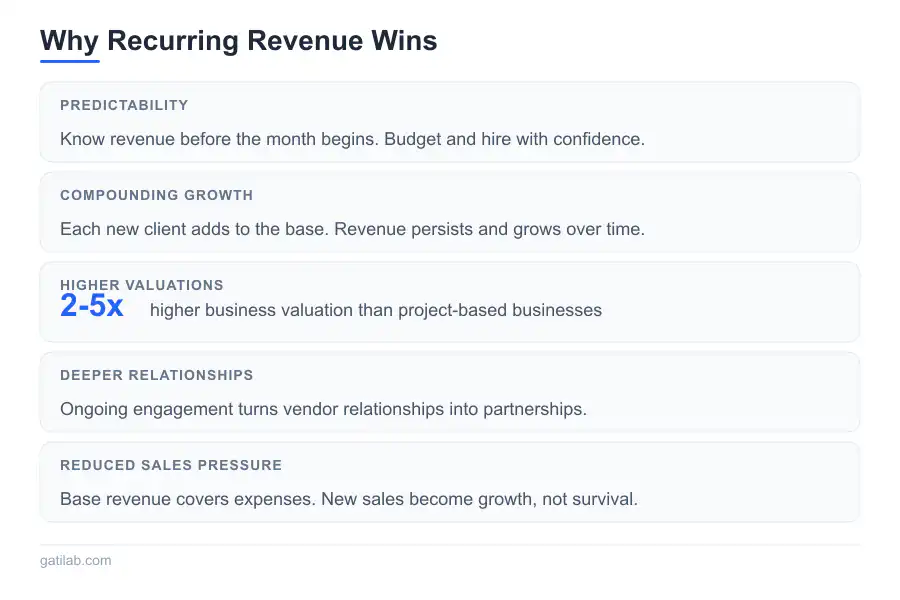
Predictability transforms planning. You know revenue before the month begins. Budgets make sense. Hiring decisions have foundation. Investment becomes possible because you’re not guessing whether next month will bring feast or famine. I went from constant anxiety about where the next payment was coming from to confidently planning quarters ahead. That shift alone was worth everything.
Compounding value changes growth math. Each new recurring client adds to the base. Unlike project revenue that disappears after delivery, recurring revenue persists. Growth compounds. If you add 10 clients this month and retain last month’s clients, your base grows. Next month, you start from a higher floor. This compounding effect is why recurring revenue businesses consistently outperform project-based businesses over multi-year periods.
Higher valuations reward the model. Businesses with recurring revenue sell for 2-5x more than project-based businesses at similar revenue levels. Recurring revenue is a sellable asset. Private equity loves predictability. Strategic acquirers pay premiums for stable cash flows. If you ever want to exit, recurring revenue dramatically expands your options.
Customer relationships deepen naturally. Recurring models create ongoing relationships rather than transactions. You understand client needs more deeply because you’re engaged continuously. More opportunities to deliver value emerge. The relationship becomes partnership rather than vendor arrangement. And that’s where the best work happens.
Reduced sales pressure changes behavior. When base revenue covers expenses, new sales become growth, not survival. Less desperation means better decisions. You can say no to bad-fit clients. You can negotiate from strength. The quality of your client roster improves because you’re not forced to take anyone who’ll pay.
Sustainable operations become possible. Predictable revenue allows planning: hiring, investment, time off. You can build a team knowing the revenue to support them exists. You can take vacation without watching income disappear. The business becomes livable rather than a constant scramble.
Types of Recurring Revenue Models
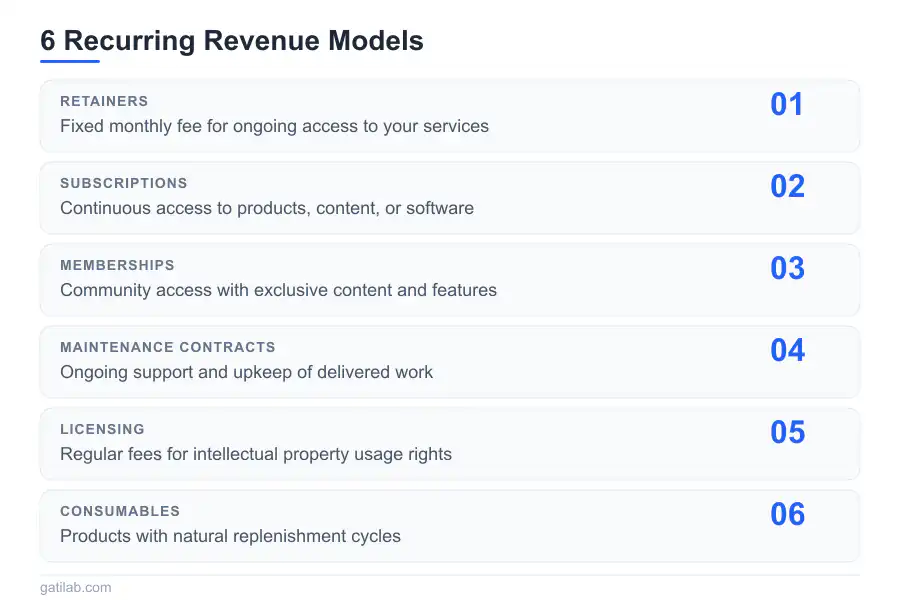
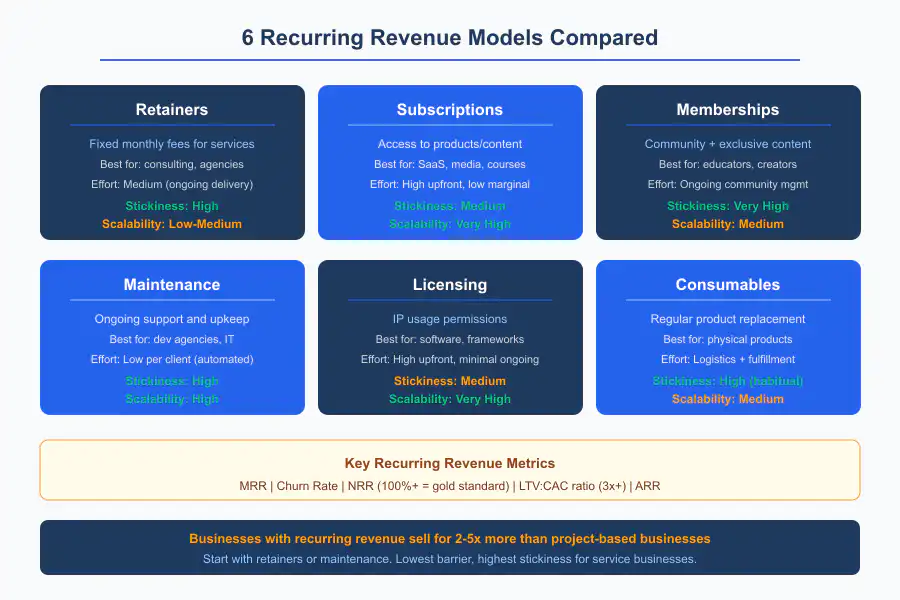
Different models suit different businesses. The key is converting what you do into something clients pay for repeatedly.
Retainers create ongoing service relationships. Fixed monthly fees for ongoing access to your services. Common in consulting, marketing, and professional services. The client pays monthly; you provide defined ongoing value. Retainers work best when clients have continuous needs and value consistent access to your expertise. This was my first recurring revenue stream, and it’s still my favorite.
Subscriptions provide continuous access. Access to products, content, or services for regular payment. Software (SaaS), content (media, courses), or physical products (boxes, consumables). The subscription model scales well because marginal cost per additional subscriber is often low.
Memberships build community value. Community access, exclusive content, or premium features for regular fees. Membership sites, premium communities, or tier-based access. The value comes from connection and belonging as much as content. Members often stay for the community even when content consumption decreases.
Maintenance contracts formalize ongoing support. Ongoing support or upkeep of delivered work. Website maintenance, equipment servicing, or support packages. These work well as add-ons to project work, converting one-time clients into ongoing relationships. I bundle maintenance with every site I build now. Conversion rate is around 70% when offered at project delivery.
Licensing generates passive income. Permission to use intellectual property for regular fees. Software, templates, frameworks, or content libraries. Licensing requires upfront creation investment but can generate revenue without proportional ongoing effort.
Consumables create natural replenishment. Products that need regular replacement. Physical goods with replenishment needs. This model works when your product naturally runs out or wears out, creating built-in repeat purchase motivation.
Transforming Project Work to Recurring Revenue
Most service businesses can add recurring elements without completely reinventing themselves. The transformation starts with recognizing ongoing needs you’re already positioned to serve.
Identify ongoing needs clients have. What do clients need after the project ends? Website maintenance, content updates, strategic guidance, performance monitoring, periodic reviews, ongoing optimization. These needs represent recurring revenue opportunities hiding in plain sight. Every project has aftercare requirements that someone will provide. It might as well be you.
Package ongoing services deliberately. Create defined offerings for ongoing needs. “Website Care Plan” with monthly updates, monitoring, and support hours. “Marketing Retainer” with monthly strategy calls, content calendar management, and performance reporting. Clear scope means clear pricing. Clients know what they’re getting; you know what you’re delivering. No ambiguity means no resentment on either side.
Bundle adjacent services for comprehensive value. Combine related services into packages that serve client needs more completely. Marketing retainers that include strategy, content, and reporting provide more value than any single service. Bundling justifies higher monthly fees while reducing client management overhead since they don’t need multiple vendors.
Create appropriate dependency through genuine value. Build relationships where ongoing involvement adds value. Not manipulative lock-in, but genuine ongoing value delivery. You become essential because you continuously improve outcomes, not because you’ve created artificial switching costs. The best recurring relationships make clients better off for staying. That’s the standard I hold myself to.
Require retainers for priority access. Offer preferential treatment, faster response, or guaranteed availability for retainer clients. Project clients wait in queue. Retainer clients get immediate attention. This incentivizes the recurring relationship while creating real value for those who commit.
The transition often starts by offering recurring options to existing project clients. They already trust you. Converting them is easier than acquiring new recurring customers from scratch. Strong client retention strategies become essential once you’ve made this shift.
Pricing Recurring Services Strategically
Pricing recurring services requires different thinking than project pricing. You’re pricing a relationship, not a deliverable. That mindset shift matters.
Value-based pricing reflects outcomes. Price based on value delivered, not hours consumed. If your maintenance prevents $50,000 in annual downtime costs, pricing at $500/month is obviously valuable. Connect pricing to outcomes clients care about rather than inputs you provide. I stopped quoting hourly years ago for recurring services. Value-based pricing consistently earns more.
Tiered offerings serve different needs. Multiple levels serving different needs and budgets. Basic, Professional, Enterprise. Clients self-select appropriate tiers. Tiering captures more market because you’re not forcing everyone into one-size-fits-all pricing. Some clients want comprehensive service; others want essentials. Let them choose.
Annual discounts improve cash flow. Encourage annual payment with modest discount (typically 15-20%). This improves your cash flow, reduces churn risk since annual clients have made deeper commitment, and increases client investment in the relationship.
Clear scope boundaries prevent erosion. Define what’s included and excluded explicitly. Prevent scope creep. Additional work beyond scope is quoted separately. Without boundaries, recurring relationships become unprofitable as scope gradually expands while price stays flat. I learned this lesson the expensive way.
Automatic renewals reduce friction. Set expectation that service continues unless cancelled. Reduces renewal friction and churn. The relationship continues by default rather than requiring active renewal decisions that create opportunities for reconsideration.
Regular increases maintain value. Build in annual price adjustments. Even 3-5% annual increases maintain value against inflation and rising costs. Communicate increases clearly and tie them to value improvements when possible.
Price for the relationship, not individual months. Lifetime client value justifies acquisition costs that wouldn’t make sense for single transactions.
Building Subscription Products
Beyond services, products with recurring revenue include options that scale differently.
Software as a Service (SaaS) scales efficiently. Tools and applications with monthly or annual subscriptions. Requires development investment but scales without proportional cost increase. Once built, serving customer 100 costs about the same as serving customer 10,000. That leverage is why SaaS valuations are so high.
Content subscriptions monetize expertise. Newsletters, courses, video content, or research with ongoing access fees. Expertise packaged as continuously updated content. The subscription model works when you can consistently produce valuable content that subscribers want to consume.
Membership communities build network value. Access to community, events, and exclusive content. Value comes from connection and belonging as much as content. Strong communities develop network effects where the community itself becomes the product.
Product boxes create curation value. Curated physical products delivered regularly. Subscription boxes exist in countless niches from beauty to books to food. The value is curation and surprise as much as the products themselves.
Template and resource libraries serve ongoing needs. Access to regularly updated templates, frameworks, or resources. Designers, marketers, and professionals pay for ongoing access to tools that make their work easier. Regular updates justify ongoing subscription versus one-time purchase.
Product-based recurring revenue scales differently than services. Higher upfront investment, but marginal cost of additional customers is lower, creating potential for significant margins at scale.
Understanding Recurring Revenue Metrics
The math of recurring revenue reveals whether your model is actually working. Ignore these numbers at your own risk.
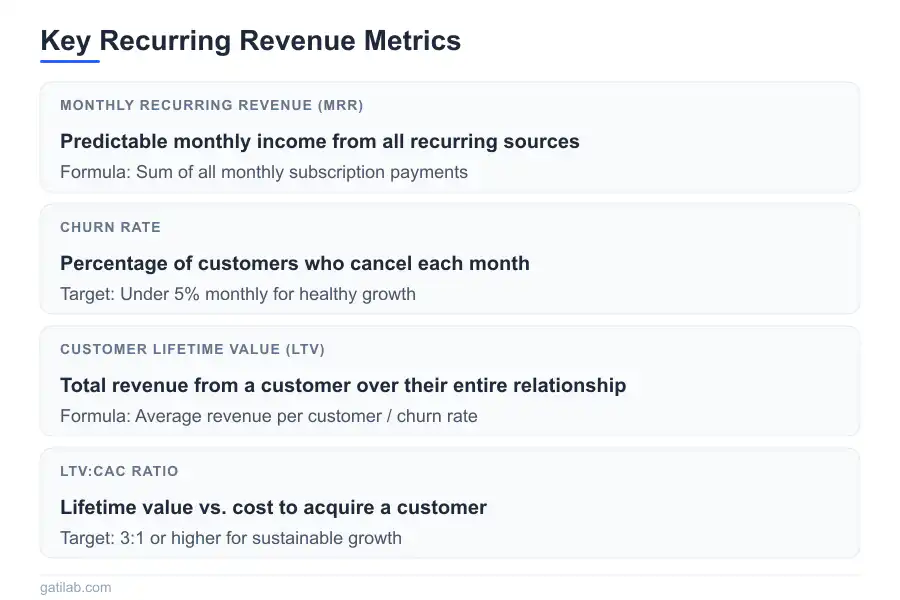
Monthly Recurring Revenue (MRR) is total monthly recurring income. This is the core metric. MRR provides the baseline against which everything else is measured. When someone asks how your business is doing, this is the number that matters.
Annual Recurring Revenue (ARR) is MRR times 12. Useful for annual planning and valuation discussions. ARR is how recurring businesses communicate scale to investors and potential acquirers.
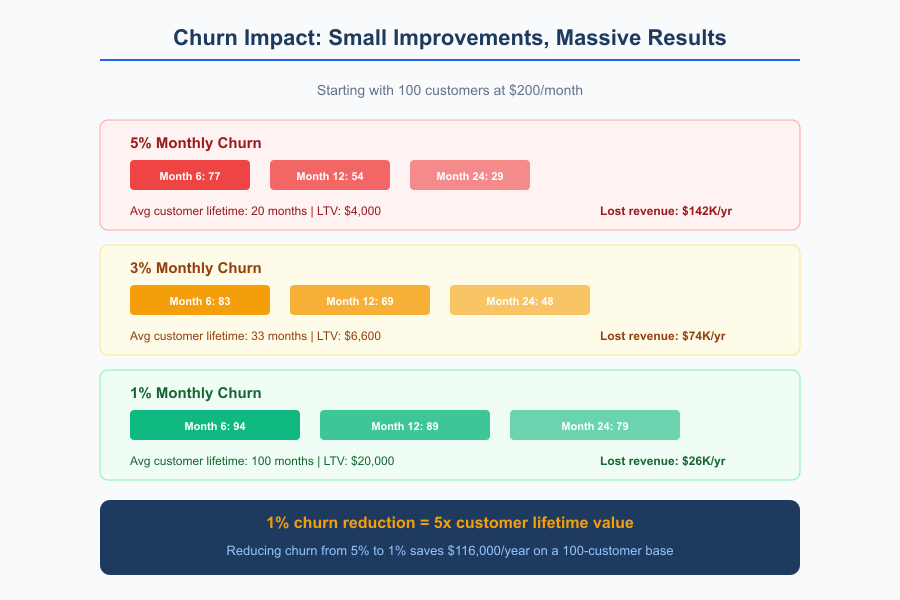
Churn rate is percentage of customers lost each period. If 100 customers start the month and 95 remain, monthly churn is 5%. Churn is the silent killer of recurring revenue businesses. High churn negates acquisition efforts. I track this weekly, not monthly.
Net Revenue Retention (NRR) measures revenue from existing customers including expansion and churn. Over 100% NRR means existing customers are worth more over time than when they started. This is the gold standard for subscription businesses.
Customer Lifetime Value (LTV) is average revenue per customer over their entire relationship. Higher LTV justifies higher acquisition costs and indicates healthy retention.
Customer Acquisition Cost (CAC) is cost to acquire new recurring customer. LTV should exceed CAC by 3x or more for healthy economics. CAC includes marketing, sales, and onboarding costs.
These metrics reveal whether recurring revenue is actually working. Vanity MRR with high churn isn’t valuable. Focus on metrics that show sustainable growth.
Managing Churn Effectively
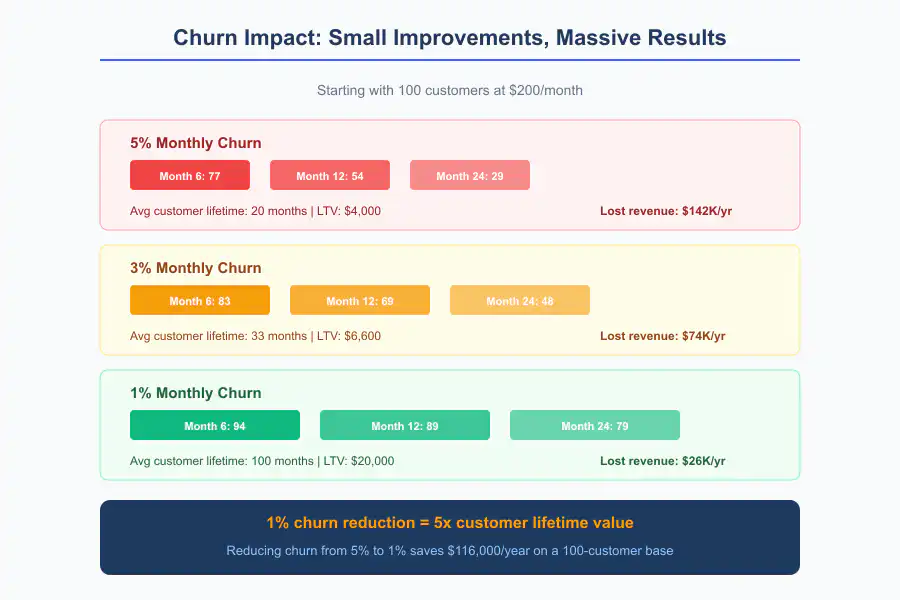
A 1% monthly churn reduction can double customer lifetime value. Reducing churn often has more impact than increasing acquisition. Small churn improvements compound significantly over time.
Churn is the enemy of recurring revenue. Every lost customer subtracts from growth, requiring new customer acquisition just to stay flat. I’ve seen businesses grow their top line every month while actually shrinking because churn ate their gains.
Deliver consistent value relentlessly. Customers who experience value don’t cancel. Ensure ongoing value delivery, not just initial delivery. The reason they signed up must remain relevant throughout the relationship.
Onboard effectively from day one. The first 30-90 days determine retention. Intensive early engagement establishes habits and value recognition. Customers who never fully adopt rarely stay. Front-load effort to drive adoption. I spend disproportionate time on the first month of any recurring relationship.
Monitor engagement proactively. Track usage and engagement metrics. Declining engagement predicts churn. Intervene before cancellation. By the time a customer requests cancellation, you’ve usually already lost them. The warning signs showed up weeks ago.
Communicate proactively and regularly. Regular touchpoints maintain relationship. Don’t wait for problems. Stay connected through check-ins, updates, and value delivery that reminds customers why they subscribe.
Address issues with urgency. When problems arise, resolve them immediately. Poor service experience accelerates churn dramatically. Speed of resolution matters as much as quality of resolution.
Offer flexibility before cancellation. Pause options, tier changes, or reduced-scope alternatives keep customers who might otherwise cancel entirely. Some revenue is better than none. A downgraded customer can upgrade again later.
Conduct exit interviews systematically. Understand why customers leave. Patterns reveal systemic issues to address. Individual cancellations provide data points; patterns reveal actionable insights.
Reducing churn often has more impact than increasing acquisition. Small churn improvements compound significantly over time. A 1% monthly churn reduction can double customer lifetime value. Read that again.
Acquiring Recurring Customers
Acquiring recurring customers differs from project sales. The goal is finding customers who will stay, not just customers who will start.
Lower initial commitment reduces friction. Monthly subscriptions have lower activation energy than large project commitments. Easier to start means more starts. But ensure you’re not attracting people who churn quickly.
Free trials and freemium demonstrate value. Let prospects experience value before paying. Reduce risk of first commitment. Trials work when the product delivers obvious value during the trial period.
Annual options reward commitment. For confident buyers, annual prepayment reduces perceived monthly cost and improves commitment. Offer annual alongside monthly to capture buyers ready to commit.
Referral programs leverage satisfaction. Satisfied recurring customers are excellent referral sources. Reward them for bringing others. Referred customers typically have better retention than acquired customers. That’s not an accident.
Content marketing demonstrates ongoing value. Ongoing value from content demonstrates ongoing value from subscription. Natural alignment between how you market and what you deliver.
Community building creates acquisition channels. Communities become self-reinforcing acquisition channels. Members bring members. The community markets itself.
Quality over quantity matters more in recurring models. A customer who stays three years is worth more than five customers who each stay three months. I’d rather close one $500/month client who stays for 24 months than five $500/month clients who leave after three.
Transitioning Your Existing Business
If you currently run a project-based business, transition thoughtfully rather than abruptly. I’ve seen too many people make this mistake.
Start with existing clients who trust you. They already value your work. Offer recurring options for ongoing needs. Convert project relationships to retainer relationships. This is your easiest path to initial recurring revenue.
Pilot before scaling broadly. Test recurring offerings with a few clients before broad launch. Refine based on early feedback. Learn what works before committing fully. My first maintenance plan was messy. The fifth version was profitable.
Maintain project revenue during transition. Don’t abandon working revenue sources until recurring revenue is substantial. Bridge the gap. You need income while building the recurring base. This transition isn’t a light switch.
Adjust operations for recurring delivery. Recurring revenue requires different operations than projects. Capacity planning, ongoing delivery, and relationship management. Build systems that support continuous service.
Shift sales focus deliberately. Instead of selling projects, sell ongoing relationships. Different pitch, different value proposition, different objections. Train yourself and any team to sell recurring.
Set realistic timelines. Transition takes 1-3 years for most service businesses. Patience prevents desperation decisions. This is a fundamental business model change, not a quick fix.
The transition is a journey, not a switch. Build recurring revenue alongside project revenue, then gradually shift the balance as recurring base grows.
Avoiding Common Recurring Revenue Mistakes
Several mistakes consistently undermine recurring revenue efforts. I’ve made most of these.
Underpricing destroys margins. Recurring doesn’t mean cheap. Price for sustainable operations with healthy margins. Low prices attract price-sensitive customers who churn faster. They also train the market to undervalue your work.
Overdelivering erodes profitability. Giving more than promised erodes margins and creates unsustainable expectations. Deliver what’s promised excellently rather than constantly exceeding scope. Generosity is great. Unprofitable generosity kills businesses.
Ignoring churn creates leaky buckets. Growing MRR while losing customers creates a leaky bucket. Both acquisition and retention matter. Growth without retention is exhausting and ultimately futile.
Poor scope definition leads to scope creep. Unclear boundaries lead to expanding expectations. Define what’s included explicitly. Additional work beyond scope is additional pricing.
Missing exit terms create disputes. Clear cancellation policies and expectations prevent disputes. How does the relationship end? What notice is required? What happens to work in progress?
Neglecting existing customers for acquisition. Focusing only on new customers while existing customers feel ignored destroys retention. Balance attention between acquisition and success.
Complexity confuses customers. Too many tiers, add-ons, and options confuse customers. Simplicity sells. Start simple, add complexity only when necessary.
Build recurring revenue correctly from the start. Fixing broken models is harder than building good ones.
I went from constant anxiety about where the next payment was coming from to confidently planning quarters ahead. The month I shifted from project-based to retainer-based pricing was the month I stopped worrying about next month’s income. That shift alone was worth everything.
The Long-Term View
Recurring revenue transforms business fundamentals over time. The trajectory matters more than any single month.
Year one: Recurring revenue supplements project income. Still project-dependent. Building the base. This is the grind phase.
Year two: Recurring revenue provides baseline security. Projects add upside. Less stress, more options. You start sleeping better.
Year three: Recurring revenue dominates. Projects become optional or premium. Predictability established. You start making real plans.
Year five: Significant recurring revenue base. Real business value. Exit options if desired.
The compounding nature of recurring revenue rewards patience. Each retained customer adds to a base that grows year over year. The businesses that commit to building recurring revenue over years fundamentally change their trajectories, creating sustainable operations that support the life they want rather than constantly demanding more from them.
That’s the promise of recurring revenue. And from where I sit, having made this transition myself, I can tell you it delivers.
Recurring Revenue FAQ
Frequently Asked Questions
What is recurring revenue and why does it matter?
Recurring revenue is predictable income that arrives regularly from ongoing customer relationships, whether through retainers, subscriptions, memberships, or maintenance contracts. It matters because it transforms business planning. You know revenue before the month begins, growth compounds as clients accumulate, and businesses with recurring revenue sell for 2-5x more than project-based businesses at similar revenue levels.
What are the main types of recurring revenue models?
Six main models: retainers (fixed monthly fees for ongoing services), subscriptions (continuous access to products or content), memberships (community access and exclusive content), maintenance contracts (ongoing support and upkeep), licensing (permission to use intellectual property), and consumables (products needing regular replacement). Different models suit different businesses. The key is converting what you do into something clients pay for repeatedly.
How do I transition from project-based work to recurring revenue?
Start by offering recurring options to existing clients who already trust you. Identify ongoing needs they have after project completion and package those as defined monthly services. Maintain project revenue during transition since you need income while building the recurring base. Pilot with a few clients before broad launch to refine the offering. Expect the full transition to take 1-3 years for most service businesses. This is a fundamental business model change, not a quick fix.
How should I price recurring services?
Price based on value delivered, not hours consumed. Create tiered offerings (Basic, Professional, Enterprise) for different needs and budgets. Offer annual discounts of 15-20% to improve cash flow and commitment. Define clear scope boundaries to prevent margin erosion. Build in 3-5% annual price increases. Set automatic renewals to reduce friction. Price for the relationship, not individual months. Lifetime client value justifies acquisition costs that would not make sense for single transactions.
What is a good churn rate for recurring revenue?
Monthly churn under 5% is acceptable for many service businesses. Under 3% is good. For SaaS products, 2-3% monthly churn is typical, with enterprise products targeting under 1%. The gold standard is Net Revenue Retention over 100%, meaning existing customers are worth more over time through expansion revenue exceeding churn losses. A 1% monthly churn reduction can double customer lifetime value.
What metrics should I track for recurring revenue?
Track five core metrics: Monthly Recurring Revenue (MRR) as your baseline, churn rate (percentage of customers lost each period), Net Revenue Retention (revenue from existing customers including expansion), Customer Lifetime Value (average revenue per customer over their relationship), and Customer Acquisition Cost (cost to acquire a new recurring customer). LTV should exceed CAC by 3x or more for healthy economics. Vanity MRR with high churn is not valuable.
How do I reduce churn in a recurring revenue business?
Deliver consistent value relentlessly. Onboard effectively in the first 30-90 days since that period determines retention. Monitor engagement proactively and intervene before cancellation. Communicate regularly beyond just invoicing. Resolve issues with urgency. Offer pause options or tier changes before full cancellation. Conduct exit interviews to identify systemic problems. Reducing churn often has more impact than increasing acquisition because improvements compound over time.
What does the transition timeline look like for most businesses?
Year one: recurring revenue supplements project income, still project-dependent, building the base. Year two: recurring revenue provides baseline security, projects add upside, less stress. Year three: recurring revenue dominates, projects become optional or premium, predictability established. Year five: significant recurring revenue base with real business value and exit options. The compounding nature of recurring revenue rewards patience and consistent delivery.