
Retainer-Based Business Models: Setup, Pricing, and Retention
Project work is a treadmill. Finish one project, find the next. Every month starts at zero revenue until you close something new. You’re always hunting.
Retainers change everything.
A retainer is an ongoing agreement where clients pay you monthly for continued access to your services. Instead of hunting for new work constantly, you have predictable income that renews automatically. You start each month knowing most of your revenue is already secured.
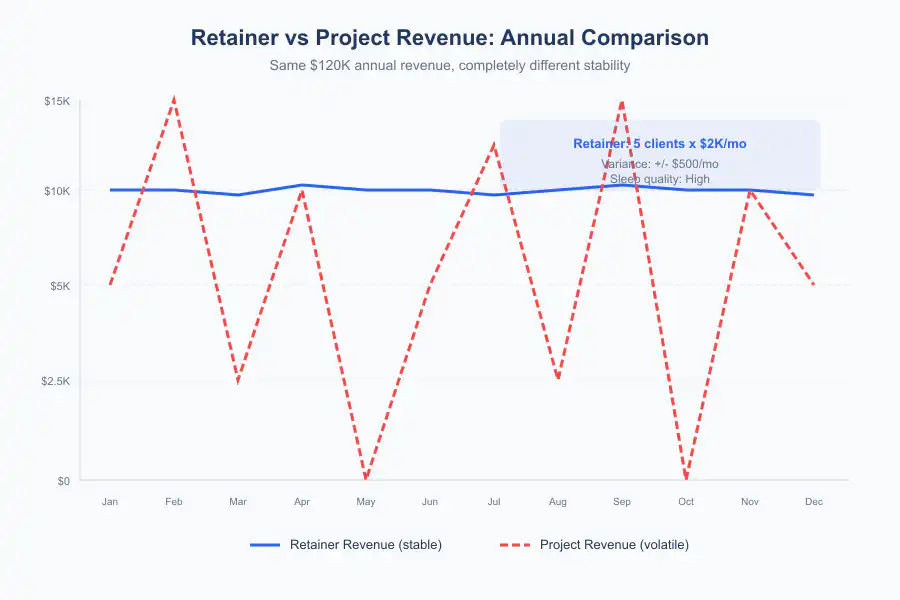
I spent years in project mode before transitioning most of my revenue to retainers. The stress reduction alone was worth it. I remember the exact month it shifted. I had five retainer clients totaling about $12,000 per month, and for the first time in my freelance career, I didn’t wake up on the first of the month wondering where money would come from. But the financial and strategic benefits go much deeper than just peace of mind.
What a Retainer Actually Is
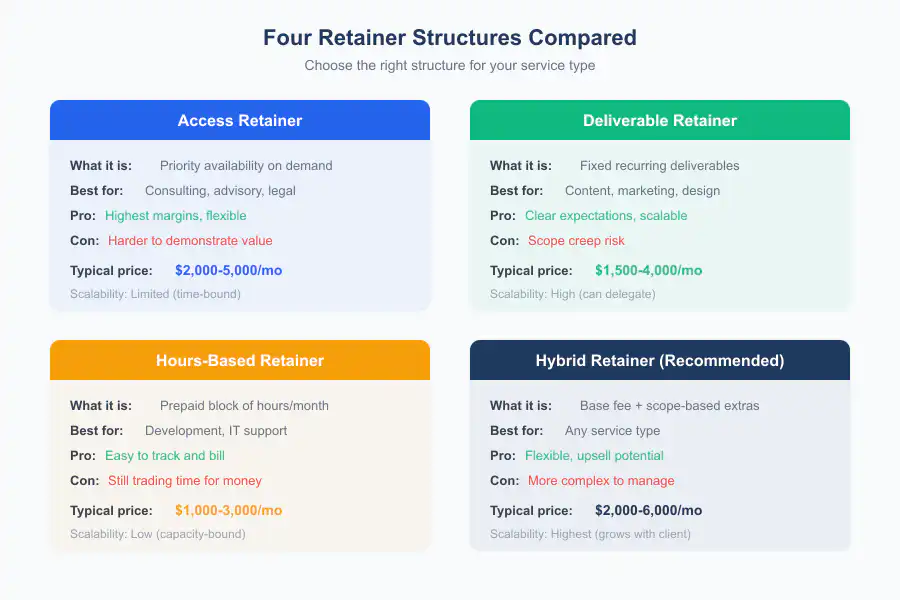
A retainer is a recurring agreement where clients pay a fixed monthly amount for ongoing services. The arrangement can take different forms, and choosing the right structure matters more than most people realize.
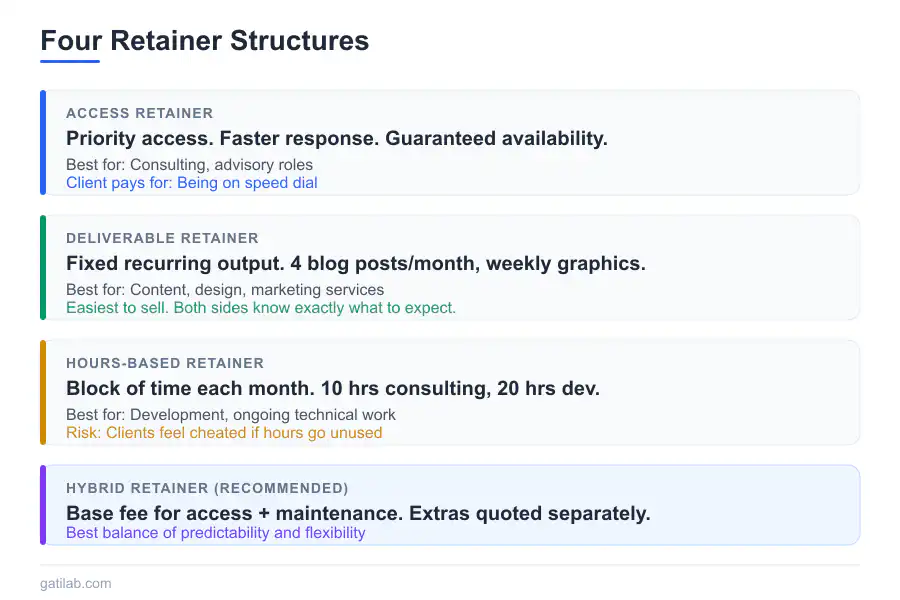
Access retainers mean the client pays for priority access to you. They get faster response times, guaranteed availability, and the ability to call on you when needed. Hours may or may not be specified. This is common in consulting where clients want a trusted advisor on speed dial.
Deliverable retainers mean the client pays for specific recurring work. Four blog posts per month. Weekly social media graphics. Monthly website maintenance. Clear deliverables, predictable workload. I’ve found these are the easiest to sell because both sides know exactly what’s expected.
Hours-based retainers mean the client buys a block of your time each month. Ten hours of consulting, twenty hours of development work. Unused hours may or may not roll over. These are the most common structure I see in WordPress development, though they come with a risk: clients sometimes feel cheated if they don’t use all their hours, even when the arrangement works in their favor.
Hybrid retainers combine elements. A base fee for access and maintenance plus additional fees for specific deliverables. This is actually my preferred structure. A base monthly fee covers maintenance and availability, and anything beyond that scope gets quoted separately.
Each structure has tradeoffs. The right choice depends on your service type, client needs, and how much ambiguity you’re comfortable managing.
Why Retainers Beat Project Work
The financial case for retainers is compelling, and I’ve lived both sides of this equation.
Predictable revenue is the obvious benefit. You know in advance what next month looks like. Planning, hiring, and investing become possible when income isn’t volatile. I can’t overstate how much this changes your relationship with your business. When you know $15,000 is coming in next month regardless, you make completely different decisions than when you’re hoping to close something.
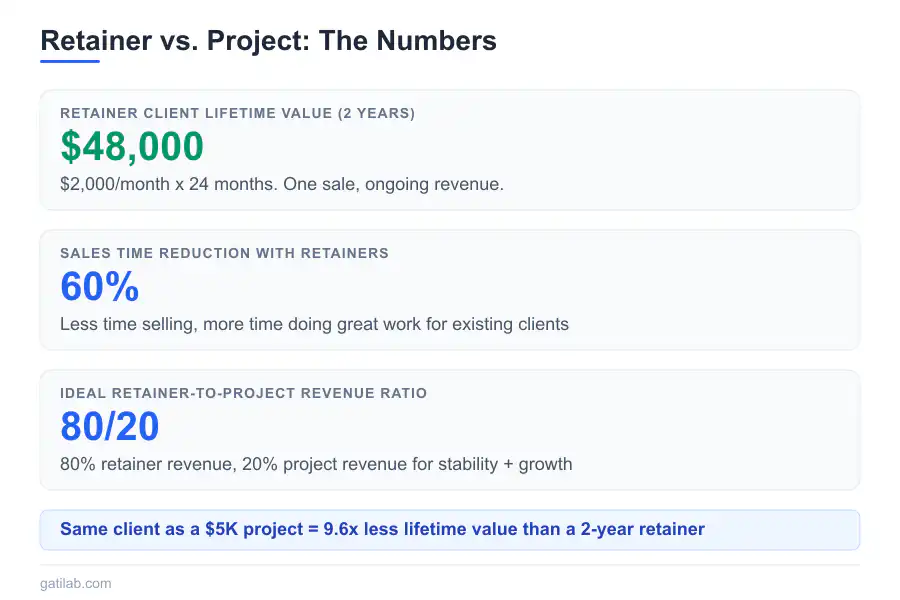
Lower sales effort is the underappreciated benefit. Each retainer client represents one sale that keeps paying. To earn the same annual revenue from projects, you need many more sales conversations, proposals, and negotiations. I estimated that switching to retainers cut my sales time by about 60%. That time went directly into doing better work for existing clients.
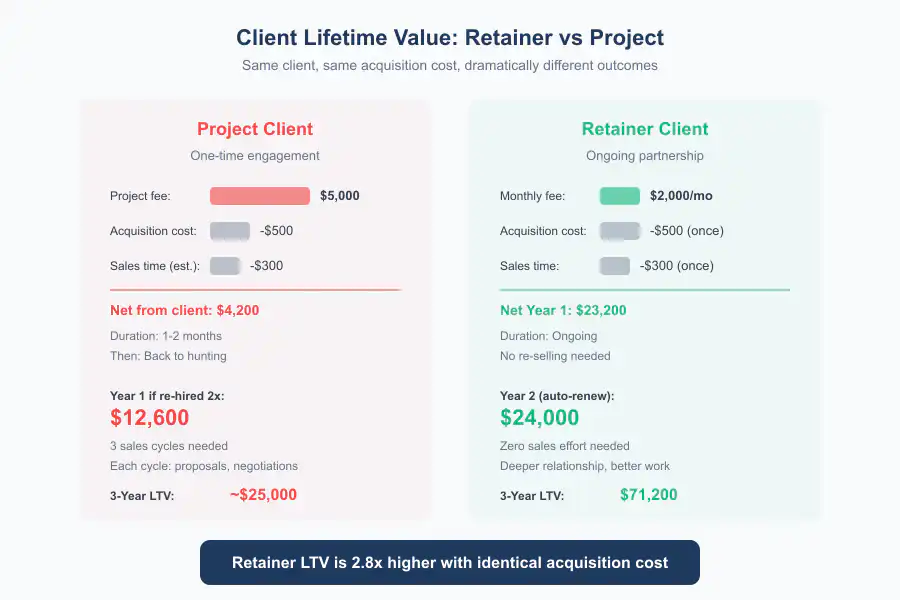
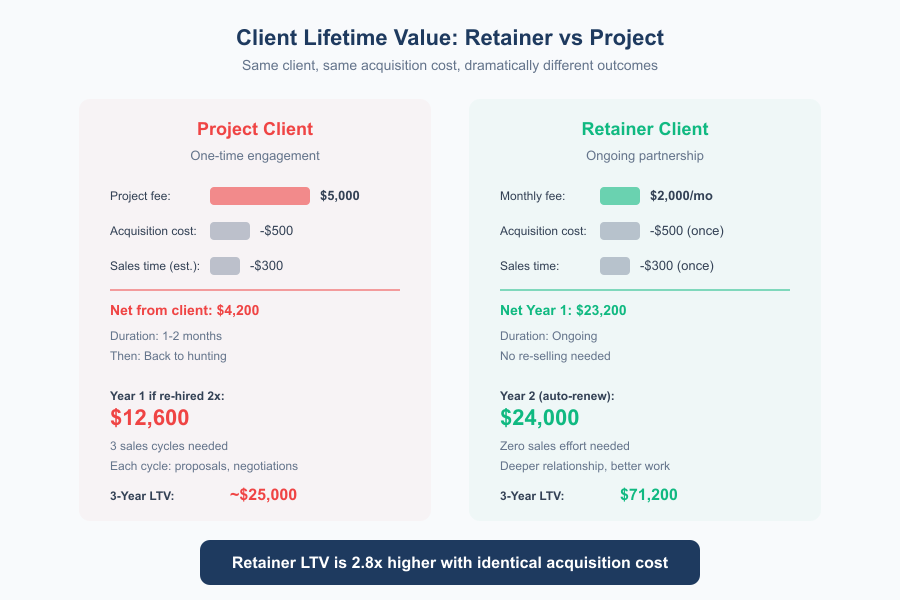
Higher lifetime value makes every client relationship more valuable. A $2,000/month retainer for two years is $48,000 from one client. That same client as a $5,000 project is just $5,000. The retainer relationship is worth nearly 10x more, and the acquisition cost was identical.
Better client relationships develop naturally over time. Ongoing relationships build deeper understanding. You know the client’s business, they trust your judgment, and the work improves because of that accumulated context. Some of my best work has come in year two or three of a retainer, when I understood the client’s business almost as well as they did.
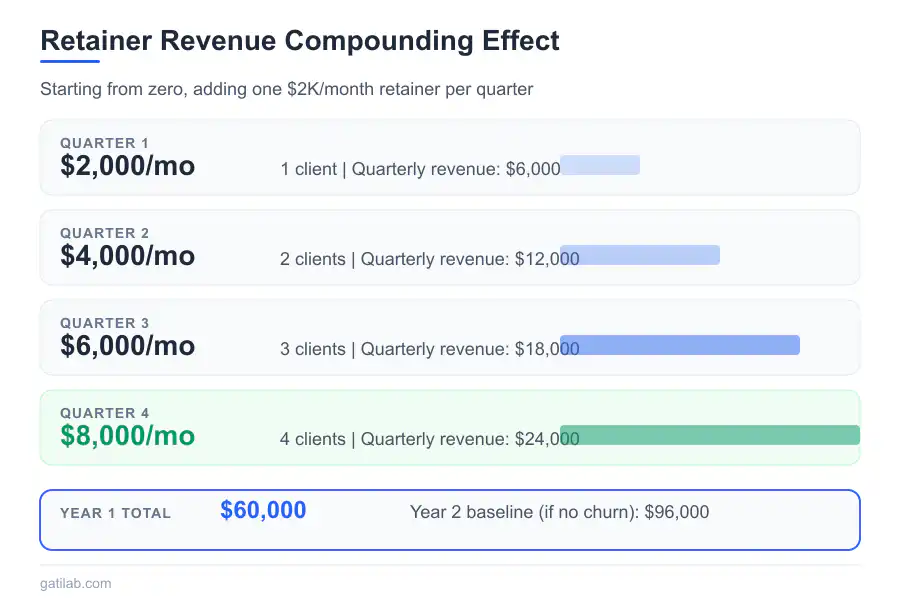
The compounding advantage is what makes retainers transformative long-term. Each new retainer adds to your base. From five retainer clients, adding one means 20% revenue growth without losing anything. Project work doesn’t compound the same way because every project ends.
The stability of retainer revenue lets you make decisions that project-dependent businesses can’t. Turn down bad clients. Invest in systems. Take vacations without worrying about pipeline. If you’re struggling with managing multiple projects, retainers simplify your operational complexity dramatically.
Services That Work as Retainers
Almost any service can become a retainer with the right framing, but some fit more naturally than others.
Naturally recurring services are the easiest to sell as retainers because the ongoing need is obvious. Website maintenance and updates. Social media management. Content writing and marketing. Bookkeeping and financial management. SEO and ongoing optimization. IT support and helpdesk. Design support for ongoing needs. If the client would hire you repeatedly anyway, you’re just formalizing the relationship and giving them a better deal on commitment.
For managing client communications and deliverables, tools like ClickUp or monday.com help organize retainer workflows so nothing falls through the cracks.
Project-based services can be reframed as retainers with some creativity. Development support becomes “ongoing bug fixes, updates, and small features.” Strategic consulting becomes “regular check-ins and guidance.” Marketing becomes “ongoing campaign management.” Video production becomes “regular content rather than one-offs.”
The key is finding ongoing need. If clients need your service once and never again, retainers feel forced and both parties will resent the arrangement. If needs recur naturally, retainers make sense for both parties because they reduce friction and cost.
Structuring Your Retainer Offering
Define scope precisely in every retainer agreement. “Website maintenance” is vague and leads to arguments. “Up to 4 hours of updates, weekly backups, security monitoring, and uptime checks” is clear. Specificity protects both you and the client.
A well-structured retainer is clear about what’s included and what isn’t. I’ve learned this the hard way. Vague retainers create scope creep, resentment, and eventual cancellation.
Define scope precisely. What exactly does the monthly fee cover? Be specific. “Website maintenance” is vague and will lead to arguments. “Up to 4 hours of updates, weekly backups, security monitoring, and uptime checks” is clear. Specificity protects both you and the client.
Set boundaries explicitly. What’s outside the retainer? Rush requests, major changes, new features, additional sites. Clarify so clients don’t assume everything is included. I list exclusions in every retainer agreement because the things left unsaid are the things that cause problems.
Establish communication expectations. Response times, meeting frequency, preferred channels. “48-hour response during business days” sets appropriate expectations. Without this, some clients will expect instant replies at midnight, and they’re not wrong to expect it if you never said otherwise.
Determine rollover policies carefully. Do unused hours roll over? If so, for how many months? Many retainers are use-it-or-lose-it, which simplifies planning but can frustrate clients. I allow a one-month rollover as a compromise. It feels fair without creating unlimited liability.
Define overage handling before it becomes an issue. When clients exceed the retainer scope, what happens? Additional billing at what rate? This should be clear from day one. I charge my standard hourly rate for overages, which is higher than the effective retainer rate. This incentivizes clients to stay within scope while giving them a clear path when they need more.
Put everything in writing. The retainer agreement should be a document clients can reference, not a verbal understanding that each party remembers differently.
Pricing Your Retainers
Retainer pricing differs from project pricing in important ways.
For project work, you estimate effort and price accordingly. For retainers, you’re pricing ongoing value plus access plus priority. The relationship itself has value beyond the hours.
The hourly floor method is the simplest starting point. Calculate what you’d charge hourly, estimate hours the retainer will require, add a premium for the relationship value and priority access. If 10 hours at $150/hour is $1,500, the retainer might be $2,000 to reflect the added value of guaranteed availability.
The value-based method prices against client outcomes. What is this ongoing service worth to the client? If website uptime prevents revenue loss, if content drives leads, if financial clarity enables decisions, price relative to that value. I’ve had clients where preventing a single hour of downtime saved them more than the entire monthly retainer.
The market method provides context. What do similar retainer services cost? This sets a reference point even if you price above or below market based on your positioning and expertise.
The capacity method works backward from your needs. How many retainer clients can you effectively serve? What annual income do you need? Divide to find your minimum per client. Then adjust up based on the value you deliver.
Retainers are generally priced higher per hour than project work because you’re providing reliability, priority, and consistency. Clients pay for knowing you’ll be there, not just for the specific work performed. I think of it as insurance premium plus service. They’re buying certainty.
Converting Existing Clients to Retainers
Your best retainer prospects are clients who already work with you repeatedly. They’ve already demonstrated ongoing need with their behavior.
If a client has hired you for three web projects in the past year, they clearly have ongoing needs. A retainer formalizes that relationship and gives them priority access. I look for this pattern in my client history at least twice a year.
The conversion conversation is straightforward when the need is genuine:
“I’ve noticed we work together frequently on web updates. Have you considered a monthly retainer arrangement? It would give you priority access for updates, guaranteed response times, and better rates than one-off projects. Plus you’d have predictable costs for budgeting.”
Frame it as a benefit to them, not just to you. They get priority, predictability, and often better per-hour rates. You get stability. Understanding value-based pricing helps you have these conversations confidently.
Not every project client wants to become a retainer client. That’s fine. Don’t force it. The best retainer relationships come from mutual recognition that ongoing partnership serves both parties. When both sides genuinely want the arrangement, retention is natural.
Finding New Retainer Clients
Beyond converting existing clients, you can attract retainer clients specifically through how you position and market.
Position your offerings as ongoing services. Marketing that emphasizes projects attracts project buyers. Marketing that emphasizes ongoing support attracts retainer buyers. I changed my website copy from “WordPress development projects” to “ongoing WordPress development and maintenance” and the inquiries I received shifted noticeably.
Target clients with recurring needs. Growing companies need ongoing marketing. Active websites need ongoing maintenance. Scaling businesses need ongoing financial help. Look for businesses where the work never ends.
Qualify for retainer fit during sales. Ask about ongoing needs, budget for continuous support, and preference for relationships versus transactions. Some clients genuinely prefer project-based work, and that’s fine. But you won’t know unless you ask.
Offer retainers as the default. Instead of quoting projects and offering retainers as an option, quote retainers and mention projects for one-off needs. The default shapes expectations. When I started leading with retainer pricing, my retainer conversion rate doubled.
Use content marketing about ongoing value. Articles about “why ongoing SEO beats one-time optimization” or “the cost of reactive versus proactive website maintenance” attract clients who already think in retainer terms.
Managing Multiple Retainers
As retainer count grows, operational challenges appear. This is where systems become essential.
Systematize recurring work. Create checklists, templates, and processes for what you do monthly. Website maintenance should be the same process every month, not reinvented each time. I have a 23-point checklist for monthly WordPress maintenance that every retainer client gets. Same list, consistent execution, reliable results.
Schedule retainer work deliberately. Block time for each retainer client. If you have 10 retainers, maybe each gets a half-day per week. Consistent scheduling prevents one demanding client from absorbing all your attention while others get neglected.
Track hours if relevant. If your retainers are hours-based, accurate tracking matters for both billing and capacity planning. Tools like FreshBooks make time tracking and invoicing seamless for retainer billing.
Communicate proactively. Don’t wait for clients to wonder what you’re doing. Send monthly summaries of work completed, issues addressed, and recommendations for next steps. I send a brief email on the last day of each month summarizing what I did. It takes 10 minutes per client and prevents the “what am I paying for?” question from ever arising.
Monitor client satisfaction actively. Retainers fade away when clients feel neglected or unclear about value. Regular check-ins catch problems before they become cancellations. A quarterly 30-minute call with each retainer client has saved me from losing clients I didn’t even know were unhappy.
The goal is making retainer delivery efficient enough that you can handle many without compromising quality on any.
The Capacity Question
A common question: how many retainers can one person manage?
It depends entirely on what each retainer involves. Ten retainers requiring 4 hours each is 40 hours of work. Manageable. Ten retainers requiring 20 hours each isn’t manageable by one person. That’s two full-time jobs.
Do the math before taking on new retainers. Estimate hours honestly. Include communication time, administrative overhead, and context-switching costs, not just billable work. I’ve found that actual time per retainer client is usually 20 to 30% higher than the billable hours because of emails, calls, and task management.
Running at 100% capacity leaves no room for emergencies or new opportunities. Most people function best at 70 to 80% capacity. Build that margin into your retainer planning. I try to keep my retainer commitments at about 65% of available hours so I have room for overages, emergencies, and the occasional project that’s too interesting to pass up.
Handling Retainer Cancellations
Retainers end. Clients leave, budgets change, needs evolve. This is normal, not failure. How you handle endings matters for your reputation and future business.
Notice periods help both parties. 30-day notice clauses give you time to fill the gap. Most clients are fine with reasonable notice requirements because they’d want the same consideration from you.
Exit gracefully every single time. Help clients transition. Document what you’ve done, hand over credentials properly, wish them well. Good endings lead to future referrals and sometimes to clients returning. I’ve had three former retainer clients come back after trying cheaper alternatives.
Learn from every cancellation. Why did they leave? Budget issues are fundamentally different from dissatisfaction. If clients consistently cite a specific problem, address it. Cancellation conversations, handled with genuine curiosity instead of defensiveness, are some of the most valuable feedback you’ll ever get.
Maintain relationships after the retainer ends. Former retainer clients are excellent prospects for future work. They know you, they trust you, and they may return when circumstances change.
Diversification protects against individual cancellations. Having 10 retainers at $1,500 each is more stable than three retainers at $5,000 each. One cancellation hurts less when it’s 10% of your revenue instead of 33%.
The 80/20 Split
A common goal is 80% retainer revenue, 20% project revenue. I think this is close to ideal, though the exact ratio depends on your business.
Retainers provide stability. Projects provide variety, challenge, and higher potential for exceptional per-project income. Both serve a purpose in a well-designed business.
Pure retainer businesses can become monotonous. You’re doing the same work for the same clients month after month, and that predictability that’s so financially comforting can become creatively stifling. Pure project businesses are too volatile. You never know what’s coming, which is exciting until the pipeline goes dry.
The mix balances stability with excitement. I aim for about 75/25 retainer-to-project, and that’s worked well for over five years.
You might not hit 80/20 immediately. Many businesses start at 0% retainers and build gradually. Add one retainer. Then another. Each one shifts the balance. I went from zero retainers to 80% retainer revenue over about three years. It wasn’t a switch; it was a gradual transition.
When Retainers Don’t Work
Retainers aren’t right for every service or every client, and it’s important to be honest about fit.
Highly specialized project work that happens once per client doesn’t lend itself to retainers. If you do brand identity redesigns, each client needs it once. Forcing a retainer around a one-time need creates an awkward arrangement.
Clients with irregular needs may prefer project-based relationships where they pay when they need you rather than every month. Check out must-have tools for freelancers for managing both project and retainer work efficiently.
Very high-value one-off services may make more sense as projects. If each engagement is $50,000+, the relationship continuity of retainers is less important than the project structure.
Early in your career when you need diverse experience, projects let you work with more clients and learn faster than deep retainer relationships. I didn’t start offering retainers until about year three of freelancing, and I’m glad I had those project years to build breadth first.
Be honest about fit. Forced retainers where clients don’t really need ongoing service become resentful relationships that churn anyway. If the need isn’t genuine, the retainer won’t last.
Building Your First Retainer
If you have no retainers currently, here’s the path I’d recommend.
Identify 3 to 5 past clients who’ve worked with you multiple times or who have obvious ongoing needs. These are your warmest prospects because the relationship already exists.
Create a retainer offering with clear scope, pricing, and terms specific to what those clients need. Don’t create a generic package. Tailor it to the actual work you’ve been doing for them.
Reach out with a personalized proposal explaining the benefits of ongoing partnership. Not a mass email. A personal conversation or message that references your specific history together.
Refine based on feedback. If everyone says no, adjust scope or pricing. If everyone says yes, you probably priced too low. Somewhere in between is normal. I converted 2 of my first 5 prospects, which felt slow at the time but was actually a great start.
Deliver exceptionally for your first retainer clients. Their satisfaction builds testimony for future retainer sales. Over-deliver in the first three months. Set the standard high and then maintain it.
One retainer changes your mindset. You have something that renews next month without effort. That stability, even small, shifts how you operate and how you think about your business.
Project businesses are always hunting. Retainer businesses are building. I remember the exact month it shifted, when five retainer clients meant I didn’t wake up on the first of the month wondering where money would come from. That stability changes everything about how you run your business.
The Retainer Mindset
Beyond the business model, retainers represent a mindset shift that changes how you approach everything.
You’re not selling tasks. You’re selling ongoing value, reliability, and partnership. The conversation moves from “what do you need done?” to “how can I help your business succeed?”
You’re not managing transactions. You’re managing relationships. And relationships, when managed well, last for years.
This mindset affects everything: how you communicate, how you price, how you think about your business’s future. It changes your identity from “person who does things for money” to “partner who creates ongoing value.”
Project businesses are always hunting. Retainer businesses are building. After 16 years in this industry and hundreds of client relationships, I can tell you with certainty: building beats hunting every single time.
Choose building.
Retainer Business FAQ
Frequently Asked Questions
What is a retainer agreement and how does it work?
A retainer is a recurring agreement where clients pay a fixed monthly amount for ongoing access to your services. It can be structured as access retainers (priority availability), deliverable retainers (specific recurring work like 4 blog posts per month), hours-based retainers (a block of time each month), or hybrid retainers combining elements. Unlike project work that ends after delivery, retainers renew automatically and provide predictable recurring income.
How do I price a retainer service correctly?
Four approaches work: the hourly floor method (hourly rate times estimated hours plus a premium for availability), value-based pricing (pricing against client outcomes), market-based pricing (what similar services charge), and the capacity method (working backward from your income needs and maximum client count). Retainers typically command higher effective hourly rates than project work because clients pay for reliability, priority access, and consistency.
What percentage of revenue should come from retainers vs projects?
Aim for 80% retainer revenue and 20% project revenue. Retainers provide stability while projects offer variety, creative challenge, and higher per-project income potential. Pure retainer businesses risk becoming monotonous, and pure project businesses are too volatile. Building toward this split typically takes 2-3 years of gradual transition, adding one retainer client at a time.
How do I convert existing project clients into retainer clients?
Look for clients who have hired you for multiple projects, as they already demonstrate ongoing need. Frame the retainer as a benefit to them: priority access, guaranteed response times, better effective rates, and predictable budgeting. Create a tailored retainer proposal referencing your shared history rather than sending a generic package. Not every project client wants a retainer, and that is fine. The best retainer relationships come from mutual recognition that ongoing partnership serves both parties.
How many retainer clients can one person manage?
It depends entirely on scope. Ten retainers requiring 4 hours each is 40 hours of manageable work. Ten retainers at 20 hours each is impossible for one person. Estimate hours honestly and include communication time, admin overhead, and context-switching costs, which typically add 20-30% beyond billable hours. Running at 70-80% capacity leaves room for emergencies and opportunities. Track actual time per client to validate estimates.
What services work best as retainers?
Naturally recurring services fit best: website maintenance, content writing, social media management, SEO, bookkeeping, IT support, and ongoing design work. Project-based services can be reframed as retainers with creativity. Development becomes ongoing bug fixes and feature updates. Strategic consulting becomes regular check-ins and guidance. The key test is whether the client genuinely has ongoing needs. Forced retainers without real recurring demand create resentment and churn.
How do I handle retainer cancellations?
Include 30-day notice clauses in agreements to give yourself time to fill the gap. Exit gracefully every time by helping clients transition, documenting your work, and handing over credentials properly. Learn from every cancellation by asking why they left. Diversify your client base so no single cancellation hurts too much. Having ten retainers at $1,500 each is more stable than three at $5,000 each because one cancellation represents 10% of revenue instead of 33%.
What should a retainer agreement include?
Every retainer agreement should include precise scope definition (what is included and what is not), communication expectations (response times and meeting frequency), rollover policies for unused hours, overage handling with clear rates, notice period for cancellation, and payment terms. Specificity protects both sides. Vague retainers create scope creep and resentment. Put everything in writing so neither party relies on memory about what was agreed.