
Competing in Saturated Markets: Positioning Strategies That Work
The market is crowded. Every search reveals dozens of competitors. Every industry conference is packed with people doing what you want to do. The conventional wisdom says find a blue ocean, an untapped niche, virgin territory.
But what if your passion, skills, and experience point toward a market that’s decidedly red?
I’ve built businesses in markets that looked impossibly crowded. WordPress development, content marketing, freelance consulting. These markets had thousands of providers before I entered. Yet there was room… because saturation is more nuanced than it appears. Many crowded markets are full of mediocre providers, leaving space for excellence. Others have underserved segments hiding within the noise. When I started offering WordPress services, there were already tens of thousands of WordPress developers. That didn’t stop me from building a client roster of 800+ projects including IBM, Adobe, and HubSpot.
Saturated markets exist for a reason. They’re proven. Customers spend money there. Demand is established. The infrastructure for serving customers exists. While competition is fierce, the opportunity is real. Many successful businesses were built in crowded markets by entrepreneurs who found ways to differentiate, specialize, or simply execute better than entrenched players.
This guide covers how to enter and succeed in markets others consider too crowded.
Rethinking Market Saturation
Before accepting that a market is full, examine it more carefully. Opportunity often hides in apparent crowding.
Saturation is relative to customer satisfaction. A market with many providers can still have underserved customers. Truly satisfied customers are rare in most industries. If customers are settling rather than delighted, space exists for someone who actually delivers. I’ve won clients from agencies five times my size simply because those agencies stopped caring about quality once they got comfortable.
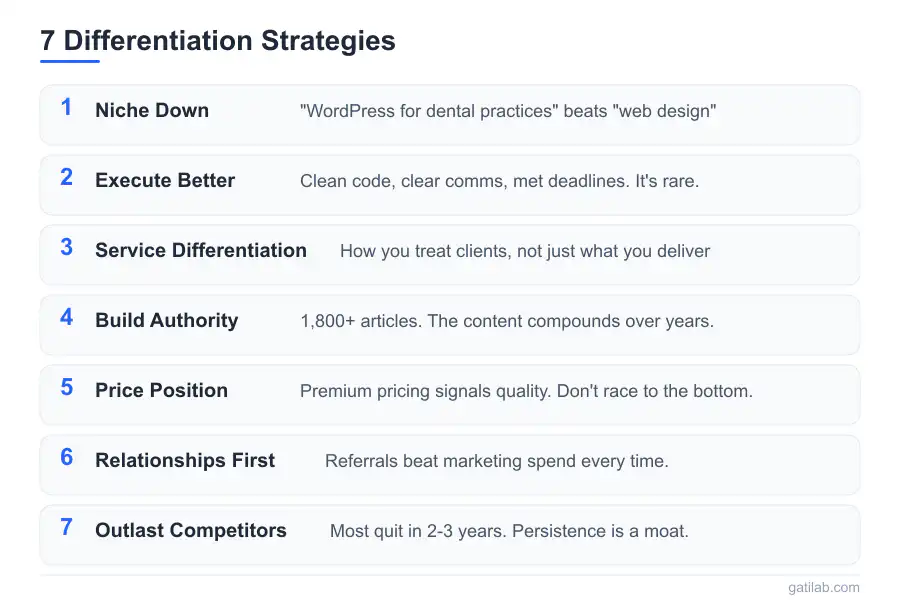
Quality gaps create opportunity. Many crowded markets are full of mediocre offerings. Excellence stands out precisely because it’s unusual. When everyone is doing adequate work, exceptional work becomes a competitive advantage. I’ve seen this repeatedly in WordPress development. There are thousands of developers, but finding one who delivers clean code, communicates clearly, and meets deadlines? That narrows the field dramatically.
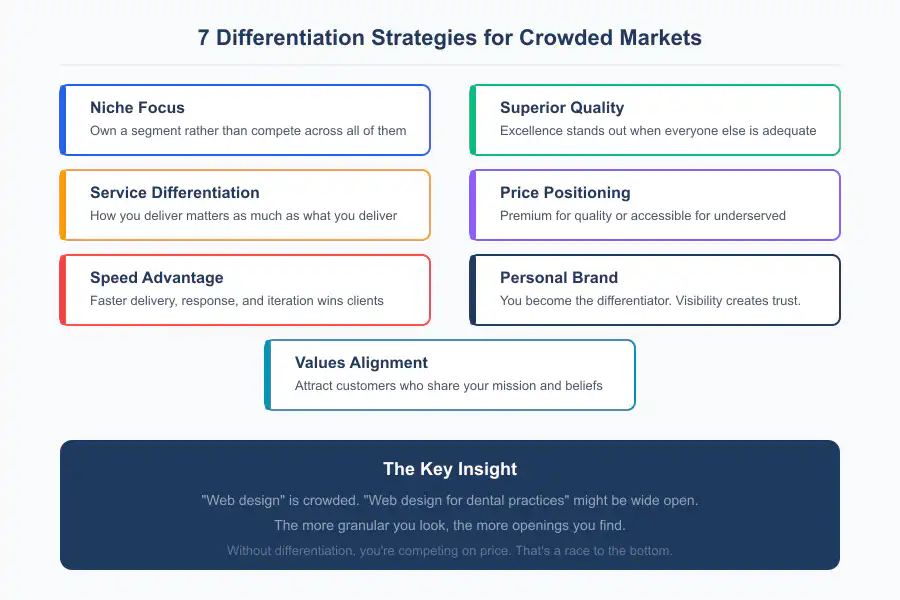
Segment opportunities exist within broad markets. The broad market may be saturated while specific segments remain underserved. Web design is crowded, but web design for dental practices might have room. Marketing is saturated, but marketing for B2B SaaS companies with 10-50 employees might be wide open. The more granular you look, the more openings you find.
Service gaps matter more than product gaps. Products exist but service quality is often poor. Service differentiation works when customers are frustrated with how they’re treated, not what they’re offered. Most of the clients who’ve come to me were frustrated with a previous provider’s communication, not their technical skills.
Geographic variation creates local opportunity. Saturated in some locations, opportunities in others. Remote work has changed this dynamic, but local presence still matters for many services.
Evolution creates disruption opportunity. Customer needs change. Yesterday’s solution may not fit today’s problem. Markets that look saturated with yesterday’s offerings may be open for tomorrow’s approach.
Incumbent complacency opens doors. Established players often stop innovating once they’ve achieved market position. They get lazy. They take customers for granted. I’ve won some of my best clients from incumbents who were coasting. Disruption remains possible when incumbents rest on their laurels.
Why Crowded Markets Actually Work
The case for competing in established markets is stronger than the “blue ocean” advocates admit.
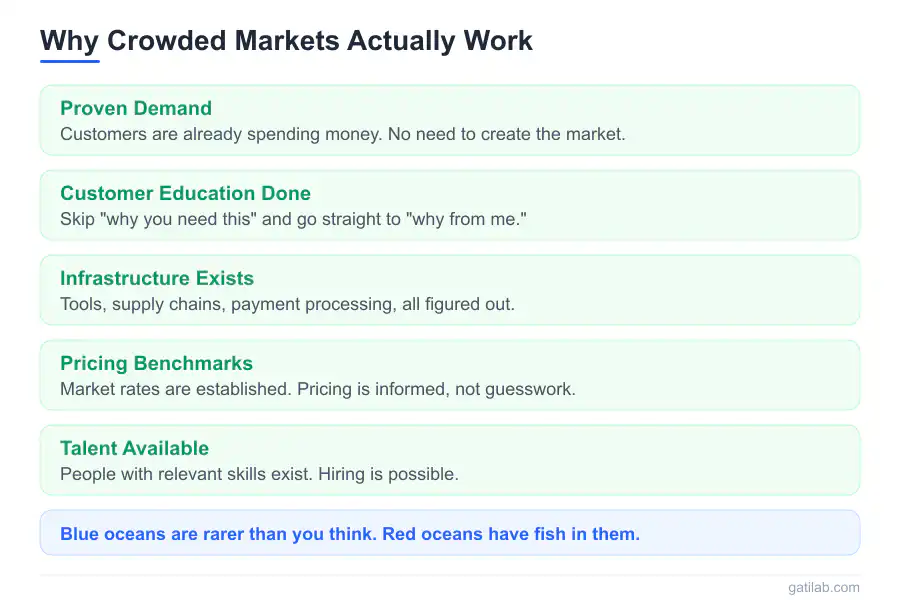
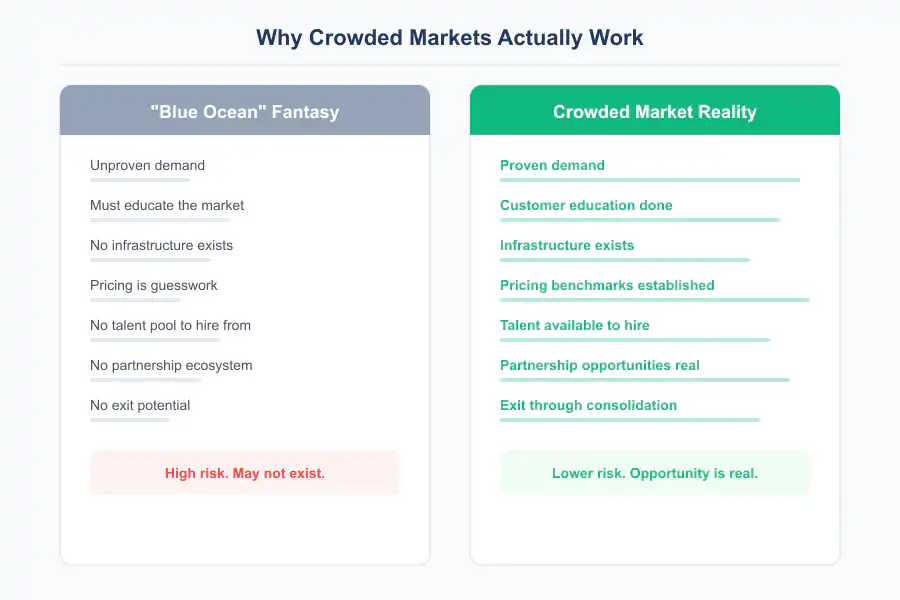
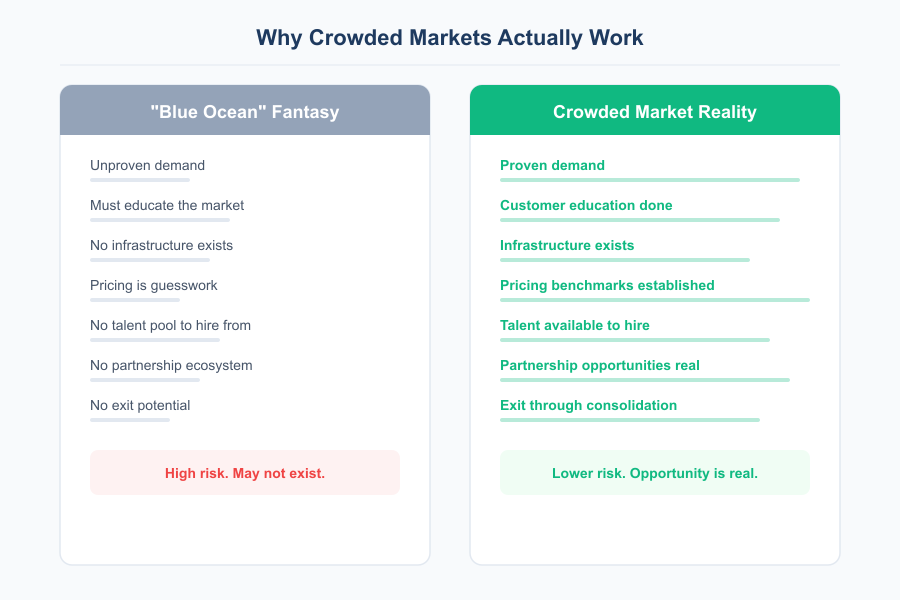
Proven demand removes market risk. Customers are spending money. No need to create the market. You don’t have to convince anyone the category matters. Demand validation is complete before you start. That’s massive. I’ve tried creating entirely new categories before, and the education cost alone is brutal.
Customer education is done. Customers understand the category. Less explanation needed. You can skip the “why you need this” conversation and move directly to “why you need this from me.” That shortens every sales cycle.
Infrastructure exists to support you. Supply chains, service providers, tools developed. You don’t start from scratch. Everything from payment processing to project management to marketing channels has been figured out.
Pricing benchmarks inform your decisions. Market rates are established. Pricing decisions are informed rather than guesswork. You know what customers expect to pay, which makes positioning yourself much easier.
Talent availability solves hiring. People with relevant skills exist. Hiring is possible. In emerging markets, finding qualified team members is often the bottleneck. In established markets, talent pools already exist.
Partnership opportunities are real. Related businesses exist. Collaboration options are available. You can partner, refer, and build relationships within an established ecosystem.
Exit potential exists through consolidation. Crowded markets often see consolidation. Acquisition possibilities exist. Someone may want to buy what you build.
Don’t dismiss crowded markets automatically in pursuit of an elusive blue ocean that may not exist.
When I started offering WordPress services, there were already tens of thousands of developers. That didn’t stop me from building a client roster including IBM, Adobe, and HubSpot. Saturated markets are full of mediocre providers. Excellence stands out precisely because it’s unusual.
Finding Your Competitive Edge
Differentiation is essential in crowded markets. Without it, you’re just another option competing primarily on price. That’s a race to the bottom, and nobody wins that race except the customer who gets cheap work.
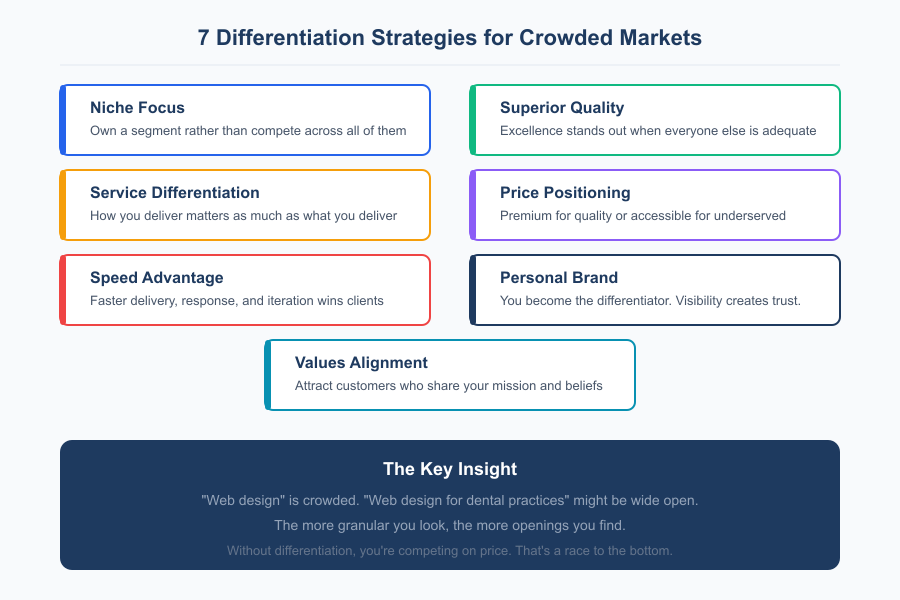
Niche focus creates depth. Specialize where others generalize. Own a segment rather than compete across all of them. Depth beats breadth when you’re fighting for attention. This is probably the single most effective strategy I’ve seen. When I narrowed my focus to WordPress specifically rather than “web development,” everything got easier.
Superior quality commands premium. Simply be better. Attention to detail, excellence in execution. Quality differentiation is demanding but defensible. Competitors can copy your positioning but can’t easily copy your standards. I charge more than most WordPress developers. I also deliver better work. Those two facts are connected.
Service differentiation wins hearts. Same product, better experience. Customer service as differentiator. How you deliver matters as much as what you deliver. Most providers are mediocre at service because it requires sustained effort, not a one-time investment.
Price positioning claims market space. Premium for quality or accessible for underserved segments. Clear positioning prevents the mushy middle where you’re neither affordable nor premium. Pick a lane.
Speed advantage captures impatient buyers. Faster delivery, faster response, faster iteration. Time matters to customers. Speed is harder to copy than most people think because it requires systems, not just effort.
Personal brand creates recognition. You as the differentiator. Building visibility around yourself. When you become known, you’re no longer competing with unknowns. I’ve had clients tell me they chose me because they’d been reading my blog for years before they needed help.
Values alignment attracts aligned customers. Customers who share your values choose you. Mission-driven differentiation works for customers who care about more than price and features.
Technology advantage enables efficiency. Better tools, better systems, better efficiency. Technology can enable quality or speed advantages that compound over time.
The Niche Strategy in Depth
“Web design” is crowded. “Web design for dental practices” might be wide open. The more granular you look, the more openings you find. When I narrowed to WordPress specifically rather than “web development,” everything got easier.
Owning a segment is often the most effective strategy for saturated markets. What’s crowded broadly may be open narrowly.
Define the segment precisely. Who specifically are you serving? Narrow enough to own, large enough to sustain. “Small businesses” is too broad. “E-commerce businesses doing $1-5M revenue on Shopify” is specific. When I work with consultants on niche selection, the biggest struggle is always getting them to go narrow enough.
Understand the segment deeply. Know segment problems, language, culture better than generalists ever could. Read what they read. Join their communities. Learn their specific challenges. I spent months in WordPress forums and Slack channels before I truly understood what people struggled with. That investment paid off for years.
Tailor offerings specifically. Products and services designed specifically for segment needs. Generic offerings with minor customization don’t count. Build from the segment’s perspective. When everything you offer is designed for their world, the fit is obvious.
Speak their language fluently. Marketing that resonates with segment worldview. Use their terminology, reference their specific situations, address their actual objections. Generalists sound generic. Specialists sound like insiders.
Build community around the segment. Become the center of gravity for your segment. Host events, create resources, facilitate connections. When you’re the hub, business flows through you naturally.
Establish recognized authority. Be the expert for segment-specific needs. Create content that demonstrates deep understanding. Become the obvious choice so thoroughly that prospects feel risky choosing anyone else.
Leverage referral concentration. Segment members refer each other. Network effects develop within niches. One satisfied customer connects you to many similar prospects because they all know each other. I’ve gotten chains of five or six referrals from a single client in the same industry.
The riches really are in the niches.
Competing on Quality
When better wins, quality differentiation provides sustainable advantage.
Craftsmanship focus distinguishes you. Attention to detail that competitors skip. The extra polish that makes work notable. Quality shows in everything from deliverables to communication. I’ve always believed in over-delivering. Not in a way that kills your margins, but in a way that makes clients genuinely impressed. That impression generates referrals.
Results emphasis proves value. Measurable outcomes that exceed market standard. When you can demonstrate superior results, price objections fade. Nobody argues about your rate when the results are undeniable.
Value-based positioning supports premium. Price for value delivered, not market average. Quality work justifies quality pricing. If your work generates $100,000 in value, charging $10,000 is a bargain regardless of what competitors charge.
Testimonial power builds credibility. Satisfied customers who share their experience become your sales force. Quality work generates quality testimonials automatically.
Portfolio proof speaks loudly. Work quality that speaks for itself. When prospects see your work, the comparison becomes obvious. I’ve won projects purely because my portfolio demonstrated a level of craft that competitors couldn’t match.
Quality consistency builds reputation. Every delivery at standard. No variability. Consistency is itself a differentiator when most providers are inconsistent. Clients don’t just want great work once. They want great work every time.
Premium signaling sets expectations. Presentation, communication, process that reflect quality. Everything about how you show up signals your quality level.
Quality differentiation requires consistent excellence. It’s demanding but defensible.
Competing on Service
Experience as differentiator works when products are similar. How you deliver matters as much as what you deliver.
Response speed demonstrates respect. Faster replies, faster turnaround. Time is service. Customers notice when you respond in hours while competitors take days. I aim for same-business-day responses. That single habit has won me more repeat business than any technical skill.
Communication quality shows professionalism. Clear, proactive, professional communication. Keeping clients informed without being asked. Writing clearly and thoroughly. Most freelancers are terrible communicators. Don’t be most freelancers.
Accessibility removes friction. Easy to reach, easy to work with. Removing barriers to engagement. Being available when clients need you. Not 24/7 availability, but reliable and predictable access.
Problem resolution builds trust. When things go wrong, make them right quickly. How you handle problems defines the relationship more than how you handle successes. I’ve turned potential disasters into my strongest client relationships by owning mistakes fast and fixing them faster.
Personalization creates connection. Treating customers as individuals, not numbers. Remembering details, anticipating needs, adapting to preferences.
Going beyond creates delight. Exceeding expectations consistently. Surprise with extra value. Small gestures that demonstrate care.
Client relationship investment yields loyalty. Long-term relationship focus rather than transaction. Building relationships that last years, not projects.
Service differentiation works when products are commoditized. Most providers neglect it because it requires ongoing effort rather than one-time investment.
The Personal Brand Play
In commoditized markets, the provider becomes the product. Invest in yourself as the differentiator.
Visibility building creates recognition. Personal brand that makes you known in the market. When prospects know your name before they need your service, you’re ahead. I’ve been writing publicly for over sixteen years. That sustained visibility means prospects often arrive already trusting me.
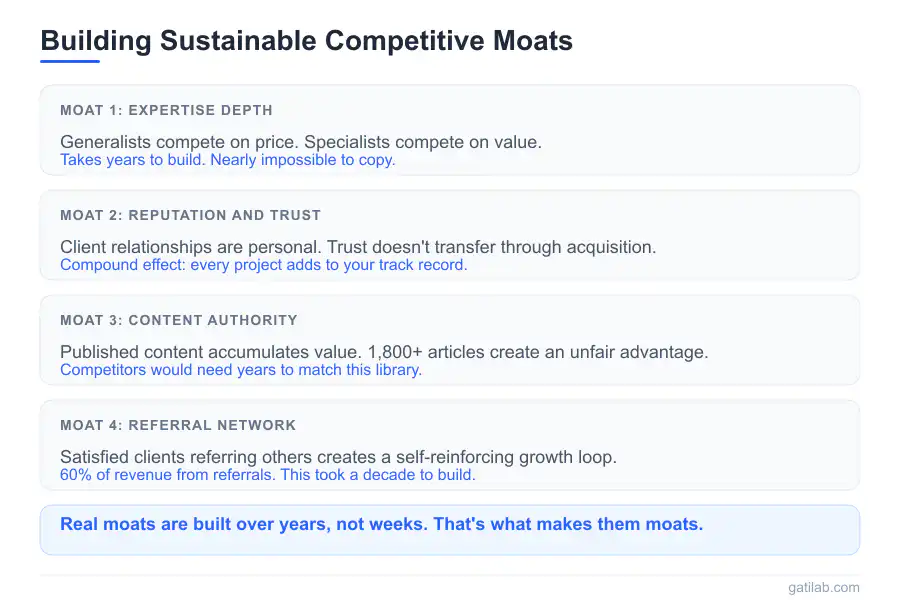
Content authority demonstrates expertise. Sharing knowledge that shows what you know. Helpful content that proves you understand the problems prospects face. With 1,800+ published articles, my content does the selling before I ever get on a call.
Authentic voice creates differentiation. Your perspective, your style. Distinctive presence that couldn’t be anyone else. Authenticity is impossible to copy because nobody else has your specific combination of experience and opinion.
Story connection creates affinity. Your journey that resonates with certain customers. Shared background or experience that creates natural connection.
Relationship building compounds over time. Networking that creates genuine connections. Relationships that develop into referrals, partnerships, and opportunities.
Trust development enables premium. Consistency that builds reputation over time. Trust that allows you to charge more and close faster.
Values expression attracts alignment. What you stand for attracting customers who share those values. Values-based differentiation filters for great-fit clients.
Personal brand is particularly effective in service businesses where the provider relationship matters more than the service specification.
Strategic Market Entry
How you enter affects your trajectory. Choose your entry strategy deliberately.
Stealth approach builds quietly. Enter quietly, build strength before competitors notice. Work on your offering, develop your client base, refine your approach before announcing your presence. This is how I entered most of my markets. No fanfare. Just heads-down work until the work spoke for itself.
Disruption approach demands attention. Enter loudly with something genuinely different. Make noise about what you’re doing differently. This works when you have a genuinely novel approach, not just a marginal improvement.
Partnership entry leverages existing relationships. Collaborate with established players to gain access. Partnerships provide credibility and client access you couldn’t achieve alone. Some of my best early clients came through partnerships with designers who needed a developer.
Acquisition entry skips the building phase. Buy an existing player rather than starting from zero. If you have capital, acquiring an established business can be faster than building.
Adjacent entry uses existing strength. Enter from a related market where you have strength. Your reputation in a related space transfers to the new market.
Premium entry avoids the crowd. Enter at the high end where competition is thinner. Premium positioning often has less competition than the middle market. Most new entrants compete on price, so competing on quality is counterintuitive but effective.
Underserved entry claims neglected customers. Enter serving customers others ignore. Find the segments that established players neglect because they’re too small or too demanding.
Entry strategy should match your resources, timeline, and competitive dynamics. There’s no single right approach.
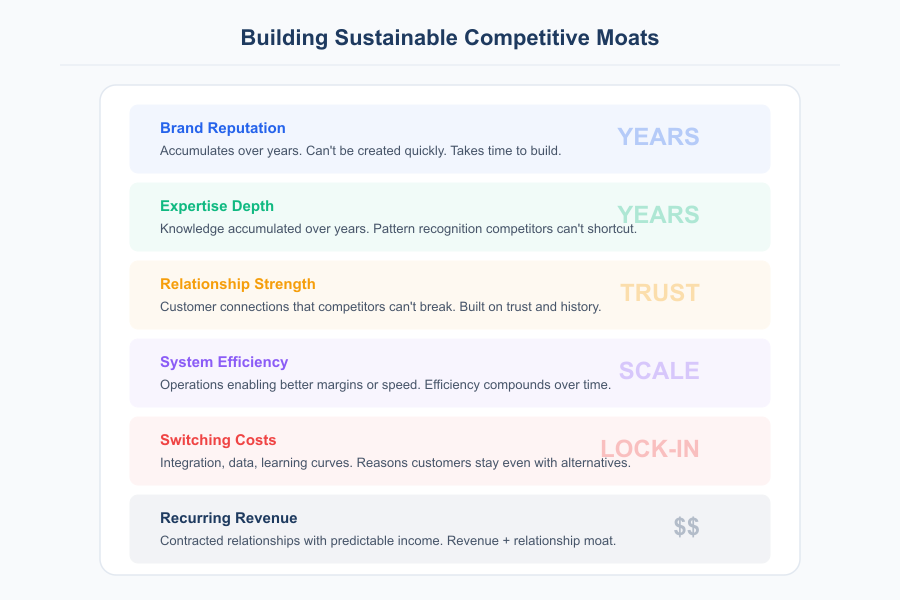
Building Sustainable Competitive Moats
Advantages that last make competition harder over time. Build moats intentionally.
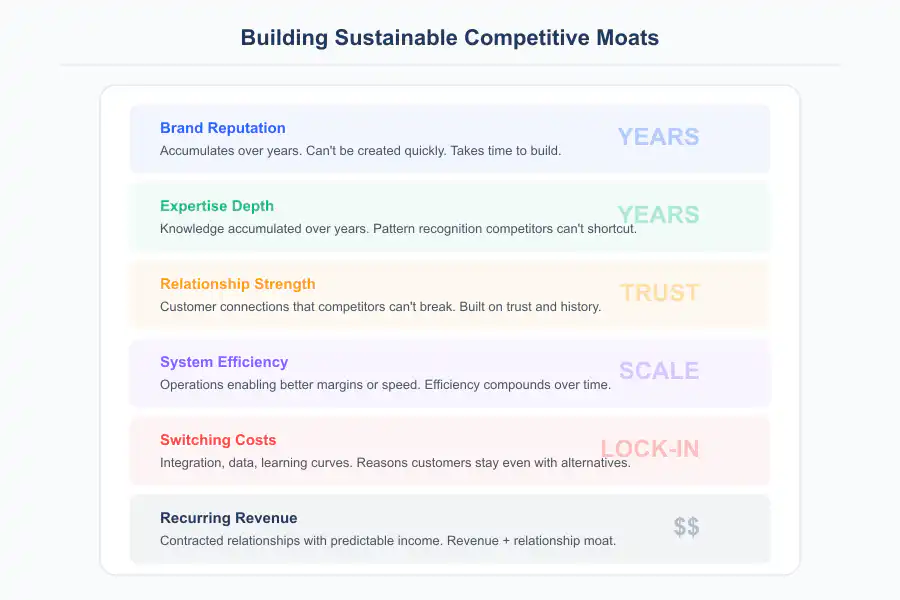
Expertise depth takes time to develop. Knowledge that accumulates over years. Deep expertise in specific areas that competitors can’t quickly acquire. My sixteen years in WordPress means I’ve seen problems that newer developers haven’t even encountered yet. That pattern recognition is a moat.
Relationship strength resists competition. Customer connections that competitors can’t easily break. Relationships built on trust and history. When a client has worked with you for five years, a competitor offering 20% lower rates doesn’t move the needle.
System efficiency enables better economics. Operations that enable better margins or speed. Efficiency compounds into either lower prices or higher profits.
Brand reputation accumulates over years. Recognition and trust that takes time to build. Brand is a moat because it can’t be created quickly.
Network effects compound advantage. Value that increases with scale. When being bigger makes you better, advantage compounds.
Switching costs encourage retention. Reasons customers stay even when competitors offer alternatives. Integration, data, relationships, learning curves all create switching costs.
Recurring revenue provides stability. Contracted relationships that provide predictable income. Recurring revenue moats both revenue and relationships.
Moats take time to build. The businesses that win in crowded markets are usually those that stayed long enough to build defensible advantages.
Pricing in Crowded Markets
Strategic pricing decisions affect everything else. Choose your positioning deliberately.
Premium positioning protects margins. Higher prices signaling higher quality. Margin protection that enables investment in quality. I’ve always positioned at the upper end of market rates. Not the absolute highest, but clearly above average. That positioning attracted clients who valued quality over cost, which made every project more enjoyable.
Competitive pricing with differentiation elsewhere. Market-rate pricing with value creation through service or quality. Pricing isn’t your differentiator, but it’s not your weakness either.
Penetration pricing carries risk. Lower initial pricing to gain share. Risky without a clear path to profitability. Works when you’re confident customers will expand or accept price increases. I tried this once early on and regretted it. The clients who come in on price leave on price.
Value pricing disconnects from market rates. Price based on outcomes, not market comparison. When you can demonstrate value, market rates become irrelevant.
Segment pricing captures different willingness to pay. Different pricing for different customer types. Enterprise pays more than startup. Capture value where it exists.
Bundling creates unique offerings. Combining services for unique value packages. Bundles are harder to compare, reducing price pressure.
Transparency approach builds trust. Clear pricing that builds trust in murky markets. When competitors hide pricing, transparency differentiates.
Pricing affects positioning. Choose deliberately rather than defaulting to market rates because that’s what everyone else charges.
Marketing in Saturated Markets
Getting noticed requires more effort when competition is fierce. Marketing must work harder.
Content differentiation rises above noise. Content that’s genuinely better or different from market noise. Depth, perspective, or approach that stands out. I’ve built my entire business on content marketing. When I write about WordPress, I write from the perspective of someone who’s actually built hundreds of sites, not someone summarizing other people’s advice.
SEO for long-tail captures specific searches. Targeting specific queries rather than broad terms. Long-tail terms often have less competition and higher intent. “WordPress developer for law firms” converts better than “WordPress developer” and is far easier to rank for.
Referral emphasis leverages satisfaction. Happy customers as primary growth engine. Referrals are warmer leads with lower acquisition cost. About 60% of my business comes through referrals. That didn’t happen by accident. It happened because I deliver work worth talking about.
Community building creates owned audience. Creating gathering space for your niche. Communities you own are marketing channels you control.
Partnership leverage expands reach. Collaborating with complementary businesses. Partners introduce you to their audiences.
Thought leadership differentiates perspective. Ideas that differentiate, not just marketing that promotes. Original thinking that positions you as a leader.
Story-driven marketing creates connection. Narrative that connects rather than features that blur together. Stories are memorable when feature lists aren’t.
In crowded markets, marketing isn’t optional. The businesses that win are usually those that market consistently and effectively.
Learning from Competitors
Use saturation as intelligence about what works and what’s missing.
Competitive analysis reveals gaps. What are others doing well? What are they missing? Gaps in competitor offerings are your opportunities. I regularly review what other WordPress consultants offer and how they position themselves. The gaps I find inform my own positioning.
Review mining exposes pain points. Customer reviews reveal frustrations and opportunities. What do customers complain about? What do they wish was different? Read negative reviews of your competitors. That’s your roadmap.
Positioning gaps show white space. What positions are unclaimed? Where is space in the market? Positioning nobody owns is positioning available to you.
Service gaps identify opportunities. What are customers complaining about regarding service? Service gaps are often the easiest to exploit because they require effort, not innovation.
Pricing intelligence informs strategy. What are market rates? Where are opportunities? Pricing patterns reveal market structure.
Success patterns guide strategy. Who is winning and why? Learn from those who’ve figured it out.
Failure lessons prevent mistakes. Who is failing and why? Avoid the mistakes others have made. I’ve learned as much from watching competitors fail as from watching them succeed.
Competitors provide free education. Study them to find your path.
When to Avoid Saturated Markets
Sometimes saturation is real, and entering would be a mistake. Honest assessment matters more than optimism.
No differentiation path. If you genuinely can’t be different, reconsider. Without differentiation, you’re competing on price, which is exhausting and ultimately unsustainable.
Capital disadvantage. Some markets require resources you don’t have. If competitors have war chests you can’t match, choose a different battlefield.
Timing disadvantage. Some markets have passed the entry window. The time to enter may have been years ago. Not every opportunity stays open forever.
Passion absence. If you’re only entering because it seems lucrative, reconsider. Crowded markets require persistence that passion enables. You’ll need to push through years of building. Without genuine interest, you’ll burn out before the moat forms.
Commodity reality. Some markets really are purely price competition. When customers truly don’t differentiate between providers, margins compress to nothing.
Barrier absence. If anyone can enter, margins will always compress. Markets without barriers to entry tend toward commoditization.
Decline trajectory. Some saturated markets are also declining. Saturation plus decline is a combination to avoid.
Not every crowded market is opportunity. Know when to walk away.
The Long Game
Building in crowded markets takes time. Patience isn’t just helpful. It’s essential.
Patience is required. Market share builds slowly against established players. Quick wins are rare in saturated markets. I spent three years before my WordPress business felt truly established. Three years of consistent work before the compound effects kicked in.
Consistency compounds over time. Showing up reliably over extended time. Consistency itself becomes competitive advantage because most people quit before the compounding starts.
Reputation accumulates gradually. Trust builds through repeated positive experiences. Reputation that takes years to build is hard to compete against. That’s the point.
Relationship depth develops slowly. Customer relationships strengthen over years. Deep relationships are moats that take time to dig.
Compound growth rewards persistence. Small advantages compound into significant position. Each year’s growth builds on previous years. The math favors those who stay.
Evolution improves your offering. Your offering improves as you learn the market. Experience makes you better. After sixteen years, I solve problems in hours that used to take me days. That efficiency is a competitive advantage nobody can shortcut.
Persistence outlasts competitors. Outlasting less committed competitors. Many who enter won’t stay. Being here in five years is itself an advantage.
Saturated markets reward those who commit for the long term. The uncommitted filter out over time, creating room for the persistent.
Success Patterns in Crowded Markets
The businesses that win in crowded markets share common characteristics.
Clear differentiation that’s genuinely different. Something meaningfully different, not marginally better. Difference that matters to customers, not just difference for its own sake.
Customer obsession that goes deep. Deep understanding and service of customer needs. Knowing customers better than competitors do. Not just collecting feedback, but genuinely caring about outcomes.
Operational excellence that compounds. Execution that competitors can’t match. Operations that enable quality, speed, or margin advantages. Systems that get better every year.
Long-term view that enables patience. Building for years, not quarters. Willingness to invest now for returns later.
Founder fit that enables persistence. Genuine passion and capability for the market. Energy that sustains through difficult periods.
Adaptive strategy that responds to reality. Willingness to evolve as the market teaches lessons. Flexibility to adjust while maintaining core direction.
The businesses that succeed in crowded markets don’t win by being slightly better. They win by being meaningfully different, consistently excellent, and persistently present over time. They build advantages that compound until the competition they once feared becomes the competition that fears them.
Building a Business FAQ
Frequently Asked Questions
Should I avoid starting a business in a saturated market?
Not necessarily. Saturated markets have proven demand, established customer education, existing infrastructure, and pricing benchmarks. Many crowded markets are full of mediocre providers, leaving space for excellence. When I started offering WordPress services, there were already tens of thousands of developers. That didn’t stop me from building a client roster including IBM, Adobe, and HubSpot. The key is finding a genuine edge that makes you meaningfully different.
What’s the best way to differentiate in a crowded market?
Niche focus is usually the most effective strategy. Own a specific segment rather than competing across the entire market. “Web design” is crowded but “web design for dental practices” might be wide open. Other differentiation options: superior quality, exceptional service, personal brand building, speed advantage, premium positioning, or technology advantage. Without clear differentiation, you’re competing on price, which is a race nobody wins.
Why are crowded markets actually good for new businesses?
Proven customer demand removes market risk entirely. Customer education is already complete so you skip the “why you need this” conversation. Infrastructure like payment processing, tools, and marketing channels has been figured out. Pricing benchmarks inform your decisions. Talent with relevant skills is available to hire. Partnership opportunities exist. Exit potential through acquisition is real. All of this reduces your startup risk compared to creating an entirely new category.
How do I build a competitive moat in a crowded market?
Build moats through deep expertise that takes years to develop, strong customer relationships built on trust and history, operational efficiency that enables better margins or speed, brand reputation that accumulates gradually, and recurring revenue from contracted relationships. My sixteen years in WordPress means I’ve seen problems newer developers haven’t encountered. That pattern recognition is a moat competitors can’t shortcut.
How should I price my services in a saturated market?
Position deliberately rather than defaulting to market average. Premium positioning protects margins and signals quality. Value-based pricing disconnects from competitor rates entirely. Segment pricing captures different willingness to pay (enterprise pays more than startups). Bundling makes price comparison harder. I’ve always positioned at the upper end of market rates. That attracted clients who valued quality over cost, making every project more enjoyable and profitable.
How important is personal branding in a competitive market?
Critical. When products and services look similar, the provider becomes the differentiator. Build visibility through consistent content that demonstrates expertise. Share your perspective, style, and authentic voice. Authenticity is impossible to copy because nobody else has your combination of experience and opinion. I’ve had clients choose me because they read my blog for years before needing help. That kind of trust takes time to build but creates an unfair competitive advantage.
How long does it take to succeed in a saturated market?
Years, not months. Market share builds slowly against established players. Trust accumulates through repeated positive experiences. Relationships strengthen over time. I spent three years before my WordPress business felt truly established. The compound effects kicked in around year five. Most who enter won’t stay. Being here in five years is itself a competitive advantage because persistence filters out the uncommitted, creating room for those who remain.
When should I genuinely avoid a saturated market?
Avoid when you genuinely can’t differentiate (competing on price alone is unsustainable), when competitors have capital resources you can’t match, when the entry window has passed, when you lack genuine passion for the space (crowded markets require persistence that passion enables), when the market is purely commodity with no quality differentiation, or when the market is both saturated and declining. Not every crowded market is opportunity.