
The Freelancer Ceiling: Why Growth Stalls at $8-10K/mo

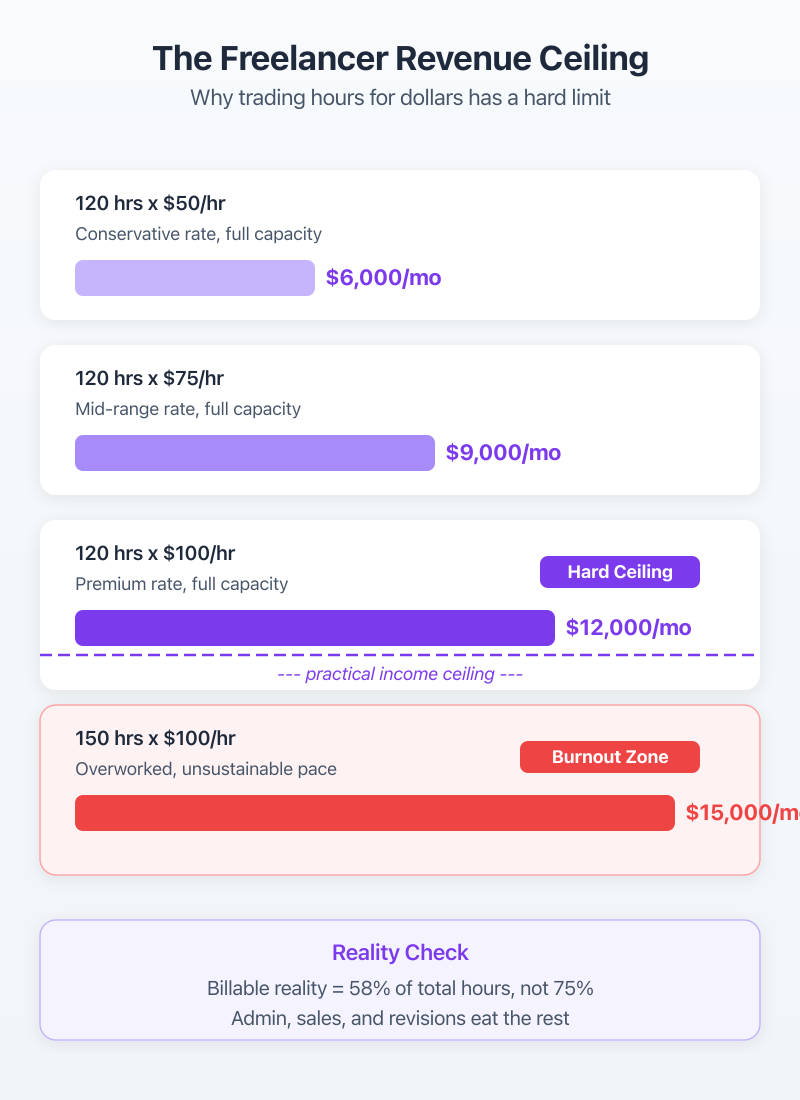
You’re billing $75-$100/hour as a solo WordPress freelancer, every slot is booked, and you’re still stuck at $8,000-$10,000/month. Worse, you’re turning down $3,000-$5,000 projects every week because there aren’t enough hours. The ceiling isn’t skill or demand. It’s you. One person, 120 billable hours per month max, and that number doesn’t grow no matter how hard you work.
Most freelancers stay stuck here for years. They try working 60-hour weeks, which pushes the ceiling to maybe $12K before burnout hits. They raise rates, which helps until clients start shopping cheaper alternatives. The math is unforgiving: a solo freelancer tracking time in Toggl or FreshBooks will find their actual billable percentage sits around 58%, not the 75% they assumed. That gap is the difference between $9,000/month and $7,000/month.
This guide covers the actual transition sequence from solo WordPress freelancer to agency, including the revenue levels where things break, who to hire at each stage, and the pricing shifts that make it work.
Solo WordPress freelancers hit a hard revenue ceiling between $8,000 and $10,000 per month. The math is simple and unforgiving: there are 168 billable hours in a month (assuming you work zero weekends, take zero sick days, and somehow never spend time on admin, invoicing, or email). You won’t bill all 168. Nobody does.
Realistic billable hours for a solo freelancer? About 100-120 per month. The rest goes to client communication, project scoping, proposals, invoicing through FreshBooks or whatever you use, and the admin work that nobody talks about.
You Are the Bottleneck
At $75-$100/hour (which is solid freelancer pricing for WordPress work in 2026), 120 billable hours gets you $9,000-$12,000/month on a good month. But “good months” require everything to go right. No scope creep. No revision rounds that eat into the next project. No clients who take two weeks to send content and then want the site launched yesterday.
I tracked my actual billable percentage for three months in 2016. It was 58%. Not 75% like I’d been assuming. That meant I was billing roughly 97 hours per month out of 168 total working hours. And that 58% was with obsessive time tracking in Toggl.
The uncomfortable truth? You can’t outwork the ceiling. Working 60-hour weeks just burns you out faster and pushes the ceiling to maybe $12K before you crash. The bottleneck isn’t effort. It’s the fact that there’s only one of you.
The Math That Forces the Decision
Once you’re turning down $15,000-$20,000 in potential projects per month, the decision makes itself. Either you refer those projects out (and leave money on the table), or you find someone to help deliver them.
I did the math on a napkin at a coffee shop in Kushinagar. If I could bring on a developer at $800-$1,200/month and they could handle even 40% of my build work, I’d free up roughly 40 hours per month. At my rate, those 40 hours represented $3,000-$4,000 in additional capacity. Minus the $1,000 developer cost, I’d net $2,000-$3,000 more per month.
The math worked. But what I didn’t account for was everything that breaks the moment you add another person to the equation.
Stage 1: Solo with Subcontractors ($5K-$10K/mo)
The first stage isn’t really an “agency” at all. It’s you, doing what you’ve always done, with occasional help from subcontractors. This is where most freelancers start the transition, and it’s the safest way to test the model without committing to full-time hires.
I started with one subcontractor from Upwork in late 2016. A mid-level WordPress developer in the Philippines charging $18/hour. For simple builds, theme customizations, and plugin configurations, he was solid. For anything requiring custom PHP or complex WooCommerce work, I still had to do it myself.
Finding Reliable WordPress Subcontractors
Good WordPress subcontractors are hard to find and harder to keep. Platforms like Codeable, Upwork, and Fiverr are the obvious starting points, but the vetting process matters more than the platform.
My screening process (after getting burned twice on subpar work):
- Send a paid test project. Always paid. A real task worth $200-$400 that takes 8-15 hours. Never ask for free work.
- Review the code, not just the output. Clean code, proper WordPress standards, no shortcuts. If they’re enqueueing scripts directly in the header, that’s a red flag.
- Check communication speed. A 24-hour response time is fine. A 72-hour response time means they’re juggling too many clients.
Subcontractor rates in 2026 range from $15-$35/hour for developers in India, the Philippines, and Eastern Europe. US-based subcontractors run $50-$100/hour, which only makes sense for specialized work like WooCommerce development or performance optimization.
What to Outsource First (and What to Keep)
Outsource implementation. Keep strategy and client relationships.
That sounds obvious, but I got it wrong at first. I tried outsourcing client communication to save time, and within two weeks, a client complained that they felt “handed off.” They’d hired me specifically because they trusted my judgment on their WordPress rebuild. Hearing from someone else felt like a bait-and-switch.
What to outsource first:
- Theme setup and customization (page builds, responsive adjustments)
- Plugin installation and configuration
- Content migration (the most tedious, lowest-skill work)
- Basic maintenance tasks (updates, backups, uptime monitoring)
What to keep:
- Client calls and strategy sessions
- Custom development (PHP, JavaScript, API integrations)
- Website pricing and proposal writing
- Quality assurance and final review before launch
Pay your subcontractors on time, every time. I pay within 48 hours of milestone completion. Reliable payment is the single biggest factor in retaining good subcontractors. The ones worth keeping have options, and they’ll prioritize clients who pay fast.
Stage 2: First Hires and Real Overhead ($10K-$20K/mo)
The jump from subcontractors to full-time hires is where most freelancer-to-agency transitions either take off or fall apart. You’re adding fixed overhead for the first time. That monthly expense shows up whether you have projects or not.
I made my first full-time hire in mid-2017. A junior WordPress developer in Kushinagar at $800/month. Looking back, that single hire changed the entire trajectory of Gatilab. But for the first three months, it felt like I was losing money.
Developer vs Project Manager: Who to Hire First
Hire a developer first. Always. I’ve seen freelancers hire a project manager as their first employee because they’re drowning in admin work. That’s backwards. A PM doesn’t generate revenue. A developer does.
Your first hire should be a junior-to-mid WordPress developer who can handle 60-70% of your implementation work. Not a senior developer (too expensive for this stage), not a designer (you can outsource that cheaper), and not a sales person (you ARE the sales person right now).
For Gatilab, the first developer hire freed me up to focus on what actually grew the business: client acquisition, higher-value projects, and building relationships that would eventually lead to enterprise clients.
Monthly cost for a first developer hire in 2026:
Location Junior Dev Mid-Level Dev Senior Dev India $600-$1,000 $1,200-$2,500 $3,000-$5,000 Philippines $500-$900 $1,000-$2,000 $2,500-$4,000 Eastern Europe $1,200-$2,000 $2,500-$4,000 $4,500-$7,000 United States $3,500-$5,000 $5,500-$8,000 $8,000-$12,000
The Painful Profit Margin Dip
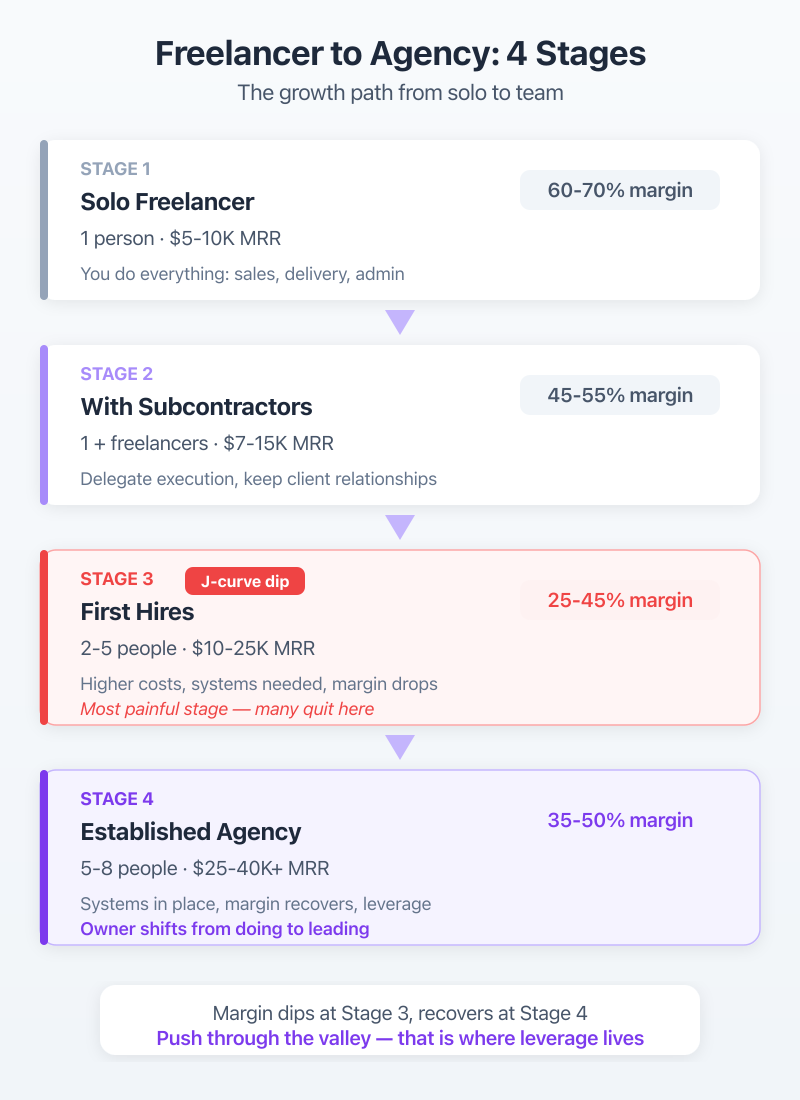
Nobody warns you about the margin dip. As a solo freelancer, my profit margin was around 65-70% (revenue minus tools, hosting, and minor expenses). The month I hired my first developer, that margin dropped to about 35%.
And it felt terrible. Honestly, there were nights I questioned whether I’d made the right call. Revenue was growing, but take-home pay actually decreased for about four months.
This is the J-curve that every freelancer-to-agency transition goes through:
Stage Monthly Revenue Team Size Profit Margin Biggest Challenge Solo Freelancer $5K-$10K 1 60-70% Time ceiling First Hire $10K-$15K 2-3 25-35% Margin compression Early Agency $15K-$25K 3-5 30-40% Process gaps Established Agency $25K-$40K 5-8 35-45% Leadership, not delivery
The margin recovers. But only if you raise your prices (more on that below) and increase the volume of projects your team can handle. If you keep freelancer pricing and just add headcount… you’ll run the agency into the ground. I’ve watched three WordPress freelancers do exactly that.
Stage 3: Systems Over Talent ($20K-$40K/mo)
At $20K+ per month, individual talent stops being your growth lever. Systems become the thing that determines whether you scale or stall. I learned this the hard way when my second developer quit in 2018 and took all the undocumented processes with him.
The difference between a $15K/month operation and a $30K/month agency isn’t better people. It’s better systems. When a new developer can pick up a project on day one because the onboarding docs, code standards, and deployment checklists already exist… that’s when you’ve built something that doesn’t depend entirely on you.
SOPs That Actually Get Used
I’ve written SOPs that nobody read. Long Google Docs with 40 steps and screenshots that went stale within a month. They were useless. Not because documentation is bad, but because I wrote them wrong.
SOPs that work follow three rules:
- Short. Under 15 steps for any single process. If it’s longer, break it into multiple SOPs.
- Video-first. I record a Loom video of the process, then write bullet points underneath. The video is the primary reference. The text is backup.
- Living. Every SOP has a “last updated” date. If it’s older than 90 days, someone reviews it. ClickUp handles this with recurring tasks.
At Gatilab, we have SOPs for: WordPress site setup (theme installation, plugin stack, security configuration), client onboarding, QA and launch checklist, monthly maintenance reporting, and invoice generation through FreshBooks.
That’s 12 core SOPs. Not 100. Twelve. Each one under 15 steps.
Client Onboarding That Doesn’t Need You
The test of a good system? It runs without the founder. Client onboarding was the first process I removed myself from completely, and it took three iterations to get right.
Version 1 (bad): I personally walked every new client through the kickoff call, collected assets, set up their staging site, and sent the project timeline. That took 4-6 hours per client.
Version 2 (better): I created a Google Form for asset collection, a templated kickoff agenda, and had my PM handle the call. Took 2 hours of my time.
Version 3 (current): Automated welcome email with asset collection form, staging site auto-provisioned, kickoff call run entirely by the PM using a standardized agenda. My involvement? Zero. I review the project brief after kickoff. That takes 15 minutes.
Getting to Version 3 took about eight months. And it only works because the PM was involved in creating the process, not just following instructions I wrote.
The Gatilab Story: From Kushinagar to Enterprise Clients
Most WordPress agency origin stories start in San Francisco or London. Mine started in Kushinagar, a town in eastern Uttar Pradesh, India, with a population under 25,000. No tech scene. No co-working spaces. No startup culture. Just me, a laptop, and a 10 Mbps internet connection that dropped twice a day.
I share this because the “where you start” question holds a lot of people back. I’ve had freelancers from Tier-2 and Tier-3 Indian cities ask me whether they can build an agency without moving to Bangalore or Delhi. The answer is yes. I’m living proof.
Starting in a Tier-3 Indian City
I started freelancing on Upwork in 2009. WordPress theme customizations, mostly. $10-$15/hour work. Over seven years, I built a reputation, raised my rates gradually, and developed deep expertise in WordPress development, content marketing, and SEO.
By 2016, I was earning $5,000-$7,000/month as a solo freelancer. Good money anywhere. Excellent money in Kushinagar. But the ceiling was real. I had more work than I could handle, and I was tracking every hour obsessively because I couldn’t afford to waste any of them.
The decision to build an agency wasn’t inspired by some entrepreneurial vision. It was practical. I had $15,000+ in monthly project requests and could only deliver $7,000 worth. The remaining $8,000 was walking out the door every month.
Landing IBM, Adobe, and HubSpot as Clients
Enterprise clients didn’t happen overnight. It was a six-year progression.
Year 1-2 (2009-2011): Small business WordPress sites from Upwork. $500-$2,000 projects.
Year 3-5 (2012-2015): Mid-market clients through referrals. $3,000-$8,000 projects. Content marketing and WordPress development.
Year 6-8 (2016-2018): Gatilab officially formed. First hires. Projects hit $10,000-$25,000. Started working with recognizable brands through content partnerships.
Year 9+ (2019-present): Enterprise clients including IBM, Adobe, HubSpot, and Canva. Projects range from $15,000 to six figures. WordPress Core Contributor status. Over 2,000 published articles across client projects.
The inflection point wasn’t a single event. It was becoming a WordPress Core Contributor in combination with publishing consistently on gauravtiwari.org. When an IBM procurement team Googled my name, they found 10+ years of WordPress expertise documented publicly. That’s what closed the deal, not a fancy website or a sales deck.
What Changes at Every Revenue Milestone
Revenue milestones aren’t just numbers. They’re inflection points where the thing that got you here actively prevents you from getting there. I’ve hit each of these walls, and the pattern is consistent: what works at one stage becomes the bottleneck at the next.
$5K/mo: You Need Help
At $5,000/month, you’ve proven the freelance model works. Clients are coming in. You’re profitable. And you’re probably working 50+ hours a week.
This is the stage where you should bring on your first subcontractor. Not a full-time hire. A reliable freelancer you can send overflow work to. Budget $500-$1,500/month on subcontractor costs.
What breaks at $5K: Your personal capacity. You’ll start missing deadlines or turning down projects. Both are signals that you need help, not motivation.
$15K/mo: You Need Processes
At $15,000/month, you probably have 1-2 full-time team members and maybe a subcontractor. Revenue is growing, but so are the fires. Client communication falls through cracks. Projects run over scope because nobody documented the requirements properly. Your inbox has 47 unread messages, and you can’t remember which client needs what.
This is the process stage. You need a project management system (I use ClickUp after trying Asana, Basecamp, and Notion), standardized client onboarding, and a QA checklist that your team can follow without asking you questions.
What breaks at $15K: Communication and accountability. You can’t keep everything in your head anymore. And if a team member has to wait for you to unblock them on every decision, you’ve just recreated the freelancer bottleneck with higher expenses.
$30K/mo: You Need Leadership
$30,000/month means you have a real team. Five to eight people, likely. And the challenge shifts from “how do we do the work” to “how do we manage the people doing the work.”
I couldn’t make this jump until I hired a dedicated project manager. Before that, I was managing developers, handling client calls, reviewing code, writing proposals, AND trying to do strategic work that would grow the business. Something had to give, and it was usually the strategic work.
What breaks at $30K: Founder dependency. If you’re still the person who has to approve every design, review every deployment, and be on every client call… you don’t have an agency. You have an expensive freelance practice.
Pricing Shifts from Freelancer to Agency
Your freelance rates won’t work for an agency. Full stop. This is the single biggest financial mistake I see in the freelancer-to-agency transition, and I made it myself for almost a year.
Why Your Freelance Rates Won’t Work
As a freelancer charging $75/hour, most of that revenue is profit. Your expenses are minimal: hosting, a few SaaS tools, maybe a coworking space. Profit margin: 60-70%.
As an agency, that same $75/hour rate now has to cover: developer salaries, project management time, tool subscriptions (Google Workspace, ClickUp, Slack, staging environments), downtime between projects, training, and the 15-20% of every project that goes to non-billable overhead.
At $75/hour with a three-person team, your actual profit margin drops to 10-15%. That’s not a business. That’s a stressful way to earn less than you did as a freelancer.
Building in Team Overhead and Profit
Agency pricing requires a multiplier. The industry standard for WordPress agencies is 2.5-3x the cost of delivery.
If a project takes your developer 40 hours and the developer costs you $25/hour ($1,000), your minimum project price should be $2,500-$3,000. Not $1,000 plus a small markup. Not “my old freelance rate times the hours.” The 2.5-3x multiplier accounts for overhead, non-billable time, management, and profit.
Metric Solo Freelancer Early Agency Mature Agency Hourly Rate (Effective) $75-$100 $100-$150 $150-$250 Project Minimum $1,500 $5,000 $15,000 Profit Margin 60-70% 25-35% 35-45% Revenue Per Team Member $8K-$10K $4K-$6K $6K-$8K Pricing Model Hourly/project Project-based Value-based/retainer
The shift from hourly to value-based pricing was the biggest revenue unlock for Gatilab. When we stopped quoting hours and started quoting outcomes (“We’ll build your WordPress site that converts at 3%+ and loads under 2 seconds”), projects jumped from $5,000-$8,000 to $15,000-$25,000. Same work, roughly. Different framing.
Look, I know value-based pricing gets thrown around like a buzzword. But the math is real. A WooCommerce site that generates $50,000/month in revenue? The client doesn’t care if the build takes 40 hours or 400 hours. They care that it works. And they’ll pay $25,000 for a site that makes them $50,000/month without blinking.
Tools That Scale with Your Agency
The tools you use as a freelancer won’t work at agency scale. But you also don’t need to overhaul everything on day one. Tools should upgrade as your team and revenue grow, not before.
Project Management: ClickUp vs Linear vs Notion
I’ve used all three. At different stages, each one made sense.
Solo freelancer to 2 people: Notion worked fine. Simple databases for projects, a kanban board for tasks, and docs for everything else. Free for personal use, $10/month per member for teams.
3-5 people: ClickUp became necessary. Notion is great for documentation but terrible for task management at scale. ClickUp handles time tracking, workload views, automations, and client-facing dashboards. We switched at the 4-person stage and haven’t looked back. $7/month per member.
5+ people with developers: Linear is worth considering if your team is developer-heavy. It’s fast, opinionated, and built for sprint-based workflows. But it’s less flexible than ClickUp for mixed teams (developers + designers + PMs).
Communication and Client Portals
Internal communication: Slack. Period. I tried Discord (too casual), Microsoft Teams (too slow), and email threads (too chaotic). Slack with organized channels per client project keeps everything searchable and separate.
Client communication: Don’t put clients in Slack. Use email for async updates and ClickUp’s client-facing views for project progress. Clients want to see progress, not participate in your internal conversations.
Category Solo Freelancer Early Agency (3-5) Mature Agency (5+) Project Management Notion / Trello ClickUp ClickUp / Linear Invoicing PayPal / Stripe FreshBooks FreshBooks + custom Communication Email + WhatsApp Slack + Email Slack + ClickUp portals Time Tracking Toggl ClickUp built-in ClickUp + Harvest Documentation Google Docs Notion Notion + Loom Version Control FTP (don’t) Git + GitHub Git + GitHub + CI/CD
Don’t adopt tools before you need them. Every new tool adds cognitive overhead and onboarding time. If Trello is working for your two-person team, keep using Trello. Switch to ClickUp when Trello’s limitations actually slow you down, not when some blog post tells you to upgrade.
Common Mistakes in the Freelancer-to-Agency Transition
I’ve made most of these. Some of them cost me months of progress and tens of thousands in lost revenue. If this section saves you from even one of them, the article was worth your time.
Hiring Too Fast
The most expensive mistake in the freelancer-to-agency transition is hiring before you have consistent revenue to support it. I’ve seen WordPress freelancers go from solo to four employees in 60 days, then lay off two of them within six months because the project pipeline couldn’t sustain four salaries.
My rule: don’t hire full-time until you’ve had three consecutive months of revenue that can cover the salary with at least 20% buffer. If you’re making $15,000/month and want to hire a $2,000/month developer, make sure you’ve been hitting $15K consistently, not just once.
The hiring sequence that worked for Gatilab:
Hire Order Role Monthly Cost (India) Monthly Cost (US) Revenue Impact 1st Junior WordPress Developer $800-$1,200 $3,500-$5,000 Frees 40+ hours/mo of your build time 2nd Mid-Level Developer $1,500-$2,500 $5,500-$8,000 Doubles project capacity 3rd Project Manager $1,000-$2,000 $4,000-$6,000 Removes you from daily delivery
Notice: the PM comes third, not first. You need revenue-generating capacity before you need management capacity. A PM with nobody to manage is an expensive mistake.
Keeping Freelancer Habits at Agency Scale
This one’s subtle and it takes longer to recognize. Freelancer habits that served you well for years become liabilities at agency scale.
The “I’ll just do it myself” habit. When a developer submits subpar code and you rewrite it yourself instead of training them, you’ve saved 30 minutes today and guaranteed you’ll need to save 30 minutes tomorrow, and the day after, and every day until you stop and teach.
The “clients have my personal number” habit. Works when you have five clients. Breaks at fifteen. Set communication boundaries early. Clients email the team inbox or message through the project management system. Not your WhatsApp at 11pm.
The “I don’t need a contract” habit. As a freelancer, handshake deals with small clients rarely caused problems. As an agency, a $20,000 project without a signed contract is a financial risk you can’t afford. I lost $8,500 once on a project where the client changed direction mid-build with no change order process in place. Never again.
The “I’ll handle finances later” habit. Separating personal and business finances is something most freelancers put off. But when you have payroll, subcontractor payments, tool subscriptions, and client retainers flowing in and out, a single bank account becomes chaos. Set up FreshBooks or equivalent accounting from day one of the agency transition.
OK, so what should you actually do? If you’re reading this and you’re a freelancer hitting that $8-10K ceiling, here’s the honest playbook. Don’t quit freelancing tomorrow and declare yourself an agency. Start with one subcontractor. Test whether you can manage someone else’s work while maintaining quality. Track whether the additional capacity actually converts to additional revenue.
If the subcontractor model works for 3-4 months, consider your first hire. Run the numbers on a junior developer. Make sure your pipeline can sustain the overhead for at least six months. And raise your prices before you hire, not after.
The transition from WordPress freelancer to agency took me about three years to get right. From solo in Kushinagar to a team serving IBM and Adobe. It wasn’t glamorous. It wasn’t fast. But looking back at the $9,200/month ceiling I hit in 2017… the math speaks for itself.
You don’t need to be in Silicon Valley. You don’t need venture capital. You don’t need a fancy office. You need consistent revenue, documented processes, and the willingness to let go of the freelancer identity that got you here.
The freelancer ceiling is real. But so is the other side of it.
Frequently Asked Questions
When should a freelancer start an agency?
When you’re consistently turning down projects due to capacity, not skill. If you’ve hit $8-10K/mo for 3+ consecutive months and your close rate exceeds 60%, the market is telling you there’s demand beyond your personal capacity. Don’t start an agency because you want to. Start one because the math demands it.
How much does it cost to start a WordPress agency?
Starting costs range from $2,000-$5,000/mo for your first subcontractor or employee, project management tools ($50-$200/mo), and upgraded hosting for client sites. You don’t need an office. I ran Gatilab from Kushinagar for years with zero physical overhead beyond internet and electricity.
Who should be your first agency hire?
A junior-to-mid WordPress developer who can handle 60-70% of your implementation work. Not a project manager, not a sales person. You need to free up your build time so you can focus on sales and client relationships. The PM comes as hire number three.
How do you find clients for a WordPress agency?
Referrals from existing freelance clients convert best (40-60% close rate in my experience). Then Codeable for vetted leads, LinkedIn for enterprise prospects, and agency partnerships for white-label work. Cold outreach has the lowest ROI for WordPress agencies. Build your reputation through published content and let inbound do the work.
What profit margin should a WordPress agency target?
Healthy WordPress agencies operate at 30-45% net profit margins. During the transition, expect a dip to 15-25% as overhead increases before revenue catches up. If you’re below 20% for more than 6 months, your pricing needs to increase. The 2.5-3x cost multiplier is your target for project pricing.
How do you manage subcontractors for WordPress projects?
Clear scope documents, milestone-based payments (not hourly), code review before client delivery, and NDAs. Use ClickUp or Linear for task tracking. Pay reliably and quickly. Good subcontractors are your most valuable asset at the early stages of agency growth.
Can you build a WordPress agency from India?
Yes. I built Gatilab from Kushinagar, a Tier-3 city in Uttar Pradesh, India, serving IBM, Adobe, HubSpot, and Canva. The key is positioning on expertise and results, not competing on price. Platforms like Codeable and consistent content publishing on your own site are what open enterprise doors.
How long does the freelancer-to-agency transition take?
Expect 2-3 years to go from solo freelancer to a functional agency with 5+ team members and $25K+/mo revenue. The transition from first subcontractor to first hire takes 6-12 months. The jump from 3 people to 5+ takes another year. Rushing this process is the number one reason agency transitions fail.