
Freemium Economics: When Free Users Convert to Paid Customers
The Economics of Freemium: When Free Users Actually Pay
Most companies get freemium wrong because they think of free users as future customers. They’re not. Most of them will never pay you a dollar.
I’ve watched this play out from multiple angles. As a WordPress plugin developer with products on the .org repository, I’ve lived the freemium math. As a consultant who has worked with 800+ clients building digital businesses, I’ve seen freemium succeed brilliantly and fail expensively. And as a user, I’ve been that person who stayed on the free plan for three years before upgrading.
The question isn’t “how many free users will convert?” It’s “can you afford the 97% who won’t?” That’s the question this article answers, with actual math, from both sides of the transaction.
“`
What Freemium Actually Is (And What It Isn’t)
Freemium isn’t “giving stuff away for free.” It’s a customer acquisition strategy where the product itself does the selling.
The model works like this: offer a genuinely useful free version of your product. Some percentage of free users hit a limit, need an advanced feature, or grow enough that upgrading makes financial sense. They convert to paying customers. The free version replaces marketing spend. Instead of paying $50-200 to acquire a customer through ads, your free product acquires them at near-zero marginal cost.
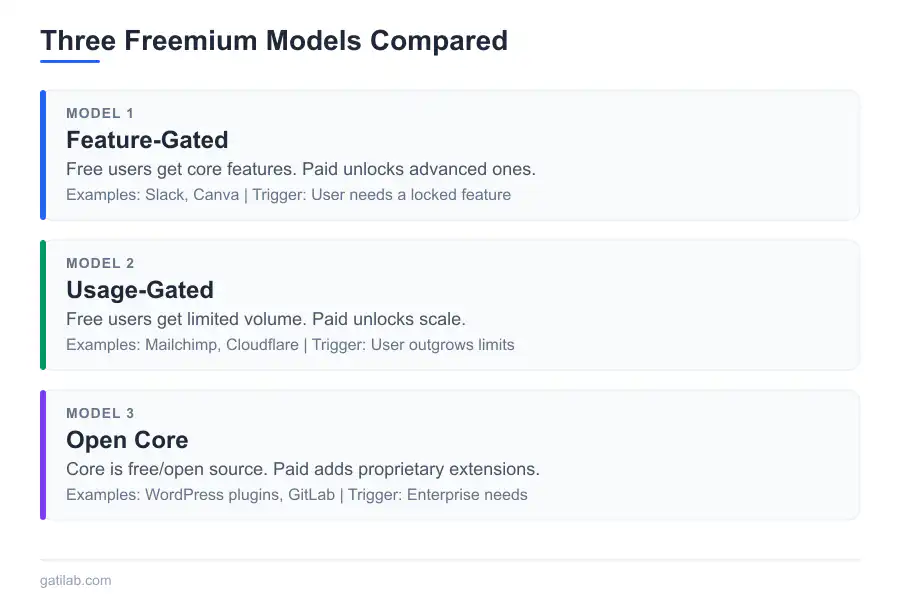
Three variants exist, and they’re not interchangeable:
| Model | How It Works | Example | Conversion Trigger |
|---|---|---|---|
| Feature-gated | Free users get core features. Paid unlocks advanced ones. | Slack (message history limit), Canva (premium templates) | User needs a feature behind the gate |
| Usage-gated | Free users get limited volume. Paid unlocks scale. | Mailchimp (500 contacts free), Cloudflare (bandwidth tiers) | User grows past the free threshold |
| Open Core | Core product is free and open source. Paid adds proprietary extensions. | WordPress plugins, GitLab, Elastic | User needs enterprise features or support |
The WordPress plugin ecosystem runs almost entirely on the Open Core variant. Free plugin on WordPress.org for distribution. Pro version sold through your own site for revenue. I’ll break down the specific economics of this model later because it’s the one I know from the inside.
What freemium is NOT:
- A free trial. Trials expire. Freemium doesn’t. A user can stay on the free plan forever.
- A loss leader. Loss leaders lose money by design to sell something else. Freemium can be self-sustaining if the marginal cost per free user is low enough.
- A charity. The free version has a job: convert some users into paying customers and generate word-of-mouth distribution for the rest.
The Basic Math of Freemium
The entire model rests on one equation. If the revenue from your converting users exceeds the cost of serving all users (including the ones who never pay), the model works. If it doesn’t, you’re subsidizing free users with investor money or burning savings.
“`html
Revenue = Conversion Rate × Total Users × Price Per Paying User
Cost = Total Users × Cost Per User (free + paid)
The model is profitable when Revenue > Cost. Which means:
Conversion Rate > Cost Per User / Price Per Paying User
Worked Example: SaaS Product at $50/month
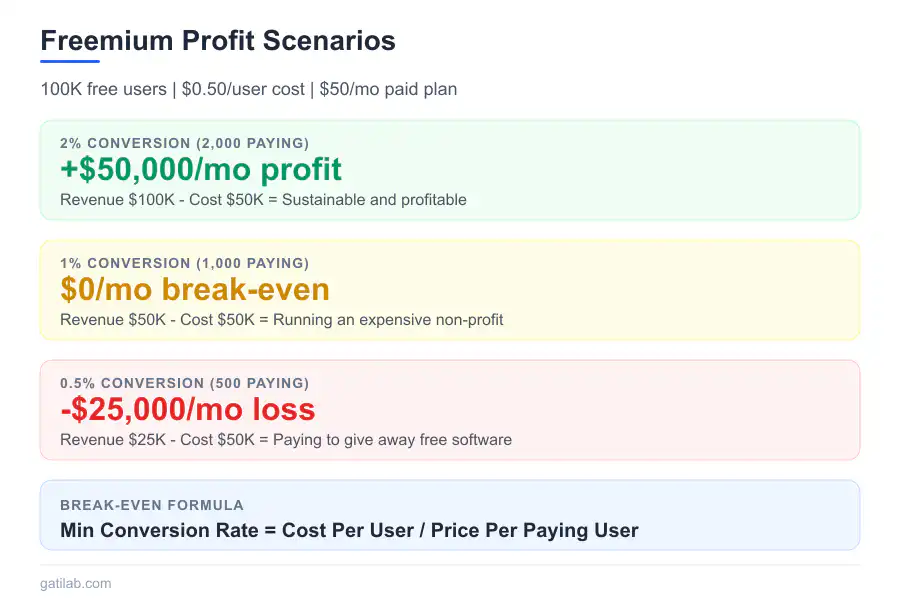
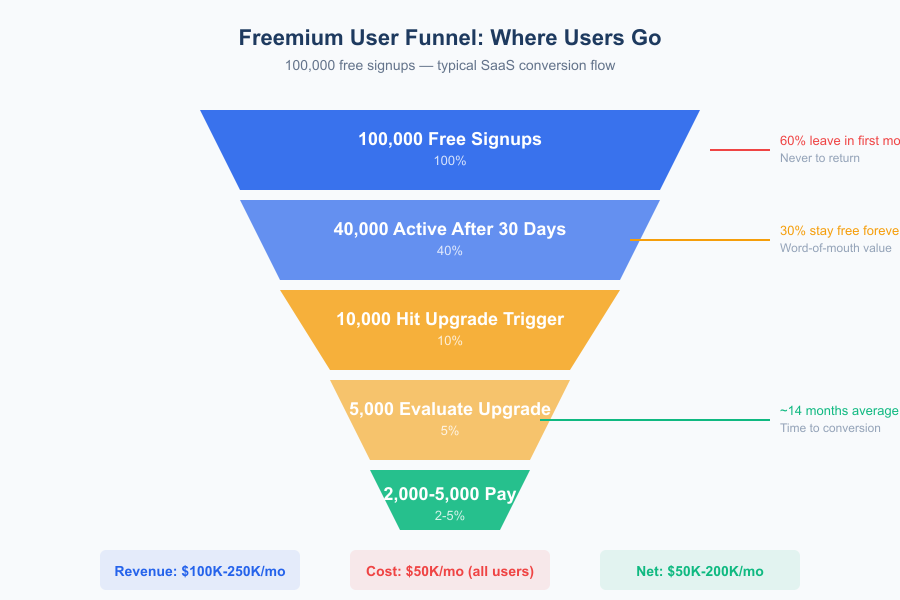
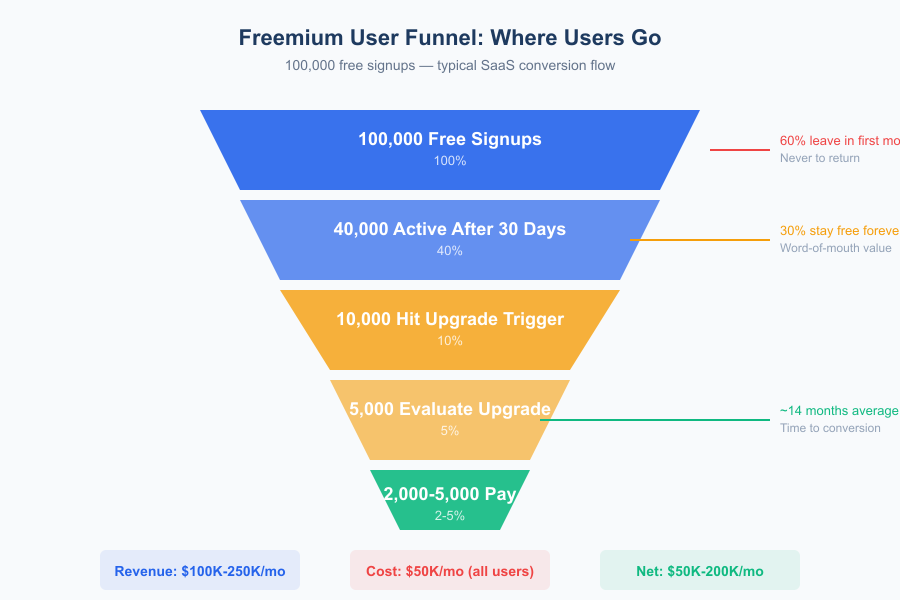
Let’s say you have 100,000 free users. Your infrastructure and support cost per user is $0.50/month (servers, email support, monitoring). Your paid plan is $50/month.
At 2% conversion (2,000 paying users):
- Monthly revenue: 2,000 × $50 = $100,000
- Monthly cost: 100,000 × $0.50 = $50,000
- Net: $50,000/month profit. The math works.
At 1% conversion (1,000 paying users):
- Monthly revenue: 1,000 × $50 = $50,000
- Monthly cost: 100,000 × $0.50 = $50,000
- Net: $0. Break-even. You’re running a very expensive non-profit.
At 0.5% conversion (500 paying users):
- Monthly revenue: 500 × $50 = $25,000
- Monthly cost: 100,000 × $0.50 = $50,000
- Net: -$25,000/month. You’re paying $25K/month for the privilege of giving away free software.
The break-even formula: Minimum conversion rate = cost per user / price per paying user. For this example: $0.50 / $50 = 1%. Anything below 1% loses money.
Why This Equation Changes Everything
That formula reveals two levers:
1. Reduce cost per free user. If you can serve free users at $0.10/month instead of $0.50, your break-even drops to 0.2%. This is why freemium works best for digital products with near-zero marginal cost. A SaaS tool hosted on shared infrastructure with minimal support? Cheap. A product requiring dedicated compute per user? Expensive.
2. Increase price per paying user. At $100/month instead of $50, your break-even drops to 0.5% at the same cost structure. This is why enterprise SaaS companies love freemium. Their paid tiers are expensive enough that even tiny conversion rates generate profit.
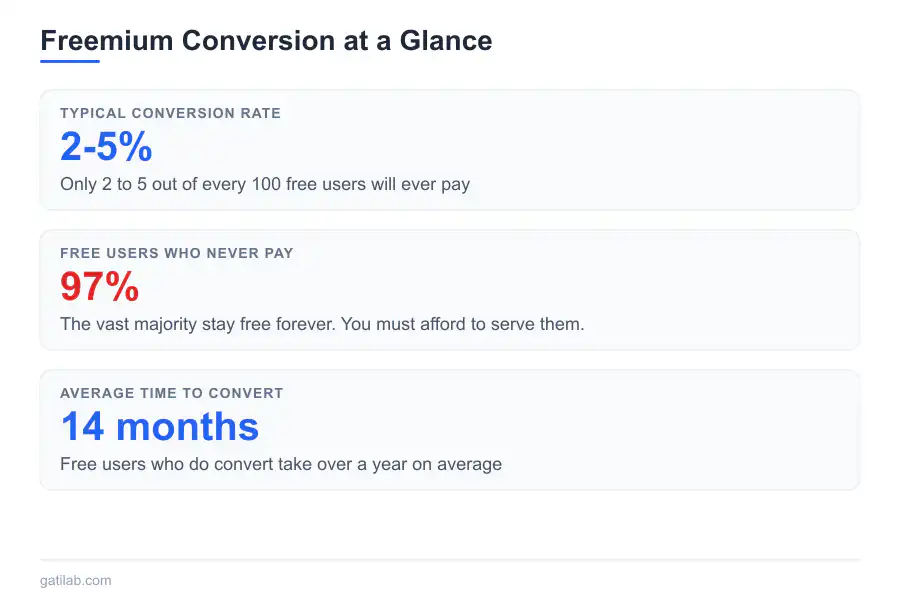
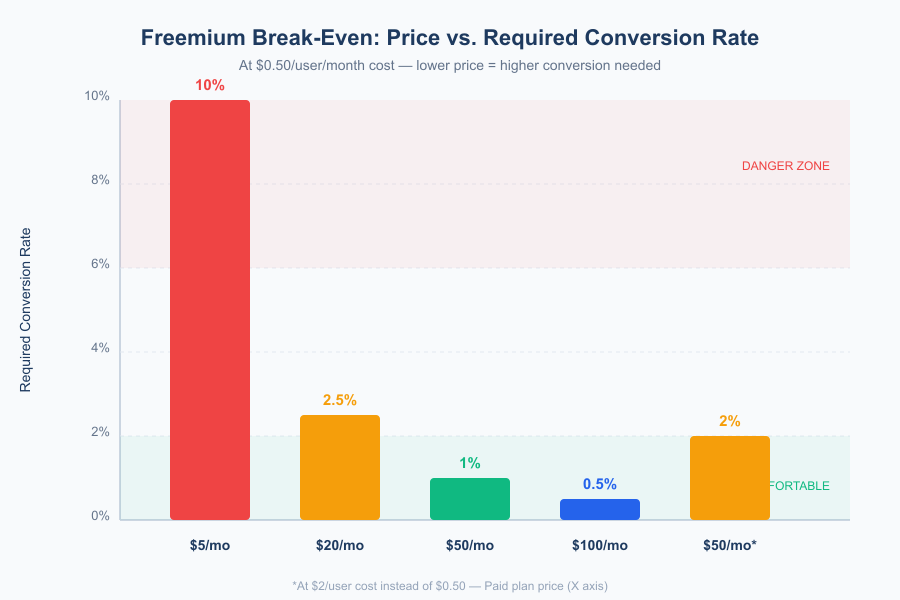
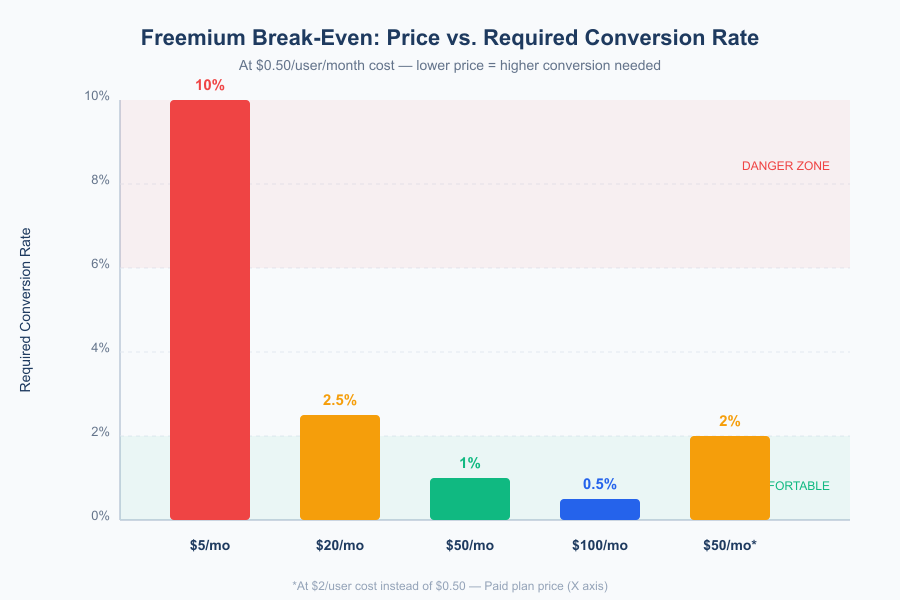
The math also explains why freemium fails for cheap products. If your paid plan is $5/month and your cost per user is $0.50, you need a 10% conversion rate to break even. Typical freemium converts at 2-5%. You’ll never make it work.
| Paid Price | Cost/User | Break-Even Conversion | Viable? |
|---|---|---|---|
| $5/mo | $0.50 | 10% | Almost impossible |
| $20/mo | $0.50 | 2.5% | Tight but doable |
| $50/mo | $0.50 | 1% | Comfortable |
| $100/mo | $0.50 | 0.5% | Easy |
| $50/mo | $2.00 | 4% | Difficult |
| $100/mo | $2.00 | 2% | Doable |
Look at that table. At $5/month, freemium is nearly impossible unless your marginal cost is essentially zero. At $100/month, you can afford to serve a lot of free users. This is why Slack and Notion can run freemium profitably while cheap SaaS tools struggle.
The Company Perspective
The Hidden Advantage: Retention
One thing that doesn’t show up in the conversion math but changes the long-term economics significantly: freemium-converted customers churn less.
When someone signs up for a paid product through an ad, they’re making a purchase decision based on marketing. When someone upgrades from a free plan after 6 months of use, they’re making a purchase decision based on experience. They’ve already integrated the product into their workflow. Switching cost is high. Satisfaction is real, not projected.
Industry data suggests freemium-converted customers have 20-30% lower annual churn than direct-purchase customers. Over a 5-year customer lifetime, that retention difference compounds dramatically.
Quick math: If direct-purchase customers have 5% monthly churn (60% annual churn, so ~40% retained after year 1), and freemium converts have 3.5% monthly churn (42% annual, ~58% retained after year 1):
- Direct-purchase: $50/month × 1 year average lifetime = $600 LTV
- Freemium convert: $50/month × 1.7 year average lifetime = $1,020 LTV
The freemium convert is worth 70% more over their lifetime. That’s not marginal. That changes the entire acquisition math.
The User Perspective
Most freemium analysis focuses on the company. But users have their own economic calculation, and understanding it explains why conversion rates are so low and why that’s OK.
Why Users Stay Free
It’s not because they’re cheap. It’s because the free version does what they need.
If Canva’s free plan handles 90% of a blogger’s design work, upgrading to remove watermarks from premium templates isn’t worth $13/month. The user isn’t a “failed conversion.” They’re a satisfied free user who occasionally recommends Canva to friends. That word-of-mouth has value even if it doesn’t show up as revenue.
The monetization strategies available to digital creators have expanded enough that most people have strong opinions about which subscriptions are worth keeping. Freemium products compete against every other $10-50/month subscription in the user’s stack.
When Users Upgrade
Conversion happens at specific trigger points, not gradually:
1. Growth triggers. Mailchimp’s free plan caps at 500 contacts. When a newsletter grows past 500, the user upgrades or leaves. This is predictable and measurable. 2. Feature triggers. Slack’s message history limit. When a team can’t search old messages, someone authorizes the credit card. The pain has to exceed the price. 3. Professional triggers. A freelancer using Canva Free lands a client who needs brand-kit consistency. Now Canva Pro is a business expense, not a personal one. The buying psychology shifts completely. 4. Competitive triggers. A user sees a competitor using premium features and realizes they’re at a disadvantage. Fear of missing out is real in business contexts.
The 14-Month Average
Conversion doesn’t happen in day 7 or month 1. Research across SaaS companies suggests the median time from free signup to paid conversion is roughly 14 months. That’s over a year of serving a user for free before seeing revenue.
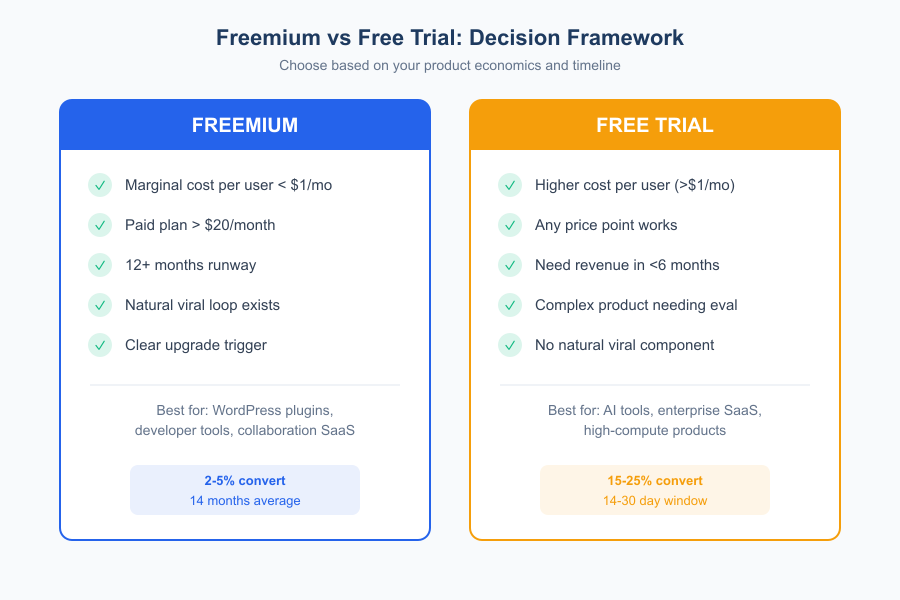
This has implications. If your runway is 12 months, freemium won’t save you. The revenue arrives after you’ve already run out of cash. Freemium is a long game. Companies that need revenue in 90 days should use free trials instead.
The WordPress Plugin Model: A Case Study
I know this model from the inside, so let me use real numbers.
The WordPress.org plugin repository is the largest freemium distribution channel in the CMS world. Over 60,000 plugins. Billions of downloads. And virtually every commercial WordPress plugin uses the same model: free version on .org, pro version sold through a personal site.
The Math for a WordPress Plugin
Say you build a WordPress plugin. You release the free version on .org. It gains traction and reaches 10,000 active installs over 18 months.
Revenue side:
- Typical conversion rate for WordPress plugins: 1-3%
- At 2% conversion: 200 paying customers
- At $49/year per license: $9,800/year
- At $99/year per license: $19,800/year
Cost side:
- Hosting: ~$50/month for a small SaaS backend or license server
- Support time: 5-10 hours/week (valued at your hourly rate)
- Development: ongoing, but this is the product investment regardless of model
- WordPress.org forum support: expected by the community, 2-3 hours/week
- Infrastructure: near-zero marginal cost per free user (they host the plugin themselves)
The critical insight for WordPress plugins: the user hosts the free version on their own server. Your marginal cost per free user is essentially zero. There’s no server bill that scales with free users. This is why freemium works so well in the WordPress ecosystem. The break-even conversion rate approaches zero because cost per free user approaches zero.
The cost is support time, not infrastructure. And that’s a human constraint, not a financial one. It’s why so many solo WordPress developers burn out despite profitable plugins. The math works. The workload doesn’t.
When Freemium Makes Sense
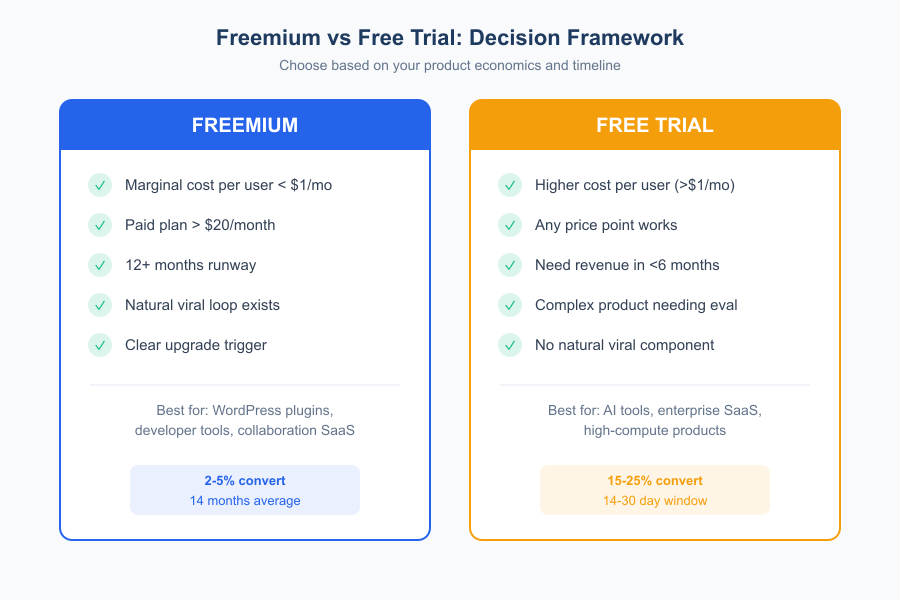
Not every product should be freemium. These conditions need to be true:
Freemium Viability Checklist
No checklist items added.
The three strongest signals:
1. Near-zero marginal cost. If adding a free user costs you nothing (or almost nothing), the break-even math is trivially easy. WordPress plugins, mobile apps, and developer tools all qualify. SaaS products with per-user compute costs (AI tools, video processing) usually don’t.
2. High paid tier price. The higher your paid price, the lower your conversion rate can be while still generating profit. Enterprise SaaS at $500/month can thrive at 0.5% conversion. A $5/month productivity app needs 10%+ to break even, which almost never happens.
3. Natural viral loop. If free users expose the product to potential paying users through normal usage, freemium becomes a growth engine. Slack does this: free teams invite more people, some of whom bring Slack to their own companies and buy paid plans. Without a viral component, freemium is just a cost center with a conversion funnel attached.
When Freemium Doesn’t Make Sense
| Situation | Why Freemium Fails | Better Alternative |
|---|---|---|
| High marginal cost per user | Every free user costs real money. At scale, the cost of non-converting users exceeds revenue. | Free trial (14-30 days) with automatic expiry |
| Low paid price point | At $5-10/month, you need 5-10% conversion to break even. That’s 2-5x typical rates. | Direct paid with money-back guarantee |
| Less than 12 months runway | Freemium revenue takes 12-18 months to materialize. You’ll run out of cash first. | Paid launch with limited-time discount |
| No natural upgrade trigger | If the free version does everything most users need, conversion stays below 1%. | Feature-limited trial or open-core with clearer gates |
| Complex product requiring sales | Products that need demos, onboarding calls, or enterprise procurement aren’t self-serve enough for freemium. | Sales-led with pilot programs |
The most common failure I’ve seen: a developer builds a $9/month tool with moderate infrastructure costs, launches a generous free plan to grow users, then wonders why revenue doesn’t cover hosting bills six months later. The math was never going to work. A free trial with a 14-day window would have served the same evaluation purpose without the ongoing cost burden.
The Freemium Trap: Vanity Metrics
100,000 free users is an exciting number. It looks great in investor presentations. It feels like growth.
But if your conversion rate is 1.5% and your paid plan is $30/month, your actual revenue is 1,500 × $30 = $45,000/month. You’re a $540K ARR business with the support burden and infrastructure costs of a company serving 100,000 users.
I’ve watched this play out with WordPress plugin developers who celebrate hitting 50,000 active installs on .org while making $3,000/month in pro license sales. The installs are a vanity metric. The $3K is the business. And the 50,000 free users are generating forum threads, compatibility issues, and feature requests that take 20+ hours per week to manage.
The discipline is to track the metrics that actually matter: conversion rate, revenue per user, support cost per user, and LTV of converted customers. Free user count is an input to those calculations, not a metric in itself.
What I’ve Learned From Both Sides
I’ve sat on both sides of this table. Building products with freemium models. Using freemium products for years before upgrading (or not upgrading).
The uncomfortable truth is that freemium works best for companies that don’t need it. If your product is good enough that people pay for it on day one, freemium accelerates growth. If your product isn’t good enough to charge for, freemium just delays the moment you discover nobody will pay.
The companies that win with freemium share three traits: the free version is genuinely useful (not a crippled demo), the upgrade path is obvious (you hit a wall that upgrading solves), and the company can afford to be patient (12-18 months before conversion revenue is meaningful).
For anyone reading the SaaS blogs I recommend, you’ll notice the successful freemium stories share these characteristics. The failures usually tried to use freemium as a substitute for product-market fit.
Freemium works best for companies that don’t need it. If your product is good enough that people pay on day one, freemium accelerates growth. If it isn’t, freemium just delays the discovery that nobody will pay.
How to Evaluate Freemium as a Strategy
Whether you’re building a product or choosing one as a user, ask these questions:
If you’re building: 1. What’s your cost per free user? If it’s above $1/month, freemium might not work at your price point. 2. What’s the natural upgrade trigger? If you can’t name it in one sentence, your free plan is probably too generous. 3. Can you survive 14 months before conversion revenue is meaningful? If not, use a free trial. 4. Does your product have a viral component? If free users don’t expose the product to potential paid users, you’re paying for distribution with no multiplier.
If you’re buying/using: 1. Is the free plan genuinely useful, or is it crippled to push you toward paying? Genuinely useful free plans signal a healthy business. Aggressively crippled ones signal desperation. 2. Has the company been around for 3+ years? Young freemium companies are the riskiest. If they haven’t figured out the conversion math, the free version might disappear. 3. Can you export your data? Free plans trap users when switching costs are high. Make sure you can leave.
The Bigger Picture
Freemium isn’t going anywhere. If anything, the AI transformation of SaaS products is making it more common. AI features are expensive to run (high marginal cost per user), which means companies are using freemium for the core product while gating AI features behind paid plans. It’s a new variation on the same economic model.
The fundamental economics haven’t changed. Low marginal cost + high paid price + natural upgrade triggers = freemium works. Change any of those variables and the math breaks.
The most important lesson from 16 years of watching these models play out: freemium is a distribution strategy, not a business model. The business model is the paid product. Freemium is how you get people to discover it. Companies that confuse the two end up with impressive user counts and empty bank accounts.
Numbers in this article are based on publicly available benchmarks and my own experience with WordPress products and SaaS advisory. Specific conversion rates and metrics vary by product, market, and audience. Run your own calculations before making business decisions based on these frameworks.
Frequently Asked Questions
What is the typical freemium conversion rate for SaaS products?
The typical freemium conversion rate across SaaS is 2-5%. Anything above 5% is considered strong performance. Below 2% usually means the free plan is too generous or the upgrade trigger isn’t compelling enough. Outliers like Spotify convert above 25%, but that’s driven by music licensing constraints rather than a replicable playbook.
How do you calculate if freemium is profitable for your product?
The break-even formula is: minimum conversion rate = cost per free user / price per paying user. If your cost per free user is $0.50/month and your paid plan is $50/month, you need at least 1% conversion to break even. Below that, you lose money on every free user you serve. Products priced under $20/month struggle to make freemium math work at typical conversion rates.
Is freemium better than a free trial for customer acquisition?
Freemium works when your marginal cost per user is near zero and you can afford to wait 12+ months for conversions. Free trials are better when per-user costs are significant or you need revenue quickly. If your product is priced under $20/month, a 14-day free trial is almost always the better choice because the freemium math won’t generate enough revenue to cover serving non-paying users.
How long does it take for free users to convert to paid?
The median time from free signup to paid conversion is roughly 14 months across SaaS products. Some convert in weeks when they hit a hard usage limit, but most take 6-18 months. This means freemium requires at least 12 months of runway before conversion revenue becomes meaningful. Companies expecting quick revenue should use different acquisition models.
Why does freemium work so well for WordPress plugins?
WordPress plugins have the best freemium unit economics because users host the plugin on their own server. Your marginal cost per free user is essentially zero since there’s no infrastructure bill that scales with free users. The WordPress.org repository provides free distribution to millions of users. The real constraint is support time, not hosting costs. A plugin with 10,000 active installs converting at 2% can generate $10K-20K/year with near-zero infrastructure costs.
What are the three types of freemium models?
Feature-gated freemium gives free users core features while locking advanced ones behind payment (like Slack’s message history limit). Usage-gated freemium gives free users limited volume with paid unlocking scale (like Mailchimp’s 500-contact free tier). Open Core makes the core product free and open source while selling proprietary extensions (like most WordPress plugins). Each triggers conversion differently and works best for different product types.
Can you switch from freemium to paid-only without losing customers?
Technically yes, but the backlash is typically severe. Users feel entitled to what was previously free, competitors highlight the change, and negative press follows quickly. The safest approach is to grandfather existing free users while only changing the offering for new signups. Removing a free plan from existing users is one of the fastest ways to destroy trust and generate negative publicity.
What is the biggest mistake companies make with freemium pricing?
Confusing user count with business health. Having 100,000 free users and 1,500 paying customers means you’re actually running a 1,500-customer business with the support costs of a 100,000-user platform. The second biggest mistake is making the free plan too generous so there’s no natural upgrade trigger. Track conversion rate, revenue per user, and cost per user instead of raw user count.