
Compound Growth in Business: The Numbers Behind Exponential Scale
“Just grow 10% monthly and you’ll 3x your revenue in a year.”
Sounds reasonable. Motivational speakers and business coaches love this math. It’s technically true. But it ignores almost everything that matters in running an actual business.
Real compound growth is harder, slower, and more constrained than the simple math suggests. I’ve experienced this firsthand across multiple businesses over 16 years. The spreadsheet says one thing. Reality says another. Understanding why changes how you plan, what you promise stakeholders, and what you can reasonably expect from yourself and your team. See also my thoughts on bootstrapping vs funding for context on growth strategies.
Here’s the actual math of compound growth, including the parts nobody mentions in their Twitter threads and course pitches.
The Basic Formula
Compound growth follows an exponential function:
Future Value = Present Value x (1 + growth rate)^periods
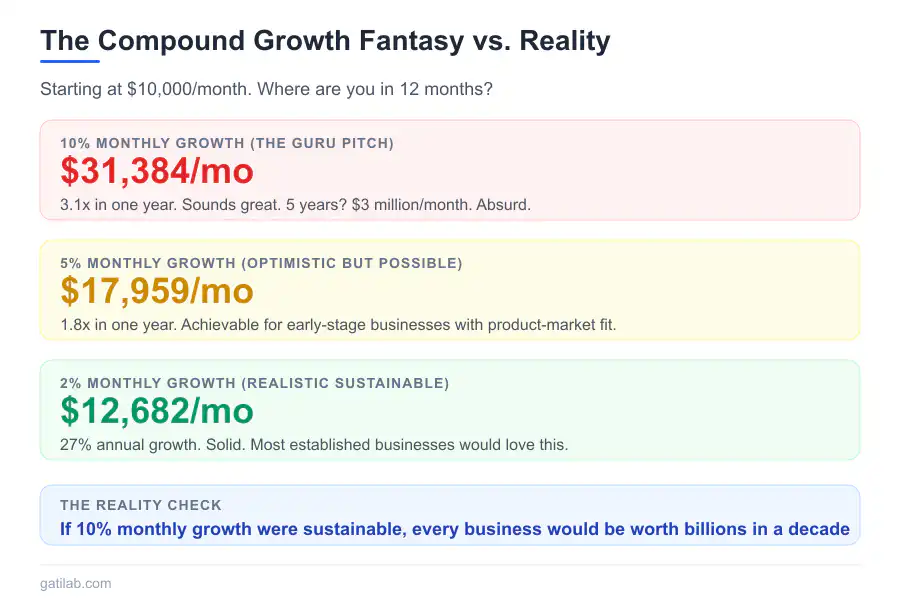
If you make $10,000 monthly and grow 10% monthly:
After 12 months: $10,000 x (1.10)^12 = $31,384
You’ve more than tripled revenue. The math is correct. Nobody’s lying about the formula.
The magic of compounding shows up in the absolute numbers. In month 1, 10% growth adds $1,000. In month 12, 10% growth adds $2,853. Same percentage, very different absolute dollars. That’s compounding. Growth builds on growth, and the curve gets steeper the further you go.
Over longer periods, this becomes dramatic:
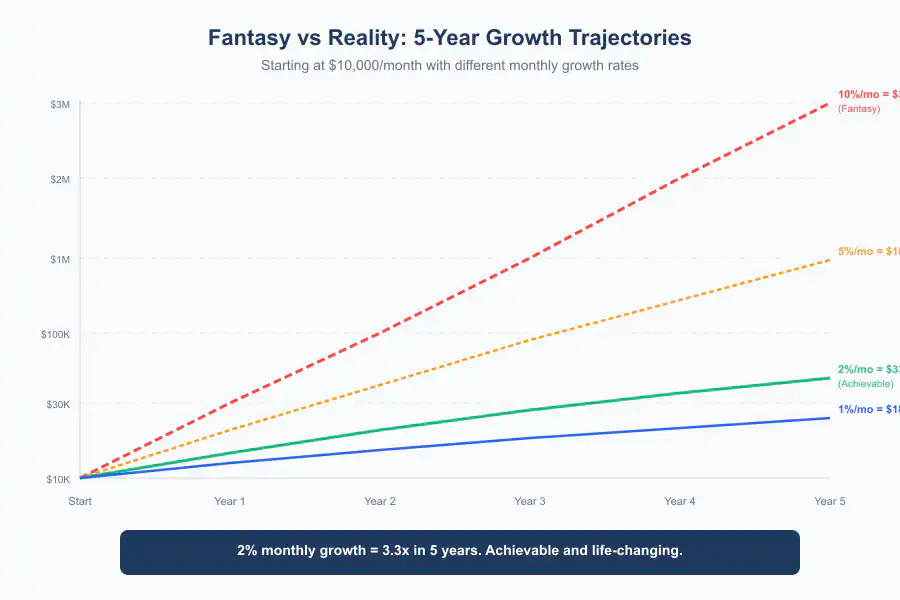
5 years of 10% monthly growth: $10,000 becomes $3,044,816
The numbers get absurd quickly. Which should be your first warning sign that something in this model doesn’t survive contact with reality.
Why the Simple Math Lies
If 10% monthly growth were achievable consistently, every business would be worth billions within a decade. They’re not. The math is technically correct but practically impossible for almost every business on the planet. Here’s why.
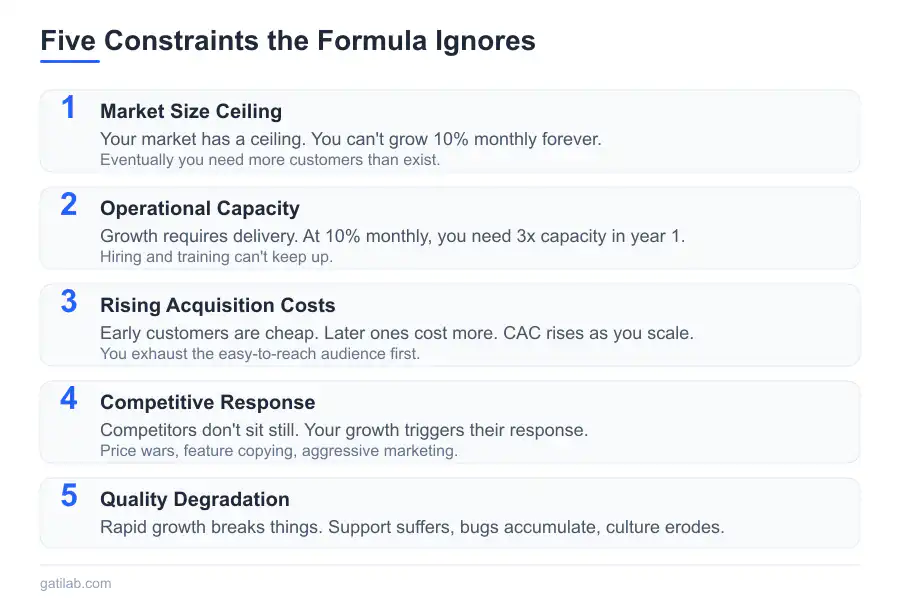
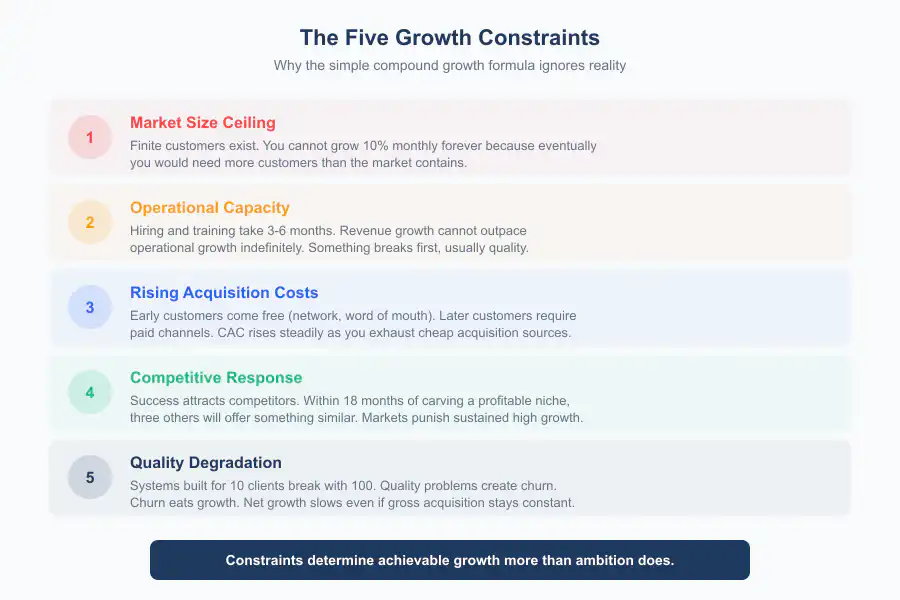
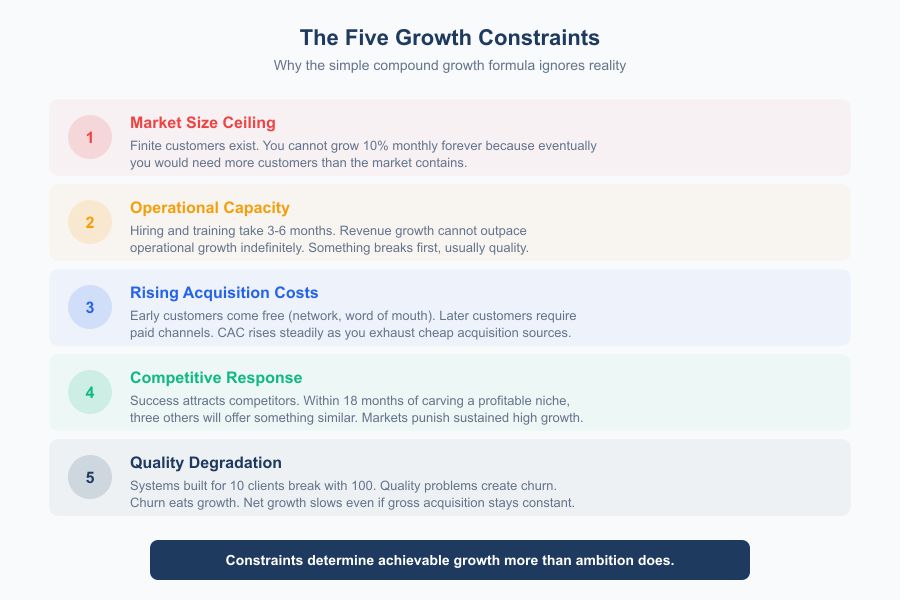
Every business faces five constraints that the simple compound growth formula ignores: market size ceilings, operational capacity limits, rising acquisition costs, competitive response, and quality degradation. Understanding these is the difference between realistic planning and fantasy math.
Constraint 1: Market size
Your market has a ceiling. If you sell WordPress development in Bangalore, there are only so many potential clients. You can’t grow 10% monthly forever because eventually you’d need more clients than exist. I’ve seen this with my own consulting practice. There’s a finite number of companies that need WordPress performance optimization at any given time, and no amount of growth hacking changes that.
The formula assumes unlimited demand. Reality doesn’t work that way. Every market has walls.
Constraint 2: Operational capacity
Growth requires delivery. If you’re a solo freelancer growing 10% monthly, by month 12 you need 3x your current capacity. By month 24, you need 9x. Where does that capacity come from?
Hiring takes time. Training takes time. Building systems takes time. I’ve hired people and watched the 3 to 6 month ramp-up period eat into profitability long before the new capacity started paying for itself. Revenue growth can’t outpace operational growth indefinitely. Something breaks first, usually quality.
Constraint 3: Acquisition costs
Early customers are cheapest. They come from your network, word of mouth, and organic channels. I remember when my first clients came from blog comments and WordPress forum posts. Zero acquisition cost.
Later customers cost more. You exhaust free channels and pay for advertising. Customer Acquisition Cost tends to rise as you scale. Your growth rate naturally slows as acquisition becomes more expensive. The first 100 customers cost almost nothing to acquire. The next 1,000 cost real money.
Constraint 4: Competition
Success attracts competitors. Your 10% growth might work until competitors notice and start competing for your customers. I’ve watched this happen in real time. You carve out a profitable niche, and within 18 months, three other people are offering something similar. Markets rarely tolerate consistent high growth without competitive response.
Constraint 5: Quality degradation
Fast growth strains quality. Systems built for 10 clients break with 100 clients. Service that was personal becomes impersonal. Products that were polished become rushed.
Quality problems create churn. Churn eats growth. Net growth slows even if gross acquisition stays constant. I’ve seen agencies double their client count and then spend the next year dealing with the quality problems that doubling created. Two steps forward, one step back.
What Realistic Growth Looks Like
Instead of fantasy numbers, here’s what sustainable growth typically looks like across different business stages. These are based on what I’ve observed across my own businesses and hundreds of client businesses over the years.
Early stage (year 1-2):
High growth rates are possible because you’re starting small. Growing from $5,000 to $10,000 monthly is a 100% increase, but it’s only $5,000 in absolute terms. Doubling is achievable when the base is small.
Realistic range: 50 to 100% annual growth. Monthly equivalent: 3 to 6%.
Growth stage (year 3-5):
You’ve found product-market fit. Systems exist. But you’re larger now. Absolute growth requires more resources. Percentage growth naturally slows even when absolute growth is increasing.
Realistic range: 25 to 50% annual growth. Monthly equivalent: 2 to 3%.
Maturity (year 5+):
Market share is established. You’re competing against other established players. Growth comes from market expansion, not just market capture.
Realistic range: 10 to 25% annual growth. Monthly equivalent: 1 to 2%.
The math with realistic rates:
$10,000/month at 2% monthly growth for 5 years: $10,000 x (1.02)^60 = $32,810/month
Still meaningful growth. You’ve tripled revenue over 5 years. That’s a genuinely successful business trajectory. But it’s not the $3 million fantasy of 10% monthly growth that gets clicks on social media.
The Churn Problem
Revenue growth isn’t what you add. It’s what you add minus what you lose. This is the part most growth projections conveniently ignore.
Net growth = New revenue – Churned revenue
If you add $2,000 in new monthly revenue but lose $1,500 from existing customers, net growth is only $500. Your sales team is celebrating adding $2,000. Your finance spreadsheet shows $500.
The churn compounding effect:
Churn compounds too, but negatively. This is the dark side of compounding that nobody puts on motivational slides.
5% monthly churn means losing half your customers annually: Customer retention after 12 months: (1 – 0.05)^12 = 54%
To grow 10% monthly with 5% churn, you need to add 15% gross new revenue monthly. That’s much harder than the simple growth target suggests. I’ve seen businesses work twice as hard as they should because they didn’t account for churn in their projections.
Healthy churn rates:
SaaS: 5 to 7% annual churn is healthy. 2 to 3% is excellent. Service businesses: 10 to 15% annual churn is normal. Freelancers: Higher project-based turnover is expected and built into the model.
Your growth plan must account for realistic churn, not assume 100% retention. Assuming zero churn is the business planning equivalent of assuming zero gravity. The math works, but it doesn’t describe the world you actually operate in.
The Unit Economics Reality
Compounding revenue means nothing if unit economics don’t work. I’ve seen businesses celebrate revenue milestones while hemorrhaging money on every customer they add.
Key metrics:
LTV (Lifetime Value): Total revenue from a customer over their lifetime. CAC (Customer Acquisition Cost): Cost to acquire that customer. LTV:CAC ratio: Should be at least 3:1 for a healthy business.
The scaling trap:
Early customers have high LTV (they stick around, they’re loyal, they refer friends) and low CAC (they came through free channels like your blog or your network).
Later customers have lower LTV (a larger base includes more marginal customers who aren’t as committed) and higher CAC (you’ve exhausted free channels and you’re paying for ads).
Your LTV:CAC ratio often deteriorates as you scale. Growth that looks profitable at $50K/month might be unprofitable at $200K/month. I’ve seen this trap catch smart people who were growing fast and assumed the economics would stay constant.
Running the real numbers:
Early stage: LTV: $5,000, CAC: $500, LTV:CAC: 10:1, Verdict: Scale aggressively.
Growth stage: LTV: $3,500 (more diverse customers), CAC: $1,200 (paid channels needed), LTV:CAC: 2.9:1, Verdict: Slow down, optimize.
The simple compound growth formula ignores this deterioration entirely. It assumes every new customer is as profitable as the first one. They’re not.
Time Value Adjustments
Money today is worth more than money tomorrow. Compound growth calculations often ignore this, and it matters more than most people realize.
Discount rate:
Future revenue should be discounted back to present value. A dollar next year is worth less than a dollar today because you could invest today’s dollar and earn a return.
Common discount rates: 10 to 20% for growing businesses.
Adjusted growth value:
$100,000 revenue in year 5 at 15% discount rate: Present Value: $100,000 / (1.15)^5 = $49,718
Your spectacular future growth is worth roughly half as much in today’s terms. That 5-year projection that looked incredible? Cut it in half for a more honest picture.
Why this matters:
If you’re sacrificing today’s profitability for tomorrow’s growth, make sure the discounted future value actually exceeds what you’re sacrificing. A lot of founders burn current profits to chase growth that, when properly discounted, doesn’t justify the sacrifice.
Growing revenue 3x while burning cash might look worse than growing revenue 2x while staying profitable, once you discount future values properly. I’ve made this calculation for my own businesses, and it changed how I think about growth versus profitability.
Realistic Growth Scenarios
Let me model some achievable scenarios that reflect how businesses actually grow.
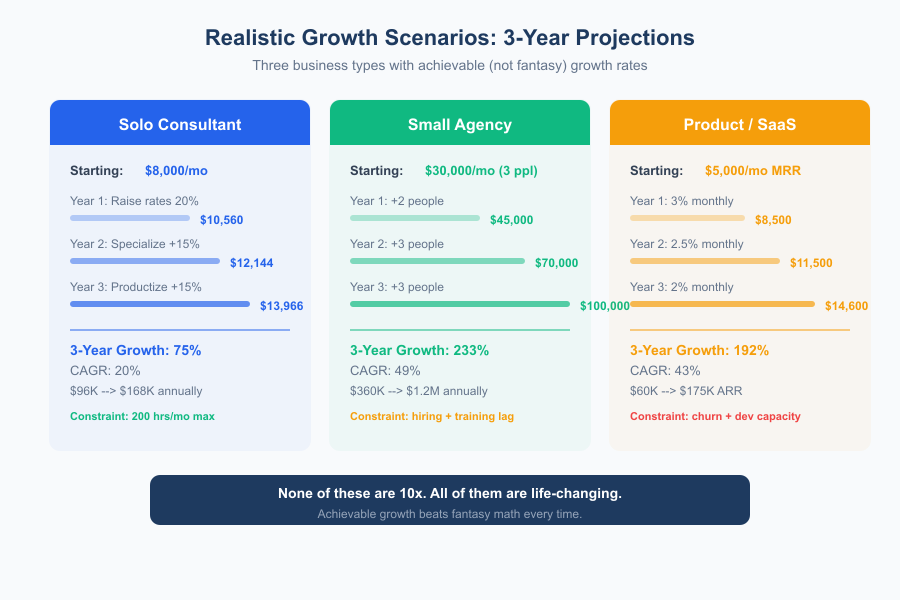
Scenario 1: Solo consultant
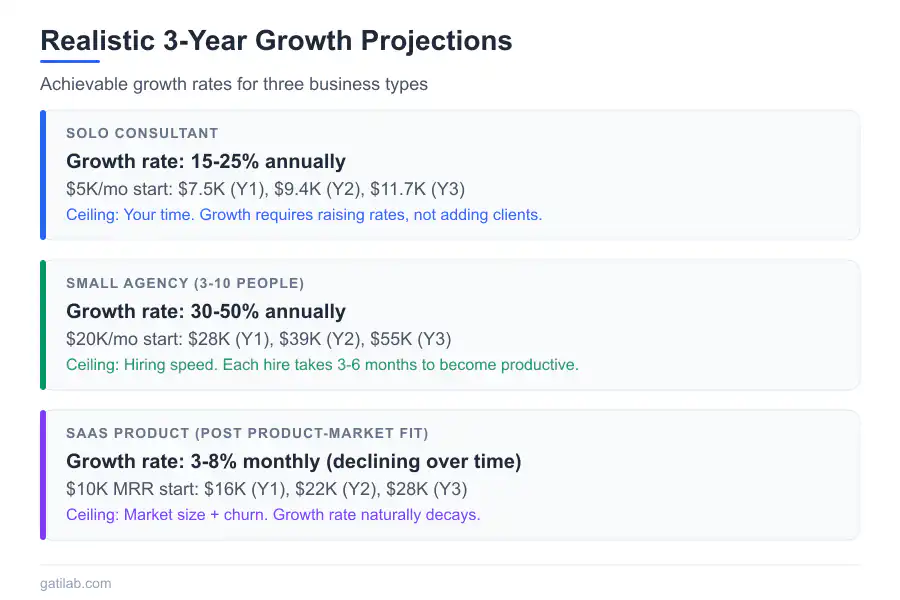
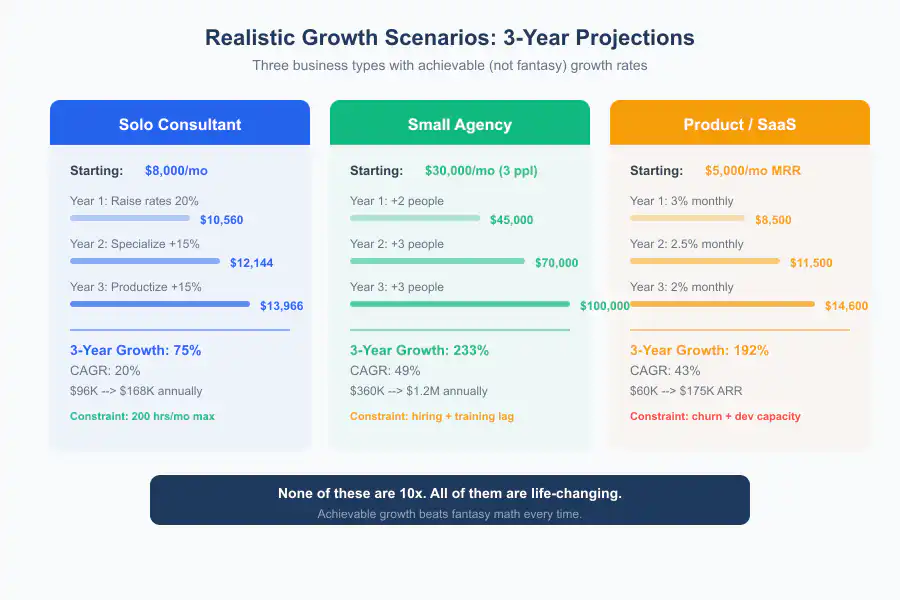
Starting: $8,000/month (see how to price your services). Goal: Maximize income without hiring. Constraint: Roughly 200 billable hours/month maximum.
Realistic growth path: Year 1: Raise rates 20%, add 10% more hours = $10,560/month. Year 2: Raise rates 15%, specialize = $12,144/month. Year 3: Raise rates 15%, productize some work = $13,966/month.
Total growth: 75% over 3 years. CAGR: 20%.
This is solid, meaningful growth. Not 10x. Not overnight. But sustainable and realistic and life-changing for most people. Going from $96K to $168K annually through rate increases and specialization is a genuine success story. It just doesn’t make for a viral tweet.
Scenario 2: Small agency
Starting: $30,000/month with 3 people (learn about transitioning to agency). Goal: Build sustainable agency. Constraint: Each hire adds capacity after 3 to 6 month ramp.
Realistic growth path: Year 1: Add 2 people, grow to $45,000/month. Year 2: Add 3 people, grow to $70,000/month. Year 3: Add 3 people, grow to $100,000/month.
Total growth: 233% over 3 years. CAGR: 49%.
Strong growth, but requiring significant hiring and operational development at every stage. Every percentage point of growth comes with management complexity that the math doesn’t show.
Scenario 3: Product business
Starting: $5,000/month recurring revenue. Goal: Build to acquisition-worthy scale. Constraint: Development capacity, market size.
Realistic growth path: Year 1: 3% monthly growth = $8,500/month by year end. Year 2: 2.5% monthly growth = $11,500/month by year end. Year 3: 2% monthly growth = $14,600/month by year end.
Total growth: 192% over 3 years. CAGR: 43%.
Respectable SaaS growth. Not unicorn territory. But potentially attractive for acquisition. A product doing $175K ARR with consistent growth and healthy margins gets attention from buyers.
The Growth Rate vs. Profit Tradeoff
Faster growth usually means lower profit margins. This is the tradeoff that nobody discusses on podcasts.
Growth costs real money:
- Marketing and sales investment
- Hiring ahead of revenue
- Systems and infrastructure
- Opportunity cost of founder time spent on growth instead of delivery
The efficiency frontier:
You can grow faster by spending more. But spending more reduces profitability. There’s a tradeoff, and finding your optimal point matters.
High growth, low profit: Reinvesting everything into growth. Moderate growth, moderate profit: Balanced approach. Low growth, high profit: Extracting value rather than building.
None is objectively wrong. It depends on your goals, stage, and market. I’ve operated at all three points at different times and in different businesses. The right choice changes based on circumstances.
The VC model:
Venture capital optimizes for growth over profit. They want 10x returns, which requires massive growth. Profitability comes later (or never, for the companies that fail).
This distorts public perception of “normal” growth. VC-backed companies grow abnormally because they’re burning investor money. Self-funded businesses can’t and shouldn’t try to match these rates. When a bootstrapped founder compares their growth to a company that just raised $50 million, that comparison is worse than useless. It’s demoralizing and misleading.
Planning for Realistic Growth
How to plan when you understand real compound growth.
Set growth targets by stage:
Early: Aggressive percentage growth is achievable and appropriate. Growth: Moderate percentage, significant absolute growth. Mature: Lower percentage, focus on profitability and sustainability.
Adjust targets as your business evolves. The growth rate that was healthy in year 1 might be irresponsible in year 5.
Model multiple scenarios:
Optimistic: Everything goes right. Realistic: Normal execution with normal obstacles. Pessimistic: Things go wrong, market shifts, competitors emerge.
Plan for realistic. Hope for optimistic. Prepare for pessimistic. I build all three into my planning, and I’ve never once been sorry for the pessimistic scenario planning when something unexpected hit.
Include constraints:
- Maximum operational capacity
- Available cash for growth investment
- Realistic customer acquisition costs
- Expected churn rates
- Market size ceiling
Constraints determine achievable growth more than ambition does. Wishing for 10x growth doesn’t remove the constraint that your market only has 5,000 potential customers.
Track leading indicators:
Revenue is a lagging indicator. By the time revenue slows, problems started months ago.
Track: Pipeline volume, conversion rates, churn signals, customer satisfaction scores, operational capacity utilization.
These predict future growth before it shows in revenue. When I see pipeline volume drop, I know revenue will follow 60 to 90 days later. That gives me time to adjust before the damage appears in the numbers.
The Honest Conversation
Most growth projections are fantasy. Business plans showing 10x growth in 3 years are either:
- Venture-funded with high failure tolerance
- Delusional
- Marketing material, not operational plans
I’ve reviewed hundreds of business plans over the years, and the ones that actually achieved their projections shared something in common: realistic numbers with boring timelines.
Compound growth is powerful. Real compound growth, with realistic rates over real time periods, can still transform your business and your life. You don’t need fantasy numbers. You need consistent execution over years. A decade of consistent 20% annual growth turns a $100K business into a $619K business. That’s life-changing. And it’s actually achievable.
Honest compound growth planning:
- Uses realistic growth rates for your stage
- Accounts for churn
- Includes operational constraints
- Adjusts for declining unit economics at scale
- Considers time value of money
- Plans for multiple scenarios
The numbers are less exciting. They don’t make great slide decks. But they’re achievable. And building something achievable beats dreaming about something impossible.
That’s the part nobody shows you. The math is simple. The execution takes a decade. But a decade of consistent 20% annual growth turns a $100K business into a $619K business. That’s real compound growth. That’s life-changing. And it’s actually achievable.
Compound Growth FAQ
Frequently Asked Questions
Why is 10% monthly growth unrealistic for most businesses?
Five constraints prevent sustained high growth: market size limits total potential customers, operational capacity cannot scale instantly, customer acquisition costs rise as you exhaust cheap channels, competition increases as you succeed, and quality degrades under rapid growth causing churn. 10% monthly means 3x annual growth, and most businesses would collapse operationally long before achieving this consistently. The formula is correct but ignores real-world friction.
What is a realistic growth rate for a small business?
Early stage (year 1-2): 50 to 100% annual or 3 to 6% monthly, since doubling is achievable when the base is small. Growth stage (year 3-5): 25 to 50% annual or 2 to 3% monthly. Mature stage (year 5+): 10 to 25% annual or 1 to 2% monthly. At 2% monthly growth over 5 years, $10,000 per month becomes roughly $33,000. That is life-changing growth without fantasy projections.
How does customer churn affect compound growth?
Net growth equals new revenue minus churned revenue. With 5% monthly churn, you lose about half your customers annually. To achieve 10% net monthly growth with 5% churn, you need to add 15% gross new revenue every month, which is dramatically harder than simple growth math suggests. Healthy churn rates are 5 to 7% annually for SaaS and 10 to 15% annually for service businesses. Your growth plan must account for realistic churn, not assume zero attrition.
What is the LTV to CAC ratio and why does it matter for growth?
LTV (Lifetime Value) divided by CAC (Customer Acquisition Cost) should be at least 3:1 for a healthy business. This ratio often deteriorates as you scale because early customers come through free channels with high loyalty while later customers require paid acquisition and include more marginal buyers. A business with 10:1 LTV:CAC early on might drop to under 3:1 at scale. Growth that looks profitable at $50K per month might be unprofitable at $200K per month.
Should I prioritize growth rate or profitability?
It depends on your funding and goals. VC-backed companies optimize for growth over profit because they need 10x returns. Self-funded businesses usually need balanced growth with profitability since there is no outside money to burn. Faster growth costs real money through marketing investment, hiring ahead of revenue, and systems infrastructure. Compare yourself to similarly funded businesses, not to companies that just raised $50 million.
How do you calculate the real present value of future growth?
Apply a discount rate of 10 to 20% for growing businesses to convert future revenue to present value. The formula is Present Value equals Future Value divided by (1 plus discount rate) raised to the number of years. For example, $100,000 in revenue five years from now at a 15% discount rate is worth roughly $49,700 today. If you are sacrificing current profitability for future growth, make sure the discounted future value actually exceeds what you are giving up.
What are the five constraints that limit business growth?
Market size sets a ceiling on total potential customers. Operational capacity limits how fast you can deliver because hiring and training take months. Acquisition costs rise as you exhaust free channels and move to paid advertising. Competition responds when you succeed, fighting for the same customers. Quality degradation under rapid growth creates churn that eats into net growth. These five constraints together explain why sustained 10% monthly growth is a fantasy for nearly every business.
How should I plan for realistic compound growth?
Set growth targets by business stage rather than using one fixed rate. Model three scenarios: optimistic, realistic, and pessimistic. Include constraints like maximum operational capacity, available cash for investment, realistic acquisition costs, expected churn, and market size ceiling. Track leading indicators such as pipeline volume, conversion rates, and churn signals rather than relying on lagging revenue metrics. A decade of consistent 20% annual growth turns a $100K business into $619K. That is achievable and life-changing.