
Business Pivots: When to Pivot, How to Execute, and What to Avoid
Every business plan meets reality, and reality often wins. The market you expected doesn’t materialize. The product that seemed brilliant solves the wrong problem. The business model that should work… doesn’t. When this happens, you face a choice: persist with what isn’t working, or pivot to something that might.
I’ve pivoted three times in my career. Once from pure freelancing to productized services. Once from a product idea that went nowhere to the content business that eventually became my primary revenue stream. And once from a service offering that clients didn’t value to one they couldn’t live without. Each pivot felt terrifying. Each one turned out to be the right call.
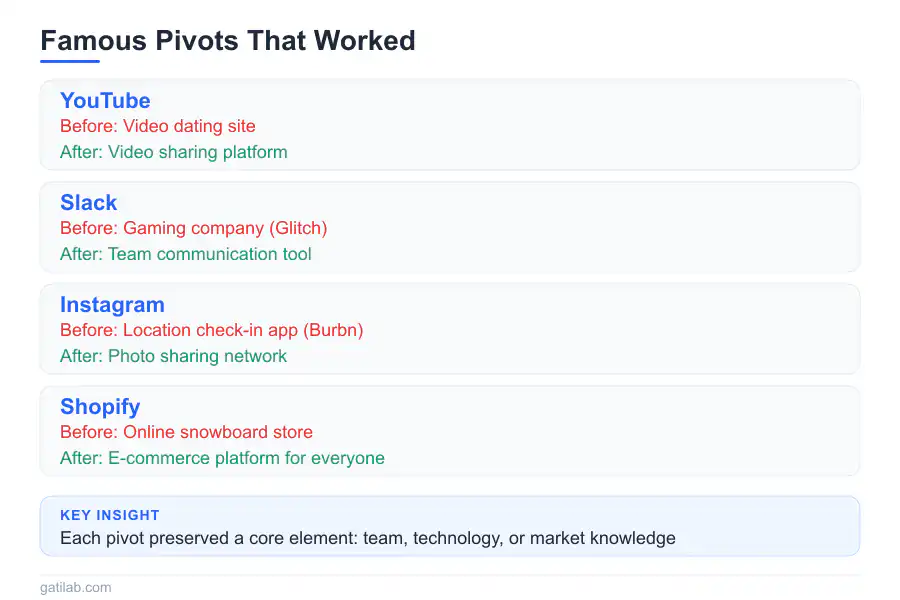
Pivoting, fundamentally changing direction while leveraging what you’ve learned and built, is one of the most important skills in entrepreneurship. Many of today’s most successful companies pivoted from their original ideas. YouTube started as a video dating site. Slack began as a gaming company. Instagram was originally a location-based check-in app. Knowing when and how to pivot can mean the difference between failure and breakthrough success.
Understanding Pivots
A pivot is a fundamental change in business strategy while preserving some core element, whether that’s team, technology, or learning. It’s not a minor adjustment or optimization. It’s a significant directional shift.
The distinction matters because pivots carry real costs. They’re disruptive, risky, and emotionally difficult. You don’t want to call every course correction a “pivot” and you don’t want to dismiss a necessary pivot as “just an adjustment.”
A pivot is also different from a restart. A restart abandons everything. A pivot builds on what you’ve learned. Your previous direction wasn’t wasted. It generated knowledge, relationships, and capabilities that the new direction can leverage. That’s the whole point. You’re not starting over. You’re redirecting.
The core question of any pivot is: what stays the same and what changes? The answer to that question determines what kind of pivot you’re making and how disruptive it will be.
Types of Pivots
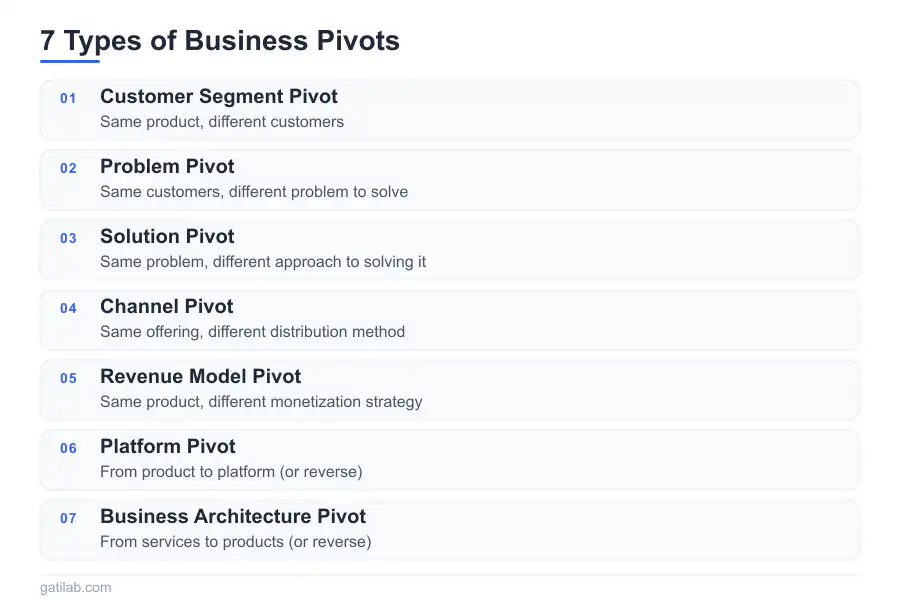
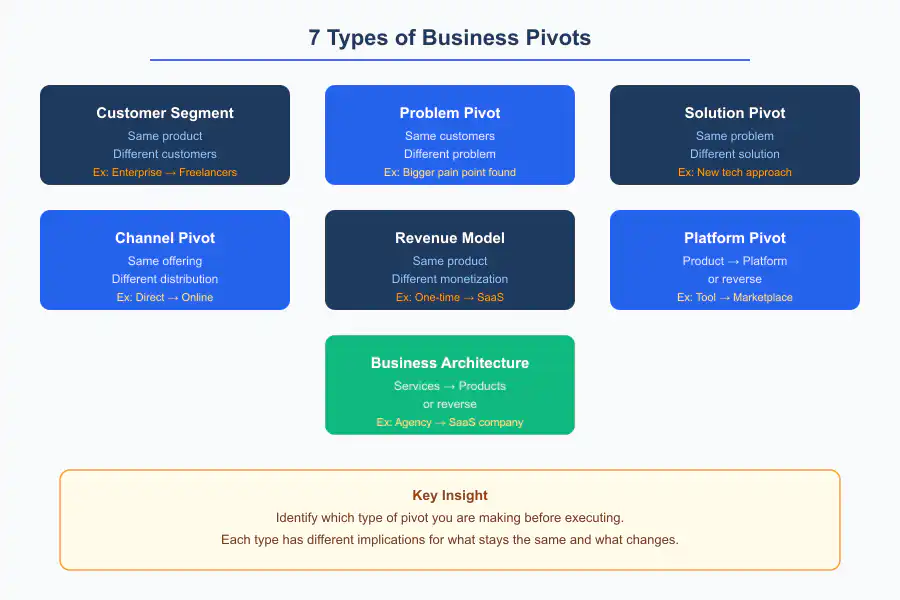
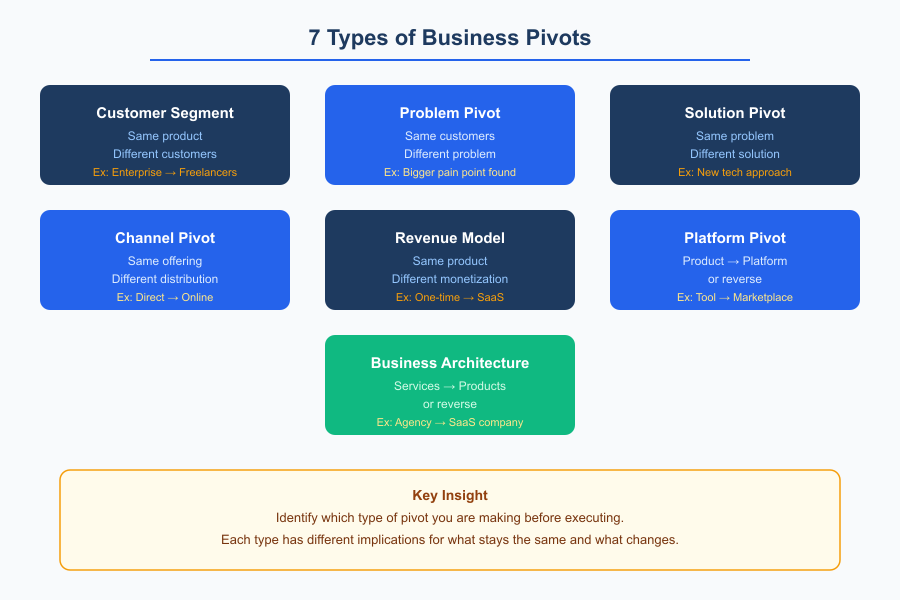
There are many ways to change direction. Understanding which type of pivot you’re making helps you execute it more effectively.
Customer segment pivot. Same product, different customers. You built something valuable, but the people willing to pay for it aren’t who you expected. I see this constantly in WordPress development. Someone builds a tool for enterprise clients and discovers freelancers love it. The product doesn’t change. The marketing and positioning do.
Problem pivot. Same customers, different problem. You’re talking to the right people, but solving the wrong problem. Your conversations with them revealed a bigger, more urgent pain point. This is actually one of the best pivots because you already have relationships and understanding of the customer base.
Solution pivot. Same problem, different solution. The problem is real, but your approach to solving it was wrong. Maybe a different technology, different format, or different delivery model works better.
Channel pivot. Same offering, different distribution. How you reach customers changes fundamentally. Selling direct instead of through partners. Going online instead of in-person. Moving from self-serve to high-touch sales.
Revenue model pivot. Same product, different monetization. You change how you capture value. Subscriptions instead of one-time purchases. Freemium instead of paid. Advertising-supported instead of user-paid.
Platform pivot. From product to platform, or reverse. Enabling others to build versus serving end users directly. This is a massive shift that changes everything about your business.
Business architecture pivot. From services to products or the reverse. This is the pivot I’ve made multiple times. Fundamental model change that affects every aspect of how you operate.
Identify which type of pivot you’re making. It affects execution significantly.
Signs You Need to Pivot
Recognizing when to change direction requires honest assessment, not rationalization.
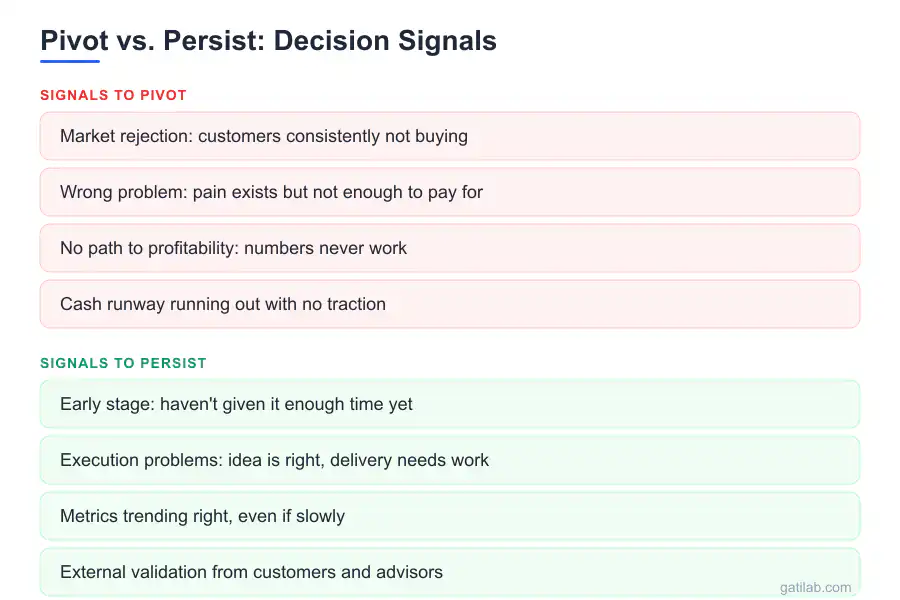
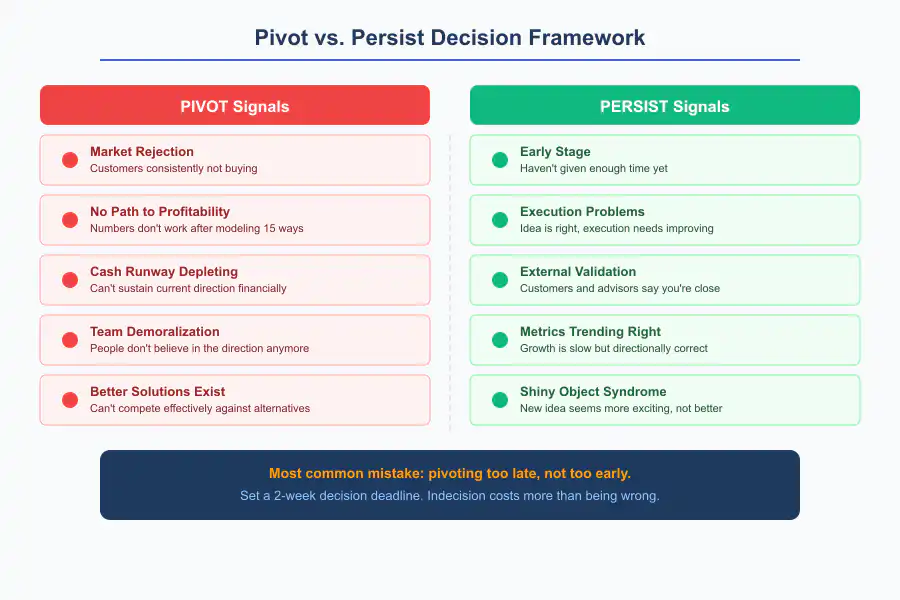
Market rejection. Customers consistently aren’t buying. Not just slow sales. Fundamental lack of interest. If you’ve tried multiple angles, adjusted pricing, improved your pitch, and the market still says no… it might be saying no to the direction, not the execution. I spent four months trying to sell a service that nobody wanted. The signs were there at month one. I just didn’t want to see them.
Wrong problem. Customers have the problem you identified, but it’s not painful enough to pay to solve. This is subtle and frustrating because you’re technically right about the problem existing. It just doesn’t matter enough.
Better solutions exist. You can’t compete effectively against alternatives. Sometimes the honest answer is that someone else already solved this better.
No path to profitability. The numbers don’t work no matter how you model them. If you’ve run the spreadsheet fifteen different ways and none of them show a viable path, believe the spreadsheet.
Cash runway running out. Without more funding, you can’t continue the current path. This forces the pivot decision whether you’re ready for it or not.
Team demoralization. People don’t believe in the direction anymore. When your team’s energy drops, pay attention. They’re seeing things you might be too close to see.
Learning reveals mismatch. Customer conversations consistently show you’re on the wrong track. Listen to what people tell you, especially when it contradicts your assumptions.
The most common mistake isn’t pivoting too early. It’s pivoting too late. Ego and sunk cost fallacy keep people on wrong paths long after the evidence is clear. If multiple signals point to a needed change, don’t wait for certainty. It never comes.
Signs to Persist
Not every difficulty means you need to pivot. Sometimes you need more time, better execution, or just a thicker skin.
Early stage. Haven’t given it enough time yet. Premature pivoting wastes the learning your current direction is generating. Most things take longer than expected to work.
Execution problems. The idea might be right but the execution is poor. Fix the execution before abandoning the direction. I’ve seen people pivot away from great ideas because they marketed them poorly.
Shiny object syndrome. Wanting to pivot because a new idea seems more exciting. The grass is always greener. New ideas feel full of potential because you haven’t encountered their problems yet.
Fear-based. Pivoting to avoid difficult work, not because the direction is wrong. Sometimes the path forward is uncomfortable but correct. Don’t mistake discomfort for wrongness.
External validation. Customers, mentors, and advisors say you’re close. If people who understand the market tell you to keep going, listen.
Progress indicators. Metrics trending right even if slowly. Growth that’s directionally correct might just need more time to compound.
Distinguishing between “this needs to pivot” and “this needs more time or better execution” is one of the hardest calls in business. I’ve gotten it wrong in both directions.
Making the Pivot Decision
This is where most people get stuck. The decision to pivot feels enormous because it is. Here’s how to approach it.
Honest assessment. Is this idea viable with better execution? Or is it fundamentally flawed? These require very different responses. The first needs persistence. The second needs redirection. Be brutally honest with yourself.
Customer evidence. What do customers actually say and do? Not what you hope they’ll say. Not what they told you to be polite. What are their actions showing? Data over hope, always.
Resource reality. What can you afford to try? Financial constraints shape options. A pivot with zero runway is different from a pivot with twelve months of savings.
Team input. What does your team observe and believe? They’re often closer to the problem than you are.
Advisor perspective. External viewpoints from trusted advisors can cut through the emotional fog. They don’t have your ego invested in the original direction.
Opportunity cost. What are you giving up by not pivoting? Every month spent on a dead direction is a month not spent on the right one.
Decision deadline. Set a date to decide. Endless deliberation is its own problem. I give myself two weeks maximum for pivot decisions. After that, the cost of indecision exceeds the risk of being wrong.
Planning the Pivot
Once you’ve decided to pivot, resist the urge to just start moving. Plan first.
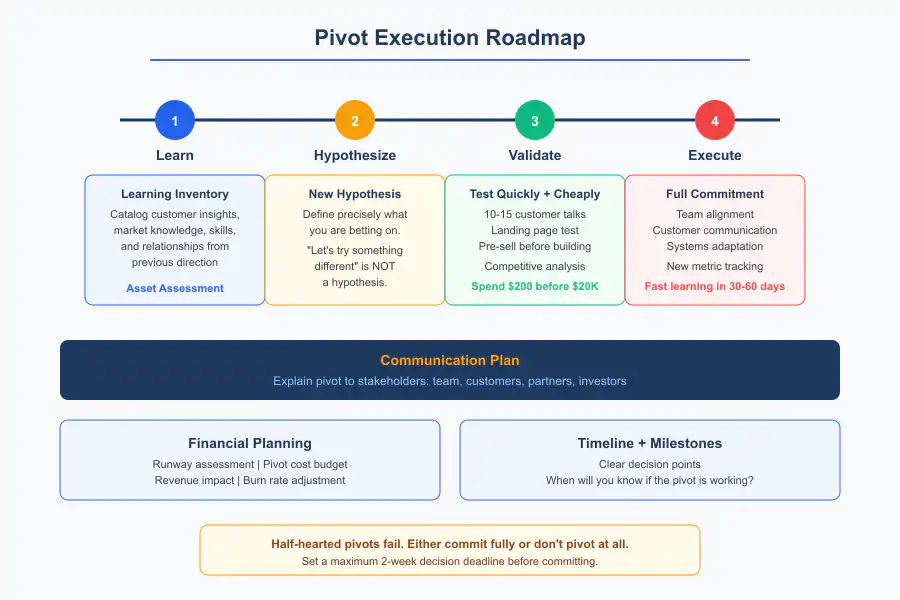
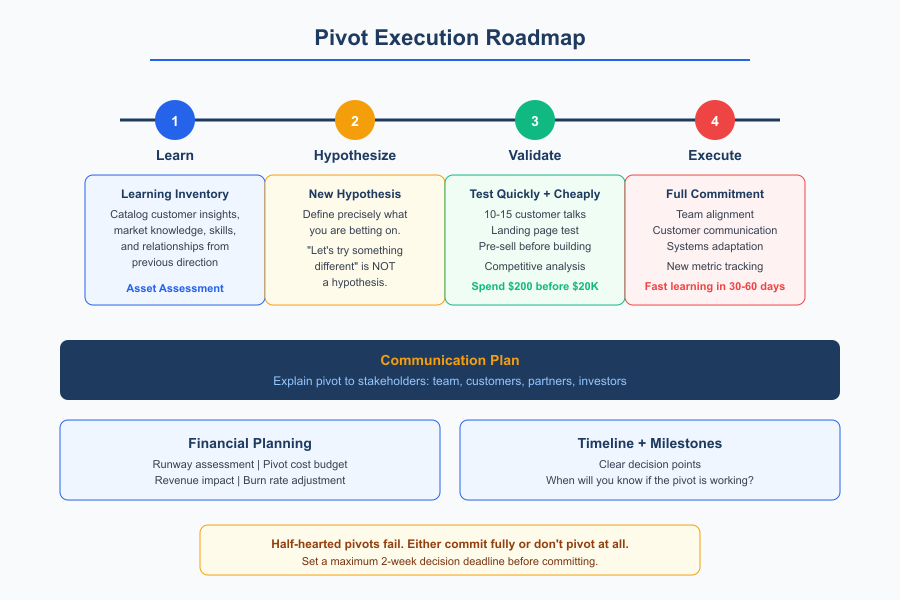
Learning inventory. What have you learned that applies to the new direction? Customer insights, market knowledge, technical skills, relationships. Catalog everything. Your previous direction wasn’t wasted if you extract the learning.
Asset assessment. What do you have, technology, relationships, team, brand, that transfers to the new direction? The more you can carry forward, the less you’re starting over.
New hypothesis. What specifically are you now betting on? Be precise. “We’re going to try something different” isn’t a hypothesis. “We believe freelancers will pay $49/month for automated client reporting because manual reporting takes 3 hours weekly” is a hypothesis.
Validation plan. How will you test the new direction quickly and cheaply? Don’t commit everything before you’ve validated the basics. I spent $200 testing my current business model before investing real resources. Best $200 I ever spent.
Timeline. What are the milestones and decision points? When will you know if the pivot is working?
Communication plan. How will you explain the pivot to stakeholders, customers, team, partners?
Executing the Pivot
Planning only gets you started. Execution determines whether the pivot succeeds.
Clean break or transition? Sometimes you need to stop the old direction immediately. Sometimes you transition gradually, maintaining old revenue while building the new. For service businesses, gradual transition usually works better because you need income during the change. I transitioned over six months, gradually shifting my client mix from the old model to the new one.
Team alignment. Everyone needs to understand and commit to the new direction. Half-hearted pivots fail. If someone on your team doesn’t believe in the new direction, address that directly. It’s better to have a difficult conversation now than a failed pivot later.
Customer communication. For existing customers, be honest about what’s changing and why. Explain how it affects them. Offer transition support. How you handle existing customers during a pivot affects your reputation for years.
Systems adaptation. Processes, tools, and infrastructure need changing. Don’t underestimate this. Old systems optimized for the old direction will fight the new one.
Fast learning. Run small experiments to validate the new direction quickly. The first 30-60 days after a pivot should generate more learning than the previous six months. If they don’t, something’s wrong.
Metric reset. Define new measures of success. The old metrics might not apply. Set up tracking for what matters in the new direction from day one.
Financial Considerations
Money during a pivot. This is where things get real.
Runway assessment. How much time do you have? The pivot must happen within your financial constraints. Running out of money mid-pivot is the worst possible outcome.
Pivot cost. What does changing direction require financially? New tools, new marketing, new hiring, rebranding? Budget it honestly.
Revenue impact. Will existing revenue continue through the pivot? If not, you need reserves. If you’re pivoting away from paying clients, have a plan for the gap.
Burn rate adjustment. You may need to reduce spending during pivot uncertainty. Cut nonessentials before you’re forced to. The leaner you are during a pivot, the more runway you have to make it work.
Funding for pivot. Do you need additional capital? If so, secure it before you pivot, not after. Fundraising while pivoting is extremely difficult.
Team and Culture Through the Pivot
The human dimension of pivoting is often underestimated. People aren’t machines you can just point in a new direction.
Transparent communication. Explain why the pivot is happening. People handle change better when they understand the reasoning. Don’t sugarcoat it. Your team can handle the truth, and they’ll respect you more for sharing it.
Role evolution. Some roles change, some become unnecessary. Address this honestly and quickly. Uncertainty about job security will destroy morale faster than bad news.
New skills needed. The pivot may require capabilities you don’t have. Identify the gaps and fill them, through training, new hires, or contractors.
Morale management. Pivots can be demoralizing. People invested in the old direction might feel like their work was wasted. Acknowledge that feeling. Frame the pivot as building on what was learned, not abandoning what was built.
Commitment renewal. Re-establish team buy-in for the new direction. People need to choose the new path, not just be dragged along.
Departures. Some people may not want to make the pivot. That’s okay. Better to have a smaller, aligned team than a larger, divided one.
Common Pivot Mistakes
I’ve made some of these. Watching others make the rest.
Pivoting too often. Never giving ideas enough time. Chasing every new possibility. Serial pivoting exhausts resources and credibility. If you’ve pivoted three times in twelve months, the problem might not be the direction.
Pivoting too late. Holding on too long, consuming resources on a dead direction. This is the more common mistake. Ego and sunk cost fallacy keep people on wrong paths long after the evidence is clear.
Incomplete pivot. Half-changing while half-maintaining the old approach. Commitment issues kill pivots. You can’t serve two masters. Either commit to the new direction or don’t pivot at all.
Ignoring learning. Not carrying forward what you’ve learned. The whole point of a pivot versus a restart is leveraging accumulated knowledge. If you’re not doing that, you’re just starting over with extra steps.
Random pivoting. Changing direction without clear hypothesis. “Let’s try something different” isn’t a strategy. Know specifically what you’re testing and why.
Pivot without validation. Jumping to a new direction without testing it first. You’re repeating the original mistake of assuming you know what the market wants.
Same mistakes. Pivoting to an approach with the same underlying flaws. If your problem was pricing, channel, or team, a pivot won’t fix that. Be honest about root causes.
Validating the New Direction
Test before you bet everything. This is where most people cut corners, and it’s where most pivots fail.
Customer conversations. Does the new direction resonate with target customers? Not “do they think it’s interesting” but “would they pay for this?” Talk to at least 10-15 potential customers before committing.
Small experiments. Can you test cheaply before fully committing? Build a landing page. Run a small ad. Offer the service manually before automating it.
Pre-selling. Will customers pay before you build? This is the ultimate validation. If people hand you money based on a promise, you’ve got something real. I pre-sold my first productized service to three clients before building any of the systems.
Competitive analysis. Is the new direction viable against existing competitors? What’s your angle?
Market research. Data supporting the opportunity. Don’t rely solely on gut feel, especially when your gut was wrong about the last direction.
Validation reduces pivot risk. The hour you spend validating saves the month you’d spend building the wrong thing.
Multiple Pivots
Sometimes direction changes again. That’s okay, within limits.
Learning accumulation. Each pivot should add learning. If you’re not getting smarter with each change, something is fundamentally wrong with how you’re approaching the market.
Pattern recognition. What’s working? What keeps not working? After multiple attempts, patterns emerge. Maybe it’s not the direction that’s wrong. Maybe it’s the execution, the team, or the founder’s skills.
Resource reality. Multiple pivots consume resources. Runway matters more with each successive change.
Team fatigue. Repeated changes wear on people. There’s a limit to how many times you can ask a team to restart emotionally.
Core question. Is the problem with direction or with execution? If three different directions all fail in similar ways, the common element might be you. That’s a hard realization but an important one.
Exit consideration. Sometimes the right answer is to stop, not pivot again. Not every business idea is viable, and knowing when to walk away is also a skill.
When Not to Pivot
Persistence has real value. Not every difficulty signals the need for a pivot.
Stay the course when early metrics show promise even if growth is slow. Stay when the problems are operational, not strategic, because those are fixable. Stay when the market needs time to develop, some ideas are early rather than wrong. Stay when customers indicate value even if sales are lagging.
And critically, stay when you recognize a pattern of habitually abandoning ideas too quickly. Some founders are addicted to the excitement of new beginnings and allergic to the grind of execution. If that’s you, discipline yourself to persist.
Building a Business That Can Pivot
The smartest founders design for adaptability from the start.
Modular approach. Build components that can be reconfigured rather than monolithic systems that only work one way.
Learning systems. Regular feedback from customers and market. Monthly customer calls, usage analytics, market monitoring. The earlier you spot the need to pivot, the cheaper it is.
Resource flexibility. Don’t over-commit to one approach. Contractors instead of full-time hires in the early stages. Month-to-month tools instead of annual contracts. Flexibility costs a small premium but provides enormous optionality.
Diverse skills. A team capable of multiple directions adapts more easily than specialists who can only do one thing.
Customer relationships. Connections that transcend specific offerings. If clients trust you, they’ll follow you through a pivot. If they only valued one specific service, they won’t.
Financial reserves. Resources to fund direction changes. The businesses that can afford to pivot survive longer than those that can’t.
Design businesses that can adapt, and pivoting becomes a strategic tool rather than a crisis response.
The ability to pivot well is a competitive advantage. Markets change, customers surprise you, and initial hypotheses prove wrong. The entrepreneurs who succeed aren’t necessarily those who get it right the first time. They’re the ones who learn fast and adapt appropriately. Master the art of the strategic pivot, and you dramatically increase your chances of eventually finding the direction that works.
Business Pivots FAQ
Frequently Asked Questions
What is a business pivot and how is it different from a restart?
A pivot is a fundamental change in business strategy while preserving some core element like your team, technology, or accumulated learning. A restart abandons everything and begins from scratch. The key difference is leverage: a pivot builds on what you already know, while a restart discards it. YouTube pivoted from a dating site to video sharing. Slack pivoted from a gaming company to workplace messaging. Both kept their technology and teams while completely changing direction.
What are the main types of business pivots?
The seven main pivot types are: customer segment pivot (same product, different customers), problem pivot (same customers, different problem), solution pivot (same problem, different approach), channel pivot (different distribution method), revenue model pivot (different monetization strategy), platform pivot (product to platform or reverse), and business architecture pivot (services to products or reverse). Identifying which type you are making helps you execute more effectively.
How do I know when my business needs to pivot?
Key signals include: customers consistently not buying despite multiple approaches, solving a problem that is not painful enough to pay for, better solutions already existing in the market, no path to profitability after modeling it multiple ways, cash runway running out, team demoralization, and customer conversations consistently showing you are on the wrong track. The most common mistake is pivoting too late, not too early. Ego and sunk cost fallacy keep people on wrong paths long after the evidence is clear.
When should I persist instead of pivoting?
Persist when early metrics show promise even if growth is slow, when problems are operational rather than strategic, when the market needs time to develop, when customers indicate value even if sales lag, and when trusted advisors say you are close. Also persist if you recognize a pattern of habitually abandoning ideas too quickly. Some founders are addicted to the excitement of new beginnings and allergic to the grind of execution.
How do I validate a new direction before fully committing?
Talk to at least 10-15 potential customers to see if the new direction resonates. Run small, cheap experiments like landing pages or small ad tests. Pre-sell the service or product before building it. If people hand you money based on a promise, you have something real. Conduct competitive analysis to confirm viability. Validation reduces pivot risk significantly. The hour you spend validating saves the month you would spend building the wrong thing.
What are the biggest mistakes people make when pivoting?
Seven common mistakes: pivoting too often without giving ideas enough time, pivoting too late and wasting resources, making an incomplete pivot while trying to maintain the old approach, ignoring accumulated learning from the previous direction, pivoting randomly without a clear hypothesis, jumping to a new direction without validating it first, and pivoting to an approach with the same underlying flaws. If you have pivoted three times in twelve months, the problem might not be the direction.
How do I handle finances during a business pivot?
Start with a runway assessment to know exactly how much time you have. Budget the pivot costs honestly, including new tools, marketing, and potential hiring. Determine whether existing revenue will continue during the transition. Reduce burn rate by cutting nonessentials before you are forced to. Secure additional funding before you pivot, not after, because fundraising while pivoting is extremely difficult. Running out of money mid-pivot is the worst possible outcome.
How do I communicate a pivot to my team and customers?
Be transparent with your team about why the pivot is happening. People handle change better when they understand the reasoning. Address role changes honestly and quickly because uncertainty about job security destroys morale faster than bad news. For existing customers, explain what is changing and why, how it affects them, and offer transition support. Re-establish team buy-in for the new direction. How you handle people during a pivot affects your reputation for years.