
Business Planning for Creatives: A No-Spreadsheet Approach
You became a creative to create, not to fill out spreadsheets. The word “business plan” conjures images of corporate templates, financial projections, and PowerPoint decks. The opposite of why you do what you do. So you avoid planning entirely. Wing it. Figure it out as you go. Mistake lack of planning for spontaneity.
I get it. I resisted planning for years. I’m a developer and content creator by nature, not a business strategist. The first time someone told me I needed a business plan, I literally laughed. Then I spent three years making decisions reactively instead of intentionally, and the results were exactly as chaotic as you’d expect.
But businesses without direction wander. Income stays chaotic. Growth feels random. The same energy that resists rigid planning should demand intentional direction. Planning doesn’t have to feel corporate. It doesn’t have to look like an MBA template. This guide covers business planning approaches that work for creative minds without killing the creative spirit.
Why Creatives Resist Planning
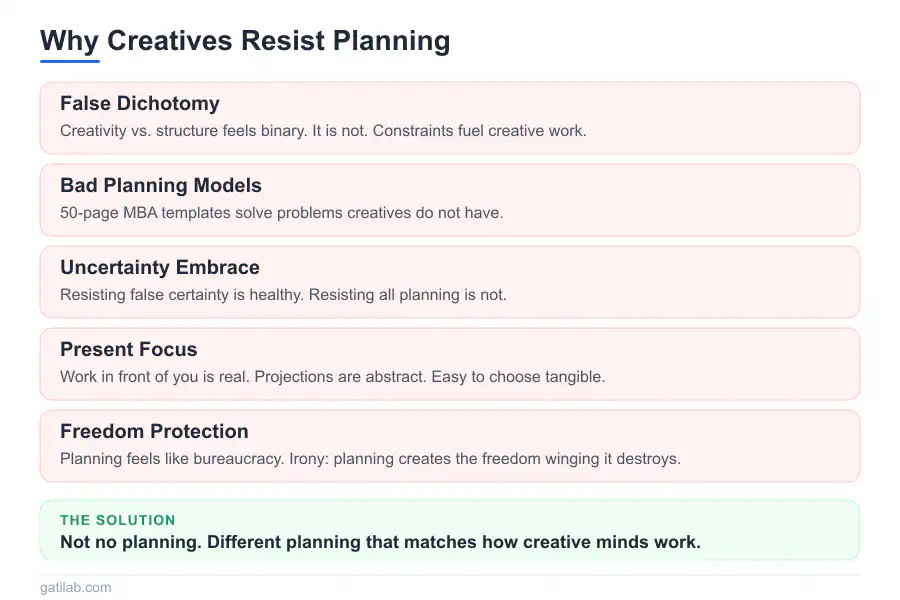
Understanding the resistance helps overcome it. And the resistance is legitimate, not laziness.
The false dichotomy is the biggest trap. Creativity versus structure feels like a binary choice. It isn’t. Structure can serve creativity rather than constrain it. Constraints often fuel creative work. Think about how a sonnet’s structure produces better poetry than “write whatever you want.”
Bad planning models deserve blame too. The business plans creatives have seen are wrong for their businesses. Traditional plans solve problems they don’t have. A 50-page document makes sense for seeking bank loans. It makes no sense for running a design studio or a WordPress development practice.
Uncertainty embrace is actually healthy in creative work. Creative work is inherently unpredictable. Rigid plans feel incompatible with emergent work. What feels like resistance to planning is often healthy resistance to false certainty. You’re right that detailed 5-year projections are fiction. You’re wrong that this means all planning is pointless.
Present focus pulls attention to what’s tangible. The work in front of you is real. Projections are abstract. Easy to prioritize what’s tangible. But without future thinking, you react to whatever arrives instead of directing where you’re going.
Freedom protection is deeply personal. You started your business for freedom. Planning feels like bureaucracy limiting that freedom. The irony, and I’ve experienced this directly, is that planning creates the freedom that winging it destroys. When I finally started planning my revenue targets, I gained the freedom to say no to bad clients because I knew what I needed and how to get it.
Past failures create reasonable skepticism. Abandoned plans and unfollowed goals make all planning suspect. If you’ve tried traditional planning approaches and they didn’t work, of course you’re skeptical. The problem wasn’t planning. It was the wrong kind of planning.
The solution isn’t no planning. It’s different planning. Approaches matching how creative minds actually work.
Minimum Viable Planning
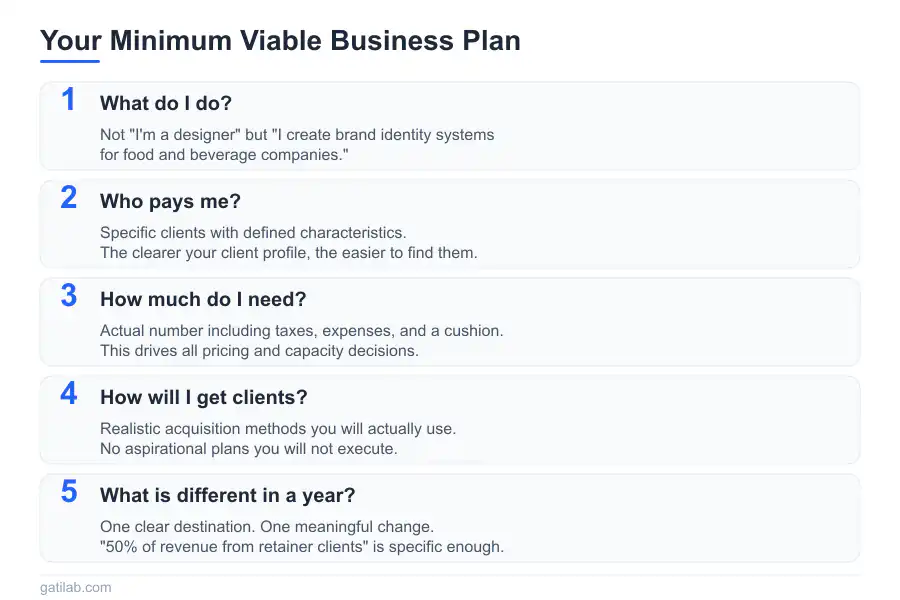
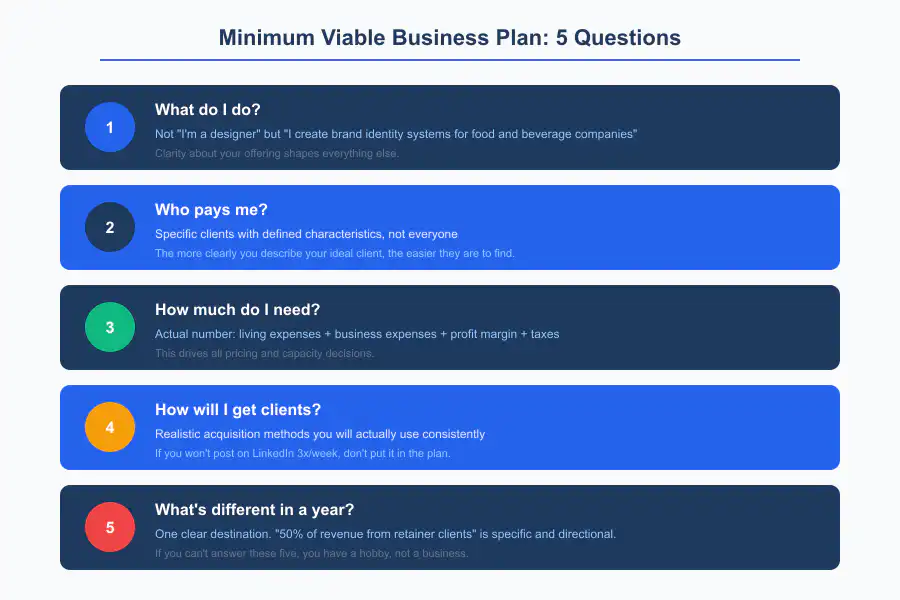
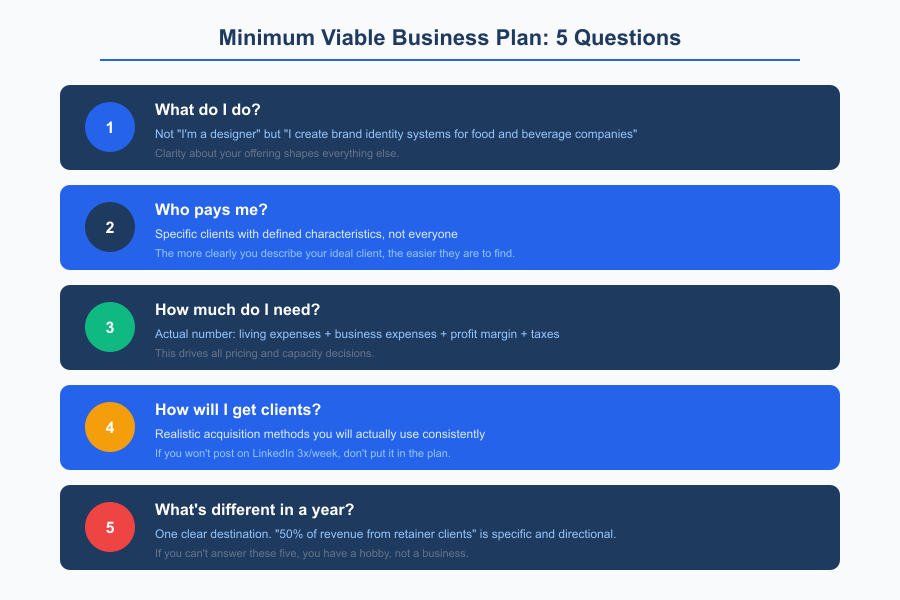
You don’t need a 50-page business plan. You need answers to five key questions. That’s it.
Your Minimum Viable Business Plan
What do I do? The specific service or product. Not “I’m a designer” but “I create brand identity systems for food and beverage companies.” Not “I’m a developer” but “I build and maintain WordPress sites for mid-size businesses.” Clarity about your offering shapes everything else.
Who pays me? Specific clients, not everyone. Target clients with defined characteristics. The more clearly you can describe your ideal client, the easier they are to find and serve. When I got specific about my client profile, my marketing became effortless because I knew exactly where those people were and what they needed to hear.
How much do I need? Minimum income to sustain your life and business. Actual number, not vague hope. Include taxes, expenses, and a cushion. This number drives all pricing and capacity decisions. I spent years without knowing my number, and it showed in inconsistent pricing and random project selection.
How will I get clients? Realistic acquisition methods you’ll actually use. No aspirational marketing plans you won’t execute. What has worked before? What can you commit to consistently? If you won’t actually post on LinkedIn three times a week, don’t put it in the plan.
What’s different in a year? One clear destination. Where you want to be in 12 months. Not everything about the future, just one meaningful change you’re working toward. “I want 50% of my revenue from retainer clients” is specific and directional without being prescriptive about every step.
These five questions answered clearly constitute a business plan. Everything else is elaboration. If you can’t answer these five questions, you have a hobby, not a business. Harsh, but I needed to hear it too.
Planning Approaches for Creatives
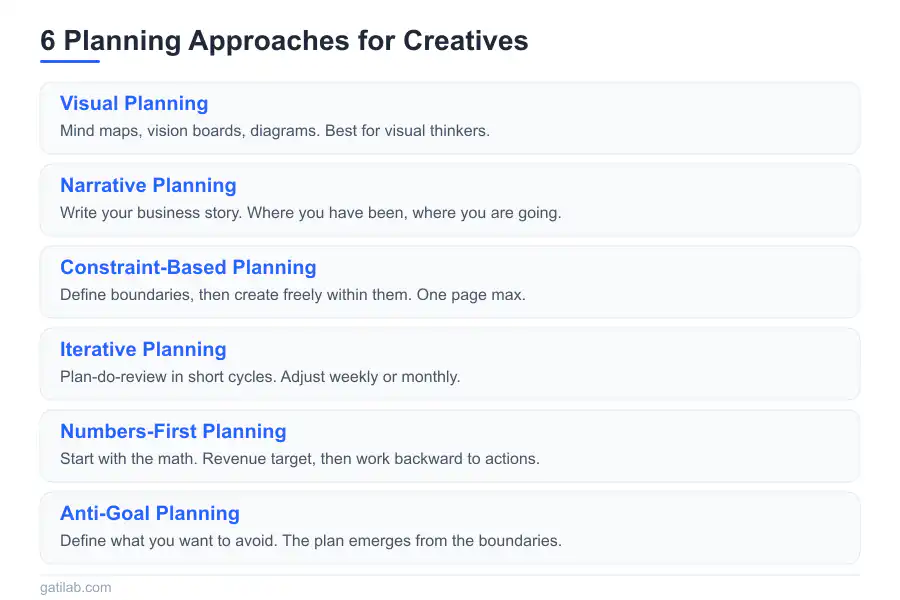
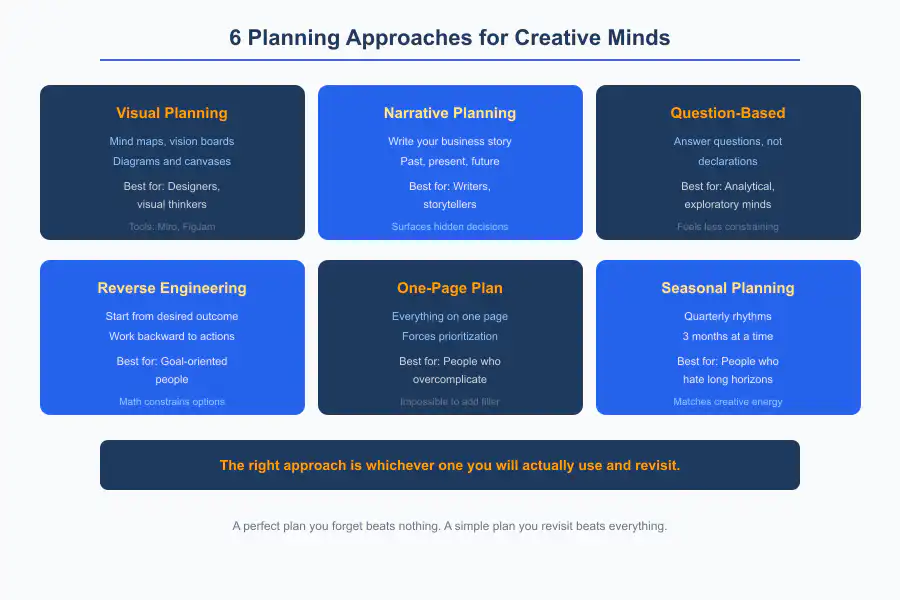
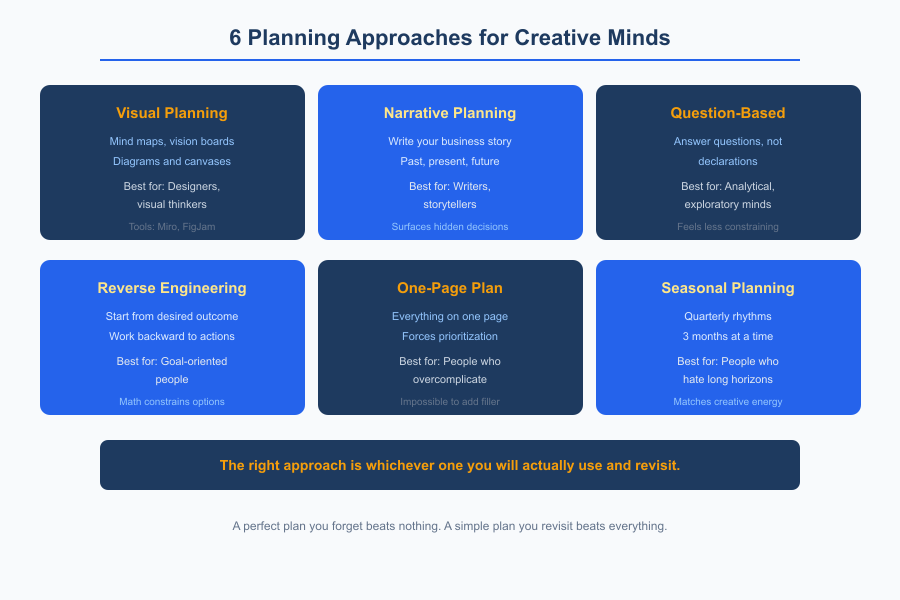
Different frameworks for different thinking styles. The right approach is whichever one you’ll actually use.
Visual planning works for visual thinkers. Mind maps, vision boards, and diagrams. Non-linear representation of business direction. If you think visually, plan visually. Tools like Miro or FigJam support visual business thinking. I’ve seen designers create gorgeous business plans as flowcharts that work better than any spreadsheet.
Narrative planning works for writers and storytellers. Write your business story. Where you’ve been, where you are, where you’re going. Storytelling as strategy. If you’re a writer, write your way to clarity. I’ve used this approach myself, and the act of writing the narrative surfaced decisions I didn’t even know I was avoiding.
Question-based planning works for analytical minds. Instead of making declarations, answer questions. What problems do I solve? What does success look like? What would have to change? Questions feel less constraining than statements and leave room for discovery.
Reverse engineering works for goal-oriented people. Start from desired outcome. Work backward to required actions. If you want $150,000 revenue, what has to happen? How many clients at what price point? The math constrains the options and makes the path clearer.
One-page planning forces distillation. Everything on a single page. Forces prioritization and clarity. No room for filler. If it doesn’t fit on one page, you haven’t distilled it enough. This is my preferred approach because it’s impossible to overcomplicate.
Seasonal planning works for people who struggle with long horizons. Quarterly or seasonal rhythms. Short-term focus matching creative energy cycles. Three months feels manageable where five years feels absurd. Plan one season at a time.
Choose the approach that matches your thinking style. No single format works for everyone, and the one you’ll actually revisit beats the perfect one you’ll create and forget.
Financial Planning Without Spreadsheet Hell
Numbers matter, but they don’t have to dominate your creative life.
Know your number. Annual income needed. Calculate: living expenses plus business expenses plus profit margin plus taxes. Be honest about this number. Many creatives underprice because they’ve never calculated what they actually need. I spent years charging less than I needed because I never sat down and did this basic math.
Reverse the math. How many clients or projects at what price to reach your number? Simple arithmetic, not complex modeling. If you need $120,000 and can handle 12 projects annually, minimum project value is $10,000. This one calculation constrains pricing and scoping decisions more effectively than hours of strategy.
Track the basics. Income in, expenses out. What’s left. You don’t need complex accounting. You need awareness. A simple spreadsheet or accounting tool that you actually check is better than sophisticated systems you ignore. I check my numbers once a week, every Monday morning, and it takes 10 minutes.
Emergency cushion changes everything. Three to six months expenses accessible. Building emergency reserves provides creative freedom that nothing else can. When you’re not desperate for any project, you make better decisions about which projects to take. The cushion is what lets you say no, and saying no to bad work is how you make room for good work.
Pricing aligned to goals is non-negotiable. Your pricing must support your needs given your capacity. If the math doesn’t work, something needs changing: raise prices, reduce expenses, increase capacity, or add revenue streams. The math doesn’t care about your feelings. It either works or it doesn’t.
Simple tools are better than sophisticated ones you won’t use. A spreadsheet for tracking, or even simpler: accounting software that automates what it can. Wave, QuickBooks, or even a well-organized Numbers spreadsheet works fine. See also how to create a business budget that makes sense.
Financial planning for creatives means knowing the numbers that matter, not creating complexity for its own sake.
Goal Setting for Non-Linear Thinkers
Traditional goal frameworks don’t fit everyone, and that’s fine. There are alternatives.
Theme over targets works when specific numbers feel arbitrary. Instead of “reach $120,000 revenue,” choose a theme: “year of sustainability” or “building foundations” or “expansion year.” Themes provide direction without rigid numbers that feel constraining. My best years have been theme years.
One goal maximum prevents scattered attention. Not five goals. Not ten. One primary focus. Everything else supports it or gets eliminated. Multiple goals scatter attention. One goal creates clarity. This sounds extreme, but it works. When everything supports one goal, decisions become obvious.
Process goals focus on actions within your control. “Publish weekly content” rather than “get 10,000 followers.” You control the process. Outcomes depend on factors beyond you. Measuring process gives you daily wins. Measuring outcomes gives you daily anxiety.
Flexible milestones replace rigid deadlines. Check-in points, not drop-dead dates. Direction maintained, timing flexible. Progress assessed regularly without deadline anxiety driving panic decisions.
Anti-goals define what you won’t do, and they’re surprisingly effective. Clarity from elimination as much as intention. “I won’t take projects under $2,000” or “I won’t work weekends for clients” shapes direction by removing options. I’ve gotten more clarity from anti-goals than from positive goals.
Regular reflection keeps everything calibrated. Weekly or monthly review of direction. Adjustment built into the process, not treated as failure. Plans change as you learn. Reflection is how you learn what needs changing.
Goals should motivate, not discourage. Find formats that create energy rather than drain it.
Strategic Direction Without Strategy Documents
You need direction. You don’t need corporate strategy.
One sentence positioning covers the essentials. Who you help, what you help them with, why you. Niche clarity in a sentence. If you can’t say it simply, you haven’t clarified it. I spent six months refining mine until it fit naturally into a conversation.
Three priorities is the maximum for any quarter. What you’re focusing on this quarter. No more than three things at once. Everything on your list is either a priority or a distraction.
Decision filters prevent decision fatigue. What criteria help you say yes or no? If it doesn’t serve the priorities, it’s a no. “Does this help me reach $10K/month?” answers most questions faster than any analysis.
Opportunity assessment gives you a quick framework for when shiny objects appear. When opportunities arise, how do you evaluate them? Not every opportunity is your opportunity, even when it’s flattering. I’ve turned down opportunities that looked amazing but didn’t fit my direction, and I’ve never regretted it.
Competitive awareness provides context without obsession. Who else does what you do? How are you different? Not obsessive comparison that paralyzes you. Just awareness that helps you position intelligently.
Evolution recognition keeps you ahead of shifts. Where is the market going? How should you evolve? Long-term perspective without over-planning. You can’t predict the future, but you can watch for trends.
Strategic thinking is about direction and decisions, not documents and presentations.
Planning Your Marketing
Creative businesses need clients. Marketing planning doesn’t have to be painful.
Where do your clients come from? Understand current acquisition before trying new channels. Double down on what works. If referrals bring your best clients, invest in referral systems, not Instagram. I tracked my client sources for one year and discovered 80% came from three channels. I stopped spending time on the other seven.
One or two channels mastered beats eight channels done poorly. Not all platforms, all strategies. Master a few referral systems, content approaches, or networking methods. Spreading across everything means mediocrity everywhere.
Minimum viable marketing asks: what’s the least you can do consistently? Better than ambitious plans executed for two weeks and abandoned. Weekly is better than daily if daily isn’t sustainable. Monthly is better than weekly if weekly burns you out.
Content calendar light means rough themes, not every post scripted in advance. Framework for consistency without rigidity. You don’t need detailed content calendars. You need general direction and consistent output.
Batching creative work respects energy patterns. Create marketing content in focused sessions. Separate creation from distribution. Batching respects creative energy cycles better than constant context-switching.
Automation where possible reduces daily decisions. Schedule posts, automate email sequences. Systems that run without daily attention free you for creative work. Set it up once, adjust periodically, and focus your energy on creation.
Marketing plans should serve creative work, not overwhelm it.
Time and Capacity Planning
How you spend time determines what’s possible. And most creatives have never deliberately designed their time.
Energy mapping identifies your peak hours. When are you most creative? Most productive? Protect those times for important work. Don’t waste peak hours on email and admin. I do my best creative work between 7 and 11 AM. Those hours are sacred.
Client capacity is a hard number you need to know. How many clients can you handle? Know your limits before overcommitting. Saying yes to too much leads to saying no to quality.
Project planning needs honest timelines. Realistic estimates for work. Include buffer for revision and unexpected complexity. Under-promise and over-deliver rather than the reverse. I add 25% buffer to every project estimate because complexity always exceeds expectations.
Revenue and capacity alignment is where math meets reality. Can your capacity support your revenue goals? If not, something needs changing: pricing, offerings, or goals. The gap between what you need and what you can deliver at current prices is the single most important number in your business.
Non-work time deserves planning too. Rest is productive. Burnout undermines everything. Plan time off, not just time on. See how to create a sustainable work schedule for more.
Quarterly rhythm provides natural breaks for evaluation and adjustment. Business seasons matching energy seasons. Planning time isn’t limiting. It’s protective.
Planning for Growth
Moving from survival to development requires different thinking.
Define growth on your own terms. More revenue? More freedom? More impact? Different growth requires different plans. “Growth” means different things to different people. I chose freedom-growth over revenue-growth for three years, and it was the best decision I’ve made.
Staged development focuses on the next step, not the destination five years away. What’s the next stage? Not five stages from now. You can’t plan for stages you haven’t reached. Focus on the transition you’re actually in.
Skill development identifies what capabilities you need. What do you need to learn to reach the next stage? Both depth and breadth matter.
Systems and processes create leverage. Creating systems that allow growth without proportional time increase. Systematize repeatable work so your output can grow faster than your hours.
Revenue streams reduce vulnerability. Can you diversify income beyond your primary offering? Products, passive income, different services. Multiple streams reduce single-point-of-failure risk.
Team potential becomes relevant as you grow. When and how to bring on help? Building support as the business scales. You can’t do everything forever, and trying to is a plan for burnout.
Growth planning ensures you’re building toward something, not just responding to what arrives.
Dealing with Uncertainty
Planning in unpredictable creative business requires embracing uncertainty instead of pretending it away.
Scenario thinking prepares for multiple futures. What if things go well? What if they don’t? Multiple paths, not single prediction. I keep three scenarios in mind: great, normal, and rough. Each has a plan.
Flexible commitments maintain adaptability. Avoid locking into positions that can’t change. Month-to-month commitments are better than annual contracts if flexibility matters more than savings.
Regular review catches drift before it becomes crisis. Plans change as reality provides feedback. Monthly check-ins with yourself take 30 minutes and prevent months of wandering.
Experimentation budget allocates time and money for trying new things. Learning built into the plan. Not all experiments succeed, and that’s why they’re experiments, not commitments.
Minimum viable path asks the most important question: what’s the smallest thing that could work? Don’t over-plan before testing. Validate ideas before investing heavily. I’ve saved months of wasted work by running small tests before full commitments.
Uncertainty isn’t the enemy of planning. Rigid plans that can’t adapt to uncertainty are the enemy.
Quarterly Planning Rhythm
A practical planning cadence for creatives that actually works.
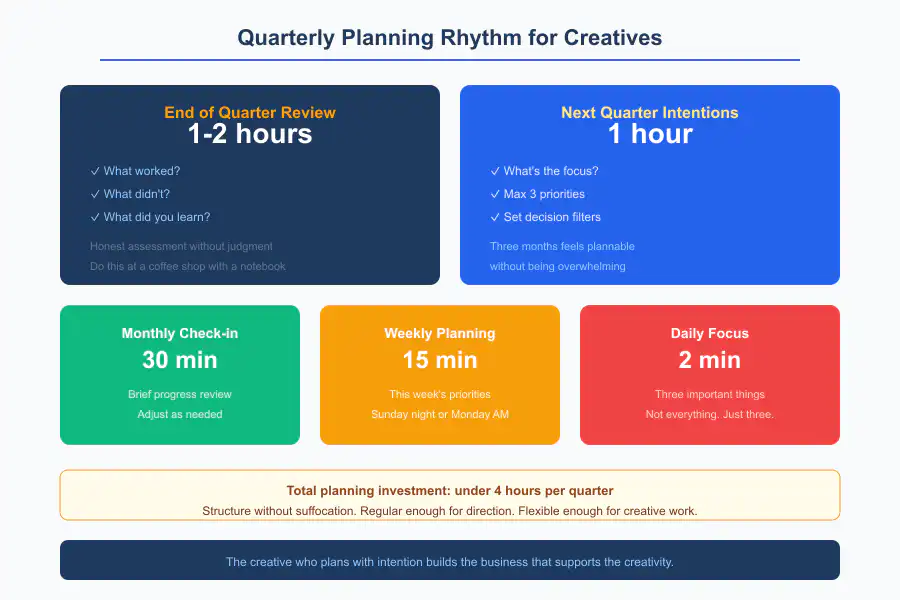
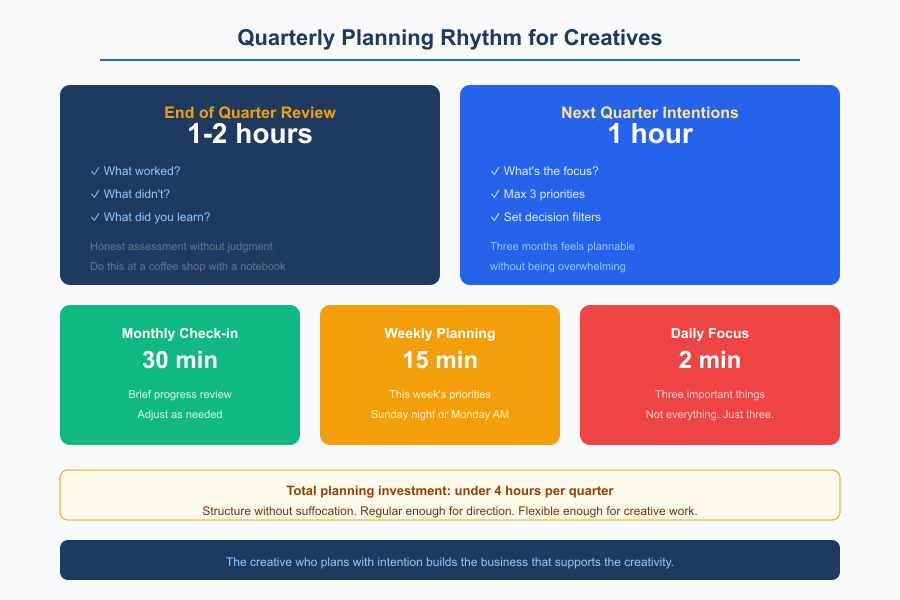
End of quarter review takes one to two hours. What worked? What didn’t? What did you learn? Honest assessment without judgment. I do this at a coffee shop with my notebook, and it’s become one of my most valuable rituals.
Next quarter intentions take another hour. What’s the focus? What will you accomplish? Three months feels plannable without being overwhelming.
Monthly check-ins take 30 minutes. Brief review of progress. Adjustment as needed. Thirty minutes monthly prevents major drift and keeps you honest about whether you’re actually executing the plan.
Weekly planning takes 15 minutes. What are this week’s priorities? What needs attention? Sunday evening or Monday morning, set the week’s direction. I do this every Sunday night and it transforms my Monday from reactive to intentional.
Daily focus takes 2 minutes. Three important things. Not everything. Just the three things that would make today a success.
This rhythm provides structure without suffocation. Regular enough to maintain direction. Flexible enough to adapt to the unpredictability of creative work.
Tools for Creative Business Planning
Simple tools that support planning without overcomplicating it.
Paper and pen. Sometimes analog is best. Sketch plans, mind map ideas, journal progress. Physical writing can unlock thinking that screens suppress.
A simple notes app. Keep plans accessible. Review anywhere. Apple Notes, Notion, Google Docs, whatever you’ll actually open and use regularly.
A single spreadsheet. Financial basics in one place. Income, expenses, projections. One sheet you understand beats complex systems you don’t.
Calendar blocking. Time for planning and review. If it’s not scheduled, it won’t happen. Protect planning time like client time.
Visual tools. Miro, FigJam, or similar for visual thinkers. Plans as diagrams and canvases instead of documents.
Project management light. Trello, Notion, or simple task systems. Enough structure to stay organized, not so much that managing the system becomes a project itself.
Match tools to your style. Complex tools you won’t use are worse than simple tools you will. The best planning tool is the one that’s actually open on your screen.
Making Planning a Habit
Planning works when it’s consistent. Occasional planning is barely better than no planning.
Scheduled planning time makes it real. Weekly and quarterly blocks. Protect the time. Treat planning meetings with yourself as seriously as client meetings, because they matter at least as much.
Rituals that work create consistency. Coffee shop planning sessions. Friday afternoon reviews. Whatever you’ll actually do. Build planning into existing habits rather than creating entirely new ones.
Accountability adds follow-through. Someone who asks about your plans. Advisor or mentor relationships help enormously. I report to a peer group monthly, and the accountability has been worth more than any tool.
Visual reminders keep plans present. One-page plan visible in your workspace. Goals where you’ll see them daily. Out of sight is genuinely out of mind for most people.
Celebration of progress sustains motivation. Acknowledge movement toward goals. Planning works when results are recognized. Small wins matter, and most creatives don’t celebrate enough.
Forgiveness for lapses prevents abandonment. Miss a planning session? Resume without guilt. Progress, not perfection. Falling off and getting back on is infinitely better than never starting.
Planning becomes natural when integrated into how you work. Start small. Build gradually. The creative who plans with intention builds the business that supports the creativity. The creative who refuses to plan builds… well, usually a very stressful hobby.
Business Planning FAQ
Frequently Asked Questions
Do creative businesses really need a business plan?
Yes, but not a traditional 50-page document. A minimum viable business plan answers five questions: what do you do specifically, who pays you, how much do you need, how will you get clients, and where do you want to be in 12 months. These answers on a single page constitute a working plan. If you cannot answer these five questions, you have a hobby, not a business. The right planning approach feels natural, not corporate.
Why do creatives resist business planning?
The resistance is legitimate, not laziness. Common reasons include a false dichotomy between creativity and structure, exposure to wrong planning models designed for corporate businesses, healthy embrace of uncertainty that resists false certainty, present-focus that prioritizes tangible work over abstract projections, desire to protect creative freedom, and past failures with abandoned plans. The solution is not no planning but different planning that matches how creative minds actually work.
What planning approach works best for visual thinkers?
Visual planning using mind maps, vision boards, diagrams, and tools like Miro or FigJam works well for visual thinkers. Other options include narrative planning for writers, question-based planning for analytical minds, reverse engineering for goal-oriented people, one-page planning that forces distillation, and seasonal planning for those who struggle with long horizons. The right approach is whichever one you will actually use and revisit regularly.
What financial numbers should creatives track?
Know your number: annual income needed including living expenses, business expenses, profit margin, and taxes. Reverse the math to find how many clients or projects at what price reach that number. Track income in and expenses out weekly. Build an emergency cushion of 3-6 months expenses. Align pricing to support your needs given your capacity. A simple spreadsheet you actually check beats sophisticated systems you ignore.
How do I set goals as a creative who hates rigid targets?
Try themes over targets, like a year of sustainability rather than a specific revenue number. Focus on one goal maximum per period to prevent scattered attention. Use process goals you control, like publish weekly content, rather than outcome goals you cannot. Set flexible milestones instead of rigid deadlines. Define anti-goals that clarify what you will not do. Build regular reflection into the process so adjustment feels like progress rather than failure.
What is the ideal planning rhythm for creative businesses?
End of quarter review takes 1-2 hours for honest assessment. Next quarter intentions take another hour for setting focus. Monthly check-ins take 30 minutes for progress review and adjustment. Weekly planning takes 15 minutes for setting priorities. Daily focus takes 2 minutes for identifying three important things. This rhythm provides structure without suffocation, and the total time investment is under 4 hours per quarter.
How do I plan marketing without it overwhelming my creative work?
Start by understanding where your current clients come from and double down on what works. Master one or two channels rather than doing eight poorly. Define minimum viable marketing, the least you can do consistently. Use a light content calendar with rough themes rather than scripted posts. Batch creative marketing content in focused sessions to respect energy patterns. Automate distribution where possible so systems run without daily attention.
How do I make business planning a consistent habit?
Schedule dedicated planning time and protect it like client meetings. Build rituals that work for you, like coffee shop sessions or Friday afternoon reviews. Find accountability through advisors, mentors, or peer groups. Keep visual reminders of your plan visible in your workspace. Celebrate progress to sustain motivation. Forgive lapses without abandoning the practice entirely. The creative who plans with intention builds the business that supports the creativity.