
Building a Business That Runs Without You: Systems and Processes
I built a business I couldn’t leave. Every client wanted to talk to me. Every decision ran through me. Every vacation meant checking email three times a day and apologizing to my family.
The business made money. I was miserable. And if I got sick for two weeks? Everything would collapse.
That was five years ago. Now I can disappear for a month and revenue keeps flowing. Client work gets done. Problems get solved without my involvement. The business runs whether I show up or not.
This didn’t happen by accident. It happened because I systematically removed myself from operations. And you can do the same thing, even if you’re currently the person everyone depends on for everything.
The Real Goal: Owner Independence
Let’s be clear about what we’re building. Not a passive income fantasy where money appears while you sleep. That’s mostly marketing nonsense.
We’re building owner independence. A business where:
- Operations continue when you’re not there
- Decisions happen without your input
- Revenue doesn’t depend on your daily presence
- You choose when to work, not when the business demands it
This matters for three reasons.
Sustainability. Businesses dependent on one person aren’t businesses. They’re jobs with extra steps. You’ve created an expensive way to be self-employed with no sick days. I’ve been there. It’s not as glamorous as it sounds.
Value. A business that runs without you is worth something. One that collapses without you is worth nothing to anyone except you. If you ever want to sell, or even just step back, owner-dependence kills value. For more on building lasting value, see the guide on lessons from running a business for 16 years.
Quality of life. The whole point of owning a business is freedom. But freedom you can’t actually use isn’t freedom. It’s a prison with good marketing.
Phase 1: Document Everything You Do
You can’t remove yourself from something you haven’t defined. Start by capturing what you actually do.
The Time Log Exercise
For two weeks, log every task. Not what you think you do. What you actually do. Every email, every decision, every call, every small task you handle.
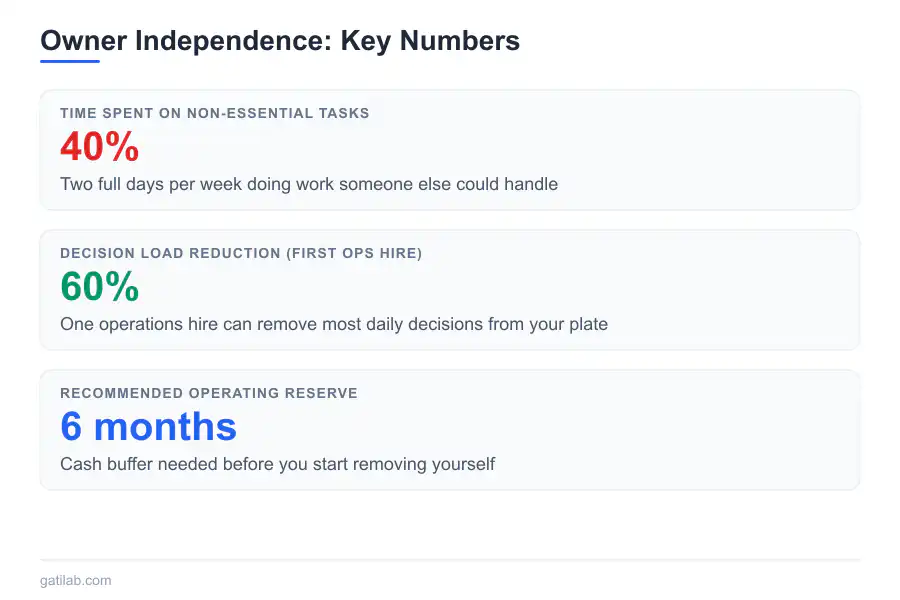
I did this exercise three years into my business and the results surprised me. I was spending 40% of my time on things that didn’t need me at all. Forty percent. That’s two full days a week doing work someone else could handle.
Use any method that works. I used a simple spreadsheet:
| Time | Task | Duration | Could Someone Else Do This? |
|---|---|---|---|
| 9:00 | Checked client email about project status | 15 min | Yes |
| 9:15 | Reviewed designer’s work on homepage | 30 min | Yes (with criteria) |
| 9:45 | Called client about invoice dispute | 20 min | Maybe |
| 10:05 | Fixed plugin conflict on client site | 45 min | Yes (with access) |
Two weeks gives you enough data to see patterns. You’ll discover:
- Tasks you do daily that take surprisingly long
- Decisions you make that don’t actually need you
- Work that feels important but isn’t
- The few things that genuinely require your expertise
Create Your Task Inventory
After two weeks, categorize everything:
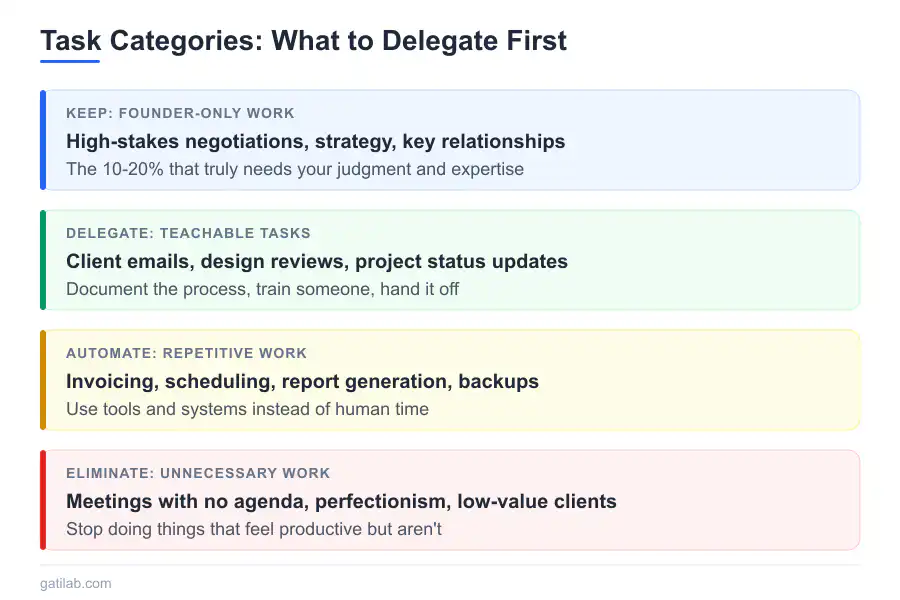
Founder-only work. Things that genuinely need your judgment, relationships, or expertise. For me: high-stakes client negotiations, strategic decisions, product direction, key relationship management.
Trainable work. Tasks someone could learn with proper documentation. For me: most client communication, project management, quality reviews, standard troubleshooting.
Automatable work. Repetitive tasks that software could handle. For me: invoicing, appointment scheduling, report generation, backup monitoring.
Eliminable work. Things that don’t actually need to happen. For me: checking analytics daily (weekly is fine), attending every client meeting (most don’t need me), custom reports nobody reads.
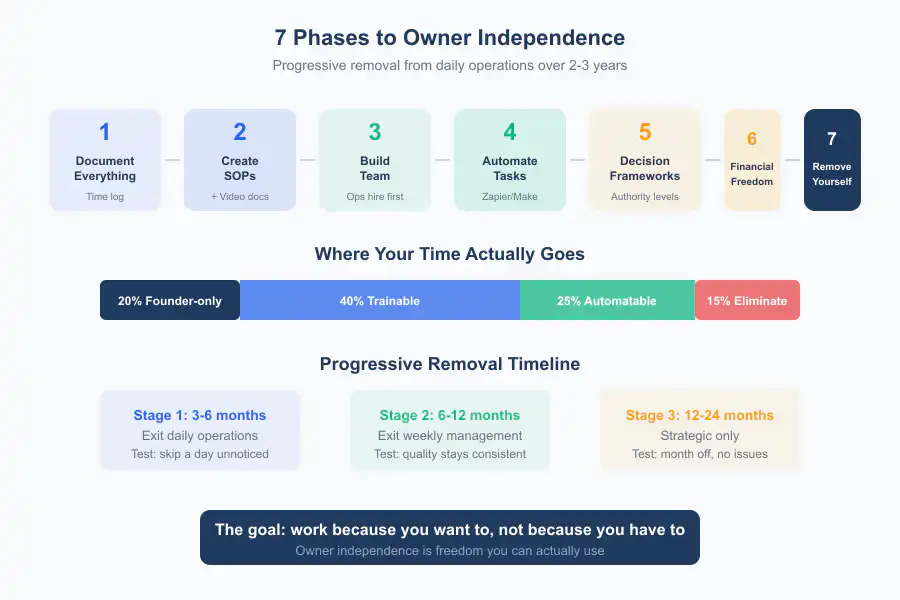
Most business owners discover that founder-only work is maybe 20% of their time. The rest is work they’re doing because they always have, not because it requires them. That realization stings a little. It should.
Phase 2: Document Before Delegating
Don’t hire someone, explain things verbally, and wonder why it doesn’t stick. You need real documentation. Not notes you scribbled once, but systems someone can actually follow. My first hire spent more time asking me questions than doing work. The problem wasn’t her. It was me.
You need documentation. Real documentation. Not notes you scribbled once, but systems someone can actually follow. I learned this the hard way after my first hire spent more time asking me questions than doing work. The problem wasn’t her. The problem was me.
The SOP Framework
For every trainable task, create a Standard Operating Procedure. See the complete guide on SOPs for small agencies for the full breakdown:
Trigger: What initiates this task?
Steps: Exactly what to do, in order.
Tools: What software or resources are needed?
Decisions: What judgment calls might come up?
Output: What does success look like?
Exceptions: When should someone escalate to you?
Example SOP: Responding to Project Status Inquiries
TRIGGER: Client emails asking about project status

STEPS:
1. Check project board in ClickUp for current status
2. Note completed tasks since last update
3. Note upcoming tasks and timeline
4. Draft response using template below
5. If any delays exist, explain reason and revised timeline
6. Send response

TOOLS: ClickUp, email, status template (link)

DECISIONS:
- If project is more than 2 days behind, notify project manager before responding
- If client seems frustrated (negative language, caps, multiple follow-ups), escalate

OUTPUT: Client receives clear status update within 4 hours of inquiry

EXCEPTIONS:
- Billing disputes → escalate to Gaurav
- Scope change requests → escalate to project manager
- Technical questions beyond status → escalate to lead developer
This level of detail seems excessive until someone needs to do your job. Then it’s essential.
Video Documentation
Some tasks are easier to show than write. I use Loom to record myself doing tasks, narrating my thought process.
“I’m approving this design because the spacing is consistent, the colors match brand guidelines, and the mobile layout stacks correctly. If any of those were off, I’d send it back with notes.”
That 2-minute video teaches judgment in a way written SOPs can’t. I have about 40 of these recordings now. They’ve saved me hundreds of hours of explanation.
Store Everything Accessibly
Documentation nobody can find is worthless. Put SOPs where your team actually works.
Notion works well for documentation. So does ClickUp Docs if you’re already using ClickUp for projects. Google Docs with clear folder structure is fine for smaller operations.
The tool matters less than the habit. Document as you do. Don’t save it for later. Later never comes. Trust me on that one.
Phase 3: Build Your Team Strategically
Documentation without people to use it is just an archive. You need team members who can actually run things.
Start With Your Weaknesses
Don’t hire for what you’re good at. Hire for what drains you or what you delay doing.
Hate bookkeeping? Hire a bookkeeper. Dread client calls? Hire an account manager. Slow on admin work? Get a virtual assistant.
Every hour someone else handles your weak spots is an hour you recover for high-value work. And honestly? You’ll do that high-value work better because you’re not exhausted from the stuff you hate.
The First Hire That Matters
For most service businesses, your first strategic hire should be an operations person. Someone who can manage workflows, handle client communication, and make routine decisions.
Titles vary: Operations Manager, Project Manager, Account Manager, Executive Assistant. The role is the same: keep things moving without constant founder input.
This person becomes your force multiplier. They turn your systems into action. They become the first line of defense so you’re not the answer to every question. My first ops hire cut my weekly decision load by about 60%. Sixty percent. I didn’t fully appreciate how much mental energy I was spending on routine choices until someone else started making them.
Training Is Not Optional
Hiring without training creates a different kind of dependence. Instead of doing everything yourself, you’re constantly explaining and fixing.
My training approach for new team members:
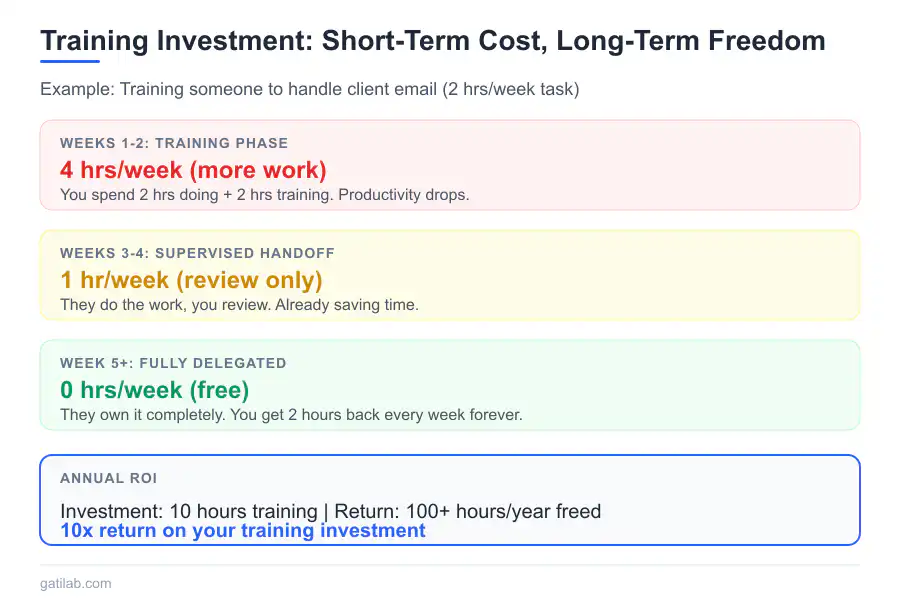
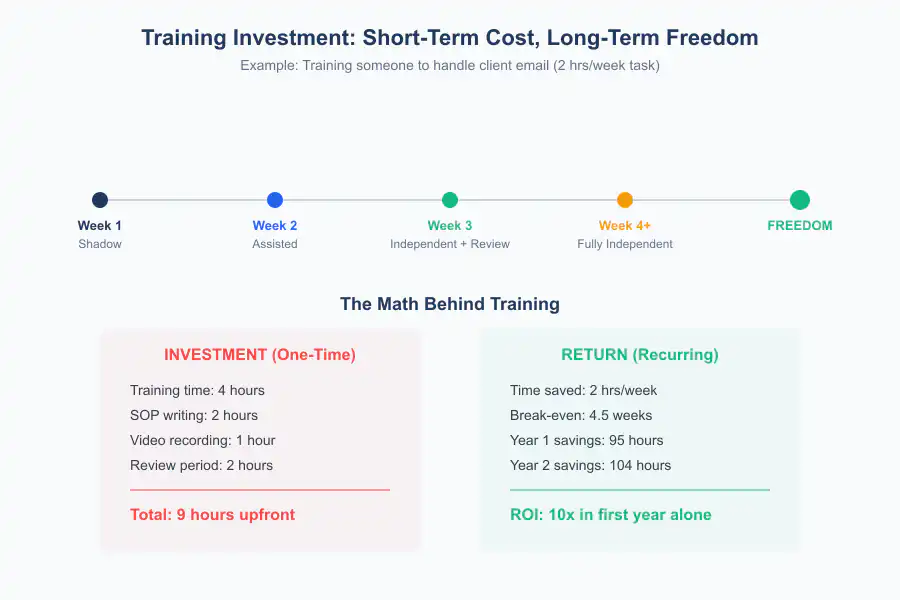
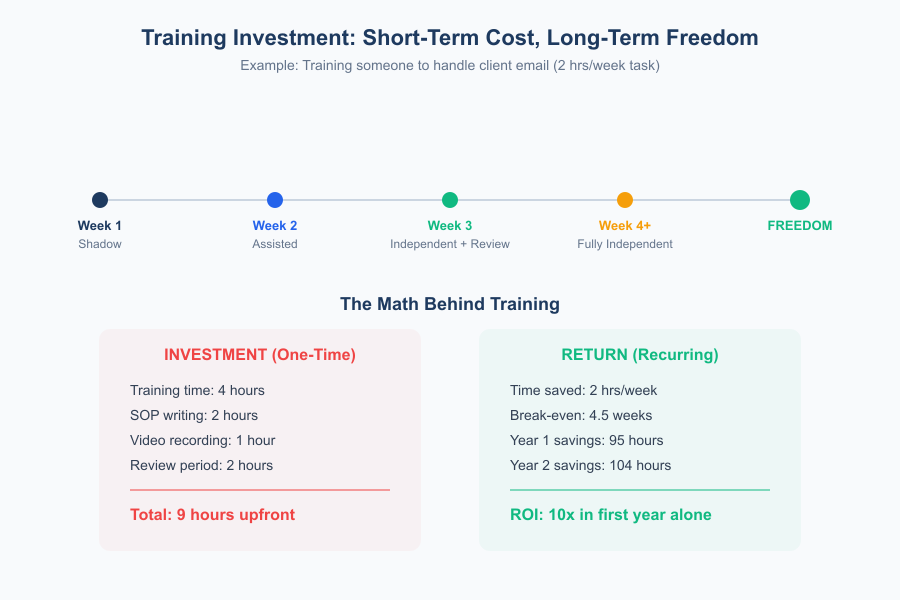
Week 1: Shadow everything. They watch me work, ask questions, take notes.
Week 2: Assisted work. They do tasks while I watch, with immediate feedback.
Week 3: Independent work with review. They complete tasks, I review before delivery.
Week 4: Full independence on trained tasks. I only see exceptions.
This seems slow. It’s actually faster than throwing people into work they’re not ready for and cleaning up mistakes for months. I’ve tried both approaches. The slow way saves more time by month three.
Hire Before You’re Ready
If you wait until you desperately need help, you’ll hire in panic and train poorly. Hire when you could still handle things alone but see growth coming.
I hired my first operations person when I was at about 80% capacity. Gave me time to train them properly without client work suffering. Best timing decision I’ve made.
Phase 4: Automate Repetitive Tasks
Some work shouldn’t be done by anyone. It should happen automatically.
What to Automate
Scheduling. Calendar tools like Calendly or SavvyCal let clients book time without email tennis. I haven’t scheduled a call manually in three years. Not one.
Invoicing. FreshBooks or Zoho Invoice can auto-generate recurring invoices and send payment reminders. I see money, not paperwork.
Reporting. Automated dashboards pull data from your tools and display it. No manual compilation. I use Databox to aggregate metrics from multiple sources.
Backups. Your website backups should happen automatically. Solid Backups or UpdraftPlus handle this without intervention.
Client onboarding. When someone becomes a client, a sequence of emails, forms, and setup tasks can trigger automatically. What used to take me 45 minutes of manual setup now happens in the background.
Simple Automation With Zapier
Make and Zapier connect your tools. When X happens, do Y.
Examples from my setup:
- When invoice paid → update project status in ClickUp
- When client form submitted → create project folder in Google Drive, send welcome email, notify team in Slack
- When new task assigned → send summary to my phone (exceptions only)
- When proposal signed → trigger onboarding sequence
Each automation is small. Together they eliminate hours of manual coordination every week.
Don’t Over-Automate
Automation should handle predictable, repetitive tasks. It shouldn’t replace human judgment in complex situations.
I automated status updates but not client communication about problems. I automated invoice reminders but not payment negotiations. Automation handles the 80% that’s routine. Humans handle the 20% that matters. Blurring that line creates the kind of cold, impersonal experience that drives good clients away.
Phase 5: Create Decision Frameworks
This is where most owner-dependent businesses get stuck. Even with staff and systems, the owner makes all decisions because nobody else knows how.
The solution is frameworks. Documented ways to make decisions without you. And look, this is the part that feels hardest to let go of. I get it. But it’s also where the biggest freedom gains happen.
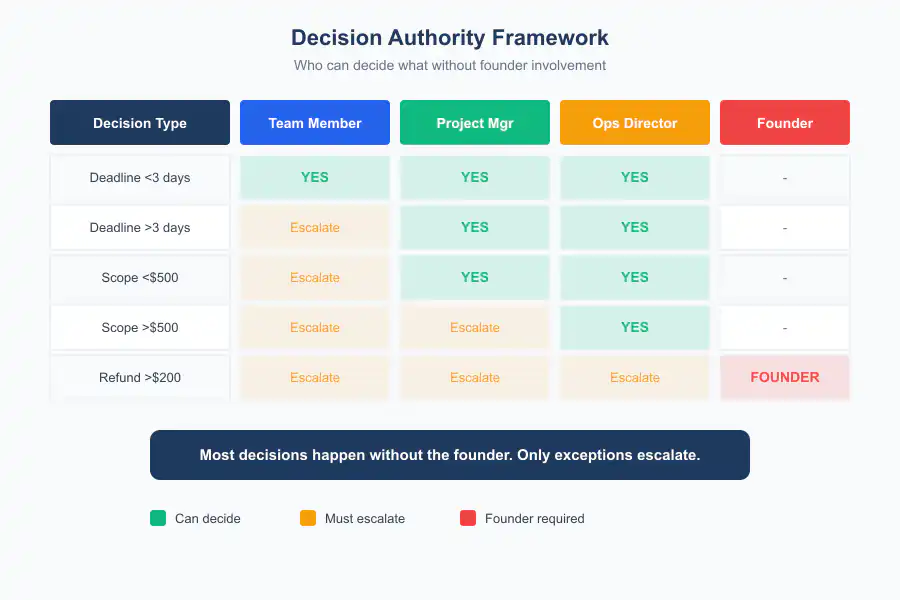
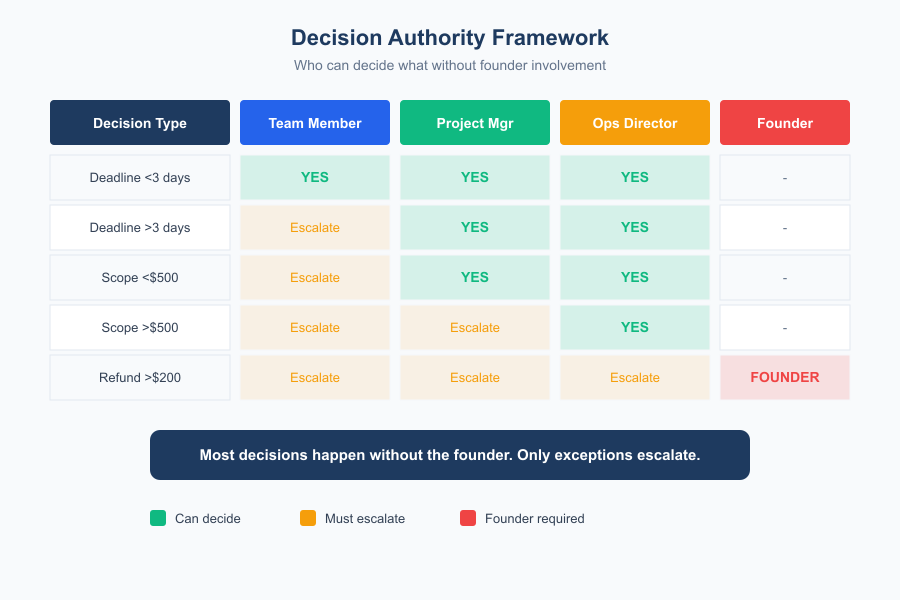
Authority Levels
Define what decisions each role can make independently.
My framework:
| Decision Type | Team Member | Project Manager | Operations Director |
|---|---|---|---|
| Deadline extension (< 3 days) | Yes | Yes | Yes |
| Deadline extension (> 3 days) | Escalate | Yes | Yes |
| Scope change (< $500) | Escalate | Yes | Yes |
| Scope change (> $500) | Escalate | Escalate | Yes |
| Client refund (< $200) | Escalate | Yes | Yes |
| Client refund (> $200) | Escalate | Escalate | Me |
| Hiring decisions | Escalate | Escalate | Discuss with me |
| Vendor selection (< $100/mo) | Escalate | Yes | Yes |
With this framework, most decisions happen without me. I only see the ones that actually need founder judgment. Everything else flows.
Decision Trees
For common situations, create decision trees that guide someone through the thinking.
Example: Client Complaint About Quality
Is the complaint valid?
├── YES
│   ├── Is it a minor issue (< 1 hour to fix)?
│   │   └── Fix immediately, apologize, done
│   └── Is it a major issue (> 1 hour)?
│       ├── Acknowledge, explain fix timeline
│       └── Consider goodwill gesture if our fault
└── NO (subjective preference)
    ├── Explain our approach politely
    ├── Offer ONE additional revision
    └── If still unsatisfied, escalate to project manager
Decision trees don’t replace judgment. They provide guardrails so someone new isn’t guessing. And they encode your thinking so that even when you’re not there, your standards are.
The Magic Question
Train your team to ask: “What would Gaurav do?”
Not because they should always copy you. Because it forces them to think like an owner. Usually they know the right answer. They just need permission to act on it.
When someone asks you a decision, ask first: “What would you do?” If their answer is reasonable, say yes. They learn that they’re capable of deciding. You learn that you can trust them. Over time, they stop asking. That’s the goal.
Phase 6: Build Financial Independence Into the Business
Owner-independent operations mean nothing if money stops flowing when you’re gone.
Retainer Revenue
Project-based work stops when you stop selling. Retainer revenue continues.
For service businesses, this means:
- Monthly maintenance agreements
- Ongoing support packages
- Monthly consulting arrangements
- Content retainers
I moved from project-heavy to 60% retainer revenue over two years. Every month starts with predictable income rather than scrambling for new projects. That shift changed everything about how I run the business. Learn more about building a retainer-based business model.
Multiple Revenue Streams
Don’t depend on one type of income.
My mix:
- Client services (main revenue)
- Digital products (courses, templates)
- Affiliate income (product recommendations)
- Consulting (occasional, high-value)
If client work dries up, other streams provide runway. If one stream has problems, others keep going. I’ve seen each of these dip at various points. Having the others meant none of those dips became emergencies.
Cash Reserves
Owner independence requires financial buffer. You need runway to:
- Pay team when revenue dips
- Take time off without panic
- Handle unexpected expenses
- Weather client losses without crisis
I keep 6 months of operating expenses in reserve. It’s conservative. It’s also why I can take a month off without checking bank accounts. That peace of mind is worth every dollar sitting in that account.
Pricing That Supports the Model
You need margins that support a team. If your pricing barely covers solo work, you can’t hire without losing money.
When I decided to build owner-independence, I raised prices 30% over 18 months. Some clients left. Revenue still increased because margins enabled better operations. The clients who stayed got better service because I wasn’t doing everything myself anymore.
Cheap pricing is a trap that keeps you doing everything yourself. See the complete guide to raising your rates for strategies that work.
Phase 7: Remove Yourself Progressively
Don’t try to disappear overnight. Remove yourself gradually.
Stage 1: Daily Operations (3-6 months)
Stop handling day-to-day tasks. Team manages workflows, client communication, and routine decisions. You review and advise.
Test: Can you skip a day without anyone noticing? Then two days? Then a week?
When I first tried this, I lasted about four hours before jumping back in. Force yourself to stay out. The discomfort is temporary. The freedom is permanent.
Stage 2: Weekly Management (6-12 months)
Stop managing projects individually. You set direction and review outcomes, not tasks. Weekly check-ins instead of daily involvement.
Test: Does work quality stay consistent when you’re not reviewing everything?
Stage 3: Strategic Only (12-24 months)
You make strategic decisions, handle key relationships, and step in for major issues. Everything else runs without you.
Test: Can you take a month off with only occasional check-ins?
Your Emergency Contact List Gets Shorter
At the start, I was the answer to everything. Now my team contacts me for:
- Decisions over a specific dollar threshold
- Major client issues they can’t resolve
- Strategic questions about business direction
- New opportunities requiring my input
Everything else gets handled. My phone doesn’t ring for routine problems. That’s freedom. Real, tangible, wake-up-without-anxiety freedom.
Common Obstacles and How to Handle Them
“Nobody Can Do It As Well As Me”
Maybe. But can someone do it 80% as well as you? That 80% is enough for most things. Your perfectionism is keeping you trapped.
I had to learn this one the hard way. I’d review a client deliverable, find small issues, fix them myself, and feel validated that I was still needed. What I was really doing was preventing my team from learning and keeping myself stuck. Reserve your quality standard for the 20% that genuinely needs it. Accept good enough for the 80% that doesn’t.
“I Can’t Afford to Hire”
You can’t afford not to. If your business only works with 60-hour weeks from you, it’s not sustainable. Eventually you’ll burn out, get sick, or just hate what you’ve built.
Start small. A virtual assistant for 10 hours a week. A contractor for specific tasks. The investment pays off when you redirect saved time to higher-value work. I started with a part-time VA for $500/month. Within three months, she was handling enough admin that I could take on two more retainer clients. The math works if you let it.
“Training Takes Longer Than Doing It Myself”
Short-term, yes. Long-term, absolutely not.
The 4 hours you spend training someone to handle client emails saves you 2 hours every week after. Break-even in two weeks. Pure profit after that.
Training is an investment. Stop thinking of it as lost time. Start thinking of it as buying back your future hours.
“What If Things Go Wrong When I’m Gone”
Things will go wrong. Build resilience, not prevention.
- Clear escalation paths
- Emergency contact information
- Authority to make reasonable decisions
- Financial reserves to handle mistakes
When I first took a week off, a client got a delayed deliverable. Not a disaster. The team apologized, fixed it, offered a discount. I found out after the fact. They handled it better than I expected, honestly.
Mistakes happen with or without you. At least now you have a team sharing the load.
What Owner Independence Actually Feels Like
The first time I took a vacation without checking email, I was anxious for three days. Kept reaching for my phone. Kept expecting crisis notifications that never came.
By day four, I relaxed. Nothing was on fire. Revenue kept coming. Clients were happy. The business worked.
That’s the moment everything changed. The business was no longer my identity. It was something I built that functioned independently. Something with value beyond my daily labor.
Now I work because I want to, not because the business stops without me. I take projects I find interesting. I skip ones I don’t. I travel without anxiety. I think strategically because I’m not drowning in tactics.
This took years to build. It was worth every hour of documentation, every difficult hire, every system I created. Owner independence is the whole point of building a business instead of just having a job. If your business can’t survive without you, you don’t own a business. You own a very demanding job that happens to have your name on it.
Your First Week
Don’t try everything at once. Start here.
Day 1-2: Log every task you do. Use the simple spreadsheet format.
Day 3-4: Continue logging. Look for patterns. You’ll start seeing them by now.
Day 5: Pick one recurring task that drains you. Write an SOP for it.
Week 2: Record yourself doing that task on video. Share it with a team member, contractor, or potential hire.
Small starts compound. One documented process leads to ten. One trained person leads to a team. One automated task leads to workflows.
You don’t become replaceable overnight. But every step you take makes the business a little less dependent on your daily presence. And that’s the whole point.
Build the systems. Train the people. Let go of control.
The first time I took a vacation without checking email, I was anxious for three days. By day four, nothing was on fire. Revenue kept coming. Clients were happy. That moment changed everything. Owner independence took years to build. It was worth every hour of documentation, every difficult hire, every system I created.
Your business can run without you. You just have to let it.
Building a Business FAQ
Frequently Asked Questions
How long does it take to make a business owner-independent?
Most service businesses need 2-3 years of intentional work. The first 6-12 months focus on documentation and initial delegation. The next 6-12 months involve team building and system refinement. True strategic-only involvement usually takes 18-24 months. Progress isn’t linear, and you’ll hit plateaus. But every month of effort compounds into greater freedom.
What should I document first when building SOPs for my business?
Start with a two-week time log of everything you actually do. Then categorize into four buckets: founder-only work (20% of your time), trainable work (someone could learn it), automatable work (software can handle it), and eliminable work (doesn’t need to happen). Document the trainable tasks first since they offer the biggest immediate time savings. Each SOP should include trigger, steps, tools, decision points, outputs, and exception escalation paths.
What is the best first hire for building an owner-independent business?
For most service businesses, hire an operations person first. Someone who can manage workflows, handle client communication, and make routine decisions. This person becomes your force multiplier, turning your systems into action and serving as the first line of defense. A good first ops hire can cut your weekly decision load by 60%. Start with a part-time VA for $500/month if a full hire isn’t feasible yet.
How do I create decision frameworks so my team can decide without me?
Define authority levels: what decisions each role can make independently, what requires escalation, and at what dollar thresholds. Create decision trees for common situations like client complaints or scope changes. Train your team to think “what would the owner do?” then validate their judgment. When team members suggest reasonable answers, say yes and let them learn they’re capable. Over time, they stop asking. That’s the goal.
How do I maintain quality when I’m not reviewing everything?
Create clear quality standards and checklists with objective criteria for what “good” looks like. Implement spot-checks (review 1 in 5 deliverables randomly) rather than reviewing everything. Use client feedback as a quality signal. Quality issues become process improvements to fix, not things you personally prevent through involvement. Accept that 80% of your quality standard is enough for most tasks. Reserve your standards for the 20% that genuinely needs it.
What tasks should I automate first in a service business?
Start with scheduling (Calendly eliminates email tennis), invoicing (FreshBooks or Zoho for recurring invoices and payment reminders), and client onboarding sequences (automated emails, forms, and setup tasks). Then connect tools with Zapier or Make for triggers like “invoice paid, update project status” or “form submitted, create project folder and notify team.” Each automation is small but together they eliminate hours of manual coordination weekly.
How much cash reserves should I keep for an owner-independent business?
Keep 6 months of operating expenses in reserve. This covers team salaries during revenue dips, allows you to take time off without financial panic, handles unexpected expenses, and weathers client losses without crisis. It’s conservative, but it enables the peace of mind that makes owner independence real. You also need pricing margins that support a team, which usually means raising prices 20-30% during the transition period.
What percentage of revenue should come from retainers for stability?
Aim for at least 50% recurring revenue for meaningful stability, with 60-70% as the sweet spot where you start each month with most expenses already covered. This provides runway to take time off without panic and reduces the constant pressure of finding new projects. Build toward retainers by offering maintenance packages, ongoing support arrangements, or monthly service agreements alongside project work. Every retainer client is one less client you need to replace each month.